Infineon Technologies AG · XETR:IFX
Infineon Technologies — Investor Presentation (September 2000)
10 slides from Infineon Technologies's investor presentation, Sep 14, 2000
Slide 1: DDR DRAM: Market Status and Future Trends
DDR DRAM Market Status and Future Trends Memory Product Marketing Infineon Technologies AG, Munich, Germany 14.09.2000 Page 1
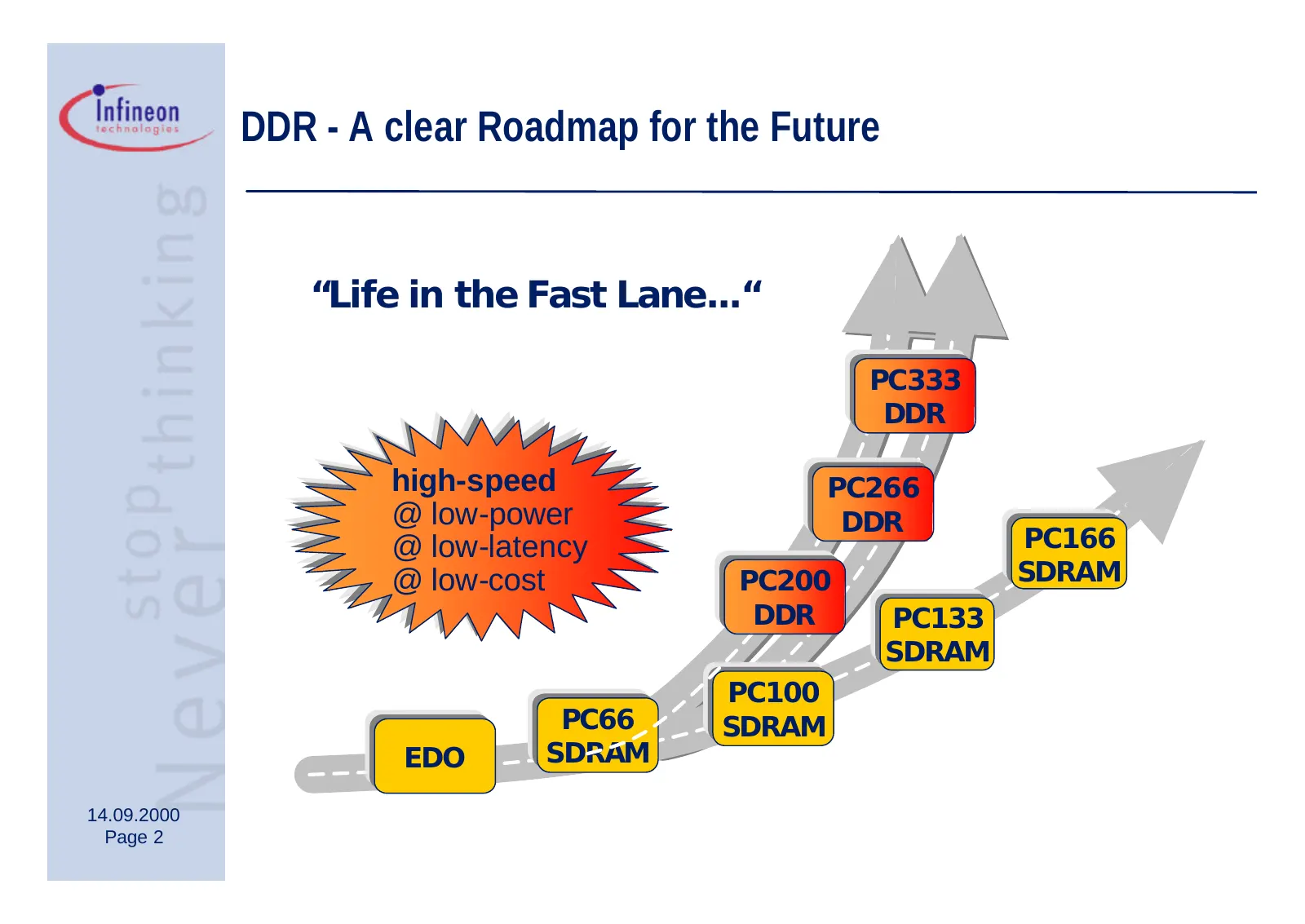
Slide 2: DDR - A clear Roadmap for the Future
DDR - A clear Roadmap for the Future “Life in the Fast Lane...“ PC333 DDR high-speed PC266 @ low-power DDR @ low-latency PC166 @ low-cost PC200 SDRAM DDR PC133 SDRAM PC100 PC66 SDRAM EDO SDRAM 14.09.2000 Page 2
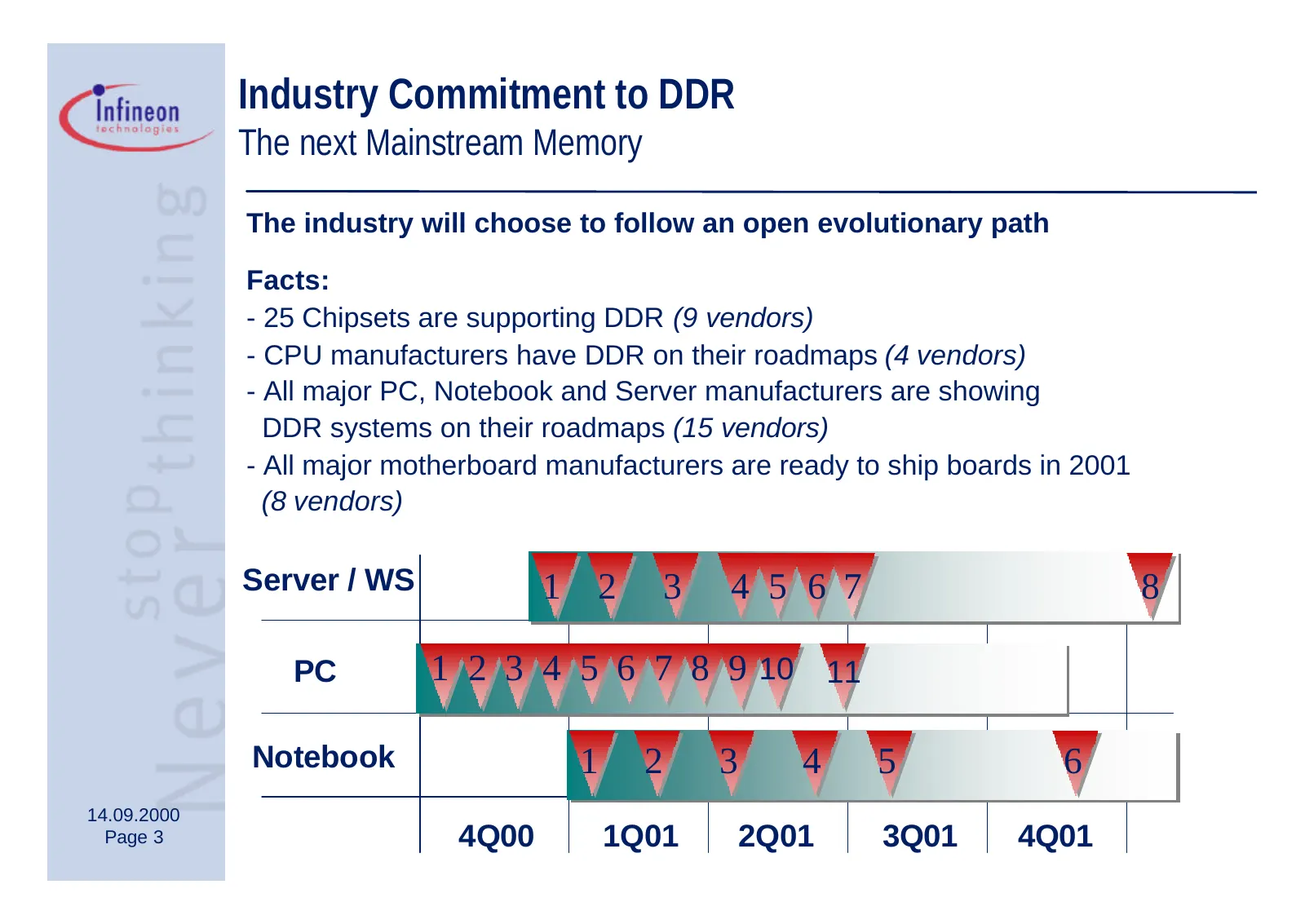
Slide 3: Industry Commitment to DDR
Industry Commitment to DDR The next Mainstream Memory The industry will choose to follow an open evolutionary path Facts: - 25 Chipsets are supporting DDR (9 vendors) - CPU manufacturers have DDR on their roadmaps (4 vendors) - All major PC, Notebook and Server manufacturers are showing DDR systems
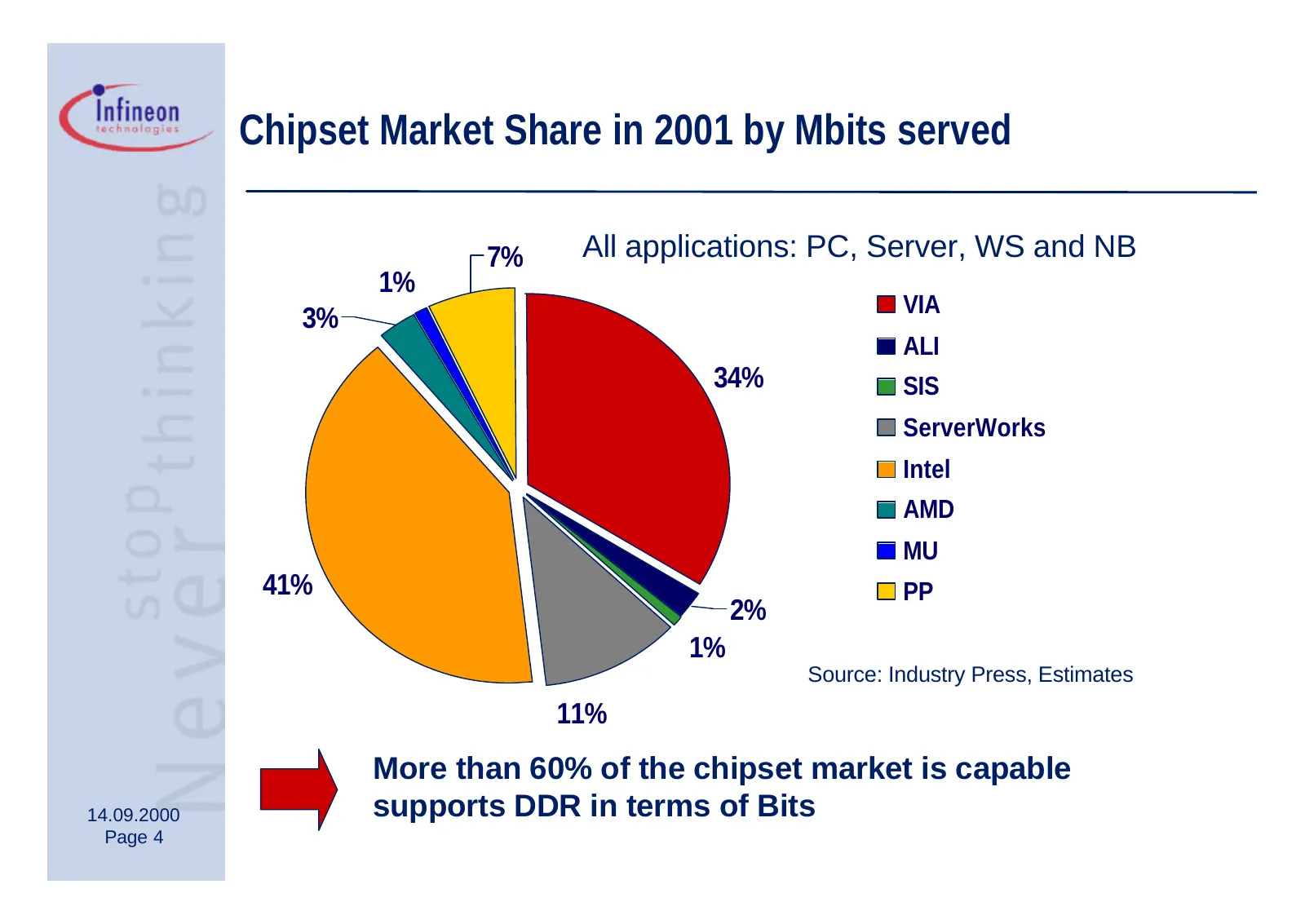
Slide 4: Chipset Market Share in 2001 by Mbits served
Chipset Market Share in 2001 by Mbits served 7% All applications: PC, Server, WS and NB 1% VIA 3% ALI 34% SIS ServerWorks Intel AMD MU 41% PP 2% 1% Source: Industry Press, Estimates 11% More than 60% of the chipset market is capable 14.09.2000 supports DDR in terms of Bits Page 4
Slide 5: Advantage of DDR Products
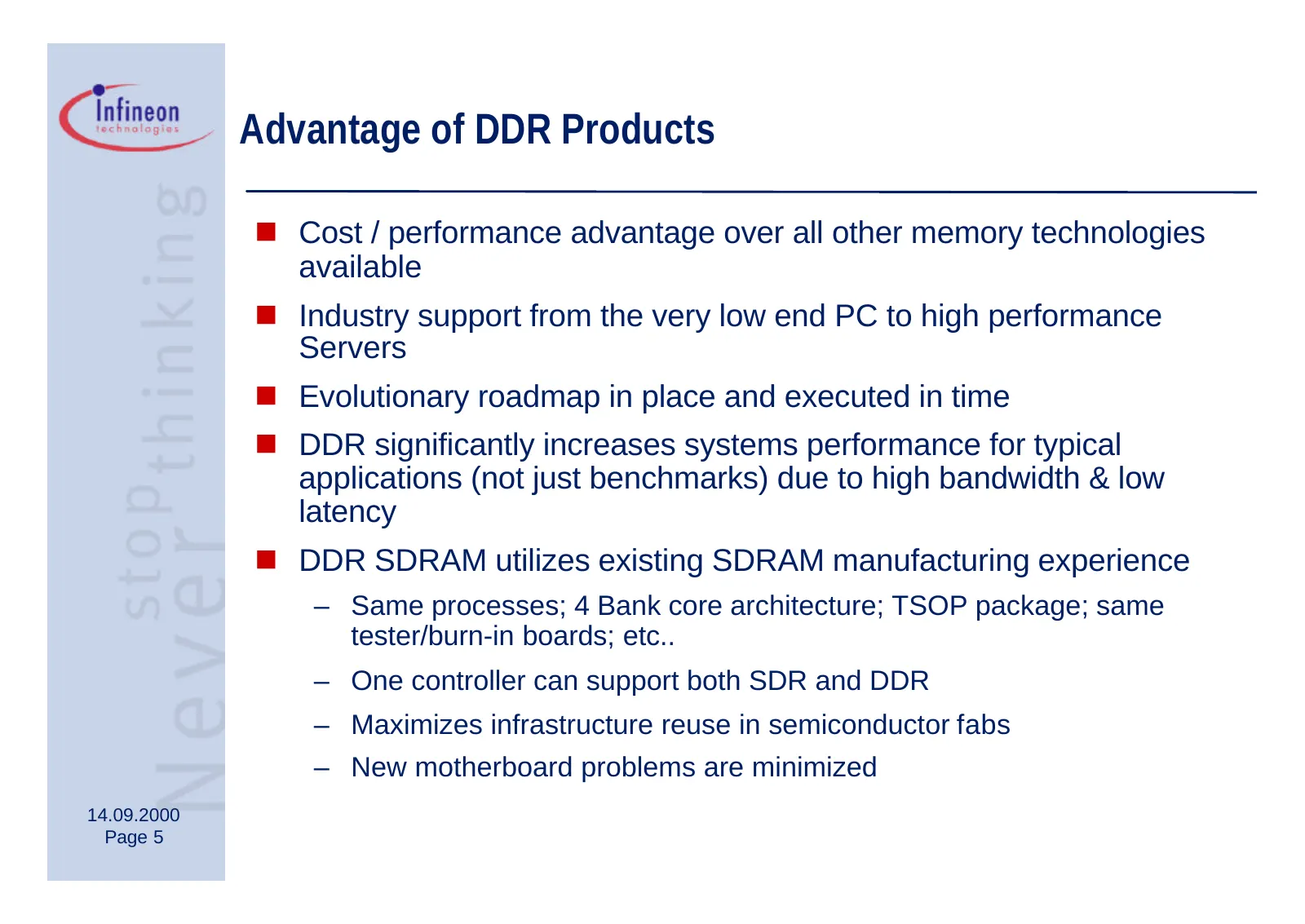
Advantage of DDR Products n Cost / performance advantage over all other memory technologies available n Industry support from the very low end PC to high performance Servers n Evolutionary roadmap in place and executed in time n DDR significantly increases systems performance for typical application
Slide 6: Bandwidth per module
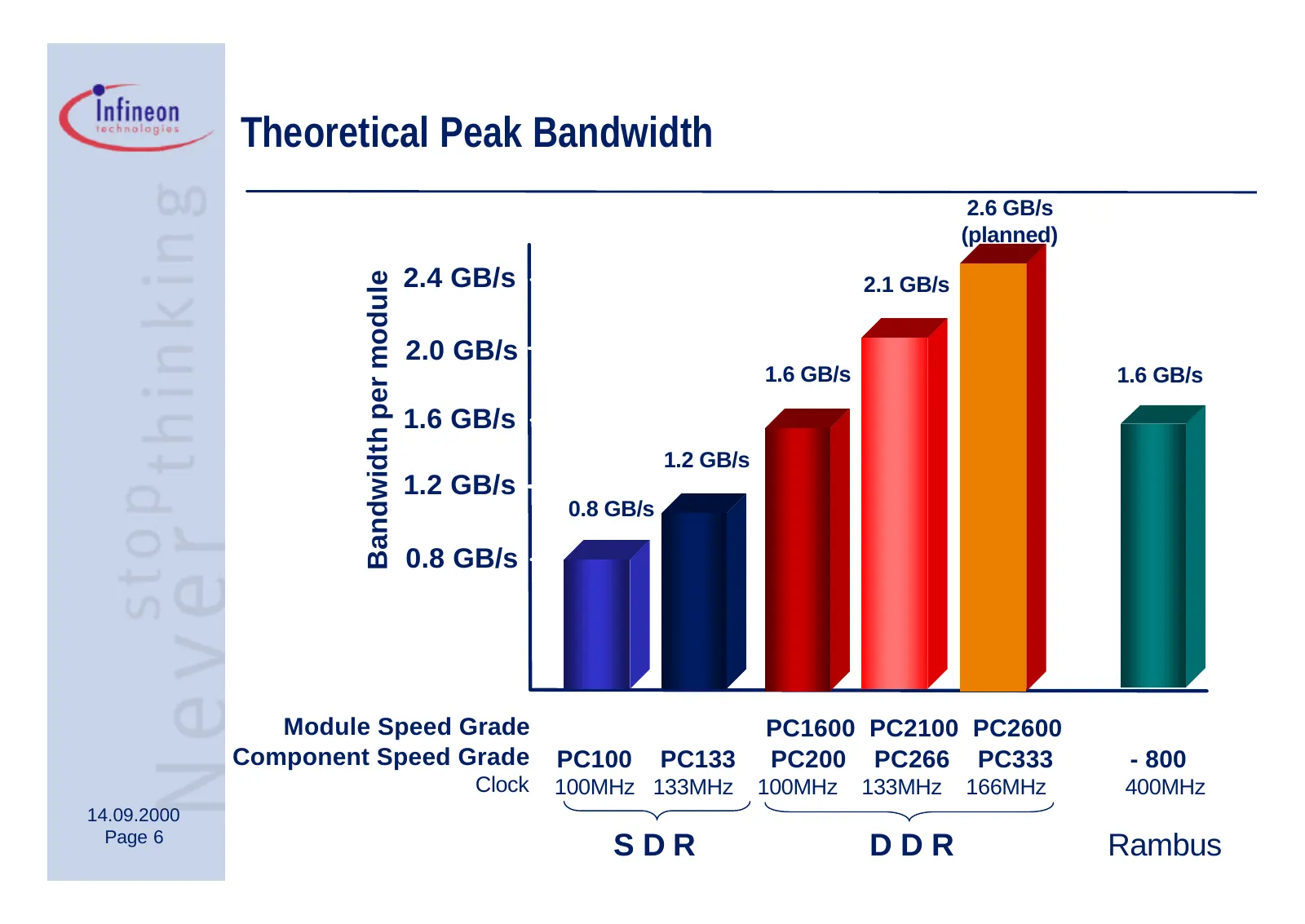
Theoretical Peak Bandwidth 2.6 GB/s (planned) 2.4 GB/s Bandwidth per module 2.1 GB/s 2.0 GB/s 1.6 GB/s 1.6 GB/s 1.6 GB/s 1.2 GB/s 1.2 GB/s 0.8 GB/s 0.8 GB/s Module Speed Grade PC1600 PC2100 PC2600 Component Speed Grade PC100 PC133 PC200 PC266 PC333 - 800 Clock 100MHz 133MHz 100MHz 133MHz 166MHz 400M
Slide 7: DDR Applications
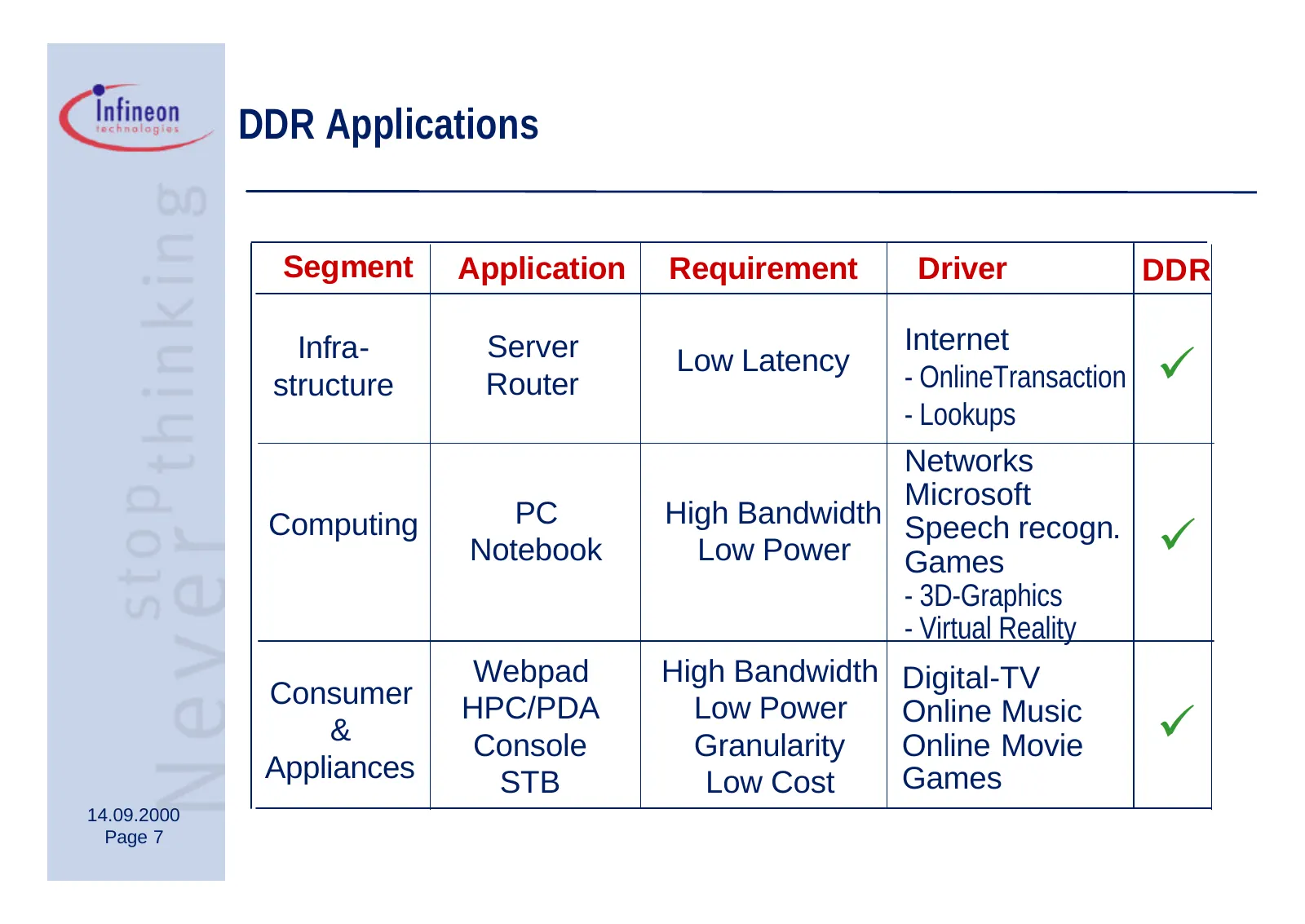
DDR Applications Segment Application Requirement Driver DDR Infra- Server Internet structure Router Low Latency - OnlineTransaction ü - Lookups Networks Microsoft PC High Bandwidth Speech recogn. Computing Notebook Low Power Games ü - 3D-Graphics - Virtual Reality Webpad High Bandwidth Digital-TV Co
Slide 8: DRAM Demand by Architecture (Short Term)
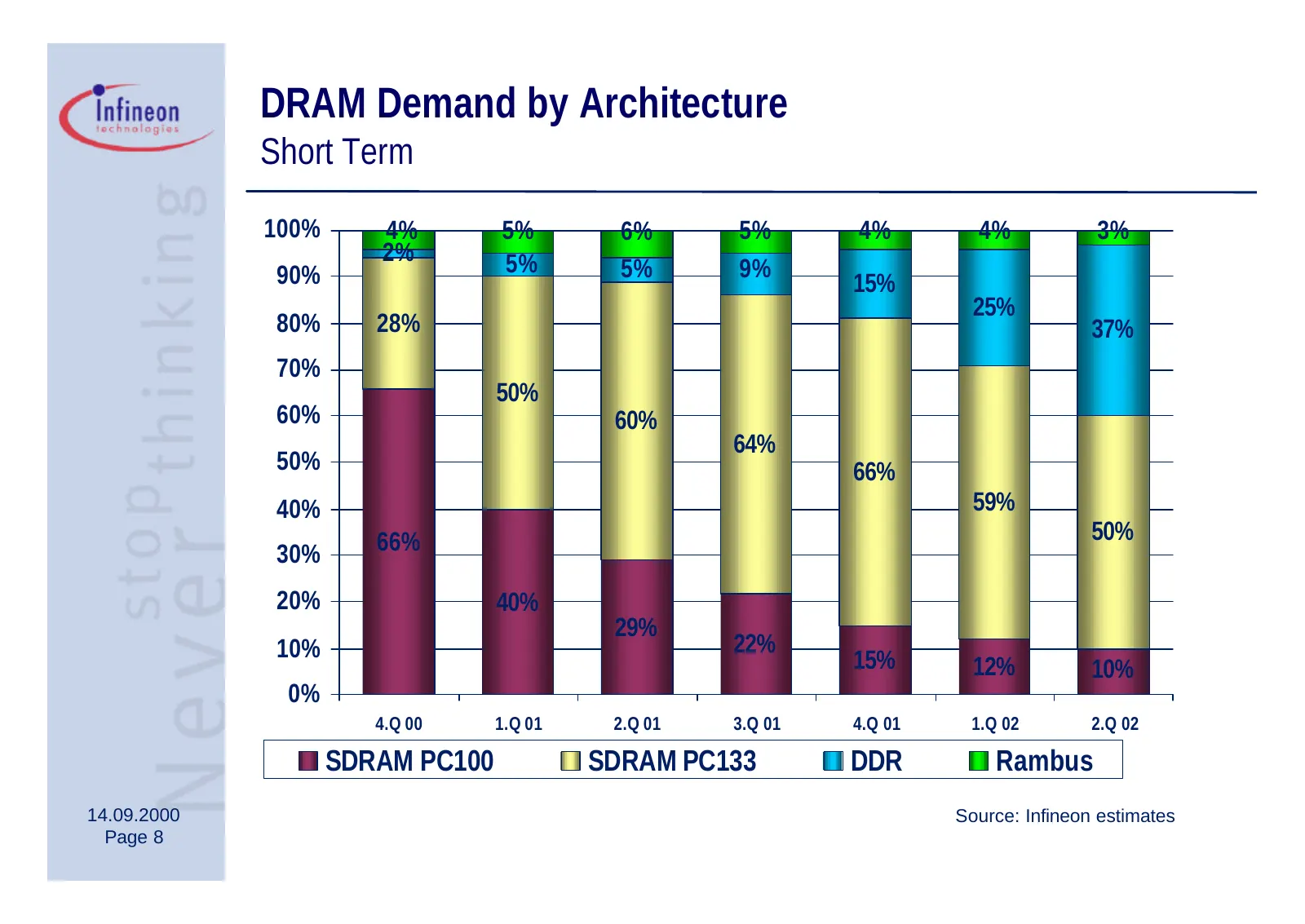
DRAM Demand by Architecture Short Term 100% 4% 5% 6% 5% 4% 4% 3% 2% 5% 90% 5% 9% 15% 25% 80% 28% 37% 70% 50% 60% 60% 64% 50% 66% 40% 59% 66% 50% 30% 20% 40% 29% 10% 22% 15% 12% 10% 0% 4.Q 00 1.Q 01 2.Q 01 3.Q 01 4.Q 01 1.Q 02 2.Q 02 SDRAM PC100 SDRAM PC133 DDR Rambus 14.09.2000 Source: Infineon esti
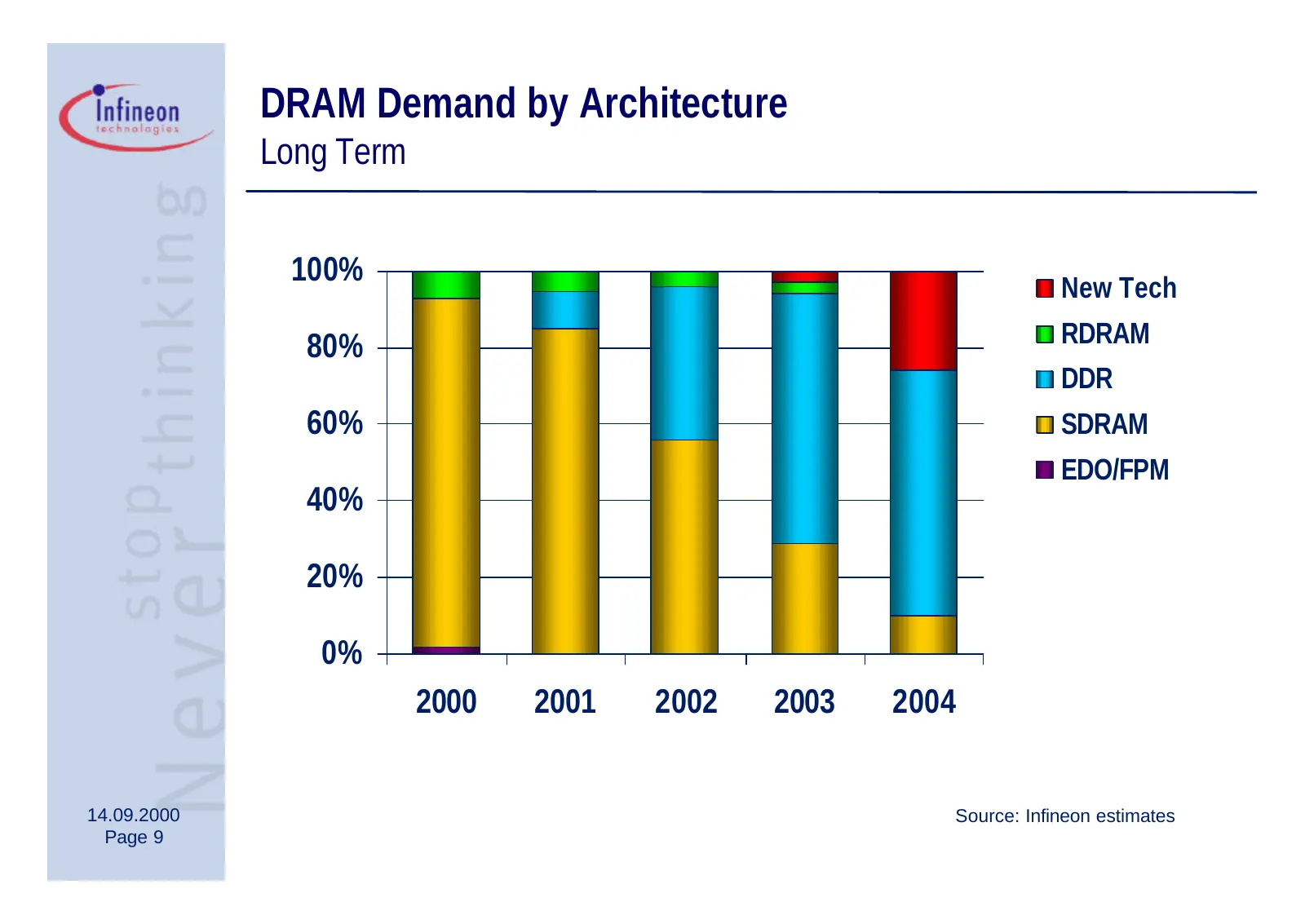
Slide 9: DRAM Demand by Architecture (Long Term)
DRAM Demand by Architecture Long Term 100% New Tech 80% RDRAM DDR 60% SDRAM EDO/FPM 40% 20% 0% 2000 2001 2002 2003 2004 14.09.2000 Source: Infineon estimates Page 9
Slide 10: Summary
Summary DDR • delivers high performance at low cost • is produced on the current established SDRAM infrastructure • has a industry-wide design in of DDR is running very smoothly • has improvements to SDR regarding data capture structure • takes advantage of of existing SDR command structure • achiev
Source: Internet Archive copy of infineon.com
More decks from Infineon Technologies AG
 Q4 2026 Earnings Presentation67 slides · Nov 10, 2026
 DA5 Consortium — Technical Presentation (September 2026)36 slides · Sep 21, 2026
 ESG Presentation (September 2026)35 slides · September 2026
 Q3 FY2026 Earnings Presentation16 slides · Aug 5, 2026
 Q3 2026 Earnings Presentation86 slides · Aug 5, 2026
 Technical Presentation (August 2026)41 slides · August 2026