Stewart Information Services Corporation · NYSE:STC
Stewart Information Services — Investor Presentation (January 2016)
22 slides from Stewart Information Services's investor presentation, Jan 21, 2016

Slide 1: Acknowledge the Knowledge!
ACKNOWLEDGE THE KNOWLEDGE! Richard L. Black Associate Senior Underwriting Counsel Austin, TX
Slide 2: Acknowledgements, New Notary Law, Correction Documents, and Recording
ACKNOWLEDGE THE KNOWLEDGE! Acknowledgements, New Notary Law, Correction Documents, and Recording
Slide 3: New Notary Law: The Final Chapter?
New Notary Law: The Final Chapter? TEX. GOV. CODE §406.001(a) effective 1/1/2016: --Texas notary public’s seal of office must contain notary’s State-issued identifying number. --TEX. ADMIN. CODE §87.4: Inclusion of notary’s ID number in the seal is required only with new/renewed notary commissions a
Slide 4: Recording of Documents
Recording of Documents What entitles a document to be recorded in the County Clerk’s records? --Statutory acknowledgment (short-form or long-form) under Chapter 121, TEX. CIV. PRAC. & REM. CODE; --Jurat (“subscribed and sworn to before me”) under TEX. PROP. CODE §12.001(a); OR --Certification or apo
Slide 5: Recordation and Notice
Recordation and Notice What is the purpose and benefit of recording a real estate document? --Acknowledgement = entitlement to recording. -- Recording = constructive notice versus actual notice. --Binding effect of unrecorded documents. --Multiple grantors. --Abstract of Judgment exception: Recordin
Slide 6: Who Can Take Acknowledgements Part 1
Who Can Take Acknowledgements Part 1 According to TEX. CIV. PRAC. & REM. CODE §121.001: --For general purposes when done within Texas: --District Court clerk; --County Court judge or clerk; --Notary Public. --For general purposes when done outside Texas, but within the United States or its territori
Slide 7: Who Can Take Acknowledgements Part 2
Who Can Take Acknowledgements Part 2 When done outside the United States or territories (CIV. PRAC. & REM. CODE §121.001): --U.S. State Department personnel (consul, deputy consul, commercial agent, consular agent, commissioner, or charge d’affaires) accredited to and resident in the country; OR --N
Slide 8: Who Can Take Acknowledgements Part 3
Who Can Take Acknowledgements Part 3 Military personnel anywhere in the world (CIV. PRAC. & REM. CODE §121.001): --Acknowledgement by U.S. service member or member’s spouse can be taken by commissioned officer in any United States military service branch. --Presumption of acknowledgement’s regularit
Slide 9: Acknowledgements Taken in Federal Prison
Acknowledgements Taken in Federal Prison Federal penal/correctional institutions (18 U.S.C.A. §4004): --Acknowledgor can be any officer, employee, or inmate of the institution. --Acknowledgements can be taken by wardens and superintendents, associate wardens/superintendents, chief clerks, and record
Slide 10: Texas Prison/Jail Inmate's Unsworn Declaration
Texas Prison/Jail Inmate’s Unsworn Declaration TDC or jail inmate may make a “sworn declaration” in lieu of declaration, verification, or certification required by statute (TEX. CIV. PRAC. & REM. CODE §§132.001— 132.003). --Must be in writing and subscribed by declarant. --Prescribed statutory form
Slide 11: Transactional Disqualification
Transactional Disqualification When is a Notary Public considered disqualified from taking an acknowledgement? --Party to the instrument or spouse of a party. --Financial interest in the transaction. --Participant in an entity who is a party. --Trustee/beneficiary under trust involved in the instrum
Slide 12: Notary Public as Surrogate Signer
Notary Public as Surrogate Signer Notary public taking acknowledgement of a physically disabled person may sign for the acknowledgor (TEX. GOV. CODE §406.0165): --Disability of the requesting party must be severe enough to prevent making personal signature or mark. --Notary’s surrogate signing must
Slide 13: Witness Acknowledgement
Witness Acknowledgement Signer’s acknowledgement can be remote from notary by means of a “witness acknowledgment” (TEX. CIV. PRAC. & REM. CODE §§121.009—121.010): --Witness must sign the acknowledged document as witness to the signer’s signing or to signer’s oral declaration of acknowledgment. --Wit
Slide 14: Proof of Acknowledgement by Handwriting
Proof of Acknowledgement by Handwriting Instrument may qualify for recording based on handwriting evidence and notary’s statutory certification (TEX. CIV. PRAC. & REM. CODE §121.001). --Grantor and all witnesses must be dead, out-of- state, whereabouts unknown, or legally incompetent. --Notary takes
Slide 15: Acknowledgment Not Required
Acknowledgment Not Required Federal and State of Texas “grants” are recordable without further acknowledgement or proof (TEX. PROP. CODE §12.006). --Attorney General’s Opinion No. WW-805 (2/18/1960): A properly executed and authenticated deed from the Veterans Land Board of the State of Texas qualif
Slide 16: When Notary Seal Is Not Required
When Notary Seal Is Not Required Acknowledgement lacking notary seal is NOT invalid when taken in another U.S. state where use of seal is not required (TEX. PROP. CODE §12.001 & TEX. CIV. PRAC. & REM. CODE § 121.004). --TEX.GOV. CODE §405.019 requires Texas Secretary of State to distribute a list of
Slide 17: Acknowledgor's Required Identification
Acknowledgor’s Required Identification Notary’s taking of acknowledgement requires photo + signature federal- or state-issued identification (TEX. CIV. PRAC. & REM. CODE §121.005). Two statutory alternatives are allowed: --Foreign passport (but only in a “residential real estate transaction”); or --
Slide 18: Acceptable Defects in Acknowledgements
Acceptable Defects in Acknowledgements What defects in the certificate of acknowledgement are “harmless error”? --Missing state or county name in caption; --Mistaken pronouns (e.g. “he” instead of “she”); --Missing date of acknowledgment; --Minor name variance, instrument vs. certificate; or --Varia
Slide 19: Critical Defects in Acknowledgements
Critical Defects in Acknowledgements What defects in a certificate of acknowledgement are “fatal” to valid recordation? --Omission of acknowledgor’s name from certificate; --Significant name variance, certificate versus instrument; --Omission of word “acknowledged” in the certificate; --Notary’s/off
Slide 20: Statutory Limitations Applicable to Defective Certificates of Acknowledgement
Statutory Limitations Applicable to Defective Certificates of Acknowledgement If no suit raises the issue, a defective acknowledgement is considered “cured” after two (2) years in the real estate record. --TEX. CIV. PRAC. & REM. CODE §16.033(a)(8): Coverage for defective acknowledgements added in 19
Slide 21: Correcting Defective Acknowledgements--Old School
Correcting Defective Acknowledgements--Old School Three traditional approaches: --Original notary public corrects defect in the certificate of acknowledgment, and affected instrument is re-filed; OR --Grantor re-acknowledges instrument before a different notary public who attaches a new certificate,
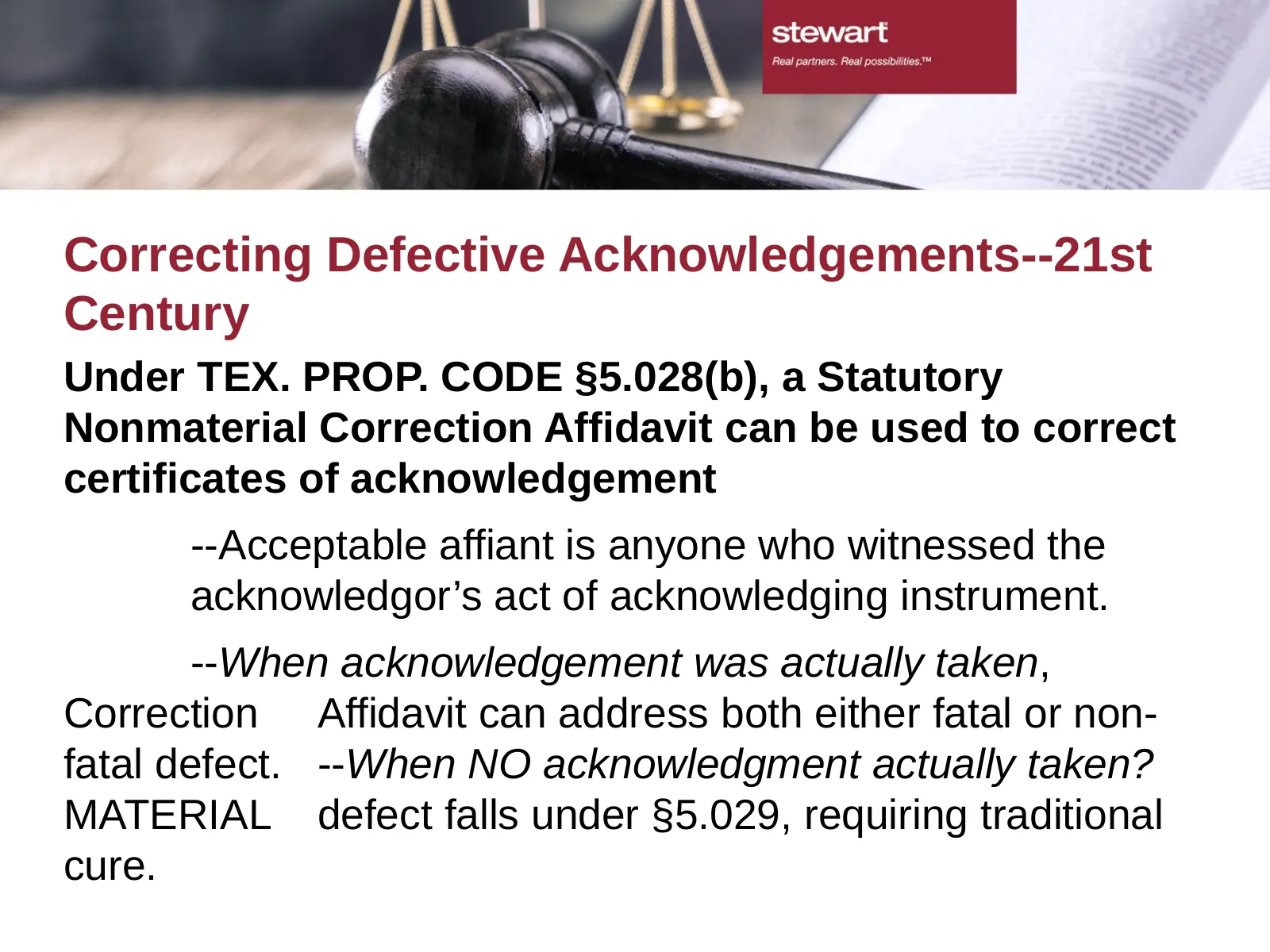
Slide 22: Correcting Defective Acknowledgements--21st Century
Correcting Defective Acknowledgements--21st Century Under TEX. PROP. CODE §5.028(b), a Statutory Nonmaterial Correction Affidavit can be used to correct certificates of acknowledgement --Acceptable affiant is anyone who witnessed the acknowledgor’s act of acknowledging instrument. --When acknowledge
Source: Internet Archive copy of stewart.com
More decks from Stewart Information Services Corporation
 Q2 2026 Earnings Presentation13 slides · Jul 23, 2026
 Investor Presentation (2024)16 slides · 2024
 Title Tenets Webinar Series (March 2023)17 slides · Mar 24, 2023
 Title Tenets Webinar Series (November 2022)27 slides · Nov 11, 2022
 Investor Presentation (November 2019)51 slides · Nov 21, 2019
 Investor Presentation (May 2019)41 slides · May 16, 2019