


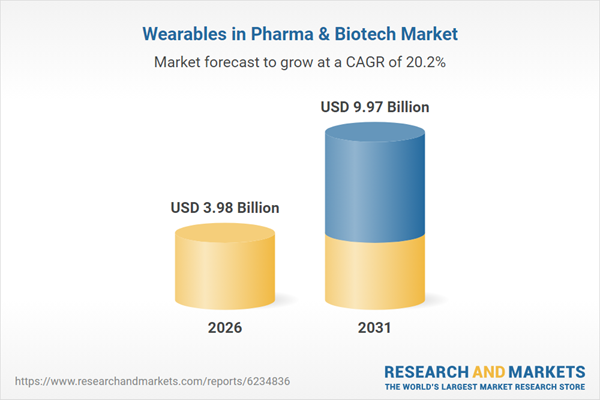
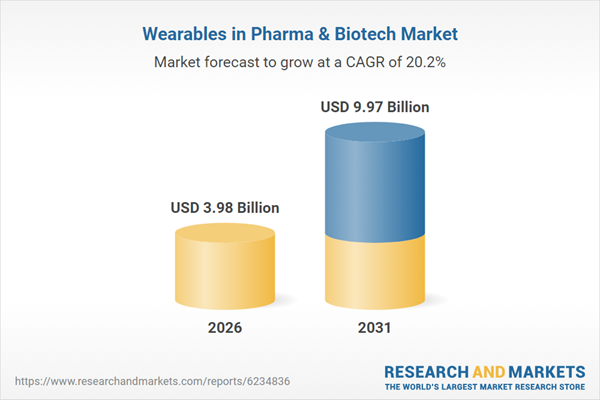
The wearables in pharma & biotech market is forecasted to grow from USD 3.98 billion in 2026 to USD 9.97 billion by 2031, at a CAGR of 20.2%. This rapid growth is fueled by advances in biosensor technology, miniaturization, and digitization, supported by strong internet connectivity worldwide. Programs like "All of Us" and RPM adoption are boosting wearables' role in research and healthcare. CGMs lead product segments due to robust clinical backing, while pharma and biotech companies were top end-users in 2025. Asia Pacific is set for high growth, driven by digital health infrastructure and research activities. Key players include Abbott and Dexcom.
Wearables in Pharma & Biotech Market
Dublin, May 18, 2026 (GLOBE NEWSWIRE) -- The "Wearables in Pharma & Biotech Market by Product, Therapy, Application, End User - Global Forecasts to 2031" has been added to ResearchAndMarkets.com's offering.
The wearables in pharma & biotech market is anticipated to grow significantly, reaching USD 9.97 billion by 2031 from USD 3.98 billion in 2026, with a CAGR of 20.2%.
This expansion is fueled by technological advancements in biosensors, miniaturization, and digitization, alongside rising global digital connectivity. The International Telecommunication Union noted that over 5.4 billion people were internet users in 2023, facilitating the seamless integration of wearable data into cloud environments.
Notably, the All of Us Research Program has recruited over 500,000 participants, some of whom contribute data from wearables, demonstrating the pivotal role of wearables in large-scale biomedical research and precision medicine, supported by increasing RPM and digital care solutions.
In the US, CMS reported a notable rise in reimbursement claims for remote physiological monitoring services post-policy expansion in 2022, indicating widespread adoption of wearable-derived care. Enhanced sensor accuracy and multi-parameter monitoring are enabling wearables to measure clinically significant endpoints, expanding their utility in drug safety and therapeutic studies.
Top market players include Abbott (US), Dexcom, Inc. (US), and Masimo (US), offering in-depth competition analysis with company profiles, and market strategies.
Continuous Glucose Monitors (CGMs) Lead Product Segment
CGMs dominate the product segment, propelled by clinical guideline support, a widening scope of eligible patients, and advanced diabetic management systems. The American Diabetes Association's 2024 Standards of Care recommends CGMs for a broad diabetic population, enlarging the market. Reimbursement schemes through the NHS and FDA approvals for interoperable CGMs have further propelled market expansion.
Pharmaceutical and Biotech Companies Hold Largest Market Share
Pharmaceutical and biotech companies lead the market in terms of share by 2025, utilizing wearable technologies for complex clinical data collection. Research by Tufts Center for the Study of Drug Development reveals that clinical trials now involve over 20 endpoints on average, increasing demand for data collection wearables. Initiatives like the UK Biobank underscore the potential of wearables in pharmaceutical research. These companies are expected to continue their dominance in the market.
Asia Pacific Registers Highest Growth
The Asia Pacific region showcases the highest growth rate in the wearables market. This surge is driven by improvements in digital health infrastructure, an increase in clinical research activities, and a substantial patient base. The WHO attributes a considerable share of the global disease burden to this region. Internet penetration here has surpassed 66-70%, and countries like China and India emerge as clinical trial hubs, incorporating technology to boost trial efficiency. Biobeat expanded into Argentina and Chile via a partnership with Infinity Pharma in September 2024.
Reasons to Buy
Research Coverage: Categorizes the market by Product, Therapeutic Area, Application, End User, and Region. It details drivers, restraints, opportunities, and challenges affecting market growth, alongside a competitive analysis of industry and startup players.
Reasons to Buy: Provides stakeholders with revenue approximations and competitive insights to enhance business positions and devise go-to-market strategies.
Market Insights: Offers analysis on drivers, restraints, opportunities, challenges, and more, facilitating stakeholders' understanding of market dynamics.
Competitive Assessment: Includes evaluation of leading players like BD, Abbott, Masimo, and DexCom, incorporating product development, innovation, market development, and diversification strategies.
Key Attributes:
Report Attribute | Details |
No. of Pages | 401 |
Forecast Period | 2026 - 2031 |
Estimated Market Value (USD) in 2026 | $3.98 Billion |
Forecasted Market Value (USD) by 2031 | $9.97 Billion |
Compound Annual Growth Rate | 20.2% |
Regions Covered | Global |
Market Dynamics
Drivers
Shift Toward Value-based and Patient-Centric Healthcare Models
Prevalence of Chronic Diseases Requiring Continuous Patient Monitoring
Rapid Digitalization of Healthcare and Expansion of Telehealth Services
Restraints
High Implementation and Integration Costs
Data Privacy and Cybersecurity Concerns
Opportunities
Expansion of Remote Patient Monitoring and Home-based Care Models
Integration of Advanced Analytics and Personalized Healthcare
Challenges
Limited Interoperability with Existing Healthcare IT Systems
Low Patient Adoption and Digital Literacy Barriers
Company Profiles
Dexcom, Inc.
Abbott
Masimo
Bd
Apple Inc.
Boston Scientific Corporation
Irhythm Technologies, Inc.
Koninklijke Philips N.V.
Medtronic
Biointellisense, Inc.
F. Hoffmann-La Roche Ltd.
GE Healthcare
Biobeat
Empatica Inc.
Vitalconnect
Ametris, LLC
Alivecor, Inc.
Withings
Vivalnk, Inc.
Medibiosense
Other Players
Sibel Health, Inc.
Byteflies
Strados Labs
Onera Technologies B.V.
Epicore Biosystems, Inc.
For more information about this report visit https://www.researchandmarkets.com/r/j0w2n0
About ResearchAndMarkets.com
ResearchAndMarkets.com is the world's leading source for international market research reports and market data. We provide you with the latest data on international and regional markets, key industries, the top companies, new products and the latest trends.
Attachment
CONTACT: CONTACT: ResearchAndMarkets.com Laura Wood,Senior Press Manager press@researchandmarkets.com For E.S.T Office Hours Call 1-917-300-0470 For U.S./ CAN Toll Free Call 1-800-526-8630 For GMT Office Hours Call +353-1-416-8900