

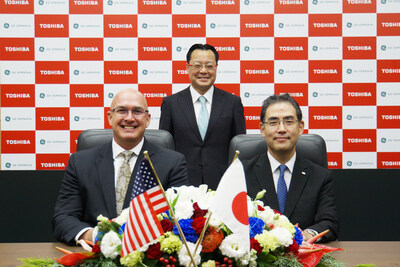
Objective of the Memorandum of Understanding (MoU) is to reduce CO2 emissions combining GE Vernova's Exhaust Gas Recirculation (EGR) system and Toshiba's CO2 capture technologies in natural gas fired power plants in Japan and other parts of Asia.
The MoU strengthens a strategic collaboration that has spanned 40 years between the two companies.
This initiative is related to the focus group introduced last June by Japan's Ministry of Economy, Trade and Industry (METI) and GE Vernova.
KAWASAKI, Japan, Nov. 6, 2025 /PRNewswire/ -- Toshiba Energy Systems & Solutions Corporation (Toshiba) and GE Vernova (NYSE: GEV) have signed a memorandum of understanding (MoU) to work together on an integrated Gas Turbine Combined Cycle (GTCC) CCS solution to reduce power plant CO2 emissions. The solution will combine GE Vernova's Exhaust Gas Recirculation (EGR) system with Toshiba's carbon capture solution, which utilizes Toshiba's proprietary solvent. This initiative is related to the recently created focus group between the Japan's Ministry of Economy, Trade and Industry (METI) and GE Vernova, and it was announced during an event attended by METI's Director-General for Energy and Environmental Policy, Shinichi Kihara, and Toshiba's and GE Vernova's representatives.
This collaboration aims to improve the efficiency of CO2 separation and capture by integrating their respective technologies in GTCC power plants in Japan and other parts of Asia, where GE Vernova supplies or will supply the gas turbines. Toshiba and GE Vernova jointly conducted comprehensive feasibility studies with leading utility companies operating GTCC power plants across Japan. These studies, completed prior to the signing of the MoU, confirmed the significant potential of the collaboration.
METI's Director-General for Energy and Environmental Policy, Shinichi Kihara said: "We welcome this initiative, to achieve decarbonization of the power generation by utilizing CCUS technology, as there is a global urgency to simultaneously achieve stable energy supply, economic growth, and decarbonization towards the global common goal of achieving net-zero."
Takehiko Matsushita, Vice President of Toshiba's Power Systems Division, said: "While thermal power plants offer a constant supply of electricity and are a primary power source, a growing global commitment to environmental sustainability has made cutting CO2 emissions from these facilities a crucial and immediate goal. We are delighted to sign this MoU, which will help us to contribute to the achievement of carbon neutrality while driving further business growth. Through our collaboration with GE Vernova, we aim to advance EGR and CO2 capture systems in Japan and other parts of Asia."
Jeremee Wetherby, Carbon Solutions Leader at GE Vernova, said: "We are pleased to explore the benefits from our steam integration, exhaust gas recirculation system, and high gas turbine backpressure solutions with Toshiba's extensive expertise in engineering and constructing of steam cycle systems. These steam systems are critical to the performance of GTCC power plants and will be important design considerations to maximize the performance of the capture systems, as well as reducing the decline in power output that occurs when CO2 capture systems are integrated."
Toshiba has extensive expertise in the design and construction of thermal power systems that incorporate steam turbines for GTCC systems, and in the development and refinement of CO2 capture systems. It uses a plant's own heat source to raise the temperature of the solvent used to capture CO2, an approach that eliminates the need for additional boilers to generate steam, and that optimizes and streamlines the system. Comprehensive expertise allows it to do this while minimizing any decline in the plant's net power output, its generation capacity.
Integrating GTCC and CCS plants reduces capital costs and improves operational flexibility. GE Vernova solutions—such as steam integration, exhaust gas recirculation (EGR), and high gas turbine backpressure—lower costs and expand operational options. For example, GE Vernova's EGR system recirculates exhaust gases into the turbine inlet, alters exhaust gas composition, allowing for a smaller carbon capture absorber tower, enhanced performance, reduced operating costs, and increased CO2 capture.
About Toshiba and GE Vernova collaboration
Toshiba and GE Vernova have built a strong relationship in the GTCC sector since 1982. In 2013, they expanded their collaboration, combining GE Vernova's gas turbines with Toshiba's steam turbines and generators to deliver advanced GTCC systems in Japan. Since 1982, they have together received orders for 20 GTCC systems worldwide, with a combined capacity of more than 13 Gigawatts (GW), and 18 units are now in operation.


View original content to download multimedia:https://www.prnewswire.com/apac/news-releases/toshiba-and-ge-vernova-sign-mou-to-advance-carbon-reduction-and-efficiency-for-gas-turbine-fired-power-plants-in-japan-and-other-parts-of-asia-302606611.html