
Drone magnetometry and WorldView-3 alteration mapping defines a large hydrothermal system spatially coincident with high-grade surface grab samples of up to 53.8 g/t Au and 17.7% Cu
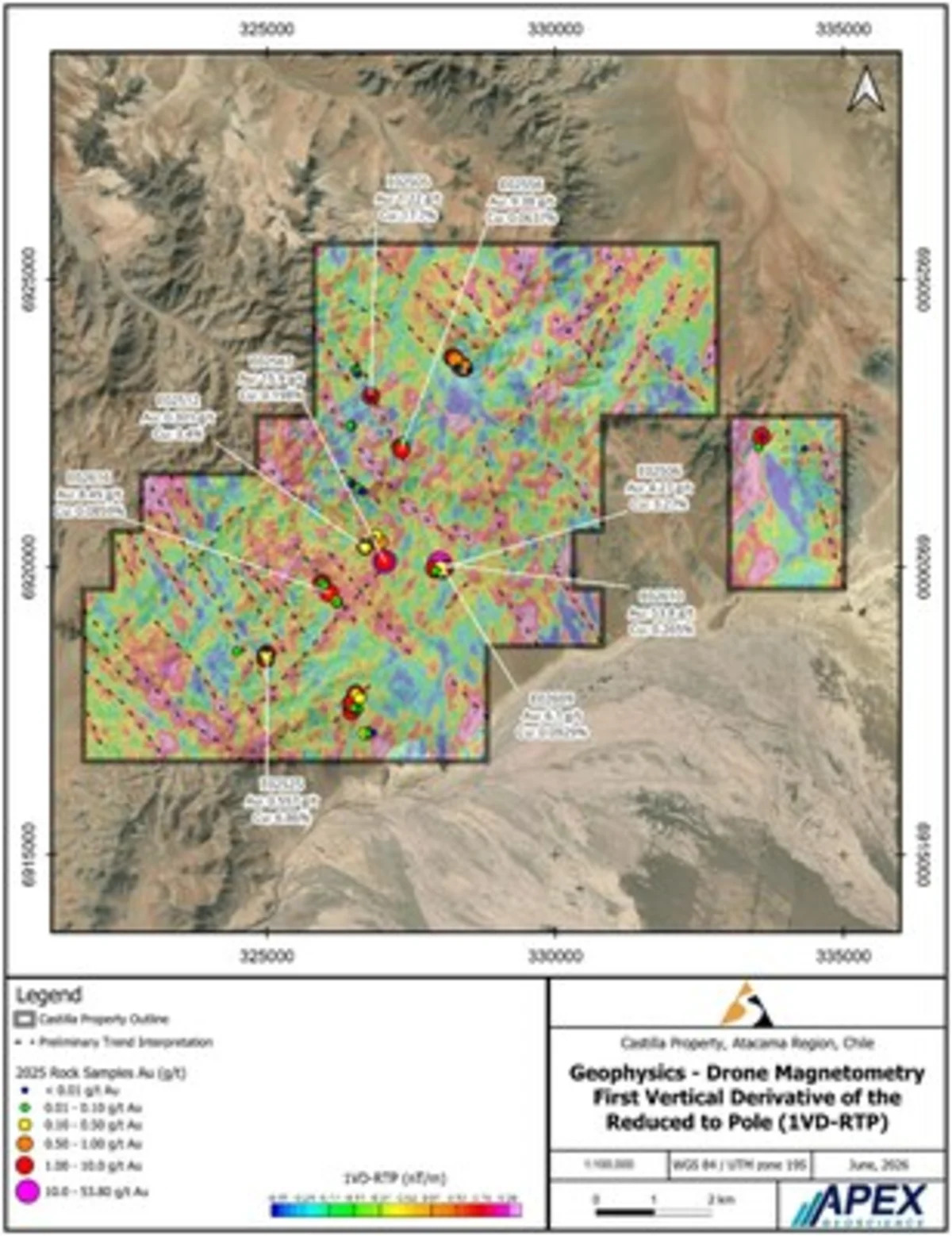
VANCOUVER, BC, June 26, 2026 /CNW/ - Super Copper Corp. (CSE: CUPR) (OTCQB: CUPPF) (FSE: N60) ("Super Copper" or the "Company") is pleased to report results from its phase one geophysics program at the 100%-owned Castilla Project ("Castilla" or the "Project"). The integrated datasets define property-scale alteration and structural corridors that are spatially coincident with the high-grade gold and copper rock samples previously reported (see news release dated January 15, 2026), and have identified a new, previously unsampled iron-oxide gossan target in the northeast portion of the Project (Figures 1 and 2).
Highlights
Property-scale alteration system mapped. WV3 hyperspectral mapping defines a large, coherent zone of phyllic (sericite) and propylitic (chlorite–epidote) alteration across central and southwestern Castilla, spatially coincident with the Company's highest-grade surface samples.
Structural control confirmed. Drone magnetic data (first vertical derivative of the reduced-to-pole field, "1VD-RTP") define conjugate northwest- and northeast-trending structural corridors. The highest-grade gold and copper rock samples cluster at the intersections of these structures (Figure 1), the dilational settings that typically focus mineralization in Atacama iron-oxide-copper-gold ("IOCG") systems.
Iron-oxide alteration over the interpreted IOCG core. Mapped hematite alteration coincides with the magnetite-rich, high-iron zone in north-central Castilla, including sample E02505 (17.7% Cu, 39.1% Fe), consistent with an IOCG core.
New iron-oxide gossan target identified. A large iron-oxide gossan and goethite footprint has been mapped in northeastern Castilla, in an area not covered by the Company's 2025 rock-sampling program. Gossans represent weathered, oxidized caps to sulphide bodies and are a recognized vector to copper mineralization.
Alteration assemblage supports the IOCG model. The near-absence of advanced argillic alteration (no detectable alunite and only minor kaolinite) is consistent with an IOCG / structurally-controlled system rather than a high-sulfidation epithermal system, helping to refine the exploration model.
Depth-targeting datasets to follow. Total-field magnetic products, a three-dimensional magnetization vector inversion ("MVI"), and an induced polarization ("IP") survey are planned to model magnetite (IOCG) bodies and sulphide mineralization at depth, and to rank drill-ready targets for a maiden diamond drill program at Castilla.