
Sun Life Financial Inc.TSX: SLF

Sun Life Asia Financial Resilience Index: Financial Security Declines as Cost-of-Living Pressure Bites

· Issued by Sun Life Financial Inc. via PR Newswire
  • More than eight in ten people surveyed across Asia (83%) say inflation has made it harder for them to meet their monthly costs.

  • Cost of everyday essentials is soaring; rising grocery prices are affecting 95% of people surveyed, followed by utilities (94%), transport fuel (92%), healthcare (91%) and cooking fuel (91%).

  • As a result, just 25% of those surveyed are highly resilient, down from 32% in 2025. Only 13% feel fully secure about their financial position.

  • Faced with a short-term budget squeeze, more than half of respondents (55%) are planning no further than a year ahead.

  • Nearly two-thirds (61%) would not cope beyond six months in the event of a sudden loss of income.

  • Households with higher financial literacy are more likely to feel confident (by 49 percentage points), more likely to feel optimistic (by 43 points), and less likely to experience frequent stress (by 14 points) about the economic environment.

HONG KONG, June 9, 2026 /PRNewswire/ -- Sun Life Asia today released its third Financial Resilience Index: Asia navigates rising costs, revealing new insights into the impact of the cost-of-living crisis across the region. As high inflation continues to impact the global economy, this year's report shows that rising living costs are putting sustained pressure on families, weakening financial resilience and leaving households less prepared for the future. Budgets are significantly strained, with more than eight in ten people surveyed (83%) saying inflation has made it harder to cover their monthly costs.

Cost of living pressure hits household finances

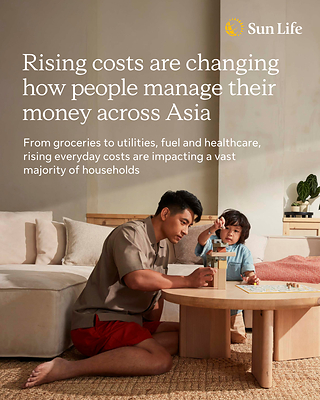
The findings highlight inflation's real-world impact as geopolitical and macroeconomic headwinds, including Middle East tensions and the resulting oil price shock, squeeze family budgets. Rising everyday costs are the most immediate pressure on households in Asia, with grocery prices affecting 95% of people, followed by utilities (94%), transport fuel (92%), cooking fuel (91%) and healthcare (91%).

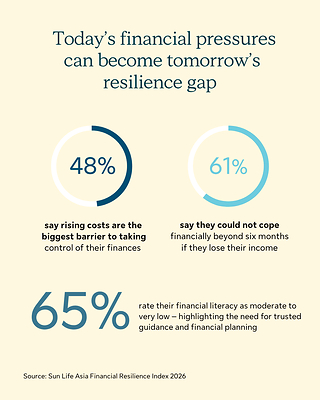
Nearly half (48%) of those surveyed say rising costs are the biggest barrier to taking control of their finances, highlighting how much financial decision-making in 2026 is shaped by affordability, and more than eight in 10 (83%) say it is harder to cover their monthly expenses. In response, households are making short-term trade-offs to balance the books, yet these compromises are coming at the expense of long-term financial security and the ability to weather future storms.

David Broom, Chief Client and Distribution Officer at Sun Life Asia, said, "What stands out this year is not just the scale of cost pressure but how it is changing financial behaviour. Rising living costs are forcing people to rethink how they manage their money on a day-to-day basis, with the price of food, fuel, and household bills placing increasing pressure on budgets. As a result, many people are becoming more focused on short-term financial decisions, and that shift is starting to affect their financial resilience."

Fewer families firmly positioned to withstand financial pressure

In an uncertain economic environment, the proportion of highly resilient households has fallen from 32% in 2025 to 25% this year. As families live with a reduced financial buffer, only 13% say they feel fully secure about their financial situation, down from 19% last year, underscoring the scale of the financial impact across Asia.

In response to rising everyday expenses, people are shortening financial planning horizons and making decisions that compromise their long-term stability. Short-term decisions are becoming a key driver of declining resilience across the region; one in four respondents are drawing down savings, 27% are reducing or skipping essential spending, and 10% have paused retirement contributions.

Managing day-to-day expenses is the top priority for 53% of people over the next 12 months, ahead of saving, investing, or long-term planning. More than half (55%) of people have no financial plan or are planning no further than a year ahead, and 61% would not be able to cope for more than six months without external financial support in the event of job loss or illness.

Financial literacy fuels confidence

While cost-of-living pressures are widespread across Asia, their impact is not felt evenly. Financial literacy emerges as a key differentiator, with those who have stronger knowledge and skills significantly more likely to feel confident about their financial situation and optimistic about the future, despite current challenges.

Households with higher financial literacy are more likely to feel confident (by 48 percentage points), more likely to feel optimistic (by 43 points), and less likely to experience frequent stress (by 14 points). These differences are also reflected in behaviour, as households with stronger financial capability are more likely to plan ahead and maintain longer-term financial habits, while others remain focused on immediate costs.

Against a challenging economic backdrop, access to financial information has expanded significantly, including the growing use of generative AI tools in financial decision-making. Around two-thirds (60%) of respondents say they use GenAI tools regularly for financial advice compared to 18% in 2025. However, greater access to information has not consistently translated into stronger financial confidence or preparedness across the board. Strong financial literacy remains a key differentiator in how households react to economic pressure.

In volatile times, household financial resilience is becoming increasingly uneven across Asia. While cost pressures affect households across all income levels, differences in financial knowledge and access to guidance are influencing how people respond, with those better informed more likely to sustain confidence and stay focused on longer-term goals despite ongoing pressures.

Broom said, "As financial decisions become more short-term, the risk is that people lose sight of longer-term outcomes. Even with more access to information and tools, navigating complex financial decisions still requires guidance. This is where professional financial advice continues to play an important role in helping people turn short-term choices into long-term plans."

The full report is available here.

About this survey

The research surveyed more than 6,000 respondents across Hong Kong SAR, Indonesia, Malaysia, the Philippines, Singapore, and Vietnam, and highlights trends in financial planning, literacy, risk appetite, and the role of professional advice in building long-term resilience in May 2026.

The Index categorises households into low, moderate, and high resilience groups based on how secure they feel and how they manage their finances. It highlights the behaviours and attitudes that distinguish those who are prepared for shocks from those who are more vulnerable.

The Index looks at five key aspects of everyday financial life:

  • Financial security: whether households feel secure or insecure in their current situation

  • Planning horizon: how far ahead they plan, from only a few months to more than five years

  • Emergency preparedness: their ability to cope with unexpected financial shocks

  • Financial literacy: how well they understand personal finance concepts and rate their own knowledge

  • Confidence in long-term goals: whether they feel able to meet future financial commitments

Together, these dimensions provide a fuller picture of how households are managing today's pressures, and how prepared they are for what comes next.

About Sun Life

Sun Life is a leading international financial services organization providing asset management, wealth, insurance and health solutions to individual and institutional Clients. Sun Life has operations in a number of markets worldwide, including Canada, the U.S., the United Kingdom, Ireland, Hong Kong, the Philippines, Japan, Indonesia, India, China, Australia, Singapore, Vietnam, Malaysia and Bermuda. As of March 31, 2026, Sun Life had total assets under management of $1.58 trillion. For more information, please visit www.sunlife.com.

Sun Life Financial Inc. trades on the Toronto (TSX), New York (NYSE) and Philippine (PSE) stock exchanges under the ticker symbol SLF.

Media relations contact: Adam Welch, Director, Communications, Asia, M: +852 9071 1821, E: adam.welch@sunlife.com
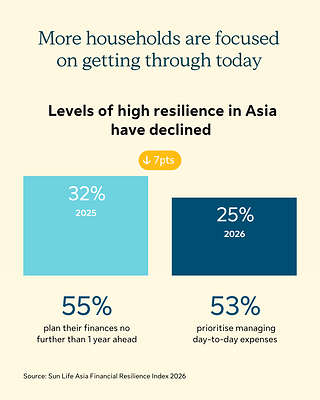
Sun Life Asia infographic 2 - More households are focused on getting through today
Sun Life Asia infographic 3 - Today’s financial pressures can become tomorrow’s resilience gap
Sun Life logo
Cision

View original content to download multimedia:https://www.prnewswire.com/apac/news-releases/sun-life-asia-financial-resilience-index-financial-security-declines-as-cost-of-living-pressure-bites-302794002.html

Attached document

Contents
  1. Financial Resilience Index · page 1
  2. Introduction · page 2
  3. David Broom · page 2
  4. Survey methodology · page 3
  5. #1 Resilience is contracting at the top, with more households shifting into the middle · page 4
  6. Perceived financial security remains low · page 4
  7. #2 Costs are forcing short-term financial trade-offs · page 5
  8. #3 Coping today, at the cost of tomorrow · page 6
  9. Short term actions are reducing future flexibility · page 6
  10. How households are coping · page 6
  11. Constructive behaviour · page 6
  12. Erosive behaviour · page 6
  13. With a sudden loss of income, nearly two-thirds would not cope beyond six months · page 6
  14. A gap remains between financial goals and financial reality · page 6
  15. Short-term pressures are squeezing long-term planning · page 7
  16. Short-term issues dominate financial priorities · page 7
  17. Paying/saving for my or Saving for retirement · page 7
  18. #5 Why resilience gaps are widening · page 8
  19. Under the same pressure, households are diverging in how they cope · page 8
  20. #6 GenAI is becoming a mainstream part of financial decision-making · page 9
  21. Practical steps to build financial resilience · page 10
  22. Start by identifying where you are today. · page 10
  23. If this sounds like you… · page 10
  24. Start here · page 10
  25. 1. Build a stronger financial foundation · page 11
  26. 2. Shape your financial future · page 11
  27. 3. Take control of your financial decisions · page 11
  28. 4. Grow your financial knowledge · page 11
  29. 5. Strengthen your financial safety net · page 11
  30. Building your overall financial resilience · page 11
  31. About the Index · page 12

Page 1

Sun Life

Financial Resilience Index

Asia navigates rising costs

Page 2

Introduction

Rising living costs are putting sustained pressure on households across Asia, forcing more families into shortterm financial decisions that protect affordability today at the expense of longer-term security.

Sun Life’s 2026 Financial Resilience Index shows how these pressures are reshaping financial behaviour. Nearly half of respondents say rising living costs are the biggest barrier to taking control of their finances, highlighting how much financial decision-making is now shaped by cost pressure. Financial buffers are under pressure, leaving households less prepared for future shocks.

More than eight in 10 of our survey respondents say inflation has made it harder to cover monthly expenses. In response, households are making short-term trade-offs to keep finances manageable today, but these decisions are weakening their ability to prepare for what comes next.

A quarter of those we surveyed across Asia are drawing down savings, while more than a quarter are cutting back on essential spending, suggesting that pressure is now affecting core household needs, not just discretionary spending. While these actions may help households cope today, over time they reduce flexibility and increase exposure to future shocks.

The Index shows overall financial resilience is weakening across the region. The proportion of highly resilient

people has fallen from 32% in 2025 to 25% in 2026, with more households now falling into the middle tier. These households are still managing day-to-day finances, but with thinner buffers and less protection against rising costs or income shocks. Only 13% of all respondents say they feel fully secure about their financial situation.

Cost of living pressure is also contributing to shorter financial planning horizons. More than half are planning no further than a year ahead, and only 39% say they could sustain themselves beyond six months without external financial support in the event of job loss or illness.

The result is not a widespread financial downturn, but rather a gradual erosion of resilience over time. Households are adapting to pressure, but in ways that increasingly limit their future options.

More people are managing today with less certainty about tomorrow. As financial pressures intensify, the need for trusted advice, simple solutions, and accessible protection has never been greater. There is a clear opportunity to better support households in navigating short-term challenges while building stronger foundations for the future.

David Broom

Chief Client and Distribution Officer, Asia

Sun Life Asia | FINANCIAL RESILIENCE INDEX 2026

Page 3

Survey methodology

Fieldwork conducted in May 2026

Markets

1,000

Respondents per market

6,000

Respondents from different wealth levels, generations, and both rural and urban settings

Hong Kong Indonesia Malaysia

Philippines Singapore Vietnam

Criteria for high and low financial resilience respondents

Feels financially…

Financial planning

Coping with financial emergency

Self-perceived literacy around personal finances

Meeting long-term financial goals

Low resilience

Insecure

Plans a few months ahead or not at all

Unprepared

Poor

Unconfident

Moderate resilience

Moderately secure

Plans 1-4 years ahead

Somewhat prepared

Moderate financial literacy

Moderately confident

High resilience

Secure

Plans more than 5 years ahead

Prepared

Good

Confident

Page 4

KEY FINDINGS

#1 Resilience is contracting at the top, with more households shifting into the middle

Fewer households are firmly positioned to withstand financial pressure

Financial resilience across Asia has weakened over the past year, with the sharpest decline among highly resilient households. The proportion of highly resilient households in the Index has fallen from 32% to 25%, with a growing share of respondents now concentrated in the middle tier, managing day-to-day finances, but with less certainty and less protection against disruption.

This shows many people are operating with far less margin for error. Most households are not in acute distress, but many are operating with thinner buffers, shorter planning horizons, and less flexibility than before. More households are moving into a position where they can manage today, but with limited capacity to absorb future shocks.

This growing fragility is also reflected in how people feel about their financial security. Only 13% say they feel very secure financially, highlighting how few households feel equipped to withstand financial shocks.

As cost pressures persist, more households are at risk of losing their financial footing.

Financial Resilience Index 2026 overall score

Moderate

Financial resilience overall score distribution 2025 vs 2026

Key contributors to resilience eroding

Perceived financial security remains low

feel very secure about their current 13%financial situation

Page 5

#2 Costs are forcing short-term financial trade-offs

Day to day affordability is taking priority over longer term financial goals

Rising living costs are now the biggest pressure shaping household finances across Asia. More than eight in 10 (83%) of respondents say inflation has made it harder to cover monthly expenses, with rising essential costs leaving households with little room to adjust.

The biggest jumps are in everyday essentials. Increases in the cost of groceries are affecting 95% of respondents, followed by utilities (94%), transportation fuel (92%), healthcare (91%), and cooking fuel (91%). When asked where expenses have increased most, respondents point first to groceries, followed by transportation and fuel, and then utilities.

Financial priorities are shifting as a result. Managing day-to-day expenses is now the top priority for 53% of respondents over the next 12 months, ahead of saving, investing, or long-term planning. At the same time, nearly half (48%) say rising costs are the biggest barrier to taking control of their finances, highlighting how much financial decision-making is now shaped by affordability pressure.

This is a constraint, not a change in preference. As essential costs rise, households are being forced to prioritise immediate needs over future goals. While longterm financial security remains important, many feel less able to build towards it while meeting day-to-day costs.

Financial behaviour is shifting as households delay or deprioritise long-term goals. Over time, these trade-offs weaken the foundations of financial resilience.

Cost increases are having a widespread impact across essential spending

% reporting impact on their finances due to increased costs, by category

Groceries

95%

Utilities

94%

Transport fuel

92%

Cooking fuel

91%

Healthcare

91%

Page 6

#3 Coping today, at the cost of tomorrow

Short term actions are reducing future flexibility

In response to rising costs, households are taking practical steps to manage immediate pressure. More than half (56%) are reducing non-essential spending, while others are focusing on improving financial knowledge or seeking better investment returns.

At the same time, many actions are coming at the expense of long-term financial stability. One in four respondents are drawing down savings, 27% are reducing or skipping essential spending, and 10% have paused retirement contributions. These actions show that financial pressure extends beyond discretionary choices into core financial security.

These trade-offs compound over time. Measures that support affordability today reduce flexibility in the future, leaving households with fewer resources to absorb further cost increases or income shocks.

This erosion is already visible in underlying financial buffers. Across Asia, 68% of consumers identify savings as the foundation of financial security, yet only 39% of those surveyed have sufficient resources to sustain themselves for more than six months without income, highlighting how limited preparedness remains.

Households are coping with current pressure, but in ways that weaken their ability to withstand what comes next. As cost pressures persist, short-term financial decisions are becoming a key driver of declining resilience across the region.

Show more of the filing

How households are coping

% of respondents reporting the actions taken over the past 12 months to improve household finances

Constructive behaviour

7% Reducing non-essential spending Less than 1 month

Reducing non-essential spending

Improving financial knowledge

Investing to increase returns

Erosive behaviour

18% Skipping or reducing essentials Beyond 12 months

With a sudden loss of income, nearly two-thirds would not cope beyond six months

Length of time respondents could self-sustain without external support

Less than 1 month7%
1–3 months26%
4–6 months28%
7–9 months10%
10–12 months11%
Beyond 12 months18%

A gap remains between financial goals and financial reality

68%

say savings are the foundation of financial security, yet 25% are drawing down on savings to manage rising costs

Page 7

#4

Short-term pressures are squeezing long-term planning

Households are prioritising immediate needs, even as future preparedness weakens

Spending is becoming more short-term by necessity, limiting how far ahead households can plan. More than half of those surveyed (55%) now have no financial plan or only plan up to one year ahead, reflecting how immediate pressures are narrowing financial decision-making. Only a quarter of respondents have a long-term plan extending beyond five years.

Households still value long-term financial security. Priorities such as retirement and financial security continue to rank highly, but the ability to act on them is becoming more constrained. Managing day-to-day

expenses is now the top financial priority for 53% of respondents, reducing the capacity to sustain longerterm behaviours such as saving and investing.

Households are not abandoning long-term goals, but they are increasingly forced to defer them. As cost pressures persist, financial decision-making is becoming shorterterm by necessity rather than choice. Just under half of respondents (49%) feel ready to absorb further increases in living costs, highlighting how limited financial headroom remains.

The result is a growing gap between intention and capability. Constrained buffers, limited flexibility, and lower confidence are making it harder for households to act on long-term financial goals.

Short-term issues dominate financial priorities

% of respondents focusing on specific expenses over the next 12 months

53%

Day-to-day expenses

38%

Building emergency funds

33%

Paying/saving for my or my children’s education

33%

Paying/saving for my or Saving for retirement

Saving for retirement

26%

Paying off debts

Page 8

#5 Why resilience gaps are widening

Under the same pressure, households are diverging in how they cope

While cost pressures are widespread across Asia, their impact is not evenly distributed. Households facing similar conditions are experiencing very different outcomes, with some maintaining confidence and longer-term focus, and others become more constrained and reactive.

Financial capability is a key dividing line. 65% rate their financial literacy as moderate, low or very low, underscoring the scale of the challenge. Households with stronger financial literacy are significantly more likely to feel confident about their financial situation and optimistic about the future, while experiencing lower levels of financial stress. The gap is substantial: those with higher literacy are more likely to feel confident (up 48 percentage points) and optimistic (up 43 points), while less likely to experience frequent stress (down 14 points).

These differences are also reflected in behaviour. Households with stronger financial capability are more likely to plan ahead and maintain longer-term financial habits, while others remain focused on managing immediate costs.

Investment behaviour shows a similar pattern of divergence. Younger respondents are the most conservative investor group, with around 60% of those aged 18–34 describing themselves as conservative, compared with 52% among those aged 45–54. Risk appetite peaked among those aged 45–54, where 14% describe themselves as aggressive investors, compared with 9% among younger respondents.

Access to financial information has expanded significantly, including growing use of generative AI tools in financial decision making. However, greater access to information has not translated into stronger financial confidence or preparedness, with financial capability remaining a key differentiator in how households respond to pressure.

As a result, financial resilience is becoming increasingly uneven. Households with stronger capability and access to guidance are better positioned to maintain stability despite rising costs, while others continue to operate with limited buffers and a shorter-term focus.

The result is a widening gap between households that can continue building financial resilience and others focused on simply getting through today.

Financial literacy shapes how households adapt under pressure

Respondents' financial literacy LowRespondents' financial literacy High
Are confident in their current household financial situation24%72%
Feel optimistic about their financial future27%70%
Experience financial stress at least weekly50%36%
Have financial plans extending beyond one year28%50%

Preparedness for sudden cost-of-living increases is significantly higher among those with high financial literacy

Page 9

#6 GenAI is becoming a mainstream part of financial decision-making

People are increasingly using GenAI to research, compare and simplify financial decisions

Generative AI is rapidly becoming a standard part of how people research their financial decisions. Last year, just 18% of respondents cited GenAI as a source of financial information. In 2026, 60% of respondents say they use GenAI for financial advice at least sometimes, including 26% who use it every time or most of the time when making financial decisions.

Usage is widespread, but more frequent among people with higher financial capability. Nearly half (45%) of highly resilient respondents reported frequent use, compared with 14% of those with lower resilience.

When it comes to navigating complex financial decisions, respondents continue to rely on human advice. The most valued adviser qualities are helping people understand long-term benefits and risks clearly, providing simple explanations, and delivering personalised recommendations.

Financial literacy shapes adoption of GenAI tools

% reporting frequent GenAI usage for financial advice

Adoption is expected to grow further

62%

expect their GenAI use to increase over the next 12 months

Most valued characteristics in a human insurance advisor

Page 10

Practical steps to build financial resilience

Start by identifying where you are today.

The statements below can help you recognise where you may have gaps in your financial resilience. You can identify more than one, as financial resilience is built across several areas. Once you’ve identified what applies to you, explore our guidance and practical steps to strengthen your overall financial resilience, and speak with a Sun Life advisor who can help.

If this sounds like you…

“I don’t feel financially secure right now.”

“I only plan a few months ahead, or I don’t have a plan.”

“I’m not confident managing my finances.”

“I don’t feel knowledgeable about personal finance.”

“An unexpected cost would be difficult for me.”

Your resilience gap may be…

Financial security

Future planning

Financial confidence

Financial literacy

Emergency readiness

Start here

1. B uild a stronger financial foundation

2. Shape your financial future

3. T ake control of your financial decisions

4. Gr ow your financial knowledge

5. Str engthen your financial safety net

Sun Life Asia | FINANCIAL RESILIENCE INDEX

Page 11

Where are your financial resilience gaps? Here are five tips to help you take control of your financial future:

1. Build a stronger financial foundation

Savings are the cornerstone of a strong financial foundation; 64% of High Resilience respondents are building their savings fund.

Set aside a portion of your salary each month into a rainy day fund to build resilience against unexpected expenses. Keep savings in an account that offers returns above the rate of inflation to help preserve your purchasing power. Savings act as a buffer when circumstances change, giving you peace of mind and flexibility in turbulent times.

2. Shape your financial future

Don’t coast along without a plan. The most financially resilient people set clear goals and build long-term roadmaps to reach them.

High Resilience respondents are 22 percentage points more likely to work with a financial adviser and are more proactive, with 59% investing consistently for long-term growth and 78% reviewing their retirement savings or pension plan at least every few months. Working with a professional can help you balance your household budget with your long-term goals, ensure you invest in assets aligned to your risk tolerance, and develop plans that adapt as your circumstances change.

3. Take control of your financial decisions

Building financial literacy can help you feel more equipped to navigate uncertainty and understand the choices available to you.

Fifty-five percent of High Resilience respondents are actively improving their financial knowledge. Start with the areas most relevant to your life stage, such as saving, borrowing, pensions, investing, inflation, or protection. Trusted financial news, reputable online resources, and conversations with qualified professionals can help you make sense of money matters. The aim is not to know everything, but to build enough understanding to ask better questions and recognise when advice may be needed.

4. Grow your financial knowledge

Confidence grows when knowledge is put into practice. If financial decisions feel overwhelming, create a simple routine: check

in regularly, compare options, weigh risks and trade-offs, and identify your next step. Highly literate individuals are three times more likely to feel confident about their household finances, showing how understanding and action reinforce each other. For more complex decisions, sense-checking with a professional can help you move forward with confidence.

5. Strengthen your financial safety net

Financial setbacks can happen with little warning, whether it’s the loss of a job, a sudden medical expense, or costly home

repairs. Ensure you have an emergency plan that could cover your financial costs. Having a financial contingency plan in place can ease pressure and make situations more manageable. High resilience individuals are also more likely to put protection into place, with 64% holding life insurance to support longer-term security. Review how insurance can add a layer of protection for you and your loved ones.

Building your overall financial resilience

Financial resilience is built over time through consistent action across multiple areas. The most resilient households combine habits such as building savings, planning ahead, improving financial knowledge and preparing for unexpected events.

Together, these steps strengthen overall stability and flexibility, while building greater confidence in managing your finances over time.

Page 12

About the Index

Sun Life is committed to helping more people in our communities achieve financial security and live healthier lives.

Sun Life Asia’s third annual Financial Resilience Index categorises households into low, moderate, and high resilience groups based on how secure they feel and how they manage their finances. It highlights the behaviours and attitudes that distinguish those who are prepared for shocks from those who are more vulnerable.

The Index looks at five key aspects of everyday financial life:

• Financial security – whether households feel secure or insecure in their current situation

• Planning horizon – how far ahead they plan, from only a few months to more than five years

• Emergency preparedness – their ability to cope with unexpected financial shocks

• Financial literacy – how well they understand personal finance concepts and rate their own knowledge

• Confidence in long term goals – whether they feel able to meet future financial commitments

Together, these dimensions provide a fuller picture of how households are managing today’s pressures, and how prepared they are for what comes next.

Page 13

Disclaimer: This report has been produced by Sun Life Asia for general information purposes only and does not constitute offers, product recommendations, endorsements or advice of any kind. While care has been taken in gathering the data and preparing this report, Sun Life Asia and its affiliates (collectively, “Sun Life”) do not make any representations or warranties as to its timeliness, accuracy or completeness and excludes to the maximum extent permitted by law all those that might otherwise be implied. The views expressed in this report do not represent that of Sun Life’s. Sun Life accepts no responsibility, and shall not be liable for any loss, damage or expense incurred by any person arising out of or in connection with him/her using, acting or refraining from action as a result of this report, including but not limited to any statements, facts, figures or expressions of opinion or belief referenced to.

Sun Life is not responsible for the content of any third-party websites contained herein and does not warrant or guarantee the hyperlinks will be uninterrupted or free from delay, errors, defects, viruses or other malicious programs. Any dispute arising out of or relating to this report shall be governed by the laws of Hong Kong and subject to the exclusive jurisdiction of the courts of Hong Kong.

View original source (PR Newswire)Company analysis