
Direct-Synthesized NMC Hydroxide pCAM Market
EV battery expansion and high-nickel NMC demand fuel South Korea’s direct-synthesized pCAM market growth
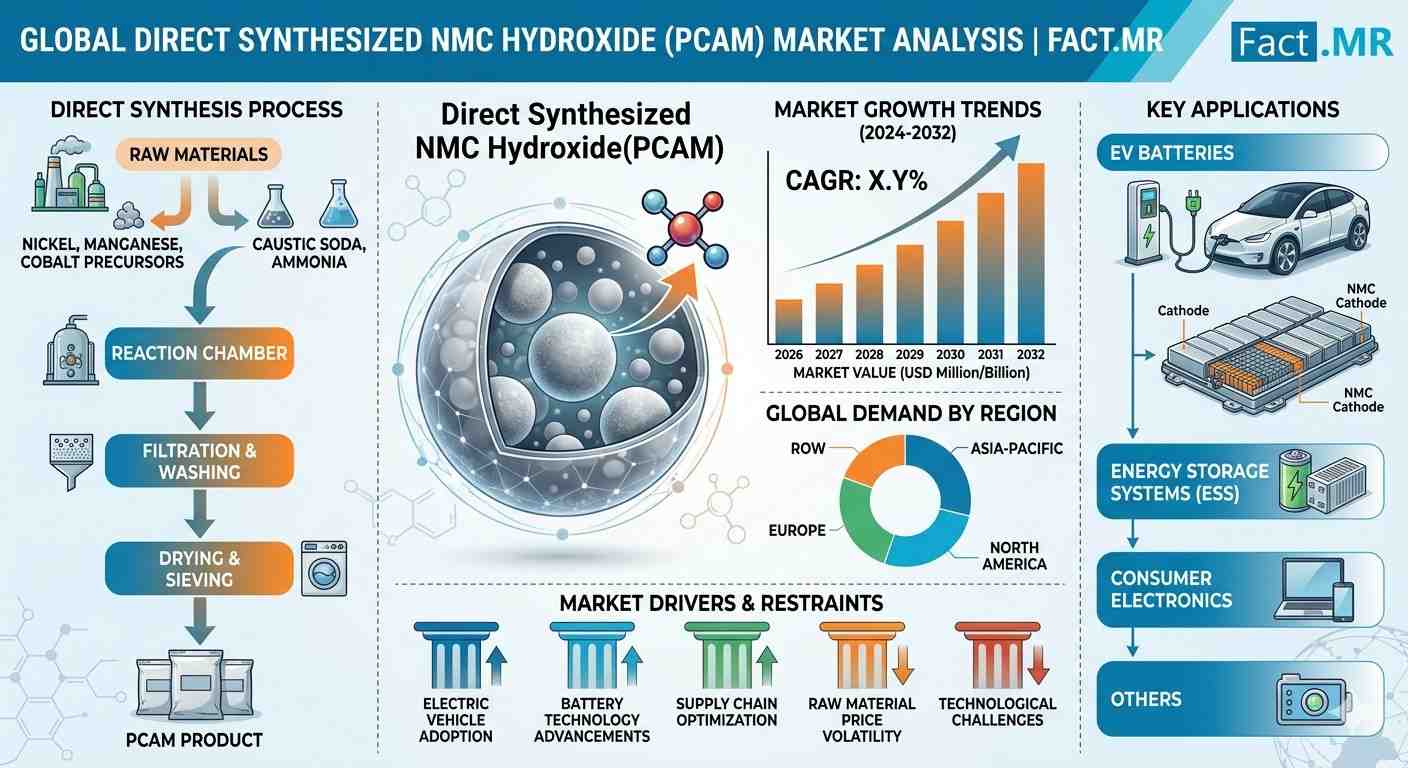
ROCKVILLE, MD, UNITED STATES, April 13, 2026 /EINPresswire.com/ -- According to Fact.MR’s latest analysis, the South Korea direct-synthesized NMC hydroxide pCAM market is part of a rapidly expanding global industry valued at USD 7.4 billion in 2025, projected to reach USD 8.9 billion in 2026, and forecast to surge to USD 53.6 billion by 2036, registering a robust 19.7% CAGR.South Korea is expected to grow at approximately 19.4% CAGR, positioning itself among the fastest-growing markets globally. The industry is set to generate an incremental opportunity of USD 44.7 billion, reflecting structural transformation rather than incremental growth.
This transformation is driven by the shift toward direct-synthesis processes, enabling superior particle consistency, reduced cobalt dependency, and alignment with high-nickel battery chemistries used in EV gigafactories.
Get detailed market forecasts, competitive benchmarking, and pricing trends:
https://www.factmr.com/connectus/sample?flag=S&rep_id=14703
Quick Stats
Market Size (2025): USD 7.4 Billion
Market Size (2026): USD 8.9 Billion
Forecast Value (2036): USD 53.6 Billion
CAGR (2026–2036): 19.7%
Incremental Opportunity: USD 44.7 Billion
Leading Segment: NMC 622 (~35% share)
Leading Application: Electric Vehicles (62% share)
Leading Country Growth: South Korea (19.4% CAGR)
Key Players: POSCO Future M, LG Chem, Samsung SDI, BASF, Umicore
Executive Insight for Decision Makers
South Korea’s market is undergoing a structural shift toward high-nickel, direct-synthesized pCAM production, tightly integrated with EV OEM supply chains.
Manufacturers must invest in direct-synthesis reactor capacity aligned with NMC 811 demand
Battery suppliers need long-term off-take agreements with OEMs
Investors should prioritize integrated supply chains and feedstock security
Risk of inaction:
Loss of OEM qualification (12–24 month cycles)
Margin pressure due to outdated co-precipitation processes
Exclusion from high-growth EV battery ecosystems
Market Dynamics
Key Growth Drivers
Rapid expansion of EV gigafactories in Asia and North America
Rising adoption of high-nickel NMC 811 chemistries
Strong OEM–supplier integration in South Korea
Policy and R&D support for advanced battery materials
Key Restraints
High capital expenditure for direct-synthesis facilities
Nickel and cobalt price volatility
Complex qualification timelines with OEMs
Emerging Trends
Transition toward low-carbon, traceable pCAM production
Growth of closed-loop battery material ecosystems
Increasing focus on high-purity morphology control
Strategic localization of battery supply chains
Segment Analysis
By Chemistry
NMC 622 leads with ~35% share due to balanced performance
NMC 811 is the fastest-growing segment, driven by EV range requirements
By Application
Electric Vehicles (62%) dominate demand
Energy Storage Systems (ESS) emerging rapidly
Consumer electronics maintaining steady growth
Strategic Importance
EV segment defines volume scalability
High-nickel chemistries define future competitiveness
Supply Chain Analysis (Critical Insight)
Value Chain Structure
Raw Material Suppliers
Nickel, cobalt, manganese sourced globally (Australia, Indonesia, Africa)
Refiners & Precursor Producers
Convert raw metals into battery-grade materials
pCAM Manufacturers
Direct-synthesis producers in South Korea (POSCO Future M, LG Chem)
Battery Cell Manufacturers
LG Energy Solution, Samsung SDI
End Users
EV OEMs, ESS developers, electronics manufacturers
“Who Supplies Whom”
Global miners → Korean refiners
Refiners → pCAM producers
pCAM producers → battery cell manufacturers
Cell manufacturers → EV OEMs
Key Insight:
South Korea’s strength lies in vertically integrated, OEM-linked supply chains, reducing dependency risks and improving qualification success rates.
Pricing Trends
Market operates as a premium, technology-driven material segment
Pricing linked to:
Nickel & cobalt costs
Process technology (direct-synthesis vs conventional)
OEM qualification status
Key Influencing Factors
Feedstock availability
Energy and processing costs
ESG and traceability compliance
Margin Insight:
Higher margins for high-nickel, OEM-qualified pCAM
Lower margins for non-integrated or non-qualified suppliers
Regional Analysis
Top Countries by CAGR
China – 20.0%
South Korea – 19.4%
Japan – 18.8%
United States – 18.0%
Germany – 17.7%
Why South Korea is Growing
Strong battery manufacturing ecosystem
Close collaboration between material suppliers and OEMs
Government-backed R&D and innovation programs
Developed vs Emerging Markets
South Korea (Developed):
High-tech production
Strong OEM integration
Premium product focus
Emerging Markets:
Capacity expansion-driven growth
Cost-focused production
Lower integration levels
Competitive Landscape
Market is moderately consolidated in technology leadership
Fragmented in terms of global capacity distribution
Key Players
POSCO Future M
LG Chem
Samsung SDI
BASF SE
Umicore
CNGR Advanced Materials
Huayou Cobalt
GEM Co., Ltd.
Sumitomo Metal Mining
Competitive Strategies
Investment in direct-synthesis technologies
Long-term OEM supply agreements
Vertical integration into raw material sourcing
Expansion of global production footprints
Strategic Takeaways
For Manufacturers
Scale direct-synthesis production capacity
Ensure feedstock integration and traceability
For Investors
Focus on battery material ecosystems
Target companies with OEM-linked contracts
For Marketers / Distributors
Highlight performance consistency and compliance
Build positioning around high-nickel expertise
Future Outlook
South Korea’s pCAM market is heading toward:
Dominance in high-nickel battery materials
Expansion of low-carbon and recycled material solutions
Deeper integration with global EV supply chains
Long-term opportunity:
Strong in next-generation EV batteries and energy storage systems
Conclusion
South Korea is emerging as a global powerhouse in advanced battery precursor materials, driven by innovation, integration, and high-growth EV demand. Companies that align with direct-synthesis technology, OEM partnerships, and sustainability standards will define the next decade of market leadership.
Why This Market Matters
Direct-synthesized NMC hydroxide pCAM is a critical enabler of EV performance, battery efficiency, and energy transition goals.
For South Korea, leadership in this market directly translates to global competitiveness in the EV value chain and long-term industrial growth.
Full Report: Unlock 360° insights for strategic decision making and investment planning-
https://www.factmr.com/checkout/14703
To View Related Report:
Zinc Hydroxide Market https://www.factmr.com/report/4251/zinc-hydroxide-market
Nickel Hydroxide Market https://www.factmr.com/report/nickel-hydroxide-market-report
Ferric Hydroxide Market https://www.factmr.com/report/ferric-hydroxide-market
Magnesium Hydroxide Market https://www.factmr.com/report/magnesium-hydroxide-market
S. N. Jha
Fact.MR
+1 628-251-1583