


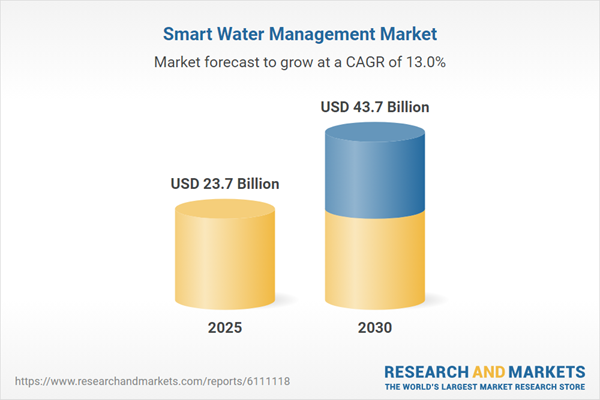
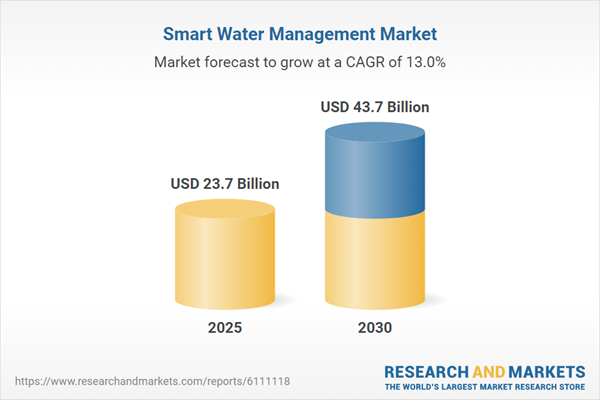
The global smart water management market is set to grow from $23.7 billion in 2025 to $43.7 billion by 2030, at a 13% CAGR. Enhanced by IoT and AI, SWM optimizes water use and distribution. Key drivers include urban demand, regulatory pushes in Europe, and adoption in Asia-Pacific. The report provides comprehensive analysis and market projections, highlighting technological advancements and segment insights.
Smart Water Management Market
Dublin, Aug. 28, 2025 (GLOBE NEWSWIRE) -- The "Smart Water Management: Global Markets to 2030 ()" report has been added to ResearchAndMarkets.com's offering.
The global market for smart water management is expected to grow from $23.7 billion in 2025 and is projected to reach $43.7 billion by the end of 2030, at a compound annual growth rate (CAGR) of 13% during the forecast period of 2025 to 2030.
SWM involves incorporating advanced digital instruments such as sensors, microcontrollers, and systems to improve water management through automation, real-time data analysis, and accurate monitoring. It includes IoT-enabled sensor technologies to monitor water quality and flow rates continuously. It also gives utilities information to identify leaks, contamination, or distribution network inefficiencies that may lead to wastage.
Sensor-generated data is sent to a cloud server and, after processing with the help of AI, sent to a computer for user review. The data is used further by AI-driven analytics to forecast equipment failures, optimize water use, and enhance maintenance activity scheduling. Thus, SWM provides comprehensive solutions to mitigate floods, droughts, and pressure and flow issues and enables efficient irrigation, improved water quality, and sufficient water quantity.
Market Dynamics and Drivers
The potential of SWM in the water industry is immense, particularly in addressing the challenges of water scarcity and inefficient distribution. Urban centers are experiencing a surge in water demand, necessitating intelligent solutions to prevent resource depletion and infrastructure failure. Governments and private-sector players increasingly focus on integrating smart water solutions to optimize distribution networks, reduce water loss, and enhance operational efficiency.
Countries in Asia-Pacific, such as India and China, increasingly are adopting smart water technologies to combat high levels of non-revenue water (NRW) loss, often exceeding 30% in developing nations. Similarly, in Europe, regulatory frameworks push utilities to upgrade their water networks through digital transformation, improving efficiency and sustainability. The agricultural sector also benefits from SWM, with smart irrigation systems that use real-time data to optimize water application, ensuring higher crop yields with minimal wastage.
Report Scope
This report provides a detailed global market analysis of smart water management (SWM), reflecting the latest data, trends, and market projections. SWM involves the integration of digital technologies, data analytics, and automation to optimize the use, distribution, and quality of water resources. It aims to improve efficiency, to reduce water waste, to increase transparency, to enhance sustainability, and to support real-time decision-making in water systems.
The report focuses on the hardware, software and services aspects of SWM. The base year for the market study is 2024, with estimates and forecasts for 2025 through 2030. Market estimates are valued in U.S. dollars (millions). Forecast growth rates are based on expected industry capacity additions, feedback from key industry players, revenue reported by major companies, and anticipated regulatory updates. Data from major smart water associations such as the International Water Resources Association, Irrigation Association, International Water Management Institute, and American Water Works Association were used to anticipate market dynamics and to further measure the market size.
The report includes:
73 data tables and 54 additional tables
An overview of the global market for smart water management (SWM)
Analyses of the global market trends, with sales data for 2024, estimates for 2025, forecasts for 2029, and projected CAGRs through 2030
Estimates of the market and revenue forecast for the global SWM market, and corresponding market share analysis by component, end-use industry and region
Highlights of emerging technological trends, opportunities and gaps, estimating current and future demand for SWM
Information on the latest developments in SWM and new industry research, upcoming technologies, and economic trends
Identification of challenges and discussion of how to overcome these so that the market reaches its commercialization potential, and ESG trends of the market
Market share analysis of the key companies and coverage of their proprietary technologies, strategic alliances, and other market strategies, and a relevant patent analysis
Profiles of the leading companies, including Xylem, Siemens, Veolia, Schneider Electric, and Honeywell International Inc.
Company Profiles
ABB
Aqua Robur Technologies Ab
Badger Meter Inc.
Hitachi Ltd.
Honeywell International Inc.
Hydropoint
Itron Inc.
Kamstrup
Landis+Gyr
Mueller Water Products Inc.
Neptune Technology Group Inc.
Schneider Electric
Siemens
Veolia
Xylem
Key Attributes:
Report Attribute | Details |
No. of Pages | 189 |
Forecast Period | 2025 - 2030 |
Estimated Market Value (USD) in 2025 | $23.7 Billion |
Forecasted Market Value (USD) by 2030 | $43.7 Billion |
Compound Annual Growth Rate | 13.0% |
Regions Covered | Global |
Key Topics Covered:
Chapter 1 Executive Summary
Market Outlook
Scope of Report
Market Summary
Market Dynamics and Drivers
Trends and Future Developments
Segmental Analysis
Regional Insights and Emerging Markets
Conclusion
Chapter 2 Market Overview
Overview
Key Benefits of Smart Water Management
Smart Water Management Framework
Major Water Information Platforms
Value Chain Analysis
R&D and Technology Development
Hardware Manufacturing
Software Development and Platform Integration
System Integration and Deployment
Operations, Maintenance and Asset Management
Data Analytics and Decision Support
Customer Engagement
Regulatory Framework in Smart Water Management Industry
Impact of Trump's Trade Policies on the Global Water Business
Chapter 3 Market Dynamics
Market Dynamics
Market Drivers
Rising Demand for Clean Water
Water Scarcity and Climate Change Drive Demand for Smart Water Management
Rising Demand for Smart Water Management in Industrial and Commercial Sectors
Advances in IoT, AI and Digital Twin
Market Restraints
High Initial Investment
Lack of Technical Expertise and Skilled Workforce
Market Opportunities
Potential to Reduce Non-Revenue Water
Growing Urbanization and Smart City Initiatives
Market Challenges
Cybersecurity Risk
Smart Water Management Integration Challenges with Legacy Systems
Chapter 4 Emerging Technologies and Developments
Overview
Innovative Trends in Smart Water Management, 2025
Enhanced Cybersecurity Protocols
Reduction of Non-Revenue Water
AI in Water Resource Management
Wastewater Treatment Plant Optimization
Flood Management
Smart Agriculture and Irrigation
Summary of Case Studies in Smart Water Management
Smart Water Grid in Singapore
Smart Irrigation System in Barcelona
AI and Digital Twins for Wastewater Management, San Diego, California
Smart Metering in Urban Households, Pimpri-Chinchwad, India
Fixing Undetected Leaks in Italy
Homestake Water Project, Colorado
Emerging Technologies
IoT and Smart Sensors
Advanced Metering Infrastructure
Digital Twins
AI and Machine Learning
Geographic Information Systems
Cloud Computing and Edge Computing
Blockchain
Patent Analysis
Key Takeaways
Significant Patent Grants
Chapter 5 Market Segmentation Analysis
Segmentation Breakdown
Market Analysis by Component
Key Takeaways
Hardware
Software
Services
Market Analysis by End Use
Key Takeaways
Utilities and Municipalities
Commercial and Industrial
Residential
Geographic Breakdown
Market Analysis by Region
Key Takeaways
North America
Europe
Asia-Pacific
South America
Middle East and Africa
Chapter 6 Competitive Intelligence
Industry Structure
Top Players Ranking Analysis
Xylem
Siemens
Veolia
Schneider Electric
Honeywell International
Strategic Analysis
Chapter 7 Sustainability in Smart Water Management Market: An ESG Perspective
Importance of ESG in the Smart Water Management Industry
Sustainability Trends in the Smart Water Management Industry
ESG Practices in the Smart Water Management Industry
Current Status of ESG in the Smart Water Management Market
ESG Score Analysis
Risk Scale, Exposure Scale, and Management Scale
Risk Scale
Exposure Scale
Management Scale
Future of ESG: Emerging Trends and Opportunities
Concluding Remarks
Chapter 8 Appendix
For more information about this report visit https://www.researchandmarkets.com/r/yeify2
About ResearchAndMarkets.com
ResearchAndMarkets.com is the world's leading source for international market research reports and market data. We provide you with the latest data on international and regional markets, key industries, the top companies, new products and the latest trends.
Attachment
CONTACT: CONTACT: ResearchAndMarkets.com Laura Wood,Senior Press Manager press@researchandmarkets.com For E.S.T Office Hours Call 1-917-300-0470 For U.S./ CAN Toll Free Call 1-800-526-8630 For GMT Office Hours Call +353-1-416-8900