


The smart pill dispenser market offers growth opportunities driven by technological advancements, IoT connectivity, and healthcare integration. Key opportunities include enhancing medication adherence, reducing costs from non-adherence, and expanding in regions with robust healthcare infrastructure like North America.
Smart Pill Dispenser Market
Dublin, April 28, 2026 (GLOBE NEWSWIRE) -- The "Smart Pill Dispenser Market - Forecast from 2026 to 2031" report has been added to ResearchAndMarkets.com's offering.
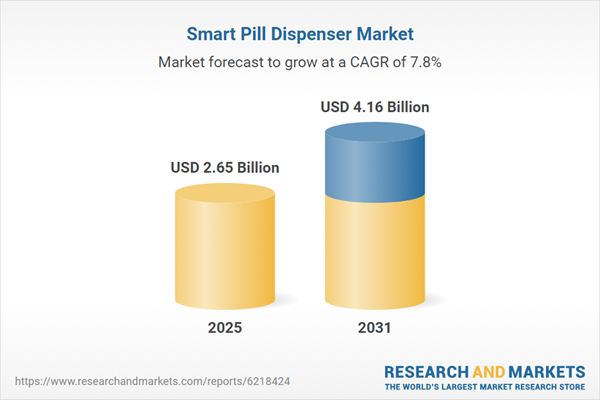
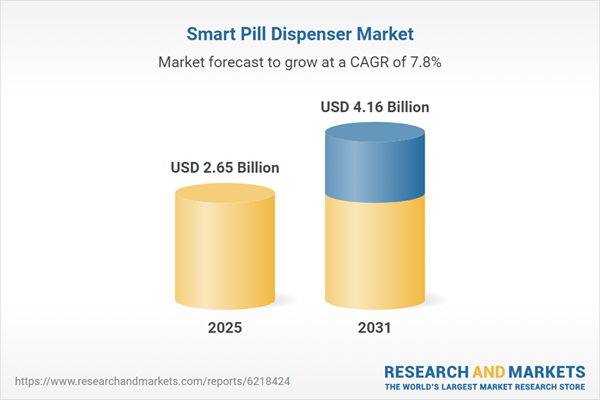
The global smart pill dispenser market is expected to grow at a 7.84% CAGR, achieving USD 4.161 billion in 2031 from USD 2.646 billion in 2025.
The smart pill dispenser market represents a rapidly evolving segment within the digital health and medication management landscape. These devices are electronic systems designed to assist individuals in managing complex prescription schedules autonomously or with remote supervision.
A primary driver for market growth is the continuous advancement and convergence of healthcare technology and consumer smart devices. Modern smart pill dispensers incorporate sophisticated electronics, robust connectivity, and intuitive user interfaces. Their evolution is fueled by developments in areas such as sensor miniaturization, low-power wireless communication, and cloud computing.
This technological progression enables more reliable, feature-rich, and user-friendly devices. The shift from standalone units to connected health ecosystems allows for enhanced functionality, including remote programming by caregivers, integration with broader health monitoring platforms, and the generation of valuable adherence data for healthcare providers. As these technologies mature and become more cost-effective, they broaden the market's potential reach and utility.
A closely related and critical driver is the deep integration with smartphones and the Internet of Things (IoT). Connectivity transforms the smart pill dispenser from a local reminder tool into a node in a networked care system. Through companion mobile applications, patients and their care circles receive real-time notifications, adherence reports, and low-medication alerts.
IoT connectivity enables seamless data syncing to cloud-based dashboards, allowing family members or clinical teams to monitor compliance remotely. This connectivity facilitates timely interventions, provides peace of mind for caregivers, and creates a continuous feedback loop that supports better medication management. The expectation for such connected health solutions, particularly among tech-savvy populations and within value-based care models, is a powerful market accelerant.
Furthermore, the compelling economic argument centered on cost-effectiveness and the potential for reducing overall healthcare expenditures underpins market adoption. Poor medication adherence is a well-documented contributor to worsening chronic conditions, avoidable hospitalizations, and increased emergency department visits, representing a massive financial burden on healthcare systems. Smart pill dispensers address this problem at its source by systematizing and verifying dosage administration.
By improving adherence, these devices have the potential to generate significant downstream savings by preventing costly complications and acute care episodes. For payers, health systems, and even individual families managing long-term care, this potential for return on investment through improved health outcomes and avoided costs provides a strong rationale for implementation.
Geographically, North America is anticipated to hold a significant share of the global smart pill dispenser market. This outlook is based on the region's advanced healthcare infrastructure, high penetration of digital health technologies, and substantial focus on chronic disease management and aging-in-place solutions. A regulatory and reimbursement environment that increasingly recognizes the value of digital tools for care management, combined with high consumer awareness and spending on healthcare innovation, creates a fertile ground for adoption. The prevalence of chronic conditions requiring complex medication regimens and a growing elderly population seeking to maintain independence further solidify the region as a primary market for these assistive technologies.
The competitive landscape features a mix of specialized digital health companies and established medical technology corporations. Players like MedMinder focus specifically on comprehensive medication management systems, offering features tailored for elderly patients or those requiring caregiver oversight.
Large healthcare technology firms, such as Philips Healthcare, leverage their broad portfolios to integrate smart dispensing solutions into wider connected care platforms aimed at both home health and institutional settings. Emerging models, exemplified by companies like Hero, combine physical dispensing hardware with sophisticated mobile applications and cloud services to offer an end-to-end medication management ecosystem.
Leading participants, including Omnicell Inc. and Capsa Healthcare, bring expertise from institutional medication management into the home care segment, while others like Becton Dickinson Company apply their deep experience in medication delivery. The strategic focus across the industry is on enhancing reliability, simplifying user experience, deepening ecosystem integrations, and leveraging collected adherence data to provide actionable insights.
The market's trajectory is defined by its role in bridging the gap between clinical prescription and daily patient behavior, using technology to create a more accountable, safe, and supported medication administration process, thereby addressing a fundamental and expensive challenge in global healthcare.
Key Benefits of this Report:
Insightful Analysis: Gain detailed market insights covering major as well as emerging geographical regions, focusing on customer segments, government policies and socio-economic factors, consumer preferences, industry verticals, and other sub-segments.
Competitive Landscape: Understand the strategic maneuvers employed by key players globally to understand possible market penetration with the correct strategy.
Market Drivers & Future Trends: Explore the dynamic factors and pivotal market trends and how they will shape future market developments.
Actionable Recommendations: Utilize the insights to exercise strategic decisions to uncover new business streams and revenues in a dynamic environment.
Caters to a Wide Audience: Beneficial and cost-effective for startups, research institutions, consultants, SMEs, and large enterprises.
Report Coverage:
Historical data from 2021 to 2025 & forecast data from 2026 to 2031
Growth Opportunities, Challenges, Supply Chain Outlook, Regulatory Framework, and Trend Analysis
Competitive Positioning, Strategies, and Market Share Analysis
Revenue Growth and Forecast Assessment of segments and regions including countries
Key Attributes:
Report Attribute | Details |
No. of Pages | 151 |
Forecast Period | 2025 - 2031 |
Estimated Market Value (USD) in 2025 | $2.65 Billion |
Forecasted Market Value (USD) by 2031 | $4.16 Billion |
Compound Annual Growth Rate | 7.8% |
Regions Covered | Global |
CompanyProfiling (Strategies, Products, Financial Information, and Key Developments)
Omnicell Inc.
Capsa Healthcare
Medminder System Inc.
Philips Healthcare
Becton Dickinson Company
Hero Health Inc.
MOBI Technologies
AARDEX Group
Smart Pill Dispenser Market Segmentation:
By Product Type
Centralized Pill Dispensers
Semi-Automatic Pill Dispensers
Fully-Automated Dispensers
Smart Pill Boxes/Bottles
Others
By End-User
Hospitals & Clinics
Home Care Settings
Pharmacies
Aged Care Facilities
Others
By Geography
North America
USA
Canada
Mexico
South America
Brazil
Argentina
Others
Europe
Germany
France
United Kingdom
Spain
Others
Middle East and Africa
Saudi Arabia
UAE
Others
Asia-Pacific
China
India
Japan
South Korea
Indonesia
Thailand
Others
For more information about this report visit https://www.researchandmarkets.com/r/fkj175
About ResearchAndMarkets.com
ResearchAndMarkets.com is the world's leading source for international market research reports and market data. We provide you with the latest data on international and regional markets, key industries, the top companies, new products and the latest trends.
Attachment
CONTACT: CONTACT: ResearchAndMarkets.com Laura Wood,Senior Press Manager press@researchandmarkets.com For E.S.T Office Hours Call 1-917-300-0470 For U.S./ CAN Toll Free Call 1-800-526-8630 For GMT Office Hours Call +353-1-416-8900