
- RT-111 achieved high bioavailability in humans -
- RT-111 was well-tolerated, with no serious adverse events -
- Celltrion has right of first negotiation to acquire worldwide rights to RT-111 following a Phase 1 clinical trial that meets its primary endpoints –
- Rani has now successfully completed three Phase 1 trials using RaniPill® technology -
- Company to host conference call today at 8:30 a.m. ET / 5:30 a.m. PT –
SAN JOSE, Calif., Feb. 05, 2024 (GLOBE NEWSWIRE) -- Rani Therapeutics Holdings, Inc. (“Rani Therapeutics” or “Rani”) (Nasdaq: RANI), a clinical-stage biotherapeutics company focused on the oral delivery of biologics and drugs, today announced positive topline results from its Phase 1 clinical study of RT-111, a RaniPill® capsule containing an ustekinumab biosimilar, CT-P43. In the study, RT-111 was well-tolerated and delivered ustekinumab with high bioavailability.
“We are highly encouraged by the positive results from our Phase 1 study for RT-111 – our third successfully completed Phase 1 trial using RaniPill® technology. To our knowledge, RT-111 is the first ever oral monoclonal antibody to achieve high bioavailability in humans,” said Talat Imran, Chief Executive Officer of Rani. “These data provide clinical validation of our ability to successfully transform an injectable large molecule into an oral pill. Specifically for this program, we believe RT-111 has the potential to offer a highly differentiated dosing regimen for patients with psoriasis compared to both injectable biologics and oral small molecules and peptides. The success of the Phase 1 study of RT-111 marks another significant milestone for the Rani team, as we diligently work towards making oral biologics a reality for the millions of patients living with autoimmune conditions.”
Ustekinumab is a human IgG1қ monoclonal antibody that binds with specificity to the p40 protein subunit used by both the interleukin-12 and interleukin-23 (IL-12 and IL-23) cytokines. Currently, ustekinumab is available only as a subcutaneous injection (SC) and is marketed in the United States by Janssen as STELARA® for the treatment of moderate to severe plaque psoriasis, active psoriatic arthritis, moderate to severe Crohn’s disease, and moderate to severe ulcerative colitis, all of which have large unmet medical needs for oral treatment. Sales for STELARA were approximately $6.4 billion in the United States and approximately $9.7 billion worldwide in 2022.
Rani’s single-center, open label, Phase 1 study of RT-111 was conducted in Australia. The study evaluated the safety, tolerability, and pharmacokinetics (PK) of RT-111 in healthy adult volunteers. The study enrolled 20 participants each in RT-111 0.5mg and 0.75mg dose groups, and 15 participants in a STELARA (ustekinumab) 0.5mg subcutaneous (SC) injection group.
Phase 1 Topline Results
Pharmacokinetics
- Oral RT-111 delivered ustekinumab biosimilar in a dose proportional manner and with high bioavailability (estimated at 84% relative to subcutaneous injection).
- Oral RT-111 demonstrated a higher Cmax and shorter Tmax compared to ustekinumab delivered by SC injection (0.5mg).
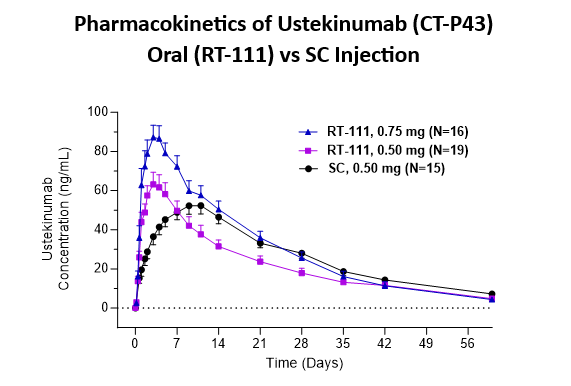
| Stelara® SC 0.50mg | RT-111 0.50mg | RT-111 0.75mg | |
| Cmax (ng/mL) | 56 ± 4 | 67 ± 7 | 92 ± 8 |
| Tmax (days) | 10 ± 0.8 | 3.1 ± 0.2* | 3.3 ± 0.2* |
| AUC (day*ng/mL) | 1,566 ± 130 | 1,315 ± 150 | 1,814 ± 165 |
Data are Mean ± SE from all subjects, including those with anti-drug antibodies. *p