
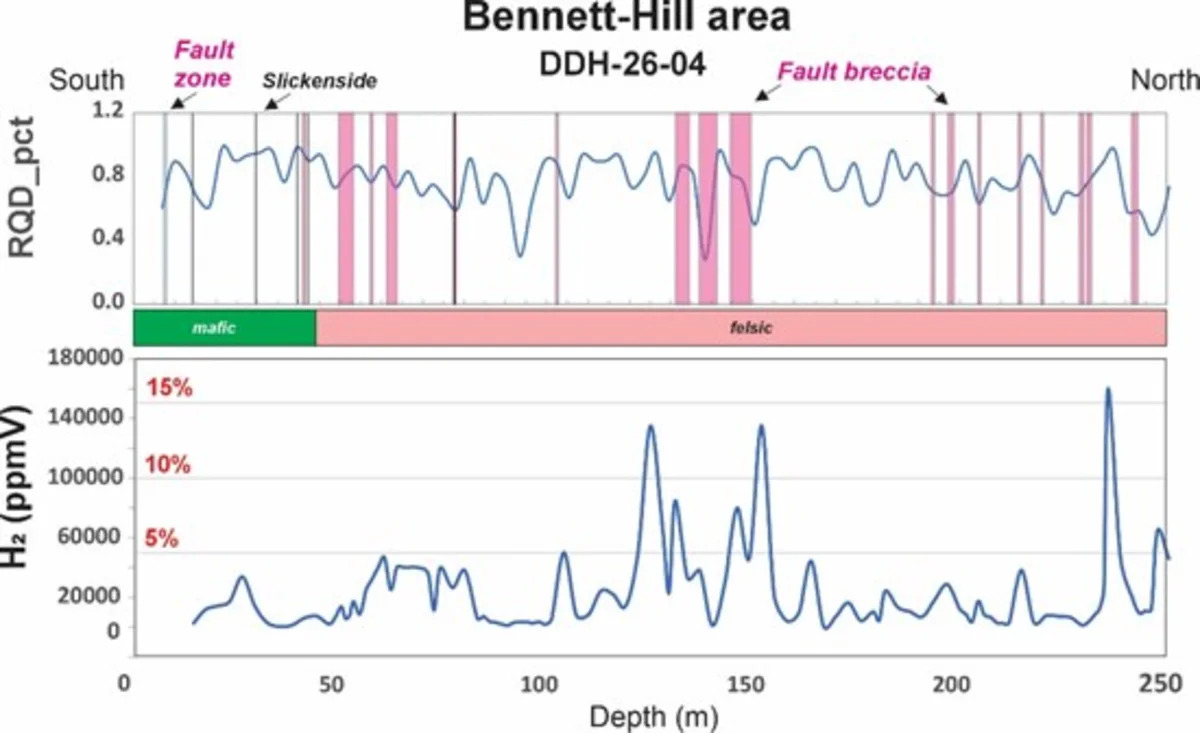
Higher-range EAGLE II analyzer records repeated percent-level hydrogen readings, with 35 of 60 IsoJar samples exceeding 1% H while methane remained near 0% and carbon dioxide at or below 0.2% across the interval
Montréal, Québec--(Newsfile Corp. - June 29, 2026) - Québec Innovative Materials Corp. (CSE: QIMC) (OTCQB: QIMCF) (FSE: 7FJ) ("QIMC" or the "Company") is pleased to report new preliminary mud-gas geochemical results from the 100-metre to 250-metre interval of diamond drill hole DDH-26-04 at Bennett Hill, Nova Scotia, including a peak hydrogen reading of 16.0% H₂ at 236 metres, two readings of 13.5% H₂, nine readings at or above 5% H₂, and 35 of 60 IsoJar samples returning readings at or above 1% H₂.
The Company considers the repeated elevated hydrogen readings over the 100-metre to 250-metre interval significant because they indicate a broadly elevated mud-gas response rather than a single isolated reading. The results were acquired using a higher-range EAGLE II analyzer deployed after the first analyzer saturated in the upper 100 metres, as disclosed in the Company's June 18, 2026 news release.
Highlights - DDH-26-04 (100m-250m Interval).
Peak and repeated high-range hydrogen readings. The Company recorded a peak reading of 16.0% H₂ at 236 metres, together with two readings of 13.5% H₂ at 125 metres and 152 metres, and nine readings at or above 5% H₂ across the reported interval.
Broadly elevated hydrogen response. Of the 60 co-collected IsoJar mud-gas samples obtained over the 100m-250m interval, 35 samples returned readings at or above 1% H₂, which the Company interprets as indicating repeated elevated hydrogen readings across the sampled interval rather than a single isolated reading.
District-scale exploration model. The elevated hydrogen response at Bennett Hill, located approximately 15 kilometres from the Eatonville Road drill holes DDH-26-01 and DDH-26-02, provides additional data supporting QIMC's evolving geological model of a potentially extensive natural hydrogen system across the Advocate Area.
Shallow occurrence. The percent-level readings occur within the first 250 metres of DDH-26-04, shallower than the deeper percent-level intervals previously reported at the Eatonville Road (West-Advocate) holes, including the 10.77% H₂ reading reported near 848 m in DDH-26-03, as disclosed May 20, 2026. Depth comparisons reflect measurements at each hole and are not equivalent calibrated values.
Higher-range analyzer deployed. The readings were obtained using a higher-range EAGLE II analyzer deployed after the first analyzer reached its 4.03% H₂ upper measurement limit in the upper 100 metres, as disclosed on June 18, 2026.
Low-methane, low-carbon-dioxide gas signature. Methane (CH₄) was recorded at approximately 0% and carbon dioxide (CO₂) at or below 0.2% across the interval, which the Company preliminarily interprets as potentially consistent with a natural hydrogen gas signature.
Structural association. The strongest readings coincide with fractured and brecciated zones logged within the deformed felsic and fault-affected lithologies of the hole, including a fault breccia interval logged between approximately 132 m and 149 m, which the Company interprets as being consistent with its working hypothesis that local structures may influence gas migration.
Regional exploration model. Bennett Hill is located approximately 15 kilometres from the Eatonville drill area. The Company considers the shallow elevated response at Bennett Hill as additional data supporting its regional exploration model across the Advocate Area.
Drilling and validation ongoing. Sampling below 250 metres is ongoing and further results will be reported once available and validated.