
-- Single patient in 2mg cohort with stage 3 colon cancer who received 4 prior lines of therapy achieves prolonged stable disease and remains on drug into 6th dosing cycle --
-- No treatment-related adverse events (TRAEs) or dose-limiting toxicities (DLTs) observed to date, including no rash or gastrointestinal (GI) AEs --
-- Systemic exposure at steady-state enables constant target inhibition while avoiding peak plasma toxicities --
-- Half-life of approximately 70 hours supports once-daily or less frequent oral dosing --
-- Distinctive MEK inhibitor profile for the treatment of both NF1-related plexiform and cutaneous neurofibromas, cancer, and other opportunities --
MIAMI, Sept. 26, 2024 (GLOBE NEWSWIRE) -- Pasithea Therapeutics Corp. (NASDAQ: KTTA) (“Pasithea” or the “Company”), a clinical-stage biotechnology company developing PAS-004, a next-generation macrocyclic MEK inhibitor, for the treatment of neurofibromatosis type 1 (NF1) and other cancer indications, today announced safety, tolerability, pharmacokinetic (PK) and preliminary efficacy data from the first 2 cohorts of patients (n=6) in its Phase 1 clinical trial of PAS-004, being conducted at four clinical sites in the United States.
The Phase 1 clinical trial is a multi-center, open-label, dose escalation 3+3 study design to evaluate the safety, tolerability, pharmacokinetic (PK), pharmacodynamic (PD), and preliminary efficacy of PAS-004 in patients with MAPK pathway driven advanced solid tumors with a documented RAS, NF1 or RAF mutation or patients who have failed BRAF/MEK inhibition (NCT06299839).
“We are very pleased to share the PK, safety, and preliminary efficacy data from the 2 mg and 4 mg cohorts in our first-in-human Phase 1 clinical trial of PAS-004. We believe these data demonstrate a PK and safety profile that differentiates PAS-004 as a next-generation MEK inhibitor. We have already achieved significant PAS-004 exposures with a favorable safety profile and have not seen adverse side effects such as rash or GI toxicity, which are typical for MEK inhibitors even at low doses. The long half-life at approximately 70 hours, and the ability to achieve a flat PK curve at steady-state, aim to provide a constant target inhibition while avoiding peak plasma toxicities, which is a unique PK profile among MEK inhibitors used for the treatment of Neurofibromatosis type 1 (NF1),” stated Dr. Tiago Reis Marques, Chief Executive Officer of Pasithea.
“In addition, we are encouraged to see early potential signs of efficacy, with a heavily pre-treated patient with colorectal cancer showing prolonged stable disease. Colorectal cancer is known to not provide a RECIST response when treated with single-agent MEK inhibitors. This patient has a BRAF K601E mutation, a mutational status with no approved therapies. We are encouraged that this patient has been treated continuously into the 6th 28-day dosing cycle with no toxicities or AEs observed. While still early in clinical development, we believe PAS-004 is showing early signs of differentiation, indicating PAS-004 has the potential to outperform current MEK inhibitors in terms of safety, reduced administration frequency, and potentially efficacy. Our goal is to provide a once-daily or less frequent dosing treatment with broader application, not only for NF1 but also for other indications.”
Interim Phase 1 Results
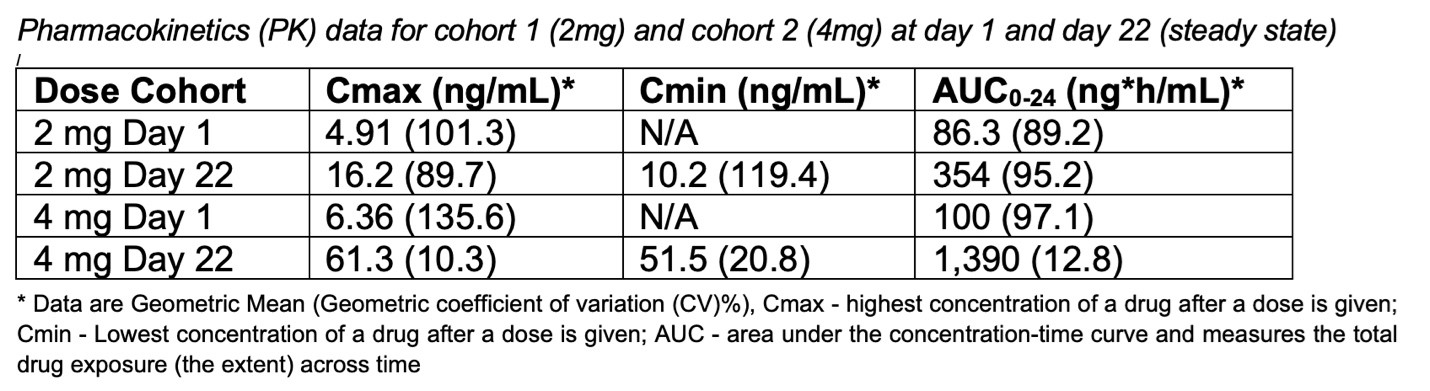
Pharmacokinetics (PK)
- Plasma exposure increased with an increase in dose and linear PK is observed
- Long half-life of approximately 70 hours will allow for once daily dosing or longer intervals
- Prolonged systemic exposure with minimal fluctuation in PAS-004 plasma concentration at steady state (Cmax/Cmin ratio of 1.2) indicates a potential to achieve constant target inhibition
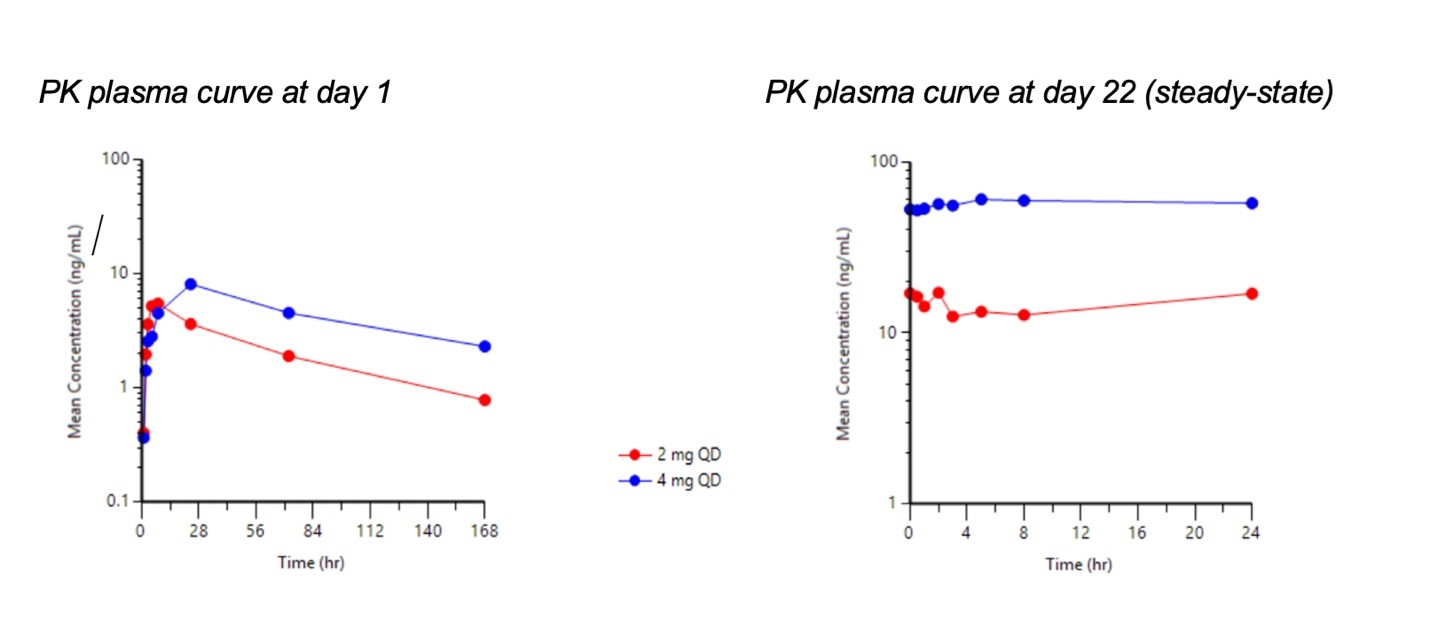
At steady-state, drug levels peaked at about 5 hours with a geometric mean maximum concentration (Cmax) of 16.2 and 61.3 ng/mL for the 2 mg and 4 mg dose groups, respectively. The mean elimination half-life was 67.9 hours supporting once-daily or less frequent oral dosing.
“PAS-004 has demonstrated distinct properties that we believe are significant advantages for an oral MEK inhibitor. PAS-004 has a significantly longer half-life compared to early-generation MEK inhibitors, particularly those used for the treatment of NF1, which have half-lives of less than 8 hours. The ability to achieve prolonged plasma exposures, as reflected in stable plasma concentrations at steady state, may potentially allow PAS-004 to achieve efficacious doses with a favorable safety profile,” stated Dr. Tiago Reis Marques, Chief Executive Officer of Pasithea.
Safety & Tolerability
- No treatment-related adverse events (TRAEs) or dose limiting toxicities (DLTs) observed to date
In the first 2 dosing cohorts (n=6), PAS-004 was shown to be well-tolerated with a favorable safety profile with no drug-related dose interruptions, reductions or discontinuations. There were no drug-related serious AEs (SAE) in any dose arm and no protocol-defined stopping criteria were met. Importantly, at the 2 and 4 mg dose levels no rash or skin toxicity, gastro-intestinal (GI) toxicity, or ocular toxicity have been observed to date.
The study independent Safety Review Committee has completed its safety review of data from the second dose cohort of 4 mg and the Company has initiated cohort 3 dosing at an increased dose of 8 mg in capsules and has filed a protocol amendment to increase dosing schedule.
PAS-004 Demonstrates a Differentiated MEK Inhibitor Profile
Unlike first-generation MEK inhibitors for the treatment of NF1 that require twice-daily dosing (BID) and exhibit short half-lives (