
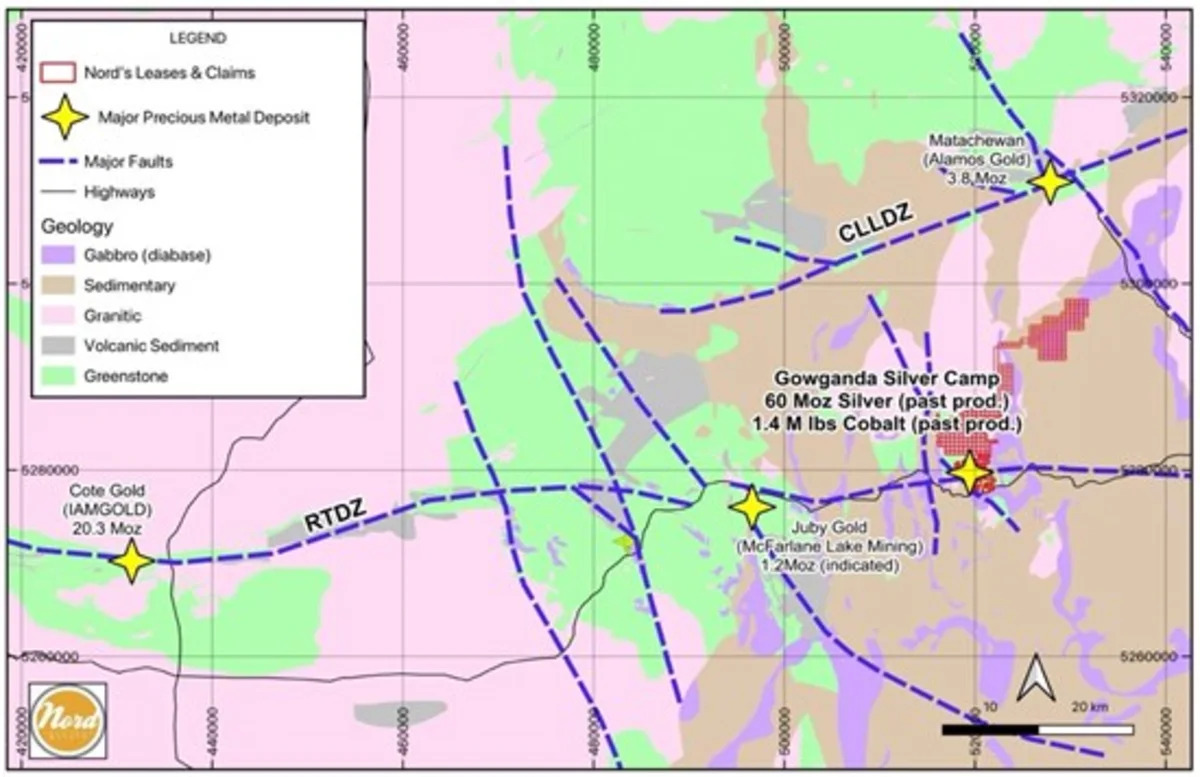
Compilation of surface and drill-hole gold results across the consolidated Castle-Gowganda district — on trend with the producing Côté Gold mine along the Ridout-Tyrrell corridor — defines targets to be advanced in parallel with the Company's silver-focused drilling and tailings recovery program
Cobalt, Ontario--(Newsfile Corp. - July 13, 2026) - Nord Precious Metals Mining Inc. (TSXV: NTH) (OTCQB: NPMMF) (FSE: QN3) ("Nord" or the "Company") provides the following overview of the gold potential of its consolidated Castle-Gowganda district. The Abitibi greenstone belt is one of the largest gold districts in the world, hosting significant deposits of gold, silver, copper, nickel and cobalt. Over 300 million ounces of gold have been identified along the Destor-Porcupine and Cadillac-Larder Lake (CLLDZ) deformation zones. Another deformation zone, the Ridout-Tyrrell (RTDZ), has been attracting increasing attention with several precious metal deposits and occurrences along its length including IAMGOLD's Côté Gold, McFarlane Lake Mining's Juby Gold and the Gowganda Silver Camp.
The Company is consolidating the gold results generated across its Castle-Gowganda district into a ranked set of exploration targets. Gold was first identified on surface through boulder-train mapping, with original assays returning grades of 1.32 g/t and 1.25 g/t gold with copper values up to 1.03% (previously disclosed December 8, 2014).
Based on the surface findings, diamond drilling in 2018 outlined an important near-surface hydrothermal system with gold-bearing quartz veins with a halo of disseminated nickel and copper mineralization in the Archean volcanics above the Nipissing diabase which is the host lithology of the majority of the 60 million ounce silver production in the Gowganda Silver Camp.
Earlier stripping and channel sampling returned values of up to 3.77 g/t gold over 1.27 metres (previously disclosed April 2, 2015). Several drill holes have since intersected gold, including 24.95 g/t gold over 0.3 meters in hole CS-20-31 — a shallow interval at 49.7 meters downhole carrying coarse visible gold (previously disclosed in 2020) — with a further 3.82 g/t gold over 2.86 meters at 451.0 meters downhole, including 6.11 g/t gold over 1.66 meters. These intercepts lie near the Robinson Zone, but the gold mineralization is distinct from, and not linked to, the silver-cobalt vein mineralization, consistent with the Company's interpretation of a separate Archean gold system in the district. Individual assays in this setting can be strongly influenced by coarse gold (nugget effect). Unless otherwise stated, reported intervals are downhole core lengths and true widths are unknown.