
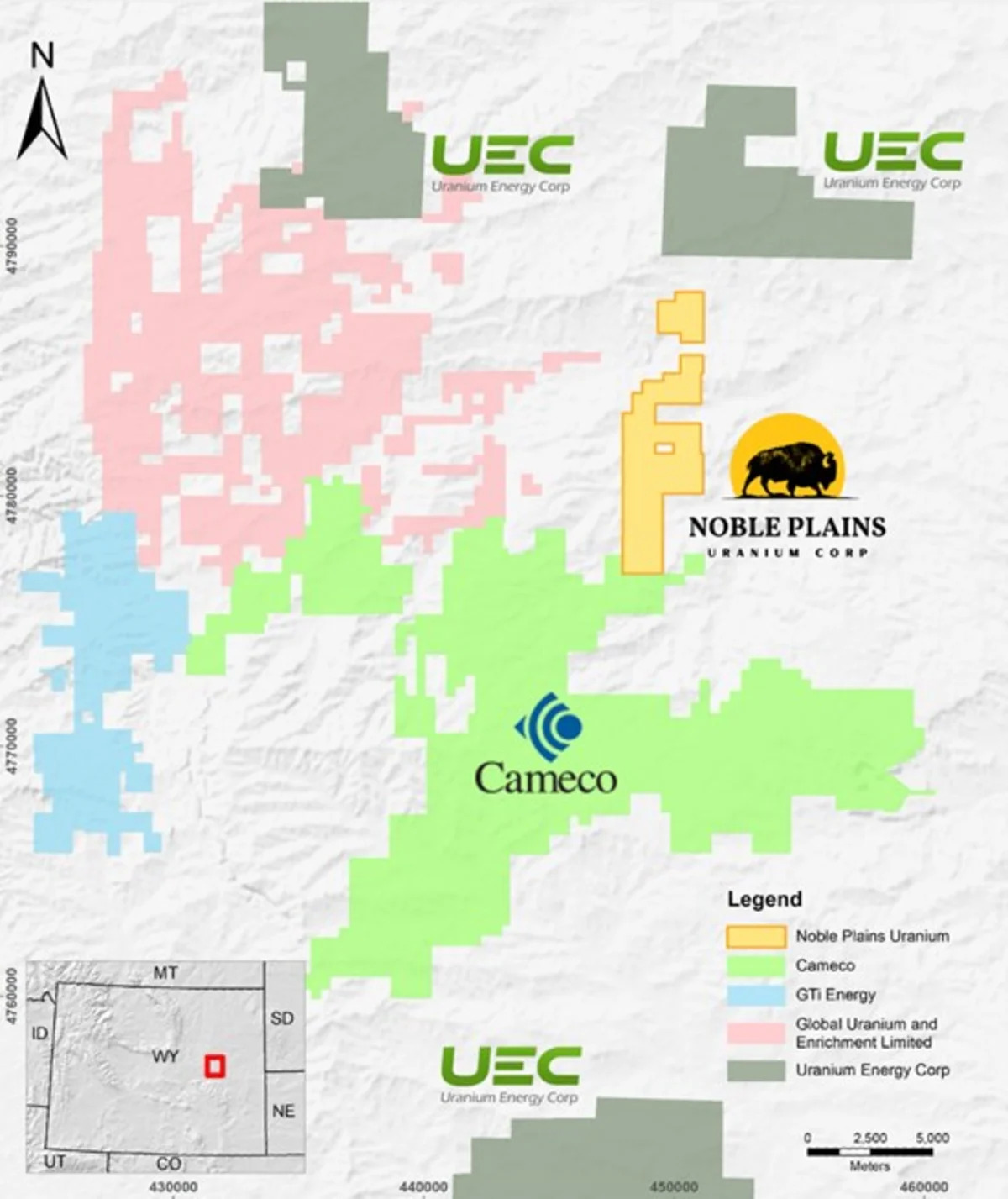
Vancouver, British Columbia--(Newsfile Corp. - July 16, 2026) - Noble Plains Uranium Corp. (TSXV: NOBL) (OTCQB: NBLXF) (FSE: INE0) ("Noble Plains" or the "Company") a U.S.-focused uranium exploration and development company, is pleased to announce it has initiated a geophysical program at its flagship Duck Creek property to detect buried shallow (Wasatch Fm.) and deeper (Fort Union Fm.) uranium mineralization. Duck Creek hosts a NI 43-101 compliant resource of 5.32 million Indicated and 1.04 million Inferred pounds of U₃O₈ in the Wasatch Formation.
"Our maiden resource at Duck Creek was built from roughly 2.5 miles of a mineralized trend that runs approximately 5.25 miles across our land package," said Drew Zimmerman, CEO of Noble Plains Uranium. "That leaves close to 2.75 miles of that same trend, plus the deeper Fort Union Formation beneath it, still largely untested. These geophysical surveys will help us identify mineralized roll-front noses for sharper drill targeting across the project, part of a systematic strategy to continue building out the pounds at Duck Creek."
With the maiden resource in hand, the Company is turning to advanced geophysical tools to systematically expand the resource, targeting both the untested extensions of the Wasatch trend along strike and the deeper, largely unexplored deeper Fort Union Formation. The program, conducted in partnership with the University of Wyoming Near-Surface Geophysics Instrument Center (UWNSG), involves shooting both a 2D Vibroseis as well as Standard Truck mounted Impact reflection seismic (REFL) profile line and a 2D High Power (10KW) DC Resistivity and Full Waveform decay Induced Polarization (FWD_IP) across different portions of the property to help distinguish areas of potentially mineralized sands. If successful, the instantaneous attributes of the REFL data modelling will identify specific targets and structures in the Fort Union and reduce the number of exploratory holes needed to identify mineralization. Similarly, the FWD_IP study is being conducted across the redox front in the Wasatch Formation to help identify additional mineralization that could be drill-tested to expand the resource. Both surveys extend beyond the Company's completed drilling areas to cover portions of the broader mineralized trend along strike, helping prioritize where future drill programs should be focused.
Dr. Carr, Director of UWNSG, stated, "In traditional uranium exploration and characterization, radiometric surveys followed by drilling and borehole gamma logging are the standard approaches. Those methods are reliable, but they only tell you what is happening directly at the drill hole. Seismic reflection lets us image the geometry of the sand packages between holes, which is one of the more effective ways to help distinguish sands likely to host mineralization within the Fort Union. Pairing that with induced polarization across the redox front helps trace the boundary between oxidized and reduced conditions, the geochemical setting where roll-front uranium deposits tend to form, over a much larger area than drilling alone could economically cover. Together, these datasets give the Company a more complete subsurface picture to guide both near-term drill targeting and, longer term, extraction planning."