
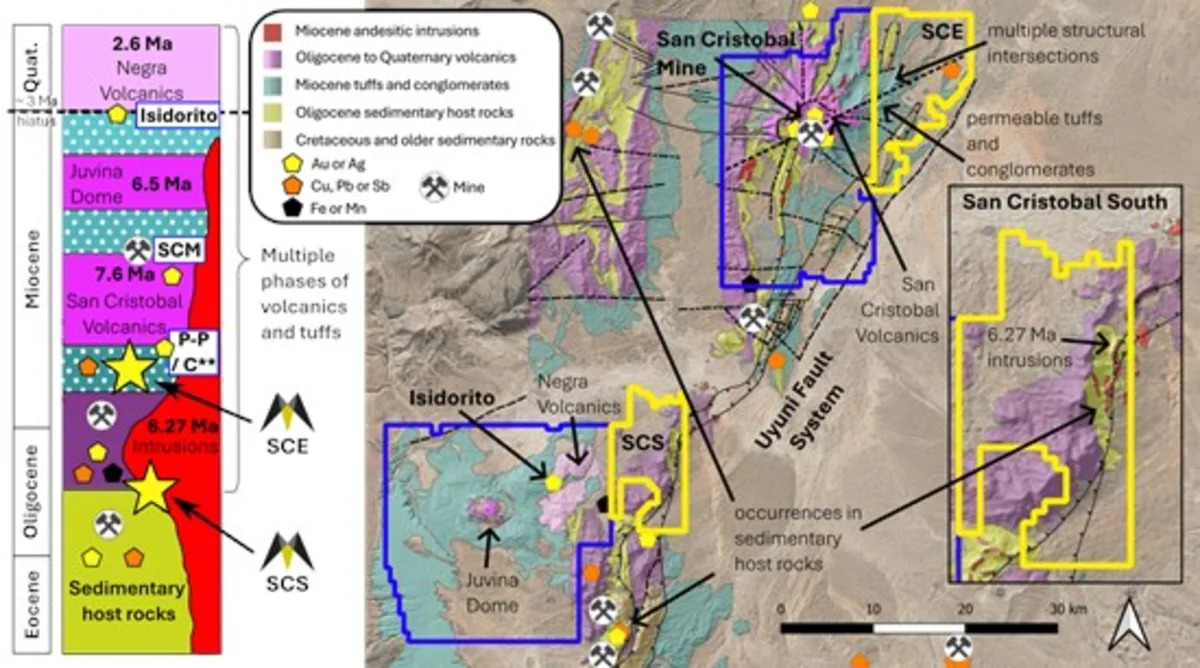
Edmonton, Alberta--(Newsfile Corp. - July 7, 2026) - Metalero Mining Corp. (TSXV: MLO) ("Metalero" or the "Company") is pleased to provide further geological context for its recently announced project acquisitions in Bolivia near the San Cristobal Silver-Lead-Zinc Mine. As announced on May 20, 2026, Metalero has applied for 230 square kilometers (km2 or 23,000 hectares) of exploration concessions known as the San Cristobal East (SCE) and San Cristobal South (SCS) projects in western Bolivia (Figure 1).
"Our newly staked claims, next to two of the most prominent, and promising, silver assets in the world, are well aligned with Metalero's vision as an early mover in Bolivia," stated Rob L'Heureux, President & CEO of Metalero Mining. "The similarities between our SCE and SCS projects and the San Cristobal Mine is staggering as we look at the regional geology including multiple phases of mineralized magmatic activity, numerous faults and structures, and known mineral occurrences of precious- and base-metals. We are excited to be at the ground floor of this fantastic, unexplored opportunity."
The SCE and SCS projects share important common geological aspects with the San Cristobal Mine (SCM) and the Isidorito Prospect including (Figure 1)*:
proximity to the Uyuni Fault System (UFS);
a structural geology framework with intersections acting as magmatic and hydrothermal fluid pathways;
permeable host rocks allowing for the infiltration of mineralizing fluids;
similar geology in the surrounding area hosts small- and large-scale mines and occurrences; and
mapped intrusive and volcanic rocks with ages bracketed by the SCM and Isidorito host rocks.
* The information concerning adjacent properties and mineralization is provided solely for informational purposes and should not be construed as a guarantee of mineral presence, quality, or economic viability. While efforts have been made to provide accurate and up-to-date information, mineralization can vary significantly between properties and may not be indicative of similar conditions on Metalero's properties. Neither Metalero nor the QP have visited these adjacent properties and have not verified the information presented.
Figure 1. Geological map and schematic stratigraphic column of the San Cristobal region including SCE, SCS, the San Cristobal Mine and the Isidorito prospect. Metalero's SCE and SCS projects (yellow outlines) total ~230 km2. The map shows the SCE and SCS underlain by geological units known to host mineralization elsewhere in the region, multiple ages of significant structures and faults known to control the distribution of mineralization and intrusive activity, and mineralized intrusive/volcanic rocks with overlapping ages to the significant projects in the region. This area is also geologically connected to the Pulacayo-Paca and Cosuño projects which lie approximately 100 km northeast along the Uyuni Fault System. The city of Uyuni, 75 km to the north, provides road access, infrastructure and logistical support including an international airport. **The stratigraphic position of the Pulacayo-Paca and Cosuño projects are inferred from limited geological information and timing relationships.