


Key market opportunities in Latin America's quick commerce include integration into super-apps and fintech ecosystems, driving growth through ecommerce and mobile usage. Partnerships and consolidation streamline operations, while expansion beyond meals into groceries and health products widens market scope.
Latin American Quick Commerce Market
Dublin, April 30, 2026 (GLOBE NEWSWIRE) -- The "Latin America Quick Commerce Market Size & Forecast by Value and Volume Across 100+ KPIs by Product Type, Payment Mode, Age Group, Location, Business Model, and Delivery Time - Databook Q1 2026 Update" report has been added to ResearchAndMarkets.com's offering.
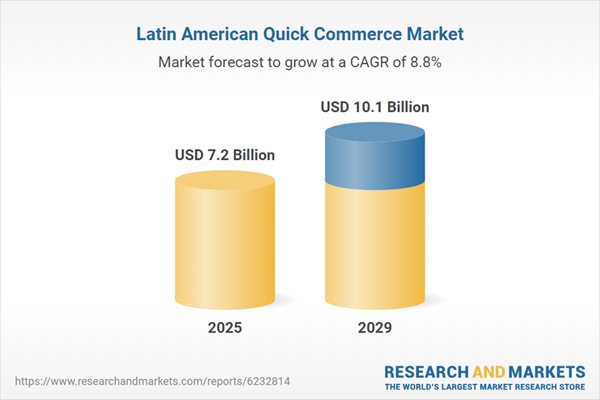
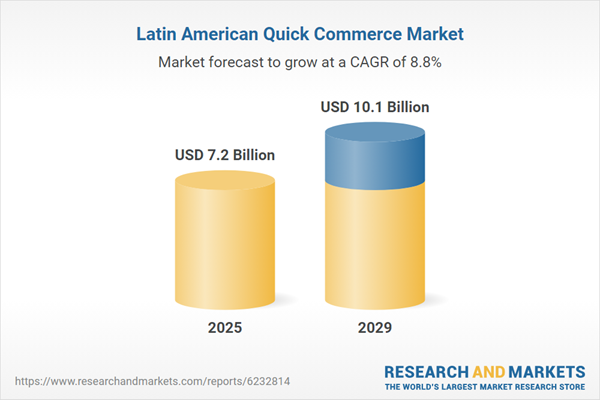
The quick commerce market in Latin America region is expected to grow by 9.1% annually, reaching US$07.2 billion by 2025. The quick commerce market in the region has experienced robust growth during 2020-2024, achieving a CAGR of 8.4%. This upward trajectory is expected to continue, with the market forecast to grow at a CAGR of 8.8% from 2025 to 2029. By the end of 2029, the quick commerce market is projected to expand from its 2024 value of US$06.6 billion to approximately US$10.1 billion.
Over the next 2-4 years, quick commerce in Brazil, Mexico, Colombia, and Chile is likely to be defined less by "meal delivery" and more by mission types, such as urgent medicine, top-up groceries, missing ingredients, small electronics, or pet products. Players that can manage cold chain, substitutions and on-shelf accuracy will strengthen their position with supermarkets and pharmacies. Fast next-day delivery from Mercado Libre and others will sit alongside sub-30-minute services from Rappi, iFood and Uber, giving consumers multiple speed-price trade-offs for similar baskets.
Current State of the Market
The quick commerce segment in Latin America is evolving rapidly but remains concentrated among a few major players in major markets such as Brazil, Mexico and Colombia. Platforms that began in food delivery are extending into grocery, pharmacy and convenience goods.
Logistics and last-mile costs remain high, and consumer expectations for sub-hour or same-day fulfilment are intensifying. Urban population density, mobile penetration and growth in digital payments enable this shift, but operational complexity and cost pressure persist.
Key Players and New Entrants
Among the incumbent players, Rappi (Colombia-founded) operates across nine Latin American countries with its Turbo offering for very fast delivery. iFood (Brazil) maintains a leading share in food delivery in Brazil and is leveraging its infrastructure into adjacent quick commerce missions.
Mercado Libre (with Mercado Pago and Mercado Envios) is expanding logistics and payments infrastructure in Brazil and Mexico, strengthening its readiness for quick-commerce scale. On the entrant side, global players such as Amazon are committing regional investments, while Chinese platform models (for example, via "low-cost" catalogue sellers) are increasing competitive intensity.
Recent Launches, Mergers, and Acquisitions
In May 2025, Uber and iFood announced a strategic partnership in Brazil: iFood users will access Uber ride-hailing services directly within the iFood app, and Uber users will gain access to iFood's food, grocery, and pharmacy delivery services within the Uber app.
In September 2025, Amazon invested $ 25 million in Rappi via a convertible note, positioning itself for quick-commerce scale and broader logistics synergies. These moves reflect consolidation, alliance building and platform-ecosystem integration rather than hundreds of independent dark-store start-ups.
Key Trends & Drivers
Embed quick commerce inside super-apps and fintech ecosystems
Reconfigure quick commerce around partnerships and consolidation
Broaden quick-commerce missions beyond meals into grocery, pharmacy and everyday retail
Adjust quick commerce to tighter regulation, tax and labour rules while using AI and credit to improve economics
A Bundled Offering, Combining the Following 6 Reports, Covering 600+ Tables and 700+ Figures
Latin America Overall and Quick Commerce Market Business and Investment Opportunities Databook
Argentina Overall and Quick Commerce Market Business and Investment Opportunities Databook
Brazil Overall and Quick Commerce Market Business and Investment Opportunities Databook
Chile Overall and Quick Commerce Market Business and Investment Opportunities Databook
Colombia Overall and Quick Commerce Market Business and Investment Opportunities Databook
Mexico Overall and Quick Commerce Market Business and Investment Opportunities Databook
Key Attributes:
Report Attribute | Details |
No. of Pages | 840 |
Forecast Period | 2025 - 2029 |
Estimated Market Value (USD) in 2025 | $7.2 Billion |
Forecasted Market Value (USD) by 2029 | $10.1 Billion |
Compound Annual Growth Rate | 8.8% |
Regions Covered | Latin America |
Report Scope for Each Report
Quick Commerce Market Size and Growth Dynamics
Gross Merchandise Value
Gross Merchandise Volume
Average Order Value
Order Frequency per Year
Quick Commerce Market Segmentation by Product Type
Groceries and Staples
Fruits and Vegetables
Snacks and Beverages
Personal Care and Hygiene
Pharmaceuticals and Health Products
Home Decor
Clothing and Accessories
Electronics
Others
Quick Commerce Market Segmentation by Payment Mode
Instant Bank Transfer
Wallets and Digital Payments
Credit and Debit Cards
Cash on Delivery
Quick Commerce Market Segmentation by Age Group
Gen Z (15-25)
Millennials (26-39)
Gen X (40-55)
Baby Boomers (Above 55)
Quick Commerce Market Segmentation by Location Tier
Tier 1 Cities
Tier 2 Cities
Tier 3 Cities
Quick Commerce Market Segmentation by Business Model
Inventory-led Model
Hyper-local Model
Multi-vendor Platform Model
Others
Quick Commerce Market Segmentation by Delivery Time
Delivery in 30 Minutes
Delivery 30-60 Minutes
Delivery in 3 Hours
Quick Commerce Consumer Behavior and Demographics
Average Subscription Uptake by Age Group
Average Subscription Uptake by Location Tier
Average Subscription Uptake
Average Delivery Time
Quick Commerce Revenue Structure and Composition
Advertising Revenue
Delivery Fee Revenue
Subscription Revenue
Quick Commerce Operational Metrics by Product Type
Gross Merchandise Value by Product Type
Gross Merchandise Volume by Product Type
Average Order Value by Product Type
Order Frequency by Product Type
Quick Commerce Operational Metrics by Payment Mode
Gross Merchandise Value by Payment Mode
Gross Merchandise Volume by Payment Mode
Average Order Value by Payment Mode
Quick Commerce Operational Metrics by Age Group
Gross Merchandise Value by Age Group
Gross Merchandise Volume by Age Group
Average Order Value by Age Group
Quick Commerce Operational Metrics by Location Tier
Gross Merchandise Value by Location Tier
Gross Merchandise Volume by Location Tier
Average Order Value by Location Tier
Order Frequency by Location Tier
Quick Commerce Operational Metrics by Business Model
Gross Merchandise Value by Business Model
Gross Merchandise Volume by Business Model
Average Order Value by Business Model
Quick Commerce Operational Metrics by Delivery Time
Gross Merchandise Value by Delivery Time
Gross Merchandise Volume by Delivery Time
Average Order Value by Delivery Time
Order Frequency by Delivery Time
For more information about this report visit https://www.researchandmarkets.com/r/uqdlh1
About ResearchAndMarkets.com
ResearchAndMarkets.com is the world's leading source for international market research reports and market data. We provide you with the latest data on international and regional markets, key industries, the top companies, new products and the latest trends.
Attachment
CONTACT: CONTACT: ResearchAndMarkets.com Laura Wood,Senior Press Manager press@researchandmarkets.com For E.S.T Office Hours Call 1-917-300-0470 For U.S./ CAN Toll Free Call 1-800-526-8630 For GMT Office Hours Call +353-1-416-8900