
Step-up dose titration lowered GI side effects while maintaining clinical activityMajority of patients completing 13 weeks of treatment demonstrated significant improvement on at least 2 measures of disease activityConference Call and Webcast today at 8:30am EST
|
|||||
SOUTH SAN FRANCISCO, Calif., Nov. 12, 2019 (GLOBE NEWSWIRE) -- Kezar Life Sciences, Inc. (Nasdaq: KZR), a clinical-stage biotechnology company discovering and developing novel small molecule therapeutics to treat unmet needs in autoimmune disease and cancer, today announced positive updated results from the Phase 1b (Ph1b) portion of the MISSON study evaluating the safety and tolerability of KZR-616 in patients with systemic lupus erythematosus (SLE). The results are being presented during the American College of Rheumatology (ACR/ARP) Annual Meeting in Atlanta, GA.
“We are thrilled to share these additional promising data with KZR-616, our novel immunoproteasome inhibitor, at the American College of Rheumatology annual meeting,” said Christopher Kirk, PhD, Kezar’s President and Chief Scientific Officer. “The ongoing Phase 1b portion of MISSION accomplished our primary goal of identifying active and well-tolerated doses that meet target levels of immunoproteasome inhibition and support the further advancement of KZR-616 in autoimmune diseases of high unmet need. We believe the safety and tolerability profile exhibited in patients with SLE will extend into the five indications currently enrolling in our Phase 2 programs.”
The primary objective of the Ph1b portion of MISSION is to assess safety and tolerability. Secondary objectives include evaluating pharmacokinetics (PK), pharmacodynamics (PD), and selecting dose levels for the Phase 2 trials. Several exploratory efficacy measures are also being assessed: Systemic Lupus Erythematosus Disease Activity Index 2000 (SLEDAI-2K), Cutaneous Lupus Erythematosus Severity Index-Activity (CLASI-A), Tender and Swollen Joint Counts (TJC/SJC), and Physician Global Assessment (PhGA)/Patient Global Assessment (PtGA)/Patient Assessment of Pain (PtP).
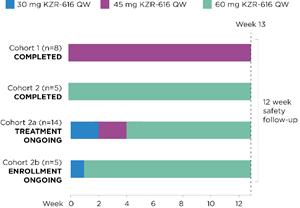
As of the September 20, 2019 data cutoff, the Ph1b portion of MISSION enrolled 32 SLE patients across four separate cohorts (detailed below). All patients received stable background treatment.
An infographic accompanying this announcement is available at https://www.globenewswire.com/NewsRoom/AttachmentNg/3ee3c805-5cae-4a27-888d-b98be6676880
Updated data suggest KZR-616 continues to show a differentiated safety profile from non-specific proteasome inhibitors and, importantly, that a dose of 60 mg is well-tolerated when administered via step-up dosing. Additionally, KZR-616 appears to exhibit broad immunomodulatory activity and has the potential for limited immunosuppressive side effects.
The updated results are detailed below:
- Step-up dosing exhibits improved tolerability
- Nausea and vomiting were reported in