
MELBOURNE, Australia, May 02, 2023 (GLOBE NEWSWIRE) -- Incannex Healthcare Limited (Nasdaq: IXHL) (ASX: IHL), (‘Incannex’ or the ‘Company’) a clinical-stage pharmaceutical company developing unique medicinal cannabinoid pharmaceutical products and psychedelic medicine therapies for unmet medical needs, is pleased to announce that it has received final results from the Phase 1 clinical trial undertaken to assess pharmacokinetics and safety of the anti-inflammatory drug IHL-675A.
IHL-675A is a combination cannabinoid drug comprising cannabidiol (‘CBD’) and hydroxychloroquine (‘HCQ’) in a fixed dose combination. IHL-675A was observed to outperform either CBD and HCQ in various pre-clinical models of inflammation, including in vivo models of rheumatoid arthritis, inflammatory bowel disease and lung inflammation. Synergistic anti-inflammatory activity of CBD and HCQ was observed in these distinct pre-clinical studies and was evidence to support the Company’s international patent application over the drug.
The Phase 1 trial measured the safety, tolerability, and pharmacokinetic profiles of IHL-675A compared to the reference listed drugs, Epidiolex (CBD) and Plaquenil (HCQ). Three cohorts of 12 participants (n = 36) received either IHL-675A, CBD or HCQ and the clinical assessments were identical across the three arms of the trial. Participants were monitored for adverse events and had blood samples collected for pharmacokinetic analysis over a four-week period. The trial was conducted by CMAX Clinical Research in Adelaide, South Australia and managed by Avance Clinical.
Safety and Tolerability Results
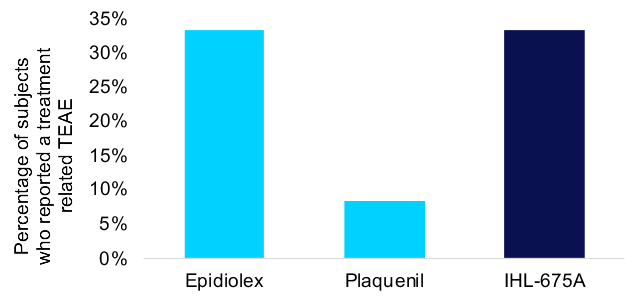
IHL-675A was well tolerated, with no adverse events of concern and no serious adverse events reported. The same number of treatment related treatment emergent adverse events (TEAEs) were reported for IHL-675A as for Epidiolex. Treatment-related TEAEs included abdominal pain, dizziness, fatigue, frequent bowel movements, headache and somnolence. All TEAEs were minor with the exception of one incidence of moderate severity abdominal cramps which resolved soon after on set.
CBD Pharmacokinetic Results
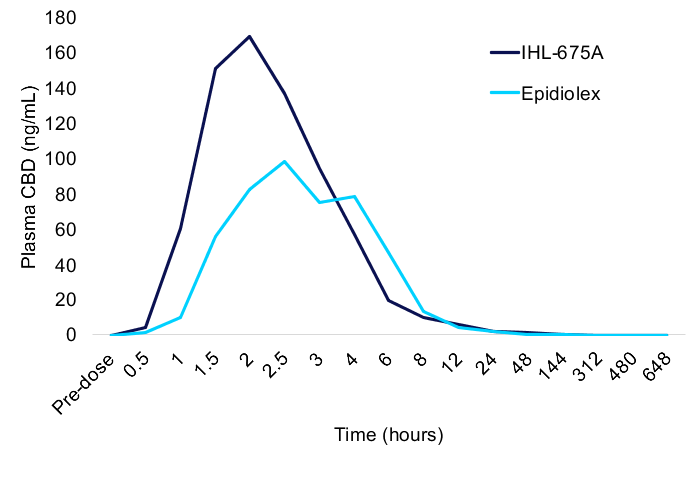
Comparison of the average pharmacokinetics of CBD in participants administered IHL-675A compared to those administered Epidiolex revealed that the CBD was taken up from IHL-675A more quickly and reached a higher maximum concentration than from Epidiolex. The average maximum concentration (Cmax) of CBD from IHL-675A was 1.57 times higher than for Epidiolex. The time to reach the maximum concentration (Tmax) was 26% faster for IHL-675A than Epidiolex. CBD administered in IHL-675A was also cleared more quickly than Epidiolex. The half-life (t1/2) of CBD from IHL-675A was 13% faster than Epidiolex. The total exposure (AUCinf) was similar for CBD administered as IHL-675A and Epidiolex. These patterns are trends at this point (p >0.05). Similar results were observed for CBD metabolites 7-COOH-CBD and 7-OH-CBD. Data is presented in the appendix.
Hydroxychloroquine Pharmacokinetic Results
Comparison of the average pharmacokinetics of hydroxychloroquine in participants administered IHL-675A compared to those administered Plaquenil revealed that hydroxychloroquine was taken up more slowly from IHL-675A than from Plaquenil but the two drugs had a similar maximum plasma concentration. The time to reach the maximum concentration (Tmax) for HCQ administered as IHL-675A was 46% slower than for Plaquenil.
The hydroxychloroquine clearance and total exposure was similar for the two drugs. These patterns are trends at this point (p >0.05). Plasma concentrations of hydroxychloroquine metabolites desethylhydroxychloroquine, bisdesethylhydroxychloroquine and desethylchloroquine were detected only at low levels (