

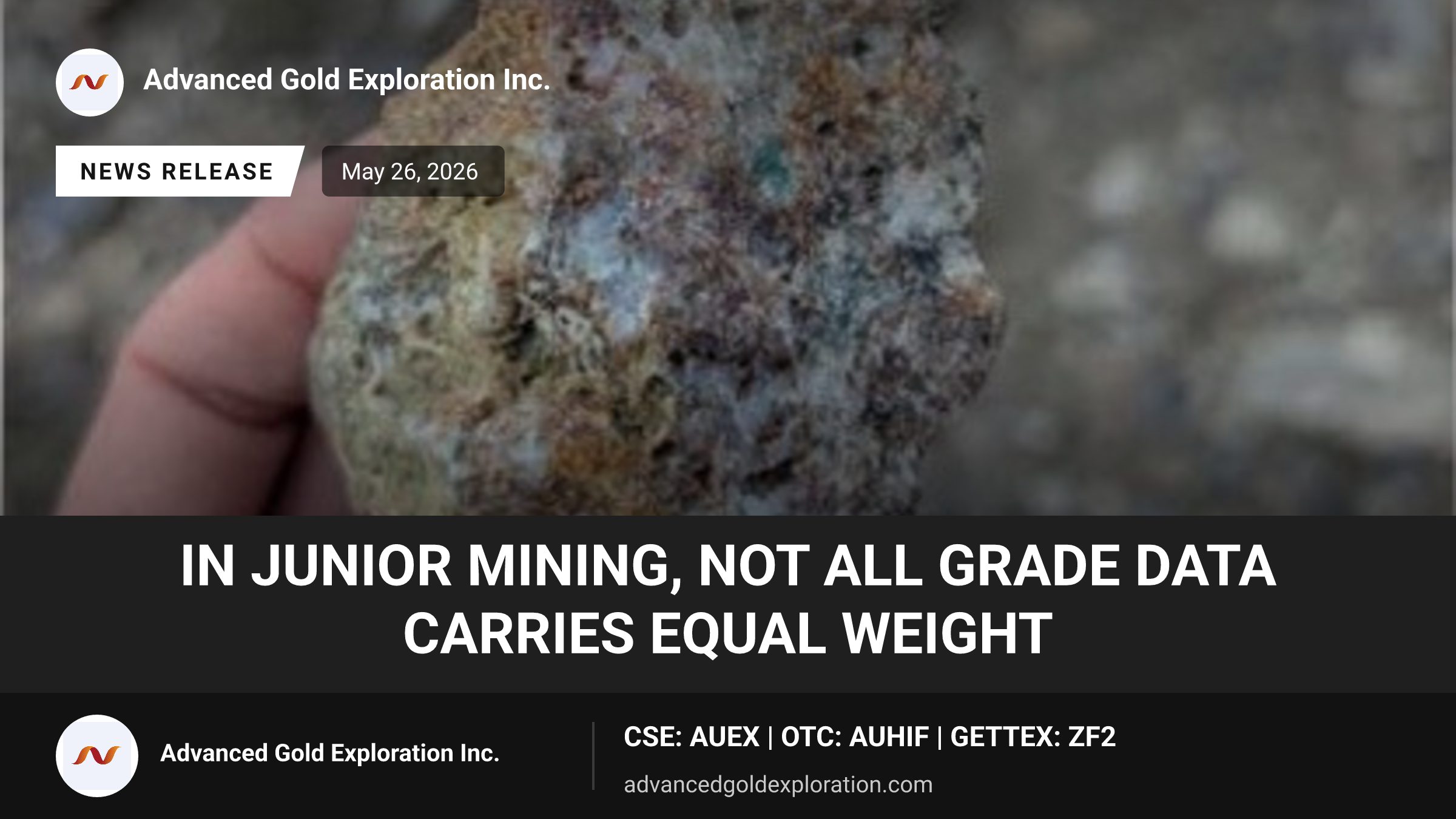
In mineral exploration, the difference between a successful junior and a perpetual cycle of financings often comes down to the quality of the evidence supporting the geological thesis. Not all grade data carries equal weight. Surface samples can be misleading, particularly in mineralized systems where supergene enrichment or selective sampling may create inflated impressions of what exists at depth. Drill intercepts provide stronger evidence, but they remain statistical snapshots of much larger systems.
Sometimes, the most compelling evidence is not produced by modern exploration at all. It comes from historical records of ore that was actually mined, milled, and shipped to a smelter, where metal content was independently verified through commercial settlement.
Advanced Gold Exploration Inc. (CSE: AUEX) (OTCQB: AUHIF) is assembling a portfolio around projects carrying that rarer category of evidence. Across three assets in Nevada and Ontario, the company holds historical production records, smelter receipts, visible gold occurrences, and modern drill confirmation that collectively suggest a different level of geological confidence than a typical greenfield exploration story.
Silver Belle: Historical Production, Not Theoretical Grades
The clearest example is the Silver Belle Project in Nevada’s Eureka County. Situated within the prolific Eureka-Battle Mountain mineral belt, the approximately 2,000-acre property hosts documented historical production grades verified by smelter records rather than exploration sampling.
A 1937 shipment of 21 short tons of underground ore from the Silver Bell Mining Co. to the ASARCO smelter in Salt Lake City reportedly returned approximately 1,611 grams per tonne silver, 37% lead, 10% zinc, 1% copper, and 3,000 grams per tonne antimony.
Those were not selectively collected surface samples. They were grades from ore that had already been mined, shipped, processed, and commercially settled.
Skeena Resources Limited (NYSE: SKE) (TSX: SKE) has built much of its market narrative around precisely this kind of evidence at the Eskay Creek project in British Columbia. The historic Eskay Creek mine operated from 1994 through 2008, producing approximately 3.3 million ounces of gold and 160 million ounces of silver at extraordinary average head grades of 49 grams per tonne gold and 2,224 grams per tonne silver.
Those are production records, not theoretical exploration estimates, and they have served as a cornerstone of Skeena’s redevelopment thesis through financing, permitting, and construction planning. Silver Belle places Advanced Gold within that same category of historical production-backed geological validation, albeit at a far earlier stage.
Doyle: Visible Gold Tells Its Own Story
The thesis extends into Ontario at the Doyle project in the Batchawana Greenstone Belt, located roughly 20 kilometers from the Hemlo gold camp.
Historical drilling intersected 46 grams per tonne gold over one meter in a quartz vein containing visible gold. In mineral exploration, visible gold remains one of the most direct forms of geological evidence. The metal is physically present in particles large enough to be seen rather than inferred solely through assay data.
Additional historical drilling returned 14.6 grams per tonne gold over one meter within a broader 9-meter interval averaging 2.5 grams per tonne gold, also containing visible gold.
Despite these results and the project’s geological similarities to the Hemlo camp, which has produced more than 21 million ounces of gold, Doyle has not seen drilling since 1995.
K92 Mining Inc. (TSX: KNT) (OTCQX: KNTNF) has built substantial institutional credibility around visible gold intercepts at its Kainantu operation in Papua New Guinea. The company has repeatedly published high-grade drill results featuring visible native gold, with images of mineralized core often reinforcing the narrative visually.
That consistency helped drive K92’s evolution from junior explorer to established producer. The principle is similar at Doyle: visible gold reduces interpretive ambiguity in a way low-grade disseminated systems often cannot.
Buck Lake Adds Modern Drill Confirmation
Advanced Gold’s third project, Buck Lake, presents a slightly different but equally tangible evidence set.
Drilling completed between 2022 and 2025 confirmed massive sulphide mineralization in 13 of 15 holes, including intervals grading 1.51% copper over 11.75 meters, with higher-grade sections returning 4.59% copper over 3.1 meters.
In volcanogenic massive sulphide systems, massive sulphide intercepts carry their own form of geological certainty. The mineralization is visually identifiable in core and often indicative of larger systems capable of expansion through step-out drilling.
i-80 Gold Corp. (NYSE American: IAUX) (TSX: IAU) has built much of its Nevada strategy around acquiring past-producing assets with documented operating histories and applying modern exploration and development to unlock additional value.
Its portfolio includes Granite Creek and Ruby Hill, with Ruby Hill located roughly 55 kilometers from Silver Belle in the same Eureka district. The logic is straightforward: historical production often provides some of the strongest signals when evaluating systems with both geological merit and realistic development potential.
Multiple Catalysts Ahead
Advanced Gold enters the balance of 2026 with multiple potential catalysts.
The company recently dispatched its first 87 rock chip and grab samples from Silver Belle to an independent accredited laboratory, with assay results pending. It has retained ProDeMin USA LLC, led by Dr. Craig Gibson as Qualified Person under NI 43-101, to prepare a formal technical report.
At Buck Lake, drilling is positioned to resume from a rig that remained onsite through the winter, while geophysical interpretation continues at Doyle ahead of future targeting.
The company also maintains a relatively tight corporate structure, with approximately 23.5 million shares outstanding and insider ownership near 20%.
The Bigger Picture
In a junior mining market often driven by narrative as much as geology, the strongest signal may still be the simplest one: some of the best clues about what a mineralized system can produce are found in records of what it already has.
Advanced Gold Exploration appears to be building its thesis around exactly that premise.
---
About AllPennyStocks.com Media, Inc.:
Founded in 1999, AllPennyStocks.com Media, Inc. is North America's largest and longest running website dedicated exclusively to micro-cap and small-cap insights.
Catering to both Canadian and U.S. markets, AllPennyStocks.com provides a wealth of resources and expert content designed for everyone, from beginner investors to seasoned traders.
AllPennyStocks.com's content is prominently featured across numerous top-tier financial platforms, reaching a broad audience of investors and industry professionals.
Disclaimer:
All opinions and information provided above are intended for educational and research purposes only. The information provided above should be used as a starting point for conducting any research on the public companies discussed. All readers should do their own due diligence and research when determining which investment strategies are best suited for them or seek the advice of an investment professional prior to making an investment decision. The profiles of the above discussed public companies are not in any way a solicitation or a recommendation to buy, sell or hold their securities. Advanced Gold Exploration Inc. has initiated AllPennyStocks.com for digital media advertising valued at twenty-eight thousand four hundred dollars.
Any forward-looking statements set forth in the article above are based on expectations, estimates and projections at the time such statements are made that involve a number of risks and uncertainties which could cause actual results or events to differ materially from those presently anticipated. Forward looking statements may be identified through the use of words such as “projects,” “foresees” “expects,” “will,” “anticipates,” “estimates,” “believes,” “understands” or by statements indicating certain actions “may,” “could” or “might” occur. There is no guarantee past performance will be indicative of future results or that any such forward-looking projections will occur.
For a complete disclaimer, investors are encouraged to click here: https://www.allpennystocks.com/disclaimer/.