
- One-time infusion of IMA203CD8 PRAME cell therapy in the ongoing Phase 1 dose escalation/dose expansion trial achieved anti-tumor activity in platinum-resistant ovarian cancer and in uterine cancer with a 63% objective response rate (ORR), 50% confirmed ORR (cORR), including four complete responses, and longest ongoing response at 12 months
- Additional Phase 1 data for IMA203CD8 in heavily pretreated patients with synovial sarcoma showed deep and durable responses with a 67% ORR and 64% cORR, including one complete response, and ongoing responses up to ~3 years
- IMA203CD8 demonstrated a manageable and consistent tolerability profile across patient populations
- Clinical anti-tumor activity observed across tumor types (ovarian carcinoma, uterine cancer, melanoma, synovial sarcoma) with distinct biology and differing levels of PRAME expression, including lower PRAME levels in ovarian carcinoma
- Clinical profile of IMA203CD8 supports continued development in gynecologic cancers and expansion into other PRAME-positive solid tumors
- Determination of recommended phase 2 dose (RP2D) remains expected in 2026
Houston, Texas and Tuebingen, Germany, May 30, 2026 – Immatics N.V. (NASDAQ: IMTX, “Immatics” or the “Company”), the global leader in precision targeting of PRAME with multiple clinical-stage programs spanning cell therapies and bispecifics, today announced updated Phase 1 data for its IMA203CD8 PRAME TCR T-cell therapy in gynecologic cancers and synovial sarcoma at the Annual Meeting of the American Society for Clinical Oncology (ASCO) in Chicago, IL, USA. One-time infusion of IMA203CD8 demonstrated meaningful clinical activity across different tumor types as well as manageable tolerability. The broad expression of PRAME in more than 50 cancers further supports the continued development of IMA203CD8 in multiple PRAME-positive solid tumors.
The updated Phase 1 results in gynecologic cancers will be presented on May 30, 2026, during the Rapid Oral Abstract Session – Gynecologic Cancer from 8:00-9:30 am CDT by Antonia Busse, M.D., Charité Medical University Hospital, Berlin, Germany (Abstract ID 5509). Presentation slides are accessible in the ‘Events & Presentations’ section of the Investors & Media section of the Company’s website. Phase 1 data in synovial sarcoma will be presented on May 31, 2026, during the Rapid Oral Abstract Session – Sarcoma from 4:30-6:00 pm CDT by Dejka M. Araujo M.D., The University of Texas MD Anderson Cancer Center (Abstract ID 11516). Presentation slides will be accessible on May 31, 2026.
“These clinical data in ovarian cancer, uterine cancer and synovial sarcoma, along with previously released data in melanoma, further reinforce our aim to develop IMA203CD8 in PRAME-positive cancers beyond melanoma. PRAME is expressed in more than 50 cancers, and the compelling anti-tumor activity observed in these historically hard-to-treat indications supports its promise as a broadly applicable target,” said Cedrik Britten, M.D., Ph.D., Chief Medical Officer at Immatics. “We are encouraged by the consistency of response signals observed with IMA203CD8 and remain focused on advancing IMA203CD8 in gynecologic cancers with the potential to broaden development to other indications in a tumor-agnostic approach to deliver meaningful outcomes to patients.”
Next development steps:The clinical activity observed in ovarian cancer, a tumor type generally associated with lower levels of PRAME expression, together with the observed activity across tumor types with different and distinct tumor microenvironments, supports the broad applicability of IMA203CD8 across solid tumors with differing levels of PRAME and tumor biology, starting with ovarian and uterine cancer. Updated data from the ongoing study, including durability follow-up at the RP2D, are planned for presentation in the second half of 2026. Immatics is expanding clinical evaluation of IMA203CD8 into additional PRAME-positive solid tumor indications to more fully assess its therapeutic potential.
Highlights of Immatics’ clinical data on IMA203CD8 presented at ASCO 2026
Gynecologic cancers: Patient population: Heavily pretreated patient population with limited treatment options
- As of March 30, 2026, 27 heavily pretreated patients with gynecologic cancers received a one-time infusion of IMA203CD8 in the ongoing Phase 1 dose escalation/dose expansion trial (NCT03686124).
- The median total infused dose across seven escalating dose levels was 3.3x10⁹ TCR T cells (range 0.5x10⁹ - 12.5x10⁹ TCR T cells) for ovarian carcinoma and 3.2x10⁹ TCR T cells (range 1.3x10⁹ - 10.1x10⁹ TCR T cells) for uterine cancer.
- All patients were heavily pretreated, including at least one prior line of platinum-based regimen. Patients with ovarian carcinoma had a median of four lines of systemic treatment (range 1-7), patients with uterine cancer had a median of two lines (range 1-3).
- The efficacy-evaluable1 patient population included 26 patients, 19 of whom were treated at clinically relevant doses (≥DL4c, median 5.4 x10⁹ TCR T cells, range 1.4 – 12.5): 17 with ovarian carcinoma and two with uterine cancer
Safety: Treatment with IMA203CD8 showed predictable and manageable tolerability
- IMA203CD8 demonstrated manageable tolerability in the 27 enrolled patients.
- The most frequent treatment-emergent adverse events (TEAE) were anticipated cytopenias associated with lymphodepletion.
- Expected and manageable cytokine release syndrome (CRS) was mostly low-grade and was consistent with the mechanism of action (Grade 1: 44%, Grade 2: 44%, Grade 3: 7%).
- Immune effector cell-associated neurotoxicity syndrome (ICANS) and hemophagocytic lymphohistiocytosis (HLH) were infrequently observed (any Grade: 7%, each).
- No IMA203CD8-related Grade 5 events occurred.
- Based on the manageable tolerability profile, the Company expects to determine the recommended Phase 2 dose (RP2D) in 2026.
Anti-tumor activity: A one-time infusion of IMA203CD8 PRAME cell therapy showed anti- tumor activity in gynecologic cancers at clinically relevant doses (≥DL4c)
- Objective response rate (ORR): 63% (12/19), confirmed ORR (cORR)2: 50% (9/18)
- Including two confirmed and two unconfirmed complete responses
- 89% (8/9) of confirmed responses were ongoing as of the data cutoff with longest ongoing response at 12 months post infusion (metabolic complete response)
- Responses were observed with and without low-dose IL-2
- Tumor reduction: 78% (14/18)
- Disease Control Rate (DCR) at week 6: 68% (13/19)
- Median duration of response (mDOR), median progression free survival (mPFS) and median overall survival (mOS) were not reached, with median follow-up times (mFU) of 3.9, 5.3 and 5.3 months, respectively
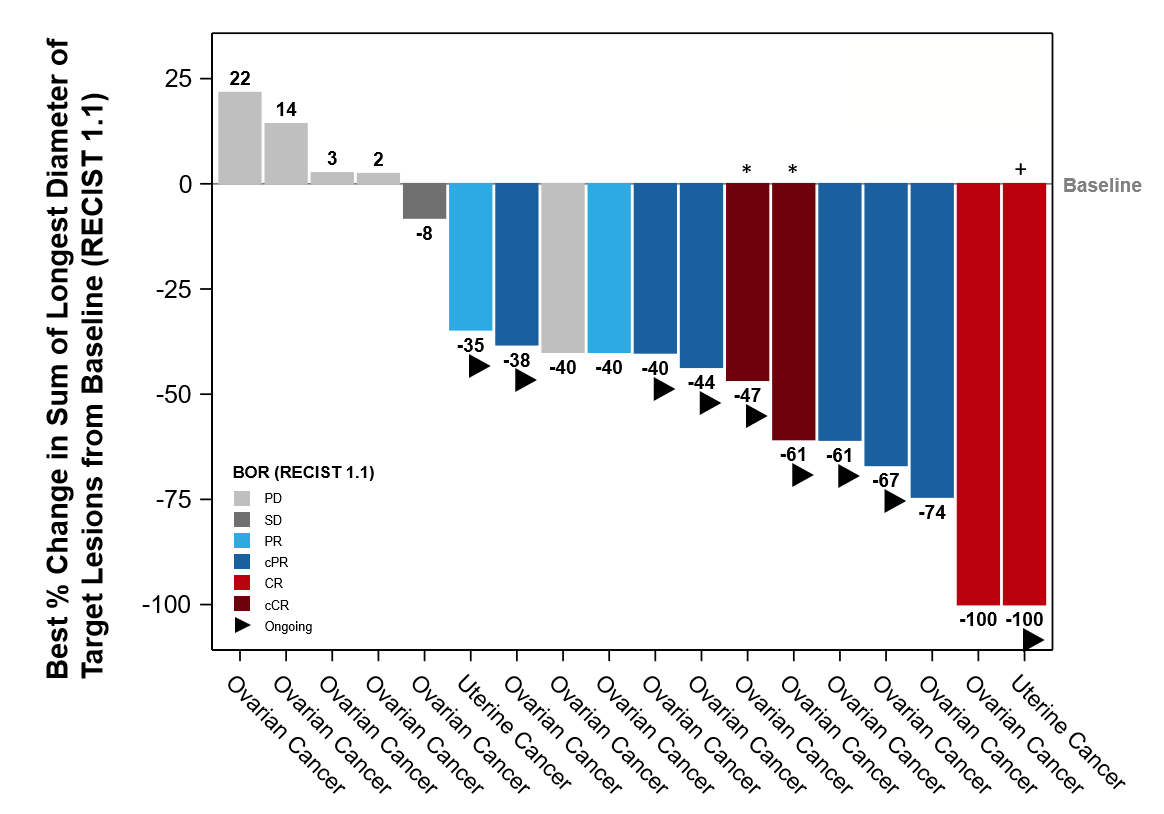
* For those patients who achieved a (c)CR with