Security Labels Market
Regulatory mandates, anti-counterfeiting demand, and smart label adoption accelerate transformation, positioning China as a 6.8% CAGR growth engine through 2036
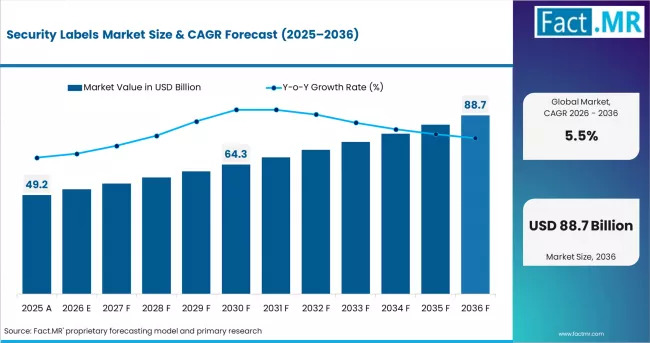
ROCKVILLE, MD, UNITED STATES, April 21, 2026 /EINPresswire.com/ -- According to the latest analysis by Fact.MR, the global security labels market is undergoing a structural transformation driven by compliance mandates and digital authentication technologies. The market is valued at USD 49.2 billion in 2026, projected to reach USD 84.0 billion by 2036, expanding at a CAGR of 5.5% and generating an incremental opportunity of USD 34.8 billion.Get detailed market forecasts, competitive benchmarking, and pricing trends: https://www.factmr.com/connectus/sample?flag=S&rep_id=14777
China is emerging as the most dynamic growth hub, supported by stringent pharmaceutical track-and-trace regulations and expanding luxury goods authentication demand. The shift from commodity barcode labels to high-value RFID and NFC-enabled solutions is redefining competitive dynamics and margin structures.
Quick Stats
Market Size (2026): USD 49.2 billion
Market Size (2025): USD 46.6 billion
Forecast Value (2036): USD 84.0 billion
CAGR (2026–2036): 5.5%
Incremental Opportunity: USD 34.8 billion
Leading Segment: RFID Labels (48% share)
Leading Material: Paper (43% share)
Leading Region: Asia Pacific (China-led growth)
Key Players: Avery Dennison Corporation, CCL Industries Inc., UPM Raflatac, Honeywell International Inc., Brady Corporation
Executive Insight for Decision Makers
The market is shifting from volume-driven commodity labels to value-driven intelligent labeling systems.
Strategic Shift: Integration of RFID, NFC, and serialized QR technologies into packaging ecosystems
Action Required:
Invest in RFID encoding and digital authentication capabilities
Align with GS1 standards and regulatory frameworks
Build end-to-end traceability solutions
Risk of Inaction:
Loss of pharmaceutical and retail contracts
Margin erosion due to commoditization
Competitive displacement by integrated solution providers
Market Dynamics
Key Growth Drivers
Pharmaceutical serialization mandates (China NMPA, DSCSA equivalents)
Rising organized retail crime driving EAS and RFID adoption
Growth in luxury goods requiring anti-counterfeiting solutions
Expansion of e-commerce logistics requiring traceability
Key Restraints
High capital investment for RFID/NFC infrastructure
Price competition from low-cost barcode labels
Integration complexity across supply chains
Emerging Trends
Rapid adoption of NFC-enabled consumer authentication
Integration of labels with digital ecosystems and mobile apps
Growth of polyester-based RFID substrates for durability
Convergence of security labels with IoT-enabled packaging
Segment Analysis
Leading Segment: RFID labels (48% share) driven by compliance and inventory tracking
Leading Material: Paper (43% share) due to cost efficiency and scalability
Leading Application: Boxes and cartons (45% share)
Fastest-Growing Segment
NFC-enabled labels, driven by luxury and consumer engagement use cases
Strategic Importance
RFID enables regulatory compliance and supply chain visibility
NFC supports brand engagement and anti-counterfeiting
Paper substrates ensure cost competitiveness in high-volume applications
Supply Chain Analysis (Critical Insight)
Key Stakeholders
Raw Material Suppliers: Adhesives, paper, polyester films, RFID chips
Manufacturers: Label converters and integrated solution providers
Distributors: Packaging integrators, logistics partners
End-Users: Pharma companies, retailers, electronics manufacturers, luxury brands
“Who Supplies Whom”
Material suppliers → Label manufacturers (substrates, chips)
Label manufacturers → Pharma & retail companies (serialized labels)
Technology providers → Manufacturers (encoding, software integration)
Distributors → End-users (deployment and logistics integration)
China’s ecosystem is increasingly localized, with domestic converters supporting global players while scaling high-volume production for pharmaceuticals and e-commerce.
Pricing Trends
Commodity Labels (Barcode/QR): Low-margin, high-volume
Premium Labels (RFID/NFC): 3–5x higher pricing due to technology integration
Key Pricing Drivers
Raw material costs (paper, polymers, chips)
Regulatory compliance requirements
Technology integration and encoding costs
Volume contracts with large retailers
Margin Insights
Premium labels deliver higher margins despite slower volume growth
Commodity segments face intense price competition
Regional Analysis
Top 5 Countries by CAGR (2026–2036)
China: 6.8%
India: 6.5%
United States: 5.2%
United Kingdom: 4.5%
France: 4.0%
China Spotlight
Strong NMPA track-and-trace mandates
Rapid growth in luxury and electronics sectors
Expansion of e-commerce authentication systems
Developed vs Emerging Markets
Developed Markets: Compliance-driven, stable demand, high-value solutions
Emerging Markets: Volume growth, increasing regulatory adoption, rising counterfeit risks
Competitive Landscape
Market Structure: Moderately consolidated at the top, fragmented at technology level
Key Players
Avery Dennison Corporation
CCL Industries Inc.
3M Company
UPM Raflatac
Honeywell International Inc.
Brady Corporation
Competitive Strategies
Vertical integration (materials + RFID inlays)
Expansion of regional production capacities
Investment in smart label technologies
Long-term contracts with pharma and retail giants
Strategic Takeaways
For Manufacturers
Invest in RFID/NFC capabilities
Expand compliance-driven product portfolios
For Investors
Focus on high-margin smart label segments
Target Asia Pacific, especially China
For Marketers & Distributors
Position solutions around compliance and brand protection
Build partnerships with e-commerce and luxury brands
Future Outlook
The market is moving toward fully digital, connected labeling ecosystems.
RFID and NFC will dominate value creation
Sustainability will drive innovation in recyclable substrates
Integration with blockchain and IoT will redefine traceability
China will remain a central growth engine, driven by regulatory enforcement and rapid industrial digitization.
Conclusion
The global security labels market is transitioning from a cost-driven labeling industry to a technology-led authentication ecosystem. Companies that invest in smart labeling technologies and regulatory compliance will capture disproportionate value.
For decision-makers, the opportunity lies not just in scaling production, but in owning the data, connectivity, and intelligence embedded within labels.
Why This Market Matters
Security labels are no longer optional they are critical infrastructure for global trade, compliance, and brand protection. As counterfeiting risks and regulatory pressures intensify, the ability to deliver secure, traceable, and intelligent labeling solutions will define competitive success in the decade ahead.
Unlock 360° insights for strategic decision making and investment planning: https://www.factmr.com/checkout/14777
To View Our Related Report:
Security Detectors and Scanners Market: https://www.factmr.com/report/security-detectors-and-scanners-market
High Security Wedge Barricades Market: https://www.factmr.com/report/high-security-wedge-barricades-market
Tourism Security Market: https://www.factmr.com/report/tourism-security-market
Airport Security Market: https://www.factmr.com/report/airport-security-market
S. N. Jha
Fact.MR
+1 628-251-1583