Ion Exchange Resins Market
Rising demand for ultrapure water, power generation expansion, and regulatory compliance reshape the global ion exchange resins market outlook through 2036
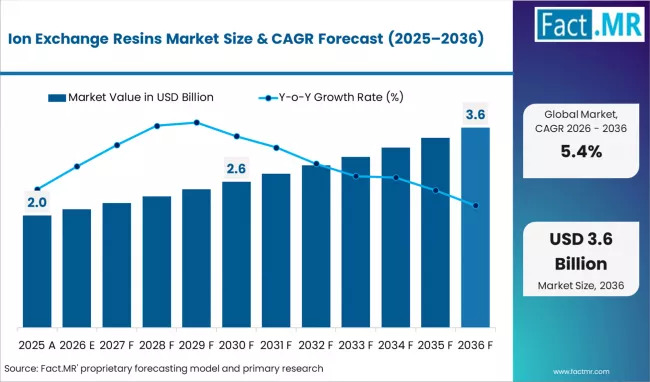
ROCKVILLE, MD, UNITED STATES, April 8, 2026 /EINPresswire.com/ -- According to the latest analysis by Fact.MR, the global ion exchange resins market is valued at USD 2.11 billion in 2026, projected to reach USD 2.22 billion in 2027, and is forecast to expand to USD 3.57 billion by 2036, growing at a CAGR of 5.40%.Get detailed market forecasts, competitive benchmarking, and pricing trends: https://www.factmr.com/connectus/sample?flag=S&rep_id=12125
The market is set to create an incremental opportunity of USD 1.46 billion during the forecast period. This growth is driven by structural transformation across industrial water treatment ecosystems, where resin performance durability, regeneration efficiency, and ultrapure water requirements are redefining procurement decisions across power, semiconductor, and pharmaceutical sectors.
Quick Stats Snapshot
Market Size (2026): USD 2.11 Billion
Market Size (2027): USD 2.22 Billion
Forecast Value (2036): USD 3.57 Billion
CAGR (2026–2036): 5.40%
Incremental Opportunity: USD 1.46 Billion
Leading Segment: Cationic Resins (46.0% share)
Leading End-use: Power Generation (40.0% share)
Leading Region: Asia-Pacific (India & China fastest-growing)
Key Players: DuPont, LANXESS, Mitsubishi Chemical, Purolite, Thermax
Executive Insight for Decision Makers
The ion exchange resins market is undergoing a shift from commodity-based procurement to performance-based lifecycle contracting.
Strategic imperatives:
OEMs must prioritize resin longevity (5–7 years lifecycle validation)
Manufacturers should integrate resin + system + monitoring solutions
Investors should target ultrapure water and semiconductor-driven demand clusters
Risk of inaction:
Failure to align with performance-driven procurement models may result in loss of long-term contracts, especially in power plants and semiconductor fabs where downtime costs are critical.
Market Dynamics
Key Growth Drivers
Expansion of power generation infrastructure requiring boiler feedwater treatment
Rising demand for ultrapure water in semiconductors & pharmaceuticals
Stringent environmental regulations and wastewater discharge norms
Growth in food & beverage processing requiring purification systems
Key Restraints
High regeneration chemical and operational costs
Resin fouling and maintenance complexity
Limited adoption in cost-sensitive industries
Emerging Trends
Shift toward selective and specialty resins
Adoption of automated and continuous regeneration systems
Integration with digital monitoring and smart water systems
Growing focus on resource recovery and sustainability
Segment Analysis
Leading Segment:
Cationic resins dominate with 46.0% share due to superior hardness removal and operational reliability
Fastest-Growing Segment:
Semiconductor & pharmaceutical ultrapure water applications
Breakdown
By Product: Cationic, Anionic, Specialty Resins
By End-use:
Power Generation (40%)
Chemicals & Petrochemicals
Food & Beverage
Electronics
Pharmaceuticals
Strategic Insight:
Cationic resins remain foundational, while specialty resins unlock premium margins and differentiation.
Supply Chain Analysis (Critical Insight)
Value Chain Structure
Raw Material Suppliers
Styrene, divinylbenzene, functional chemicals
Manufacturers / Producers
Polymerization and resin bead production
Functionalization for selective ion exchange
Distributors / Integrators
Water treatment solution providers
EPC contractors and industrial suppliers
End-users
Power plants → boiler feedwater treatment
Semiconductor fabs → ultrapure water systems
Pharma → process purity
Food industry → product quality refinement
Who Supplies Whom
Chemical suppliers → Resin manufacturers
Resin manufacturers → Water treatment OEMs
OEMs → Industrial plants (power, pharma, electronics)
Key Insight:
Control over application engineering and after-sales service is as critical as manufacturing capability.
Pricing Trends
Market operates across commodity and premium tiers
Commodity resins compete on volume and price
Premium resins command higher margins due to:
Longer lifecycle
Higher selectivity
Certification compliance
Pricing Influencers
Raw material costs (petrochemical derivatives)
Regeneration chemical pricing
Regulatory certifications
End-use application criticality
Margin Insight:
Premium resins deliver higher lifecycle value despite higher upfront costs, driving adoption in high-purity industries.
Regional Analysis
Top Countries by CAGR (2026–2036)
India – 6.5%
China – 6.1%
USA – 5.4%
Brazil – 5.1%
Germany – 4.8%
Regional Growth Drivers
India & China: Industrial expansion + environmental compliance
USA: Semiconductor and chemical sector demand
Brazil: Food processing and industrial water treatment
Germany: Strict EU water quality regulations
Developed vs Emerging
Developed markets → Technology-driven, high purity demand
Emerging markets → Volume-driven, infrastructure expansion
Competitive Landscape
Market Structure
Moderately consolidated with 50–70 active players
Key Players
DuPont de Nemours, Inc.
LANXESS AG
Mitsubishi Chemical Corporation
Purolite Corporation
Thermax Limited
Graver Technologies
Resonac Holdings
Doshion Polyscience
Competitive Strategies
Product innovation (specialty resins)
Long-term contracts with performance guarantees
Global distribution networks
Integrated solution offerings
Strategic Takeaways
For Manufacturers
Invest in high-performance, long-life resins
Offer integrated water treatment solutions
For Investors
Focus on semiconductor & pharma water treatment segments
Target Asia-Pacific growth markets
For Distributors / Marketers
Build technical advisory capabilities
Emphasize total cost of ownership (TCO) over price
Future Outlook
The ion exchange resins market is expected to evolve toward:
Smart water treatment ecosystems
Increased adoption of AI-enabled monitoring systems
Growth in sustainable and recyclable resin technologies
Long-term opportunities lie in:
Semiconductor fabs
Biopharmaceutical manufacturing
Water-scarce regions adopting advanced purification
Unlock 360° insights for strategic decision making and investment planning: https://www.factmr.com/checkout/12125
To View Our Related Report:
Ion Exchange Softeners Market: https://www.factmr.com/report/ion-exchange-softeners-market
Anionic Dispersants Market: https://www.factmr.com/report/anionic-dispersants-market
Nafion Market: https://www.factmr.com/report/4965/nafion-market
Cationic Reagent Market: https://www.factmr.com/report/cationic-reagent-market
S. N. Jha
Fact.MR
+1 628-251-1583