

cellular glass market
Press Release: Global Cellular Glass Market Set to Reach USD 908.5 Million by 2036 as Fire Safety and Energy Mandates Tighten
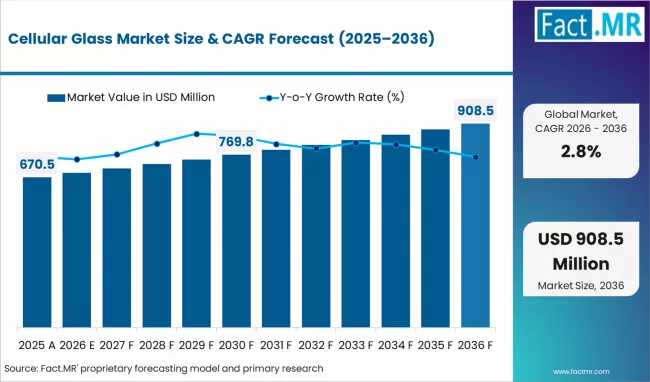
ROCKVILLE, MD, UNITED STATES, April 7, 2026 /EINPresswire.com/ -- The global cellular glass market is entering a high-specification era, valued at USD 689.27 million in 2026 and projected to ascend to USD 908.50 million by 2036. According to the latest analysis, the industry will maintain a steady 2.8% CAGR, driven by a structural shift toward non-combustible, moisture-impermeable insulation in safety-critical construction and industrial infrastructure.Market Overview & Strategic Analysis
Cellular glass—an inorganic, closed-cell foam derived from molten glass—has transitioned from a niche specialty material to a mandatory specification in high-moisture and fire-prone environments. While the market faces a ""first-cost"" hurdle compared to organic foams like EPS or XPS, its lifecycle value is increasingly recognized by Tier-1 architects and industrial process engineers.
For Details Deep insights, Please Request A sample report for Free
Key Market Projections (2026–2036)
Market Value (2026): USD 689.27 Million
Projected Value (2036): USD 908.50 Million
Incremental Opportunity: USD 219.23 Million
Dominant Segment: Blocks & Shells (67.4% market share)
Primary Application: Construction (47.0% market share)
Demand Drivers & Pricing Trends
The market's growth trajectory is anchored by three primary pillars:
Stringent Fire Safety Mandates: Post-2030 building codes increasingly require non-combustible insulation (Euroclass A1) for high-rise facades and critical infrastructure.
Industrial Cryogenics & LNG: The expansion of LNG terminals in Asia Pacific demands insulation that maintains thermal integrity at sub-zero temperatures without moisture ingress.
Sustainability & Circular Economy: With high recycled glass content, cellular glass aligns with LEED and BREEAM certifications, optimizing ""Green Building"" credit strategies.
Pricing Insight: Analysts note that while cellular glass maintains a premium price point, the Total Cost of Ownership (TCO) is lower in below-grade applications where organic foams typically fail due to moisture absorption and compressive degradation.
Regional Performance & Future Outlook
Growth is increasingly pivoting toward the Asia-Pacific region, though Western markets remain high-value specification hubs.
Country CAGR (2026-2036) Primary Growth Driver
India 4.5% Cold storage & petrochemical infrastructure boom
China 4.1% Urbanization & stringent fire safety for high-rises
USA 2.5% Commercial roofing & updated energy codes
Germany 2.3% Passivhaus standards & foundation insulation
Japan 1.9% Seismic-resilient and disaster-proof building upgrades
Competitive Landscape & Supply Chain
The competitive environment is moderately concentrated, with the top three players controlling roughly 40-45% of the global share. The supply chain is characterized by ""who supplies whom"" dynamics, where manufacturers partner closely with specialized insulation contractors and technical building material distributors.
Key Industry Players:
Market Leaders: Owens Corning (Pittsburgh Corning), Misapor AG, Geocell Schaumglas GmbH.
Specialized Challengers: Glapor Werk Mitterteich GmbH, Earthstone International LLC, Uusioaines OY.
Asia-Pacific Contenders: Zhejiang Dehe Insulation Technology Co. Ltd., Anhui Huichang New Material Co. Ltd.
Expert Commentary
""The true adoption barrier for cellular glass is not performance, but the initial cost premium that discourages price-sensitive segments,"" says Shambhu Nath Jha, Principal Consultant at Fact.MR. ""However, in environments where insulation must withstand heavy compressive loads or meet non-combustible ratings, the maintenance and replacement expenses of organic foams quickly exceed the initial investment of cellular glass.""
For instant access to this report, click "Buy Now" or connect with our analyst for customization: https://www.factmr.com/checkout/11811
Executive Takeaways for Decision-Makers
Manufacturers: Prioritize the development of lifecycle cost analysis tools to help specifiers justify the ""upfront premium.""
Contractors: Pre-qualify teams for cellular glass installation to capture high-margin industrial and chemical plant projects.
Investors: Look toward the Foam Glass Gravel sub-segment, which is seeing accelerated adoption in civil engineering for lightweight fill and ground stabilization.
To View Related Report
Glass-Free HD 3D Display Market https://www.factmr.com/report/286/glass-free-hd-3d-display-market
Fiberglass Fabric Market https://www.factmr.com/report/878/fiberglass-fabric-market
3D Glasses Chargers Market https://www.factmr.com/report/1036/3d-glasses-chargers-market
Container Glass Coating Market https://www.factmr.com/report/1051/container-glass-coatings-market
S. N. Jha
Fact.MR
+ +1 628-251-1583