

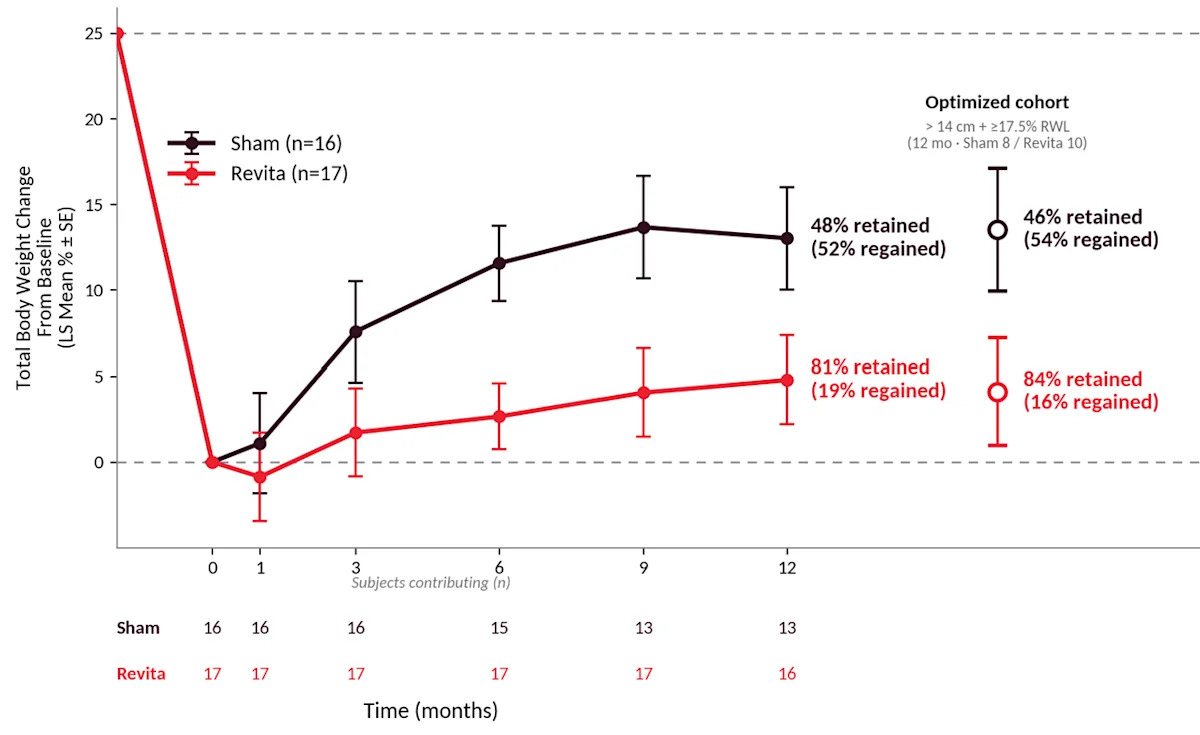
Up to 84% of GLP-1 induced weight loss retained with Revita® versus 46% with sham at one year in patients receiving complete duodenal ablations
Next anticipated Revita® milestones are topline six-month randomized data from the REMAIN-1 Pivotal Cohort in early Q4 2026 and a potential FDA De Novo marketing application submission in late Q4 2026
Company to host investor webcast today at 8:00 a.m. ET
BURLINGTON, Mass., July 15, 2026 (GLOBE NEWSWIRE) -- Fractyl Health, Inc. (Nasdaq: GUTS) (the Company or Fractyl), a clinical-stage metabolic therapeutics company focused on pioneering novel approaches to treat obesity and type 2 diabetes (T2D), today announced positive one-year results from its REMAIN-1 Midpoint Cohort ("Midpoint Cohort"). The new results reinforce the potential of the Revita DMR System (Revita) to be the first durable procedural therapy for post-GLP-1 weight maintenance.
Key Findings:
Dose-dependent durability confirmed at one year: In the full modified intention-to-treat (mITT) population (N=45), a single Revita procedure reduced weight regain by approximately 40% versus sham at one year (least-squares mean weight regain of 7.8% versus 13.0% of body weight; n=29 versus 16 for Revita versus sham). Participants who received complete duodenal ablation (>14 cm) maintained approximately 81% of GLP-1-induced weight loss at one year, compared with 48% in sham participants (least-squares mean weight regain of 4.8% versus 13.0% of body weight; n=17 versus 16 for Revita versus sham), reflecting a reduction in weight regain of over 60% versus sham. This is consistent with earlier findings that more complete duodenal ablation drives greater treatment effect.
Greatest benefit in patients with greatest need: In an optimized population of participants who received complete duodenal ablation (>14 cm) and had higher GLP-1 run-in weight loss (≥17.5%), Revita maintained approximately 84% of GLP-1-induced weight loss at one year versus 46% with sham (least-squares mean weight regain of 4.1% versus 13.5% of body weight; n=10 versus 8 for Revita versus sham). These results are consistent with the view that patients at greatest need may derive the greatest benefit from Revita due to their higher propensity for weight regain after GLP-1 discontinuation.
Weight-maintenance responder rate: The second co-primary endpoint of the Pivotal Cohort, assessed against a U.S. Food and Drug Administration (FDA) mandated pre-specified performance goal of >50%, measures the proportion of Revita patients maintaining at least 5% total body weight loss relative to their pre-tirzepatide weight at one year. As a reference point for the Pivotal Cohort, this responder rate was 73% in the Midpoint Cohort mITT population, rising to 91% in those with complete duodenal ablation (>14 cm).