
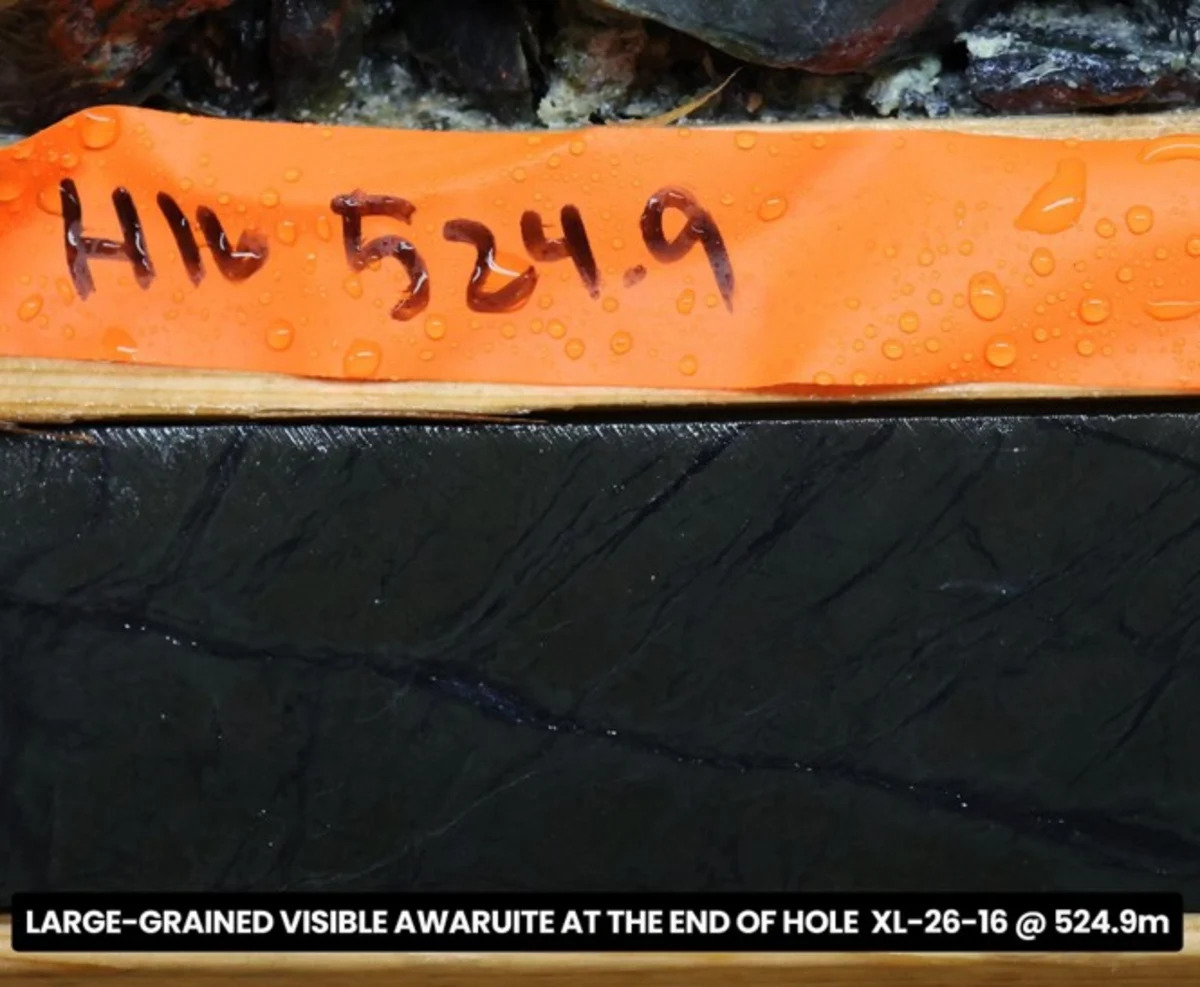
GRAND FALLS-WINDSOR, Newfoundland and Labrador, July 16, 2026 (GLOBE NEWSWIRE) -- First Atlantic Nickel & Cobalt Corp. (TSXV: FAN) (OTCQB: FANCF) (FSE: P210) ("First Atlantic" or the "Company") is pleased to announce that drill hole XL-26-16, the second drill hole completed at the Alloy Max Zone, intersected large-grain, visibly disseminated awaruite over its entire 525-meter drilled length. It is the deepest hole drilled to date at the Company's wholly owned Pipestone XL Nickel-Cobalt (Ni-Fe-Co) Alloy Project in central Newfoundland. XL-26-16 was drilled approximately 445 meters south of the Alloy Max discovery hole, XL-26-15, announced on June 15, 20261 and ended in mineralization. Alloy Max is the Company's second large-scale awaruite zone at Pipestone XL, in addition to the RPM Zone. XL-26-16 returned a higher visual abundance of awaruite and a greater frequency of coarser grains than the Alloy Max discovery hole, XL-26-15, with abundance and grain size increasing downhole.
XL-26-16 intersected visibly disseminated awaruite continuously, starting after only approximately 9 meters of overburden down to the end of the hole at 525 meters, where awaruite remained clearly visible in the final interval of core. The zone remains open at depth, indicating potential for further mineralization below the deepest drilling completed to date at Pipestone XL. Together with XL-26-15, drilling has now confirmed approximately 445 meters of strike length within the approximately 4 km Alloy Max target area outlined by surface sampling, geological mapping, and geophysics2, representing roughly 11% of the target strike length and leaving the large majority of the zone untested along strike and at depth.
First Atlantic welcomes calls directly from shareholders and prospective investors. For questions about the Company, the Pipestone XL Project, or this news release, or simply to learn more, investors are invited to call Rob Guzman, Investor Relations, at +1-844-592-6337 or email rob@fanickel.com.
KEY HIGHLIGHTS
445-Meter Step-Out South Extends the Alloy Max Zone: XL-26-16 was drilled approximately 445 meters south of the Alloy Max discovery hole, XL-26-15, intersected large-grain, visibly disseminated awaruite over the 525-meter drilled length and ended in mineralization. Drilling has now confirmed approximately 445 meters of strike within the approximately 4 km target area, representing roughly 11%, and approximately 285 meters of lateral width within a zone mapped as being up to approximately 1.5 km wide.
Higher Visual Abundance and Coarser Grains Than the Alloy Max Discovery Hole: Company geologists observed a higher visual abundance of awaruite grains in XL-26-16 compared to the first hole at Alloy Max, discovery hole XL-26-15, together with an increased frequency of larger grain sizes that increased with depth downhole.
Deepest Drill Hole to Date at Pipestone XL: At 525 meters downhole, and drilled at a dip of -60 degrees to the east, XL-26-16 is the deepest hole drilled on the project. It intersected large-grained, visibly disseminated awaruite over more than half-a-kilometre of drilled length, with awaruite still clearly visible in the final core interval and potential for further mineralization at depth.
Second Hole Confirms Continuity and Scale of the Alloy Max Zone: Back-to-back mineralized holes at Alloy Max confirm the continuity of widely disseminated awaruite between XL-26-15 and XL-26-16 and support the scale of a second large-scale zone within the Pipestone XL Project, with the potential for equal or greater tonnage at Alloy Max relative to the RPM Zone based on geophysics, geological mapping, and surface sampling.
Minimal Overburden, Near-Surface Mineralization at Alloy Max: XL-26-16 encountered only approximately 9 meters of overburden before entering mineralized bedrock, consistent with the shallow cover across Alloy Max that has allowed Company geologists to expose and sample bedrock directly at drill pad locations.
Refined Magnetic Interpretation Signals Expansion Potential: Company geologists observed that awaruite abundance, consistency, and grain size increased where magnetite decreased, indicating that prior geological interpretations focused on the most magnetically intense areas may understate the size potential of both Alloy Max and the RPM Zone. The Company is reinterpreting its regional magnetic surveys on this basis.