
ARCONTECH GROUP PLC
("Arcontech", the "Company" or the "Group")
Final Results for the year ended 30 June 2025
Arcontech (AIM: ARC), the provider of products and services for real-time financial market data processing and trading, is pleased to announce its final audited results for the year ended 30 June 2025.
Financial Highlights:
· Turnover was £3,106,991 (2024 £2,910,232)
· Profit before taxation was £987,390 (2024 £1,098,959) down by £111,569
· Recurring revenues represented 94% of total revenues for the period (2024: 99%)
· Net cash of £7,395,514 (2024 £7,160,177), an increase of 3.3%
· Final dividend increased 6.7% to 4.00 pence per share (2023: 3.75 pence per share)
Operational Highlights:
· Addition of a new high-end customer
· An increase in consulting income
· Enhancement of product functionality to appeal to a potential wider customer base
· Enlarged support team to strengthen customer relationships
· Active participation in several RFIs (Request for Information) with potential new customers
· Number of prospective clients has increased to be the strongest it has been for many years
Commenting on the results, Geoff Wicks, Chairman and Non-Executive Director of Arcontech said:
"Our strategy has served us well and the concentration on our core market has helped to continue to grow and retain our customer base. Our growing sales and support teams are helping to drive growth with customers and is bringing good new prospects. Customer retention and product development will continue to help with further growth in the coming years."
Enquiries:
Arcontech Group plc 020 7256 2300
Geoff Wicks, Chairman and Non-Executive Director
Matthew Jeffs, Chief Executive
Cavendish Capital Markets Ltd (Nomad & Broker) 020 7220 0500
Jonny Franklin-Adams/Isaac Hooper (Corporate Finance)
Harriet Ward (Corporate Broking)
To access more information on the Group please visit: www.arcontech.com
This announcement contains inside information for the purposes of Article 7 of the Market Abuse Regulation (EU) 596/2014 as it forms part of UK domestic law by virtue of the European Union (Withdrawal) Act 2018 ("MAR"), and is disclosed in accordance with the company's obligations under Article 17 of MAR.
Chairman's Statement
In the year to 30 June 2025 Arcontech benefited from its strong sales pipeline and the Company has continued to grow revenue with a new high-end customer and the return of consulting revenue. Even though we have seen some downsizing due to competitive pressure, we have kept our excellent customer base and continued to improve our position in the market.
The market remains challenging with our two main competitors offering enhanced packages and many customers having to review costs. We have strengthened customer relationships with an enlarged support team and also widened the scope of our sales operation with a larger team. This has been a key part of improving our prospective customer list. Lead times remain long and we have a number of new prospects in the throes of testing which gives us confidence for further growth.
Turnover was £3,106,991 (2024: £2,910,232) up 6.8% on last year. Profit before taxation (PBT) was £987,390 (2024: £1,098,959) down 10.1% on last year as a result of higher staffing costs including the annualised cost of a senior customer services hire made part way through the previous financial year, and the strengthening of our development team with the hire of an additional developer. Statutory earnings per share for the year to 30 June 2025 were 7.05p (2024: 7.98p).
The proportion of our recurring revenue remains high at 94%, however one-off revenue related to specific requirements for customers has helped our growth during the year. We do not expect this to continue at the same level as we develop products to include many of these individual requirements. We have also continued to secure our customers on longer term contracts which helps to give even greater visibility for the future.
Financing
Cash balances were £7,395,514 (2024: £7,160,177) at the year end, an increase of 3.3% from prior year. As at the date of signing this report our cash balance is £8,018,154. This strong balance sheet allows the Company to continue to invest in organic growth and to continue to look for relevant acquisitions.
Dividend
I am pleased to announce that subject to approval at the Annual General Meeting we intend to pay a dividend ahead of market expectations of 4.00p per share for the year ended 30 June 2025 (2024: 3.75 pence) an increase of 6.7%, to those shareholders on the register as at the close of business on 3 October 2025 with a dividend payment date of 31 October 2025.
Outlook
Our strategy has served us well and the concentration on our core market has helped continue to grow and retain our customer base. We see no reason to change this. At the same time we continue to build out our products and are more competitive in certain areas of the market than before. We currently have a number of potential customers close to contract and have an excellent prospect list. At the same time we expect some churn as the market is increasingly competitive. Consolidation in the market may provide opportunities for us to acquire one of our smaller competitors.
Geoff Wicks
Chairman and Non-Executive Director
Chief Executive's Review
The 2024/25 financial year saw further revenue growth of 6.8% as a result of non-recurring development work to enable future earnings from the deployment of recurring revenue solutions. Despite the greater focus on development work, the percentage of recurring revenue remained at over 90%.
Our clients and prospective clients continue to seek alternatives to their existing market data platform solutions and evidencing that, we have received and are participating in several RFIs (Request for Information) which are at various stages. These projects are involved and take time and, although none have yet been confirmed, we are optimistic of winning several new mandates.
As well as working to maintain our existing client base, this year has seen a range of engagements and the conclusion of earlier PoCs (Proof of Concept) that included the continuation of a build out to displace an alternative solution at a global investment bank in New York; the development of a custom solution to integrate Arcontech software with an inhouse market data system for another global investment bank; and the development of a new sophisticated market data publishing system for a new central bank customer. In addition to generating non-recurring revenues from this development work, the work will also contribute to our recurring revenues, solidify our position with those clients and create more opportunities with other existing and prospective clients.
The delivery of complex solutions is invariably not without issue and that Arcontech was able to do so in good time and often with new challenges that were only presented mid-project, is a testament to our abilities and the quality of our solutions and staff.
As a counter to our hard work and successes we did see a slight reduction in desktop user numbers at one client due to competitor action, however, we are confident the impact has been limited as we renewed a multi-year agreement with the same client shortly afterwards.
The year also saw positive results from our support team's remit to identify opportunities for growth with existing clients where we have strengthened our relationships. Our support team also worked to keep us abreast of client supplier requirements and I am pleased to say Arcontech is now recognised by UKAS as being accredited with ISO 27001 and ISO 22301.
This year has been notable in that our number of prospective clients has increased to be the strongest it has been for many years. Within this the pipeline for existing products remains strong and we are making good progress with the development of an extension to our product range which will allow us to compete more effectively by allowing customers to change their market data platform completely. This has brought interest both from current customers and from new prospects.
The past year also saw us formalise our search for potential acquisitions which yielded some interesting results and for which we continue to evaluate the opportunities with growth potential and fit as the primary considerations.
Our staff are a key asset to the Company and have continued to provide exemplary service and support to our clients. I would like to express my thanks for their continued commitment.
With our increased product range, stronger relationships with clients and excellent pipeline, we feel optimistic for the year ahead and beyond.
Matthew Jeffs
Chief Executive
Strategic Report
The Directors present the group strategic report for Arcontech Group plc and its subsidiaries ("the Group") for the year ended 30 June 2025.
Principal activities
The principal activities of the Company and its subsidiaries during the year were the development and sale of proprietary software and provision of computer consultancy services.
Review of the business and prospects
A full review of the operations, financial position and prospects of the Group is given in the Chairman's Statement and Chief Executive's Review on pages 2 to 3.
Key performance indicators (KPIs)
The Directors monitor the business using management reports and information, reviewed and discussed at monthly Board meetings. Financial and non-financial KPIs used in this report include:
Financial KPIs:
Revenue £3,106,991 (2024: £2,910,232; 2023: £2,730,172) Measurement:
Revenue from sales made to all customers (excluding intra-group sales which eliminate on consolidation)
Performance:
Increase from 2024 with an increase in once-off development work from existing customers
Adjusted EBITDA £874,083 (2024: £1,030,898; 2023: £1,044,522) Measurement:
Adjusted EBITDA is EBITDA before the release of accruals for administrative costs in respect of prior years (as disclosed in the footnote to the Income Statement), and share-based payments. This measurement is reconciled as Operating Profit (£778,553), add depreciation (£118,367), subtract accruals release (£47,611) and add share-based payments (£24,774).
This is an alternative, non-IFRS performance measure, that is considered relevant as it provides a more accurate reflection of trading performance than EBITDA. The accruals release for 2023 included a release of £110,000 which was disclosed separately in the Group Statement of Income.
Performance:
Adjusted EBITDA is down year-on-year, reflective of an increase in staff costs and professional fees
Adjusted profit £895,819 (2024: £1,043,054; 2023: £861,716) Measurement:
Adjusted profit is net profit after tax (£943,430) less the amount of accruals for administrative costs released (£47,611) as disclosed in the footnote to the Income Statement. This is an alternative, non-IFRS performance measure, that is considered relevant as it provides a more accurate reflection of trading performance than net profit after tax. The accruals release for 2023 included a release of £110,000 which was disclosed separately in the Group Statement of Income.
Performance:
Adjusted profit is down year-on-year, reflective of an increase in staff costs and professional fees
Strategic Report (continued)
|
Cash £7,395,514 (2024: £7,160,177; 2023: £6,411,241) |
Measurement: |
||||||
|
Earnings per share (basic) 7.05p (2024: 7.98p; 2023: 7.33p) |
Measurement: Earnings after tax divided by the weighted average number of shares |
||||||
|
Earnings per share (diluted) 7.02p (2024: 7.96p; 2023: 7.32p) |
Measurement: |
||||||
|
Non-financial KPIs: |
|||||||
|
Staff retention rate (net) 94% (2024: 94%; 2023: 94%) |
Measurement: |
||||||
Environmental, Social and Governance
Arcontech Group plc qualified as a low energy user in the year ending 30 June 2025 and accordingly is not required to disclose energy consumption and Greenhouse Gas emission information in accordance with the Streamline Energy & Carbon Reporting regulations.
Principal risks and uncertainties
The Group's performance is affected by a number of risks and uncertainties, which the Board monitor on an ongoing basis in order to identify, manage and minimise their possible impact. General risks and uncertainties include changes in economic conditions, interest rate fluctuations and the impact of competition. The Group's principal risk areas and the action taken to mitigate their outcome are shown below:
|
Risk area |
Nature |
Mitigation |
|
Competition |
Loss of business due to existing competition or new entrants into the market |
Ongoing investment in research and development responding to the changing needs of clients to remain competitive |
|
Loss of key personnel |
Inability to execute business plan due to the risk of losing key personnel |
Employee share option scheme in place |
|
Brexit |
Business made difficult due to increased regulations between the UK and Europe caused by Brexit |
Arcontech is a global company and as such seeks growth across a geographically diverse customer base |
Strategic Report (continued)
Relations with shareholders
Section 172(1) Statement - Promotion of the Company for the benefit of the members as a whole
The Directors believe they have acted in the way most likely to promote the success of the Group for the benefit of its members as a whole, as required by s172 of the Companies Act 2006.
The requirements of s172 are for the Directors to:
· Consider the likely consequences of any decision in the long term;
· Act fairly between the members of the Company;
· Maintain a reputation for high standards of business conduct;
· Consider the interests of the Company's employees;
· Foster the Company's relationships with suppliers, customers and others;
· The desirability of the Company maintaining a reputation for high standards of business conduct; and
· Consider the impact of the Company's operations on the community and the environment.
Section 172(1) Companies Act 2006
The Board takes decisions with the long term in mind, and collectively and individually aims to uphold the highest standards of conduct. Similarly, the Board understands that the Company can only prosper over the long term if it understands and respects the views and needs of its customers, distributors, employees, suppliers and the wider community in which it operates.
A firm understanding of investor needs is also vital to the Company's success. The Directors are fully aware of their responsibilities to promote the success of the Company in accordance with Section 172(1) of the Companies Act 2006. The text of Section 172(1) of the Companies Act 2006 has been sent out to each main Board Director.
The Board ensures that the requirements are met, and the interests of stakeholders are considered as referred to elsewhere in this report and through a combination of the following:
· A rolling agenda of matters to be considered by the Board through the year, which includes an annual strategy review meeting, where the strategic options for the following year are developed;
· At each board meeting, to receive and discuss a report on customers, employees and other colleagues, and investors;
· Standing agenda points and papers;
· A review of certain of these topics through the Audit Committee and the Remuneration Committee agenda items referred to in this report; and
· Detailed consideration is given to of any of these factors where they are relevant to any major decisions taken by the Board during the year.
The Group's operation is the development and sale of proprietary software and provision of computer consultancy services. The Board has identified its key stakeholders as its customers, shareholders, employees and suppliers. The Board keeps itself appraised of its key stakeholders' interests through a combination of both direct and indirect engagement, and the Board has regard to these interests when discharging its duties.
The application of the s172 requirements can be demonstrated in relation to some of the key decisions made during the year to 30 June 2025:
· Allocation of the Group's capital in a way which offers significant returns to shareholders in line with the Company's dividend policy, while also ensuring that the Group retains flexibility to continue to deploy capital towards profitable growth;
· Continuation of a hybrid location working format for staff as working environments have evolved over recent years, while ensuring that the Group continued to deliver both the high level of service and security that our customers depend on without compromising the health and safety of employees.
During the year to 30 June 2025, the Board assessed its current activities between the Board and its stakeholders, which demonstrated that the Board actively engages with its stakeholders and takes their various objectives into consideration when making decisions. Specifically, actions the Board has taken to engage with its stakeholders over the last twelve months include:
· All Directors attended the 2024 AGM to answer questions and receive additional feedback from investors;
· The outcome of the AGM is published on the Company's corporate website;
· The Board receives regular updates on the views of shareholders through briefings and reports from the executive directors, and the Company's brokers;
· Arranged meetings with certain stakeholders to provide them with updates on the Company's operational activities and other general corporate updates;
· We discussed feedback from investors' and analysts' meetings following the release of our annual and half-year announcements. We have an investor relations programme of meetings with existing and potential shareholders;
· Monitored company culture and engaged with employees on efforts to continuously improve company culture and morale; and
· A range of corporate information (including all Company announcements) is also available to shareholders, investors and the public on the Company's corporate website: www.arcontech.com.
The Board believes that appropriate steps and considerations have been taken during the year so that each Director has an understanding of the various key stakeholders of the Company. The Board recognises its responsibility to contemplate all such stakeholder needs and concerns as part of its discussions, decision-making, and in the course of taking actions, and will continue to make stakeholder engagement a top priority in the coming years.
Approved on behalf of the board on 9 September 2025 by:
|
Matthew Jeffs |
|
|
Chief Executive |
Board of Directors
Directors - Executive
Matthew Jeffs (Chief Executive Officer)
Matthew was appointed Chief Executive Officer in April 2013. Matthew spent 10 years with Barclays International, 10 years with Dow Jones and then 6 years with Reuters in a variety of senior roles. In addition to the UK, he has wide experience in the Asia Pacific region, working in Hong Kong, Japan, Korea (where he was country manager for Reuters and country representative for Dow Jones), Thailand and Vietnam. In his most recent role, Matthew was the Managing Director, ICS International at Broadridge Financial Solutions where he was responsible for the overall management of the Global Proxy business with offices in the U.K., U.S., Japan, Australia and India. Matthew has an MBA from Buckinghamshire Business School.
Directors - Non-Executive
Geoff Wicks (Chairman)
Geoff was appointed Non-Executive Director in July 2020, and Chairman and in September 2020. Geoff was most recently Chairman of ULS Technology plc (now Smoove PLC), the provider of online technology platforms for the UK conveyancing and financial intermediary markets. Prior to this, he was CEO of Group NBT plc, a specialist in online brand protection and digital asset management, from 2001 until he led the sale of the business to HGCapital in 2011. He remained part of the Group NBT business, now renamed NetNames, as a non-executive director until 2013. Geoff spent much of his earlier career at Reuters, including heading divisions in the UK, France and Nordic regions and latterly was director of corporate communications. Prior to Reuters, Geoff worked in the banking and insurance industries.
Raj Nagevadia
Raj was appointed Non-Executive Director in October 2022. Raj is the current Chief Financial Officer (CFO) of Bfinance, a financial services consultancy, and holds a wealth of experience in financial managerial roles across the technology sector, primarily as a CFO. Prior to Bfinance, Raj was CFO of SecureData Europe, a cyber security management service, where he oversaw a broad range of acquisitions. Before this, Raj was CFO of NetNames (formerly Group NBT), the AIM quoted internet services provider, for over 10 years. Here, Raj managed the company's acquisition strategy as well as aiding in the sale of the Company to Hg Capital in 2011.
Corporate Governance
Corporate governance report
This Corporate Governance Report forms part of the Directors' Report.
The Directors recognise the importance of, and are committed to, high standards of corporate governance. Of the two widely recognised formal codes, the directors have decided to adhere to the Quoted Companies Alliance Corporate Governance ("QCA Code") code. The Group's compliance with the 2023 version of the code is summarised below and can be found in full on the Group's website at: https://www.arcontech.com/wp-content/uploads/2025/02/Arcontech-Corporate-Governance_Feb-25.pdf
The working of the Board and its Committees
At 30 June 2025, the Board comprised two Non-Executive Directors, one of whom is the Chairman, and one Executive Director. The Board is responsible to the shareholders for the proper management of the Group. It meets regularly to review financial and non-financial performance. Matters for review by the Board are circulated before the Board Meetings.
All of the Directors are subject to election at the first Annual General Meeting following their appointment and to re-election at least once every three years.
The Chairman and Non-executive Director have other third-party commitments including directorships of other companies. The Company is satisfied that these commitments have no significant impact on their ability to carry out their responsibilities effectively. All Directors have access to the advice and services of the Company Secretary, who is responsible to the Board for ensuring that Board procedures are followed, and that applicable rules and regulations are complied with. In addition, the Company Secretary will ensure that the Directors receive appropriate training as necessary. All Directors are supplied with information in a timely manner in a form, and of a quality, appropriate to enable them to discharge their duties.
During the year, certain Directors who were not Committee members attended meetings of the Audit Committee and Remuneration Committee by invitation. These details have not been included in the table.
Board meeting attendance
|
Board Meeting |
Audit Committee |
Remuneration Committee |
Nomination Committee |
|
|
Executive Directors Matthew Jeffs |
10/10 |
2/2 |
N/A |
N/A |
|
Non-Executive Directors Geoff Wicks (Independent) Raj Nagevadia (Independent) |
10/10 10/10 |
2/2 2/2 |
1/1 1/1 |
0/0 0/0 |
Board performance
The Company has a formal process of annual performance evaluation for the Board, its Committees and individual Directors. The Board and its Committees are satisfied that they are operating effectively. A performance evaluation of the Board, its Committees and individual Directors is conducted annually via an internal peer review between Directors.
Corporate Governance (continued)
Corporate governance report (continued)
The review is based on key areas, to include Board composition, information, process, internal control, accountability, CEO and top management and standards of conduct. The areas are scored by all members, reviewed by the Chairman and Company Secretary and compared against the previous evaluation. Lower scores are discussed.
The Company has Directors' and officers' liability insurance in place.
Committees
The following committees deal with the Group's affairs:
Audit Committee
Details of the Audit Committee are given in its Report on pages 11-12.
Remuneration Committee
Details of the Remuneration Committee are given in its Report on pages 13-19. This includes details of the Directors' remuneration, interest in shares, interest in share options, and service contracts. No Director is involved in decisions about their own remuneration.
Nomination Committee
The Nomination Committee assists the Board in discharging its responsibilities relating to the composition and make-up of the Board and any committees of the Board. It is also responsible for periodically reviewing the Board's structure and identifying potential candidates to be appointed as Directors or committee members as the need may arise. The Nomination Committee is responsible for evaluating the balance of skills, knowledge and experience and the size, structure and composition of the Board and committees of the Board, retirements and appointments of additional and replacement Directors and committee members and will make appropriate recommendations to the Board on such matters.
The Nomination Committee is chaired by Geoff Wicks. Raj Nagevadia is the other committee member. The Nomination Committee is mandated to meet not less than once a year. There was no meeting of the Nominations Committee for the year under review as the Board made the collective decision that with Non-Executive Director appointments and retirements in 2022 and 2023 respectively, combined with the experience and skill-sets of the existing Directors, that the Board was able to fulfil its duties through to the end of the reporting period with its existing composition. It is the intention of the Nominations Committee to meet during the current reporting period.
Geoff Wicks
Chairman and Non-Executive Director
9 September 2025
Corporate Governance (continued)
Audit Committee report
The Audit Committee is responsible for ensuring that the financial position of the Group is properly monitored. The Audit Committee generally meets twice a year and the Finance Director of the trading subsidiary, appointed to lead the finance function, also attends by invitation. The Committee meets with the Group & Company Independent Auditor ("Auditor") at least twice during the annual year-end audit and has direct access to the Auditor at any time throughout the year. At 30 June 2025, the members of the Audit Committee were:
Raj Nagevadia (Chairman)
Geoff Wicks
Matthew Jeffs
Objectives and responsibilities
The role of the Audit Committee is to primarily monitor the Group's financial statements, the effectiveness of financial controls and systems and to oversee the relationship with external auditors.
Activities of the Audit Committee during the year
The Audit Committee focuses on financial reporting and the statutory audit, and the assessment of internal controls. The Committee reviewed the treasury mandate to ensure achieving a market rate of return on existing cash balances, and banking relationships to ensure that appropriate day-to-day banking facilities were in place to support its ability to execute operational activities.
Financial reporting and statutory audit
The Audit Committee reviews the half year and annual financial statements with emphasis on:
- the overall truth and fairness of the results and financial position;
- the transparency and understandability of the accounts for users;
- the appropriateness of the accounting policies;
- the resolution of management's significant accounting judgements or of matters raised by the external auditors;
- the quality of the Annual Report as a whole.
The Audit Committee considers that the Annual Report taken as a whole is fair, balanced and understandable.
Accounting policies, practices and judgements
|
Issue |
Action |
|
· Accounting policies |
The Committee reviewed and discussed the significant accounting policies with management and the external auditor and reached the conclusion that each policy was appropriate to the Group. |
|
· Going concern review |
The Committee considered the ability of the Group to operate as a Going Concern considering cash flow forecast for the 12 months from the date of signing this report, and milestone achievements. It was determined by the Committee that it was reasonable to expect that the Group has or will have sufficient funds for the next 12 months and that it was appropriate for the Financial Statements to be prepared on a going concern basis. |
Corporate Governance (continued)
Audit Committee report (continued)
|
Issue |
Action |
|
· Review of audit and non-audit services and fees |
The external auditor is not engaged by the Group to carry out any non-audit work in respect of which it might, in the future, be required to express an audit opinion. The Committee reviewed the fees charged for the provision of audit and non-audit services and determined that they were in line with fees charged to companies of similar size and stage of development. The Committee considered and was satisfied the external auditor's assessment of its own independence. |
Internal audit
The Group does not have internal auditors as the Audit Committee considers that it is not yet of a size or complexity to necessitate this.
Raj Nagevadia
Audit Committee Chairman
9 September 2025
Corporate Governance (continued)
Remuneration Committee report
Dear shareholder
I am pleased to introduce the Directors' Remuneration Report for the year ended 30 June 2025.
The Chairman's Statement on page 2 provides a summary of the progress the Group has made during the financial year. The Remuneration Committee is committed to structuring executive remuneration that supports the Group's strategy and performance and to help it grow profitably. The Remuneration Committee is appointed by the Board and comprises the two independent Non-Executive Directors.
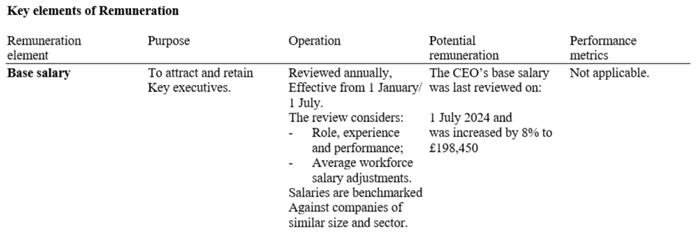
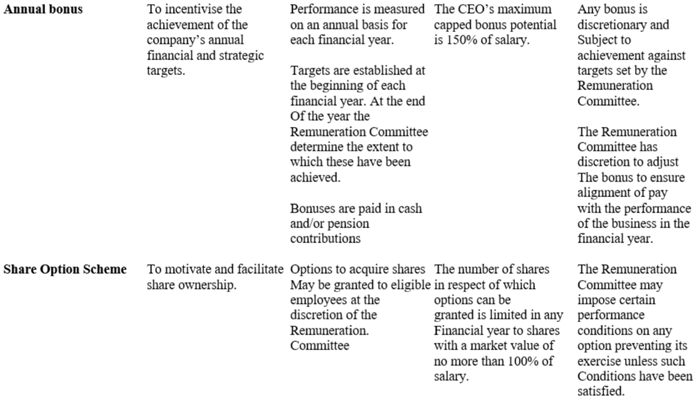
Short-term performance is incentivised by an annual bonus scheme based on the achievement of certain financial performance targets. Long-term performance is incentivised by the Group's Share Option Scheme.
Directors' Remuneration Policy
This part of the Directors' Remuneration Report sets out the Group's remuneration policy.
Policy on Executive Remuneration
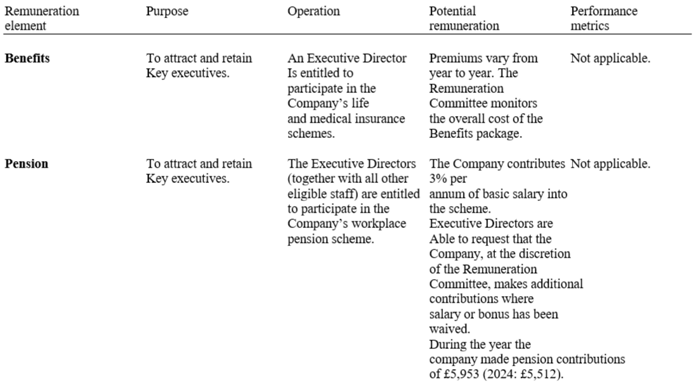
The Group's remuneration policy is designed to ensure that the Company is able to attract, motivate and retain executives and senior management to promote long-term success. The retention of key management and the alignment of management incentives with the creation of shareholder value are key objectives of this policy.
The Remuneration Committee seeks to ensure that salaries are market competitive for similar companies.
Corporate Governance (continued)
Remuneration Committee report (continued)
Key elements of Remuneration (continued)
Corporate Governance (continued)
Remuneration Committee report (continued)
Key elements of Remuneration (continued)
Alignment of Executive Remuneration and the Market
The Remuneration Committee takes advantage of the availability of various annual AIM Directors' Remuneration reports as well as available data about similar companies. The Company aims to ensure that Directors' salaries are set at a level sufficient to ensure there is significant incentive and regard for better than average long-term results.
Consideration of Employee Pay
The Remuneration Committee takes account of pay and conditions of employees throughout the Group when setting pay and benefits for Executive Directors. The Company endeavours to provide competitive remuneration packages for all employees. Employees may be eligible to participate in the Share Option Scheme at the discretion of the Remuneration Committee. The Company does not consult directly with its employees as part of the process for determining Executive pay.
Policy on recruitment
When appointing new Executive Directors, the Remuneration Committee will consider their remuneration by reference to the Remuneration Policy set out in this Report. The Remuneration Committee would not usually expect to pay sign-on payments or compensate new Directors for any variable remuneration forfeited from any employment prior to joining the Board other than in exceptional circumstances, recognising that the Company needs to attract appropriately skilled and experienced individuals.
Corporate Governance (continued)
Remuneration Committee report (continued)
Policy on recruitment (continued)
Salary and annual bonus will be set so as to be competitive with comparable companies and also taking into account the experience, seniority and responsibility of the appointee coming into the new role. New Executive Directors will receive benefits and pension contributions in line with the Company's existing policy and to participate in the annual bonus scheme on a pro-rated basis for the portion of the financial year for which they are in post.
Policy on Loss of Office
Executive Directors leaving employment from the Group, other than in circumstances of gross misconduct or incompetence, serious dishonesty or wilful neglect of duty (in which cases no amount will be payable), will be entitled to receive salary in accordance with their notice periods and pro-rated annual bonus to the date of leaving. The notice periods and the contractual rights on termination of each Director are set out below. The Company's Employee Share Option Scheme also provides leaver provisions as follows:
An Executive Director who ceases to be a Director or employee of the Group by reason of death, retirement, ill-health, injury or disability, redundancy or the sale of the company for which they work will be a good leaver. As such they will be permitted to exercise their options. Where the cessation is on any other grounds the awards will lapse on the date of cessation, unless the Remuneration Committee determines at its discretion prior to the date of cessation that the awards shall vest.
Share option awards held by good leavers that are already capable of being exercised at the date of cessation may, at the discretion of the Remuneration Committee, be exercised up to 12 months of the leaving date (depending on the reason for leaving). If the good leaver ceases to be an employee or Director before the end of the third anniversary of the grant of the award it may, at the discretion of the Remuneration Committee, be allowed to vest on the normal vesting date.
External appointments
It is the Board's policy to allow Executive Directors to accept directorships of other quoted and non-quoted companies provided that they have obtained the consent of the Chairman of the group. Any such directorships must be formally notified to the Board.
Policy on Non-Executive Director Remuneration
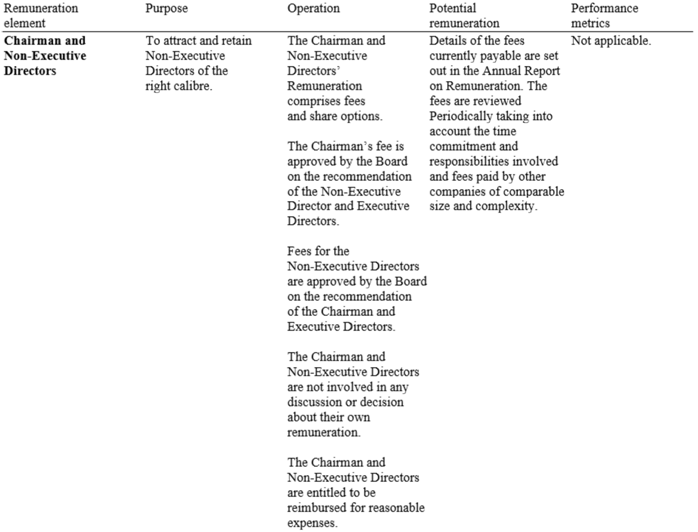
The remuneration of the Chairman and the other Non-Executive Director comprises fees that are paid via the payroll. The Non-Executive Directors no longer participate in the Company's Share Option Scheme. Fees are reviewed annually. The Non-Executive Directors are not involved in any decisions about their own remuneration. No additional fees are payable to the chairmen of the Audit and Remuneration Committees.
Corporate Governance (continued)
Remuneration Committee report (continued)
Directors' Service Agreements
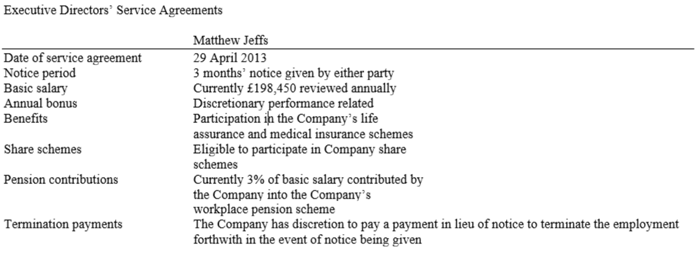
Non-Executive Directors' Letters of Appointment
The Non-Executive Directors have Letters of Appointment stating that their appointment is for an initial term up until they are required to retire by rotation. The Letters of Appointment provide for termination of the appointment on three months' notice by either party.
The current Non-Executive Directors' appointments commenced on the following dates:
Geoff Wicks 20 July 2020
Raj Nagevadia 26 October 2022
Annual Report on Remuneration
Introduction
The Annual Report on Remuneration sets out information about the remuneration of the Directors of the Company for the year ended 30 June 2025.
Remuneration Committee
The Remuneration Committee consisted of the following Directors at 30 June 2025:
Geoff Wicks, Independent Non-Executive Director and Chairman of the Board
Raj Nagevadia (Chairman), Independent Non-Executive Director
Role of the Remuneration Committee
The Remuneration Committee assists the Board in determining the remuneration and benefits package for the Executive Directors.
Activities of the Remuneration Committee during the year
The Remuneration Committee meets whenever it is appropriate. The committee met two times in the current year. In addition to agreeing the remuneration report and reviewing the remuneration of the Executive Directors, the award of share options to Directors and Employees was approved.
Corporate Governance (continued)
Remuneration Committee report (continued)
Directors' Remuneration
The detailed emoluments of the Executive and Non-Executive Directors are set out below.
Year ended 30 June 2025
|
Salary/fees |
Benefits |
Bonus |
Pension |
Total |
|
|
Chairman and Non-Executive Directors |
|||||
|
Geoff Wicks (Chairman) |
32,500 |
- |
- |
- |
32,500 |
|
Raj Nagevadia |
25,000 |
- |
- |
- |
25,000 |
|
Total Non-Executive |
57,500 |
- |
- |
- |
57,500 |
|
Executive Directors |
|||||
|
Matthew Jeffs |
198,450 |
3,406 |
82,701 |
5,953 |
290,510 |
|
Total Executives |
198,450 |
3,406 |
82,701 |
5,953 |
290,510 |
|
Total Remuneration |
255,950 |
3,406 |
82,701 |
5,953 |
348,010 |
Analysis of bonuses & pension:
Bonuses Bonuses Paid Total accrued paid as cash as pension
Directors
Matthew Jeffs
Year ended 30 June 2024 77,930 (77,930) - -
Year ended 30 June 2025 82,701 - 5,953 88,654
Year ended 30 June 2024
|
Salary/fees |
Benefits |
Bonus |
Pension |
Total |
|
|
Chairman and Non-Executive Directors |
|||||
|
Geoff Wicks (Chairman) |
32,500 |
- |
- |
- |
32,500 |
|
Raj Nagevadia |
25,000 |
- |
- |
- |
25,000 |
|
Total Non-Executive |
32,500 |
- |
- |
- |
32,500 |
|
Executive Directors |
|||||
|
Matthew Jeffs |
183,750 |
3,185 |
77,930 |
5,512 |
270,377 |
|
Total Executives |
183,750 |
3,185 |
77,930 |
5,512 |
270,377 |
|
Total Remuneration |
241,250 |
3,185 |
77,930 |
5,512 |
327,877 |
Corporate Governance (continued)
Remuneration Committee report (continued)
Directors' Remuneration (Continued)
Directors' share interests
The number of ordinary shares of the Company in which the Directors were beneficially interested at 30 June 2025 was:
Director 30 June 2025 30 June 2024
Geoff Wicks - -
Raj Nagevadia - -
Matthew Jeffs 1,013,000 935,000
Directors' share options interests
Director At 1 July 2024 Granted Lapsed At 30 June 2025 Exercise Normal exercise
price period
Geoff Wicks 30,000 - - 30,000 164.50 pence 30 Jun 23 - 2 Oct 30
Matthew Jeffs 100,000 - - 100,000 110.00 pence 30 Jun 21 - 29 Jun 28
50,000 - - 50,000 130.50 pence 30 Jun 24 - 11 Oct 31
50,000 - (50,000) - 76.50 pence 30 Jun 25 - 21 Oct 32
There are no performance conditions on the exercise of the options granted prior to 1 July 2018. There were no options granted to directors during the year to 30 June 2025.
* Fully diluted earnings will be based on: (a) the Company's pre-tax profit excluding exceptional items and the share option charge and (b) the current UK corporation tax rate of 19%, such that the fully diluted earnings calculation takes no account of R&D and deferred tax credits. For the purposes of the fully diluted earnings calculation, the applied rate of corporation tax will remain constant at 19% irrespective of any current or future changes to corporation tax.
Raj Nagevadia
Remuneration Committee Chairman
9 September 2025
Directors' Report
The Directors present their Report and financial statements for the year ended 30 June 2025.
General information
Arcontech Group plc is a public limited company which is listed on the AIM segment of the London Stock Exchange and is incorporated in the United Kingdom.
Results and dividends
Details of the results for the year are given on page 28. The Directors recommend the payment of a final dividend of 4.00 pence per ordinary share (2024: 3.75 pence per share) to be paid on 31 October 2025 to ordinary shareholders on the register on 3 October 2025 £534,912 (2024: £501,480).
Directors
The Directors who have held office during the period from 1 July 2024 to the date of this report are as follows:
Geoff Wicks
Matthew Jeffs
Raj Nagevadia
Refer to page 18 for details of the remuneration paid to each Director for the years to 30 June 2025 and 2024.
Raj Nagevadia, who retires by rotation under Article 106 of the Company's articles of association and, who being eligible, offers himself to be re-elected as a Director of the Company.
Except as disclosed in note 23 to the financial statements none of the Directors had an interest in any contracts with the Company or its subsidiaries during the year.
Employees
The Directors recognise the importance of good communication with employees to ensure a common awareness of factors affecting the Group. They also recognise their statutory responsibilities. Matters of current concern or interest are discussed with staff on a regular basis.
Internal control
The Directors acknowledge their responsibilities for the Group's system of internal control. The Board considers major business and financial risks. All strategic decisions are referred to the Board, which meets monthly, for approval. Accepting that no system of control can provide absolute assurance against material misstatement or loss, the Directors believe that the established systems of internal control within the Group are appropriate to the business.
Future developments
Interest in our products is higher than we have seen for some time and we are optimistic that this will drive future revenue growth over the coming years.
Financial risk management
The Group's financial instruments comprise cash and cash equivalents, and items such as trade payables and trade receivables, which arise directly from its operations.
The main risks arising from the Group's financial instruments are interest rate fluctuations and liquidity risk. Refer to Note 25 for further detail on the Group's financial instruments and risk exposures. It is the Group's policy to finance its operations through a mixture of cash and, where appropriate, external finance and to review the projected cash flow requirements of the Group with an acceptable level of risk exposure.
Directors' Report (continued)
Going concern
On the basis of current projections and having regard to the Group's existing cash reserves, the Directors consider that the Group has adequate resources to continue in operational existence for the foreseeable future. Accordingly, the Directors have adopted the going concern basis in the preparation of the financial statements (Refer to Note 1).
Research and Development
The Group continues to make progress in product development, while continuing to keep control of costs. Research and development expenditure is charged to the income statement in the year incurred, unless it meets the capitalisation criteria under IAS 38.
Directors' and Officers' Liability Insurance
Directors' and Officers' liability insurance is in place at the date of this report. The Board remains satisfied that an appropriate level of cover is in place and a review of cover takes place annually.
Disclosures to auditors
In the case of each of the persons who are Directors at the time when the report is approved, the following applies:
- so far as each of the Directors are aware, there is no relevant audit information of which the Company's auditors are unaware; and
- each of the Directors have taken all the steps that they ought to have taken as Directors in order to make themselves aware of any relevant audit information and to establish that the Company's auditors are aware of that information.
This information is given and should be interpreted in accordance with the provisions of s418 of the Companies Act 2006.
Independent Auditors
A resolution to re-appoint PKF Littlejohn LLP will be proposed at the annual general meeting.
On behalf of the Board
Matthew Jeffs
Chief Executive
9 September 2025
Statement of Directors' Responsibilities
The Directors are responsible for preparing the Strategic Report, Directors' Report and the financial statements in accordance with applicable UK law and regulations.
Company law requires the Directors to prepare financial statements for each financial year. Under that law the Directors have elected to prepare the financial statements in accordance with UK-adopted international accounting standards (UK IAS) and as regards the Company financial statements, as applied in accordance with the requirements of the Companies Act 2006. Under company law the Directors must not approve the financial statements unless they are satisfied that they give a true and fair view of the state of affairs of the Company and of the Group and of the profit or loss of the Group for that period. In preparing these financial statements, the Directors are required to:
- select suitable accounting policies and then apply them consistently;
- make judgments and accounting estimates that are reasonable and prudent;
- state whether they comply with UK-adopted international accounting standards, subject to any material departures disclosed and explained in the financial statements; and
- prepare the financial statements on the going concern basis unless it is inappropriate to presume that the Group will continue in business.
The Directors are responsible for keeping adequate accounting records that are sufficient to show and explain the Company's transactions and disclose with reasonable accuracy at any time the financial position of the Company and enable them to ensure that the financial statements comply with the Companies Act 2006. They are also responsible for safeguarding the assets of the Company and the Group and hence for taking reasonable steps for the prevention and detection of fraud and other irregularities.
The Directors are responsible for ensuring that they meet their responsibilities under the AIM rules.
The Directors are responsible for the maintenance and integrity of the corporate and financial information included on the Company's website. Legislation in the United Kingdom governing the preparation and dissemination of financial statements may differ from legislation in other jurisdictions.
Independent Auditor's Report to the members of
Arcontech Group PLC
Opinion
We have audited the financial statements of Arcontech Group Plc (the 'parent company') and its subsidiaries (the 'group') for the year ended 30 June 2025 which comprise the Group Income Statement and Statement of Comprehensive Income, the Statements of Changes in Equity, the Statements of Financial Position, the Group and Parent Company Statements of Cash Flows, and notes to the financial statements, including significant accounting policies. The financial reporting framework that has been applied in their preparation is applicable law and UK-adopted international accounting standards and as regards the parent company financial statements, as applied in accordance with the provisions of the Companies Act 2006.
In our opinion:
· the financial statements give a true and fair view of the state of the group's and of the parent company's affairs as at 30 June 2025 and of the group's profit for the year then ended;
· the group financial statements have been properly prepared in accordance with UK-adopted international accounting standards;
· the parent company financial statements have been properly prepared in accordance with UK-adopted international accounting standards and as applied in accordance with the provisions of the Companies Act 2006; and
· the financial statements have been prepared in accordance with the requirements of the Companies Act 2006.
Basis for opinion
We conducted our audit in accordance with International Standards on Auditing (UK) (ISAs (UK)) and applicable law. Our responsibilities under those standards are further described in the Auditor's responsibilities for the audit of the financial statements section of our report. We are independent of the group and parent company in accordance with the ethical requirements that are relevant to our audit of the financial statements in the UK, including the FRC's Ethical Standard as applied to listed entities, and we have fulfilled our other ethical responsibilities in accordance with these requirements. We believe that the audit evidence we have obtained is sufficient and appropriate to provide a basis for our opinion.
Conclusions relating to going concern
In auditing the financial statements, we have concluded that the directors' use of the going concern basis of accounting in the preparation of the financial statements is appropriate. Our evaluation of the directors' assessment of the group's and parent company's ability to continue to adopt the going concern basis of accounting included a review of: key inputs to the forecast financial information prepared by management for the period up to 30 September 2026; management's assessment of going concern; and relevant post year end information such as regulatory news announcements, Board minutes, and year to date financial information. We have challenged the applicable assumptions and key estimates and obtained an understanding of the key assumptions used to prepare this information as follows:
· Agreeing inputs (including contracted and committed expenditures) to underlying supporting documentation;
· Ensuring the calculations applied in the forecast are mathematically accurate;
· Comparison of forecasts with recent historical financial information to consider accuracy of forecasting;
· Comparing forecasts to actual post year-end cash levels through agreement to bank statements; and
· Stress-testing the forecasts to consider the impact of reasonably possible changes to key assumptions such as revenue projections and operational costs.
Based on the work we have performed, we have not identified any material uncertainties relating to events or conditions that, individually or collectively, may cast significant doubt on the group's or parent company's ability to continue as a going concern for a period of at least twelve months from when the financial statements are authorised for issue.
Our responsibilities and the responsibilities of the directors with respect to going concern are described in the relevant sections of this report.
Independent Auditor's Report to the members of
Arcontech Group PLC (continued)
Our application of materiality
|
Materiality |
Performance Materiality |
Basis for materiality |
|
Group: £47,000 (2024: £58,200) Company: £22,000 (2024: £57,600) |
Group: £35,000 (2024: £43,650) Company: £17,000 (2024: £43,200) |
1.5% of revenue; performance materiality at 75% 2% of total assets (capped at a level below group materiality); performance materiality at 75% |
We consider revenue to be the most significant determinant of the group's financial position and performance used by shareholders as this drives profitability. The going concern of the group is dependent on its ability to continue to generate profits through revenue growth. We consider assets to be the key determinant of the parent company's financial position as its underlying value is derived from the recoverability of its investment in the main trading subsidiary, Arcontech Limited. An asset basis for the parent company is considered most appropriate given this entity is not revenue generating but holds key assets including cash and investments in subsidiaries.
Whilst materiality for the group financial statements as a whole was set as £47,000 (2024: £58,200), materiality for the parent company was set at a level of £22,000 (2024: £57,600) and materiality for the main trading company, being the only other material component, was set at a level of £44,000 (2024: £57,600), with performance materiality set at 75% (2024: 75%) for group and both material components, a threshold considered appropriate for a group of this size and inherent risk profile. We applied the concept of materiality both in planning and performing our audit, and in evaluating the effect of misstatements.
We agreed with the audit committee that we would report to the committee all audit differences identified during the course of our group and parent company audits in excess of £2,000 (2024: £2,910) as well as differences below these thresholds that, in our view, warranted reporting on qualitative grounds, as well as disclosure matters that we identified when assessing the overall presentation of the financial statements.
We applied the concept of materiality both in planning and performing our audit, and in evaluating the effect of misstatement. Materiality is reassessed throughout the audit. The materiality threshold for both the group and the parent company has not changed since the audit planning stage.
Our approach to the audit
In designing our audit, we determined materiality and assessed the risk of material misstatement in the financial statements. In particular, we looked at areas requiring the directors to make subjective judgements, for example in respect of assessing the carrying value and recoverability of investments in subsidiaries (including intragroup receivables) at parent company level and goodwill at group level, the valuation of share-based payments, recoverability of deferred tax assets and the consideration of future events that are inherently uncertain. We also addressed the risk of management override of internal controls, including evaluating whether there was evidence of bias by the directors that represented a risk of material misstatement due to fraud.
We considered revenue recognition to be a key audit matter and designed our audit procedures to address the risk of misstatement of revenue, including consideration of key contractual terms within customer agreements and whether recognition is therefore in accordance with IFRS 15 Revenue from Contracts with Customers.
An audit was performed on the financial information of the group's material components which, for the year ended 30 June 2025, were located in the United Kingdom. All work was performed by PKF Littlejohn LLP in London.
We identified what we considered to be key audit matters in the next section and planned our audit approach accordingly.
Independent Auditor's Report to the members of
Arcontech Group PLC (continued)
Key audit matters
Key audit matters are those matters that, in our professional judgement, were of most significance in our audit of the financial statements of the current period and include the most significant assessed risks of material misstatement (whether or not due to fraud) we identified, including those which had the greatest effect on: the overall audit strategy, the allocation of resources in the audit; and directing the efforts of the engagement team. These matters were addressed in the context of our audit of the financial statements as a whole, and in forming our opinion thereon, and we do not provide a separate opinion on these matters.
|
Key Audit Matter |
How our scope addressed this matter |
|
Revenue recognition (see Note 1 - Revenue Recognition policy and Note 3) |
|
|
The group generates sales from the licensing of its proprietary software, which delivers real time market data information tailored to customer requirements, as well as support and maintenance services. Under IFRS 15 Revenue from Contracts with Customers, a key consideration for the Group is whether the performance obligation/s within their licensing arrangements are met at a point in time or over time. As certain revenue streams can be recognised at a point in time whilst others have to be recognised over time, and the identification of the differing contract types and obligations therein is judgemental, there is a risk that revenue is materially misstated and the terms of the contracts with customers including the performance obligations therein have not been appropriately accounted for in accordance with IFRS 15. Given the audit time spent in this area, and the management judgement required in the identification of the differing contract types and obligations therein, revenue recognition is considered to be a key audit matter. |
Our work in this area included: · Updating our documentation of the systems and controls in place surrounding its material revenue streams, being fees from fixed and floating licences and related support and maintenance services; · Performing walkthrough tests to confirm our understanding of the internal control environment in operation surrounding revenue; · Reviewing the accounting treatment in respect of revenue recognition in accordance with IFRS 15 by reference to key contractual terms and concluding as to the appropriateness of the accounting treatment; · Substantive transactional testing of income recognised in the financial statements, including testing of deferred and accrued income balances; · Reviewing post year end receipts to ensure completeness of income recorded in the accounting period; and · Review of disclosures surrounding revenue in the financial statements to ensure compliance with IFRS 15. |
Other information
The other information comprises the information included in the annual report, other than the financial statements and our auditor's report thereon. The directors are responsible for the other information contained within the annual report. Our opinion on the group and parent company financial statements does not cover the other information and, except to the extent otherwise explicitly stated in our report, we do not express any form of assurance conclusion thereon. Our responsibility is to read the other information and, in doing so, consider whether the other information is materially inconsistent with the financial statements or our knowledge obtained in the course of the audit, or otherwise appears to be materially misstated. If we identify such material inconsistencies or apparent material misstatements, we are required to determine whether this gives rise to a material misstatement in the financial statements themselves. If, based on the work we have performed, we conclude that there is a material misstatement of this other information, we are required to report that fact.
We have nothing to report in this regard.
Independent Auditor's Report to the members of
Arcontech Group PLC (continued)
Opinions on other matters prescribed by the Companies Act 2006
In our opinion, based on the work undertaken in the course of the audit:
· the information given in the strategic report and the directors' report for the financial year for which the financial statements are prepared is consistent with the financial statements; and
· the strategic report and the directors' report have been prepared in accordance with applicable legal requirements.
Matters on which we are required to report by exception
In the light of the knowledge and understanding of the group and the parent company and their environment obtained in the course of the audit, we have not identified material misstatements in the strategic report or the directors' report.
We have nothing to report in respect of the following matters in relation to which the Companies Act 2006 requires us to report to you if, in our opinion:
· adequate accounting records have not been kept by the parent company, or returns adequate for our audit have not been received from branches not visited by us; or
· the parent company financial statements are not in agreement with the accounting records and returns; or
· certain disclosures of directors' remuneration specified by law are not made; or
· we have not received all the information and explanations we require for our audit.
Responsibilities of directors
As explained more fully in the Statement of Directors' Responsibilities, the directors are responsible for the preparation of the group and parent company financial statements and for being satisfied that they give a true and fair view, and for such internal control as the directors determine is necessary to enable the preparation of financial statements that are free from material misstatement, whether due to fraud or error.
In preparing the group and parent company financial statements, the directors are responsible for assessing the group and the parent company's ability to continue as a going concern, disclosing, as applicable, matters related to going concern and using the going concern basis of accounting unless the directors either intend to liquidate the group or the parent company or to cease operations, or have no realistic alternative but to do so.
Auditor's responsibilities for the audit of the financial statements
Our objectives are to obtain reasonable assurance about whether the financial statements as a whole are free from material misstatement, whether due to fraud or error, and to issue an auditor's report that includes our opinion. Reasonable assurance is a high level of assurance but is not a guarantee that an audit conducted in accordance with ISAs (UK) will always detect a material misstatement when it exists. Misstatements can arise from fraud or error and are considered material if, individually or in the aggregate, they could reasonably be expected to influence the economic decisions of users taken on the basis of these financial statements.
Irregularities, including fraud, are instances of non-compliance with laws and regulations. We design procedures in line with our responsibilities, outlined above, to detect material misstatements in respect of irregularities, including fraud. The extent to which our procedures are capable of detecting irregularities, including fraud is detailed below:
· We obtained an understanding of the group and parent company and the sector in which they operate to identify laws and regulations that could reasonably be expected to have a direct effect on the financial statements. We obtained our understanding in this regard through discussions with management and industry experience. We also selected a specific audit team based on experience with auditing entities within this industry facing similar audit and business risks.
· We determined the principal laws and regulations relevant to the group and parent company in this regard to be those arising from:
Independent Auditor's Report to the members of
Arcontech Group PLC (continued)
o Companies Act 2006;
o AIM Rules;
o UK employment law; and
o UK tax laws and regulations.
· We designed our audit procedures to ensure the audit team considered whether there were any indications of non-compliance by the group and parent company with those laws and regulations. These procedures included, but were not limited to:
o Making enquiries of management regarding potential instances of non-compliance;
o Reviewing Board minutes during the year and post-year end;
o Reviewing the legal and professional fee ledger accounts; and
o Reviewing Regulatory News Service announcements during the year and post-year end.
· We also identified the risks of material misstatement of the financial statements due to fraud. Aside from the non-rebuttable presumption of a risk of fraud arising from management override of controls, we also considered there to be a risk of fraud related to revenue recognition. This has been addressed as described within the Key audit matters section above.
· As in all of our audits, we addressed the risk of fraud arising from management override of controls by performing audit procedures which included, but were not limited to: the testing of journals, reviewing accounting estimates for evidence of bias; and evaluating the business rationale of any significant transactions that are unusual or outside the normal course of business.
Because of the inherent limitations of an audit, there is a risk that we will not detect all irregularities, including those leading to a material misstatement in the financial statements or non-compliance with regulation. This risk increases the more that compliance with a law or regulation is removed from the events and transactions reflected in the financial statements, as we will be less likely to become aware of instances of non-compliance. The risk is also greater regarding irregularities occurring due to fraud rather than error, as fraud involves intentional concealment, forgery, collusion, omission or misrepresentation.
A further description of our responsibilities for the audit of the financial statements is located on the Financial Reporting Council's website at: www.frc.org.uk/auditorsresponsibilities. This description forms part of our auditor's report.
Use of our report
This report is made solely to the company's members, as a body, in accordance with Chapter 3 of Part 16 of the Companies Act 2006. Our audit work has been undertaken so that we might state to the company's members those matters we are required to state to them in an auditor's report and for no other purpose. To the fullest extent permitted by law, we do not accept or assume responsibility to anyone, other than the company and the company's members as a body, for our audit work, for this report, or for the opinions we have formed.
Imogen Massey (Senior Statutory Auditor) 15 Westferry Circus
For and on behalf of PKF Littlejohn LLP Canary Wharf
Statutory Auditor London E14 4HD
9 September 2025
Group Income Statement and Statement of Comprehensive Income
For the year ended 30 June 2025
|
Note |
2025 |
2024 |
||||
|
£ |
£ |
|||||
|
Revenue |
3 |
3,106,991 |
2,910,232 |
|||
|
Administrative costs |
(2,328,438) |
(2,040,541) |
||||
|
Operating profit |
4 |
778,553 |
869,691 |
|||
|
Net finance income |
5 |
208,837 |
229,268 |
|||
|
Profit before taxation |
987,390 |
1,098,959 |
||||
|
Taxation |
9 |
(43,960) |
(31,302) |
|||
|
Profit for the year after tax |
943,430 |
1,067,657 |
||||
|
Total comprehensive income for the year |
943,430 |
1,067,657 |
||||
|
Earnings per share (basic) |
10 |
7.05p |
7.98p |
|||
|
Adjusted* Earnings per share (basic) |
10 |
6.70p |
7.80p |
|||
|
Earnings per share (diluted) |
10 |
7.02p |
7.96p |
|
Adjusted* Earnings per share (diluted) |
10 |
6.67p |
7.78p |
*Adjusted to exclude the release of accruals for administrative costs relating to prior years of £47,611 (2024: £24,603). This is a non-IFRS alternative performance measure that the Board considers to be a more accurate indicator of underlying trading performance. This measure has been adopted as a KPI and is disclosed in the Strategic Report on page 4.
All of the results relate to continuing operations.
There was no Other Comprehensive Income other than Profit for the year after tax for the year under review (2024: nil).
The notes on pages 33 to 59 form part of these financial statements
Statements of Changes in Equity
For the year ended 30 June 2025
Group:
|
Share capital |
Share premium |
Share option reserve |
Retained earnings |
Total equity |
|
|
£ |
£ |
£ |
£ |
£ |
|
|
Balance at 30 June 2023 |
1,671,601 |
115,761 |
279,455 |
5,547,328 |
7,614,145 |
|
Profit for the year |
- |
- |
- |
1,067,657 |
1,067,657 |
|
Total comprehensive income for the year |
- |
- |
- |
1,067,657 |
1,067,657 |
|
Dividend paid |
- |
- |
- |
(468,048) |
(468,048) |
|
Share-based payments |
- |
- |
51,291 |
- |
51,291 |
|
Balance at 30 June 2024 |
1,671,601 |
115,761 |
330,746 |
6,146,937 |
8,265,045 |
|
Profit for the year |
- |
- |
- |
943,430 |
943,430 |
|
Total comprehensive income for the year |
- |
- |
- |
943,430 |
943,430 |
|
Dividend paid |
- |
- |
- |
(501,480) |
(501,480) |
|
Share-based payments |
- |
- |
24,774 |
- |
24,774 |
|
Transfer between reserves |
- |
- |
(31,832) |
31,832 |
- |
|
Balance at 30 June 2025 |
1,671,601 |
115,761 |
323,688 |
6,620,719 |
8,731,769 |
Company:
|
Share capital |
Share premium |
Share option reserve |
Retained earnings |
Total equity |
|
|
£ |
£ |
£ |
£ |
£ |
|
|
Balance at 30 June 2023 |
1,671,601 |
115,761 |
279,455 |
4,312,405 |
6,379,222 |
|
Profit for the year |
- |
- |
- |
328,596 |
328,596 |
|
Total comprehensive expense for the year |
- |
- |
- |
328,596 |
328,596 |
|
Dividend paid |
- |
- |
- |
(468,047) |
(468,047) |
|
Share-based payments |
- |
- |
51,291 |
- |
51,291 |
|
Balance at 30 June 2024 |
1,671,601 |
115,761 |
330,746 |
4,172,954 |
6,291,062 |
|
Profit for the year |
- |
- |
- |
347,587 |
347,587 |
|
Total comprehensive income for the year |
- |
- |
- |
347,587 |
347,587 |
|
Dividend paid |
- |
- |
- |
(501,480) |
(501,480) |
|
Share-based payments |
- |
- |
24,774 |
- |
24,774 |
|
Transfer between reserves |
- |
- |
(31,832) |
31,832 |
- |
|
Balance as at 30 June 2025 |
1,671,601 |
115,761 |
323,688 |
4,050,893 |
6,161,943 |
The notes on pages 33 to 59 form part of these financial statements.
Statements of Financial Position
Registered number: 04062416
As at 30 June 2025
|
Group |
Group £ |
Company |
Company £ |
|||||
|
Note |
||||||||
|
Non-current assets |
||||||||
|
Goodwill |
11 |
1,715,153 |
1,715,153 |
- |
- |
|||
|
Property, plant and equipment |
12 |
7,964 |
5,404 |
- |
- |
|||
|
Right of use asset |
17 |
391,369 |
503,190 |
- |
- |
|||
|
Investments in subsidiaries |
13 |
- |
- |
2,017,471 |
2,017,471 |
|||
|
Deferred tax asset |
19 |
336,000 |
358,000 |
75,000 |
71,000 |
|||
|
Trade and other receivables |
14 |
141,750 |
141,750 |
- |
- |
|||
|
Total non-current assets |
2,592,236 |
2,723,497 |
2,092,471 |
2,088,471 |
||||
|
Current assets |
||||||||
|
Trade and other receivables |
14 |
833,462 |
677,069 |
3,947,914 |
4,069,236 |
|||
|
Cash and cash equivalents |
15 |
7,395,514 |
7,160,177 |
293,485 |
287,606 |
|||
|
Total current assets |
8,228,976 |
7,837,246 |
4,241,399 |
4,356,842 |
||||
|
Current liabilities |
||||||||
|
Trade and other payables |
16 |
(1,592,079) |
(1,688,025) |
(171,927) |
(154,251) |
|||
|
Lease liabilities |
17 |
(119,668) |
(110,308) |
- |
- |
|||
|
Provisions |
18 |
- |
- |
- |
- |
|||
|
Total current liabilities |
(1,711,747) |
(1,798,333) |
(171,927) |
(154,251) |
||||
|
Non-current liabilities |
||||||||
|
Lease liabilities |
17 |
(307,696) |
(427,365) |
- |
- |
|||
|
Provisions |
18 |
(70,000) |
(70,000) |
- |
- |
|||
|
Total non-current liabilities |
(377,696) |
(497,365) |
- |
- |
||||
|
Net current assets |
6,517,229 |
6,038,913 |
4,069,472 |
4,202,591 |
||||
|
Net assets |
8,731,769 |
8,265,045 |
6,161,943 |
6,291,062 |
||||
|
Equity |
||||||||
|
Called up share capital |
20 |
1,671,601 |
1,671,601 |
1,671,601 |
1,671,601 |
|||
|
Share premium account |
21 |
115,761 |
115,761 |
115,761 |
115,761 |
|||
|
Share option reserve |
21 |
323,688 |
330,746 |
323,688 |
330,746 |
|||
|
Retained earnings |
21 |
6,620,719 |
6,146,937 |
4,050,893 |
4,172,954 |
|||
|
8,731,769 |
8,265,045 |
6,161,943 |
6,291,062 |
As permitted by s408 of the Companies Act 2006, the Company has not presented its own income statement. The Company profit for the year was £347,587 (2024: £328,596).
The notes on pages 33 to 59 form part of these financial statements.
Approved on behalf of the board on 9 September 2025 by:
|
Matthew Jeffs |
|
|
Chief Executive |
Group Statement of Cash Flows
For the year ended 30 June 2025
|
Note |
2025 |
2024 |
|||
|
£ |
£ |
||||
|
Cash generated from operations |
22 |
667,719 |
1,051,177 |
||
|
Tax paid |
(61,304) |
(15,586) |
|||
|
Net cash generated from operating activities |
606,415 |
1,035,591 |
|||
|
Investing activities |
|||||
|
Interest received |
5 |
249,816 |
247,903 |
||
|
Receipts from the sale of plant and equipment |
- |
417 |
|||
|
Purchases of plant and equipment |
(9,107) |
(12,055) |
|||
|
Net cash generated from investing activities |
240,709 |
236,265 |
|||
|
Financing activities |
|||||
|
Dividend paid |
(501,480) |
(468,048) |
|||
|
Payment of lease liabilities |
17 |
(110,307) |
(54,872) |
||
|
Net cash used in financing activities |
(611,787) |
(522,920) |
|||
|
Net increase in cash and cash equivalents |
235,337 |
748,936 |
|||
|
Cash and cash equivalents at beginning of year |
7,160,177 |
6,411,241 |
|||
|
Cash and cash equivalents at end of year |
15 |
7,395,514 |
7,160,177 |
For the year to 30 June 2025, the Group had no debt, and there were no material non-cash transactions.
The notes on pages 33 to 59 form part of these financial statements.
Company Statement of Cash Flows
For the year ended 30 June 2025
|
Note |
2025 |
2024 |
|||
|
£ |
£ |
||||
|
Net cash generated by / (used in) operating activities |
22 |
500,201 |
227,448 |
||
|
Tax paid |
(2,136) |
(1,706) |
|||
|
Net cash generated from / (used in) operating activities |
498,065 |
225,742 |
|||
|
Investing activities |
|||||
|
Interest received |
9,294 |
11,234 |
|||
|
Net cash generated from investing activities |
9,294 |
11,234 |
|||
|
Financing activities |
|||||
|
Dividend paid |
(501,480) |
(468,048) |
|||
|
Net cash used in financing activities |
(501,840) |
(468,048) |
|||
|
Net increase / (decrease) in cash and cash equivalents |
5,879 |
(231,072) |
|||
|
Cash and cash equivalents at beginning of year |
287,606 |
518,678 |
|||
|
Cash and cash equivalents at end of year |
15 |
293,485 |
287,606 |
For the year to 30 June 2025, the Company had no debt, and there were no material non-cash transactions.
The notes on pages 33 to 59 form part of these financial statements.
Notes to the Financial Statements
For the year ended 30 June 2025
1. Accounting policies
The principal accounting policies are summarised below. They have all been applied consistently throughout the period covered by these financial statements except where changes have been noted below.
Reporting entity
Arcontech Group plc ("the Company") is a company incorporated in England and Wales with a registered address at 1st floor, 11-21 Paul Street, London, EC2A 4JU. The consolidated financial statements incorporate the financial statements of the Company and its subsidiaries (together referred to as "the Group").
Principal Activity
The principal activities of the Company and its subsidiaries during the year were the development and sale of proprietary software and provision of computer consultancy services.
Basis of preparation
These financial statements have been prepared in accordance with UK-adopted international accounting standards and with the requirements of the Companies Act 2006.
On the basis of current projections, confidence of future profitability and cash balances held, the Directors have adopted the going concern basis in the preparation of the financial statements.
The financial statements have been prepared under the historical cost convention. As at 30 June 2025 all assets and liabilities are recorded at amortised cost, and there were no assets or liabilities recorded at fair value.
Going Concern
On the basis of current projections and having regard to the Group's existing cash reserves, the Directors consider that the Group has adequate resources to continue in operational existence for the foreseeable future. In reaching this conclusion the Directors have projected cash flow out twelve months from the date of signing this report. Revenue projection has been based on recurring revenue streams from existing customers and a forecast for new revenue from additional sales that the Directors feel is achievable. The Group has a highly stable cost base which has been reviewed to incorporate the impact of additional costs for revenue generation activities such as industry trade shows. The Directors have stress tested the cash flow projections assuming no new revenue generation and an increase in costs of up to 15%, given the current inflationary environment. Under this scenario given expected cash generation from operations and existing cash balances, the Group will have sufficient resources to continue trading for well in excess of the next twelve months. Accordingly, the Directors have adopted the going concern basis in the preparation of the financial statements.
Changes in accounting policies and disclosures
a) New and amended Standards and Interpretations adopted by the Group and Company
The International Accounting Standards Board (IASB) issued various amendments and revisions to International Financial Reporting Standards and IFRIC interpretations per the table below. The amendments and revisions were applicable for the period year 30 June 2025 but did not result in any material changes to the financial statements of the Group.
|
Standard |
Impact on initial application |
Effective date |
|
IAS 1 (Amendments) |
Non-current liabilities with covenants |
1 January 2024 |
|
IFRS 16 (Amendments) |
Lease liability in a Sale-and-Leaseback |
1 January 2024 |
|
IAS 7 & IFRS 7 (Amendments) |
Supplier Finance Arrangements |
1 January 2024 |
Notes to the Financial Statements
For the year ended 30 June 2025 (continued)
1. Accounting policies (continued)
b) New and amended Standards and Interpretations issued but not effective for the financial year beginning 1 July 2024
|
Standard |
Impact on initial application |
Effective date |
|
IAS 21(Amendments) |
The Effects of Changes in Foreign Exchange Rates - Lack of exchangeability |
1 January 2025 |
|
IFRS 1 (Amendments) |
First-time Adoption of International Financial Reporting Standards |
1 January 2026 |
|
IFRS 7 (Amendments) |
Financial Instruments: Disclosures and Amendments to Guidance on Implementing IFRS 7 Financial Instruments: Disclosures |
1 January 2026 |
|
IFRS 9 (Amendments) |
Financial Instruments |
1 January 2026 |
|
IFRS 10 (Amendments) |
Consolidated Financial Statements |
1 January 2026 |
|
IAS 7 (Amendments) |
Statement of Cash Flows |
1 January 2026 |
The impact of new and amended Standards and Interpretations which are in issue but not yet mandatorily effective is not expected to be material.
Basis of consolidation
The Group financial statements incorporate the financial statements of the Company and entities controlled by the Company (its subsidiaries) prepared to 30 June 2025. Subsidiaries are entities controlled by the Group. Control is achieved when the Group is exposed, or has rights, to variable returns from its involvement with the investee and has the ability to affect those returns through its power over the investee. Specifically, the Group controls an investee if, and only if, the Group has:
· Power over the investee (i.e. existing rights that give it the current ability to direct the relevant activities of the investee).
· Exposure, or rights, to variable returns from its involvement with the investee
· The ability to use its power over the investee to affect its returns.
Generally, there is a presumption that a majority of voting rights result in control. To support this presumption and when the Group has less than a majority of the voting or similar rights of an investee, the Group considers all relevant facts and circumstances in assessing whether it has power over an investee, including:
· The contractual arrangement with the other vote holders of the investee.
· Rights arising from other contractual arrangements.
· The Group's voting rights and potential voting rights.
Consolidation of a subsidiary begins when the Group obtains control over the subsidiary and ceases when the Group loses control of the subsidiary. Assets, liabilities, income and expenses of a subsidiary acquired or disposed of during the year are included in the consolidated financial statements from the date the Group gains control until the date the Group ceases to control the subsidiary. The acquisition method is used to account for the acquisition of subsidiaries.
All intra-group transactions, balances, income and expenses are eliminated on consolidation.
Business combinations and goodwill
On acquisition, the assets and liabilities and contingent liabilities of subsidiaries are measured at their fair value at the date of acquisition. Any excess of cost of acquisition over the fair values of the identifiable net assets acquired is recognised as goodwill. Any deficiency of the cost of acquisition below the fair values of the identifiable net assets acquired (i.e. discount on acquisition) is credited to the income statement in the period of acquisition. Goodwill arising on consolidation is recognised as an asset and reviewed for impairment at least annually. Any impairment is recognised immediately in the income statement and is not subsequently reversed.
Notes to the Financial Statements
For the year ended 30 June 2025 (continued)
1. Accounting policies (continued)
Revenue recognition
Revenue is recognised in accordance with the transfer of promised services to customers (i.e. when the customer gains control of the service) and is measured as the consideration which the group expects to be entitled to in exchange for those services. Consideration is typically fixed on the agreement of a contract except for quarterly flexible license contracts. Payment terms are agreed on a contract by contract basis.
A service is distinct if the customer can benefit from the service on its own or together with other resources that are readily available to the customer and the entity's promise to transfer the service to the customer is separately identifiable from other promises in the contract.
Contracts with customers do not contain a financing component.
Under IFRS 15, revenue earned from contracts with customers is recognised based on a five-step model which requires the transaction price for each identified contract to be apportioned to separate performance obligations arising under the contract and recognised either when the performance obligation in the contract has been performed (point in time recognition) or over time as control of the performance obligation is transferred to the customer.
The group recognises revenue when it satisfies a performance obligation by transferring a promised service to the customer as follows:
• Revenue from recurring license fees and other license fees is recognised on an over time basis via a straight line across the period the services are provided. In reaching this conclusion the group has assessed that ongoing contractual obligations are not separately identifiable from other promises in the contract and are not distinct from the licence, and hence are accounted for as a single performance obligation. As the license is not distinct the combined performance obligation is recognised over time.
In assessing whether a licence is distinct the Group considered the continuing requirement to:-
- optimise functionality;
- optimise performance; and
- provide enhancements to ensure user regulatory compliance.
• Revenue from flexible license contracts that include variable consideration are quarterly contracts assessed at the end of each calendar quarter and revenue is recognised based on actual usage confirmed for that quarter at the point of customer acceptance;
• Revenue from project work is recognised on satisfactory completion of each project, as this is considered to be the point in time the customer gains control over the results of the project work.
Taxation
The tax charge/(credit) represents the sum of the tax payable/(receivable) and any movement in deferred tax.
Research and development tax credits are recognised when received.
The tax payable/(receivable) is based on the taxable result for the year. The taxable result differs from the net result as reported in the income statement because it excludes items of income or expense that are taxable or deductible in other years and it further excludes items that are never taxable or deductible. The Company's liability for current tax is calculated using tax rates that have been enacted or substantively enacted by the balance sheet date.
Deferred tax is the tax value of carried forward tax losses that can be expected to be offset against future profits, recognised as an asset, calculated using the corresponding tax bases used in the computation of taxable profit. Deferred tax liabilities are generally recognised for all taxable temporary differences and deferred tax assets are recognised to the extent that it is probable that taxable profits will be available against which deductible temporary differences can be utilised. Such assets and liabilities are not recognised if the temporary difference arises from goodwill or from the initial recognition (other than in a business combination) of other assets and liabilities in a transaction that affects neither the taxable profit nor the accounting profit.
Notes to the Financial Statements
For the year ended 30 June 2025 (continued)
1. Accounting policies (continued)
Taxation (continued)
Deferred tax liabilities are recognised for taxable temporary differences arising on investments in subsidiaries, except where the Group is able to control the reversal of the temporary difference and it is probable that the temporary difference will not reverse in the foreseeable future.
The carrying amount of deferred tax assets is reviewed at each balance sheet date.
Deferred tax is calculated at the tax rates that are expected to apply in the period when the liability is settled, or the asset realised. Deferred tax is charged or credited to the income statement, except when it relates to items charged or credited directly to equity, in which case the deferred tax is also dealt with in equity.
Deferred tax assets and liabilities are offset when there is a legally enforceable right to set off current tax assets against current tax liabilities and when they relate to income taxes levied by the same taxation authority and the Group intends to settle its current assets and liabilities on a net basis.
Share-based payments
The cost of share-based employee compensation arrangements, whereby employees receive remuneration in the form of shares or share options, is recognised as an employee benefit expense in the income statement.
The total expense to be apportioned over the vesting period of the benefit is determined by reference to the fair value (excluding the effect of non market-based vesting conditions) at the date of grant. Fair value is measured by the use of the Black-Scholes model. The expected life used in the model has been adjusted, based on management's best estimate, for the effects of the non-transferability, exercise restrictions and behavioural considerations. A cancellation of a share award by the Group or an employee is treated consistently, resulting in an acceleration of the remaining charge within the consolidated income statement in the year of cancellation.
Impairment of tangible and intangible assets
The carrying amounts of the Group's and Company's tangible and intangible assets are reviewed at each year end date to determine whether there is any indication of impairment. If any such indication exists, the asset's recoverable amount is estimated.
Expenses incurred on Research & Development are currently expensed through the income statement as the expenditure is incurred on the maintenance and enhancement of existing products. The applicability of this treatment is reviewed regularly by the Company.
For goodwill, the recoverable amount is estimated at each year end date, based on value in use. The recoverable amount of other assets is the greater of their fair value less costs to sell, and value in use.
In assessing value in use, the estimated future cash flows are discounted to their present value using a pre-tax discount rate that reflects current market assessments of the time value of money and the risks specific to the asset.
For an asset that does not generate largely independent cash inflows, the recoverable amount is determined for the cash generating unit to which the asset belongs.
An impairment loss is recognised in the income statement whenever the carrying amount of an asset or its cash-generating unit exceeds its recoverable amount. Impairment losses recognised in respect of cash-generating units are allocated first to reduce the carrying amount of any goodwill allocated to cash-generating units and then to reduce the carrying amount of the other assets in the unit on a pro rata basis.
A cash generating unit is the smallest identifiable group of assets that generates cash inflows that are largely independent of the cash inflows from other assets or groups of assets.
Notes to the Financial Statements
For the year ended 30 June 2025 (continued)
1. Accounting policies (continued)
Property, plant and equipment
Property, plant and equipment are stated at cost less accumulated depreciation and any recognised impairment loss.
Depreciation is charged so as to write off the cost of assets, over their estimated useful lives, on the following bases:
|
Leasehold property |
- over the period of the lease |
|
Computer equipment |
- 33% - 40% on cost |
|
Office furniture and equipment |
- 20% - 25% on cost or reducing balance |
Investments in subsidiaries
Investments in subsidiaries are stated at cost less any provision for impairment.
Financial instruments
Financial assets and financial liabilities are recognised in the statement of financial position when the Group becomes a party to the contractual provisions of the instrument.
Financial assets
The Group does not hold any investments other than investments in subsidiaries.
Trade receivables are held in order to collect the contractual cash flows and are initially measured at the transaction price as defined in IFRS 15, as the contracts of the Group do not contain significant financing components. Impairment losses are recognised based on lifetime expected credit losses in profit or loss.
Other receivables are held in order to collect the contractual cash flows and accordingly are measured at initial recognition at fair value, which ordinarily equates to cost and are subsequently measured at cost less impairment due to their short-term nature. A provision for impairment is established based on 12-month expected credit losses unless there has been a significant increase in credit risk when lifetime expected credit losses are recognised. The amount of any provision is recognised in the income statement.
Cash and cash equivalents
Cash and cash equivalents comprise cash held by the Group and short-term bank deposits with an original maturity of three months or less.
Financial liabilities and equity
Financial liabilities and equity instruments issued by the Group are classified in accordance with the substance of the contractual arrangements entered into and the definitions of a financial liability and an equity instrument. An equity instrument is any contract that evidences a residual interest in the assets of the Group after deducting all of its liabilities. Equity instruments issued by the company are recorded at the proceeds received, net of direct issue costs.
Effective interest rate method
The effective interest rate method is a method of calculating the amortised cost of a financial asset or liability and allocating interest income or expense over the relevant period. The effective interest rate is the rate that exactly discounts estimated future cash flows through the expected life of the financial asset or liability, or, where appropriate, a shorter period, to the net carrying amount on initial recognition.
Notes to the Financial Statements
For the year ended 30 June 2025 (continued)
1. Accounting policies (continued)
Financial instruments (continued)
(a) Classification
The Group classifies its financial assets as applicable in the following measurement categories:
· those to be measured subsequently at fair value (either through OCI or through profit or loss); and
· those to be measured at amortised cost.
The classification depends on the Group's business model for managing the financial assets and the contractual terms of the cash flows.
For assets measured at fair value, gains and losses will be recorded either in profit or loss or in OCI. For investments in equity instruments that are not held for trading, this will depend on whether the Group has made an irrevocable election at the time of initial recognition to account for the equity investment at fair value through other comprehensive income (FVOCI). See Note 16 for further details.
(b) Recognition
Purchases and sales of financial assets are recognised on trade date (that is, the date on which the Group commits to purchase or sell the asset). Financial assets are derecognised when the rights to receive cash flows from the financial assets have expired or have been transferred and the Group has transferred substantially all the risks and rewards of ownership.
(c) Measurement
At initial recognition, the Group measures a financial asset at its fair value plus, in the case of a financial asset not at fair value through profit or loss (FVPL), transaction costs that are directly attributable to the acquisition of the financial asset. Transaction costs of financial assets carried at FVPL are expensed in profit or loss.
Debt instruments
Amortised cost; Assets that are held for collection of contractual cash flows, where those cash flows represent solely payments of principal and interest, are measured at amortised cost. Interest income from these financial assets is included in finance income using the effective interest rate method.
Any gain or loss arising on derecognition is recognised directly in profit or loss and presented in other gains/(losses) together with foreign exchange gains and losses. Impairment losses are presented as a separate line item in the statement of profit or loss.
(d) Impairment
The Group assesses, on a forward-looking basis, the expected credit losses associated with its debt instruments carried at amortised cost. The impairment methodology applied depends on whether there has been a significant increase in credit risk.
For trade receivables, the Group applies the simplified approach permitted by IFRS 9, which requires expected lifetime losses to be recognised from initial recognition of the receivables.
Leases
Leases are recognised as a right-of-use asset and a corresponding lease liability at the date at which the leased asset is available for use by the Group.
Notes to the Financial Statements
For the year ended 30 June 2025 (continued)
1. Accounting policies (continued)
Leases (continued)
Assets and liabilities arising from a lease are initially measured on a present value basis. Lease liabilities include the net present value of the following lease payments:
· Fixed payments (including in-substance fixed payments), less any lease incentives receivable;
· Variable lease payment that are based on an index or a rate, initially measured using the index or rate as at the commencement date;
· Amounts expected to be payable by the Group under residual value guarantees;
· The exercise price of a purchase option if the Group is reasonably certain to exercise that option; and
· Payments of penalties for terminating the lease, if the lease term reflects the Group exercising that option.
Lease payments to be made under reasonably certain extension options are also included in the measurement of the liability.
The lease payments are discounted using the interest rate implicit in the lease. If that rate cannot be readily determined, which is generally the case for leases in the Group, the lessee's incremental borrowing rate is used, being the rate that the individual lessee would have to pay to borrow the funds necessary to obtain an asset of similar value to the right-of-use asset in a similar economic environment with similar terms, security and conditions.
Lease payments are allocated between principal and finance cost. The finance cost is charged to profit or loss over the lease period.
Right-of-use assets are measured at cost which comprises the following:
· The amount of the initial measurement of the lease liability;
· Any lease payments made at or before the commencement date less any lease incentives received;
· Any initial direct costs; and
· Restoration costs.
Right-of-use assets are generally depreciated over the shorter of the asset's useful life and the lease term on a straight-line basis. If the Group is reasonably certain to exercise a purchase option, the right-of-use asset is depreciated over the underlying asset's useful life.
Payments associated with short-term leases (term less than 12 months) and all leases of low-value assets (generally less than £4k) are recognised on a straight-line basis as an expense in profit or loss.
Provisions
Provisions are recognised when the Group has a present obligation, legal or constructive, resulting from past events and it is probable that an outflow of resources embodying economic benefits will be required to settle the obligation and a reliable estimate can be made of the obligation.
Research and development ("R&D")
Research costs are charged to the income statement in the year incurred. Development expenditure is capitalised to the extent that it meets all of the criteria required by IAS 38, otherwise it is charged to the income statement in the year incurred. In order for development expenditure to meet the capitalisation criteria of IAS 38, it must be both technically feasible to complete the work, and there must be the intention to either use or sell the asset created. R&D currently being undertaken by the Group is on maintenance and enhancements to its existing products in order to continue to meet the needs of customers, and not new products capable of being sold separately, and thus is not possible to attribute any future economic benefit for work that has been undertaken during the period under review.
Pension costs and other post-retirement benefits
The Group makes payments to occupational and employees' personal pension schemes. Contributions payable for the year are charged in the income statement.
Notes to the Financial Statements
For the year ended 30 June 2025 (continued)
1. Accounting policies (continued)
Foreign currencies
Transactions denominated in foreign currencies are translated into sterling at the exchange rate ruling when the transaction was entered into. Where consideration is received in advance of revenue being recognised the date of the transaction reflects the date the consideration is received. Foreign currency monetary assets and liabilities are translated into sterling at the exchange rate ruling at the balance sheet date. Exchange gains or losses are included in operating profit.
Segment reporting
Operating segments are reported in a manner consistent with the internal reporting provided to the chief operating decision-maker as required by IFRS 8 "Operating Segments". The chief operating decision-maker responsible for allocating resources and assessing performance of the operating segments has been identified as the Board of Directors. The accounting policies of the reportable segments are consistent with the accounting policies of the group as a whole. Segment profit/(loss) represents the profit/(loss) earned by each segment without allocation of foreign exchange gains or losses, investment income, interest payable and tax. This is the measure of profit that is reported to the Board of Directors for the purpose of resource allocation and the assessment of segment performance. When assessing segment performance and considering the allocation of resources, the Board of Directors review information about segment assets and liabilities. For this purpose, all assets and liabilities are allocated to reportable segments with the exception of cash and cash equivalents and current and deferred tax assets and liabilities.
2. Critical accounting judgments and key sources of estimation uncertainty
The preparation of financial statements in conformity with generally accepted accounting practice requires management to make estimates and judgements that affect the reported amounts of assets and liabilities as well as the disclosure of contingent assets and liabilities at the balance sheet date and the reported amounts of revenues and expenses during the reporting period.
Estimates and judgements are continually evaluated and are based on historic experience and other factors, including expectations of future events that are believed to be reasonable under the circumstances.
Judgements
Determination of performance obligations and satisfaction thereof
For the purposes of recognising revenue, the Directors are required to identify distinct services in contracts and allocate the transaction price to the performance obligations. Details of determining performance obligations, passing of control and amounts recognised as costs incurred to obtain or fulfil a contract are given in Note 1 - Revenue recognition. There has been no change in the Group's business model from the previous year and the Directors are satisfied that the revenue recognition policy remains correct for the year under review.
Capitalisation of development costs
As described in Note 1, the Group capitalises development costs when certain criteria are met including the probability of relevant future economic benefits. The key variable in making judgement of the correct treatment of development costs is new product development versus modification and maintenance of existing products. The development work undertaken has been on maintenance and enhancements to its existing products in order to continue to meet the needs of customers, and having assessed the likelihood of future economic benefit, the Directors have judged it appropriate to not capitalise any development costs as it is not possible to attribute any separate economic benefit to the work undertaken (2024 - £Nil).
Share based payment transactions
The Company has made awards of options and over its unissued share capital to certain Directors and employees as part of their remuneration package.
The valuation of these options involves making a number of critical estimates relating to price volatility, future dividend yields, expected life of the options and forfeiture rates. These assumptions have been described in more detail in Note 20.
Notes to the Financial Statements
For the year ended 30 June 2025 (continued)
2. Critical accounting judgments and key sources of estimation uncertainty (continued)
Estimates
Impairment of intangible assets and investment in subsidiary
Determining whether non-current assets are impaired requires an estimation of the value in use of the cash generating units to which non-current assets have been allocated. The value in use calculation requires the Group to estimate the future cash flows expected to arise from the cash-generating unit and a suitable discount rate in order to calculate the present value. The key variables used in cash flow projections are: a timeline of fourteen years (the "time period"); the forecast for the next year which is used as the base for future years; revenue and cost projections for the time period using the average rate of increase / (decrease) achieved over the preceding ten years. No provision for impairment was made in the year to the carrying value of goodwill (see note 11) or investments in subsidiaries (see note 13).
Recognition of deferred tax assets
As described in Note 1, the Group recognises deferred tax assets arising from unused tax losses when certain criteria are met including the probability that future relevant taxable profits will be available. The directors have assessed the likelihood of future taxable profits being available and have judged it appropriate to recognise deferred tax assets for unused losses. The key variables used in the calculation of deferred tax assets are: a timeline of three years out from reporting date; revenue and cost projections on the same basis as used in the assessment of impairment of goodwill; a cost of capital of 8.44%. At the year-end a deferred tax asset of £336,000 (2024 - £358,000) was recognised.
Valuation of share-based payments
Accounting for some equity-settled share-based payment awards requires the use of valuation models to estimate the future share price performance of the Company. These models require the Directors to make assumptions regarding the share price volatility, risk free rate and expected life of awards in order to determine the fair values of the awards at grant dates.
3. Revenue
An analysis of the Group's revenue is as follows:
|
2025 |
2024 |
||||
|
Software development, licence fees and project work |
3,106,991 |
2,910,232 |
All of the Group's revenue relates to continuing activities.
4. Operating profit for the year is stated after charging/(crediting):
|
2025 |
2024 |
|||||
|
Depreciation of plant and equipment (see note 12) |
6,546 |
4,752 |
||||
|
Depreciation of leased assets (see note 17) |
111,821 |
129,766 |
||||
|
Interest on leased assets (see note 17) |
40,891 |
18,435 |
||||
|
Staff costs (see note 8) |
1,762,666 |
1,499,656 |
||||
|
Research and development |
642,393 |
521,853 |
||||
|
Release of accruals for administrative costs in respect of prior years1 |
(47,611) |
(24,603) |
||||
1 the accruals in respect of prior years are in connection with a former business premises.
Notes to the Financial Statements
For the year ended 30 June 2025 (continued)
5. Finance income and Finance costs:
|
2025 |
2024 |
|
|
Finance income |
||
|
Interest on cash and cash equivalents |
249,816 |
247,903 |
|
Finance costs |
||
|
Lease interest expense |
(40,891) |
(18,435) |
|
Other interest expense |
(88) |
(200) |
|
Net finance income |
208,837 |
229,268 |
6. Auditor's remuneration:
|
2025 |
2024 |
||||
|
Fees payable to the Group's auditor for the audit of the Group's annual accounts |
42,875 |
40,500 |
|||
|
Fees payable to the Group's auditor for other services: |
|||||
|
- audit of the Company's subsidiaries |
7,000 |
7,000 |
|||
|
49,875 |
47,500 |
Notes to the Financial Statements
For the year ended 30 June 2025 (continued)
7. Operating segments:
The Group reports internally to the Chief Operating Decision Maker (CODM), who is considered to be the Board. Intersegment license fees and management charges are not included in the reports reviewed by the CODM during the year but are calculated for statutory reporting purposes and therefore are excluded from the following revenue and operating profit disclosures.
|
2025 |
2024 |
||||
|
£ |
£ |
||||
|
Revenue by segment |
|||||
|
Software development and licence fees |
3,106,991 |
2,910,232 |
|||
|
External segment revenue |
3,106,991 |
2,910,232 |
|||
|
Operating profit by segment |
|||||
|
Software development and licence fees |
1,331,560 |
1,394,367 |
|||
|
Unallocated overheads |
(553,007) |
(524,676) |
|||
|
Total operating profit |
778,553 |
869,691 |
|||
|
Net finance income |
208,837 |
229,268 |
|||
|
Total profit before tax as reported in the Group income statement |
987,390 |
1,098,959 |
|
2025 |
2024 |
||||
|
£ |
£ |
||||
|
Segment total of assets |
|||||
|
Software development and licence fees |
10,296,400 |
10,056,804 |
|||
|
Unallocated assets |
4,463,398 |
4,564,942 |
|||
|
14,759,798 |
14,621,746 |
||||
|
Less intercompany debtors |
(3,938,586) |
(4,061,003) |
|||
|
Total assets |
10,821,212 |
10,560,743 |
|
2025 |
2024 |
||||
|
£ |
£ |
||||
|
Segment total of liabilities |
|||||
|
Software development and licence fees |
5,855,411 |
6,202,071 |
|||
|
Unallocated liabilities |
172,618 |
154,630 |
|||
|
6,028,029 |
6,356,701 |
||||
|
Less intercompany creditors |
(3,938,586) |
(4,061,003) |
|||
|
Total liabilities |
2,089,443 |
2,295,698 |
Notes to the Financial Statements
For the year ended 30 June 2025 (continued)
7. Operating segments (continued):
|
2025 |
2024 |
||||
|
£ |
£ |
||||
|
Additions of property, plant and equipment assets by segment |
|||||
|
Software development and licence fees |
9,107 |
12,055 |
|||
|
Total additions |
9,107 |
12,055 |
|||
|
2025 |
2024 |
||||
|
£ |
£ |
||||
|
Depreciation of property, plant and equipment assets recognised in the period by segment |
|||||
|
Software development and licence fees |
6,546 |
4,752 |
|||
|
Total depreciation |
6,546 |
4,752 |
|
Non-current assets by country |
2025 |
2024 |
|||
|
£ |
£ |
||||
|
UK |
2,592,236 |
2,723,497 |
|||
|
Total non-current assets |
2,592,236 |
2,723,497 |
|
Geographical information - External revenue |
2025 |
2024 |
|||
|
£ |
£ |
||||
|
UK |
2,108,738 |
1,958,953 |
|||
|
Europe (excluding UK) |
535,633 |
585,263 |
|||
|
Africa |
45,000 |
45,000 |
|||
|
North America |
301,448 |
287,788 |
|||
|
Australasia |
96,837 |
12,604 |
|||
|
Asia Pacific |
19,335 |
20,624 |
|||
|
3,106,991 |
2,910,232 |
During the year there were 4 customers (2024: 5) who accounted for more than 10% of the Group's revenues as follows:
|
2025 |
2024 |
||||||||
|
Value of |
% of Total |
Value of £ |
% of Total |
||||||
|
Customer 1 |
668,164 |
22% |
668,506 |
23% |
|||||
|
Customer 2 |
590,442 |
19% |
437,978 |
15% |
|||||
|
Customer 3 |
505,193 |
16% |
520,990 |
18% |
|||||
|
Customer 4 |
330,881 |
10% |
337,900 |
12% |
|||||
|
Customer 5 |
- |
- |
278,186 |
10% |
|||||
|
2,094,680 |
67% |
2,243,560 |
78% |
||||||
These revenues are attributable to the software development and licence fees segment.
Notes to the Financial Statements
For the year ended 30 June 2025 (continued)
8. Staff costs:
|
2025 £ |
2024 £ |
||||
|
a) Aggregate staff costs, including Directors' remuneration |
|||||
|
Wages and salaries |
1,512,743 |
1,267,472 |
|||
|
Social security costs |
191,794 |
152,473 |
|||
|
Pension contributions |
33,355 |
28,420 |
|||
|
Share-based payments |
24,774 |
51,291 |
|||
|
1,762,666 |
1,499,656 |
|
b) The average number of employees (including Directors) was: |
|||||
|
Sales and administration |
7 |
7 |
|||
|
Development and support |
11 |
10 |
|||
|
18 |
17 |
|
£ |
£ |
||||
|
c) Directors' emoluments |
|||||
|
Short-term employee benefits |
342,057 |
322,365 |
|||
|
Pension contributions |
5,953 |
5,512 |
|||
|
Share-based payments |
8,268 |
21,000 |
|||
|
356,278 |
348,877 |
||||
|
Social security costs |
45,105 |
40,554 |
|||
|
Total Director compensation |
401,383 |
389,431 |
The average number of employees of the parent company is 3 (2024: 3).
The highest paid Director received remuneration of £290,510 (2024: £270,377).
The number of Directors that are members of a defined contribution pension scheme is 1 (2024: 1). Pension contributions paid to a defined contribution scheme in respect of the highest paid Director amounted to £5,953 (2024: £5,512).
Notes to the Financial Statements
For the year ended 30 June 2025 (continued)
9. Taxation
|
2025 |
2024 |
||||
|
£ |
£ |
||||
|
Current tax |
(21,960) |
(61,302) |
|||
|
Deferred tax |
(22,000) |
30,000 |
|||
|
Total tax charge for the year |
43,960 |
31,302 |
The tax assessed for the year is lower (2024: lower) than the standard rate of corporation tax in the United Kingdom at 25% (2024: 25%). The differences are explained below:
|
2025 £ |
2024 £ |
||||
|
Profit on ordinary activities before tax |
987,390 |
1,098,959 |
|||
|
Profit on ordinary activities multiplied by the effective rate of corporation tax in the UK of 25.00% (2024: 25.00%) |
246,847 |
274,740 |
|||
|
Effects of: |
|||||
|
Disallowed expenses |
68 |
68 |
|||
|
Temporary differences on deferred tax |
1,962 |
1,921 |
|||
|
Deferred tax asset movement |
22,000 |
(30,000) |
|||
|
Brought forward losses utilised |
(226,917) |
(215,427) |
|||
|
Total tax charge for the year |
43,960 |
31,302 |
Factors which may affect future tax charges
At 30 June 2025 the Group has tax losses of approximately £6,700,000 (2024: £7,600,000) to offset against future trading profits.
Notes to the Financial Statements
For the year ended 30 June 2025 (continued)
10. Earnings per share
|
2025 |
2024 |
||||
|
£ |
£ |
||||
|
Earnings |
|||||
|
Earnings for the purpose of basic and diluted earnings per share being net profit attributable to equity shareholders |
943,430 |
1,067,657 |
|||
|
less: release of accruals relating to prior years1 |
(47,611) |
(24,603) |
|||
|
Adjusted earnings for the purpose of basic and diluted earnings per share being net profit attributable to equity shareholders |
895,819 |
1,043,054 |
|||
|
Earnings per share (basic) |
7.05p |
7.98p |
|||
|
Adjusted earnings per share (basic) |
6.70p |
7.80p |
|||
|
Earnings per share (diluted) |
7.02p |
7.96p |
|||
|
Adjusted earnings per share (diluted) |
6.67p |
7.78p |
1 the accruals in respect of prior years are in connection with a former business premises.
|
No. |
No. |
||||
|
Number of shares |
|||||
|
Weighted average number of ordinary shares for the purpose of basic earnings per share |
13,372,811 |
13,372,811 |
|||
|
Number of dilutive shares under option |
63,570 |
31,620 |
|||
|
Weighted average number of ordinary shares for the purposes of dilutive earnings per share |
13,436,381 |
13,404,431 |
The calculation of diluted earnings per share assumes conversion of all potentially dilutive ordinary shares, all of which arise from share options. A calculation is done to determine the number of shares that could have been acquired at fair value, based upon the monetary value of the subscription rights attached to outstanding share options.
11. Goodwill
|
2025 |
2024 |
||||
|
£ |
£ |
||||
|
Cost and net book amount |
|||||
|
At 1 July 2024 and at 30 June 2025 |
1,715,153 |
1,715,153 |
Goodwill acquired in a business combination is allocated at acquisition, to the cash generating units (CGUs) that are expected to benefit from that business combination. The carrying amount of goodwill has been allocated as follows:
|
2025 |
2024 |
||||
|
£ |
£ |
||||
|
Arcontech Limited |
1,715,153 |
1,715,153 |
|||
|
1,715,153 |
1,715,153 |
The CGU used in these calculations is Arcontech Limited. The group tests goodwill annually for impairment or more frequently if there are indications that goodwill might be impaired. The recoverable amounts of the CGUs are determined from value in use calculations. The key assumptions for the value in use calculations are those regarding the discount rates, growth rates and expected changes to selling prices and direct costs during the period. The discount rate is estimated using pre-tax rates that reflect current market assessments of the time value of money and the risks specific to the CGUs. Long-term growth rates are based on industry growth forecasts. Changes in selling prices are based on past practices and expectations of future changes in the market. Changes in direct costs are based on expected cost of inflation of 6.0% and 1.8% after year 5.
Notes to the Financial Statements
For the year ended 30 June 2025 (continued)
11. Goodwill (continued)
Cashflow forecasts are based on the latest financial budgets and extrapolate the cashflows for the next five years based on an estimated growth in revenue representing an average rate of 3.3% (2024: 3.3%) per annum, after which the UK long-term growth rate of 1.8% is applied for a further eight years. The Directors consider a timeline of fourteen years appropriate given the historical consistency of revenue to date, and that the rate of 3.3% for the first five years is appropriate given the current sales pipeline. Fluctuation in revenue is the most sensitive of assumptions. Should revenue fall by more than an average of 5% per annum then this could result in the value of goodwill being impaired.
As the Group does not have any borrowings, the rate used to discount all the forecast cash flows is 8.8% (2024: 8.8%), which represents the Group's cost of capital.
Goodwill on the purchase of Arcontech Limited is attributable to the operating synergies that have arisen as a result of the combination.
12. Property, plant and equipment - Group
|
Leasehold |
Office |
Total |
|||||
|
Cost |
£ |
£ |
£ |
||||
|
At 1 July 2023 |
26,199 |
103,365 |
129,564 |
||||
|
Additions |
- |
4,471 |
4,471 |
||||
|
Disposals |
(26,199) |
(795) |
(26,994) |
||||
|
At 1 July 2024 |
- |
107,041 |
107,041 |
||||
|
Additions |
- |
9,107 |
9,107 |
||||
|
At 30 June 2025 |
- |
116,148 |
116,148 |
||||
|
Depreciation |
|||||||
|
At 1 July 2023 |
24,981 |
98,633 |
123,614 |
||||
|
Charge for the year |
1,218 |
3,534 |
4,752 |
||||
|
Disposals |
(26,199) |
(530) |
(26,729) |
||||
|
At 1 July 2024 |
- |
101,638 |
101,638 |
||||
|
Charge for the year |
- |
6,546 |
6,546 |
||||
|
At 30 June 2025 |
- |
108,184 |
108,184 |
||||
|
Net book amount at 30 June 2025 |
- |
7,964 |
7,964 |
||||
|
Net book amount at 30 June 2024 |
- |
5,404 |
5,404 |
Notes to the Financial Statements
For the year ended 30 June 2025 (continued)
13. Investment in subsidiaries
|
2025 |
2024 |
||||
|
Carrying amount |
£ |
£ |
|||
|
At 1 July 2024 |
2,017,471 |
2,017,471 |
|||
|
At 30 June 2025 |
2,017,471 |
2,017,471 |
Details of the investments in which the Group and the Company holds 20% or more of the nominal value of any class of share capital are listed below. The Goodwill recognised in Note 11 is in connection with investments made in subsidiaries, and given the value of Goodwill recognised in the Consolidated Statement of Financial Position the Directors are satisfied that the carrying amount of the investment in subsidiaries does not require impairment:
|
Country of |
Address |
Nature of business |
Ordinary shares held |
|
|
Arcontech Solutions Limited |
England |
11-21 Paul Street, London EC2A 4JU |
Dormant |
100% |
|
Cognita Technologies Limited |
England |
11-21 Paul Street, London EC2A 4JU |
Software development |
100% |
|
Arcontech Limited |
England |
11-21 Paul Street, London EC2A 4JU |
Software development and consultancy |
100% |
14. Trade and other receivables
|
Group |
Group £ |
Company |
Company |
|||||
|
Due within one year: |
||||||||
|
Trade and other receivables |
659,197 |
458,227 |
- |
- |
||||
|
Amounts owed by group undertakings |
- |
- |
3,938,487 |
4,060,905 |
||||
|
Prepayments and accrued income |
174,265 |
218,842 |
9,427 |
8,331 |
||||
|
Other receivables |
- |
- |
- |
- |
||||
|
833,462 |
677,069 |
3,947,914 |
4,069,236 |
The Directors have reviewed the amounts owing from Group undertakings and given the value of Goodwill recognised in the Consolidated Statement of Financial Position the Directors are satisfied that the carrying value of amounts owing from Group undertakings does not require impairment other than as disclosed in note 23.
Notes to the Financial Statements
For the year ended 30 June 2025 (continued)
14. Trade and other receivables (continued)
|
Group |
Group £ |
Company |
Company |
|||||
|
Due after more than one year: |
||||||||
|
Other receivables |
141,750 |
141,750 |
- |
- |
||||
|
141,750 |
141,750 |
- |
- |
Trade receivables, which are the only financial assets at amortised cost, are non-interest bearing and generally have a 30-90 day term. Due to their short maturities, the carrying amount of trade and other receivables is a reasonable approximation of their fair value. A provision for impairment of trade receivables is established using an expected loss model. Expected loss is calculated from a provision based on the expected lifetime default rates and estimates of loss on default.
As at 30 June 2025, trade receivables of £Nil were impaired (2024: £Nil) and during the year an impairment charge relating to trade receivables of £Nil (2024: £Nil) was recognised. As at 30 June 2025 trade receivables of £90,070 (2024: £214,142) were past due but not impaired as full recovery is expected. The ageing analysis of these trade receivables is as follows:
|
Group |
Group £ |
Company |
Company |
|||||
|
Up to 3 months past due |
506,714 |
214,142 |
- |
- |
||||
|
3 to 6 months past due |
- |
- |
- |
- |
||||
|
506,714 |
214,142 |
- |
- |
15. Cash and cash equivalents
Cash and cash equivalents comprise cash held by the Group and short-term bank deposits with an original maturity of three months or less. The Directors consider that the carrying amount of cash and cash equivalents approximates to their fair value.
16. Trade and other payables
|
Group |
Group £ |
Company |
Company |
|||||
|
Trade payables |
64,882 |
61,328 |
3,221 |
3,437 |
||||
|
Amounts owed to group undertakings |
- |
- |
100 |
100 |
||||
|
Other tax and social security payable |
75,759 |
106,899 |
13,996 |
12,612 |
||||
|
Other payables and accruals |
540,921 |
426,963 |
154,610 |
138,102 |
||||
|
Deferred income |
910,517 |
1,092,835 |
- |
- |
||||
|
1,592,079 |
1,688,025 |
171,927 |
154,251 |
The Directors consider that the carrying amount of trade and other payables approximates to their fair value.
Trade payables and other payables and accruals constitute the financial liabilities within the category "Financial liabilities at amortised cost." The total value of Financial liabilities at amortised cost is £605,803 (2024: £488,291) which includes provisions (Refer to note 18).
Notes to the Financial Statements
For the year ended 30 June 2025 (continued)
17. Leases
Under IFRS 16, the Group recognises right-of-use assets and lease liabilities for all leases on its balance sheet. The only lease applicable under IFRS 16 is the Group's office.
The key impacts on the Statement of Comprehensive Income and the Statement of Financial Position are as follows:
|
As at 30 June 2025 |
Lease liability £ |
Right of use asset £ |
Income statement £ |
||||
|
Carrying value at 30 June 2024 |
(537,673) |
503,190 |
- |
||||
|
Depreciation |
- |
(111,821) |
(111,821) |
||||
|
Interest |
(40,891) |
- |
(40,891) |
||||
|
Lease payments |
151,200 |
- |
- |
||||
|
Carrying value at 30 June 2025 |
(427,364) |
391,369 |
(152,712) |
|
Reconciliation of lease liabilities |
Operating cash flow £ |
Financing cash flow £ |
Non-cash £ |
Total £ |
|
As at 1 July 2024 |
- |
- |
- |
537,673 |
|
Cash flows: |
||||
|
Interest paid |
(40,891) |
- |
- |
(40,891) |
|
Liability reduction |
- |
(110,309) |
- |
(110,309) |
|
Non-cash changes: |
||||
|
Interest expense |
- |
- |
40,891 |
40,891 |
|
As at 30 June 2025 |
(40,891) |
(110,309) |
40,891 |
427,364 |
|
As at 30 June 2024 |
Lease liability £ |
Right of use asset £ |
Income statement £ |
||||
|
Carrying value at 30 June 2023 |
(40,324) |
73,152 |
- |
||||
|
Additions |
(552,221) |
559,804 |
- |
||||
|
Depreciation |
- |
(129,766) |
(129,766) |
||||
|
Interest |
(18,435) |
- |
(18,435) |
||||
|
Lease payments |
73,307 |
- |
- |
||||
|
Carrying value at 30 June 2024 |
(537,673) |
503,190 |
(148,201) |
Notes to the Financial Statements
For the year ended 30 June 2025 (continued)
17. Leases (continued)
|
Reconciliation of lease liabilities |
Operating cash flow £ |
Financing cash flow £ |
Non-cash £ |
Total £ |
|
As at 1 July 2023 |
- |
- |
- |
40,324 |
|
Cash flows: |
||||
|
Interest paid |
(18,435) |
- |
- |
(18,435) |
|
Liability reduction |
- |
(54,872) |
- |
(54,872) |
|
Non-cash changes: |
||||
|
New lease |
- |
- |
552,221 |
552,221 |
|
Interest expense |
- |
- |
18,435 |
18,435 |
|
As at 30 June 2024 |
(18,435) |
(54,872) |
570,656 |
537,673 |
|
Contractual maturity analysis of lease liabilities as at 30 June 2025 |
|||||
|
Less than 3 months £ |
3 - 12 Months £ |
1 - 5 Year £ |
Longer than 5 years £ |
Total £ |
|
|
Lease liabilities |
37,800 |
81,868 |
307,696 |
- |
427,364 |
18. Provisions
|
Group |
Group £ |
Company |
Company |
|||||
|
As at 1 July |
70,000 |
70,000 |
- |
- |
||||
|
Increase in provision |
- |
- |
- |
- |
||||
|
As at 30 June |
70,000 |
70,000 |
- |
- |
||||
|
Disclosed as: |
||||||||
|
Current liabilities |
- |
- |
- |
- |
||||
|
Non-current liabilities |
70,000 |
70,000 |
- |
- |
Provisions consists of dilapidations for the Office premises of £70,000 (2024: £70,000). Refer to note 1 for the Accounting Policy for Provisions. The total estimate of dilapidation costs for the Paul Street office is £50,000 which is disclosed as a non-current liability as at 30 June 2025, as the lease is due to end beyond twelve months. The £20,000 non-current dilapidations provision relates to a potential liability in connection with a previous office. The value of the provisions has not been discounted as the impact is not material.
Notes to the Financial Statements
For the year ended 30 June 2025 (continued)
19. Deferred tax
Deferred tax is calculated in full on temporary differences under the liability method using the tax rate of 24.98% which is the effective tax rate of the Group. The movement on the deferred tax account is as shown below:
|
Group |
Group £ |
Company |
Company |
|||||
|
At 1 July |
358,000 |
328,000 |
71,000 |
68,000 |
||||
|
Effect of change in tax rate |
- |
- |
- |
- |
||||
|
Effect of movement in temporary differences |
(22,000) |
30,000 |
4,000 |
3,000 |
||||
|
At 30 June |
336,000 |
358,000 |
75,000 |
71,000 |
The deferred tax asset has been recognised in relation to forecast taxable profits which are considered probable.
Losses to offset against future trading profits at 30 June 2025 amounted to approximately £7,200,000 (2024: £7,600,000).
20. Share capital
The Company has authorised share capital of 16,000,000 Ordinary shares of £0.125 each.
|
Company Allotted and fully paid: |
Shares of 12.5p each |
Share Capital |
Share Premium £ |
|||
|
As at 1 July 2024 |
13,372,811 |
1,671,601 |
115,761 |
|||
|
As at 30 June 2025 |
13,372,811 |
1,671,601 |
115,761 |
Share options
Under the Company's approved 2002 Share Option Scheme, certain Directors and employees held options at 30 June 2025 for unissued Ordinary Shares of 12.5 pence each as follows:
|
Share options |
At 1 July |
Granted |
Exercised |
Lapsed |
At 30 June |
Exercise price |
Normal exercise period |
|
Employees: |
100,000 |
- |
- |
- |
100,000 |
64.50 pence |
25 Apr 20 - 24 Apr 27 |
|
50,000 |
- |
- |
- |
50,000 |
110.00 pence |
30 Jun 21 - 29 Jun 28 |
|
|
20,000 |
- |
- |
- |
20,000 |
196.00 pence |
30- Jun 22 - 27 Sep 29 |
|
|
43,000 |
- |
- |
- |
43,000 |
164.50 pence |
30 Jun 23 - 2 Oct 30 |
|
|
67,500 |
- |
- |
- |
67,500 |
130.50 pence |
30 Jun 24 - 11 Oct 31 |
|
|
70,000 |
- |
- |
(20,000) |
50,000 |
76.50 pence |
30 Jun 25 - 21 Oct 32 |
|
|
- |
30,000 |
- |
- |
30,000 |
125.50 pence |
30 Jun 28 - 4 Dec 34 |
|
|
Directors: |
|||||||
|
Geoff Wicks |
30,000 |
- |
- |
- |
30,000 |
164.50 pence |
30 Jun 23 - 2 Oct 30 |
|
- |
- |
||||||
|
Matthew Jeffs |
100,000 |
- |
- |
- |
100,000 |
110.00 pence |
30 Jun 21 - 29 Jun 28 |
|
50,000 |
- |
- |
- |
50,000 |
130.50 pence |
30 Jun 24 - 11 Oct 31 |
|
|
50,000 |
- |
- |
(50,000) |
- |
76.50 pence |
30 Jun 25 - 21 Oct 32 |
|
|
Total |
580,500 |
30,000 |
- |
(70,000) |
540,500 |
||
|
Weighted average exercise price |
109.2 pence |
125.5 pence |
- |
76.50 pence |
114.3 pence |
The number of options exercisable at 30 June 2025 was 510,500 (at 30 June 2024: 460,500), these had a weighted average exercise price of 113.7 pence (2024: 117.7 pence).
Notes to the Financial Statements
For the year ended 30 June 2025 (continued)
20. Share capital (continued)
The weighted average share price as at the exercise date of the shares exercised in the year was nil pence (2024: nil pence) and of the shares were forfeited in the year was nil pence (2024: nil pence).
Options granted under the Company's approved 2002 Share Option Scheme are forfeited when the Optionholder ceases to be a Director or employee of a Participating Company. The Directors may before the expiry of 3 months following cessation of employment permit an Optionholder to exercise their Option within a period ending no later than 12 months from the cessation of employment.
The highest price of the Company's shares during the year was 127.0 pence, the lowest price was 73.0 pence and the price at the year-end was 89.0 pence.
The weighted average remaining contractual life of share options outstanding at 30 June 2025 was 6 years (2024: 6 years).
Share-based payments
The Group operates an approved Share Option Scheme for the benefit of Directors and employees. Options are granted to acquire shares at a specified exercise price at any time following but no later than 10 years after the grant date. There are no performance conditions on the exercise of the options granted prior to 1 July 2018. The performance conditions of those granted after 1 July 2018 which apply to executive directors and certain key staff, are set out below.
The options issued to certain directors and members of staff in November 2018, September 20192, October 20203, October 2021 and in October 2022 will be exercisable from 30 June 2021, 30 June 2022, 30 June 2023, 30 June 2024 and 30 June 2025 respectively, dependent on the Company's compound annual rate of growth in fully diluted earnings* for the three financial years ending 30 June 2022, 2023, 2024 and 2025, respectively. There were no performance conditions attached to the options granted in December 2024.
|
Options issued date |
Exercisable from |
Dependent on the Company's compound annual rate of growth in fully diluted earnings1 for the three financial years ending |
|
November 2018 |
30 June 2021 |
30 June 2021 |
|
September 2019 |
30 June 2022 |
30 June 2022 |
|
October 2020 |
30 June 2023 |
30 June 2023 |
|
October 2021 |
30 June 2024 |
30 June 2024 |
|
October 2022 |
30 June 2025 |
30 June 2025 |
|
December 2024 |
30 June 2028 |
n/a |
The Options will vest subject to performance criteria as follows:
- compound annual earnings growth of 10% or more - fully vested (100%);
- compound annual earnings growth between 5%-10% - partial vesting between 0% and 100% on a sliding scale; and
- compound annual earnings growth of 5% and below - nil.
Any Ordinary Shares arising from the vesting of Options must be held for a period of two years after vesting.
1 Fully diluted earnings will be based on: (a) the Company's pre-tax profit excluding exceptional items and the share option
charge and (b) the current UK corporation tax rate of 19%, such that the fully diluted earnings calculation takes no account
of R&D and deferred tax credits. For the purposes of the fully diluted earnings calculation, the applied rate of corporation tax
will remain constant at 19% irrespective of any current or future changes to corporation tax.
2 70,000 options issued in October 2022 lapsed on 30 June 2025 as compound annual earnings growth targets for the financial years ended 30 June 2023, 2024 and 2025 were not achieved.
Notes to the Financial Statements
For the year ended 30 June 2025 (continued)
20. Share capital (continued)
The fair value of options is valued using the Black-Scholes pricing model. An expense of £24,774 (2024: £51,291) has been recognised in the year in respect of share options granted. The cumulative share option reserve at 30 June 2025 is £323,688 (2024: £330,746).
The inputs into the Black-Scholes pricing model are as follows:
|
Directors & Employees |
||||
|
Grant date |
25 Apr 2017 |
29 Nov 2018 |
27 Sep 2019 |
2 Oct 2020 |
|
Exercise price |
64.5 pence |
110.0 pence |
196.0 pence |
164.5 pence |
|
Expected life |
10 years |
10 years |
10 years |
10 years |
|
Expected volatility |
50% |
50% |
50% |
49% |
|
Risk free rate of interest |
0.5% |
0.75% |
0.75% |
0.00% |
|
Dividend yield |
Nil |
Nil |
Nil |
0.01% |
|
Fair value of option |
36.7 pence |
57.0 pence |
115.0 pence |
91.92 pence |
|
Directors & Employees |
|||
|
Grant date |
11 Oct 2021 |
21 Oct 2022 |
4 Dec 2024 |
|
Exercise price |
130.5 pence |
76.5 pence |
125.5 pence |
|
Expected life |
10 years |
10 years |
10 years |
|
Expected volatility |
45% |
44% |
40% |
|
Risk free rate of interest |
0.60% |
3.69% |
4.23% |
|
Dividend yield |
0.01% |
0.04% |
Nil |
|
Fair value of option |
70.03 pence |
45.47 pence |
72.79 pence |
Volatility has been estimated based on the historic volatility over a period equal to the expected term from the grant date.
21. Reserves
Details of the movements in reserves are set out in the Statement of Changes in Equity. A description of each reserve is set out below.
Share capital reserve
This is used to record the aggregate nominal amount of the Company's shares on issue.
Share premium account
This is used to record the aggregate amount or value of premiums paid when the Company's shares are issued at a premium, net of issue costs, less amounts cancelled by court order.
Share option reserve
This relates to the fair value of options granted which has been charged to the income statement over the vesting period of the options, less amounts transferred to retained earnings.
Retained earnings
This relates to accumulated profits and losses together with distributable reserves arising from capital reductions, less amounts distributed to shareholders.
Notes to the Financial Statements
For the year ended 30 June 2025 (continued)
22. Net cash generated from operations - Group
|
2025 |
2024 |
||
|
£ |
£ |
||
|
Operating profit and exceptional items before tax |
778,554 |
869,691 |
|
|
Depreciation charge |
118,367 |
134,518 |
|
|
Non cash share option charges |
24,774 |
51,291 |
|
|
Profit on disposal of plant and equipment |
- |
(151) |
|
|
Lease interest paid |
(40,891) |
(18,435) |
|
|
Other interest paid |
(88) |
(200) |
|
|
(Increase) in trade and other receivables |
(156,394) |
(318,958) |
|
|
(Decrease) / increase in trade and other payables |
(56,603) |
333,421 |
|
|
Cash generated from operations |
667,719 |
1,051,177 |
|
Net cash generated from operations - Company
|
2025 |
2024 |
||
|
£ |
£ |
||
|
Operating profit |
336,059 |
316,497 |
|
|
Non cash share option charges |
8,268 |
21,000 |
|
|
Decrease / (increase) in trade and other receivables |
136,062 |
(196,644) |
|
|
Increase in trade and other payables |
19,812 |
86,595 |
|
|
Cash generated from operations |
500,201 |
227,448 |
|
Notes to the Financial Statements
For the year ended 30 June 2025 (continued)
23. Related party transactions
Group
Transactions between the Company and its subsidiaries, which are related parties, have been eliminated on consolidation and are disclosed in this part of the note.
Key management compensation
Key management are those persons having authority and responsibility for planning, controlling and directing the activities of the Group. In the opinion of the Board, the Group's key management are the Directors of Arcontech Group PLC. Information regarding their compensation is given in notes 8 and 20 for each of the categories specified in IAS 24 Related Party Disclosures. All emoluments given in notes 8 and 20 relate to short-term employee benefits and there are no post-employment or other long-term benefits.
The financial statements include the following amounts in respect of services provided to the Group:
Company
Transactions between the Parent Company and its subsidiaries during the year were as follows:
Management charges payable by subsidiaries £659,803 (2024: £626,698).
The amounts due from/to subsidiaries at the balance sheet date were as follows:
|
2025 |
2024 |
|||||
|
Amount due from subsidiaries |
7,094,968 |
7,443,477 |
||||
|
Less: Provision for impairment |
(3,156,382) |
(3,382,474) |
||||
|
Amount due from subsidiaries - net |
3,938,586 |
4,061,003 |
||||
During the year a provision of £226,092 was released (2024: £212,047) in respect of balances due from a subsidiary is not anticipated to have cash reserves that would be required to make repayment.
24. Dividends
A final dividend of 4.00 pence will be proposed at the Annual General Meeting but has not been recognised as it requires approval (2024: 3.75 pence).
Notes to the Financial Statements
For the year ended 30 June 2025 (continued)
25. Financial instruments
The Group's financial instruments comprise cash and cash equivalents, and items such as trade payables and trade receivables, which arise directly from its operations. The main purpose of these financial instruments is to provide finance for the Group's operations.
The Group's operations expose it to a variety of financial risks including credit risk, liquidity risk and interest rate risk. Given the size of the Group, the Directors have not delegated the responsibility of monitoring financial risk management to a sub-committee of the Board. The policies set by the Board of Directors are implemented by the Company's finance department.
Credit risk
The Group's credit risk is primarily attributable to its trade receivables. The Group has implemented policies that require appropriate credit checks on potential customers before sales are made. The amount of exposure to any individual counterparty is subject to a limit, which is reassessed annually by the Board. Trade receivables are considered in default and subject to additional credit control procedures when they are more than 30 days past due in line with industry practice. Trade receivables are only written off when there is no reasonable expectation of recovery due to insolvency of the debtor.
The carrying amount of financial assets represents the maximum credit exposure. The maximum exposure to credit risk at the reporting date was:
|
Group |
Group |
Company |
Company £ |
|||||
|
Trade receivables |
659,197 |
458,227 |
- |
- |
||||
|
Cash and cash equivalents |
7,395,514 |
7,160,177 |
293,485 |
287,606 |
||||
|
Amounts owed by group undertakings |
- |
- |
3,949,705 |
4,069,092 |
||||
|
8,054,711 |
7,618,404 |
4,243,190 |
4,356,698 |
The carrying amount of financial liabilities represents the maximum credit exposure. The maximum exposure to credit risk at the reporting date was:
|
Group |
Group |
Company |
Company £ |
|||||
|
Trade payables |
64,882 |
61,328 |
3,221 |
3,437 |
||||
|
64,882 |
61,328 |
3,221 |
3,437 |
Interest rate risk
The Group has interest bearing assets and no interest-bearing liabilities. Interest bearing assets comprise only cash and cash equivalents, which earn interest at a variable rate.
The Group has not entered into any derivative transactions during the period under review.
The Group does not have any borrowings.
The Group's cash and cash equivalents earned interest at variable rates, between 3.00% below bank base rate and 0.20% below bank base rate. There were no fixed rate deposits held as at reporting date (2024: variable rates of between 4.35% below bank base rate and 0.25% below bank base rate and at fixed/variable rates of of between 1.56% below bank base rate and 0.56% below).
Notes to the Financial Statements
For the year ended 30 June 2025 (continued)
25. Financial instruments (continued)
Liquidity risk
The Group has no short-term debt finance. The Group monitors its levels of working capital to ensure that it can meet its liabilities as they fall due.
The Group's financial liabilities comprise trade payables and other payables, provisions and accruals, excluding deferred income, with a carrying value equal to the gross cash flows payable of £605,803 (2024: £488,291) all of which are payable within 6 months.
Market risk and sensitivity analysis
Equity price risk
The Directors do not consider themselves exposed to material equity price risk due to the nature of the Group's operations.
Foreign currency exchange risk
The Directors do not consider themselves exposed to material foreign currency risk due to the nature of the Group's operations. All invoices are raised in sterling, receivables maintained in sterling, and all cash balances held in sterling.
Interest rate risk
The Group is exposed to interest rate risk as a result of positive cash balances, denominated in sterling, which earn interest at variable and fixed rates. As at 30 June 2025, if bank base rate had increased by 0.5% with all other variables held constant, post-tax profit would have been £36,978 (2024 £35,801) higher and equity would have been £36,978 (2024: £35,801) higher. Conversely, if bank base rate had fallen 0.5% with all other variables held constant, post-tax profit would have been £36,978 (2024: £35,801) lower and equity would have been £36,978 (2024: £35,801) lower.
26. Capital risk management
The Group's objectives when managing capital are to safeguard the Group's ability to continue as a going concern in order to provide returns for shareholders and maintain an optimal capital structure.
The Group defines capital as being share capital plus reserves. The Board of Directors continually monitors the level of capital.
The Group is not subject to any externally imposed capital requirements.
27. Ultimate controlling party
There is no ultimate controlling party.
28. Copies of these statements
Copies of this statement are available from the Company Secretary at the Company's registered office at 1st Floor, 11-21 Paul Street, London, EC2A 4JU or from the Company's website at www.arcontech.com.