
24 December 2024
Agronomics Limited
("Agronomics" or the "Company")
Annual audited results for the year ending 30 June 2024
Notice of AGM
The Board of Agronomics, a leading listed investor in cellular agriculture, is pleased to announce its audited annual results for the year ending 30 June 2024.
Copies of the 2024 Audited Report and Financial Statements are being posted to shareholders and will shortly be available from the Company's website, https://agronomics.im/investors/, in the investor portal section, under the financial reports tab.
The Company will post its Notice of Annual General Meeting ("AGM") to Shareholders at the same time. The AGM will be held at the Sanderson Suite, Claremont Hotel, Loch Promenade, Douglas, Isle of Man IM1 2LX at 10:00 a.m. on 7 February 2025.
The Board considers it important that all shareholders should have the opportunity to exercise their voting rights at the AGM. To this end, the Company invites shareholders to complete the voting proxy form as early as possible. Shareholders may also submit questions to the Company Secretary either in writing at the registered office or by email to katie@burnbrae.com prior to the meeting and as early as possible.
Financial Highlights
- Net Asset Value per share (NAV) at 30 June 2024 of 15.58 pence (2023: 16.94 pence), a decrease of 8%,
- Net operating loss of £10,989,608 (2023: net operating profit of £22,373,676), with no Shellbay fee being due for the year (2023: Shellbay fee of £3,372,672),
- Net unrealised investment losses of £8,342,317 (2023: net unrealised investment gains of £29,703,324),
- The carrying amount of invested assets is £145,143,166 (2023: £141,773,297), an increase of 2.4%,
- Cash and cash equivalents and cash deposits stood at £12,235,092 (2023: £28,093,984),
- Total assets of £157,435,237 (2023: £170,203,091), and
- Total liabilities of £166,167 (2023: £1,946,093).
The Board notes the c £10.9 million decline in the Company's NAV during the year which relates primarily to the following:
- An unrealised foreign exchange loss of £2.1 million across the portfolio companies where we hold our investments in EUR, USD and AUD, due to negative currency movements against the Company's reporting currency of Pound Sterling during the year.
The USD, EUR and AUD rates had the following movements during the year, contributing to the unrealised foreign exchange loss noted above:
|
30 June 2024 |
30 June 2023 |
% movement |
|
|
USD:GBP |
1.270 |
1.262 |
(0.6%) |
|
EUR:GBP |
1.180 |
1.165 |
(1.6%) |
|
AUD:GBP |
1.913 |
1.881 |
(1.7%) |
- A write-down of Agronomics position in Geltor Inc of £7.3 million. This adjustment was made in line with the new valuation that was set by the lead of the current round.
- A complete write-down of Agronomics' position in VitroLabs Inc of £7.8 million was undertaken as communicated previously (see announcement dated28 November 2024 ; and
- Cash balance reduced by £2.4 million relating to ongoing operating costs.
- The decrease in NAV is counter-balanced by the following gains:
o An unrealised gain recognised on California Cultured of £2m, following the company's successful Series A raise;
o An unrealised gain recognised on Onego Bio of £3.8 million, following the company's successful Series A raise;
o An unrealised gain recognised on Clean Food Group of £0.7 million, following the company's successful Series A raise; and
o A write up of the position held in Shiok Meats for £0.4 million following the company's merger with Umami Bioworks.
Operational Highlights
There have been several operational highlights throughout the period. During the financial year, the Company made two follow-on investments, had four positive revaluations and saw portfolio companies receive government support and form new strategic partnerships:
· 9 August, 2023, Meatable raised €30 million in its Series B including a contribution of €4 million by Agronomics;
· 5 April 2024, Agronomics invested $10 million into Liberation Labs for the continued construction of its facility in Richmond Indiana. This was followed by an additional $2 million investment in October 2024;
· 14 February 2024, California Cultured announced a partnership with leading Japanese chocolate company Meiji for the production of cell based cocoa products. The partnership involves a 10-year long arrangement for the supply and integration of California Cultured's cell cultured flavanol cocoa powder into an array of products tailored for both the US and Japanese markets;
· 13 March 2024, Agronomics announced its portfolio company Shiok Meats was acquired by UMAMI Bioworks Pte. Ltd. in a share-for-share transaction;
· 26 March 2024, Clean Food Group received a further £2.5 million in funding from Clean Growth Fund Management LLP ("Clean Growth Fund");
· 2 April 2024, Onego Bio successfully raised €27 million in its Series A financing, led by NordicNinja VC with participation of Agronomics for €1.55 million. In addition, Onego Bio secured a further €9.5 million in non-dilutive funding from Business Finland;
· 17 April 2024, Mosa Meat, a cultivated beef production company, successfully raised €40 million to finance scaling of their production processes and market entry;
· 26 April 2024, Solar Foods raised an additional €8 million in funding via Finnish investment organiser Springvest Oyj bringing its total Series B funding to €16 million; and
· 7 May 2024, portfolio company Meatly achieved a significant milestone in developing a protein-free culture medium costing only one pound per litre.
Post-period End Highlights
· 18 July 2024, Onego Bio Ltd secured €14 million in new funding from the European Innovation Council Accelerator Program and an additional Series A investor;
· 4 September 2024, Galy Co closed an oversubscribed $ 33 million Series B financing led by Breakthrough Energy Ventures LLC, with additional participation from new investors H&M Group Ventures and Industria de Diseño Textil, S.A. (through Mundi Ventures);
· 10 September 2024, Formo Bio GmbH secured $61 million in its Series B funding round, with participation from existing investors. Formo also welcomed new investors Sazaby League, Seven Ventures, Woodline Partners, The Nature Conservancy as well as the REWE Group, Europe's second-largest retailer;
· 24 September 2024, Meatable secured €7.6 million in funding under the Innovation Credit programme from the Netherlands Enterprise Agency; and
· 27 November 2024, All G announced it received regulatory approval for the sale of recombinant bovine lactoferrin in China.
Jim Mellon, Chair of Agronomics Limited, commented:
"We continue to have high conviction in the potential of the portfolio and has continued to achieve significant milestones during the financial year and beyond. Since August 2023, eleven of the portfolio companies (representing 51% of NAV) have raised substantial funding rounds, collectively accounting for a substantial proportion of fundraising in the sector during the period.
We have seen a decline in net asset value, driven primarily by unrealised losses and a reduction in the valuations of portfolio companies' Geltor and VitroLabs. We have proactively re-evaluated these positions to be confident that the net asset value is a true reflection of the portfolio. We will continue to focus our efforts on supporting the portfolio and identifying the companies which are emerging as early successes.
A number of our more mature portfolio companies are now turning their attention to scaling their production in order to supply the market with increased quantities of their products. Our focus will be on helping portfolio companies identify strategic partnerships, refine target markets and scale operations in order to capitalise on their commercial traction. We are looking forward to the upcoming year and are optimistic on the overall outlook for our portfolio and the wider industry."
"
This announcement contains inside information for the purposes of Article 7 of the Market Abuse Regulation (EU) No. 596/2014, as it forms part of UK Domestic Law by virtue of the European Union (Withdrawal) Act 2018. Upon the publication of this announcement, this inside information is now considered to be in the public domain.
About Agronomics
Agronomics is a leading London-listed company focusing on investment opportunities within the field of cellular agriculture. The Company has established a portfolio of over 20 companies in this rapidly advancing sector. It seeks to invest in companies owning technologies with defensible intellectual property that offer new ways of producing food and materials with a focus on products historically derived from animals. These technologies are driving a major disruption in agriculture, offering solutions to improve sustainability, as well as addressing human health, animal welfare and environmental damage. This disruption will decouple supply chains from the environment and animals and improve food security for the world's expanding population. A full list of Agronomics' portfolio companies is available at https://agronomics.im/.
For further information please contact:
|
Agronomics Limited |
Beaumont Cornish Limited |
Canaccord Genuity Limited |
Cavendish Capital Markets Limited |
Peterhouse Capital Limited |
SEC Newgate |
|
The Company |
Nomad |
Joint Broker |
Joint Broker |
Joint Broker |
Public Relations |
|
Jim Mellon Denham Eke |
Roland Cornish James Biddle |
Andrew Potts Harry Pardoe |
Giles Balleny Michael Johnson Charlie Combe |
Lucy Williams Charles Goodfellow |
Bob Huxford |
|
+44 (0) 1624 639396 info@agronomics.im |
+44 (0) 207 628 3396 |
+44 (0) 207 523 8000 |
+44 (0) 207 397 8900 |
+44 (0) 207 469 0936 |
agronomics@secnewgate.co.uk |
Nominated Adviser Statement
Beaumont Cornish Limited ("Beaumont Cornish"), is the Company's Nominated Adviser and is authorised and regulated in the United Kingdom by the Financial Conduct Authority. Beaumont Cornish's responsibilities as the Company's Nominated Adviser, including a responsibility to advise and guide the Company on its responsibilities under the AIM Rules for Companies and AIM Rules for Nominated Advisers, are owed solely to the London Stock Exchange. Beaumont Cornish is not acting for and will not be responsible to any other persons for providing protections afforded to customers of Beaumont Cornish nor for advising them in relation to the proposed arrangements described in the announcement or any matter referred to in it.
Chairman's statement
I am pleased to present the Annual Report for Agronomics Limited ("Agronomics" or the "Company") for the year ended 30 June 2024.
This financial year, Agronomics' portfolio has continued to show significant technological and commercial progress and has achieved some of the largest financings in the sector, raising over $300m since August last year. This is markedly impressive against the backdrop of a challenging macroeconomic environment as well as a period of negative media headlines around lay-offs and commercial difficulties associated with larger players in the industry. We believe this is a real testament to the strength of the technology platforms, IP and management teams within our portfolio which are leading the way to a range of commercial products helping to transform food production towards an industry that is both ethically and environmentally sustainable and economically competitive.
We remain optimistic about the future of cellular agriculture, and our strategy has remained one of consolidation, continuing to support our portfolio of leading companies in the field through follow-on investments. We believe these technologies, including cell culture and precision fermentation, have the potential to address some of the world's most pressing challenges, including global food insecurity and environmental destruction.
Recent global crises, including the COVID-19 pandemic, the war in Ukraine, and climate-related disasters have highlighted the fragility of our existing food systems. Following two years of pandemic-produced shocks that stressed supply chains, the FAO Food price index for staples like vegetable oils and cereals increased by 182% and 68% respectively[1]. This was immediately followed by Russia's invasion of Ukraine which further shocked the global food supply, as together, Russia and Ukraine export over 50% of the world's seed oils and between 20-30% of the world's corn, barley and wheat.[2] Additionally, similar price spikes have been experienced in other industries such as the cocoa market. In the year between March 2023 and March 2024, the price of cocoa increased over 232% due to inconsistent rainfall, longer dry spells and fluctuating temperatures, making it challenging and expensive to source [3].
As the demand for protein increases globally, it is critical that our food system adapts to be able to increase food production for the growing population in a sustainable way. By decoupling production from conventional methods, cellular agriculture offers an opportunity to meet the increasing demand without the associated environmental damage and a way of diversifying our current supply chains, thereby mitigating exposure to exogenous risks from geopolitical and climate-related events.
Within the field of cellular agriculture, precision fermentation technology is currently the nearest-term opportunity to address the challenges associated with our food system. Precision fermentation is already used for the mass production of rennet, an enzyme used in cheese production, 97% of which is produced via precision fermentation. In addition, precision fermentation-produced ingredients can seamlessly slot into existing supply chains offering functionally identical replacements and price-stable supplies of animal proteins like eggs and dairy. Naturally, precision fermentation infrastructure which will enable the scale-up and commercialisation of biomanufactured proteins, is the nearest term cash generative opportunity. Precision fermentation infrastructure is not a bet on the success of any one company in the field but on the demand for precision fermentation as a means of production. In the last few years, this demand has been increasingly recognised by governments across the world, as they identify biomanufacturing as a strategic priority.
Product-agnostic facilities such as the one being built by Liberation Labs will host a variety of end products from food ingredients to industrial chemicals and biomaterials, further derisking its model. We continue to maintain high conviction in Liberation Labs' management team and business model and invested a further $10 million during the financial year, and a further US$ 2 million post yearend, to support it in advance of its series A round. Liberation Labs currently has LOIs representing over 200% of the available capacity and is nearing the signing of offtake agreements with its first customers for production starting in H2 2025.
In addition to this investment, Agronomics increased its exposure to precision fermentation via follow-on investments in Onego Bio and Clean Food Group, two strong companies in the precision fermentation space focusing on egg proteins and palm oil respectively. Onego Bio closed a €37m round in April, which was shortly followed by another €14m of both equity and non-dilutive funding. This will be used to continue scaling and optimising its production processes, finance its work with its contract manufacturing partners and prepare for FDA filing for regulatory approval in the United States. Agronomics also participated in Clean Food Group's £2.3m pre-series A round which was shortly followed by another £2.5m from Clean Growth Fund Management LLP, a climate-specific UK venture capital fund.
Post yearend, we saw the first approval of cultivated meat in Europe from Agronomics portfolio company Meatly, which also represented the first approval of cultivated pet food globally. This approval was a major milestone not only for Meatly but for the broader industry, signalling the UK as a target market for the commercialisation of cultivated meat. In October of this year, the UK government awarded the Food Standards Agency £1.6m in funding to develop an efficient safety assessment process for novel foods, further supporting the UK's position as an attractive market for cultivated meat.[4]
Financial Review
The Company recorded a net operating loss of £10,989,608 for the year (2023: net operating profit of £22,373,676) prior to accounting for the fee due to Shellbay Investments Limited ("Shellbay"). During the year, no Shellbay fee was due (2023: £3,372,672). Our investment loss, including net unrealised losses on investment fair valuation, reflected a loss of £8,342,317 (2023: gain of £29,703,324). Unrealised foreign exchange losses of £2,143,477 (2023: losses of £3,364,673) have been recognised in profit and loss. The net operating loss for the year is a result of unrealised fair value investment losses and unrealised foreign exchange losses on investments held, which is detailed in the Investment Review section on page .
The carrying amount of invested assets is £145,143,166 (2023: £141,773,297), an increase of 2.4%, and cash and equivalents and bank deposits stood at £12,235,092 (2023: £28,093,984). Our total assets stood at £157,435,237 (2023: £170,203,091). Total liabilities stood at £166,167 (2023: £1,946,093). As a result, the net asset value per share at 30 June 2024 was 15.58 pence (2023: 16.94 pence), an decrease of 8%.
Financing activity
During the year, the Company received warrant exercise notices and issued a total of 5,702 Ordinary Shares, for cash proceeds of £1,680.
Corporate Governance
The Board of Agronomics is committed to best practice in corporate governance throughout the Company. The Directors have agreed to comply with the provisions of the Quoted Companies Alliance ("QCA") Corporate Governance Code for Small and Mid-Size Quoted Companies (2018) to the extent which is appropriate to its nature and scale of operations. Details of the Company's compliance with the QCA can be found on page 9.
Investment Strategy and Outlook
Looking forward, Agronomics' investment strategy will focus on continuing to strengthen our portfolio companies by assisting with expanding and supporting revenue generation opportunities as more companies receive regulatory approval for the commercial sale of their products in their respective target markets. Additionally, through the progress and development of Liberation Labs, we will continue to help expand manufacturing capabilities and off-take agreements to develop biomanufacturing capabilities that can help support the continued growth of the precision fermentation industry.
Post yearend, the Company announced that Shellbay Investments Limited, the adviser to the Company providing portfolio management and investment services, has appointed Dr Philip Boigner as its interim Chief Executive Officer with immediate effect. Dr Boigner serves as Director at New Agrarian Company Limited, an active investor in cell agriculture and fermentation technologies (and an affiliate of Agronomics, having a number of portfolio companies in common). Dr Philip Boigner, together with the Board, will ensure investors understand the great value opportunity that exists currently, the enormous strides that have been made by companies in the portfolio recently, and the great potential of these technologies.
Jim Mellon
Executive Chairperson
23 December 2024
Investment Review
During the year, the Company made two follow-on investments, had four positive revaluations and saw portfolio companies receive government support and form new strategic partnerships:
● 9 August 2023, Agronomics co-led portfolio company Meatable's €30 million Series B round with a €4 million investment alongside New Agrarian Company Limited.
● 14 August 2023, Agronomics invested £0.7 million in portfolio company Clean Food Group's £2.3 million pre-Series A financing round. The round was led by Alianza Team, a leading South American food company which has 75 years of experience and expertise in developing functional, value-add oils and fats products for the world's leading food manufacturers.
● 9 October 2023, portfolio company BlueNalu closed a US$ 33.5 million Series B round led by NEOM with a US$ 20 million investment. The investment was accompanied by the signing of a Memorandum of Understanding (announced on the 1st of November) betwen BlueNalu for the commercialisation, marketing and distribution of BlueNalu's cultured seafood.
● 16 November 2023, portfolio company Solar Foods closed an €8 million Series B financing round through the Finnish-based investment organiser Springvest.
● 1 December 2023, portfolio company Liberation Labs secured a US$ 25 million loan for its biomanufacturing facility in Richmond, Indiana. The loan was awarded by Ameris Bank which received a loan guarantee from the USDA as part of its "Business and Industry" loan guarantee program.
● 5 December 2023, portfolio company Clean Food Group was awarded government funding towards a £1 million project to accelerate novel low-emission food production systems.
● 14 February 2024, portfolio company California Cultured announced a partnership with leading Japanese chocolate company Meiji for the production of cell based cocoa products. The partnership involves a 10-year long arrangement for the supply and integration of California Cultured's cell cultured flavanol cocoa powder into an array of products tailored for both the US and Japanese markets.
● 13 March 2024, Agronomics announced its portfolio company Shiok Meats was acquired by UMAMI Bioworks Pte. Ltd. in a share-for-share transaction. As disclosed in the audited results for the year ending 30 June 2022, Agronomics' position in Shiok Meats was fully written down. As a result of this transaction, Agronomics now holds an equity ownership of 0.71% in UMAMI Bioworks on a fully diluted basis.
● 26 March 2024, portfolio company Clean Food Group received a further £2.5 million in funding from Clean Growth Fund Management LLP ("Clean Growth Fund").
● 2 April 2024, portfolio company Onego Bio successfully raised €27 million in its Series A financing, led by NordicNinja VC, a Japanese-Nordic VC backing companies in climate and deep tech. In addition, Onego Bio secured a further €9.5 million in non-dilutive funding from Business Finland, a government organisation offering grant funding for innovative Finnish companies that address significant global needs and challenges. Agronomics participated in the round with a €1.55 million investment.
● 5 April 2024, Agronomics invested US$ 10 million in its portfolio company Liberation Labs as part of a wider US$ 12.5 million financing round with participation from existing investor Siddhi Capital. The investment was made in the form of a Secured Convertible Promissory Note ("SCPN"), a form of convertible debt, for the continued construction of its facility in Richmond, Indiana in advance of Liberation Labs' Series A round.
● 17 April 2024, portfolio company Mosa Meat, a leader in cultivated beef production, successfully raised €40 million in new capital to help finance further scaling up of production processes and prepare its products for market entry.
● 26 April 2024, portfolio company Solar Foods raised an additional €8 million in funding via Finnish investment organiser Springvest Oyj bringing its total Series B funding to €16 million.
● 7 May 2024, portfolio company Meatly achieved a significant milestone in developing a protein-free culture medium costing only one pound per litre. Medium costs account for a significant portion of the costs of producing cultivated meat and reducing them is a well-known hurdle the industry faces as it looks to scale up and achieve price parity with conventional meat products.
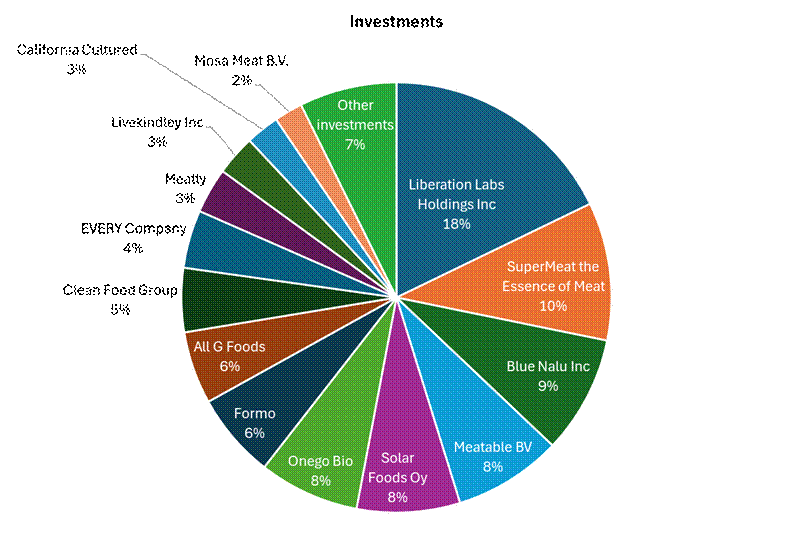
A reconciliation of investment carrying amounts is as follows:
|
Investment |
30 June 2023 £'000 |
Capital Invested £'000 |
Unrealised fair value gain/(loss) £'000 |
Unrealised foreign exchange gain/(loss) £'000 |
Accrued interest on loan note £'000 |
30 June 2024 £'000 |
|
All G Foods |
7,920 |
- |
- |
(9) |
- |
7,911 |
|
Blue Nalu Inc |
13,523 |
- |
- |
(734) |
66 |
12,855 |
|
Bond Pets |
742 |
- |
- |
(4) |
- |
738 |
|
California Cultured |
1,752 |
- |
1,953 |
(47) |
- |
3,658 |
|
CellX Limited |
2,020 |
- |
17 |
- |
2,037 |
|
|
Clean Food Group |
5,636 |
700 |
648 |
- |
- |
6,984 |
|
EVERY Company |
6,415 |
- |
- |
(88) |
- |
6,327 |
|
Formo |
9,459 |
- |
- |
(151) |
- |
9,308 |
|
Galy Co |
2,822 |
- |
(167) |
(43) |
- |
2,612 |
|
Geltor Inc |
7,561 |
- |
(7,260) |
(48) |
- |
253 |
|
Good Protein Fund |
99 |
39 |
- |
(19) |
- |
119 |
|
HydGene Renewables |
1,294 |
- |
- |
24 |
- |
1,318 |
|
Laverock Therapeutics |
- |
- |
48 |
- |
- |
48 |
|
Liberation Labs Holdings |
17,752 |
7,960 |
- |
(77) |
235 |
25,870 |
|
Livekindley Inc |
4,401 |
- |
- |
(12) |
- |
4,389 |
|
Meatable BV |
8,376 |
3,436 |
- |
9 |
- |
11,821 |
|
Meatly |
4,959 |
- |
- |
- |
- |
4,959 |
|
Mosa Meat B.V. |
3,000 |
- |
- |
99 |
- |
3,099 |
|
Onego Bio |
5,970 |
1,337 |
3,829 |
(172) |
- |
10,964 |
|
Seattle Food Tech, Inc. |
346 |
- |
- |
2 |
- |
348 |
|
Solar Foods Oy |
11,336 |
- |
- |
(96) |
21 |
11,261 |
|
SuperMeat |
15,584 |
- |
- |
(517) |
- |
15,067 |
|
Tropic Biosciences Limited |
2,379 |
- |
- |
(6) |
- |
2,373 |
|
Umami Bioworks |
- |
- |
380 |
2 |
- |
382 |
|
Vitrolabs |
7,798 |
- |
(7,584) |
(214) |
- |
- |
|
Wild Microbes |
392 |
- |
- |
2 |
- |
394 |
|
Legacy Investments |
237 |
- |
(189) |
- |
- |
48 |
|
──────── |
──────── |
──────── |
──────── |
──────── |
──────── |
|
|
Total |
141,773 |
13,472 |
(8,342) |
(2,082) |
322 |
145,143 |
|
════════ |
════════ |
════════ |
════════ |
════════ |
════════ |
Post Yearend Highlights:
● 17 July 2024, portfolio company Meatly became the first company in the world to receive regulatory clearance for cultivated meat to be sold as pet food, following approval from UK regulators including the Food Standards Authority and the Department for Environment, Food and Rural Affairs. Meatly's cultivated chicken for pet food can now be sold in the UK.
● 18 July 2024, portfolio company Onego Bio secured EUR 14 million in new funding from the European Innovation Council Accelerator Program and an additional Series A investor. In April 2024, Onego Bio announced it closed EUR 37 million in its series A round which, including this new capital, brings Onego Bio's total funding to date to EUR 65 million.
● 3 September 2024, portfolio company Solar Foods announced that it has obtained self-affirmed Generally Recognized as Safe ("GRAS") status in the US for the sale of its single-cell protein, Solein®. Achieving GRAS status is a major step towards Solein's commercialisation and entry into the US market. This is the second approval Solar Foods has secured after the sale of food products containing Solein was approved in Singapore in September 2022.
● 4 September 2024, portfolio company Galy closed an oversubscribed US$ 33 million Series B financing led by Breakthrough Energy Ventures LLC, with additional participation from new investors H&M Group Ventures and Industria de Diseño Textil, S.A. (through Mundi Ventures).
● 10 September 2024, portfolio company Formo announced it secured US$ 61 million in its Series B funding round to scale its operations. In addition to the raise, Formo's first two products Frischhain and Camembritz, two pioneering products are now available at over 2000 REWE, BILLA and METRO stores across Germany and Austria.
● 10 September 2024, portfolio company Solar Foods began trading on the Nasdaq First North Growth Exchange today under the ticker "SFOODS".
At 30 June 2024, the following investments are held by the Company:
Richard Reed
Chairperson Investment Committee
23 December 2024
Directors' report
The Directors of Agronomics Limited (the "Company") take pleasure in presenting the Directors' report and financial statements for the year ended 30 June 2024.
Principal activity
Agronomics Limited is a Company domiciled in the Isle of Man. The Company's strategy is to create value for Shareholders through investing in companies that operate in the nascent industry of cellular agriculture, which are environmentally friendly alternatives to the traditional production of meat and plant-based sources.
Further details of the investing policy can be found on the Company's website at www.agronomics.im.
Results and transfer to reserves
The results and transfers to reserves for the year are set out on pages 22 and 24.
The Company recorded a net operating loss of £10,989,608 for the year (2023: net operating profit of £22,373,676) prior to accounting for the fee due to Shellbay Investments Limited ("Shellbay"). During the year, as no Shellbay fee was due, net operating loss remains at £10,989,608 (2023: net operating profit, after accounting for the Shellbay Fee, of £22,373,676).
The net asset value per share at 30 June 2024 was 15.58 pence (2023: 16.94 pence).
Dividend
The Directors do not propose the payment of a dividend (2023: £nil).
Policy and practice on payment of creditors
It is the policy of the Company to agree appropriate terms and conditions for its transactions with suppliers by means of standard written terms to individually negotiated contracts. The Company seeks to ensure that payments are always made in accordance with these terms and conditions.
Financial risks
Details relating to the financial risk management are set out in note 8 to the financial statements.
Directors
The Directors who served during the year and to date were:
|
Jim Mellon |
Executive Chairperson (appointed as Chairperson on 14 December 2023) |
|
Denham Eke |
Executive Finance Director |
|
Richard Reed |
Independent Non-Executive (resigned as Chairperson on 14 December 2023) |
|
David Giampaolo |
Independent Non-Executive |
|
Marisa Drew |
Independent Non-Executive |
Directors' interests
As at 30 June 2024, the interests of the Directors and their families (as such term is defined in the AIM Rules for Companies) in the share capital of the Company are as follows:
|
Ordinary shares |
||
|
30 June 2024 |
30 June 2023 |
|
|
Jim Mellon 1 |
152,287,421 |
154,553,366 |
|
Denham Eke 2 |
1,551,824 |
739,390 |
|
Richard Reed |
6,354,412 |
6,354,412 |
|
David Giampaolo |
2,434,783 |
2,434,783 |
1 - Galloway Limited, a company where Jim Mellon is considered to be the ultimate beneficial owner, holds 147,591,813 shares and 2,313,647 are held by Shellbay Investments Limited, companies which are both indirectly wholly owned by Jim Mellon, and 2,381,961 ordinary shares are held directly by Mr Mellon.
2 - Denham Eke is Managing Director of Galloway Limited.
Significant shareholdings
Except for the interests disclosed in this note, the Directors are not aware of any holding of ordinary shares as at 30 June 2024 representing 3% or more of the issued share capital of the Company:
|
Number of ordinary shares |
Percentage of total issued capital |
|
|
Jim Mellon 1 |
152,287,421 |
15.09% |
|
Hargreaves Lansdown (Nominees) |
102,332,851 |
10.14% |
|
Interactive Investor |
58,201,536 |
5.77% |
|
BlackRock |
52,173,346 |
5.17% |
|
Canaccord Genuity Wealth Management |
39,500,000 |
3.91% |
|
JPMorgan Chase Bank |
37,989,575 |
3.76% |
Note:
1 - Galloway Limited, a company where Jim Mellon is considered to be the ultimate beneficial owner, holds 147,591,813 shares and 2,313,647 are held by Shellbay Investments Limited, companies which are both indirectly wholly owned by Jim Mellon, and 2,381,961 ordinary shares are held directly by Mr Mellon.
Auditors
KPMG Audit LLC, being eligible, have expressed their willingness to continue in office.
On behalf of the Board
Denham Eke
Finance Director
23 December 2024
1st Floor, Viking House
St Paul's Square
Ramsey, Isle of Man
IM8 1GB
Corporate Governance Statement
Corporate Governance Report
The Board of Agronomics (the "Board") is committed to best practice in corporate governance throughout the Company. The Directors have agreed to comply with the provisions of the Quoted Companies Alliance ("QCA") Corporate Governance Code for Small and Mid-Size Quoted Companies (2018) to the extent which is appropriate to its nature and scale of operations. This report illustrates how the Company complies with those principles.
QCA Principle 1: Establish a strategy and business model which promotes long-term value for shareholders
The strategy and business operations of the Company are set out in the Chairman's Statement on pages 2 to 3.
The Company's strategy and business model and amendments thereto are developed by the Chairperson and their senior management team and approved by the Board. The management team is responsible for implementing the strategy and managing the business at an operational level.
The Company's overall strategic objective is to develop a profitable and sustainable platform for investing in the nascent industry of modern foods which are environmentally friendly alternatives to the traditional production of meat and plant-based sources of nutrition.
In executing the Company's strategy and operational plans, management will typically confront a range of day-to-day challenges associated with these key risks and uncertainties and will seek to deploy the identified mitigation steps to manage these risks as they manifest themselves.
QCA Principle 2: Seek to understand and meet shareholder needs and expectations
The Company via the Chairperson seeks to maintain a regular dialogue with both existing and potential new shareholders in order to communicate the Company's strategy and progress and to understand the needs and expectations of shareholders.
Beyond the Annual General Meeting, the Chairperson and, where appropriate, other members of the senior management team or Board will meet with investors and analysts to provide them with updates on the Company's business and to obtain feedback regarding the market's expectations of the Company.
The Company's investor relations activities encompass dialogue with both institutional and private investors. From time to time, the Company attends private investor events, providing an opportunity for those investors to meet with representatives from the Company in a more informal setting.
QCA Principle 3: Take into account wider stakeholder and social responsibilities and their implications for long-term success
The Company is aware of its corporate social responsibilities and the need to maintain effective working relationships across a range of stakeholders. These include the Company's advisors, suppliers, and investee companies. The Company's operations and working methodologies take account of the need to balance the needs of all these stakeholders while maintaining focus on the Board's primary responsibility to promote the success of the Company for the benefit of its members as a whole. The Company endeavours to take account of feedback received from stakeholders, and where appropriate, ensures any amendments are consistent with the Company's longer-term strategy.
The Company takes due account of any impact that its activities may have on the environment and seeks to minimise this impact wherever possible.
QCA Principle 4: Embed effective risk management, considering both opportunities and threats, throughout the organisation
The Board is responsible for the systems of risk management and internal control and for reviewing their effectiveness. Internal controls are designed to manage rather than eliminate risk and provide reasonable but not absolute assurance against material misstatement or loss. Through the activities of the Company Audit, Risk and Compliance Committee, the effectiveness of these internal controls is reviewed annually.
A comprehensive budgeting process is completed once a year and is reviewed and approved by the Board. The Company's results, compared with the budget, are reported to the Board on a monthly basis.
The Company maintains appropriate insurance cover in respect of actions taken against the Directors because of their roles, as well as against material loss or claims against the Company. The insured values and type of cover are comprehensively reviewed on a periodic basis.
The senior management team meets at least monthly to consider new risks and opportunities presented to the Company, making recommendations to the Board and/or Company Audit, Risk and Compliance Committee as appropriate.
QCA Principle 5: Maintain the board as a well-functioning, balanced team led by the chair
The Company's Board currently comprises three Non-executive Directors and two Executive Directors.
All of the Directors are subject to election by shareholders at the first Annual General Meeting after their appointment to the Board and will continue to seek re-election at least once every three years.
The Board is responsible to the shareholders for the proper management of the Company and intends to meet at least four times a year to set the overall direction and strategy of the Company, to review operational and financial performance and to advise on management appointments. All key operational decisions are subject to Board approval.
Richard Reed, David Giampaolo and Marisa Drew, all Non-executive Directors, are considered to be independent. The QCA Code suggests that a board should have at least two independent Non-executive Directors. The Board considers that the current composition and structure of the Board of Directors is appropriate to maintain effective oversight of the Company's activities for the time being.
Non-executive Directors receive their fees in the form of a basic cash emolument. The current remuneration structure for the Board's Executive and Non-executive Directors is deemed to be proportionate.
QCA Principle 6: Ensure that between them the Directors have the necessary up-to-date experience, skills, and capabilities
The Board considers that the Executive Directors and Non-executive Directors are of sufficient competence and calibre to add strength and objectivity to its activities and bring considerable experience in the operational and financial development of the Company.
The Directors' biographies are detailed on the Company's website www.agronomics.im.
The Board regularly reviews the composition of the Board to ensure that it has the necessary breadth and depth of skills to support the ongoing development of the Company.
The Chairperson, in conjunction with the Finance Director, ensures that the Directors' knowledge is kept up to date on key issues and developments pertaining to the Company, its operational environment and to the Directors' responsibilities as members of the Board. During the course of the year, Directors received updates from the Finance Director and various external advisers on a number of corporate governance matters.
Directors' service contracts or appointment letters make provision for a Director to seek professional advice in furtherance of his or her duties and responsibilities, normally via the Company Secretary.
QCA Principle 7: Evaluate board performance based on clear and relevant objectives, seeking continuous improvement
Internal evaluation of the Board, the Committees and individual Directors is undertaken on an annual basis in the form of peer appraisal and discussions to determine their effectiveness and performance as well as the Directors' continued independence.
The results and recommendations that come out of the appraisals for the Directors shall identify the key corporate and financial targets that are relevant to each Director and their personal targets in terms of career development and training. Progress against previous targets is also assessed where relevant.
QCA Principle 8: Promote a corporate culture that is based on ethical values and behaviours
The Board seeks to maintain the highest standards of integrity and probity in the conduct of the Company's operations. With the Company being a vehicle for holding investment, it has no employees and limited capacity to effect changes in culture in companies it is affiliated with. However, the Board will strive to ensure that the Company's in which it has an interest in, act in an ethical manner.
The Board ensures that all portfolio companies have policies in place to comply with applicable governance laws and regulations, such as anti-bribery and modern-day slavery.
The Board has a zero-tolerance approach to breaches of these laws and regulations. The Board promotes ethical behaviour throughout the portfolio, through directions to the Company's investment advisors in relation to the ethical management of the portfolio.
QCA Principle 9: Maintain governance structures and processes that are fit for purpose and support good decision- making by the board
The Role of the Board
The Board is collectively responsible for the long-term success of the organisation. Its principal function is to determine the strategy and policies of the Company within an effective control framework which enables risk to be assessed and managed.
The Board ensures that the necessary financial and human resources are in place for the Company to meet its objectives and that business and management performance is reviewed. Furthermore, the Board ensures that the Company operates within its constitution, relevant legislation and regulation and that proper accounting records and effective systems of business control are established, maintained, documented, and audited.
There are at least four formal Board meetings each year. All Board members have the benefit, at the Company's expense, of liability insurance in respect of their responsibilities as Directors and have access to independent legal or other professional advice if required. The Board has a formal schedule of matters which are reserved for its consideration, and it has established three committees to consider specific issues in greater detail, being the Company Audit, Risk and Compliance, Remuneration and Nomination Committees. The Terms of Reference for each of these Committees are published on the Company's website.
The Chairperson
The Chairperson is responsible for leading the Board, ensuring its effectiveness in all aspects of its role, promoting a culture of openness of debate, and communicating with the Company's members on behalf of the Board. The Chairperson sets the direction of the Board and promotes a culture of openness and debate by facilitating the effective contribution of Non-executive Directors and ensuring constructive relations between Executive and Non-executive Directors. The Chairperson also ensures that Directors receive accurate, timely and clear information. In doing so, this fosters a positive corporate governance culture throughout the Company.
The Chief Executive Officer
At present, the Company does not have a Chief Executive Officer. Instead, the responsibility for managing the Company's business and operations within the parameters set by the Board is held by the Finance Director.
Non-executive Directors
The Non-executive Directors are responsible for bringing independent judgement to the discussions held by the Board, using their breadth of experience and understanding of the business. Their key responsibilities are to constructively challenge and contribute to strategic proposals, and to monitor performance, resources, and standards of conduct, compliance and control, whilst providing support to executive management in developing the Company.
The Board has established a Company Audit, Risk and Compliance Committee ("ARCC"), a Remuneration Committee and a Nominations Committee with formally delegated duties and responsibilities. Richard Reed chairs the ARCC, Jim Mellon chairs the Remuneration Committee, and the Nominations Committee is chaired by Richard Reed and comprised of the whole board.
Company Audit, Risk and Compliance Committee
The Company Audit, Risk and Compliance Committee meets at least two times each year is chaired by Richard Reed. The external auditors attend by invitation. Its role is to be responsible for reviewing the integrity of the financial statements and the balance of information disclosed in the accompanying Directors' Report, to review the effectiveness of internal controls and risk management systems and recommend to the Board (for approval by the members) the appointment or re-appointment of the external auditor. The ARCC reviews and monitors the external auditor's objectivity, competence, effectiveness and independence, ensuring that if it or its associates are invited to undertake non-audit work it will not compromise auditor objectivity and independence.
Further information can be found within the Company Audit, Risk and Compliance Report contained within this Annual Report.
Remuneration Committee
The Remuneration Committee intends to meet at least once a year and comprises of two Non-executive Directors and one Executive Director. It is chaired by Jim Mellon and is responsible for determining the remuneration of the Executive Director, the Company Secretary and other members of the management. Committee members do not take part in discussions concerning their own remuneration.
Further information can be found within the Remuneration Report contained within this Annual Report.
Nomination Committee
The Nomination Committee is comprised of the whole Board. It is chaired by the Chairperson of the Board and is responsible for making recommendations to the Board on matters relating to the composition of the Board, including Executive and Non-executive Director succession planning, the appointment of new Directors and the election and re-election of Directors. The Nomination Committee only meets as matters arise.
Appointments to the Board
The principal purpose of the Nomination Committee is to undertake the assessment of the balance of skills, experience, independence and knowledge on the Board against the requirements of the business, with a view to determining whether any shortages exist. Having completed the assessment, the Committee makes recommendations to the Board accordingly. Appointments to the Board are made on merit, with due regard to the benefits of diversity. Within this context, the paramount objective is the selection of the best candidate, irrespective of background, and it is the view of the Board that establishing quotas or targets for the diversity of the Board is not appropriate.
All Director appointments must be approved by the Company's Nominated Adviser, as required under the AIM Rules, before they are appointed to the Board.
Prior to appointment, Non-executive Directors are required to demonstrate that they are able to allocate sufficient time to undertake their duties.
Re-election
The Company's Rules require that all Directors are submitted for election at the AGM following their first appointment to the Board. Thereafter all directors will submit themselves for re-election at least once every three years, irrespective of performance.
Board and committee attendance
The number of formal scheduled Board and committee meetings held and attended by Directors during the year was as follows: -
|
Board |
ARCC |
Nomination |
Remuneration |
|
|
Richard Reed |
15/16 |
2/2 |
- |
- |
|
David Giampaolo |
16/16 |
2/2 |
- |
- |
|
Jim Mellon |
16/16 |
- |
- |
- |
|
Denham Eke |
16/16 |
2/2 |
- |
- |
|
Marisa Drew* |
15/16 |
- |
- |
- |
QCA Principle 10: Communicate how the company is governed and is performing by maintaining a dialogue with shareholders and other relevant stakeholders
The Company places a high priority on regular communications with its various stakeholders and aims to ensure that all communications concerning the Company's activities are clear, fair, and accurate. The Company's website is regularly updated, and users can register to be alerted when announcements or details of presentations and events are posted onto the website.
Notices of General Meetings of the Company can be found here: https://agronomics.im/latest-news/.
The results of voting on all resolutions in general meetings are posted to the Company's website, including any actions to be taken as a result of resolutions for which votes against have been received from at least 20 per cent of independent shareholders.
Approval
This report was approved by the Board of Directors on 23 December 2024 and signed on its behalf by:
Denham Eke
Finance Director
Audit, Risk and Compliance Committee Report
The Directors ensure the Company complies with the provisions of the Quoted Companies Alliance ("QCA") Corporate Governance Code for Small and Mid-Size Quoted Companies (2018) to the extent which is appropriate to its nature and scale of operations.
This report illustrates how the Company complies with those principles in relation to its Audit, Risk and Compliance Committee (the "ARCC").
Membership
The Committee comprises of two Non-Executive Directors, being Richard Reed and David Giampaolo, and one Executive Director, being Denham Eke. The composition of the Committee has been reviewed during the year and the Board is satisfied that the Committee members have the relevant financial experience and the expertise to resource and fulfil its responsibilities effectively, including those relating to risk and controls.
Meetings
The Committee meets two times a year, including the review of the interim and full year results. Other Directors and representatives from the external auditors attend by invitation.
Duties
The Committee carries out the duties below for the Company, as appropriate:
§ Monitors the integrity of the financial statements of the Company, including annual and half-yearly reports, interim management statements, and any other formal announcement relating to financial performance, reviewing significant financial reporting issues and judgements which they contain.
§ Reviews and challenges the consistency of the information presented within the financial statements, compliance with stock exchange or other legal requirements, accounting policies and the methods used to account for significant or unusual transactions.
§ Keeps under review the effectiveness of the Company's internal controls and risk management systems.
§ KPMG Audit LLC was appointed as auditor in 2011 and the ARCC will oversee the relationship with them including meetings when considered appropriate to discuss their remit and review the findings and any issues with the annual audit. It will also review their terms of appointment and plans to meet them once a year independent of management and will consider and make recommendations to the Board, to be put to the Company for approval at the Annual General Meeting, in relation to the appointment, re-appointment and removal of the Company's external auditor. There are no contractual restrictions in place in respect of the auditor choice.
§ The Committee is governed by a Terms of Reference and a copy of this is available on the Company's website.
2024 Annual Report
During the year, ARCC confirms that it has received sufficient, reliable and timely information from management and the external auditors to enable it to fulfil its responsibilities.
The Committee has satisfied itself that there are no relationships between the auditor and the Company which could adversely affect the auditor's independence and objectivity.
All internal control and risk issues that have been brought to the attention of ARCC by the external auditors have been considered and the Committee confirms that it is satisfied that management has addressed the issues or has plans to do so.
The Company has a number of policies and procedures in place as part of its internal controls and these are subject to continuous review and as a minimum are reviewed by ARCC on an annual basis.
ARCC has reviewed and discussed together with management and the external auditor the Company's financial statements for the year ended 30 June 2024 and reports from the external auditor on the planning for and outcome of their reviews and audit. The key accounting issues and judgements considered relating to the Company's financial statements and disclosures were as follows:
§ Valuation of unquoted investments £145,099,814;
§ Going concern - ARCC reviewed the going concern position of the Company, taking into account the 12-month cash flow forecasts. ARCC is satisfied that preparing the financial statements on a going concern basis is appropriate.
Richard Reed
Chairperson ARCC
23 December 2024
Report of the Remuneration Committee
As an Isle of Man registered company there is no requirement to produce a Directors' Remuneration Report. However, the Board follows best practice and therefore has prepared such a report.
The Directors have agreed to comply with the provisions of the Quoted Companies Alliance ("QCA") Corporate Governance Code for Small and Mid-Size Quoted Companies (2018) to the extent which is appropriate to its nature and scale of operations.
This report illustrates how the Company complies with those principles in relation to directors' remuneration.
The Level and Components of Non-Executive Directors Remuneration
The Remuneration Policy reflects the Company's business strategy and objectives as well as sustained and long-term value creation for shareholders. In addition, the policy aims to be fair and provide equality of opportunity, ensuring that:
§ the Company is able to attract, develop and retain high-performing and motivated people in the competitive local and wider markets;
§ The Company offers a competitive remuneration package to encourage enhanced performance and rewards individual contributions to the success of the Company, in a fair and responsible manner;
§ it reflects the Company's culture and values; and
§ there is full transparency of the Remuneration Policy.
In line with the Board's approach, which reflects that adopted within other comparable organisations, the Remuneration Policy provides for the reward of the Non-Executive Directors through fees and other benefits.
Non-Executive Directors Emoluments
The remuneration for the Non-Executive Directors reflects their responsibilities. It comprises fees and may include eligibility to participate in an annual bonus scheme, private healthcare and share option incentives, when any of these are considered appropriate.
Annual bonus scheme payments are not pensionable and are not contracted.
Non-executive Directors' Remuneration
Non-executive Directors do not receive any benefits other than their fees and travelling expenses for which they are reimbursed. The level of fees payable to Non-executive Directors is assessed using benchmarks from a group of comparable organisations.
Executive Directors Remuneration
Executive Directors do not receive any benefits other than their fees and travelling expenses for which they are reimbursed. The level of fees payable to Executive Directors is assessed using benchmarks from a group of comparable organisations.
The Committee believes that share ownership by executives strengthens the link between their personal interests and those of shareholders. Options will be granted to executives periodically at the discretion of the Remuneration Committee. The grant of share options is not subject to fixed performance criteria. This is deemed to be appropriate as it allows the Committee to consider the performance of the executives and the contribution of the individual executives and, as with annual bonus payments, illustrates the relative importance placed on performance-related remuneration.
Except when required by statute, the Company does not intend to contribute to the personal pension plans of Directors in the forthcoming year.
Executive Directors' Contractual Terms
The service contract of the Executive Directors provides for a notice period of six months.
The Procedure for Determining Remuneration
The Remuneration Committee, comprising two Non-executive Directors and one Executive Director, is responsible for setting the remuneration of the Executive Directors and is chaired by Jim Mellon. Committee members do not take part in discussions concerning their own remuneration. The basic Non-executive Director fee is set by the Chairperson. The Chairperson of the Committee reports at the Board meeting following a Committee meeting.
It is the view of the Committee that Directors' remuneration awarded across the Company for the year has been in accordance with the Company's stated Remuneration Policy and, on behalf of the Committee I recommend that you endorse this report. An analysis of Directors' emoluments is as follows:
|
2024 £ |
2023 £ |
||
|
Emoluments |
- salaries, bonuses, and taxable benefits |
- |
- |
|
- fees |
153,750 |
117,709 |
|
|
153,750 |
117,709 |
Directors' Emoluments
|
Fees £ |
Bonus £ |
Termination payments £ |
Benefits £ |
2024 Total £ |
2023 Total £ |
|
|
Executive - salary |
||||||
|
Denham Eke ** |
- |
- |
- |
- |
- |
- |
|
Jim Mellon* |
38,750 |
- |
- |
- |
38,750 |
30,000 |
|
Non-executive - fees |
- |
- |
- |
|||
|
Richard Reed |
35,000 |
- |
- |
- |
35,000 |
40,000 |
|
David Giampaolo |
30,000 |
- |
- |
- |
30,000 |
30,000 |
|
Marisa Drew |
50,000 |
- |
- |
- |
50,000 |
17,709 |
|
Aggregate emoluments |
153,750 |
- |
- |
- |
153,750 |
117,709 |
* In addition to director fees, further emoluments are subject to an agreement with Shellbay Investments Limited ("Shellbay"), whereby Shellbay shall be entitled to an annual fee equal to the value of 15% of any increase between the Company's net asset value ("NAV") on a per issued share basis at the start of a reporting period and 30 June each year during the term of the New Shellbay Agreement (please see Note 2 to the Accounts).
** Denham Eke was appointed as a Director on 30 May 2012 and currently receives no remuneration for providing his services (refer note 11).
Approval
The report was approved by the Board of directors and signed on behalf of the Board.
Jim Mellon
Chairperson of Remuneration Committee
23 December 2024
Statement of Directors' Responsibilities in Respect of the Directors' Report and the Financial Statements
The Directors are responsible for preparing the Directors' Report and the financial statements in accordance with applicable law and regulations.
Company law requires the Directors to prepare financial statements for each financial year. Under that law they have elected to prepare the financial statements in accordance with International Financial Reporting Standards as applicable to an Isle of Man company and applicable law.
Under company law the Directors must not approve the financial statements unless they are satisfied that they give a true and fair view of the state of affairs of the Company and of its profit or loss for that period. In preparing the financial statements, the Directors are required to:
· select suitable accounting policies and then apply them consistently;
· make judgements and estimates that are reasonable, relevant and reliable;
· state whether they have been prepared in accordance with IFRSs;
· assess the Company's ability to continue as a going concern, disclosing, as applicable, matters related to going concern; and
· use the going concern basis of accounting unless they either intend to liquidate the Company or to cease operations or have no realistic alternative but to do so.
The Directors are responsible for keeping adequate accounting records that are sufficient to show and explain the Company's transactions and disclose with reasonable accuracy at any time the financial position of the Company and enable them to ensure that its financial statements comply with the Isle of Man Companies Act 2006. They are responsible for such internal control as they determine is necessary to enable the preparation of financial statements that are free from material misstatement, whether due to fraud or error, and have general responsibility for taking such steps as are reasonably open to them to safeguard the assets of the Company and to prevent and detect fraud and other irregularities.
The Directors are responsible for the maintenance and integrity of the corporate and financial information included on the Company's website. Legislation in the Isle of Man governing the preparation and dissemination of financial statements may differ from legislation in other jurisdictions.
We have audited the financial statements of Agronomics Limited (the "Company"), which comprise the statement of financial position as at 30 June 2024, the statements of comprehensive income, changes in equity and cash flows for the year then ended, and notes, comprising material accounting policies and other explanatory information.
In our opinion, the accompanying financial statements:
· give a true and fair view of the state of the Company's affairs as at 30 June 2024 and of the Company's loss for the year then ended;
· have been properly prepared in accordance with International Financial Reporting Standards; and
· have been properly prepared in accordance with the requirements of the Companies Act 2006.
Basis for opinionWe conducted our audit in accordance with International Standards on Auditing (UK) ("ISAs (UK)") and applicable law. Our responsibilities are described below. We have fulfilled our ethical responsibilities under, and are independent of the Company in accordance with, UK ethical requirements including the FRC Ethical Standard as applied to listed entities. We believe that the audit evidence we have obtained is a sufficient and appropriate basis for our opinion.
Key audit matters: our assessment of the risks of material misstatementKey audit matters are those matters that, in our professional judgment, were of most significance in the audit of the financial statements and include the most significant assessed risks of material misstatement (whether or not due to fraud) identified by us, including those which had the greatest effect on: the overall audit strategy; the allocation of resources in the audit; and directing the efforts of the engagement team. These matters were addressed in the context of our audit of the financial statements as a whole, and in forming our opinion thereon, and we do not provide a separate opinion on these matters. In arriving at our audit opinion above, the key audit matter was as follows (unchanged from 2023):
|
The risk |
Our response |
|
|
Valuation of unquoted investments (including investment in subsidiary and other unquoted investments held) 2024: £145,099,814 (2023: £141,595,967) Refer to Page 13 for Audit, Risk and Compliance Committee Report, note 1(b) (use of estimates and judgement), 1(d) (accounting policy for financial instruments) and note 9 (fair value of financial instruments) disclosures |
Subjective Valuation: The Company's investment in subsidiary is stated at fair value of £136,953,040 (2023: £134,178,896). The underlying portfolio of investments held by the subsidiary comprises the entirety of its net assets. The Company also holds unquoted investments directly amounting to £8,146,774 (2023: £7,417,071). 92% (2023: 83%) of the Company's total assets (by value) are held in investments where no quoted market price is available. Unquoted investments held directly by the Company, and indirectly through the underlying portfolio in its subsidiary, are measured at fair value, which is established in accordance with the International Private Equity and Venture Capital Valuation Guidelines by using measurements of value such as comparison with prices of recent orderly transactions, where available, requires the use of significant judgments and subjective assumptions. |
Our audit procedures included: Internal Controls: Assessing the design and implementation of the investment valuation controls. Test of Detail: Auditing the accounts of the subsidiary as part of the audit of the Company, including assessing the accounting policies adopted by the subsidiary to ensure these are consistent with the Company's accounting policies. In particular, ensuring that the portfolio of investments held by the subsidiary is stated at fair value and ensuring net asset value of the subsidiary represents fair value. Use of KPMG Specialists: Involving our own valuation specialists to challenge management assumptions used to support the fair value prices. |
|
The risk |
Our response |
|
|
The preparation of the fair value estimate for the unquoted investments and related disclosures is a significant area of our audit given that it represents a significant portion of the Company's total assets and involves the use of significant judgments and subjective assumptions. The effect of these matters is that as part of our risk assessment, we determined that the valuation of unquoted investments has a high degree of estimation uncertainty, with a potential range of reasonable outcomes greater than our materiality for the financial statements as a whole and possibly many times that amount. |
Challenging managements' assumptions and inputs: Challenging the directors on key judgments affecting investee company valuations, such as the achievement of key milestones or potential dilution impacts of recent transactions. Our work included consideration of events which occurred subsequent to the year end up until the date of this report. Assessing observable inputs: Where a recent transaction has been used as a basis to value a holding, we obtained an understanding of the circumstances surrounding the transaction such as whether it was considered to be on an arms-length basis and suitable as an input into a valuation. Methodology choice: In the context of observed industry best practice and the provisions of the International Private Equity and Venture Capital Valuation Guidelines, we challenged the appropriateness of the valuation basis selected. Assessing disclosures: Consideration of the appropriateness, in accordance with relevant accounting standards, of the disclosures in respect of unquoted investments and the significant inherent uncertainty associated with valuing such investments. |
Our application of materiality and an overview of the scope of our audit
Materiality for the financial statements as a whole was set at £1,320,000 (2023: £1,260,000), determined with reference to a benchmark of total assets of £165,880,000, of which it represents approximately 0.8% (2023: 0.8%).
In line with our audit methodology, our procedures on individual account balances and disclosures were performed to a lower threshold, performance materiality, so as to reduce to an acceptable level the risk that individually immaterial misstatements in individual account balances add up to a material amount across the financial statements as a whole. Performance materiality for the Company was set at 65% (2023: 65%) of materiality for the financial statements as a whole, which equates to £858,000 (2023: £819,000). We applied this percentage in our determination of performance materiality because we did not identify any factors indicating an elevated level of risk.
We reported to the Audit Committee any corrected or uncorrected identified misstatements exceeding £66,000 (2023: £63,000), in addition to other identified misstatements that warranted reporting on qualitative grounds.
Our audit of the Company was undertaken to the materiality level specified above, which has informed our identification of significant risks of material misstatement and the associated audit procedures performed in those areas as detailed above.
Going concernThe directors have prepared the financial statements on the going concern basis as they do not intend to liquidate the Company or to cease its operations, and as they have concluded that the Company's financial position means that this is realistic. They have also concluded that there are no material uncertainties that could have cast significant doubt over its ability to continue as a going concern for at least a year from the date of approval of the financial statements (the "going concern period").
In our evaluation of the directors' conclusions, we considered the inherent risks to the Company's business model and analysed how those risks might affect the Company's financial resources or ability to continue operations over the going concern period. The risks that we considered most likely to affect the Company's financial resources or ability to continue operations over this period were:
· Availability of capital to meet operating costs and other financial commitments; and
· The recoverability of financial assets subject to credit risk;
We considered whether these risks could plausibly affect the liquidity in the going concern period by comparing severe, but plausible downside scenarios that could arise from these risks individually and collectively against the level of available financial resources indicated by the Company's financial forecasts.
We considered whether the going concern disclosure in note 1 (b) to the financial statements gives a full and accurate description of the directors' assessment of going concern.
Our conclusions based on this work:
· we consider that the directors' use of the going concern basis of accounting in the preparation of the financial statements is appropriate;
· we have not identified, and concur with the directors' assessment that there is not, a material uncertainty related to events or conditions that, individually or collectively, may cast significant doubt on the Company's ability to continue as a going concern for the going concern period; and
· we found the going concern disclosure in the notes to the financial statements to be acceptable.
However, as we cannot predict all future events or conditions and as subsequent events may result in outcomes that are inconsistent with judgements that were reasonable at the time they were made, the above conclusions are not a guarantee that the Company will continue in operation.
Fraud and breaches of laws and regulations - ability to detect
Identifying and responding to risks of material misstatement due to fraud
To identify risks of material misstatement due to fraud ("fraud risks") we assessed events or conditions that could indicate an incentive or pressure to commit fraud or provide an opportunity to commit fraud. Our risk assessment procedures included:
· enquiring of management as to the Company's policies and procedures to prevent and detect fraud as well as enquiring whether management have knowledge of any actual, suspected or alleged fraud;
· reading minutes of meetings of those charged with governance; and
· using analytical procedures to identify any unusual or unexpected relationships.
As required by auditing standards, and taking into account possible incentives or pressures to misstate performance and our overall knowledge of the control environment, we perform procedures to address the risk of management override of controls, in particular the risk that management may be in a position to make inappropriate accounting entries, and the risk of bias in accounting estimates such as valuation of unquoted investments. On this audit we do not believe there is a fraud risk related to revenue recognition because the Company's revenue streams are simple in nature with respect to accounting policy choice, and are easily verifiable to external data sources or agreements with little or no requirement for estimation from management. We did not identify any additional fraud risks.
We performed procedures including:
· identifying journal entries and other adjustments to test based on risk criteria and comparing any identified entries to supporting documentation;
· incorporating an element of unpredictability in our audit procedures; and
· assessing significant accounting estimates for bias.
Further detail in respect of valuation of unquoted investments is set out in the key audit matter section of this report.
Identifying and responding to risks of material misstatement due to non-compliance with laws and regulations
We identified areas of laws and regulations that could reasonably be expected to have a material effect on the financial statements from our sector experience and through discussion with management (as required by auditing standards), and from inspection of the Company's regulatory and legal correspondence, if any, and discussed with management the policies and procedures regarding compliance with laws and regulations. As the Company is regulated, our assessment of risks involved gaining an understanding of the control environment including the entity's procedures for complying with regulatory requirements.
The Company is subject to laws and regulations that directly affect the financial statements including financial reporting legislation and taxation legislation and we assessed the extent of compliance with these laws and regulations as part of our procedures on the related financial statement items.
The Company is subject to other laws and regulations where the consequences of non-compliance could have a material effect on amounts or disclosures in the financial statements, for instance through the imposition of fines or litigation or impacts on the Company's ability to operate. We identified financial services regulation as being the area most likely to have such an effect, recognising the regulated nature of the Company's activities and its legal form. Auditing standards limit the required audit procedures to identify non-compliance with these laws and regulations to enquiry of management and inspection of regulatory and legal correspondence, if any. Therefore if a breach of operational regulations is not disclosed to us or evident from relevant correspondence, an audit will not detect that breach.
Context of the ability of the audit to detect fraud or breaches of law or regulation
Owing to the inherent limitations of an audit, there is an unavoidable risk that we may not have detected some material misstatements in the financial statements, even though we have properly planned and performed our audit in accordance with auditing standards. For example, the further removed non-compliance with laws and regulations is from the events and transactions reflected in the financial statements, the less likely the inherently limited procedures required by auditing standards would identify it.
In addition, as with any audit, there remains a higher risk of non-detection of fraud, as this may involve collusion, forgery, intentional omissions, misrepresentations, or the override of internal controls. Our audit procedures are designed to detect material misstatement. We are not responsible for preventing non-compliance or fraud and cannot be expected to detect non-compliance with all laws and regulations.
Other informationThe directors are responsible for the other information. The other information comprises the information included in the annual report but does not include the financial statements and our auditor's report thereon. Our opinion on the financial statements does not cover the other information and we do not express an audit opinion or any form of assurance conclusion thereon.
In connection with our audit of the financial statements, our responsibility is to read the other information and, in doing so, consider whether the other information is materially inconsistent with the financial statements or our knowledge obtained in the audit, or otherwise appears to be materially misstated. If, based on the work we have performed, we conclude that there is a material misstatement of this other information, we are required to report that fact. We have nothing to report in this regard.
Respective responsibilitiesDirectors' responsibilities
As explained more fully in their statement set out on page 16, the directors are responsible for: the preparation of the financial statements including being satisfied that they give a true and fair view; such internal control as they determine is necessary to enable the preparation of financial statements that are free from material misstatement, whether due to fraud or error; assessing the Company's ability to continue as a going concern, disclosing, as applicable, matters related to going concern; and using the going concern basis of accounting unless they either intend to liquidate the Company or to cease operations, or have no realistic alternative but to do so.
Auditor's responsibilities
Our objectives are to obtain reasonable assurance about whether the financial statements as a whole are free from material misstatement, whether due to fraud or error, and to issue our opinion in an auditor's report. Reasonable assurance is a high level of assurance, but does not guarantee that an audit conducted in accordance with ISAs (UK) will always detect a material misstatement when it exists. Misstatements can arise from fraud or error and are considered material if, individually or in aggregate, they could reasonably be expected to influence the economic decisions of users taken on the basis of the financial statements.
A fuller description of our responsibilities is provided on the FRC's website at www.frc.org.uk/auditorsresponsibilities.
This report is made solely to the Company's members, as a body, in accordance with section 80(C) of the Companies Act 2006. Our audit work has been undertaken so that we might state to the Company's members those matters we are required to state to them in an auditor's report and for no other purpose. To the fullest extent permitted by law, we do not accept or assume responsibility to anyone other than the Company and the Company's members, as a body, for our audit work, for this report, or for the opinions we have formed.
KPMG Audit LLC
Chartered Accountants
Heritage Court
41 Athol Street
Douglas
Isle of Man IM1 1LA
24 December 2024
Statement of comprehensive income
for the year ended 30 June 2024
|
Note |
2024 £ |
2023 £ |
||||
|
Income |
||||||
|
Net (loss)/income from financial instruments at fair value through profit and loss |
3 |
(8,342,317) |
29,703,324 |
|||
|
──────── |
──────── |
|||||
|
(8,342,317) |
29,703,324 |
|||||
|
Operating expenses |
||||||
|
Directors' fees |
2 |
(153,750) |
(117,709) |
|||
|
Other operating costs |
4 |
(1,524,949) |
(1,648,101) |
|||
|
Foreign exchange losses |
(2,143,477) |
(3,364,673) |
||||
|
──────── |
──────── |
|||||
|
(Loss)/profit from operating activities |
5 |
(12,164,493) |
24,572,841 |
|||
|
Other costs |
||||||
|
Consulting fee |
2 |
- |
(3,372,672) |
|||
|
──────── |
──────── |
|||||
|
(Loss)/profit before other income |
(12,164,493) |
21,200,169 |
||||
|
Other income |
||||||
|
Interest received |
1,174,885 |
1,173,507 |
||||
|
──────── |
──────── |
|||||
|
(Loss)/profit before taxation |
(10,989,608) |
22,373,676 |
||||
|
Taxation |
1(h) |
- |
- |
|||
|
──────── |
──────── |
|||||
|
(Loss)/profit for the year |
(10,989,608) |
22,373,676 |
||||
|
Other comprehensive income |
- |
- |
||||
|
──────── |
──────── |
|||||
|
Total comprehensive (loss)/profit for the year |
(10,989,608) |
22,373,676 |
||||
|
════════ |
════════ |
|||||
|
Basic (loss)/profit per share (pence) |
12 |
(1.10) |
2.27 |
|||
|
Diluted (loss)/profit per share (pence) |
12 |
(1.10) |
2.20 |
|||
The Directors consider that the Company's activities are continuing.
The notes on pages 26 to 40 form an integral part of these financial statements.
Statement of financial position
as at 30 June 2024
|
2024 |
2023 |
||||
|
Note |
£ |
£ |
|||
|
Assets |
|||||
|
Financial assets at fair value through profit or loss |
7,8, 9 |
145,143,166 |
141,773,297 |
||
|
Bank deposits |
9,107,996 |
10,000,000 |
|||
|
Trade and other receivables |
56,979 |
335,810 |
|||
|
Cash and cash equivalents |
3,127,096 |
18,093,984 |
|||
|
──────── |
──────── |
||||
|
Total assets |
157,435,237 |
170,203,091 |
|||
|
════════ |
════════ |
||||
|
Equity and liabilities |
|||||
|
Capital and reserves |
|||||
|
Share capital |
6 |
1,008 |
992 |
||
|
Share premium |
6 |
136,169,365 |
134,481,365 |
||
|
Share reserve |
6 |
- |
1,686,336 |
||
|
Accumulated earnings |
21,098,697 |
32,088,305 |
|||
|
──────── |
──────── |
||||
|
157,269,070 |
168,256,998 |
||||
|
Liabilities |
|||||
|
Trade and other payables |
10 |
166,167 |
1,946,093 |
||
|
──────── |
──────── |
||||
|
Total liabilities |
166,167 |
1,946,093 |
|||
|
──────── |
──────── |
||||
|
Total equity and liabilities |
157,435,237 |
170,203,091 |
|||
|
════════ |
════════ |
The notes on pages 26 to 40 form an integral part of these financial statements.
These financial statements were approved by the Board of Directors on 23 December 2024 and were signed on their behalf by:
Denham Eke
Finance Director
Statement of changes in equity
for the year ended 30 June 2024
|
Note |
Share capital |
Share premium |
Share reserve |
Accumulated earnings |
Total |
|
|
£ |
£ |
£ |
£ |
£ |
||
|
Balance at 30 June 2022 |
6 |
968 |
129,855,667 |
4,341,639 |
9,714,629 |
143,912,903 |
|
Total comprehensive profit for the year |
||||||
|
Profit for the year |
- |
- |
- |
22,373,676 |
22,373,676 |
|
|
Transactions with owners of the company |
||||||
|
Shares issued during the year |
6 |
24 |
4,625,698 |
(4,341,639) |
- |
284,083 |
|
Recognition of share reserve |
6 |
- |
- |
1,686,336 |
- |
1,686,336 |
|
──────── |
──────── |
──────── |
──────── |
──────── |
||
|
Balance at 30 June 2023 |
992 |
134,481,365 |
1,686,336 |
32,088,305 |
168,256,998 |
|
|
════════ |
════════ |
════════ |
════════ |
════════ |
||
|
Note |
Share capital |
Share premium |
Share reserve |
Accumulated earnings |
Total |
|
|
£ |
£ |
£ |
£ |
£ |
||
|
Balance at 30 June 2023 |
6 |
992 |
134,481,365 |
1,686,336 |
32,088,305 |
168,256,998 |
|
Total comprehensive loss for the year |
||||||
|
Loss for the year |
- |
- |
- |
(10,989,608) |
(10,989,608) |
|
|
Transactions with owners of the company |
||||||
|
Shares issued during the year |
6 |
16 |
1,688,000 |
(1,686,336) |
- |
1,680 |
|
──────── |
──────── |
──────── |
──────── |
──────── |
||
|
Balance at 30 June 2024 |
6 |
1,008 |
136,169,365 |
- |
21,098,697 |
157,269,070 |
|
════════ |
════════ |
════════ |
════════ |
════════ |
||
The notes on pages 26 to 40 form an integral part of these financial statements.
Statement of cash flows
for the year ended 30 June 2024
|
2024 |
2023 |
||
|
Note |
£ |
£ |
|
|
Cash flows from operating activities |
|||
|
Operating (loss)/profit for the year |
(10,989,608) |
22,373,676 |
|
|
Purchase of investments |
8 |
(13,472,336) |
(19,542,137) |
|
Interest income |
(1,174,885) |
(1,173,507) |
|
|
Realised and unrealised gains on investments |
3 |
8,342,317 |
(29,703,324) |
|
Unrealised foreign exchange losses on investments |
8 |
2,082,826 |
2,729,121 |
|
Consulting fee to be settled in shares |
2 |
- |
1,686,336 |
|
Cash interest received * |
852,208 |
729,639 |
|
|
─────── |
─────── |
||
|
Operating cashflows before changes in working capital |
(14,359,478) |
(22,900,196) |
|
|
Change in trade and other receivables |
278,832 |
(233,152) |
|
|
Change in trade and other payables |
10 |
(1,779,926) |
(539,252) |
|
─────── |
─────── |
||
|
Net cash used in operating activities |
(15,860,572) |
(23,672,600) |
|
|
─────── |
─────── |
||
|
Cash flows from financing activities |
|||
|
Proceeds from issue of shares |
1,680 |
284,082 |
|
|
─────── |
─────── |
||
|
Net cash from financing activities |
1,680 |
284,082 |
|
|
─────── |
─────── |
||
|
Cash flows from investing activities |
|||
|
Bank deposits not considered cash and cash equivalents (net movement) |
892,004 |
10,024,176 |
|
|
─────── |
─────── |
||
|
Net cash from investing activities |
892,004 |
10,024,176 |
|
|
─────── |
─────── |
||
|
Decrease in cash and cash equivalents |
(14,966,888) |
(13,364,342) |
|
|
Cash and cash equivalents at beginning of year |
18,093,984 |
31,458,326 |
|
|
─────── |
─────── |
||
|
Cash and cash equivalents at the end of year |
3,127,096 |
18,093,984 |
|
|
═══════ |
═══════ |
||
|
* restated - Refer to Note 1 |
|||
The notes on pages 26 to 40 form an integral part of these financial statements.
1 Accounting policies
Agronomics Limited is a Company domiciled in the Isle of Man. The Company's strategy is to create value for Shareholders through investing in companies that operate in the nascent industry of modern foods, which are environmentally friendly alternatives to the traditional production of meat and plant-based sources.
The principal accounting policies are set out below.
a) Basis of accounting
The financial statements have been prepared in accordance with International Financial Reporting Standards ("IFRS"). There has been no material impact on the financial statements of new standards/interpretations that have come into effect during the current year.
b) Basis of preparation
The financial statements are prepared under the historical cost convention except where assets and liabilities are required to be stated at their fair value.
Presentational restatement
In the current year, the prior year presentation of cash interest received of £729,639 has been reclassified from financing activities to operating activities in the Statement of Cashflows to reflect the nature of the cash inflows being on cash held. The impact of this restatement reduced cashflows from financing activities for the prior year from £1,013,721 to £284,082 and reduced net cash used in operating activities from outflows of £24,402,239 to outflows of £23,672,600. This restatement does not have any impact on the statement of comprehensive income or statement of financial position.
Use of estimates and judgment
The preparation of financial statements in conformity with IFRS requires management to make judgements, estimates and assumptions that affect the application of policies and reported amounts of assets and liabilities, income and expenses. The estimates and associated assumptions are based on historical experience and various other factors that are believed to be reasonable under the circumstances, the results of which form the basis of making the judgements about carrying values of assets and liabilities that are not readily apparent from other sources. Actual results may differ from these estimates.
The estimates and underlying assumptions are reviewed on an on-going basis. Revisions to accounting estimates are recognised in the period in which the estimate is revised if the revision only affects that period or in the period of the revision and future periods if the revision affects both current and future periods.
Judgements made by the Directors in the application of IFRS, that have a significant impact on the financial statements and estimates with a significant risk of material adjustment in the next financial year relate to valuation of financial assets at fair value through profit or loss. The determination of fair values for financial assets for which there is no observable market price requires judgment as to the selection of valuation techniques as described in accounting policy 1(d). For financial instruments that trade infrequently and have little price transparency, fair value is less objective, and requires varying degrees of judgement and estimation depending on liquidity, concentration, uncertainty of market factors, pricing assumptions and other risks affecting the specific instrument. The portfolio companies are all in the start-up/development stage and in the biotechnology and biopharmaceutical sector. By their nature, such companies are difficult to value, as they have little or no track record regarding sales and margins and may be subject to continued funding being available in order to continue in operation. The eventual outcome may differ materially from the value estimate. See also note 8 in respect of the valuation of financial instruments.
Going concern
The financial statements have been prepared on a going concern basis, taking into consideration the level of cash and liquid investments held by the Company. The Directors have a reasonable expectation that the Company will have adequate resources for its continuing existence and projected activities for the foreseeable future, and for these reasons, continue to adopt the going concern basis in preparing the financial statements for the year ended 30 June 2024.
Functional and presentation currency
These financial statements are presented in Pound Sterling (£) which is the Company's functional currency and rounded to the nearest pound.
c) Net income from financial instruments at fair value through profit and loss
Any realised and unrealised gains and losses on investments are presented within 'net income from financial instruments at fair value through profit or loss'.
Interest income earned from bank deposits is not classified as operating income as it is not a return earned from the Company's investment policy and objectives, and therefore is presented as Other Income.
d) Financial instruments
Recognition and initial measurement
The Company recognises financial assets and financial liabilities at fair value on the trade date, which is the date on which the Company becomes party to the contractual provisions of the instrument. A financial asset or financial liability is measured initially at fair value plus, for an item not at FVTPL, transaction costs that are directly attributable to its acquisition or issue.
Classification
On initial recognition, the Company classifies financial assets as measured at amortised cost or FVTPL.
A financial asset is measured at amortised cost if it meets both of the following conditions and is not designated as at FVTPL:
· it is held within a business model whose objective is to hold assets to collect contractual cash flows; and
· its contractual terms give rise on specified dates to cash flows that are solely payment of principal and interest ("SPPI").
All other financial assets of the Company are measured at FVTPL.
Business model assessment
In making an assessment of the objective of the business model in which a financial asset is held, the Company considers all of the relevant information about how the business is managed, including:
· the documented investment strategy and the execution of this strategy in practice. This includes whether the investment strategy focuses on earning contractual interest income, maintaining a particular interest rate profile, matching the duration of the financial assets to the duration of any related liabilities or expected cash outflows or realising cash flows through the sale of the assets;
· how the performance of the portfolio is evaluated and reported to the Company's management;
· the risks that affect the performance of the business model (and the financial assets held within that business model) and how those risks are managed;
· how the investment manager is compensated: e.g. whether compensation is based on the fair value of the assets managed or the contractual cash flows collected; and
· the frequency, volume and timing of sales of financial assets in prior periods, the reasons for such sales and expectations about future sales activity.
Transfers of financial assets to third parties in transactions that do not qualify for derecognition are not considered sales for this purpose, consistent with the company's continuing recognition of the assets.
The Company has determined that it has two business models.
Held-to-collect business model: this includes cash and cash equivalents and bank deposits. These financial assets are held to collect contractual cash flow.
Other business model: this includes debt securities, equity investments both quoted and unquoted. These financial assets are managed and their performance is evaluated, on a fair value basis.
Fair value measurement principles
The fair value of investment holdings of listed investments is based on their quoted market prices at the reporting date on a recognised exchange or in the case of non-exchange traded instruments, sourced from a reputable counterparty, without any deduction for estimated future selling costs. Financial assets are priced at their closing bid prices, while financial liabilities are priced at their closing offer prices.
Company assets may, at any time include securities and other financial instruments or obligations that are thinly traded or for which no market exists and/or which are restricted as to their transferability under securities laws.
If a quoted market price is not available on a recognised stock exchange, or a market is not sufficiently active for the market price to be considered reliable, or if a price is not available from a reputable counterparty, fair value of the financial instruments may be estimated by the Directors using valuation techniques, including use of recent arm's length market transactions, reference to the current fair value of another instrument that is substantially the same, discounted cash flow techniques, option pricing models or any other valuation technique that provides a reliable estimate of prices obtained in actual market transactions.
The Company recognizes transfers between levels of the fair value hierarchy as at the end of the reporting period during which the change occurred.
Reclassifications
Financial assets are not reclassified subsequent to their initial recognition unless the Company were to change its business model for managing financial assets, in which case all affected financial assets would be reclassified on the first day of the first reporting period following the change in the business model.
Impairment
The Company recognises loss allowances for Expected Credit Losses ("ECLs") on financial assets measured at amortised cost.
The Company measures loss allowances at an amount equal to lifetime ECLs, except for the following, which are measured at 12-month ECLs:
· financial assets that are determined to have low credit risk at the reporting date; and
· other financial assets for which credit risk (i.e. the risk of default occurring over the expected life of the asset) has not increased significantly since initial recognition.
Derecognition
The Company derecognises a financial asset when the contractual rights to the cash flows from the asset expire, or it transfers the rights to receive the contractual cash flows in a transaction in which substantially all of the risks and rewards of ownership of the financial asset are transferred or in which the Company neither transfers nor retains substantially all of the risks and rewards of ownership and does not retain control of the financial asset.
On derecognition of a financial asset, the difference between the carrying amount of the asset (or the carrying amount allocated to the portion of the asset that is derecognised) and the consideration received (including any new asset obtained less any new liability assumed) is recognised in profit or loss. Any interest in such transferred financial assets that is created or retained by the Company is recognised as a separate asset or liability.
Cash and cash equivalents
Cash and cash equivalents comprise cash balances and call deposits with maturities of three months or less from the acquisition date that are subject to an insignificant risk of changes in fair value.
Trade and other receivables
Trade and other receivables originated by the Company are initially recognised at fair value and subsequently stated at amortised cost less impairment losses.
Trade and other payables
Trade and other payables are initially recognised at fair value less directly attributable transaction costs. Subsequently they are measured at amortised cost using the effective interest method.
e) Share capital and share premium
Ordinary shares are classified as equity. The ordinary shares of the Company have a par value of £0.000001 each. Excess proceeds received for the issue of shares has been credited to share premium. Incremental costs directly attributable to the issue of ordinary shares are recognised as a deduction from equity, net of any tax effects.
f) Foreign currencies
Transactions in foreign currencies are translated into the functional currency at the rate ruling at the date of the transaction. Monetary assets and liabilities denominated in foreign currencies are translated into the functional currency at the exchange rate at the reporting date. Non-monetary assets and liabilities that are measured at fair value in a foreign exchange currency are translated into the functional currency at the exchange rate when the fairvalue was determined. Non-monetary items that are measured based on historical cost in a foreign currency are translated at the exchange rate at the date of the transaction.
Foreign currency differences are generally recognised in profit or loss and presented as foreign exchange gains / (losses).
g) New standards and interpretations not yet adopted
A number of new standards, amendments to standards and interpretations are not yet effective for the year, and have not been applied in preparing these historical financial statements:
|
New/revised International Accounting Standards / International Financial Reporting Standards ("IAS/IFRS") |
IFRS Effective date (accounting periods commencing on or after) |
||
|
Non-current liabilities with Covenants |
1 Jan 2024 |
||
|
Lack of Exchangeability |
1 Jan 2025 |
||
|
Amendments to the Classification and Measurement of Financial Instruments - Amendments to IFRS 9 and IFRS 7 |
1 Jan 2026 |
||
|
IFRS 18 Presentation and Disclosure in Financial Statements |
1 Jan 2027 |
||
The Directors do not expect the adoption of the standards and interpretations to have a material impact on the financial statements in the period of initial application, except for IFRS 18, where the Directors are assessing the impact. There are no other standards, amendments or interpretations to existing standards that are not yet effective, that would have a material impact on the Company's reported results.
There has been no material impact on the Company's financial statements of new standards or interpretations that have come into effect during the current reporting period.
h) Taxation
The Company is subject to income tax at a rate of 0% in the Isle of Man, and accordingly, no tax has been provided for in these financial statements.
The Company may be subject to withholding taxes in relation to income from investments, or investment realisation proceeds or gains, and such amounts will be accounted for as incurred.
i) Segmental reporting
The Directors are of the opinion that the Company is engaged in a single segment of business, being investing in companies that operate in the nascent industry of modern foods, which are environmentally friendly alternatives to the traditional production of meat and plant-based sources. Information presented to the Board of Directors for the purpose of decision making is based on this single segment and in accordance with IFRS.
j) Investment entity
The Company is an investment entity and measures investments in its subsidiaries at FVTPL. In determining whether the Company meets the definition of an investment entity, management considered the Company structure as a whole. In particular, when assessing the existence of investment exit strategies and whether the Company or its subsidiary has more than one investment, management took into consideration the fact that the subsidiary was formed in order to hold investments on behalf of the Company. Management concluded that the Company and the subsidiary each meet the definition of an investment entity. Consequently, management concluded that the Company should not consolidate the subsidiary.
2 Directors' and consulting fees
The fees of Directors who served during the year ended 30 June 2024 were as follows:
|
2024 £ |
2023 £ |
|
|
Richard Reed |
35,000 |
40,000 |
|
David Giampaolo |
30,000 |
30,000 |
|
Jim Mellon |
38,750 |
30,000 |
|
Marisa Drew |
50,000 |
17,709 |
|
─────── |
─────── |
|
|
153,750 |
117,709 |
|
|
═══════ |
═══════ |
Denham Eke was appointed as a Director on 30 May 2012 and currently receives no remuneration for providing his services (refer note 11).
On 6 May 2011, Shellbay Investments Limited ("Shellbay") entered into a Letter of Appointment with the Company to provide certain services to Agronomics. In May 2021, following shareholder feedback and in consultation with the Company's advisers, the terms of this agreement were altered, on the basis that from May 2021 new arrangements would be put in place to (i) ensure the terms of Shellbay's appointment were consistent with market standard terms for commensurate services; (ii) provide greater transparency and corporate governance regarding the role of Shellbay; and (iii) establish a remuneration structure fully aligned with shareholders, and acceptable to existing and future investors. The effective date for the updated agreement is 01 July 2020.
Under the updated terms, Shellbay will provide certain services to Agronomics, including:
- Reviewing prospective asset purchases;
- Procuring and coordinating due diligence in relation to any target approved by the Company;
- Providing appropriate information to the Board in relation to any proposed acquisition or disposal opportunity;
- Providing transaction support services as requested by the Company;
- Assisting in operating, developing and commercialising any intellectual property and/or assets of the Company (including by way of joint venture, licensing agreement or other partnership);
- Developing new markets and/or territories for assets and/or intellectual property owned by the Company (including by way of manufacturing, distribution and/or branding partnerships);
- Supplying the Board with regular reports on the progress of companies and intellectual property where the Company has an interest (including any financings);
- Assisting with recruitment of management teams and operational supply chain partners for relevant products and intellectual property; and
- The services of Jim Mellon as Executive Director of the Company.
Shellbay shall be entitled to an annual fee equal to the value of 15% of any increase between the Company's net asset value ("NAV") on a per issued share basis at the start of a reporting period and 30 June ("Closing NAV Date") each year during the term of the New Shellbay Agreement, with the first reporting period being from 1 July 2020 to 30 June 2021, and annually thereafter. The opening and closing NAV for each period will be based on the audited financial statements of the Company for the relevant financial year, with the opening NAV for each reporting period being the higher of (i) 5.86 pence per share (the highest annual audited NAV per share since the Company adopted its current investment policy and reported NAV per share in September 2019)), and (ii) the highest NAV per share reported at a Closing Date for the previous reporting periods during the term of the agreement (establishing a rolling high-watermark for Shellbay to qualify for such fee). Any increase in NAV per share will then be applied to the total issued share capital at the end of the relevant period for the purposes of determining the 15% fee.
Any change in NAV per share that arises from funds raised at a premium or discount to the existing NAV per share will therefore be considered for the purposes of calculating Shellbay's fee by reference to the annual audited accounts (for clarity being an increase in respect of a premium and a decrease in respect of a discount).
At the election of the Company, the Shellbay fee shall be payable either in whole or in part by the issue of new shares at a price equal to the mid-price on the last day of the relevant Qualifying Period (being the Company's accounting year from 1 July to 30 June) or grant of nil price warrants over shares; or in cash; or (with the agreement of Shellbay), in cash-equivalents (such as shares), and other assets held by the Company.
For the year ended 30 June 2024, no Shellbay fee was due (2023: £3,372,672).
3 Net gain/(loss) from financial instruments at fair value through profit and loss
Derived from financial assets held mandatorily at fair value through profit or loss at initial recognition:
|
2024 £ |
2023 £ |
|
|
Realised gains on sale of investments |
- |
- |
|
═══════ |
═══════ |
|
|
Unrealised gains on investments |
6,865,234 |
33,585,510 |
|
Unrealised losses on investments |
(15,207,551) |
(3,882,186) |
|
─────── |
─────── |
|
|
Net unrealised (loss)/gains on investments |
(8,342,317) |
29,703,324 |
|
═══════ |
═══════ |
|
|
Net (loss)/income from financial instruments at fair value through profit and loss |
(8,342,317) |
29,703,324 |
|
═══════ |
═══════ |
4 Other operating costs
|
2024 £ |
2023 £ |
|
|
Auditors' fees |
64,000 |
62,000 |
|
Marketing |
182,797 |
148,286 |
|
Professional fees |
518,839 |
542,719 |
|
Sundry expenses |
759,313 |
895,096 |
|
─────── |
─────── |
|
|
1,524,949 |
1,648,101 |
|
|
═══════ |
═══════ |
The Company has no employees.
5 (Loss)/profit from operating activities
(Loss)/profit from operating activities is stated after charging:
|
2024 £ |
2023 £ |
|
|
Auditors' fees |
64,000 |
62,000 |
|
Directors' fees |
153,750 |
117,709 |
|
═══════ |
═══════ |
6 Share capital, share premium and share reserve
Each share in the Company confers upon the shareholder:
· the right to one vote at a meeting of the shareholders or on any resolution of shareholders;
· the right to an equal share in any dividend paid by the Company, and
· the right to an equal share in the distribution of the surplus assets of the Company on its liquidation.
The Company may by resolution of Directors redeem, purchase or otherwise acquire all or any of the shares in the Company subject to regulations set out in the Company's Articles of Association.
|
2024 |
2023 |
||
|
£ |
£ |
||
|
Authorised |
|||
|
2,000,000,000 Ordinary shares of £0.000001 |
2,000 |
2,000 |
|
|
════════ |
════════ |
|
No. of Shares |
Share Capital |
Share Premium |
Share Reserve |
|
|
£ |
£ |
£ |
||
|
Issued |
||||
|
Balance at 30 June 2022 |
969,269,715 |
968 |
129,855,667 |
4,341,639 |
|
Issued during the year for cash |
947,405 |
1 |
284,059 |
- |
|
Issued during the year to settle share reserve |
22,934,914 |
23 |
4,341,639 |
(4,341,639) |
|
Recognition of share reserve |
- |
- |
- |
1,686,336 |
|
─────── |
─────── |
─────── |
─────── |
|
|
Balance at 30 June 2023 |
993,152,034 |
992 |
134,481,365 |
1,686,336 |
|
════════ |
════════ |
════════ |
════════ |
|
|
Issued during the year for cash |
5,702 |
- |
1,680 |
- |
|
Issued during the year to settle share reserve |
16,253,847 |
16 |
1,686,320 |
(1,686,336) |
|
─────── |
─────── |
─────── |
─────── |
|
|
Balance at 30 June 2024 |
1,009,411,583 |
1,008 |
136,169,365 |
- |
|
════════ |
════════ |
════════ |
════════ |
Capital management
The Company manages its capital to maximise the return to shareholders through the optimisation of equity. The capital structure of the Company as at 30 June 2024 consists of equity attributable to equity holders of the Company, comprising issued capital, share premium and accumulated earnings as disclosed.
The Company manages its capital structure and makes adjustments to it in light of economic conditions and the strategy approved by shareholders. To maintain or adjust the capital structure, the Company may make dividend payments to shareholders, return capital to shareholders or issue new shares and release the share premium account. No changes were made in the objectives, policies or processes during the year under review.
Warrants
As part of the fundraise completed during June 2021, the Company issued warrants attached to the fundraising shares on a 1-for-1 basis, and as such, 297,727,274 warrants were issued to investors who participated in the fundraise. The warrants are exercisable quarterly over a period of two years, at a price of 28.5 pence per warrant. Remaining unexercised warrants of 297,103,645 expired during June 2024.
As part of the fundraise completed during December 2021, the Company issued warrants attached to the fundraising shares on a 1-for-1 basis, and as such, 138,368,193 warrants were issued to investors who participated in the fundraise. The warrants are exercisable quarterly over a period of two years, at a price of 30 pence per warrant. The warrants in issue at 30 June 2024 have no dilutive effect on basic earnings per share as the exercise price exceeds the quoted share price.
Reconciliation of warrants in issue
|
2024 Number |
2023 Number |
|
|
Balance at 1 July |
434,345,129 |
435,292,534 |
|
Issued during the year |
- |
- |
|
Exercised during the year |
(5,702) |
(947,405) |
|
Expired during the year |
(297,103,645) |
- |
|
─────── |
─────── |
|
|
Balance at 30 June |
137,235,782 |
434,345,129 |
|
═══════ |
═══════ |
Consulting fee due to Shellbay
As discussed in note 2, no Shellbay consulting fee was due for the year (2023: £3,372,672). In the prior year, Shellbay agreed with the Company that any fee due in the prior reporting period would be settled 50% in cash and 50% in shares (with shares issued at the mid-market price of Ordinary Shares at close of markets on the last day of the Qualifying Period, being 30 June 2023). As a result, 16,253,847 new ordinary shares were be issued to Shellbay at a price of 10.375 pence per share. A Share Reserve was recognised relating to these shares in the prior period, with the Share Reserve being utilised during the current year upon issue of the shares. The shares issued to Shellbay have a dilutive effect on basic earnings per share for the prior year. Refer to Note 11.
7 Financial assets at fair value through profit or loss
During 2020, the Company established a wholly owned subsidiary entity, Agronomics Investment Holdings Limited ("the Subsidiary" or "AIHL"), which holds the majority of the portfolio of unquoted investments. Unquoted investments were transferred by the Company into AIHL at their respective carrying amounts. The investment in subsidiary is stated at fair value through profit or loss in accordance with the IFRS 10 Investment Entity Consolidation Exception. The fair value of the investment in subsidiary is based on the year-end net asset value of the subsidiary. Additions and disposals regarding the investment in subsidiary are recognised on trade date.
|
2024 £ |
2023 £ |
|
|
Quoted |
43,352 |
177,330 |
|
Unquoted |
8,146,774 |
7,417,071 |
|
Investment in subsidiary |
136,953,040 |
134,178,896 |
|
─────── |
─────── |
|
|
145,143,166 |
141,773,297 |
|
|
═══════ |
═══════ |
7 Financial assets at fair value through profit or loss (continued)
The composition of the investments held, both directly and indirectly through the Subsidiary in the underlying portfolio, is as follows:
|
2024 £ |
2023 £ |
|
|
Equities |
136,486,059 |
132,664,299 |
|
Convertible loan notes and SAFEs* |
8,657,107 |
9,108,998 |
|
─────── |
─────── |
|
|
145,143,166 |
141,773,297 |
|
|
═══════ |
═══════ |
* A SAFE is a Simple Agreement for Future Equity. SAFE Agreements have similar characteristics to Convertible Loans and are designed to provide an early investor with an "edge" ahead of a larger planned funding. The edge is typically conversion of funds advanced for new equity at a discount to the subsequent raise.
These financial instruments were mandatorily held as at fair value through profit or loss on initial recognition. See note 8 - Fair value of financial instruments section - regarding the valuation of investments.
8 Financial instruments
Financial Risk Management
The Company has risk management policies that systematically view the risks that could prevent it from achieving its objectives. These policies are intended to manage risks identified in such a way that opportunities to deliver the Company's objectives are achieved. The Company's risk management takes place in the context of day-to-day operations and normal business processes such as strategic and business planning. The Directors have identified each risk and are responsible for coordinating and continuously improving risk strategies, processes and measures in accordance with the Company's established business objectives.
The Company's principal financial instruments consist of investments, cash, receivables and payables arising from its operations and activities. The main risks arising from the Company's financial instruments and the policies for managing each of these risks are summarised below.
Credit Risk
Credit risk is the risk of loss associated with the counterparty's inability to fulfil its obligations. The Company's credit risk is primarily attributable to receivables, cash balances, and bank deposits, and convertible loan investments, with the maximum exposure being the reported balance in the statement of financial position. The Company has a nominal level of debtors and as such the Company believes that the credit risk to these is minimal. The Company holds available cash and bank deposits with licensed banks and financial institutions. The Company considers the credit ratings of banks in which it holds funds in order to reduce exposure to credit risk. Cash balances are available on demand, with bank deposits having varying maturities up to 6 months. Convertible loan investments held inherently carry a credit risk, due to the early-stage nature of relevant investee company.
The carrying amount of financial assets represents the maximum credit exposure. The maximum exposure to credit risk at the reporting date was:
|
Carrying amount |
Carrying amount |
|
|
2024 |
2023 |
|
|
£ |
£ |
|
|
Bank deposits |
9,107,996 |
10,000,000 |
|
Cash and cash equivalents |
3,127,096 |
18,093,984 |
|
Trade and other receivables |
56,978 |
335,810 |
|
Convertible loan investments |
8,143,071 |
7,357,367 |
|
─────── |
─────── |
|
|
20,435,141 |
35,787,161 |
|
|
═══════ |
═══════ |
All of cash and cash equivalent and cash deposit balances are held in A+ credit rated financial institutions. The Company considers that ECL exposures have low credit risk based on the external credit ratings of the financial institutions.
Market price risk
Market price risk is the risk that the market price will fluctuate due to macro-economic issues such as changes in market factors specific to that security, market interest rates and foreign exchange rates.
The Company is exposed to significant market price risks as financial instruments recognised directly by the Company and indirectly by the Subsidiary are linked to market price volatility.
A 10% increase/decrease in market value of investments held by the Company and its subsidiary would increase/decrease equity and profit by £14,514,316 (2023: £13,575,948).
Liquidity risk
The Company is exposed to liquidity risk to the extent that it holds investments that it may not be able to sell quickly at close to fair value.
The risk is managed by the Company by means of cash flow planning to ensure that future cash requirements are anticipated and, where financial instruments have to be sold to meet these requirements, the process is carried out in a controlled manner intended to minimise the liquidity risk involved.
The residual undiscounted contractual maturities of financial liabilities and financial assets are as follows:
|
30 June 2024 |
Less than 1 month £ |
1-3 months £ |
3 months to 1 year £ |
1-5 years £ |
Over 5 years £ |
No stated maturity £ |
Total |
|
Financial liabilities |
|||||||
|
Trade and other payables |
108,849 |
- |
- |
- |
- |
- |
108,849 |
|
30 June 2024 |
|||||||
|
Financial assets |
|||||||
|
Financial assets at fair value through profit or loss |
137,000,095 |
137,000,095 |
|||||
|
Bank deposits |
- |
9,107,996 |
- |
- |
- |
- |
9,107,996 |
|
Cash and cash equivalents |
3,127,096 |
- |
- |
- |
- |
- |
3,127,096 |
|
Trade and other receivables |
56,978 |
- |
- |
- |
- |
- |
56,978 |
|
Convertible loan investments |
- |
8,143,071 |
- |
- |
- |
8,143,071 |
|
|
3,184,074 |
9,107,996 |
8,143,071 |
- |
- |
137,000,095 |
157,435,236 |
|
|
30 June 2023 |
|||||||
|
Trade and other payables |
202,269 |
- |
1,686,336 |
- |
- |
- |
1,888,605 |
|
30 June 2023 |
|||||||
|
Financial assets at fair value through profit or loss |
- |
- |
- |
- |
- |
134,415,930 |
134,415,930 |
|
Bank deposits |
- |
10,000,000 |
- |
- |
- |
- |
10,000,000 |
|
Cash and cash equivalents |
18,093,984 |
- |
- |
- |
- |
- |
18,093,984 |
|
Trade and other receivables |
335,810 |
- |
- |
- |
- |
- |
335,810 |
|
Convertible loan investments |
- |
- |
7,357,367 |
- |
- |
- |
7,357,367 |
|
18,429,794 |
10,000,000 |
7,357,367 |
- |
- |
134,415,930 |
170,203,091 |
Interest rate risk
A significant share of the Company's assets is comprised of cash held at banks. As a result, the Company is subject to risk due to fluctuations in the prevailing level of market interest rates. However, income earned from bank interest is not considered material to the Company's performance or financial position.
The Company holds investments in convertible loan notes ("CLN"), which attract interest income. The rates of interest are fixed for each CLN investment held, which results in a reduced interest rate risk.
Fair values of financial assets and liabilities
At 30 June 2024, the carrying amounts of cash resources, trade and other receivables, and trade and other payables approximate fair value due to their short-term maturities.
Foreign currency risk
The Company is exposed to foreign currency risk on fluctuations related to financial assets and liabilities held directly itself and indirectly via its subsidiary that are denominated in a number of currencies. The Investment in Subsidiary is held in Sterling. The analysis below reflects the underlying currency exposure in the Subsidiary's portfolio.
|
GBP equivalents as at 30 June 2024 |
||||
|
Financial assets at fair value through profit and loss |
Cash at bank |
Total by currency |
||
|
£ |
£ |
£ |
||
|
USD |
77,422,093 |
1,017,594 |
78,439,687 |
|
|
EUR |
46,453,274 |
- |
46,453,274 |
|
|
AUD |
9,229,471 |
- |
9,229,471 |
|
|
─────── |
─────── |
─────── |
||
|
133,104,838 |
1,017,594 |
134,122,432 |
||
|
═══════ |
═══════ |
═══════ |
||
|
GBP equivalents as at 30 June 2023 |
||||
|
Financial assets at fair value through profit and loss |
Cash at bank |
Total by currency |
||
|
£ |
£ |
£ |
||
|
USD |
83,763,337 |
2,775,217 |
86,538,554 |
|
|
EUR |
38,140,843 |
- |
38,140,843 |
|
|
AUD |
9,214,471 |
2,057 |
9,216,528 |
|
|
─────── |
─────── |
─────── |
||
|
131,118,651 |
2,777,274 |
133,895,925 |
||
|
═══════ |
═══════ |
═══════ |
||
The following significant exchange rates applied during the year:
|
Average rate for active year 2024 |
Average rate for active year 2023 |
|
|
USD |
1.26058 |
1.20600 |
|
EUR |
1.16422 |
1.14918 |
|
AUD |
1.92118 |
1.79225 |
|
Year-end rate 2024 |
Year-end rate 2023 |
|
|
USD |
1.27093 |
1.26281 |
|
EUR |
1.18058 |
1.16525 |
|
AUD |
1.91369 |
1.88122 |
Sensitivity analysis
A 10% percent strengthening of Sterling against the relevant currencies above at 30 June 2024, and 10% at 30 June 2023, would have decreased equity and profit for the year by the amounts shown below. The analysis assumes that all other variables, in particular interest rates, remain constant.
|
2024 |
Equity and Profit or loss £ |
|
USD |
7,843,969 |
|
EUR |
4,645,327 |
|
AUD |
922,947 |
|
2023 |
Equity and Profit or loss £ |
|
USD |
8,653,855 |
|
EUR |
3,814,084 |
|
AUD |
921,653 |
A 10% percent weakening of Sterling against the relevant currencies above at 30 June 2024, and 10% at 30 June 2023, would have the equal but opposite effect on the basis that all other variables, in particular interest rates, remain constant.
9 Fair value of financial instruments
The fair values of financial assets and financial liabilities that are traded in an active market are based on quoted market prices. For all other financial instruments, the Company and its subsidiary determine fair values using other valuation techniques in compliance with IFRS9: Financial Instruments, IFRS13: Fair Value Measurement, and based on the International Private Equity and Venture Capital Valuation Guidelines ("IPEV").
For financial instruments that trade infrequently and have little price transparency, fair value is less objective, and requires varying degrees of judgement depending on liquidity, uncertainty of market factors, pricing assumptions and other risks affecting the specific instrument.
The Company measures fair values using the following fair value hierarchy that reflects the significance of the inputs used in making the measurements:
· Level 1: Inputs that are quoted market prices (unadjusted) in active markets for identical instruments;
· Level 2: Inputs other than quoted prices included within Level 1 that are observable either directly (i.e. as prices) or indirectly (i.e. derived from prices). This category includes instruments valued using; quoted market prices in active markets for similar instruments; quoted prices for identical or similar instruments in markets that are considered less than active; or other valuation techniques in which all significant inputs are directly or indirectly observable from market data;
· Level 3: Inputs that are unobservable. This category includes all instruments for which the valuation technique includes inputs not based on observable data and the unobservable inputs have a significant effect on the instrument's valuation. This category includes instruments that are valued based on quoted prices for similar instruments but for which significant unobservable adjustments or assumptions are required to reflect differences between the instruments.
Various valuation techniques may be applied in determining the fair value of investments held as Level 3 in the fair value hierarchy. The objective of valuation techniques is to arrive at a fair value measurement that reflects the price that would be received to sell the asset or paid to transfer the liability in an orderly transaction between market participants at the measurement date.
Fair value hierarchy measurement at 30 June 2024
Investments in securities at fair value:
|
Total |
Level 1 |
Level 2 |
Level 3 |
|
|
Investments |
||||
|
Quoted |
43,352 |
43,352 |
- |
- |
|
Unquoted |
8,146,774 |
- |
- |
8,146,774 |
|
Investment in subsidiary |
136,953,040 |
- |
- |
136,953,040 |
|
─────── |
─────── |
─────── |
─────── |
|
|
145,143,166 |
43,352 |
- |
145,099,814 |
|
|
═══════ |
═══════ |
═══════ |
═══════ |
Fair value hierarchy measurement at 30 June 2023
Investments in securities at fair value:
|
Total |
Level 1 |
Level 2 |
Level 3 |
|
|
Investments |
||||
|
Quoted |
177,330 |
177,330 |
- |
- |
|
Unquoted |
7,417,071 |
- |
- |
7,417,071 |
|
Investment in subsidiary |
134,178,896 |
- |
- |
134,178,896 |
|
─────── |
─────── |
─────── |
─────── |
|
|
141,773,297 |
177,330 |
- |
141,595,967 |
|
|
═══════ |
═══════ |
═══════ |
═══════ |
The investment in subsidiary held by the Company is classified as level 3 in the fair value hierarchy - being based on the net asset value of the Subsidiary. All the underlying investments held by the Subsidiary are classed as level 3 investments.
Reconciliation of Level 3 investments:
|
30 June 2024 |
30 June 2023 |
|
|
Opening balance at 1 July 2023 |
141,595,967 |
94,562,397 |
|
Purchases |
13,472,336 |
19,542,137 |
|
Unrealised foreign currency loss |
(1,948,849) |
(2,729,121) |
|
Unrealised fair value gain |
6,865,234 |
33,556,823 |
|
Unrealised fair value loss |
(15,207,551) |
(3,780,138) |
|
Accrued interest on loan note investments |
322,677 |
443,869 |
|
─────── |
─────── |
|
|
Closing balance at 30 June 2024 |
145,099,814 |
141,595,967 |
|
═══════ |
═══════ |
The investment in subsidiary held by the Company is classified as level 3 in the fair value hierarchy - being based on the net asset value of the Subsidiary. All the underlying listed equity investments held by the Subsidiary are classed as level 3 investments
Valuation technique
In the absence of observable prices or suitable unobservable model inputs being available and, given level 3 portfolio companies are in the start-up/development stage and in the biotechnology/ biopharmaceutical sector, the Board believes that a recent share transaction cost represents the best available estimate of fair value. The price of a recent investment valuation technique, calibrated using both financial and technological milestones, is commonly used in a seed, start-up or early-stage situations. Where applicable, the Company's Level 3 investments are valued at the price of each funding round of the respective companies entered into with their shareholders, adjusted where necessary should the Directors deem any adjustment is needed in order to determine the fair value. The fair value of the relevant investee may also be adjusted based on its performance against predetermined milestones. The Directors deem all investments to be held at fair value. The price of a recent transaction is deemed most appropriate for the Company's and Subsidiary's unquoted investments. Although the Board believes that its estimates of fair value are appropriate, the use of different methodologies or assumptions could lead to different measurements of fair value. The Board continues to monitor the performance of the investee entities and the underlying information available in order to assess whether the valuation technique adopted and the fair value hierarchy remain appropriate.
No reasonably possible alternative assumptions
IFRS 13 requires disclosure, by class of financial instrument, if the effect of changing one or more inputs to reasonably possible alternative assumptions would result in a significant change to the fair value measurement. However, where fair value is determined with reference to the price of a recent transaction in the equity shares of the unquoted company, such a sensitivity analysis is not relevant. As such the Directors consider there are no reasonably possible alternative assumptions in respect of the level 3 investments held at year end.
The valuation approach adopted for the years ended 30 June 2024 and 30 June 2023 is consistent.
10 Trade and other payables
|
2024 £ |
2023 £ |
|
|
Provision for audit fee |
57,318 |
57,488 |
|
Trade creditors |
108,849 |
202,269 |
|
Provision for Shellbay fee (note 2) |
- |
1,686,336 |
|
────── |
────── |
|
|
166,167 |
1,946,093 |
|
|
══════ |
══════ |
As disclosed in Note 2, no Shellbay fee has been recognised during the year (2023: £1,686,336 settled in shares).
11 Related party transactions
Under an agreement dated 1 December 2011, Burnbrae Limited, a Company for which Jim Mellon is the ultimate beneficial owner and Denham Eke is a Director, provide certain services, principally accounting and administration, to the Company. This agreement may be terminated by either party on three months' notice. The charge for services provided in the year in accordance with the contract was £30,000 (2023: £30,000) of which £6,093 was outstanding as at the year-end (2023: £3,000).
Under an updated agreement dated May 2021, Shellbay Investments Limited, a Company related to both Jim Mellon and Denham Eke, provides certain services to the Company (see note 2). The charge for services provided in the year was £Nil (2023: £3,372,672).
In accordance with the published investing policy, Jim Mellon holds personal interests both directly and indirectly in the following investee companies: AgeX Therapeutics Inc, Portage Biotech Inc, SalvaRX Group PLC, Simply Foods Inc, Good Dog Food Ltd, Onego Bio, Clean Food Group, and Liberation Labs.
Edgewater Associates Limited ("Edgewater")
During the year, Directors and Officers insurance was obtained through Edgewater, which is a 100% subsidiary of Manx Financial Group ("MFG"). Jim Mellon and Denham Eke are Directors of MFG and Denham Eke is a Director of Edgewater.
The annual policy premium was £57,950 (2023: £42,000), and £nil was outstanding as at year-end (2023: £nil).
12 Basic and diluted earnings per share
The calculation of the basic earnings per share is based on the earnings attributable to ordinary shareholders divided by the weighted average number of shares in issue during the year.
The calculation of diluted earnings per share is based on the basic earnings per share, adjusted to allow for the issue of shares, on the assumed conversion of all dilutive share options.
|
2024 £ |
2023 £ |
|
|
(Loss)/profit for the year |
(10,989,608) |
22,373,676 |
|
No. |
No. |
|
|
Weighted average number of ordinary shares in issue |
999,522,942 |
984,863,129 |
|
Dilutive effect of shares to be issued (Note 6) |
- |
32,507,695 |
|
Diluted number of ordinary shares |
999,522,942 |
1,017,370,824 |
|
Basic (loss)/earnings per share (pence) |
(1.10) |
2.27 |
|
Diluted (loss)/earnings per share (pence) |
(1.10) |
2.20 |
13 The Subsidiary
The Company has one wholly owned subsidiary entity, Agronomics Investment Holdings Limited, which is incorporated in the British Virgin Islands. The Subsidiary was incorporated on 8 July 2020 under the provisions of the BVI Business Companies Act, 2004, as a limited liability company. The principal activity of the Subsidiary is holding investments on behalf of the Company.
14 Subsequent events
Post yearend, the Company announced that Shellbay Investments Limited, the adviser to the Company providing portfolio management and investment services, has appointed Dr Philip Boigner as its interim Chief Executive Officer with immediate effect.
The Company also received warrant exercise notices and issued a total of 2,361 Ordinary Shares post yearend, for cash proceeds of £708.
Nominated Adviser Statement
Beaumont Cornish Limited ("Beaumont Cornish"), is the Company's Nominated Adviser and is authorised and regulated in the United Kingdom by the Financial Conduct Authority. Beaumont Cornish's responsibilities as the Company's Nominated Adviser, including a responsibility to advise and guide the Company on its responsibilities under the AIM Rules for Companies and AIM Rules for Nominated Advisers, are owed solely to the London Stock Exchange. Beaumont Cornish is not acting for and will not be responsible to any other persons for providing protections afforded to customers of Beaumont Cornish nor for advising them in relation to the proposed arrangements described in the announcement or any matter referred to in it.
[1] https://www.weforum.org/agenda/2022/05/food-for-thought-globalization-s-role-in-ending-world-hunger/
[2] https://www.weforum.org/agenda/2022/05/food-for-thought-globalization-s-role-in-ending-world-hunger/
[3] https://worldwidechocolate.com/magazine/cocoa-costs-rising-2024/?srsltid=AfmBOorfCGcVmOIIMzF2pSyCOjFJYOX1zziWrTolxZDI7knjRs50iUaA
[4] https://www.food.gov.uk/news-alerts/news/groundbreaking-sandbox-programme-for-cell-cultivated-products-announced#:~:text=The%20FSA%2C%20in%20collaboration%20with,%2Dcultivated%20products%20(CCPs).