
(All amounts expressed in U.S. dollars unless otherwise noted)
VANCOUVER, British Columbia, July 30, 2026 (GLOBE NEWSWIRE) -- Eldorado Gold Corporation ("Eldorado", "Eldorado Gold" or "the Company") (TSX: ELD) (NYSE: EGO) today reports the Company's financial and operational results for the second quarter of 2026. For further information, please see the Company's Consolidated Financial Statements and Management's Discussion and Analysis ("MD&A") filed on SEDAR+ at www.sedarplus.com under the Company's profile.
Second Quarter 2026 Highlights
Operations
Gold production: 104,616 ounces.
Gold sales: 102,691 ounces at an average realized gold price per ounce sold(1) of $4,379.
Total cash costs(1): $1,432 per ounce sold.
All-in sustaining costs ("AISC")(1): $1,926 per ounce sold.
Total capital expenditures: $441.3 million, including $154.6 million of project capital and $59.6 million of accelerated operational capital at Skouries, and $78.1 million project capital invested at McIlvenna Bay. Growth capital(1) at the operating mines totalled $91.1 million and sustaining capital(1) at operating mines totalled $35.0 million.
Financial
Revenue: $487.5 million.
Production costs: $184.8 million.
Net cash generated from operating activities from continuing operations: $149.5 million.
Cash flow from operating activities before changes in working capital(1): $103.1 million.
Cash and cash equivalents: $554.6 million, as at June 30, 2026. Cash decreased by $314.8 million compared to Q4 2025, primarily due to growth capital investment, share buybacks, repayments of the VAT Facility, dividend payments, and income taxes paid. These cash outflows are offset partly by cash generated from operating activities, drawdowns on the Credit Facility and Term Facility as well as cash received on the acquisition of Foran Mining Corporation ("Foran").(2)
Net earnings attributable to shareholders: $172.8 million, or $0.69 basic earnings per share.
Adjusted net earnings(1): $136.7 million or $0.54 per share in Q2 2026. Adjustments in Q2 2026 include a $47.4 million gain on deferred tax due to changes in the Turkish corporate income tax rate, a net gain on derivative instruments of $19.0 million, and a $13.1 million expense relating to acquisition and integration costs.
Adjusted net earnings before interest, taxes, depreciation and amortization ("Adjusted EBITDA")(1): $281.1 million in Q2 2026.
Free cash flow(1): Negative $334.1 million in Q2 2026 primarily due to continued investment in Skouries and McIlvenna Bay. Free cash flow excluding Skouries and McIlvenna Bay(1) was $40.9 million.
Production and Cost Outlook
The Company is updating its consolidated 2026 annual gold production guidance to 495,000 to 600,000 ounces, reflecting the addition of initial gold production from McIlvenna Bay. Gold production in 2026 continues to be weighted to the second half of the year.
Excluding Skouries and McIlvenna Bay, the Company is maintaining its annual gold production guidance of 430,000 to 490,000 ounces, total cash costs per ounce sold of between $1,220 to $1,420 and AISC per ounce sold of between $1,670 to $1,870 per ounce sold.
Post acquisition production at McIlvenna Bay in 2026 is expected to be between 5 to 10 million pounds of copper, 3,000 to 6,000 tonnes of zinc, 5,000 to 10,000 ounces of gold and 100,000 to 200,000 ounces of silver. Operating costs per tonne are expected to range between $90 to $110 by the end of December 2026, and trend lower as the operation reaches steady-state production levels.
Corporate
On July 30, 2026, the Company declared a third quarter dividend of $0.075 per common share, payable on September 15, 2026 to shareholders of record at the close of business on September 1, 2026.
Steve Reid stepped down as Chair and from the Board, effective July 30, 2026.
Dan Myerson was appointed as Chair of the Board, effective July 30, 2026.
Patrick Godin was appointed as Lead Independent Director, effective July 30, 2026.
George Burns will retire as Chief Executive Officer of Eldorado Gold, effective September 30, 2026. Following his retirement from management, Mr. Burns will remain on the Company's Board of Directors.
Christian Milau will assume the role of President and Chief Executive Officer and will join the Board of Directors, effective September 30, 2026.
Paul Ferneyhough's role will expand to Executive Vice President, Strategy and Chief Financial Officer, effective September 30, 2026.
Commentary
"Second quarter results reflect continued cash flow generation across the portfolio, supported by a favourable gold price environment and consistent operational performance, despite planned lower production at Kisladag," said George Burns, Chief Executive Officer. "We benefited from a full quarter of production at Ormaque, which contributed to strong output at the Lamaque Complex, while Olympias delivered a third consecutive quarter of steady, plan-aligned performance as the operation continues to demonstrate improved consistency.
We also achieved several key milestones across our growth projects. At Skouries, construction is nearing completion, with first ore successfully crushed on temporary power, marking an important step as we prepare to transition from commissioning into operations. At McIlvenna Bay, following the successful integration of the Foran acquisition, we achieved first copper concentrate during the quarter and first zinc concentrate in July, with the operation now ramping up toward commercial production later in the third quarter.
Overall, these achievements reflect continued execution across our portfolio as we advance our growth projects and position the Company for increasing production and cash flow generation through the second half of the year."
Skouries Highlights
The Skouries Project, part of the Kassandra Mines Complex, is located within the Halkidiki Peninsula of Northern Greece and is a high-grade copper-gold project. In January 2022, Eldorado published the results of the Skouries Project Feasibility Study with a 20-year mine life and expected average annual production over the life of the mine of 140,000 ounces of gold and 67 million pounds of copper, or approximately 240,000 gold equivalent ounces(3).
First production of the copper-gold concentrate is expected in Q3 2026 and commercial production is expected in Q4 2026, with 2026 gold production projected to be between 60,000 and 100,000 ounces and copper production projected to be between 20 and 40 million pounds.
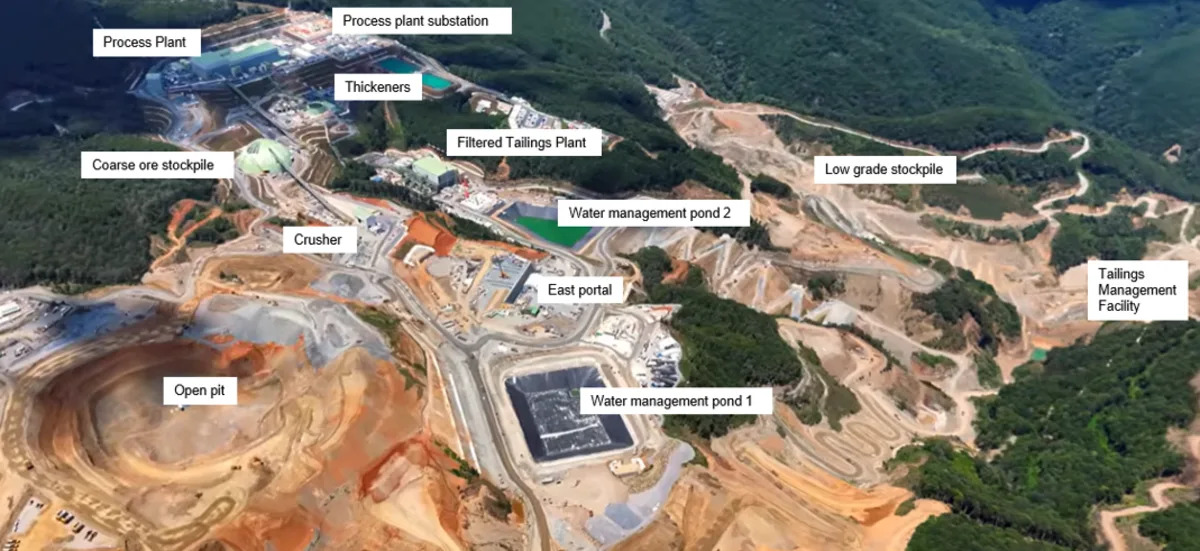
Skouries site layout
Concentrate Off-Take Agreements
The Company has entered into concentrate sales agreements with several offtakers for all expected 2026 volumes and a portion of 2027 volumes, and is in the final process with other counterparties to conclude agreements covering production through to 2029. The commercial terms agreed to are significantly better than those assumed in the 2022 feasibility study, reflective of the prevailing strong market conditions for copper-gold concentrates.
Capital Estimate and Schedule
The capital cost estimate for Skouries is approximately $1.315 billion to commercial production. The accelerated operational capital estimate is approximately $260.0 million to commercial production. The final capital cost for Skouries will reflect, among other things, completion of remaining project scope and is dependant on the date of commercial production.
The project remains fully funded through operating cash flow, cash and debt financing. The Term Facility totalling €740.4 million ($843.6 million) is fully drawn (including the Contingent Overrun Facility of €60.0 million which was drawn in Q2 2026).(4)
Project capital totalled $154.6 million in Q2 2026 and $290.2 million during the six months ended June 30, 2026. Accelerated operational capital cost totalled $59.6 million in Q2 2026, and $108.2 million during the six months ended June 30, 2026. At June 30, 2026, cumulative project capital invested towards Phase 2 of construction totalled $1.270 billion, and the cumulative accelerated operational capital totalled $201.3 million.
The Company is well positioned for start‑up, with over 3.9 million tonnes of ore stockpiled which is expected to provide the ore feed required through 2026 and supports a lower-risk commissioning and first year of production. Open pit and underground ore mining will continue for the balance of 2026 and will be blended to maximize cash flow with lower value ore being stockpiled for future years.
Construction Activities
As at June 30, 2026 overall project progress was 97% complete.
Primary Crusher Building
The primary crusher has crushed first ore in July in anticipation of mill start-up, marking an important commissioning milestone for the crushing circuit.
The stockpile dome, ancillary feeders and associated chute work is complete and ready for full operations.
Coarse ore stockpile dome
Process Plant
The process plant is substantially complete, with wet commissioning well underway, in preparation for first ore introduction. Water circulation testing through the entire circuit to the tailings thickener/filter feed tanks is underway.
Thickeners
Two of the three tailings thickeners are in the final stages of being commissioned in advance of first ore. Concrete foundation work for the third tailings thickener, which is not required for start-up, has commenced, with completion planned in Q3 2026.
Thickeners
Filtered Tailings Facility
Work continues to progress on the filtered tailings plant which remains on the critical path, with electrical installations and commissioning as the final steps. Work is also advancing on the tailings handling infrastructure which is not required for first concentrate production.
Mechanical and electrical work on two of the six filters has been completed, with both filters ready for commissioning.
Construction of the filter plant tank farm with pump and piping installation and electrical connections are advancing towards commissioning commencement.
Filtered Tailings Facility
Powerline and Substations
Power infrastructure construction at Skouries has continued to advance and construction of all 12 towers and conductors is now complete. In July, the Company coordinated a successful eight-hour power suspension on the transmission line to enable installation of the final transmission tower. Initial tests of the sub-station have been completed by an independent third-party testing group. Final site energization and receipt of final sign-off remains contingent on inspection, which includes final testing and installation of metering equipment by the relevant Greek authority.
In the interim, the Company is proactively adding additional gensets to support commissioning activities and maintain progress where practical, including readiness and commissioning activities within the process plant. Full operation of major process plant systems, crushing, grinding, flotation, concentrate handling and tailings disposal, requires final site energization by the power authority.
Process plant substation
Commissioning Activities
The plant continues to progress towards commissioning readiness across the major process and utility systems. The majority of the site's electrical distribution network has been energized using temporary power, enabling the testing and commissioning of equipment prior to startup. Critical air and water utility systems are being progressively transferred to the commissioning team, supporting equipment flushing, functional testing, and wet commissioning. Equipment supplier specialists are on-site to support the commissioning of the SAG mill and ball mill, and work is ongoing. Successful integrated water testing of the process water, rougher flotation, and tailings thickening systems confirmed system performance and enabled expanded wet commissioning activities. Commissioning of the primary crushing and conveying system has begun, with extended runs of main equipment.
Integrated Extractive Waste Management Facility
The initial filtered tailings placement areas are well advanced. The platform for the tailings stacker is complete and ready for assembly, while the access ramp and platform for the mobile (grasshopper) conveyors have been excavated and prepared for placement of the conveyor units. Construction of the rock buttress supporting the downstream embankment of the first filtered tailings placement area in the Karatza Lakkos ("KL") valley is progressing and will be completed ahead of tailings placement.
Foundation preparation for the first phase of the KL filtered tailings embankment is substantially complete, and placement of engineered fill is underway across the full footprint.
Construction of the low-grade ore stockpile continued advancing. The lower section has been completed and construction is now focusing on the upper section.
Open Pit Mining
The open pit mine continued to ramp up during Q2 2026 and remains ahead of plan in building ore stockpiles for the process plant start-up. During the quarter, 1.28 million tonnes of ore were delivered to the stockpiles. At the end of Q2 2026, the stockpiles contained approximately 3.6 million tonnes of open pit and underground ore, representing an estimated 134,000 ounces of gold and 44 million pounds of copper.
Underground Development
The underground mine delivered 131 kt of ore to stockpiles during Q2 2026. Underground access development rates continued to accelerate, with a total of 2,191 metres of development completed during the quarter. Monthly advance rates reached a project record of 900 metres in May 2026, and the ventilation drive connecting the east and west ramps was also completed during the quarter.
Drilling of the third test stope commenced in Q2 2026 in preparation for blasting and extraction of a larger test stope (approximately 100 kt), which is expected to support improved productivity.
Processing
The processing operations and maintenance teams have successfully completed their theoretical training and are now completing job familiarization training at both the Skouries and Olympias sites.
Twelve highly experienced process plant ramp-up experts have been contracted to support the operations team during the first three months of operations.
Workforce
As at June 30, 2026, there were approximately 2,948 personnel working on site, including 515 Skouries employees.
Skouries Multimedia
A progress update video can be found here: https://youtu.be/jMpdM-m6vY4
Photos of the construction progress at Skouries can be viewed and downloaded via this link:
https://eldoradogold.getbynder.com/share/303E6589-7229-4764-9BAC8F7299A7E887/
McIlvenna Bay Highlights
The McIlvenna Bay Mine, located in Saskatchewan, Canada, is a copper-zinc-gold-silver project that Eldorado acquired through its acquisition of Foran, which closed on April 14, 2026. In March 2025, Foran published a McIlvenna Bay Project Feasibility Study, with an 18-year mine life and expected average annual production over the life of the mine of 41 million pounds of copper, 20,000 ounces of gold, 444,000 ounces of silver and 54 million pounds of zinc.
First production of copper concentrate from McIlvenna Bay was achieved on June 7, 2026 with production of first zinc concentrate achieved in July. The focus is on optimizing current operations and increasing throughput to full design capacity, with a ramp up to commercial production expected in Q3 2026. In Q2 2026, plant throughput was 5,405 tonnes resulting in 65,398 payable copper pounds produced.
The mine is expected to have a long life and is supported by a robust resource base, with highly prospective exploration upside across the broader district, including the nearby Tesla Zone. The initial Mineral Resource for Tesla is expected to be published in the fourth quarter of 2026. An updated Technical Report is expected to be released in the first quarter of 2027.
Located in one of the world's most attractive mining jurisdictions, the project benefits from established infrastructure and is designated by the Government of Canada as a project of national significance to support critical mineral development.
Production at McIlvenna Bay in 2026 is expected to be 5 to 10 million pounds of copper, 3,000 to 6,000 tonnes of zinc, 5,000 to 10,000 ounces of gold and 100,000 to 200,000 ounces of silver. Operating costs per tonne are expected to range between $90 to $110 by the end of December 2026, and trend lower as the operation reaches steady-state production levels.
The total project capital cost estimate from June 1, 2024 to commercial production is expected to be $952 million. Project capital totalled $78.1 million during Q2 2026 (reported from the date of acquisition of April 14, 2026). During the third quarter the remaining spend is expected to be $90 million and relates to completion of the paste plant, water treatment plant, underground development and process optimization, together with additional scope and the final commissioning and ramp-up activities required to support commercial production.
McIlvenna Bay Mine Site Overview
Operating Activities
Primary Crusher Building
More than 400 kt of copper and zinc mineralized material is available on surface for processing. The primary crusher is operating at design capacity, material transfer to the fine ore bin is as expected, and ore-sorting and metal separation practices continue to be refined.
Process Plant
The SAG and ball mill circuits are ramping up well and continue to demonstrate increasing throughput as commissioning advances. As expected for a new processing plant, we continue to work through equipment, instrumentation and other availability-related challenges associated with ramp-up. Throughput is expected to continue increasing through the third quarter as the operation progresses toward commercial production.
Flotation
All flotation circuits are fully commissioned and have successfully produced copper, zinc and pyrite concentrates. Final commissioning of the regrind circuit is underway and expected to be completed in early August, supporting further improvements in concentrate quality as ramp-up progresses.
Thickening & Filtration
The thickening and filtration circuits are key to the ramp up of production. The teams are working to optimize the sequence of filtration and the thickening control circuit.
Tailings filtration within the process plant
Underground Development
Underground development continues to advance well. In addition to the 400 kt of ore stockpiled on surface, the mine has approximately 20 kt of blasted inventory, more than 330 km of drilling, and approximately 2 million tonnes of fully developed reserves within Block 1.
Mucking out a stope
Study Commenced on Processing Expansion, Including Throughput Increase and Silver-Lead Circuit
The Company has commenced a study to evaluate an expansion of the processing facility, which includes an increase in throughput as well as the incorporation of a silver‑lead circuit. The expansion will evaluate a potential increase of processing capacity at McIlvenna Bay from 4,900 tonnes per day to approximately 7,000 tonnes per day. The addition of a dedicated silver‑lead circuit into the flowsheet is expected to enable recovery of lead into a separate concentrate and improve payable silver recoveries relative to the current design.
This initial study will assess the technical, economic, environmental and permitting considerations associated with the expansion. Any future development would be subject to completion of the project evaluation, receipt of required permits, Indigenous and Stakeholder engagement, and a positive final investment decision. The Company is targeting commissioning of the silver‑lead circuit in 2028 and the expansion in 2030.
Positioned as the Foundation for Long-Term District Growth
The McIlvenna Bay Mine is core to our view of the district-scale geological potential to deliver future satellite development opportunities. Ongoing exploration will target additional resources, which could support further expansion or a separate processing facility over time. The 2026 exploration program includes approximately 14,000 metres of diamond drilling focused on resource expansion, high grade extensions, and advancing regional targets.
In parallel, core scanning programs will enhance geological modelling and orebody characterization. Airborne and ground geophysical surveys are expected to help refine known deposit footprints and identify new targets across the broader land package.
McIlvenna Bay Multimedia
Photos of the McIlvenna Bay site can be viewed and downloaded via this link:
https://eldoradogold.getbynder.com/share/9751B411-8FE0-4543-B224904FFB39B6DC/
Consolidated Financial and Operational Highlights
3 months ended June 30, | 6 months ended June 30, | ||||||||||||
2026 | 2025 | 2026 | 2025 | ||||||||||
Revenue | $487.5 | $451.7 | $1,019.9 | $807.0 | |||||||||
Gold produced (oz) | 104,616 | 133,769 | 204,974 | 249,662 | |||||||||
Gold sold (oz) | 102,691 | 131,489 | 203,310 | 247,752 | |||||||||
Average realized gold price ($/oz sold)(2) | $4,379 | $3,270 | $4,632 | $3,112 | |||||||||
Production costs | 184.8 | 162.2 | 373.0 | 310.5 | |||||||||
Total cash costs ($/oz sold)(2,3) | 1,432 | 1,064 | 1,451 | 1,106 | |||||||||
All-in sustaining costs ($/oz sold)(2,3) | 1,926 | 1,520 | 1,934 | 1,538 | |||||||||
Net earnings for the period(1) | 172.8 | 138.0 | 309.2 | 210.4 | |||||||||
Net earnings per share – basic ($/share)(1) | 0.69 | 0.67 | 1.38 | 1.03 | |||||||||
Net earnings per share – diluted ($/share)(1) | 0.68 | 0.67 | 1.36 | 1.02 | |||||||||
Net earnings for the period continuing operations(1,4) | 172.8 | 139.0 | 309.2 | 211.0 | |||||||||
Net earnings per share continuing operations – basic ($/share)(1,4) | 0.69 | 0.68 | 1.38 | 1.03 | |||||||||
Net earnings per share continuing operations – diluted ($/share)(1,4) | 0.68 | 0.67 | 1.36 | 1.02 | |||||||||
Adjusted net earnings(1,2,4) | 136.7 | 90.1 | 325.0 | 146.5 | |||||||||
Adjusted net earnings per share - basic ($/share)(1,2,4) | 0.54 | 0.44 | 1.45 | 0.72 | |||||||||
Net cash generated from operating activities(4) | 149.5 | 158.2 | 290.9 | 288.6 | |||||||||
Cash flow from operating activities before changes in working capital(2,4) | 103.1 | 202.0 | 290.2 | 338.5 | |||||||||
Free cash flow(2,4) | (334.1 | ) | (61.6 | ) | (463.2 | ) | (91.0 | ) | |||||
Free cash flow excluding Skouries and McIlvenna Bay(2,4,5) | 40.9 | 61.5 | 103.8 | 129.4 | |||||||||
Cash and cash equivalents(4) | 554.6 | 1,078.6 | 554.6 | 1,078.6 | |||||||||
Total assets | 10,252.2 | 6,303.8 | 10,252.2 | 6,303.8 | |||||||||
Debt | 1,749.9 | 1,157.1 | 1,749.9 | 1,157.1 |
(1) Attributable to shareholders of the Company.
(2) These financial measures or ratios are non-IFRS financial measures or ratios. See the section 'Non-IFRS and Other Financial Measures and Ratios' of our MD&A for explanations and discussions of these non-IFRS financial measures or ratios.
(3) Includes costs allocated to by-products.
(4) 2025 amounts presented are from continuing operations only and exclude the Romania segment which was carried as a discontinued operation and disposed in Q4 2025.
(5) Amounts presented add back cash-basis capital expenditure on the Skouries Project in the respective periods and the McIlvenna Bay Mine only in 2026.
In Q2 2026, we produced 104,616 ounces of gold, a decrease from Q2 2025 production of 133,769 ounces. The decrease was driven by decreases at Kisladag, due to the planned lower tonnes and ore grade stacked, and at Efemcukuru, due to lower ore grade and recoveries, partially offset by higher production at Lamaque as a result of higher throughput and recoveries, which includes the positive impact of Ormaque ore following receipt of the operating authorization in March.
Gold sales in Q2 2026 were 102,691 ounces, a decrease from 131,489 ounces sold in Q2 2025. The lower sales volume reflects lower production at Kisladag and Efemcukuru, partially offset by higher production at Lamaque.
The average realized gold price was $4,379 per ounce sold in Q2 2026, an increase from $3,270 per ounce sold in Q2 2025.
Total revenue increased to $487.5 million in Q2 2026 from $451.7 million in Q2 2025 and to $1,019.9 million in the six months ended June 30, 2026, from $807.0 million in the six months ended June 30, 2025. The increases in both periods were due to the higher average realized gold price, partially offset by lower volumes sold.
Production costs increased to $184.8 million in Q2 2026 from $162.2 million in Q2 2025 and to $373.0 million in the six months ended June 30, 2026 from $310.5 million in the six months ended June 30, 2025. Increases in both periods were driven by higher royalties in Turkiye and Greece, which accounted for approximately 23% and 53% of the increase to production costs for Q2 2026 and the six months ended June 30, 2026, respectively. The remainder relates primarily to increases in labour, contractors and maintenance in both the Turkiye operations, due to inflation and planned maintenance, as well as Lamaque due to deepening the production centre of the Triangle Mine.
Production costs include royalty expense, which increased to $33.8 million in Q2 2026 from $28.7 million in Q2 2025 and increased to $83.9 million in the six months ended June 30, 2026 from $50.9 million in the six months ended June 30, 2025. Increases in both periods were due to higher average realized gold prices and higher royalty rates, partially offset by lower volumes sold.
Total cash costs(5) averaged $1,432 per ounce sold in Q2 2026, an increase from $1,064 in Q2 2025, and $1,451 in the six months ended June 30, 2026 from $1,106 in the six months ended June 30, 2025. The increases in both the three and six-month periods were primarily due to higher production costs and lower volumes sold, partially offset by higher costs allocated to by-products.
AISC per ounce sold(5) averaged $1,926 in Q2 2026, an increase from $1,520 in Q2 2025, and $1,934 in the six months ended June 30, 2026 from $1,538 in the six months ended June 30, 2025. The increases in both periods were driven by higher total cash costs and lower volumes sold, partially offset by lower sustaining capital expenditures.
The Company reported net earnings attributable to shareholders from continuing operations of $172.8 million ($0.69 earnings per share) in Q2 2026 compared to net earnings of $139.0 million ($0.68 earnings per share) in Q2 2025 and net earnings of $309.2 million ($1.38 earnings per share) in the six months ended June 30, 2026 compared to net earnings of $211.0 million ($1.03 earnings per share) in the six months ended June 30, 2025. The increase in net earnings in both periods were driven by higher average realized gold prices, foreign exchange gains and lower depreciation, partially offset by lower volumes sold, higher production costs and higher income tax expense.
Adjusted net earnings(5) was $136.7 million ($0.54 adjusted earnings per share) in Q2 2026 compared to adjusted net earnings of $90.1 million ($0.44 adjusted earnings per share) in Q2 2025. Adjustments of non-recurring items in Q2 2026 include a reversal of $116.6 million of unrealized losses on derivative instruments, a $97.6 million realized loss on gold and copper commodity swaps relating to the Term Facility, a $47.4 million gain on deferred tax due to changes in the Turkish corporate income tax rate, and a $13.1 million expense relating to acquisition and integration costs.
Adjusted net earnings(5) was $325.0 million ($1.45 adjusted earnings per share) in the six months ended June 30, 2026 compared to adjusted net earnings of $146.5 million ($0.72 adjusted earnings per share) in the six months ended June 30, 2025. Adjustments of non-recurring items in the six months ended June 30, 2026 include a reversal of $96.6 million of unrealized losses on derivative instruments, a $97.6 million realized loss on gold and copper commodity swaps relating to the Term Facility, a $34.1 million loss on foreign exchange due to the translation of deferred tax balances, a $47.4 million gain on deferred tax due to changes in the Turkish corporate income tax rate, and a $20.8 million expense relating to acquisition and integration costs.
Quarterly Operations Update
3 months ended June 30, | 6 months ended June 30, | |||||||
2026 | 2025 | 2026 | 2025 | |||||
Consolidated | ||||||||
Gold produced (oz) | 104,616 | 133,769 | 204,974 | 249,662 | ||||
Gold sold (oz) | 102,691 | 131,489 | 203,310 | 247,752 | ||||
Production costs | $184.8 | $162.2 | $373.0 | $310.5 | ||||
Total cash costs ($/oz sold)(1,2) | $1,432 | $1,064 | $1,451 | $1,106 | ||||
All-in sustaining costs ($/oz sold)(1,2) | $1,926 | $1,520 | $1,934 | $1,538 | ||||
Sustaining capital expenditures(2) | $35.0 | $44.1 | $67.9 | $76.9 | ||||
Kisladag | ||||||||
Gold produced (oz) | 19,108 | 46,058 | 47,447 | 90,377 | ||||
Gold sold (oz) | 19,389 | 45,290 | 47,700 | 89,628 | ||||
Production costs | $41.6 | $52.7 | $98.3 | $100.2 | ||||
Total cash costs ($/oz sold)(1,2) | $2,050 | $1,133 | $1,958 | $1,086 | ||||
All-in sustaining costs ($/oz sold)(1,2) | $2,407 | $1,324 | $2,201 | $1,232 | ||||
Sustaining capital expenditures(2) | $5.6 | $6.5 | $9.0 | $8.8 | ||||
Lamaque | ||||||||
Gold produced (oz) | 52,340 | 50,640 | 94,646 | 91,078 | ||||
Gold sold (oz) | 50,060 | 49,447 | 94,667 | 91,652 | ||||
Production costs | $44.2 | $36.1 | $86.0 | $71.9 | ||||
Total cash costs ($/oz sold)(1,2) | $865 | $721 | $884 | $774 | ||||
All-in sustaining costs ($/oz sold)(1,2) | $1,192 | $1,231 | $1,276 | $1,305 | ||||
Sustaining capital expenditures(2) | $16.1 | $25.4 | $36.3 | $48.1 | ||||
Efemcukuru | ||||||||
Gold produced (oz) | 18,019 | 21,093 | 33,413 | 40,400 | ||||
Gold sold (oz) | 18,345 | 20,779 | 33,518 | 38,569 | ||||
Production costs | $38.7 | $28.5 | $76.3 | $53.2 | ||||
Total cash costs ($/oz sold)(1,2) | $1,926 | $1,335 | $2,053 | $1,345 | ||||
All-in sustaining costs ($/oz sold)(1,2) | $2,252 | $1,667 | $2,377 | $1,613 | ||||
Sustaining capital expenditures(2) | $5.7 | $6.4 | $10.3 | $9.4 | ||||
Olympias | ||||||||
Gold produced (oz) | 15,125 | 15,978 | 29,444 | 27,807 | ||||
Gold sold (oz) | 14,897 | 15,973 | 27,425 | 27,903 | ||||
Production costs | $60.3 | $44.8 | $112.4 | $85.1 | ||||
Total cash costs ($/oz sold)(1,2) | $1,923 | $1,578 | $1,788 | $1,929 | ||||
All-in sustaining costs ($/oz sold)(1,2) | $2,465 | $1,967 | $2,267 | $2,341 | ||||
Sustaining capital expenditures(2) | $7.6 | $5.8 | $12.2 | $10.7 |
(1) Includes costs allocated to by-products.
(2) These financial measures or ratios are non-IFRS financial measures or ratios. See the section 'Non-IFRS and Other Financial Measures and Ratios' of our MD&A for explanations and discussions of these non-IFRS financial measures or ratios.
Kisladag
Kisladag produced 19,108 ounces of gold in Q2 2026 compared to 46,058 ounces in Q2 2025, with the decrease due to the planned lower tonnes while the operation continues accelerated waste removal from phase 6 and the western area. Ore grade decreased to 0.40 grams per tonne in Q2 2026 from 0.74 grams per tonne in Q2 2025, which, combined with the lower tonnage, resulted in lower recoverable ounces stacked during the quarter.
Production is expected to increase in the third quarter compared to the second quarter benefitting from increased throughput and grades.
Revenue decreased to $88.6 million in Q2 2026 from $150.4 million in Q2 2025, reflecting a decrease in gold ounces sold that was partially offset by the higher average realized gold price.
Production costs decreased to $41.6 million in Q2 2026 from $52.7 million in Q2 2025, driven by lower tonnes placed on the pad and gold produced, resulting in lower sales and royalty costs. This was partially offset by higher royalty rates, labour and contractor costs, maintenance and reagents used in water management. Lower gold production was primarily responsible for the increase in total cash costs per ounce sold to $2,050 in Q2 2026 from $1,133 in Q2 2025.
AISC per ounce sold increased to $2,407 in Q2 2026 from $1,324 in Q2 2025, primarily due to lower volumes sold and higher total cash costs.
Sustaining capital expenditures were $5.6 million in Q2 2026 and $9.0 million in the six months ended June 30, 2026, which primarily included planned equipment rebuilds and geometallurgical drilling. Growth capital investment of $32.6 million and $83.8 million in the three and six months ended June 30, 2026 was primarily waste stripping and associated equipment costs and continued construction of the North Heap Leach Pad ("NHLP") Phase 3, as well as one-time land purchases totalling $23.9 million required for the construction of the NHLP and North Rock Dump.
Kisladag incurred higher reagent costs as a result of increased water management activities following a period of higher‑than‑average precipitation that resulted in elevated water levels within site ponds. The Company continues to actively manage water balances across the operation, with a focus on continuing to maximize on‑site water capture and reuse in support of its sustainability objectives, and has constructed additional water storage capacity to enhance operational flexibility.
The current higher metal price environment has enabled further optimization of the Kisladag open pit. The Company is evaluating a pit shell based on a higher reserve gold price assumption of $2,100 per ounce, compared to the prior $1,700 pit shell, which is expected to open up the western area of the pit and support resource expansion in that area. To facilitate this opportunity and address ongoing geotechnical considerations within the open pit, waste stripping is expected to increase by approximately six to eight million tonnes in 2026 over initial plans.
Progress on construction of the whole ore agglomeration circuit, which is expected to increase permeability and reduce leach time, is on track with earthworks well underway and all long-lead items procured. Commissioning and ramp-up are expected in H1 2027.
The geometallurgical study, which characterized future mining phases and evaluated the benefits of additional screening for the high‑pressure grinding rolls, has been completed and the financial evaluation is underway. An investment decision on the additional screening is expected to be considered before year-end. Results from the associated drilling program have increased confidence in grade, ore classifications and recovery variability.
Overall, this mine optimization plan is expected to support improved sequencing of ore and waste movement and with implementation of whole ore agglomeration is expected to contribute to more consistent year‑over‑year operating performance over the longer term.
Lamaque
Lamaque produced 52,340 ounces of gold in Q2 2026, an increase of 3% from 50,640 ounces in Q2 2025. The increase was due to higher throughput, benefiting from strong mill performance and the receipt of the Ormaque operating authorization in March.
Production in the third quarter is expected to be similar to the second quarter.
Revenue increased to $223.4 million in Q2 2026 from $164.8 million in Q2 2025, primarily due to the higher average realized price combined with an increase in gold ounces sold during the quarter.
Production costs increased to $44.2 million in Q2 2026 from $36.1 million in Q2 2025, reflecting higher costs and higher volume sold. As the centre of production at the Triangle Mine deepens, additional costs are incurred for haulage, equipment (including maintenance) and personnel requirements. Total cash costs per ounce sold increased to $865 in Q2 2026 from $721 in Q2 2025 due to higher costs, including mining costs for Ormaque, partially offset by modestly higher ounces sold.
AISC per ounce sold was $1,192 in Q2 2026 compared to $1,231 in Q2 2025, primarily due to lower sustaining capital, partially offset by the increase in total cash costs per ounce sold.
Sustaining capital expenditures of $16.1 million in Q2 2026 and $36.3 million in the six months ended June 30, 2026 primarily included underground development, equipment rebuilds, delineation drilling and purchases. Growth capital investment of $38.3 million in Q2 2026 and $66.1 million in the six months ended June 30, 2026 was primarily related to Ormaque development, construction of the paste plant, construction of the north basin water management structure, and continued ramp development at the Triangle Mine.
Efemcukuru
Efemcukuru produced 18,019 ounces of gold in Q2 2026 compared to 21,093 ounces in Q2 2025. The decrease was primarily due to lower ore grade, which decreased to 4.64 grams per tonne in Q2 2026 from 5.75 grams per tonne in Q2 2025, partially offset by higher mill throughput.
Production in the third quarter is expected to be similar to the second quarter.
Revenue increased to $76.8 million in Q2 2026 from $70.7 million in Q2 2025. The increase was driven by the higher average realized gold price, partially offset by lower gold ounces sold.
Production costs increased to $38.7 million in Q2 2026 from $28.5 million in Q2 2025, primarily due to higher royalty expense as a result of higher gold prices, as well as increased labour and maintenance costs. On a per ounce sold basis, higher royalties and direct operating costs combined with lower gold production resulted in an increase total cash costs per ounce sold to $1,926 in Q2 2026 from $1,335 in Q2 2025.
AISC per ounce sold increased to $2,252 in Q2 2026 from $1,667 in Q2 2025, primarily due to higher total cash costs.
Sustaining capital expenditures of $5.7 million in Q2 2026 and $10.3 million in the six months ended June 30, 2026 were primarily underground development and equipment rebuilds. Growth capital investment of $5.8 million in Q2 2026 and $8.2 million in the six months ended June 30, 2026 related to development costs at Bati, portal development at Kokarpinar, and construction of a water pond and mine rock storage facility.
Olympias
Olympias produced 15,125 ounces of gold in Q2 2026 compared to 15,978 ounces in Q2 2025, driven by lower gold grades, partially offset by a stable ore blend and flotation performance which resulted in increased metal recoveries.
Production in the third quarter is expected to increase, benefitting from increased throughput over the second quarter.
Revenue increased to $98.6 million in Q2 2026 from $65.9 million in Q2 2025, due to the higher average realized gold price, partially offset by lower ounces sold.
Production costs increased to $60.3 million in Q2 2026 from $44.8 million in Q2 2025 driven by higher labour costs and royalties as a result of higher gold prices, partially offset by lower gold sales. On a per ounce sold basis, higher royalties and higher direct operating costs, partially offset by higher by-product credits, increased total cash costs per ounce sold to $1,923 in Q2 2026 from $1,578 in Q2 2025.
AISC per ounce sold increased to $2,465 in Q2 2026 from $1,967 in Q2 2025 primarily due to higher total cash costs combined with higher sustaining capital expenditures.
Sustaining capital expenditures of $7.6 million in Q2 2026 and $12.2 million in the six months ended June 30, 2026 primarily included underground development, underground resource classification drilling, filter press refurbishment, and mobile mining equipment rebuilds and purchases. Growth capital investment of $14.3 million in Q2 2026 and $22.3 million in the six months ended June 30, 2026 was primarily related to the mill expansion project and to a lesser extent underground development.
At Olympias, production has stabilized over the past three quarters, with flotation recoveries returning to modelled levels. Completion of the 650 ktpa expansion is expected by the end of 2026, with ramp‑up anticipated in the first quarter of 2027.
For further information on the Company's operating results for the second quarter of 2026, please see the Company's MD&A filed on SEDAR+ at www.sedarplus.com under the Company's profile.
Conference Call
A conference call to discuss the details of the Company's Second Quarter 2026 Results will be held by senior management on Friday, July 31, 2026 at 11:30 AM ET (8:30 AM PT). The call will be webcast and can be accessed at Eldorado's website: www.eldoradogold.com or via this link: https://event.choruscall.com/mediaframe/webcast.html?webcastid=KlTNaz6C.
Participants may elect to pre-register for the conference call via this link: https://dpregister.com/sreg/10209854/10438a8dd8a.
Upon registration, participants will receive a calendar invitation by email with dial in details and a unique PIN. This will allow participants to bypass the operator queue and connect directly to the conference. Registration will remain open until the end of the conference call.
Conference Call Details | Replay (available until Sept. 11, 2026) | |||
Date: | July 31, 2026 | Vancouver: | +1 412 317 0088 | |
Time: | 11:30 AM ET (8:30 AM PT) | Toll Free: | +1 855 669 9658 | |
Dial in: | +1 647 846 2782 | Access code: | 6422557 | |
Toll free: | +1 833 752 3325 | |||
About Eldorado
Eldorado is a gold, copper and base metals producer with mining, development and exploration operations in Canada, Greece and Turkiye. The Company has a highly skilled and dedicated workforce, safe and responsible operations, a portfolio of high-quality assets, and long-term partnerships with local communities. Eldorado's common shares trade on the Toronto Stock Exchange (TSX: ELD) and the New York Stock Exchange (NYSE: EGO).
Contact
Investor Relations
Lynette Gould, VP, Investor Relations, Communications & External Affairs
647 271 2827 or 1 888 353 8166
lynette.gould@eldoradogold.com
Media
Chad Pederson, Director, Communications and Public Affairs
236 885 6251 or 1 888 353 8166
chad.pederson@eldoradogold.com
Non-IFRS and Other Financial Measures and Ratios
Certain non-IFRS financial measures and ratios are included in this news release, including earnings before interest, taxes, depreciation and amortization ("EBITDA"), adjusted earnings before interest, taxes, depreciation and amortization ("Adjusted EBITDA"), adjusted net earnings/(loss) attributable to shareholders, adjusted net earnings/(loss) per share attributable to shareholders, total cash costs and total cash costs per ounce sold, all-in sustaining costs ("AISC") and AISC per ounce sold, sustaining and growth capital, average realized gold price per ounce sold, free cash flow, free cash flow excluding Skouries and McIlvenna Bay, and cash flow from operating activities before changes in working capital.
Please see the June 30, 2026 MD&A for explanations and discussion of these non-IFRS and other financial measures and ratios. The Company believes that these measures and ratios, in addition to conventional measures and ratios prepared in accordance with International Financial Reporting Standards ("IFRS"), provide investors an improved ability to evaluate the performance of our gold mining operations and its ability to generate positive cash flow. These non-IFRS and other financial measures and ratios are intended to provide additional information and should not be considered in isolation or as a substitute for measures or ratios of performance prepared in accordance with IFRS. These measures and ratios do not have any standardized meaning prescribed under IFRS, and therefore may not be comparable to other issuers.
We believe that our use of total cash costs per ounce sold and all-in sustaining costs per ounce sold will assist analysts, investors and other stakeholders of the Company in understanding the costs associated with producing gold, assessing our operating performance, and our ability to generate free cash flow from gold operations. Due to the capital-intensive nature of the industry and the long useful lives over which these assets are depreciated, there can be a significant timing difference between net earnings calculated in accordance with IFRS and the amount of free cash flow that is generated by a mine, and therefore we believe these measures are useful non-IFRS operating metrics and supplement our IFRS disclosures. These measures are not representative of all of our cash expenditures as they do not include income tax payments, interest costs or dividend payments. These measures do not include depreciation or amortization. Certain additional disclosures for these and other financial measures and ratios have been incorporated by reference and can be found in the section 'Non-IFRS and Other Financial Measures and Ratios' in the June 30, 2026 MD&A available on SEDAR+ at www.sedarplus.com and on the Company's website under the 'Investors' section.
EBITDA, Adjusted EBITDA
Our reconciliation of EBITDA and Adjusted EBITDA to earnings from continuing operations before income tax, the most directly comparable IFRS measure, is presented below.
Q2 2026 | Q2 2025 | YTD 2026 | YTD 2025 | |||||||||
Earnings before income tax(1) | $227.2 | $172.2 | $473.9 | $214.5 | ||||||||
Depreciation and amortization(2) | 54.7 | 66.4 | 109.1 | 127.0 | ||||||||
Interest income | (5.4 | ) | (9.0 | ) | (13.1 | ) | (17.2 | ) | ||||
Finance costs | 10.2 | 0.7 | 24.1 | 12.9 | ||||||||
EBITDA | $286.6 | $230.3 | $594.1 | $337.2 | ||||||||
Realized loss on gold and copper derivative instruments | 97.6 | — | 97.6 | — | ||||||||
Unrealized (gain) loss on derivative instruments | (116.6 | ) | (18.7 | ) | (96.6 | ) | 44.7 | |||||
Acquisition and integration costs | 13.1 | — | 20.8 | — | ||||||||
Loss (gain) on disposal of assets | 0.2 | 0.2 | 0.6 | (7.1 | ) | |||||||
Share of loss from associate | 0.2 | — | 0.4 | — | ||||||||
Adjusted EBITDA | $281.1 | $211.8 | $616.8 | $374.8 |
(1) 2025 amounts presented are from continuing operations only and exclude the Romania segment which was carried as a discontinued operation and disposed in Q4 2025.
(2) Includes depreciation within general and administrative expenses.
Adjusted Net Earnings Attributable to Shareholders
Our reconciliation of adjusted net earnings (loss) and adjusted net earnings (loss) per share to net earnings (loss) from continuing operations attributable to shareholders of the Company, the most directly comparable IFRS measure, is presented below.
Q2 2026 | Q2 2025 | YTD 2026 | YTD 2025 | |||||||||
Net earnings attributable to shareholders of the Company(1) | $172.8 | $139.0 | $309.2 | $211.0 | ||||||||
Loss (gain) on foreign exchange translation of deferred tax balances | 15.8 | (22.8 | ) | 34.1 | (26.3 | ) | ||||||
Decrease (increase) in fair value of redemption option derivatives | 1.5 | (7.3 | ) | 7.3 | (7.9 | ) | ||||||
Realized loss on gold and copper derivative instruments | 97.6 | — | 97.6 | — | ||||||||
Unrealized (gain) loss on derivative instruments | (116.6 | ) | (18.7 | ) | (96.6 | ) | 44.7 | |||||
Acquisition and integration costs | 13.1 | — | 20.8 | — | ||||||||
Gain on deferred tax due to changes in tax rates | (47.4 | ) | — | (47.4 | ) | — | ||||||
Tax recovery on recognition of deferred tax asset | — | — | — | (73.5 | ) | |||||||
Discount on sale of marketable securities | — | — | (0.1 | ) | 5.1 | |||||||
Gain on sale of mining licenses | — | — | — | (6.5 | ) | |||||||
Share of loss from associate | 0.2 | — | 0.4 | — | ||||||||
Tax effect on adjustments | (0.2 | ) | — | (0.2 | ) | — | ||||||
Total adjusted net earnings | $136.7 | $90.1 | $325.0 | $146.5 | ||||||||
Weighted average shares outstanding (thousands) | 251,453 | 204,907 | 224,741 | 204,835 | ||||||||
Adjusted net earnings per share ($/share) | $0.54 | $0.44 | $1.45 | $0.72 |
(1) 2025 amounts presented are from continuing operations only and exclude the Romania segment which was carried as a discontinued operation and disposed in Q4 2025.
Reconciliation of Total Cash Costs, Total Cash Cost per Ounce Sold, AISC, and AISC per Ounce Sold to Production Costs
Our reconciliation of total cash costs, total cash costs per ounce sold, AISC, and AISC per Ounce Sold to production costs, the most directly comparable IFRS measure, is presented below.
For the three months ended June 30, 2026:
Kisladag | Lamaque | Efemcukuru | Olympias | Corporate(3) | Total | ||||||||||||
Direct operating costs | $51.1 | $42.4 | $23.0 | $43.3 | $— | $159.6 | |||||||||||
Transportation and selling costs | 0.2 | 0.1 | 3.2 | 3.1 | — | $6.7 | |||||||||||
Inventory change(1) | (17.2 | ) | (1.3 | ) | 0.2 | 3.0 | — | ($15.3 | ) | ||||||||
Royalty expense | 7.5 | 3.0 | 12.3 | 11.0 | — | $33.8 | ... |