
– Phase 2 trial of EDG-7500 demonstrated rapid and clinically meaningful reductions in LVOT gradients in participants with obstructive HCM –
– Four-week treatment with EDG-7500 demonstrated substantial improvements in measures of feel and function, reductions in key cardiac biomarkers and positive trends in measures of diastolic function –
– EDG-7500 was generally well-tolerated; clinical activity was observed without meaningful changes in LVEF, including no participant with a value below 50% –
BOULDER, Colo., April 2, 2025 /PRNewswire/ -- Edgewise Therapeutics, Inc., (Nasdaq: EWTX), a leading muscle disease biopharmaceutical company, today announced positive top-line data of EDG-7500 from the Phase 2 CIRRUS-HCM four-week trial in participants with obstructive or nonobstructive HCM. EDG-7500 is a novel oral, selective, cardiac sarcomere modulator, specifically designed to slow early contraction velocity and address impaired cardiac relaxation associated with HCM without impacting systolic function.
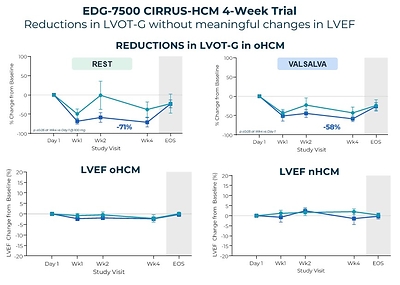
CIRRUS-HCM is a multi-part, open-label trial of EDG-7500 in individuals with HCM. In September 2024, the Company announced positive top-line data from Part A of the trial showing that a single oral dose of EDG-7500 in participants with obstructive HCM demonstrated robust reductions in left ventricular outflow tract gradient (LVOT-G) without meaningful changes in left ventricular ejection fraction (LVEF).
Part B of CIRRUS-HCM included 17 participants with obstructive HCM and Part C included 12 participants with nonobstructive HCM. Both parts of the trial evaluated the safety and efficacy of once-daily doses of 50 or 100 mg of EDG-7500 for four weeks.
In participants with obstructive HCM, EDG-7500 demonstrated meaningful dose-dependent reductions in LVOT-G at rest and post Valsalva. Participants receiving 100 mg experienced mean reductions from baseline of 71% and 58% in resting and provokable (Valsalva) gradients, respectively. Importantly, gradient reductions were achieved without meaningful changes in LVEF. Treatment with 100 mg of EDG-7500 also demonstrated a 62% mean reduction from baseline in NT-proBNP, a key biomarker of heart failure. In addition, positive trends in echocardiographic parameters of diastolic function were observed following treatment with EDG-7500. Clinically meaningful improvements were also observed on the Kansas City Cardiomyopathy Questionnaire Overall Summary Score (KCCQ-OSS), with a substantial mean increase of 23 points observed at the 100 mg dose. In addition, treatment with 100 mg of EDG-7500 over four weeks demonstrated improvements on the NYHA functional class score. Seventy-eight percent of participants improved by ≥ 1 NYHA Class, and 67% improved to NYHA Class I (i.e. asymptomatic).
In participants with nonobstructive HCM, EDG-7500 administration resulted in a dose-dependent reduction in NT-proBNP, with a 42% mean decrease from baseline at 100 mg. A positive trend in an echocardiographic parameter of diastolic function (mean e') was observed in as early as one week. Substantial improvements in KCCQ-OSS and KCCQ-Clinical Summary Scores, with substantial mean increases of 17 points and 22 points, respectively, were observed at the 100 mg dose after only four weeks.
The positive results observed in participants with obstructive HCM and nonobstructive HCM were achieved without meaningful reductions in LVEF. Importantly, there were no LVEF values