
Treatment of Aficamten was Well-Tolerated and Associated with Statistically Significant Improvements in KCCQ, Angina Frequency, NYHA Class, NTpro-BNP and High-Sensitivity Troponin I
Phase 3 Clinical Trial in Non-Obstructive HCM To Begin in 2H 2023
SOUTH SAN FRANCISCO, May 20, 2023 (GLOBE NEWSWIRE) -- Cytokinetics, Incorporated (Nasdaq: CYTK) today announced that additional data from Cohort 4 of REDWOOD-HCM (Randomized Evaluation of Dosing With CK-274 in Obstructive Outflow Disease in HCM), a Phase 2, open-label clinical trial of aficamten in patients with non-obstructive hypertrophic cardiomyopathy (nHCM), were presented in a Late Breaking Clinical Trial session at Heart Failure 2023 an International Congress of the European Society of Cardiology taking place online and in Prague, Czech Republic from May 20, 2023 – May 23, 2023.
“We’re pleased to see that, in addition to the previously reported improvements in both functional class and cardiac biomarkers, patients with nHCM treated with aficamten in Cohort 4 of REDWOOD-HCM experienced a statistically significant improvement in patient reported health status, the KCCQ clinical summary score, an important measure of disease burden,” said Fady I. Malik, M.D., Ph.D., Cytokinetics’ Executive Vice President of Research & Development. “Additionally, this study reported for the first time that patients who suffered from angina, a common and debilitating complaint in patients with nHCM that is a consequence of hypertrophy in the heart, reported a significant reduction in the frequency of anginal symptoms. We look forward to advancing aficamten into a Phase 3 clinical trial in patients with nHCM which is expected to begin in the second half of this year.”
The new data from Cohort 4, presented today by Ahmad Masri, M.D. M.S., Director of the Hypertrophic Cardiomyopathy Center at Oregon Health & Science University, build on the previously presented initial data from Cohort 4 in REDWOOD-HCM, including analyses of all 41 patients through the end of the 12-week clinical study, and new data relating to the effect of aficamten on Kansas City Cardiomyopathy Questionnaire (KCCQ) Clinical Symptom Score (CSS) and angina.
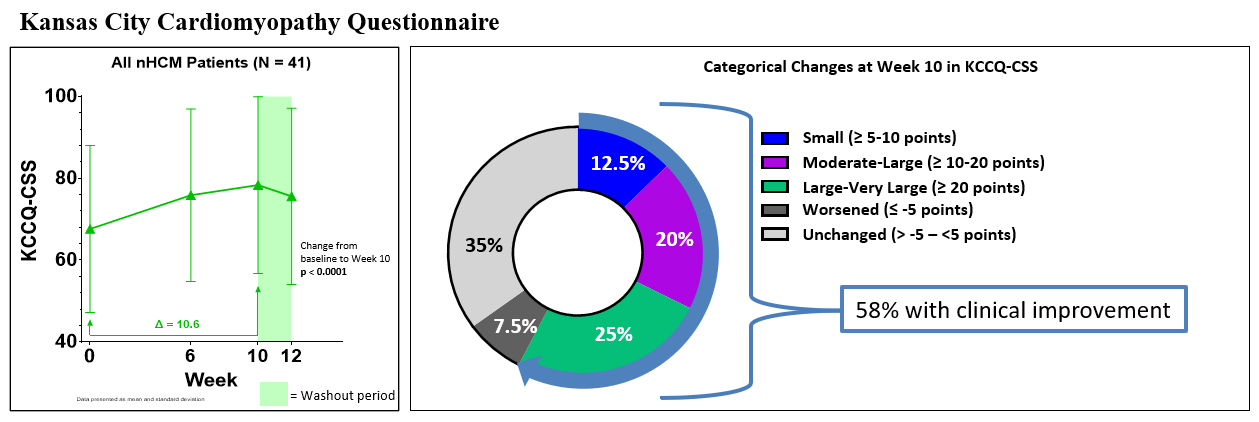
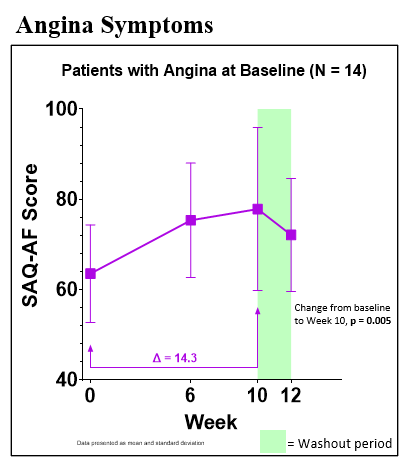
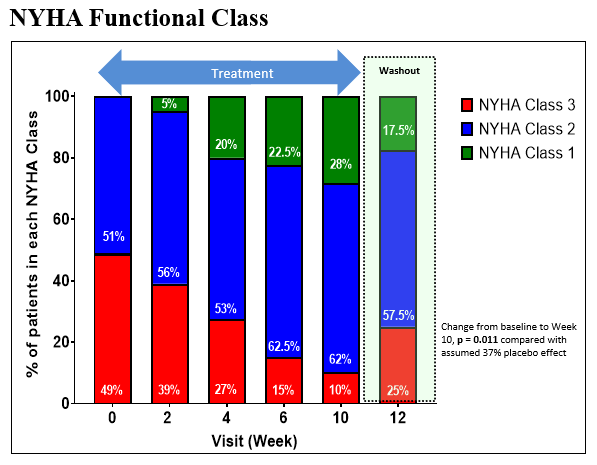
At 10 weeks, treatment with aficamten was associated with an average improvement in KCCQ-CSS of 10.6 points (p < 0.0001) (Figure 1). Overall, 58% of patients experienced a clinical reduction in symptom burden: 12.5% had a small improvement (≥ 5-10 points), 20% had a moderate to large improvement (≥ 10-20 points), and 25% had a large to very large improvement (≥ 20 points). Additionally, 56% of patients demonstrated improvement of ≥1 New York Heart Association (NYHA) Functional Class (p = 0.011) (Figure 2). By Week 10, 28% of patients were asymptomatic (NYHA Class 1). Furthermore, in the 14 patients who reported some angina at baseline, there was an average reduction in the Seattle Angina Questionnaire Angina Frequency (SAQ-AF) score of 14.3 points (p = 0.005) at Week 10, translating to a reduction in angina frequency from daily or weekly, to weekly or monthly (Figure 3).
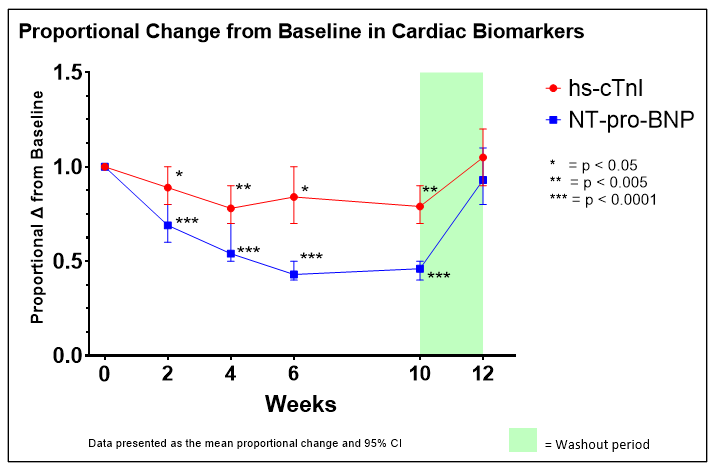
Treatment with aficamten was associated with a mean relative reduction in high-sensitivity cardiac troponin I of 21% by Week 10 with an absolute mean (SE) reduction of -24.8 ng/L (11.6; p < 0.005), and a mean relative reduction in NT-proBNP of 55% by Week 10 with an absolute mean (SE) reduction of -870 pg/mL (155.3; p < 0.0001) (Figure 4). After the 2-week washout period, NT-proBNP and high-sensitivity troponin I levels returned to baseline levels.
As previously reported, aficamten was generally well-tolerated. The most common adverse events reported were mild fatigue (9.8%) and dizziness (7.3%). By Week 6, 35 (85%) of patients achieved the highest available dose of 15 mg of aficamten, and 6 (15%) achieved 10 mg. From baseline to Week 10 there was a modest and reversible reduction in left ventricular ejection fraction (LVEF) of -5.5% (9.9%). There were no drug discontinuations due to adverse events, no treatment interruptions or down-titration events related to LVEF