


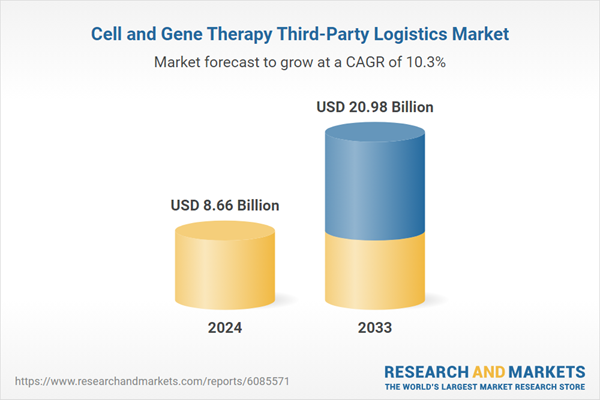
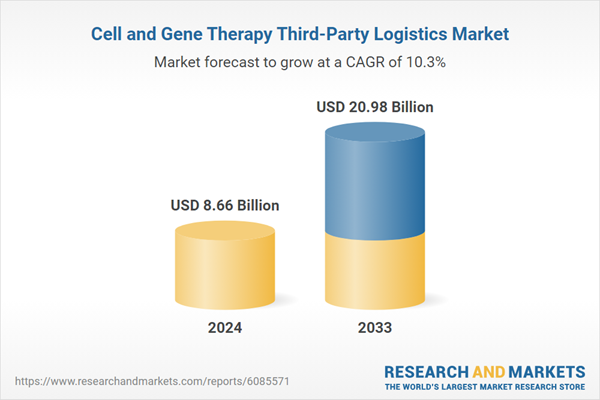
The Global Cell and Gene Therapy Third-Party Logistics Market is projected to surge to US$ 20.98 billion by 2033, up from US$ 8.66 billion in 2024, growing at a CAGR of 10.33%. Key growth drivers include technological advancements in cold chain logistics, an increase in clinical studies, and the rise of personalized medicine. The expanding demand for cell and gene therapies necessitates temperature-sensitive logistics solutions. Major players like Cardinal Health and McKesson Corporation are enhancing infrastructure and creating seamless supply chains, ensuring the safe and effective transport of these critical therapies. The market is primed for robust growth, driven by innovations and strategic partnerships across global regions.
Cell and Gene Therapy Third-Party Logistics Market
Dublin, July 28, 2025 (GLOBE NEWSWIRE) -- The "Cell and Gene Therapy Third-Party Logistics Market Size and Share Analysis - Growth Trends and Forecast Report 2025-2033" report has been added to ResearchAndMarkets.com's offering.
The Global Cell and Gene Therapy Third-Party Logistics Market is expected to reach US$ 20.98 billion by 2033 from US$ 8.66 billion in 2024, with a CAGR of 10.33% from 2025 to 2033.
Technological developments, particularly in cold chain logistics, the expansion of clinical studies and the ensuing approvals, and improvements in tailored medications are the key drivers of the market's growth. Healthcare has changed as a result of the growing desire for customized medicine, which has moved the emphasis from generalist to patient-specific remedies.
Worldwide gene and cell treatment the growing need for customized medicine and technological breakthroughs are fueling the third-party logistics (3PL) sector's rapid expansion. These treatments frequently include biological components that are sensitive to temperature, such live cells and viral vectors, which call for particular handling, storage, and transit techniques. Logistics companies are investing in cutting-edge cold chain infrastructure, such as cryogenic shippers, ultra-low temperature freezers, and real-time tracking systems, to meet these demands.
Manufacturers and logistics firms are increasingly working together to optimize distribution networks and guarantee on-time delivery. With advancements in supply chain optimization and patient-centric logistics improving the effectiveness and dependability of cell and gene therapy distribution, the sector is well-positioned for further growth despite obstacles like regulatory complexity and the requirement for specialized storage facilities.
Additionally, one of the key drivers of market expansion is the growing number of clinical studies and regulatory approvals for gene and cell treatments. The demand for safer and more effective transportation is being driven by the growing number of CGTs that are progressing from research to clinical development and ultimately commercialization. In order to move temperature-sensitive treatments, pharmaceutical and biotech businesses are carrying out multi-site studies across several areas, necessitating sophisticated logistical solutions.
Logistics are further complicated by the fact that cell and gene treatments sometimes entail direct-to-patient shipments or need patients to go to specialist treatment facilities. Several of these studies concentrate on orphan and uncommon illnesses, necessitating the coordination of delivery to sites with limited access or remote locations by logistics companies.
The need for logistics firms to provide flexible and scalable solutions has grown as a result of the growing number of investigational new drug (IND) applications for CGTs. In order to improve the safe and effective transportation of these extremely sensitive treatments, third-party logistics (3PL) providers are being asked to provide specialized services like sophisticated packaging options and ultra-cold storage facilities, which are becoming more and more necessary as cell and gene therapy clinical trials expand quickly.
Growth Drivers for the Cell and Gene Therapy Third-Party Logistics Market
Rising Demand for Cell and Gene Therapies
One of the main factors propelling the biotechnology and pharmaceutical industries' expansion is the growing need for cell and gene treatments. Personalized therapies based on each patient's unique genetic profile are becoming increasingly common as medical research advances. These treatments frequently include extremely delicate biological components that need specific handling, storage, and shipping, such live cells and viral vectors.
Because these treatments are individualized and complicated, using specialist logistics solutions is necessary to guarantee the timely and secure delivery of goods. In order to achieve these needs, third-party logistics providers are crucial because they provide sophisticated tracking systems, temperature-controlled conditions, and regulatory compliance. The demand for advanced logistics solutions will only rise as customized medicine expands.
Growing Investment in Biotech and Healthcare
The healthcare industry is expanding significantly as a result of increased biotechnology investment and the creation of novel cell and gene treatments. In order to reach a worldwide market, newly developed treatments frequently need increasingly intricate and sophisticated distribution networks. The demand for specialized logistics that can handle physiologically complex and temperature-sensitive items arises from the move toward customized medicine and advanced therapies.
Therapy developers are establishing strategic alliances with third-party logistics (3PL) suppliers in order to satisfy these increasing needs. These partnerships facilitate international supply chains, guaranteeing the safe and effective cross-border delivery of treatments. The need for skilled logistics services to handle these cutting-edge treatments will only increase as biotech and healthcare investments continue to grow.
Patient-Centric Logistics
The emphasis of logistics is moving toward patient-centric solutions as medicines become more customized. Cell and gene therapy patients need a customized strategy, which frequently includes door-to-door delivery to guarantee the product gets to them safely and on schedule. By providing real-time tracking systems, third-party logistics companies are adjusting and giving patients the most recent information on the progress of their therapeutic shipment.
By guaranteeing transparency and lowering ambiguity, this improves the patient experience overall. To preserve the integrity of the treatments while in transit, logistics companies are also spending money on sophisticated packaging, temperature control, and accelerated delivery. Patient-centric logistics is becoming a crucial component in the effective delivery of vital medications as customized medicine gains traction.
Challenges in the Cell and Gene Therapy Third-Party Logistics Market
Packaging and Handling Challenges
Since cell and gene treatments frequently need exact temperature control and safe storage to preserve their integrity, handling and packaging them can be quite difficult. In order to prevent product degradation and make the therapy hazardous or ineffective, proper packaging must protect against temperature changes, contamination, and physical damage.
Because of their sensitivity, these biologics require specific materials and monitoring systems to guarantee product stability from manufacturing to delivery. Robust packaging solutions are an essential part of the therapeutic process since improper handling and packing can raise the chance of treatment failures in addition to jeopardizing the therapy's safety and effectiveness.
Temperature Sensitivity
Live cells or viral vectors, which are extremely sensitive to temperature changes, are frequently used in cell and gene treatments. Strict temperature control is necessary for these treatments to maintain their biological activity and guarantee efficacy. To avoid deterioration or loss of efficacy during transportation, especially over long distances, a constant temperature must be maintained.
In order to track and manage temperature conditions during the whole shipping process, this logistical problem necessitates the use of specialist packing solutions, such as temperature-controlled containers and real-time monitoring systems. Any failure to maintain proper temperature control might result in a weakened product, endangering patient safety and therapeutic results. As a result, protecting these treatments from temperature changes is essential to guaranteeing their effective administration.
Recent Developments in Cell and Gene Therapy Third-Party Logistics Industry
Cardinal Health (NYSE: CAH) launched Advanced Therapy Connect, the first-to-market unified ordering platform for cell and gene treatments, in January 2025 through its Advanced Therapy Solutions subsidiary. In the past, ordering cell and gene therapies has required healthcare practitioners to register for many product platforms with various reporting formats, invoicing, and payment processes.
In October 2024, McKesson Corporation announced the creation of InspiroGeneTM by McKesson ('InspiroGene'), a specialist firm, to aid in the commercialization of cell and gene therapies (CGTs). InspiroGene's scalable and flexible package of services, which includes third-party logistics programs and a skilled leadership team, may help manufacturers, payers, and providers effectively navigate the difficult terrain of CGT commercialization. This makes it more likely that patients will be able to get the transformative therapies they need.
Key Players Analyzed: Overview, Key Persons, Recent Development & Strategies, Revenue Analysis
Cencora Corporation
Cardinal Health
McKesson Corporation
EVERSANA
Knipper Health
Arvato SE
DHL
Kuehne+Nagel
Key Attributes:
Report Attribute | Details |
No. of Pages | 200 |
Forecast Period | 2024 - 2033 |
Estimated Market Value (USD) in 2024 | $8.66 Billion |
Forecasted Market Value (USD) by 2033 | $20.98 Billion |
Compound Annual Growth Rate | 10.3% |
Regions Covered | Global |
Key Topics Covered:
1. Introduction
2. Research Methodology
2.1 Data Source
2.1.1 Primary Sources
2.1.2 Secondary Sources
2.2 Research Approach
2.2.1 Top-Down Approach
2.2.2 Bottom-Up Approach
2.3 Forecast Projection Methodology
3. Executive Summary
4. Market Dynamics
4.1 Growth Drivers
4.2 Challenges
5. Global Cell and Gene Therapy Third-Party Logistics Market
5.1 Historical Market Trends
5.2 Market Forecast
6. Cell and Gene Therapy Third-Party Logistics Market Share Analysis
6.1 By Type
6.2 By Product
6.3 By Therapeutic Area
6.4 By End Use
6.5 By Countries
7. Type
7.1 Clinical
7.2 Commercial
8. Product
8.1 Cell Therapies
8.2 Gene Therapies
9. Therapeutic Area
9.1 Oncology
9.2 Neurology
9.3 Cardiovascular Diseases
9.4 Ophthalmology
9.5 Infectious Diseases
9.6 Others
10. End Use
10.1 Biopharmaceutical Companies
10.2 CDMOs/CMOs
10.3 Others
11. Countries
11.1 North America
11.1.1 United States
11.1.2 Canada
11.2 Europe
11.2.1 France
11.2.2 Germany
11.2.3 Italy
11.2.4 Spain
11.2.5 United Kingdom
11.2.6 Belgium
11.2.7 Netherlands
11.2.8 Turkey
11.3 Asia-Pacific
11.3.1 China
11.3.2 Japan
11.3.3 India
11.3.4 South Korea
11.3.5 Thailand
11.3.6 Malaysia
11.3.7 Indonesia
11.3.8 Australia
11.3.9 New Zealand
11.4 Latin America
11.4.1 Brazil
11.4.2 Mexico
11.4.3 Argentina
11.5 Middle East & Africa
11.5.1 Saudi Arabia
11.5.2 UAE
11.5.3 South Africa
12. Porter's Five Forces Analysis
12.1 Bargaining Power of Buyers
12.2 Bargaining Power of Suppliers
12.3 Degree of Rivalry
12.4 Threat of New Entrants
12.5 Threat of Substitutes
13. SWOT Analysis
13.1 Strength
13.2 Weakness
13.3 Opportunity
13.4 Threat
14. Key Players Analysis
For more information about this report visit https://www.researchandmarkets.com/r/v29s6r
About ResearchAndMarkets.com
ResearchAndMarkets.com is the world's leading source for international market research reports and market data. We provide you with the latest data on international and regional markets, key industries, the top companies, new products and the latest trends.
Attachment
CONTACT: CONTACT: ResearchAndMarkets.com Laura Wood,Senior Press Manager press@researchandmarkets.com For E.S.T Office Hours Call 1-917-300-0470 For U.S./ CAN Toll Free Call 1-800-526-8630 For GMT Office Hours Call +353-1-416-8900