
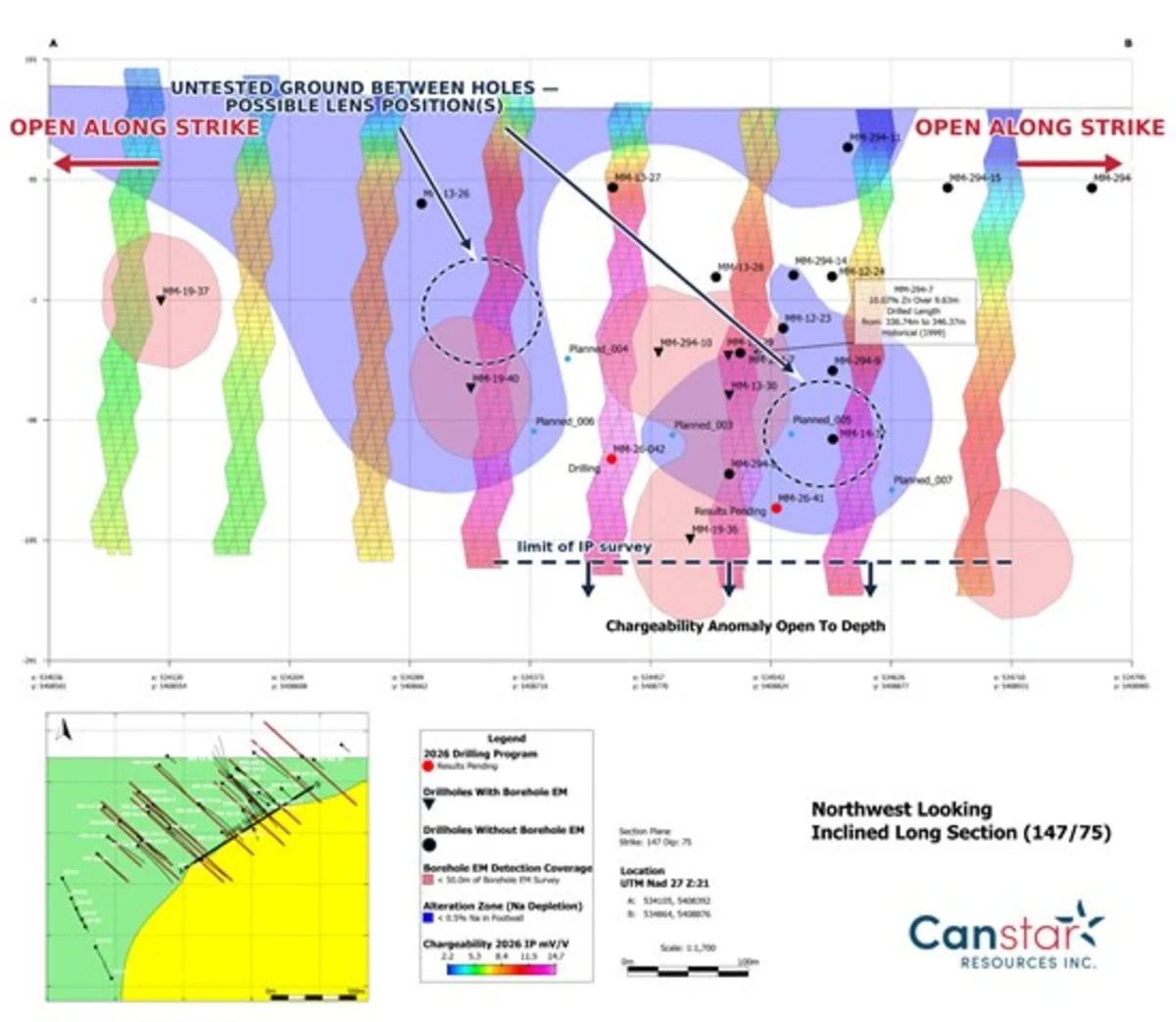
The first hole of the 2026 program drilled through to a mineralized basal contact - the horizon on which VMS lenses typically form - carrying both copper and zinc; supports the Company's geological model. Assays pending.
Toronto, Ontario--(Newsfile Corp. - July 8, 2026) - Canstar Resources Inc. (TSXV: ROX) ("Canstar" or the "Company") has encountered copper- and zinc-bearing sulphide stringers and disseminations over several apparently wide intercepts (true widths not yet determined) in the first diamond drill hole (MM-26-41) of its 2026 drill program at its flagship Mary March volcanogenic massive sulphide ("VMS") Project, in the Buchans district of central Newfoundland — its first drilling there since 2019. The drill hole intersected the targeted prospective rhyolite — the top of the mineralized package, where stringer mineralization was first encountered — at a downhole depth of 390.6 metres (an interpreted vertical depth of approximately 328 metres), essentially where the Company's 3D model predicted, and traced a total of 271 metres of altered, sulphide-bearing host rock through to an interpreted mineralized basal contact at 710.6 metres downhole (an approximate vertical depth of 568 metres). The rhyolite is interrupted by two magnetic dacitic intrusions of 40 and 9.1 metres thickness. Sulphide stringers with visually identified sphalerite occur at less-than-one-metre intervals in the upper 118 metres of the rhyolite and less frequently in the remainder, while disseminated pyrite is abundant (3-5%) in the lowermost 90 metres of the rhyolite. At 710.6 metres the rhyolite is in contact with a basaltic breccia containing red chert fragments and sulphide stringers containing sphalerite and chalcopyrite. The sulphide mineralization has the potential to be part of a feeder zone for a VMS deposit. The mineralization described in this news release is based on visual core logging and is preliminary; assays are pending.
Based on previous exploration, the mineralized rhyolite is a large target: interpreted to be continuous for approximately 1.2-1.3 kilometres along strike (approximately 700 metres confirmed by drilling) and roughly 200-300 metres thick (in part structurally thickened), and open along strike and at depth. Mineralization is present as stringers and disseminations through the rhyolite and as sphalerite- and chalcopyrite-bearing sulphides at its basal contact, so the Company regards the entire thickness as prospective. A system of this scale has the potential for more than one massive sulphide lens within it.²