
Vancouver, British Columbia – 21 May, 2026 - TheNewswire – Au Gold Corp (TSXV: AUGC) (the “Company” or “AUGC”) is pleased to provide an update on exploration activities and analytical results received to date at its Havelock Gold-Antimony project in Victoria, Australia.
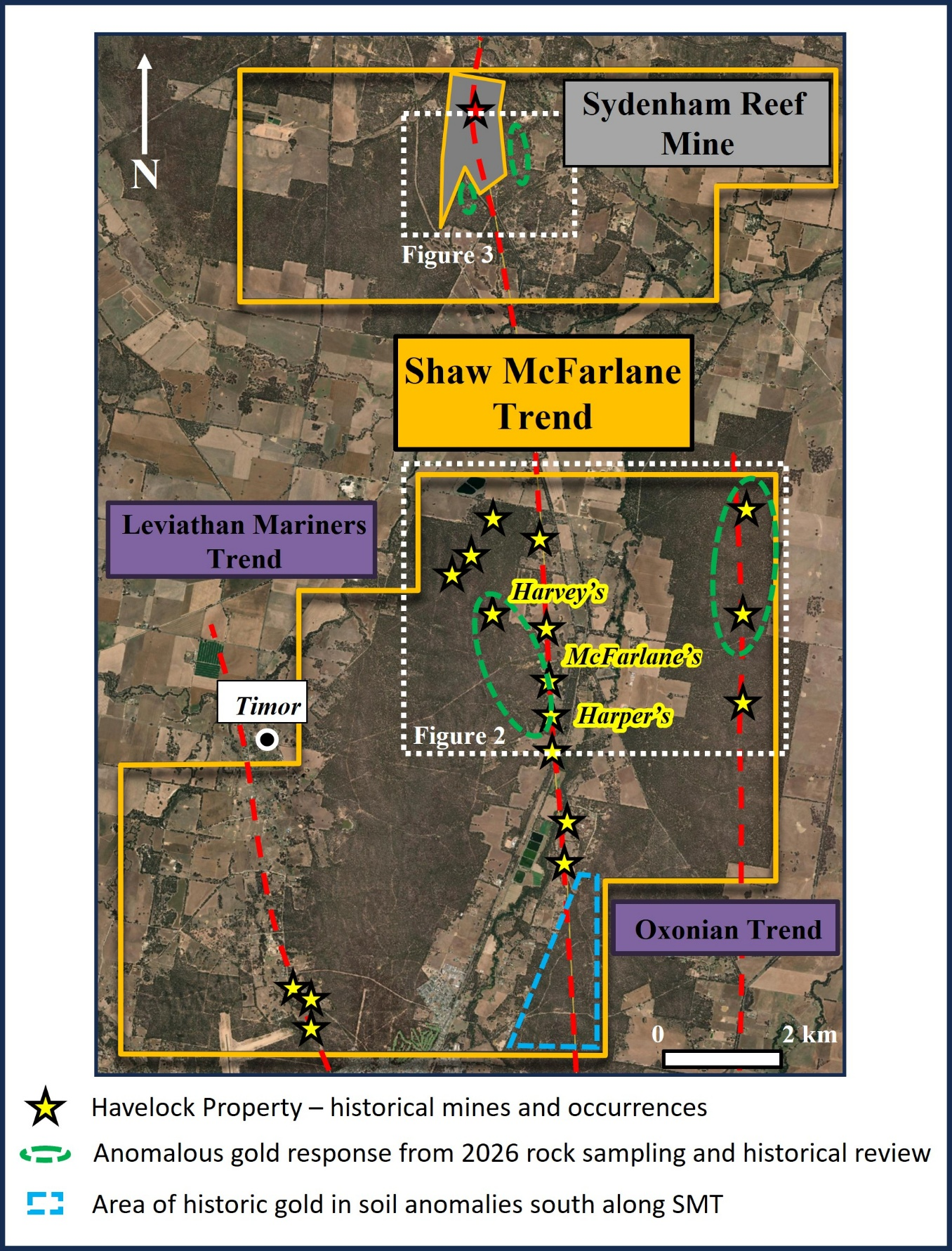
- Eighty-nine orientation rock samples were collected and analysed from various locations on the project (Figure 1), returning values from below detection to 25.10 grams per tonne (“g/t”) gold. Only gold values have been received to date, multi-element results, including antimony are pending
- Two new areas of interest have been identified on the northern claim block through historical data review proximal to the Sydenham Reef Mine (owned by a third party)
- Historic soil geochemistry data has been acquired and added to the project digital data set, resulting in the identification of anomalous gold results on the southern end of the Shaw-McFarlane Trend, between Shaw’s Reef and the southern property boundary. The anomalies appear to have had no follow up to date
- Field personnel are mobilizing to collect an additional 1,000 soil samples, comprising infill and extension around existing anomalies. Further prospecting, sample collection and interpretation will be carried out during June 2026
Marc Blythe, Founder & CEO of Au Gold, comments, “Overall we are very pleased with progress to date at Havelock. We are progressing a very methodical approach, including wringing as much information out of historical work by others at the project as possible to ensure that our own work programs are tightly focused and efficient.”
First Phase Orientation Rock Sampling Results
During March 2026, Company personnel collected 89 orientation rock samples, comprising both select and in-situ samples at a range of sites across the project. Target areas (shown in Figure 1) included two sites along the main Shaw-McFarlane Trend (SMT) reef line and several historical sites to the west assessing parallel structures including potential extensions of Harvey’s Reef. In addition, a 3 kilometre (“km”) portion of the Oxonian Trend was prospected.
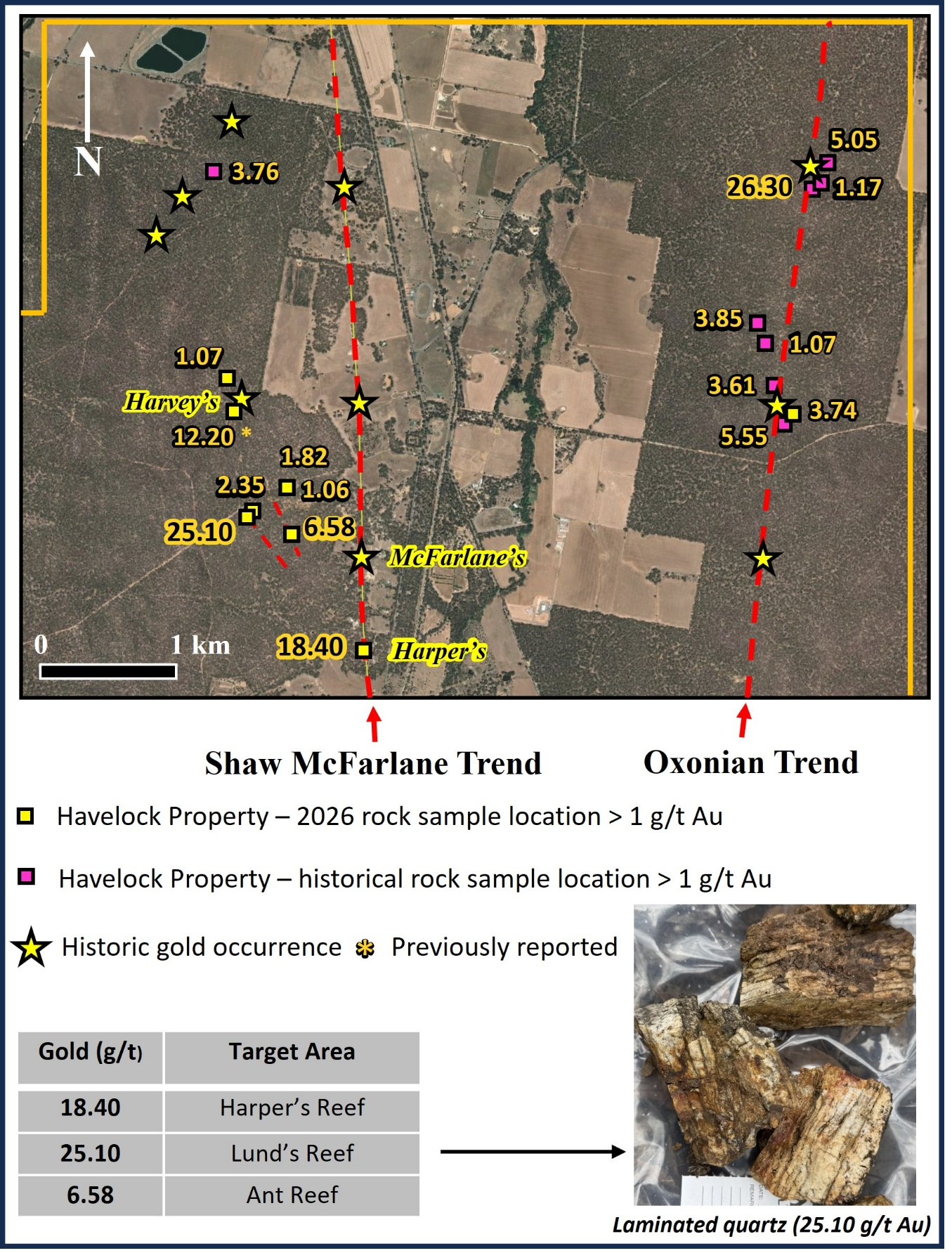
Samples consisted dominantly of massive to thinly laminated quartz reef material and iron carbonate-iron oxide quartz breccias. Samples were collected from historical dump piles and shallow pits as well as undisturbed areas. Twenty-eight samples returned anomalous gold values between 100 ppb and 25.10 g/t (Figure 2).
At Harper’s Reef, located on the Shaw-McFarlane Trend, two samples returned anomalous gold values of 0.98 and 18.40 g/t gold. The 18.40 g/t sample consisted of a composite of weakly laminated white quartz pieces collected from the top of the Harper’s Reef dump pile and the grade is in line with reported historic production records. This appears to be the only sample documented from this site.
Between McFarlane Shaft and Harvey’s Reef (Figure 2), seventeen samples returned anomalous gold values between 100 ppb and 25.10 g/t. The sample grading 25.10 g/t was a composite of laminated quartz reef material averaging 7 centimetres (“cm”) thickness from an area of shallow workings (< 1 m deep) referred to in the historic literature as Lund’s Reef. Angular blocks up to 30 cm thick of hydrothermally altered siltstone containing quartz stringers, secondary manganese and siderite returned 6.58 g/t gold from a parallel series of shallow workings known as the Ant Reef.
Prospecting and localized sampling along the Oxonian trend returned mostly sub gram gold samples with exception of one insitu sample from an 11 cm exposure of quartz-siderite which graded 3.74 g/t gold.
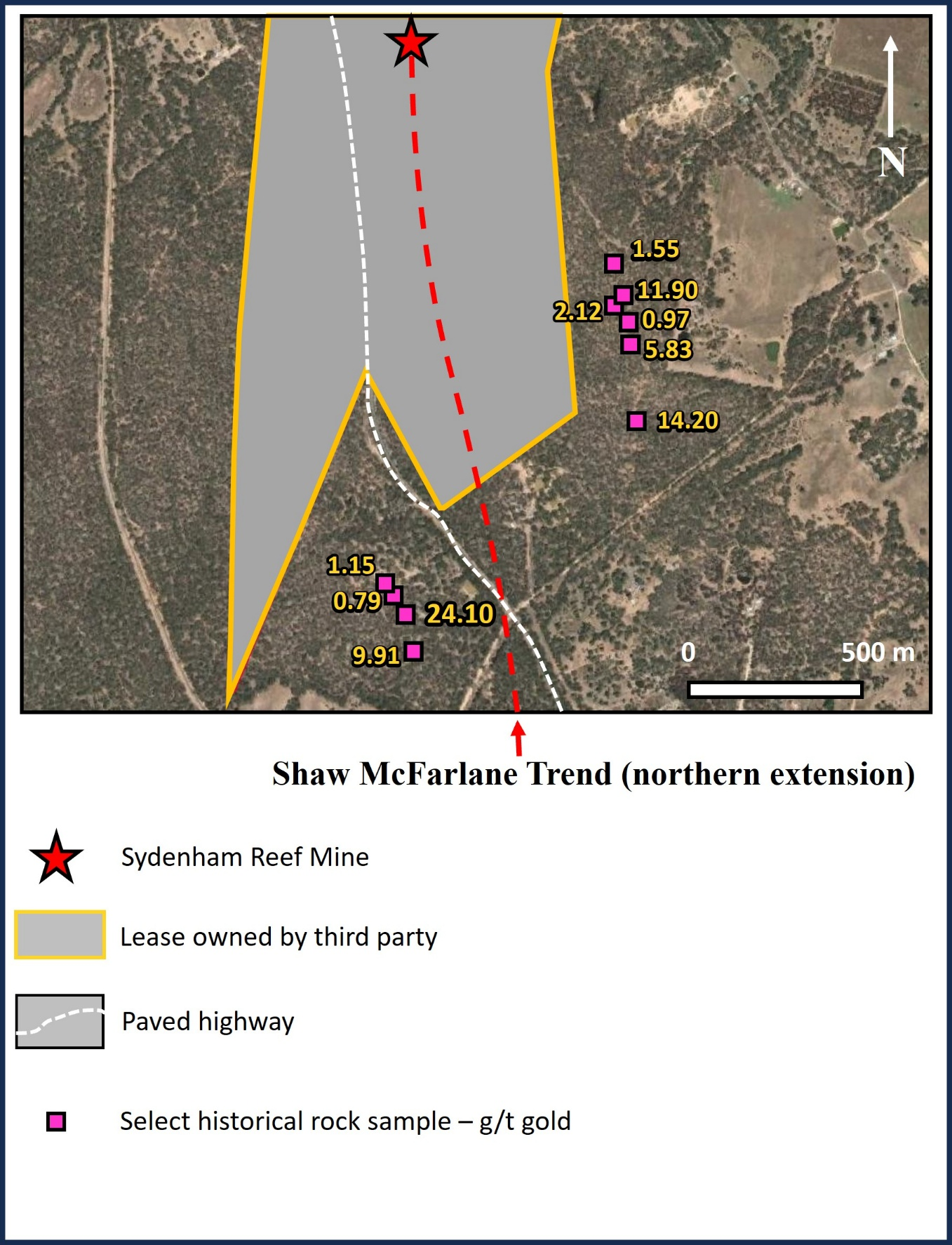
Recent completion of the Havelock data set review identified two well-defined northerly trends of gold-bearing float and insitu samples in the northern Havelock claim block (Figure 3). This region of the project is host to the Sydenham Reef Mine developed along the northern extension of the Shaw-McFarlane Trend. The mine is currently owned by a third party and believed to be inactive.
The two trends are delineated by rock samples grading between 0.79 g/t and 24.10 g/t gold. The rock samples were contained in a historical data set and appear to have had no follow up. The Sydenham Central trend of anomalous rock samples is 210 m in length and is centered on an insitu sample returning 24.10 g/t gold however the thickness of the sample was not provided. The Sydenham East trend of anomalous rock samples is 500 m in length with peak values of 14.20 g/t and 11.90 g/t gold at the southern and northern ends of the trend, respectively.
Historical Data Set Review
Part of the recent data set review included the identification and location of historical soil sampling results. These were added to the digital data set, which led to the identification of a strategic 2 km section of the Shaw-McFarlane Trend (Figure 1) in the southern part of the property containing weak and moderate intermittent gold-in soil anomalies. There are no recorded rock samples in this area suggesting no follow up work has been conducted.
Next Steps
AUGC will be commencing its phase 2 work program at Havelock shortly which will consist of the collection of approximately 1,000 soil samples in strategic parts of the property supplementing broadly spaced historical anomalies. Focused prospecting will also continue along the Shaw-McFarlane and Oxonian Trends.
The recent sampling results, along with the upcoming phase 2 work program and historical data set review will provide the basis for identifying additional high priority drill targets at Havelock. AUGC’s drill program, which is expected to commence in Q3 2026 will constitute the first modern drilling program on the SMT.
The Company continues to engage with the community, in particular private landowners within areas of interest on the project.
Qualified Person
Technical information in this press release was prepared under the supervision of Mr. William Wengzynowski, P.Eng., a Qualified Person as defined by NI 43-101. Mr. Wengzynowski is AUGC’s Exploration Manager.
Sample Analysis
Analytical samples were transported by Company personnel to On Site Laboratory Services (“On Site”) located in Bendigo, Victoria, Australia. On Site operates under both ISO 9001 and NATA quality systems. Samples were prepared and analyzed for gold using the fire assay technique (PE01S method; 25 gram charge), followed by measuring the gold in solution with flame AAS equipment. On Site inserts blanks and standards into the analytical process, AUGC did not insert additional QA/QC samples.
For further information, please contact:
Au Gold Corp
Marc G. Blythe, MBA, P.Eng., President & Chief Executive Officer
David Jan, Investor Relations
1-888-807-4566
About Au Gold
Au Gold Corp (TSXV: AUGC) is a gold exploration company focused on advancing its flagship Havelock gold-antimony project in the Victorian Gold Fields in Australia and the Ponderosa gold project in the Spences Bridge Gold Belt in British Columbia, Canada. More information at www.AuGoldCorp.com
Cautionary Note
This release includes certain statements and information that may constitute forward-looking information within the meaning of applicable Canadian securities laws. Forward-looking statements relate to future events or future performance and reflect the expectations or beliefs of management of the Company regarding future events. Generally, forward-looking statements and information can be identified by the use of forward-looking terminology such as “intends” or “anticipates”, or variations of such words and phrases or statements that certain actions, events or results “may”, “could”, “should”, “would” or “occur”. This information and these statements, referred to herein as "forward-looking statements", are not historical facts, are made as of the date of this news release and include without limitation, statements regarding discussions of future plans, estimates and forecasts and statements as to management’s expectations and intentions with respect to, among other things, future exploration activities including drilling on the Project.
These forward-looking statements involve numerous risks and uncertainties and actual results might differ materially from results suggested in any forward-looking statements. Such risks and uncertainties include, among other things, the ability of the Company to obtain sufficient financing to fund its business activities and plans, delays in obtaining governmental and regulatory approvals (including of the TSX Venture Exchange), changes in laws, regulations and policies affecting mining operations, currency fluctuations, market uncertainty, as well as those factors discussed in the Company's most recently filed management's discussion and analysis and other filings of the Company with Canadian securities authorities, copies of which can be found under the Company's profile on the SEDAR+ website at www.sedarplus.ca.
In making the forward looking statements in this news release, the Company has applied several material assumptions, including without limitation, that the Company will be able to obtain sufficient financing to carry out its planned exploration activities.
Although management of the Company has attempted to identify important factors that could cause actual results to differ materially from those contained in forward-looking statements or forward-looking information, there may be other factors that cause results not to be as anticipated, estimated or intended. There can be no assurance that such statements will prove to be accurate, as actual results and future events could differ materially from those anticipated in such statements. Accordingly, readers should not place undue reliance on forward-looking statements and forward-looking information. Readers are cautioned that reliance on such information may not be appropriate for other purposes. The Company does not undertake to update any forward-looking statement, forward-looking information or financial outlook that are incorporated by reference herein, except in accordance with applicable securities laws. We seek safe harbour.