


Market trends indicate robust expansion in online retail, convenience stores, and prepared baby food segments. Leading countries like China and India bolster growth, with key players including Nestlé and Danone at the forefront.
Asia-Pacific Organic Baby Food Market
Dublin, Nov. 04, 2025 (GLOBE NEWSWIRE) -- The "Asia-Pacific Organic Baby Food Market Size and Share Analysis - Growth Trends and Forecast Report 2025-2033" has been added to ResearchAndMarkets.com's offering.
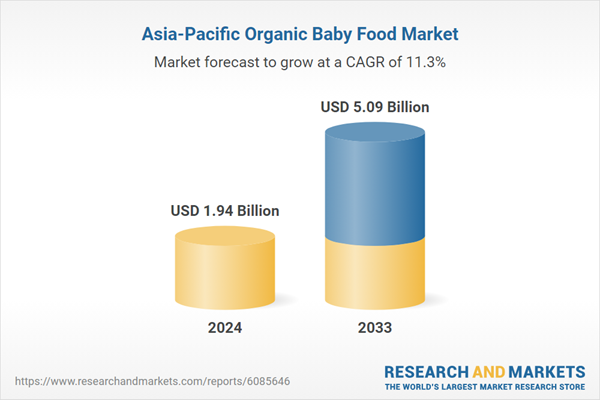
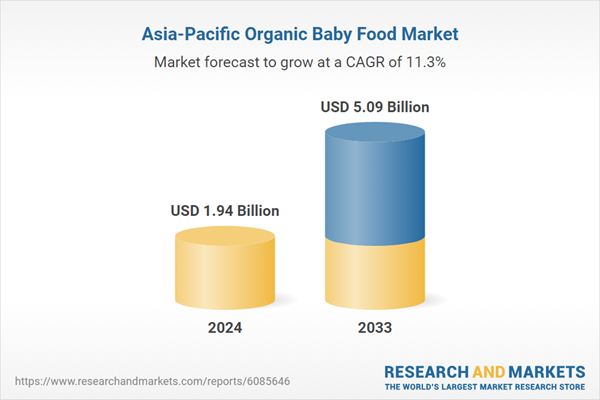
The Asia-Pacific Organic Baby Food Market was valued at USD 1.94 billion in 2024 and is likely to grow to USD 5.09 billion by 2033, at a CAGR of 11.3% from 2025 to 2033. The growing awareness of well-being and health, combined with the increased desire for chemical-free food, is propelling the demand for organic baby food in the region. Increasing disposable incomes, coupled with urbanization, are also driving the market further by making parents more inclined to spend on high-end, organic food products for their infants.
Growth Drivers in the Asia-Pacific Organic Baby Food Market
Health Consciousness Among Parents: Parents in Asia-Pacific increasingly place an emphasis on health and safety when it comes to their babies, with this factor fuelling an explosion of demand for organic baby food. Organic products are thought to be safer since they don't contain preservatives or pesticides, making them even more sought after. Such is particularly observable among higher income nations where parents pay more for top-end baby food because their children deserve to eat only the best.
Increasing Disposable Income: With disposable incomes increasing in the Asia-Pacific region, more households can afford organic food, including baby food. With rising purchasing power, organic baby food became more affordable for middle-income families, propelling the market growth. Increased disposable income also leads to a preference for quality over cost, with organic baby food emerging as a desirable choice among health-conscious parents. April 2023, Euromonitor reports that disposable income in Asia-Pacific will increase by more than twice in real terms from 2021 to 2040, surpassing all other regions, although it is still one of the lowest in the world. Asian consumers are expected to account for half of worldwide consumption growth over the next decade.
Growing Urbanization and Nuclear Families: Urbanization and the growth of nuclear families in the Asia-Pacific region drive the demand for organic baby food. With increasingly fast-paced urban lifestyles, parents are seeking convenient yet healthy food for their babies. Organic baby food products provide the ideal solution, enabling busy parents to feed their babies well while keeping an eye on their child's health. ASEAN countries have registered different urbanisation rates, with some registering more than 50% already in the 1960s, while others fall behind. A projected addition of 70 million urban residents by 2040, representing 60% of the total, heralds a turning point. The fast growth is bringing tremendous opportunities along with acute challenges for ASEAN.
Challenges in Asia-Pacific Organic Baby Foods Market
High Cost of Organic Products: One of the major issues concerning the organic baby food market in Asia-Pacific is the premium nature of organic food. Organic baby food tends to be more costly compared to standard products because organic farming and certification come at an additional expense. The price gap can restrict lower-income households from purchasing organic baby food, hence reducing market expansion in certain markets.
Limited Availability in Rural Areas: Though organic baby food is becoming popular in urban markets, it is not readily available in rural areas. Organic baby food distribution networks and channels are not yet well established in most regions of Asia-Pacific, thus barring rural families from using them. This distribution limitation can negatively impact the overall growth of the market, particularly in countries with large rural populations.
Key Attributes
Report Attribute | Details |
No. of Pages | 200 |
Forecast Period | 2024-2033 |
Estimated Market Value (USD) in 2024 | $1.94 Billion |
Forecasted Market Value (USD) by 2033 | $5.09 Billion |
Compound Annual Growth Rate | 11.3% |
Regions Covered | Asia-Pacific |
Key Topics Covered
1. Introduction
2. Research & Methodology
3. Executive Summary
4. Market Dynamics
4.1 Growth Drivers
4.2 Challenges
5. Asia-Pacific Organic Baby Food Market
5.1 Historical Market Trends
5.2 Market Forecast
6. Market Share
6.1 By Products
6.2 By Distribution Channels
6.3 By Countries
7. Products
7.1 Prepared baby Food
7.2 Dried Baby Food
7.3 Infant Milk Formula
7.4 Others
8. Distribution Channels
8.1 Supermarkets/hypermarkets
8.2 Convenience Stores
8.3 Online Retails
8.4 Others
9. Countries
9.1 China
9.2 Japan
9.3 India
9.4 South Korea
9.5 Thailand
9.6 Malaysia
9.7 Indonesia
9.8 Australia
9.9 New Zealand
9.10 Rest of Asia-Pacific
10. Porter's Five Forces Analysis
10.1 Bargaining Power of Buyers
10.2 Bargaining Power of Suppliers
10.3 Degree of Rivalry
10.4 Threat of New Entrants
10.5 Threat of Substitutes
11. SWOT Analysis
11.1 Strength
11.2 Weakness
11.3 Opportunity
11.4 Threat
12. Key Players Analysis
12.1 Abbott Laboratories
12.2 Nestle SA
12.3 Danone SA
12.4 Kewpie Corporation
12.5 Hero Group
12.6 Arla Foods amba
12.7 AAK AB
12.8 Early Foods Private Limited
12.9 Kraft Heinz
For more information about this report visit https://www.researchandmarkets.com/r/3k9lts
About ResearchAndMarkets.com
ResearchAndMarkets.com is the world's leading source for international market research reports and market data. We provide you with the latest data on international and regional markets, key industries, the top companies, new products and the latest trends.
Attachment
CONTACT: CONTACT: ResearchAndMarkets.com Laura Wood,Senior Press Manager press@researchandmarkets.com For E.S.T Office Hours Call 1-917-300-0470 For U.S./ CAN Toll Free Call 1-800-526-8630 For GMT Office Hours Call +353-1-416-8900