
VANCOUVER, BC, Oct. 8, 2026 /CNW/ -- Arras Minerals Corp. (TSXV: ARK) (OTCQB: ARRKF) ("Arras" or the "Company") is pleased to announce additional drill results from its ongoing 40,000-metre diamond drill program at the Elemes Project in Pavlodar Region, Kazakhstan. The results reported here are from the Berezski Central and K-Ozek targets and provide a much clearer picture of the scale and architecture of the Berezski Trend, where we now see multiple porphyry centres together with a well-preserved epithermal gold system.
Key Highlights:
- Berezski Central
- EL26042 returned 574m grading 0.40% CuEq from 98m, including 211m grading 0.62% CuEq from 433m with strong Cu-Mo-magnetite veins.
- EL26041 drilled 707m grading 0.26% CuEq from 4m, including 142m grading 0.29% CuEq from 90 m, with sheeted quartz-chalcopyrite-molybdenite veins developed from 492m to 709m depth that returned 271m grading 0.31% CuEq.
- The extent and type of mineralization intersected in holes EL26041 and EL26042 support an emerging large and extensive porphyry copper-gold system at the Berezski Central target.
- K-Ozek
- EL26029 intersected a broad zone grading 0.30 g/t Au over 229m grading from 2m, with a higher-grade core of 25m grading 1.11 g/t Au from 174m.
- EL26039 drilled 22.8m grading 5.37 g/t Au from 124.2m, including 13.8m grading 8.84 g/t Au and 6.1m grading 17.0 g/t Au.
- EL26044 returned 40m grading 0.83 g/t Au from 147m, including 2m grading 12.65 g/t Au.
- The result from K-Ozek highlights a broad envelope of lower-grade gold mineralization with well-developed higher-grade gold zones above 1 g/t Au, and that mineralization occurs across several broad areas rather than being confined to a single isolated structure.
The K-Ozek target sits within a down-dropped block between Berezski Central and Berezski North. We believe this has preserved the higher-level epithermal part of the hydrothermal system that has largely been eroded away over the adjacent porphyry centres. This suggests that there may be another porphyry system preserved at depth beneath K-Ozek. This remains to be tested by drilling.
Tim Barry, CEO of Arras Minerals, commented "These results are really starting to bring the Berezski Trend together geologically. Hole EL26042 is an important hole for Berezski Central. Not only does it deliver another very broad copper-gold interval, but deeper in the hole we start to see a stronger Cu-Mo-magnetite vein assemblage that we would expect as we move further into the porphyry system.
What is particularly exciting is what we are now seeing at K-Ozek. We have intersected high-grade gold in a distinctly higher-level epithermal environment that sits in a down-dropped block between Berezski Central/Berezski East and Berezski North. In simple terms, that block appears to have preserved a part of the hydrothermal system that has been eroded away over the adjacent porphyry centres. That is important because it gives us a very clear geological question to test: if the epithermal system is preserved at K-Ozek, is the porphyry system still preserved beneath it?
We do not yet know the answer to that, and it will require drilling, but the geological model is compelling. Across more than seven kilometres we now have three substantial porphyry systems at or near surface, a preserved high-grade epithermal gold system between them, and the potential for another porphyry centre at depth. That is a very attractive exploration setting and one we intend to test systematically."
Emerging Geological Model – Berezski Central/Berezski East, K-Ozek and Berezski North
The emerging geological model for the Berezski Trend is relatively simple. Berezski Central/Berezski East and Berezski North deposits expose the deeper level of a porphyry system, while K-Ozek sits within a structurally down-dropped block that has preserved a shallower epithermal system overlying a deeper porphyry center. This remains an exploration concept and has not yet been confirmed by drilling.
Assay results reported in this news release include:
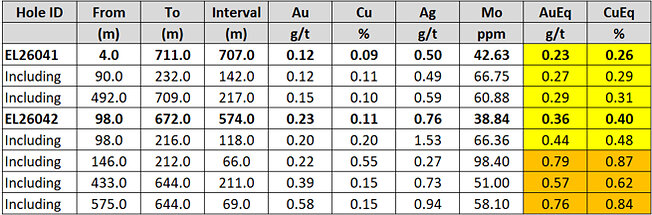
Table 3. Drill-hole locations
|
Hole_ID |
Coordinates (UTM) |
|||||
|
Easting |
Northing |
RL |
Azimuth |
Dip |
Hole Depth (m) |
|
|
EL26029 |
508082 |
5715447 |
231 |
298 |
-70 |
380.8 |
|
EL26039 |
508242 |
5715585 |
231 |
300 |
-50 |
455.0 |
|
EL26041 |
505854 |
5713471 |
240 |
118 |
-70 |
914.3 |
|
EL26042 |
506304 |
5713570 |
244 |
298 |
-65 |
833.1 |
|
EL26043 |
508341 |
5715708 |
233 |
300 |
-50 |
524.0 |
|
EL26044 |
508139 |
5715257 |
233 |
300 |
-50 |
451.8 |
|
EL26048 |
508161 |
5715063 |
235 |
300 |
-50 |
672.7 |
Drill-Hole Geological Summaries
Berezski Central Drill holes
EL26041 intersected a broad, 707m long mineralized interval starting at 4m depth. The upper part of the hole is dominated by argillic alteration, passing downward into stronger phyllic alteration with zones of local K-feldspar-magnetite alteration. The hole intersected porphyry-style mineralization at approximately 559.6m depth and consists of sheeted quartz-chalcopyrite-molybdenite veins that terminates at a shear zone at 706.3m, suggesting an offset in mineralization. The alteration and mineralization intersected in this hole is consistent with the argillic-phyllic margin of a porphyry system.
EL26042 intersected 574m grading 0.40% CuEq from 98 m, including a higher-grade zone returning 0.57% CuEq over 211m from 433m depth. The hole started in strongly argillic altered and brecciated diorites before passing into a wide zone of phyllic alteration before entering a feldspar porphyry with zones of silicification that contained stronger copper-molybdenum mineralization, that consisted of quartz-chalcopyrite-molybdenite and quartz-magnetite veins. The alteration and mineralization intersected in this hole is consistent with the phyllic-potassic zone adjacent to the core of the porphyry system.
K-Ozek Drill holes
EL26029 drilled argillic and phyllic altered andesites, with interbedded andesitic tuffs. Alteration was dominated by oxidation and argillic alteration from surface to approximately 80m depth, before passing into a zone of stronger phyllic alteration to the end of the drillhole. The hole intersected 229 m grading 0.30 g/t Au from 2m, including a 25m zone grading 1.11 g/t Au. Mineralization is characterized by pervasive quartz-sulphide-carbonate veins with several wide quartz-base metal sulphide veins hosted in fault zones. The mineral assemblage and alteration are consistent with a structurally focused, high-level epithermal environment.
EL26039 intersected a wide zone of high-grade gold mineralization returning 22.8m grading 5.37 g/t Au from 124.2m, including 13.8m grading 8.84 g/t Au and 6.1m grading 17.0 g/t Au. The high-grade gold mineralization occurs near the transition from argillic volcanic and breccia units. The alteration style and strong structural control are consistent with a high-level epithermal environment.
EL26043 returned several narrow gold-bearing intervals, including 2m grading 1.19 g/t Au from 144m. The hole is dominated by oxidized to hematitic, argillic andesite and breccia cut by repeated faults and hydrothermal structures. The hole defines a broad pyrite-dominant argillic to phyllic alteration and helps delineate the wider mineralized footprint surrounding higher-grade structures.
EL26044 intersected several gold-bearing zones, including 40m grading 0.83 g/t Au from 147m, including 2m grading 12.65 g/t Au, and a second 49m zone grading 0.36 g/t Au from 351m. Mineralization is characterized by pervasive pyrite mineralization with zones of pyrite-rich breccias and quartz-pyrite-arsenopyrite veins containing minor chalcopyrite, sphalerite, galena and molybdenite. Alteration is dominantly argillic with local zones of phyllic. The repeated brecciation, faulting and veining indicate a structurally controlled epithermal system.
EL26048 intersected 317.8m grading 0.15 g/t Au from 40.2m depth including a 40m wide gold zone grading 0.39 g/t Au from 263m. The hole alternates between strongly argillic altered diorites and faulted and fractured volcanic andesites. Mineralization consists of stockwork fine sulphide veinlets, and mineralization is similar to hole EL26029, with pervasive quartz-sulphide-carbonate veins and is consistent with a structurally focused, high-level epithermal system.
Exploration Update
Four diamond drill rigs are currently operating at Elemes. KGK (top-of-bedrock) assay results remain pending from the area north of Berezski North and from the Aimandai Trend, approximately 7 km east of the Berezski Trend. Laboratory turnaround times have extended materially over the past six months, reaching up to approximately 150 days due largely to increased sample volumes together with customs and logistics considerations. Turnaround times appear to be gradually improving.
Stock Option Grant
The Company's Board of Directors has authorized, pursuant to its Equity Incentive Plan, the grant of 5,605,000 stock options ("Options") to certain directors, officers, employees and advisors, effective prior to the start of trading on September 29, 2026 ("Grant Date"). Each Option entitles the grantee to purchase one common share (each, a "Share") in the capital of the Company. The Options were awarded at an exercise price of C$1.33 per Share for a five-year term. The Options vest over 3 years, with 1/3 of the Option vesting immediately, 1/3 vesting on September 29, 2027 and 1/3 vesting on September 29, 2028.
Elemes Project Overview: The Elemes Project comprises two exploration licences covering 531 square kilometres in northeastern Kazakhstan, approximately 13 km southwest of Ekibastuz and about 20 km from Arras's operational base. The project benefits from established infrastructure, including a paved highway crossing the licence area and access to power, heavy rail and other utilities within approximately 15 km.
Situated within the prolific Bozshakol-Chingiz metallogenic belt, Elemes lies near significant regional deposits, including the Beskauga porphyry copper-gold-silver deposit (~80 km east) and KAZ Minerals' Bozshakol copper-gold mine (~60 km northwest), which reported mined grades in Q1 2025 of 0.37% copper and 0.20 g/t gold.1
Geologically, the property is underlain by interbedded intermediate volcanic and sedimentary rocks intruded by multiple phases of diorite and monzodiorite porphyry. Copper-gold mineralization occurs in sheeted and stockwork quartz-chalcopyrite veins associated with these intrusions. High-grade low-sulphidation epithermal veins have also been mapped on the property and represent an additional exploration target.
Property-wide soil sampling programs defined two extensive Cu-Mo-As geochemical trends: Berezski and Aimandai. A Phase 1 drill program on the Berezski Trend in late 2024 returned porphyry- and epithermal-style copper-gold mineralization, with results announced in Q1 2025. Approximately 10,000 metres of diamond drilling was completed in 2025 and a further 40,000 metres of drilling is expected to be completed by the end of 2026.
References
1Bozshakol Q3, 2025 Report
https://kazminerals.com/app/uploads/2025/12/q3-2025-production-report_final.pdf
Quality Assurance and Quality Control
The Company adheres to CIM Best Practices Guidelines for exploration-related activities conducted on its property. Quality Assurance and Quality Control (QA/QC) procedures are overseen by the Qualified Person.
Arras Minerals QA/QC protocols are maintained through the insertion of certified reference material (standards), blanks and field duplicates within the sample stream. Drill core is cut at Arras Minerals' operations base in Ekibastuz, Kazakhstan by Company personnel. Diamond drill core was sawn in half with a diamond saw and sampled at maximum 2-metre intervals, stopping at geological boundaries, with one-half placed in sealed bags and shipped to the laboratory and the other half retained on site.
Each bagged core sample was shipped to ALS Laboratory in Karaganda, Kazakhstan. Samples were dried, crushed and pulverized to >80% passing -200 mesh. The prepared sample splits were sent to the ALS Chemex geochemical laboratories in Loughrea, County Galway, Ireland and Lima, Peru for multi-element analysis. Multi-element analyses were completed by ICP-MS following a four-acid digestion (method ME-MS61) and samples containing >1.0% copper were analyzed via method Cu-OG62.
Gold analysis was conducted by ALS Chemex at the analytical laboratory in Karaganda, Kazakhstan. Gold was analyzed by fire assay (30 g) with an AA (atomic absorption) finish (method Au-AA23) with detection limits of 0.005 g/t gold. Samples containing greater than 10.0 g/t gold were analyzed by fire assay with a gravimetric finish (method Au-GRA21).
ALS is an accredited laboratory that is independent of the Company. Chain of custody is maintained from the drill to the submission to the laboratory preparation facility.
Qualified Person
The scientific and technical disclosure for this news release has been prepared under the supervision of and approved by Matthew Booth, Vice President of Exploration, of Arras Minerals Corp., a Qualified Person for the purposes of NI 43-101. Mr. Booth has reviewed and approved this release. Mr. Booth has over 20 years of mineral exploration experience and is a Qualified Person and a member of the American Institute of Professional Geologists (CPG 12044).
Copper Equivalent (CuEq): Copper equivalent grades are calculated by converting the recovered value of gold, silver and molybdenum into an equivalent copper grade and adding those contributions to the copper grade and then a copper recovery is applied. The calculation uses assumed metal prices of US$3.75/lb Cu, US$3,000/oz Au, US$35/oz Ag and US$30/lb Mo, together with assumed metallurgical recoveries of 90% Cu, 85% Au, 75% Ag and 80% Mo. Each metal contribution is adjusted for its respective recovery and converted to the amount of copper that would have an equivalent recovered value.
Copper Equivalent ("CuEq") grades reported for the drill holes at Elemes were calculated using the following formula: CuEq % = ((Copper (%)) + ((Gold (g/t) x 0.8571) x 0.85) + ((Silver (g/t) x 0.0117) x 0.75) + ((Molybdenum (%) x 0.857) x 0.80).
Gold Equivalent ("AuEq") grades reported for the drill holes at Elemes were calculated using the following formula: AuEq g/t = ((Gold (g/t) + ((Copper (%) x 1.1667) x 0.9) + ((Silver (g/t) x 0.0136) x 0.75) + ((Molybdenum (%) x 6.8568) x 0.80).
On behalf of the Board of Directors,
"Tim Barry"
Tim Barry, MAusIMM CP(Geo)
Chief Executive Officer and Director
Further information can be found on:
- the Company's website https://www.arrasminerals.com or
- follow us on LinkedIn: https://www.linkedin.com/company/arrasminerals or
- follow us on X (formerly Twitter): https://twitter.com/arrasminerals
About Arras Minerals Corp
Arras is a Canadian exploration and development company advancing a portfolio of copper and gold assets in northeastern Kazakhstan, including the Elemes copper-gold porphyry project, where initial drill results in 2025 identified porphyry-style mineralization across a 10 km strike length. The Company has established one of the country's largest land packages prospective for copper and gold. The Company's shares are listed on the TSX-V under the trading symbol "ARK" and on the OTCQB under the trading symbol "ARRKF".
Cautionary note regarding forward-looking statements
This news release contains forward-looking statements regarding future events and Arras' future results that are subject to the safe harbors created under the U.S. Private Securities Litigation Reform Act of 1995, the Securities Act of 1933, as amended, and the Exchange Act, and applicable Canadian securities laws. Forward-looking statements include, among others, statements regarding plans and expectations of the exploration program Arras is in the process of undertaking, the timing, scope, nature, breadth and other information related to Arras' exploration program, any results that may be derived from Arras' exploration program, the prospects of Arras' business plans, and any expectations with respect to any permitting, development or other work that may be required to bring any of the projects into development or production. These statements are based on current expectations, estimates, forecasts, and projections about Arras' exploration projects, the industry in which Arras operates and the beliefs and assumptions of Arras' management. Words such as "expects," "anticipates," "targets," "goals," "projects," "intends," "plans," "believes," "seeks," "estimates," "continues," "may," variations of such words, and similar expressions and references to future periods, are intended to identify such forward-looking statements. Forward-looking statements are necessarily based upon a number of assumptions that, while considered reasonable by management at the time, are inherently subject to business, market and economic risks, uncertainties and contingencies that may cause actual results, performance or achievements to be materially different from those expressed or implied by forward-looking statements. Such assumptions include, but are not limited to, assumptions that the anticipated benefits of Arras' proposed exploration program will be realized, that no additional permits or licences will be required in connection with Arras' exploration programs, the ability of Arras to complete its exploration activities as currently expected and on the currently anticipated timelines, that Arras will be able to execute on its current plans, that Arras' proposed explorations will yield results as expected, and that general business and economic conditions will not change in a material adverse manner. Although Arras has attempted to identify important factors that could cause actual results to differ materially from those contained in forward-looking information, there may be other factors that cause results not to be as anticipated, estimated or intended. There can be no assurance that such information will prove to be accurate, as actual results and future events could differ materially from those anticipated in such statements. Accordingly, readers should not place undue reliance on forward-looking information. Such statements represent the current view of Arras with respect to future events and are necessarily based upon a number of assumptions and estimates that, while considered reasonable by Arras, are inherently subject to significant business, economic, competitive, political and social risks, contingencies and uncertainties. Risks and uncertainties include, but are not limited to the following: inability of Arras to realize the benefits anticipated from the exploration and drilling targets described herein or elsewhere; inability of Arras to complete current exploration plans as presently anticipated or at all; inability of Arras to economically realize the benefits, if any, derived from the exploration program; failure to complete business plans as currently anticipated; overdiversification of Arras' portfolio; failure to realize on benefits, if any, of a diversified portfolio; unanticipated changes in market price for Arras shares; changes to Arras' current and future business and exploration plans and the strategic alternatives available thereto; growth prospects and outlook of the business of Arras; and the ability to advance Arras' projects and its proposed exploration program; risks inherent in mineral exploration including risks related to worker safety, weather and other natural occurrences, accidents, availability of personnel and equipment, and other factors; aboriginal title; failure to obtain regulatory and permitting approvals; no known mineral resources/reserves; reliance on key management and other personnel; competition; changes in laws and regulations; uninsurable risks; delays in governmental and other approvals, community relations; stock market conditions generally; demand, supply and pricing for uranium; and general economic and political conditions in Canada, Kazakhstan and other jurisdictions where Arras conducts business. Other factors that could materially affect such forward-looking information are described in the filings of Arras with the Canadian securities regulators which are available on Arras' profile on SEDAR+ at www.sedarplus.ca. Readers are cautioned that forward-looking statements are not guarantees of future performance and that actual results or developments may differ materially from those expressed or implied in the forward-looking statements. Any forward-looking statement made by Arras in this release is based only on information currently available and speaks only as of the date on which it is made. Arras undertakes no obligation to publicly update any forward-looking statement, whether written or oral, that may be made from time to time, whether as a result of new information, future developments, or otherwise.