


AI in life sciences presents key opportunities in drug discovery, personalized medicine, and diagnostics by leveraging vast datasets for precise, cost-effective solutions. Growth is driven by increased data, demand for precision therapies, and partnerships with tech leaders, despite challenges in costs and regulation.
AI in Life Sciences Market
Dublin, March 13, 2026 (GLOBE NEWSWIRE) -- The "AI in Life Sciences Market, till 2040: Distribution by Deployment Mode, Type of Offering, Type of Technology, Application Areas and Key Geographical Regions: Industry Trends and Global Forecasts" report has been added to ResearchAndMarkets.com's offering.
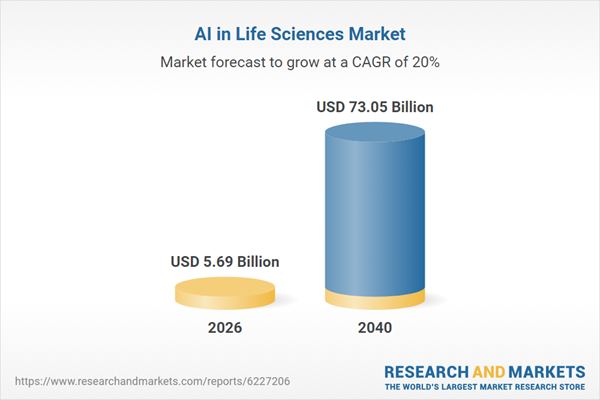
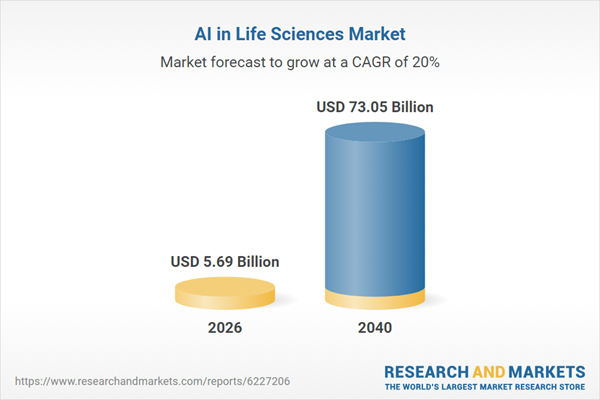
The global Artificial intelligence in life sciences market size is estimated to grow from USD 5.69 billion in current year to USD 73.05 billion by 2040, at a CAGR of 20% during the forecast period, till 2040.
Artificial intelligence (AI) is revolutionizing the life sciences sector, encompassing disciplines such as biology, pharmaceuticals, biotechnology, and medicine. These fields focus on advancing human health through the study of biological systems and therapeutic innovations. AI functions as an advanced computational framework, leveraging machine learning algorithms to process vast datasets, identify intricate patterns, and generate predictive insights with unprecedented efficiency.
The artificial intelligence in life sciences market is experiencing robust growth, fueled by the exponential increase in genomic, patient, and clinical trial data. Such huge data necessitates rapid, efficient analysis, where AI outperforms traditional methods by processing vast datasets with precision. Further, AI accelerates drug discovery timelines and significantly reduces elevated R&D expenditures and enhances clinical trial efficiency. Additionally, technological advancements in machine learning, cloud computing, and substantial investments by pharmaceutical giants also fuel the momentum of the market.
Strategic Insights for Senior Leaders
Transformative Role of Artificial Intelligence in Drug Discovery and Personalized Medicine
Artificial intelligence (AI) is revolutionizing drug discovery by speeding up the process, lowering costs, and enhancing success rates through methods, such as virtual screening, predictive modeling for efficacy and toxicity, and de novo drug design. Machine learning and deep learning techniques evaluate large datasets to pinpoint promising drug candidates, anticipate their behavior within the body, and even create completely new molecules. AI is also applied in drug repurposing and personalizing therapies by discovering new applications for existing medications or customizing treatments for individual patients based on their specific data.
In personalized medicine, AI integrates individual genomic profiles, lifestyle factors, and historical health data to develop tailored treatment strategies, forecast therapeutic responses, and dynamically adjust dosages or regimens. This minimized adverse effects, improving efficacy, and promoting patient adherence through automated reminders. Collectively, these capabilities reduce healthcare costs, expand access, and facilitates home-based models.
Key Drivers Propelling Growth of Artificial Intelligence (AI) in Life Sciences Market
Several key drivers propel the rapid expansion of AI in life sciences market. Exponential growth in data volumes from genomics, patient records, and clinical trials demands swift, precise analysis. AI surpasses traditional manual approaches in speed and accuracy and accelerates drug discovery by predicting molecular interactions effectively. It also optimizes clinical trials through superior patient selection and outcome forecasting, minimizing failure rates.
Rising demand for precision medicine further accelerates adoption, as AI tailors therapies to individual genetic and health profiles for enhanced efficacy. Advancements in machine learning algorithms and cloud computing facilitate seamless integration across research environments. Further, pharmaceutical giants are forging strategic partnerships with tech leaders like Google and IBM, backed by substantial investments. Collectively, these factors are propelling the growth of the overall AI in life sciences market during the forecast period.
Artificial Intelligence in Life Sciences Market: Competitive Landscape of Companies in this Industry
The competitive landscape of AI in life sciences features a mix of big tech giants, pharma leaders, and specialized startups driving innovation in drug discovery, clinical trials, and personalized medicine. Companies like IBM, IQVIA, and Oracle offer full-stack platforms that handle data integration, AI model training, and regulatory compliance. Pharma players such as Roche, Pfizer, and Insilico Medicine use AI to speed up drug development by analyzing vast genomic and clinical datasets, cutting costs and time-to-market. Emerging challengers like Atomwise, Sophia Genetics, and NuMedii focus on niche tools for molecular simulations, genomic analysis, and predictive modeling.
Artificial Intelligence in Life Sciences Evolution: Emerging Trends in the Industry
Key trends in the AI life sciences sector include accelerated AI-driven drug discovery, personalized medicine, and advanced diagnostics leveraging imaging and wearables. Additional developments encompass automation of laboratory workflows through AI-Science Factories, domain-specific large language models for regulatory applications, enhanced clinical trial optimization, and seamless AI integration for pharmacovigilance and preventative health strategies. These developments prioritize operational efficiency, cost reduction, and precision by harnessing vast biological and clinical datasets to enable proactive, patient-centric healthcare delivery.
Key Market Challenges
The Artificial intelligence in life sciences market faces several key challenges that hinder widespread adoption. High development costs for AI algorithms, genomic sequencing, and personalized therapies strain budgets, especially for smaller biotech firms. Data privacy concerns and regulatory hurdles, including stringent FDA guidelines on AI validation and ethical AI use, slow down approvals and integration into clinical workflows.
Additionally, problems like AI bias, stemming from training data that underrepresents certain patient groups can lead to unfair treatment results for diverse populations. This erodes trust among healthcare providers. Limited interoperability between disparate healthcare systems and AI platforms further complicates real-world data sharing for biomarker discovery and treatment customization. Despite these obstacles, ongoing innovations in federated learning offer pathways to overcome them, supporting sustained market growth.
Regional Analysis: North America to Hold the Largest Share in the Market
According to our estimates North America currently captures a significant share of Artificial Intelligence in life sciences market. This can be attributed to surging chronic disease burden, including cancer, diabetes, and infectious conditions. Robust R&D investments in AI-driven solutions, combined with advanced healthcare infrastructure and rapid regulatory approvals, further accelerates adoption and innovation in personalized diagnostics and therapies.
Reasons to Buy this Report
Detailed Market Analysis: The report provides a comprehensive market analysis, offering detailed revenue projections of the overall market and its specific sub-segments. This information is valuable to both established market leaders and emerging entrants.
In-depth Analysis of Trends: Stakeholders can leverage the report to gain a deeper understanding of the competitive dynamics within the market. Each report maps ecosystem activity across partnerships, funding, and patent landscapes to reveal growth hotspots and white spaces in the industry.
Opinion of Industry Experts: The report features extensive interviews and surveys with key opinion leaders and industry experts to validate market trends mentioned in the report.
Decision-ready Deliverables: The report offers stakeholders with strategic frameworks (Porter's Five Forces, value chain, SWOT), and complimentary Excel / slide packs with customization support.
Key Attributes:
Report Attribute | Details |
No. of Pages | 179 |
Forecast Period | 2026 - 2040 |
Estimated Market Value (USD) in 2026 | $5.69 Billion |
Forecasted Market Value (USD) by 2040 | $73.05 Billion |
Compound Annual Growth Rate | 20.0% |
Regions Covered | Global |
Companies Featured
Atomwise
BenevolentAI
Exscientia
Foundation Medicine
GE HealthCare
IBM
Insilico Medicine
Microsoft
NVIDIA
Owkin
PathAI
Recursion
Schrodinger
Tempus AI
Artificial Intelligence In Life Sciences Market: Key Market Segmentation
Deployment Mode
Cloud
On Premise
Type of Offering
Software
Hardware
Services
Type of Technology
Machine Learning
Computer Vision
Natural Language Processing
Predictive Analytics
Application Area
Medical Diagnosis
Drug Discovery
Precision & Personalized Medicine
Biotechnology
Clinical Trials
Patent Monitoring
Geographical Regions
North America
US
Canada
Mexico
Other North American countries
Europe
Austria
Belgium
Denmark
France
Germany
Ireland
Italy
Netherlands
Norway
Russia
Spain
Sweden
Switzerland
UK
Other European countries
Asia
China
India
Japan
Singapore
South Korea
Other Asian countries
Latin America
Brazil
Chile
Colombia
Venezuela
Other Latin American countries
Middle East and North Africa
Egypt
Iran
Iraq
Israel
Kuwait
Saudi Arabia
UAE
Other MENA countries
Rest of the World
Additional Benefits
Complimentary Dynamic Excel Dashboards for Analytical Modules
Exclusive Up to 15% Complimentary Content Customization
Personalized Interactive Report Walkthrough with Our Expert Research Team
Free Report Updates for Versions Older than 6-12 Months
For more information about this report visit https://www.researchandmarkets.com/r/9r4ph8
About ResearchAndMarkets.com
ResearchAndMarkets.com is the world's leading source for international market research reports and market data. We provide you with the latest data on international and regional markets, key industries, the top companies, new products and the latest trends.
Attachment
CONTACT: CONTACT: ResearchAndMarkets.com Laura Wood,Senior Press Manager press@researchandmarkets.com For E.S.T Office Hours Call 1-917-300-0470 For U.S./ CAN Toll Free Call 1-800-526-8630 For GMT Office Hours Call +353-1-416-8900