

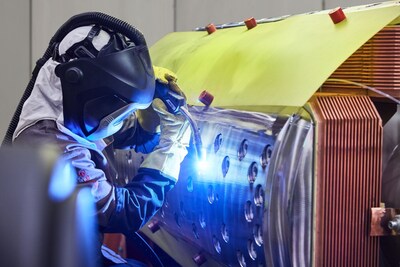
Report examines a decade of data for over 1,000 large motors and generators delivered globally by ABB's Västerås facility in Sweden
The specification gap between standard and Top Industrial Efficiency (TIE) option could be costing global operators up to $12 billion over a 25-year asset life
The typical payback period for adopting the TIE option ranges from a few months to up to three years
ZURICH, May 28, 2026 /PRNewswire/ -- ABB's new report, The Industrial Efficiency Gap, shows how high-efficiency industrial motors and generators can unlock one of the largest untapped opportunities to save energy, cut costs and reduce emissions in global industry.
Motors rated above 375 kW account for an estimated 10.4 percent of global electricity demand today, a figure projected to double by 2040. Examining a decade of data from ABB's Västerås manufacturing facility in Sweden, of more than 1,000 large synchronous motors and generators delivered worldwide between 2015 and 2025, the report finds that a significant efficiency gap persists between what is routinely specified and what is achievable through ABB's Top Industrial Efficiency (TIE) approach, which focuses on specifying the highest efficiency motor or generator using proven commercially available technology. Applied across the global installed base of similar equipment, this 0.2 percent gap is costing operators between $9.5 to $12 billion in unnecessary electricity costs and generating 60 to 75 million tons of avoidable CO₂ over a 25-year asset life - despite a typical payback period of a few months to up to three years.
Industrial energy efficiency is gaining importance as the global energy transition accelerates, with rising demand from AI and data centers adding pressure to electricity systems. Maximizing the use of each unit of electricity, while strengthening security of supply, is central to addressing these challenges.
"Industry has spent decades optimizing what happens inside a plant. Yet large motors and generators have rarely been part of that conversation, even though they run continuously for 25 years and sometimes even more, converting more energy to motion than almost anything else on site," said David Bjerhag, Global Business Line Manager, High Speed Synchronous, ABB. "The gap between a standard machine and a TIE-optimized one is not technological. It is a specification gap. The companies closing it fastest are the ones where the engineer who selects the motor and the CFO or CSO responsible for energy performance are aligned around a single metric: total cost of ownership."
The TIE initiative is ABB's contractual commitment to deliver large synchronous motors and generators with the highest possible energy efficiency, without compromising reliability or specification compliance. Open to OEMs, EPCs and end users, it enables solutions optimized for lifecycle performance rather than upfront cost.
The report highlights adoption trends by country and industry segment, showing how uptake varies across regions and applications. On average, the TIE option delivers 98.7 to 98.8 percent efficiency compared with a standard 98.5 percent - a 0.2 percentage–point improvement that serves as a baseline, with gains of 1 to 1.5 percentage points achievable in some applications, particularly induction-based systems.
Applying that TIE 0.2 percentage point efficiency improvement across the global installed base of industrial motors and generators would save 4 to 6 TWh per year, enough electricity to power roughly 750,000 to 1 million OECD households. Over a 25-year motor lifetime, that rises to 100 to 150 TWh of electricity saved, equivalent to powering the United Kingdom for five months, with associated CO₂ reductions of 60 to 75 million tonnes, equivalent to taking 13 to 16 million cars off the road permanently.
To turn potential into impact, the report sets out a clear set of actions to accelerate adoption. It calls on industry to move beyond upfront cost and embed energy efficiency into procurement decisions, including specifying minimum performance levels and requesting optimized designs. It also highlights the importance of using total cost of ownership as the primary decision metric, aligning incentives across engineering, procurement and energy management teams. Stronger collaboration across manufacturers, OEMs and EPCs will be critical to ensure high-efficiency systems are specified early and delivered at scale.
The full report is available here
ABB is a global technology leader in electrification and automation, enabling a more sustainable and resource-efficient future. By connecting its engineering and digitalization expertise, ABB helps industries run at high performance, while becoming more efficient, productive and sustainable so they outperform. At ABB, we call this 'Engineered to Outrun'. The company has over 140 years of history and around 110,000 employees worldwide. ABB's shares are listed on the SIX Swiss Exchange (ABBN) and Nasdaq Stockholm (ABB). www.abb.com
ABB Motion, a global leader in motors and drives, is at the core of accelerating a more productive and sustainable future. We innovate and push the boundaries of technology to contribute to energy efficient, decarbonizing and circular solutions for customers, industries and societies. With our digitally enabled drives, motors and services we support our customers and partners to achieve better performance, safety and reliability. To help the world's industries outrun – leaner and cleaner, we deliver motor-driven solutions for a wide range of applications in all industrial segments. Building on over 140 years of domain expertise in electric powertrains, our more than 23,000 employees across 100 countries learn and improve every day. go.abb/motion
For more information please contact:
ABB Motion - Media Relations
media-motion@abb.com
Photo - https://mma.prnewswire.com/media/2989903/ABB_High_Power.jpg

View original content to download multimedia:https://www.prnewswire.com/news-releases/abb-report-shows-how-a-0-2-percent-motor-efficiency-gain-could-unlock-billions-for-industry-302784668.html