Replay available

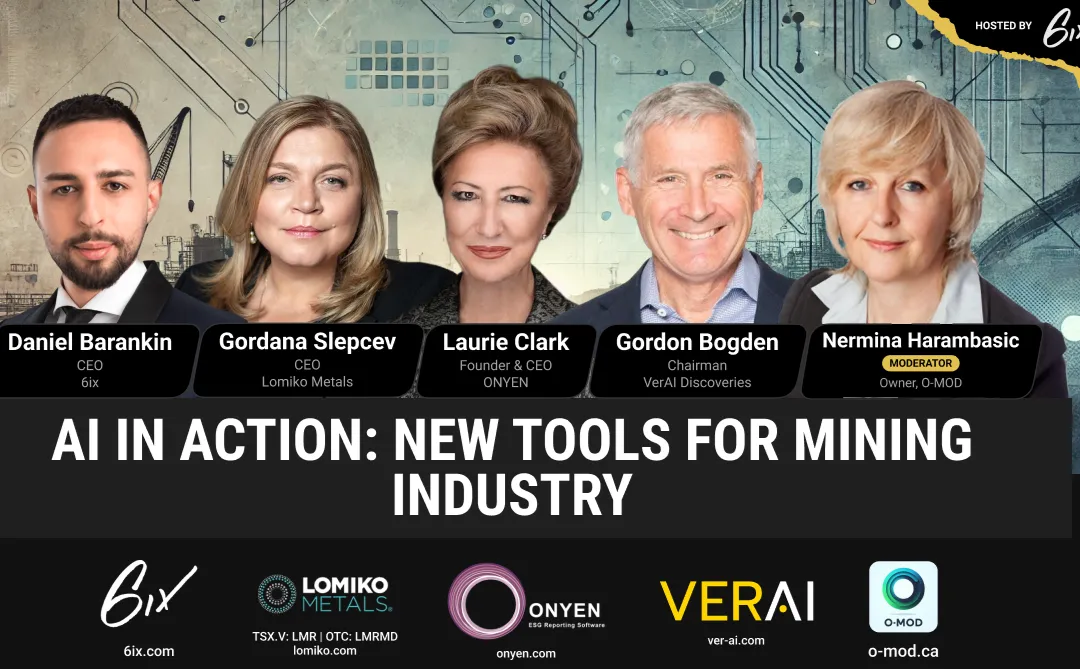
AI in Action: New Tools for Mining Industry

This virtual event brings together industry leaders with extensive experience in mining operations, capital project management, and technology integration to explore how artificial intelligence is transforming the mining sector. Experts from 6ix Inc., O-MOD, Lomiko Metals, VerAi Discoveries, and ONYEN will share insights on innovative AI applications and tools that are revolutionizing mining industry practices.

Tue, April 8, 2025 at 12:00 PMendedReplay
AI in Action: New Tools for Mining Industry
Company
6ix, Lomiko Metals Inc., O-MOD, VerAi Discoveries, ONYEN
Date
Tue, Apr 8, 2025, 12:00 PM ET
Replay
Watch the replay on this page · 1 h 1 min

On 6ix: 6ix.com/event/ai-in-action-new-tools-for-mining-industry

Replay

Transcript

Automated transcript · Written by software from the replay's audio. It can mishear names and figures; the replay is the record.

0:04 Welcome all to the panel on AI in mining industry. Our panelists, our esteemed panelists are going to share their views and their knowledge about intersection of AI and mining. On the right-hand side, you have links to our, including my link, to our website, so please feel free to click on the links, learn a little bit more about each of the companies, but also post your questions in the chat box. We would love to hear from you. So

0:45 We'll move on. Laurie, can you please introduce yourself as well as your company? Good morning, everyone. Well, I'm out here in Vancouver, so good morning for me and good afternoon for some of the others. My name is Laurie Clark. I'm the CEO of Onion Corporation. I come from the capital markets. I was a trader back in the day when women were very scarce in that profession. So all things governance, compliance, I've spent my career building businesses, 6 to date and 3 I've sold. And there are regulation and financial performance, it intersects in all my businesses. I've chaired boards, sat on advisory panels and worked across sectors where reporting isn't just paperwork.

1:34 It impacts valuation, capital access, and executive risk. I founded Onion to solve a real problem and I see it firsthand and continue to see it. It's the chaos and inefficiency around risk and compliance reporting. So we built a system that uses AI to bring structure speed and strategic value to something every company has to do, but nobody wants to spend time or money on.

2:02 So a little bit about Onion. We're the leading AI-powered software for risk and compliance reporting. The cloud-based platform enables companies across industries and geographies to simplify complex regulatory and operational reporting. And it identifies and manages key business risks. Onion's intelligent system transforms fragmented data into real-time auditable insights that support stronger governance, faster decision-making, and most importantly, improved access to capital. Okay, thank you, Laurie. Daniel.

2:39 Thank you, Nirmina. A pleasure to be here. I'm Daniel Derinkin, founder and CEO of 6. We build spaces for investors and companies to come together. And so tomorrow we have a really large update where we're going to allow anyone to create investor communities. We're going to be having coverage of about 120,000 public companies so you can go and join your favorite investor community.

3:00 Excellent, looking forward to that feature. Gordon? Okay, hi, good afternoon everyone, Gordon Bogdan.

3:11 Let's start with my background, I was a geophysicist for years, for 10 years, co-founding a geophysics company that's still around today, Quantech Geoscience, and then moved in to become an investment banker for a number of years, 25 years at CIBC, Rothschild, Newcrest Capital, National Bank, and then co-founded my own investment bank, Griffin Partners, which was then acquired by Standard Chartered Bank and retired out of investment banking for a while, but spent a number of years on boards, I've been on 14, 15 public company boards, and including IAMGOLD and NextGen Energy, was one of the founding chairman there, Royal Gold, Volta Resources.

3:58 And so in very part engaged in the mining strategic side of the business. And I'm currently the University Board Chair and Senior Advisor for Origin Merchant Partners, another merchant bank. And I'm chair of Black Loom Group, which is my own investment business, private equity business. And I was the chair, past chair of Rethink Mining, which was formerly known as Canada Investment, excuse me, Canada Mining Innovation Council, which is where I became familiar with Verai Discoveries. One of the seat shareholders of Verai Discoveries approached me to be, get involved as an advisor to the company.

4:47 And that was 3 or 4 years ago now. And I've since been asked to be chair of the company

4:54 and where it's moving and such. So VRI is a private business that has generated a portfolio of mineral targets and projects in using AI as an engine, proprietary AI. Years ago, Veri recognized, the founders of Veri, that there's an insatiable need for metals. We all recognise that. Most of the discoveries that have been made have been, most of the obvious discoveries rather have been made and new discoveries going forward are going to need to be found under cover, or areas where we have a male without outcropping or any kind of facility getting into prospecting.

5:46 We've developed our technologies for delineating and I think a project where these potential mineral systems could be delineated. And then we've assembled again a portfolio. So we own the leases or claims around some of these targets in Canada, in the US,

6:09 and in southern Chile. And we're now looking for partners to help move these projects along. So we're not a SaaS business. We're not a service business. But we've used AI as our engine to be able to delineate and identify targets better, faster, cheaper than we could have previously using conventional techniques. So that's the background. Thank you, Gordon. Gordana? Good afternoon. I'm Gordana Slapchow, I'm the CEO and President of Lomiku Metals. I'm a mining engineer by the training and have been a COO of Anaconda Mining that's now Signal Gold and the MSI prior to joining Lomiko in 2021.

7:00 So Lomiko is an explorer and developer of the critical minerals. Our flagship property, La Lutre, is translated as the seventh biggest graphite deposit in the world, and for sure is the biggest one in North America, undeveloped 1 for sure. And then LOMICO has benefited for many grants, including Department of Defense, Title III, 8.35 million US, and federal government, 4.9 million, to pilot anode production of graphite from Lellutra.

7:38 Aside of Lellutra, we also have a number of the early stage development properties in graphite, with the most promising 1 Rousseau. So that one has 4 zones discovered, with 2 fairly well defined, with the grades really tend to over 27% carbon content, very high grade deposit. So that's going to be our focus as well this year. And also we have acquired new discovery in Newfoundland it's called yellow fox. It is very prospective in antimony 11% in some of the grub samples, but also in gold and silver, 60 and 73 grams per ton. So we're working with metal streak on that one, and we're looking to start field program as soon as the snow's off.

8:31 Excellent, Thank you. That's really a great introduction by all panelists. I'll just say a little bit about myself. I'm by training an automation engineer, degree in electrical. I've been in the industry for 40 years now, mostly mining some chemical, petrochemical, and even offshore wind, in progressive management role from engineering all the way to advisory and oversight roles

8:59 on multi-billion dollar projects in some cases. And with the advancement of AI, of course, being automation engineer, that part of me kind of woke up again and said, well, waiting for this area to come to this stage for past 40 years, I'm going back into automation. So

9:21 last couple of years, I've been writing about the AI mining holding webinars for mining webinars. My consulting business is in project development and capital project development and execution but also in AI adoption process. So that's a little bit about OMOD. Now going back to why we are here, we really want to talk about the solutions that AI brings to mining industry. One of the biggest issues

9:56 is the length of time it takes from the exploration or from the prospecting phase to the operation. Right now it's in average 18 years. So Gordon, VerEye is, you have a very specific model which is very interesting, But in its core, the exploration part or technology behind

10:24 the exploration part is something that can shorten that period. And then you can talk a little bit about your model as well, which can further contribute to shortening and expediting the mining project development basically. No, sure. Thanks, Noreena. One of the advantages that we feel that we've developed here using AI as an engine is that we have increased the high, we have a high degree of confidence or a high degree of probability of intersecting, delineating a mineral system, not just a mineral occurrence or alteration.

11:11 So we have a high degree of confidence using our technologies then to look at data. And we're not generating new data, we're looking at existing data, geophysics data, magnetics, gravity, other sources. And using that, training our models on a known deposit type or a known mine. And then looking to see from pattern recognition, where is there a predicting a similar type of mineral system in the vicinity, undercover, is it within 20, 30 kilometres away, 200 kilometres away in a new area. So There's a lot of areas, of course, that are major mining camps, that there's a lot of open ground in that vicinity within 100,200 kilometers or even 50 kilometers of areas that because they're undercover, they're open, they're not state. But we've been able to, using our AI as an engine, go in there and identify where we believe there's a high degree of probability. So we believe that, and to do this, we can generate these targets using this data that is available in 2 months to deliver these targets. We can take a project from in 5 months to actual drilling.

12:43 So we can compress that time, that prospecting time that would typically take 2 to 3, 4 years to get the level of confidence that we have, that we've identified in mental systems in

12:57 months, we can compress it to months rather from years. And significantly, we can reduce the amount of cost to do that rather than going through spending 2 to 3 million bucks a year over that course period of time, we can compress that down into the highest probability of intersecting this mineral system within that those first couple of holes. So we can shorten up that

13:22 early stage discovery to production from 18 years, lopping off some of that front end of it. Yeah, that's very interesting. Are you able to also to define the ore body to some extent? The extent of it? Again, it's identifying a mineral system. So it's rather than coming in, you get into an area that's a covered area over sitting up in Northern Ontario, for example, where do you start? There's no outcrop. Where do you start? Where do you begin?

14:01 And to begin that prospecting. And so we able to, we can with a higher degree of confidence move in with to do this and we've done this successfully and we have verified, we've verified our system and its predictive power. And it works very, very well. And this is a VMS target up in Ontario that we partnered with, with Conquest, for example, and it delineated, you know, a VMS mineralization system. Is it economic? We need to, of course, any system, any to determine, make that determination requires more drilling, but we're out of the gate.

14:48 We were able to work in with Conquest. We had these targets identified within, as I said, within several weeks and then it developed that first drilling was several months after that. That's definitely one of the most critical phases in the mind development. So moving on to regulation, which also follows really a life of the mind development. So, Lori, from your side, can you please introduce your ONION program, a package, a solution, and walk us through features and capabilities and some of the potential stories if you wanna share examples.

15:42 Sure, thank you very much, Dermina. I wanna distill something down to a very, very basic element, and that is that I'm known on the street. I'm known on the street, on Bay Street, very much because of the fact that one of my companies was Datafile Software, which was bought out by ADP and now known as Broadridge. A lot of the investors around the world have used our system. When we think about AI, which is really, when we want to talk about AI, it really is math, or rather it's applied math at scale.

16:31 That's really what it is. And so when you're thinking about any kind of system, and you're taking in huge data sets, and we're used to that, we're used to taking a lot of very enormous amounts of data. And so What you're really trying to do is apply algorithms and programs to this massive amount of data and trying to come out with a result that is pragmatic and practical for any kind of industry. Now, yes, we have a system that when we developed it, Onion, myself, you know, and my team, and a lot of us came from A lot of the Onion team is from capital markets and came from those days at Datafile and Broadridge.

17:25 So we all have a lot of very financial backgrounds. But what we did is we took a very focused approach. And we apply it to not only the mining industry, but other industries as well. And, you know, a lot of industries are facing enormous pressure on timelines and capital. You know, especially right now. A lot of pressure out there. And so we solve for one of the most overlooked constraints. And it's the burden of risk and compliance reporting. And it stands between, and this is where it might sound very unglamorous, which it is.

18:10 However, it stands between companies and investor trust. So that's what we're trying to bridge. So our system uses AI to automate, to streamline, and digitize. And today we're talking about mining companies, how mining companies report their risk, their compliance, their governance data. And it's across multiple sites, jurisdictions, disclosure frameworks, and it's really communicating that information so that it provides a single, auditable, real-time platform that companies use to communicate risk clarity to boards, regulators, and investors.

19:03 So, you know, now, what does that really mean in practice? Instead of, so what our client or customers, I don't like using the word clients because it makes me sound like a lawyer, which I'm not. So our customers are actually spending less time chasing data and more time preparing for capital. In fact, we've had several customers as they were on the onion system, and I can give you many use cases, that because they were on the onion system, and I can give you many use cases, that because they were on the onion system, their investors were able to

19:39 glean information from their projects or from their new ventures or from their project, whatever they were doing or products, they were able to glean the real story behind the metrics on the system. And so they were able to actually unlock financing and reduce their cost of capital. This has happened over and over by being on the system. It is one way for me, as a past trader, to really see the result of AI in action. Because when you're putting customers onto the system that have been waiting, maybe they're trying to do a financing round and they've been at it for 2, 3 years.

20:31 And all of a sudden the investor

20:35 goes onto the system and reviews all the data and all of a sudden they're given $100 million. That's real proof right then and there that it works. Because our system is AI powered, it's not just about automation, because that's the least of it. What it does is it learns patterns,

21:00 it flags gaps. And so It makes complex reporting repeatable and defensible. That's a really interesting point right there. It makes it defensible. Even over a 20-year development horizon because what it's doing is the part of AI is machine learning and understanding the customer in its own language, in its own tone, in their own ways of performing their projects. So it's very powerful indeed. So in short, what we've done is We're giving mining companies a system that lets them focus on building their assets while we de-risk how they communicate value and accountability to the market.

22:00 And that's a very, you know, and yes, for example, if I always, I have another company which is called CanCheck Corporation and they do anti-money laundering and terrorist finance checking, you know, and it sounds a lot more glamorous again than it really is.

22:19 What we do there, we have over goodness on that system. We have over 350 financial companies on the system and all sorts of other companies as well. But what happens is that we have, if a financial company could get away without doing AML, they would. They really would. Because it's one of those really

22:50 very time-consuming, effort-driven, very costly processes that doesn't really return much on that investment. And yet, It is really important that it be done. The same with a lot of the compliance and risk reporting that we do. It's paramount to running a successful business. But if companies could get away without doing it, they would. What we do is we make it easy for them. We make it easy and much more cost-effective by implementing AI hooks, as we call them, into the system and ensuring that they get the real-time insights on risks and controls, that they get automated scoring So the regulators and the board and the investor can really understand what they're doing with their projects.

23:44 They have audit ready outputs for any disclosure requirement. All of that is done immediately for them. So basically your company has a product that covers the full cycle of the mining business from the exploration to close out and you're solving problems transparency but also providing the true patterning capabilities you're focusing problems you're focusing the companies to their real problems rather than maybe chasing or solving some other problems. And so there are multiple benefits of this

24:29 product. So what we've done is there's a couple of products that we just launched, a couple of extra products that we just launched recently. One of them is, I mean, it's a simple thing, a benchmarking report, okay? But what it does is it actually, we have peer disclosures and risk statements and filings, and we auto-generate comparative analytics, like where do we stand versus our peers? And we reinforce that learning so that we refine the context that matters the most, right? So sector, asset, geography, that type of information. And it's extremely detailed, very, very fine in detail. And we launched that recently.

25:17 And then another one that we're working on right now which is really interesting is that we're taking because we have our own proprietary AI engine, okay? And we do that because, you know, a lot of, let's face it, a lot of companies are worried about security, cybersecurity, and it's well-founded. Cybersecurity and it's well-founded.

25:49 However, what we've done is we're with our closed model, we were taking in all sorts of regulatory filings. We map it to the issue or tone and the sector language. We suggest disclosure text that aligns with those, the tone and the materiality of the jurisdictional rules. And what it does is it learns over time and it tailors the recommendations to the board or the IR preferences or to the investor community. And so that's what we're working on at the present time. These are powerful

26:28 programs that give mining companies and other companies in other industries, a lot of control, a lot of power at their fingertips now. Excellent, thank you, Lori. We have a couple of questions, but I suggest we leave them for later on, Just to give a chance to Daniel and Gordana to talk a little bit about their views or their opportunities and concerns and constraints, I would say, when it comes to the adoption of AI. So, Gordana coming from the junior mining side exploration company, raising capital is, for instance, biggest issue I'm assuming still is.

27:21 But adopting AI is not free. It's a process that requires the resources, requires the funding. I know there are some grants, Canadian level, federal level grants available for the exploration phase, right? But I don't know whether they are actually available now for the new technologies. Is there anything that the government is providing to exploration and prospecting companies in terms of grants for new technologies?

27:56 Are you aware of that? Not really, but There are some grants available for applying new technologies, not specifically AI. And then really talking about early stage projects and exploration, I really want to kind of bounce back on points that Gordon made before. The premise is to actually start with greenfield exploration and get to that 1st resource or the project or the ore body delineation sooner. So that's the biggest, you know, worry for explorers out there. So Lomiko did try some of these systems before. And usually what we found, the limitations there are really existing data or how these models are trained.

28:48 So perhaps if you are having on your property, some areas that are not covered with the previous data or no information there, you may have a holes in your recommendation. So what we've seen with these models that they read what's there, and I haven't used Gordon's company or his software to say I will put this claim in there, is just a recommendation would be made with the information that you have. So that's what I found, that's the limit of the AI. It can use only what it has. Unless these training models are maybe built on the bigger sets, more regional sets, then it can provide that information that's missing, let's say, per se on specific land claim or on specific project.

29:40 And also, depending on where is the company in its development, So would be different, of course, AI needs as your junior exploration, you want to move, of course, faster along that development line, you want to delineate that deposit faster, you want to drill less and have more confidence in your drilling. So decrease your cost per ounce or per ton, depending on what you're exploring for. So that's really your biggest concern there. And then as a junior Explorer is really collecting the data, understanding the project, the background, the community, the concerns, that kind of stuff. And as you move towards the development, the biggest thing is really understanding what are your costs, how you can track that cost, as we know not many projects that are in the development can say that they're on time and budget. So those are some of the biggest concerns for developers.

30:44 And then Once you're in operation, it's really making sure that you keep up with your OPEX and that you can deliver really on what you promised. You're going to do that here. The big focus there would be really following your operation, your parameters, reporting on this, and understanding where you're meeting them and not meeting. And of course, there is so many softwares out there that do production monitoring, comparing all of that. But what I found really, working in the mining sector, the biggest challenge is for people to actually use the data that they have and really to make this decision. So I think sometimes even having these models to learn that and really apply before even human applies, you know, help out in the plant or really in the field, anywhere that you're actually monitoring for the compliance.

31:45 Because sometimes by the time human is there, notice something is not okay, we're not there, it might be too late. Right? So it's really training these models and automation has been in the plant now for decades to say at least. And we have seen that benefit for sure. And the big thing we've been talking about, and Laurie mentioned as well, and Danielle, I believe, will talk a lot is about that, you know, digital footprint of the company and being able to raise the funds and move all these projects. And this also applies for really early stage companies, developers and the operators and really having that visibility. And what is actually the best way to reach out to investors? You know, I feel like people are sometimes very much saturated that there is, you know, thousand and thousand companies on different exchanges, different minerals and metals.

32:46 And if somebody is coming as a retail investor in this space, how do they actually find the value for the money? So some of these really softers out there might be able to actually spotlight the company, you know, that present your advantage compared to other groups or other companies, you know, how do you really work there? And, you know, there are some of the systems out there that actually do some of the compliance. They monitor your press releases. They try to distribute that over the number of the emails and everything else. The question is how do you really distinguish yourself? I hope to learn a little bit more from Daniel on that one, but basically it's a really tough business. Mining is a really tough business and many, many of the sectors, sub-sectors in the mining, including operation, production, development, they have their own challenges.

33:50 And, you know, really using the technology would help out with many of these challenges, tracking, reporting, and really having information for the management to make right decisions. Right. Thank you, Gordana. All of it is we are drowning all of us, I guess, in the in the information segregating the right one. Actually, funny enough, Daniel and I met briefly over at PIDAC, and that's exactly what we talked about, a possible use case, determining which of the juniors has the highest potential of success based on all kinds of criteria. Basically, and Laurie to your point, and Gordon's point as well, we are here dealing with unstructured data and trying to combine or deduce the decision from that pile of unstructured data. That's hopefully AI is going to get there, it's getting better by day.

34:54 Usually when you listen to AI, people are deeply into AI, they said, today is the day when AI is at its worst stage. Tomorrow it's going to be better. So this is the change. Gordon, do you want to add something to that? Yeah, I think it's just an important point that we're not trying to use a whole massive data way many of our, I would say, are the competitors of the Cobalt, there's other companies out there that are using AI models for mining exploration, delineation, Cobalt, Verify. We're not going in and taking the whole, all the data. We're trying to use the right data. And that's a big distinction between a lot of AI approaches. It's not just taking as much data and crunching it. It's going in and using the right data, looking into the data. And this is, again, I'll use the example up with Conquest up in northern Ontario, near the Sudbury area.

35:58 And we used publicly available data. It's from the Canadian Geological Survey. It's airborne magnetics that's available. We trained our model on an existing mine, the old Murray Mine, which is 70 kilometres away from the conquest ground. Looking at the data, looking within that data, and this is the things that when I was a geophysicist 35 years ago, you know, collecting the same sort of data, we weren't able to see in that data. So now with this technology, we can see into the data itself. We're not massaging this data. We're not interpreting this data. That's the big difference. This is not an interpretation. It's actually what's in that data and looking within that data and recognizing that, is there a predicting, does this data and this model that we've trained, excuse me, this deposit that we've trained our model on, do we see something else somewhere else?

37:01 And we did, 70km away, undercover in this area, 100km2, undercover, no outcrop. Under cover in this area, 100 square kilometers, under cover, no outcrop. And we delineated some targets, which we put in 4 holes, 3 of them all hit, the fourth didn't hit bedrock. So we, and we intersected mineralization, it's been published, and it verifies the predictability, the predictive power of the models that we were using. So we're in partnership with Conquest on this. We're not here as a SaaS business. We're not using our system to go out there and you're not hiring, hey, can you come out and run this across? We're here to, we generated a portfolio of properties and projects using the system. So we're a project generator effectively. So now we're looking for partners to come in to advance these.

37:53 We're not trying to be a mining company the way Cobalt is. We're building a portfolio of mining investments, small JV pieces, royalties, et cetera, using AI as that engine. But we've developed over 10 years. This is not something that, these models are extremely sophisticated. We've predecessor companies started down in Chile, and we've moved that out with a lot of money invested into them. And that's been moved forward with the data scientists out of MIT. And we have quite a crew of data scientists and geoscientists on our staff that worked in developing these models. We have over 300 different geological models also in our database as well.

38:43 But this is using the power of this and the proprietary system to generate potentially new discoveries better, faster, cheaper than we've been able to as an industry, you know, using the conventional methodologies that I was using myself as a geophysicist and interpreting. So- It's interesting, Gordon, that you, sorry for interjecting, but I want before, because I'm getting older and I can't remember things as well as I used to be able to. So, you mentioned a very important point and that is that you're distilling relevant data and you're focusing on relevant data. And that is a really important point to make because, just like us, because of the fact that we are focusing on the intersections of finance and mining and compliance and regulators, exchanges, risk, all of that.

39:48 We're taking in a heck of a lot of data, huge data sets, but we're still mining, because we're mining data, we're still mining the relevant data, the data that's going to speak to the investor at the end of the day. And that is extremely critical to understand. Systems that are going out, like the Googles of the world, and they have huge amounts of data sets. And they can understand with their AI power behind those engines a lot about the individuals that are on those sites.

40:35 And they've had that information for years and years and years and years. AI didn't... I mean, Alan Turing in 1950 was talking about the intelligence of the computer. And that wasn't, and that was no small thing. That was back in the 1950s. So AI has been around for a long time. And so Now we're seeing the nascent application of AI on our lives. I think that as days and weeks go by, you're going to see tremendous, tremendous outputs and the ability to gather data and really find the intelligence behind it is what, and that's ultimately our goal.

41:25 Yeah, yeah, I just would like to remind everyone that Toronto is a big central, not only for mining, but for AI technology. And event back in 2012, actually brought AI to the modern era, that's the beginning. So it happened in Toronto. So we have all reasons to continue to bring these 2 industries together because Toronto is a big hub for both industries. So one of the big reasons we are talking about it today is our basically tradition, especially in the case of these trade wars now where we have to look internally, what do we know internally, how can we apply it for everybody's good.

42:17 Going to Daniel now, adoption of AI, and I noticed in the last couple of months actually that things did speed up again, tends to go, it was slow, nobody was, well I shouldn't say nobody, people were still kind of cold to that idea or didn't think it's time to adopt AI. But now everybody's on that path one way or the other. There's no question about that anymore. So from your perspective, and you just mentioned a couple of projects that you are going to launch very shortly, what 6IX can bring platform to this adoption process?

43:03 How can you improve that process? That's right, so there's a number of different aspects. I think that what's really interesting and illustrative of Gordon's approach to mining investment is that ultimately every investor is going to be able to program their own AI to identify and surface opportunities. One of the biggest issues in the capital markets, and I think in particular for anyone that's investing actively, especially in the metals and mining sector, we're on the TSX and D alone, we have about 1300 companies, is how do you identify the companies that match your investment theses? And it's not enough to just filter it based on region or commodity or geophysics, because these companies are constantly changing. In my portfolio, many of the investments that I've done the best on are companies that completely change their focus. And I think that's one of the hallmarks of the junior space that's constantly looking for a mine, means looking in different places, changing the company's focus, adapting to market circumstances.

44:04 And so a company that might be called a gold company, ABC, in 3 years might actually be searching for copper or some or antimony or some other resource altogether. And so as an investor, using AI to identify what your particular thesis is, matching that with the universe of ever-changing junior mining companies and surfacing those opportunities right as they're making those movements or achieving a critical milestone the moment it happens, when it's through a press release or through some other announcement, is critical. And so I think we're going to be seeing the adoption of AI on the investor side because it generates alpha. And we'll see that both on the geology, like what Gordon is doing, as well as on the finance and capital market side. And so insofar as 6, we're investing heavily in building out these tools for investors so they can go and identify opportunities as soon as they match the investment thesis, the moment it happens.

45:00 Similarly for companies, as a company looking for investors doing roadshows, going to different cities, whether it's New York or London or elsewhere, being able to identify those funds that are actively investing in companies similar to yours and being able to meet with them during the 2 or 3 days that you might be in a city and letting all of them know, hey, I'm going to be here without spamming them. So doing so in a very focused way where the people that receive these communications are very happy to hear from you and where those meetings can actually be booked. And so that's the other part that we're investing heavily in. The third piece, and this is what's going to be live as early as tomorrow actually, is the ability for investors to chat directly with mining companies, where we are connected to all the MDMAs, all the various press releases and financial information so that you as an investor can conduct due diligence much more rapidly.

45:57 That way, often in the context of making an investment decision where you might only have hours or weeks or a finite period of time to act, you have an advantage being able to kickstart your research process. And so all of these things are ways in which AI, I think, is going to be transforming how investments happen. And these are 3 particular examples of where 6 is putting its research dollars and increasingly rolling out products to that effect. Now that's very good because we see lots of money being spread within the junior mining sector and seeing the return of the investment is a challenge, it's a place to say, and it takes time. So that brings me to the next point.

46:47 Will investors be looking into companies that are actually applying new technologies, not only AI, but AI being the case we talk about today? Is this gonna be one of the criteria when they assess the company? What's your opinion, Daniel or Gordon? The viewpoint that I have is it's primarily going to be in the PML. I think one of the most notable things about this market since I began working in the mining space about 8 years ago is the price of gold then was something like 1200 an ounce US. And that was at a time when it was almost a parody with the Canadian dollars. Today, we're looking at gold north of 3000. But despite this remarkable rise in gold price, Up until very recently, most mining companies were operating at a loss.

47:36 They weren't printing cash because their input costs rose with inflation. Mining is a very human and labor-intensive business, and there are many input costs, from the supply chain to equipment to other factors that can drive up ultimately the all-in sustaining cost of delivering that ounce out of the ground. One of the expectations I have for this business is that it's going to become a lot more lucrative. In particular, I expect there to be far fewer people involved in the mining process. The people that are involved, I think, in turn, are going to have a benefit for much greater safety because surveillance practices, which can already be monitored, can actually be analysed at scale rather than just sampling maybe 1% of what's happening to identify where issues occur. And all of these factors should in effect put down the input cost of actually running one of these operations.

48:31 Meanwhile I have no expectation that the price of gold or other metals is going to go down, particularly in the environment that we have today. And so subsequently, I expect the mining companies to be far more profitable than ever before. I think subsequently, to your point, Nermina, that's going to result in really healthy balance sheets really healthy pnl it's gonna make major companies very very successful I think what's on the stimulate a lot of their appetite to acquire juniors and so I think investors really ought to be trying to identify those companies that will benefit from those lower input costs. And the companies that apply AI technologies in a way that drives down their cost and increases their profit are going to be the first that are going to ultimately benefit from it and then drive that process.

49:17 Yeah, that's very, I'm going to say, expected. But it's interesting if you're already seeing signs of that happening, and apparently you are. Gordon, Gordana, Laurie, anything else to add? Yeah, I'd like to kind of balance on that. The biggest use of that, as we mentioned and talked about before, is really driving that cost curve down. And what really comes down, you know, in the current markets is how does the company performs against what they put out is going to be their outcome at the end of the year. And if you can impact that bottom line, that's the biggest really advantage of the AI. And as these groups are trying to maybe build that path into the mining industry, really showcasing these results and the companies that use this, call it a software, you know, at the end of the day, it is type of the software to better themselves, to decrease the cost and increase the revenue. Those are the companies that want to stay there, not just because they're now more popular, but just because they have the revenue. If you're not able to generate the revenue, if you're not able to continue exploring or acquiring other goods, you're gonna disappear from the business. Unfortunately, the mining business is a finance business. It's not

50:49 something that you find deposits that last forever. Unfortunately, all these deposits, especially nowadays, are the smaller, the grades are lower, So you need more resources first to outline these deposits and then to mine them economically. So those are some of the challenges in the mining industry and productivity has been going down for many, many years. I believe I read some articles that the highest productivity in the mining business was in 90s. So we're on 30, 35 year decline. So talking nowadays and yeah, the reason is deposits are deeper. They're more expensive. The grades are lower. Everything that was closer to the surface was already discovered and mined out. And that's why some of these other technologies that can predict and see the models a little bit further down as Gordon's looking into, that's maybe the future to find these deposits that are not outcropping, not easy to see. And also being able to really control that, your production, your operation in the real time. And I think, you know, and people may be a little bit angry on this, the more you can remove the human from the operation, the better it is. The more you can automate, the more you can have a control over the process, and that includes mining and processing plants, the better it is.

52:16 Because all these decisions could be made faster and with less lost time, to be honest, and for sure much safer. Nowadays, we have all these software that do face recognition, they have proximity detections, all of these things, ensuring that no people are close to equipment, or, you know, if you're blasting, nobody is not accounted for. You know, where are the people in the mine at that point? So we are coming close to the end. I just wanna, there is one question for Gordon. Is your software based on the commercial system? No guys, again, just to emphasize, we're not selling our system, we're not for hire.

53:09 We have used this engine to go and delineate the high probability targets that we're looking to partner with. We'd be delighted to, if you're as a junior out there and you've loved to talk to you, if you've been through project development, if you've moved a project forward, We've got over 60 mineral targets in Ontario, down in Arizona, in Nevada, down in Chile, that have a high probability of being a mineral system. And it's now we need partners to move them to the next stage. And so we're not out there using our system. You got an IRS where certainly be helpful to our resource extension.

53:56 If you've got an existing operation, that's coming towards the end of its mind life or you're moving from oxide to sulfide, and I'll say, gee, what else is out there? And to keep your plant filled, you've made hundreds of millions of dollars of investment. You want to keep that plant filled. We're delighted to work with that type of company to find that resource extension deeper or undercover, 20, 30 kilometers away. That's what we provide. We have a high degree of confidence in our predictability power of our engine that we've developed our AI since, again, it's over 10 years and it works quite well. I think exploration is the thin edge of the wedge that this industry needs to survive. Of course it does and as Gordana pointed out you know every day we deplete the value of our assets in this industry because we're producing. We've got to replace that.

54:53 We've got to continually replace that. We haven't been sweet. Exploration expenditures, as we all know, have declined since 2012. 2012 was peak global mining exploration. We've fallen off the pace there. The major companies have fallen off the pace. Most of their exploration dollars are spent near mine. Sherpa's place to find a new mine is next to an old mine. Grassroots exploration, greenfields exploration has fallen tremendously over the past decade. So where do we find these new deposits? It's where we haven't looked before. It's undercover. The obvious ones haven't been found. Also, as an industry guys, we've not done well on our return on our exploration investment. For the last 20 years, we haven't generated a lot.

55:40 We haven't found anything. We've been spending millions of dollars, hundreds of millions of dollars on the same stuff over and over and over again. A lot of juniors, and we've heard this, are lifestyle companies. So we have to break that. We want to sustain this industry. We've got to put our money, spend our money smartly, wisely. And AI can help us do that by increasing the probabilities of getting into areas that are higher grade. Higher grade, grade is forgiven. We can't afford to be mining dirt the way we have been. We've got to be finding higher grade, be smart about it, and the technology allows us to be smart about it. Exactly. And one more question. I think we have just enough time. Laurie, from your perspective, what is the major reason companies are not walking into the adoption of AI?

56:40 Or the other way around, what is their motivation or reasons? What's the balance at the moment? What do you see in the industry happening? Okay. So 2 things. Number 1, what I see going forward in my world of technology is when and what we're building on right now is predictive risk detection, okay? And so that's where we're getting to, to the ability where, you know, we flag emerging risks before they ever appear on a compliance report or any kind of report. That's what we're headed towards.

57:27 I figure we could do that in about a year. However, why mining companies in particular? And I'll say the extractives community in general. And I might even add some chemical companies in the mix. A, risk averse, they're very risk averse. And B, frankly, they're not, and this is going to sound odd because you have a lot of engineers and you have wonderfully gifted talented people working in these industries and yet they are not technologically savvy. They are not. And therefore, you will have some reticence to adopt things which they do not understand as fully as they should.

58:25 And therefore, it becomes a little more trying. Also, they tend to be, you know, especially explorers. Exploration companies is very human resource-based. They know the geologists, they're gonna go and they're gonna drill and they know where their land is and where the assets are and what the geological mapping has been telling them for years. That mindset is still very prevalent in the industry. To get them to say, okay, wow, we're going to be able to use AI and we're going to be able to do a closed engine like Gordon did or I did, where we're gonna have some advantage to be able to detect what's on our land and what our assets are telling us.

59:25 That takes a different type of understanding Because now you have to learn first the tool and then apply it. Again, it's really applied math at scale. It's a totally different concept at that point. You have to go out and you have to hire different kinds of people to do that for you. I think the investor community actually is going to force this. The investor community is going to say, look, we have to de-risk some of these projects. We have to have some return on investment. We're going to have to make money. And the way we're going to make money is you guys are going to have to start adopting much more pragmatic systems that will return our investment.

1:00:21 And so the investor community is actually going to force this issue. And that's when you're going to see a change. Okay. Well, that's, that's excellent. Actually closing statement for this talk hour went by very quickly. I'm glad we had the chance to talk about this and we need to talk more about this and bring solutions to the forefront so it can be recognized and can be adopted. So thank you all for participation and looking forward to continuing this discussion in some other time, some other space and some other opportunity. Thank you all. Join us again. Thank you All the best. Thank you very much. Have a wonderful day.
Follow 6ix into a list and get an email when it puts out news.

Follow Lomiko Metals Inc. into a list and get an email when it puts out news.

Follow O-MOD into a list and get an email when it puts out news.

Follow VerAi Discoveries into a list and get an email when it puts out news.

Follow ONYEN into a list and get an email when it puts out news.

Latest news releases

Companies on this call

Speakers

Speaker profile Daniel Barankin

Daniel Barankin

CEO at 6ix

Daniel Barankin is the founding CEO & Chairman of 6ix, where he leads the company's mission to eliminate barriers to investment through connected investor communities. Beyond his leadership at 6ix, Daniel serves on the board of the Canada-Africa Chamber of Business, where he has been elected five consecutive times, demonstrating his long-standing commitment to fostering economic ties between Canada and African nations. As founder of Save Canadian Mining, Daniel has led a significant advocacy initiative to restore fairness and transparency to Canada's capital markets, particularly for junior mining companies. Working alongside industry leaders like Eric Sprott and Rob McEwen, he has championed regulatory reform to address predatory short selling practices that disproportionately impact emerging resource companies, further demonstrating his commitment to creating equitable access to capital. Daniel's passion for international development and community building extends to sports, where he is an owner of the Ghanaian football club Sekondi Eleven Wise F.C., a historic team founded in 1919 that now stands over 106 years old with a rich legacy in Ghanaian football. A serial entrepreneur, investor, advisor and board member, Daniel's interests span a diverse range of sectors. His portfolio includes founding, advising, and investing in companies ranging from B2B, consumer, crypto, entertainment, hardware, luxury travel, natural resources, nutrition, software, specialty retail, and sports. He maintains an active investment portfolio that spans from early-stage startups to late-stage growth companies and venture funds globally. His track record includes involvement with companies that have grown from seed to multi-billion dollar market capitalizations, reflecting his ability to identify transformational opportunities across traditional industry boundaries and geographical limitations. Through these diverse roles, Daniel brings a unique global perspective to his vision of creating investment opportunities that transcend all barriers - whether geographical, socioeconomic, educational, or institutional - to democratize access to capital and expertise for innovators everywhere.

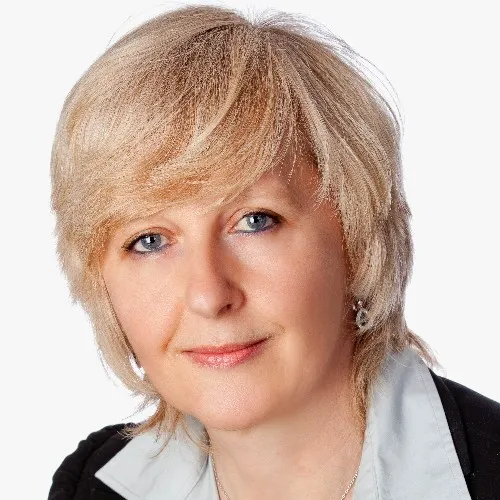
Speaker profile Nermina Harambasic

Nermina Harambasic

Owner at O-MOD

Nermina is capital project management expert with degree in automation / electrical engineering. She has over 35 years of experience and excellent track record on development, execution and oversight of mining and energy projects, including some of the world’s largest installations of its kind. With emergence of AI tools Nermina added focus on adoption of AI in mining industry. She organizes monthly "AI for Mining Industry" webinars, featuring top AI tool development companies. Additionally, she regularly contributes to "The Intelligent Miner," advocating for the integration of AI in mining. She is founder of O-MOD management/advisory and AI adoption consultancy and initiator of capital project management/advisory platform OreBit.

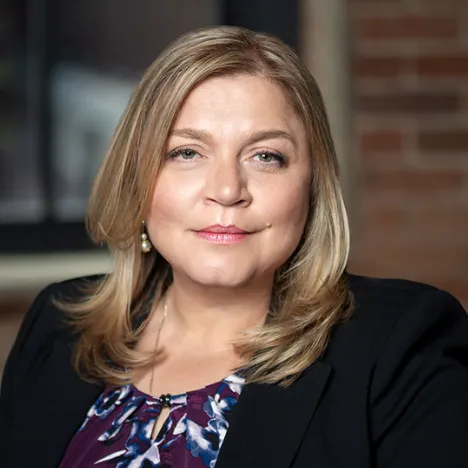
Speaker profile Gordana Slepcev

Gordana Slepcev

CEO at Lomiko Metals

Gordana Slepcev, M.Sc.P. Eng, is a Professional Mining Engineer registered in Ontario with more than 25 years of global mining experience in developing, building, and leading safe mining operations. Ms. Slepcev’s extensive experience spans multiple commodities, including gold, base metals, coal, and industrial minerals. She brings considerable experience in mineral exploration, permitting, corporate and regulatory/First Nations/ Indigenous relations, and project financing to Lomiko. Before joining the Company, Ms. Slepcev held the position of COO for BMSI, a privately held company, where she was responsible for restarting the barite reprocessing facility, mitigating historical environmental impacts, and overseeing EPCM contractors. She also formerly held the role of COO of Anaconda Mining, where she was responsible for the company’s operations and development of the Goldboro project. Ms. Slepcev graduated from the University of Belgrade with a M.Sc. and is the past Chair of the Toronto Chapter of the Canadian Institute of Mining, Metallurgy, and Petroleum (CIM). She is a WTPEO committee member and a member of the Advisory Board of the OreBit platform.

Speaker profile Laurie Clark

Laurie Clark

Founder & CEO at ONYEN

The Founder of three technology companies and awarded the “Top 100 Most Powerful Women in Canada” in 2017, 2019 and 2022. With over 20 years of capital markets experience and over $10B in direct budget oversight across Technology, Finance, Banking, Trading, Operations, Wealth Management, Start-Up/Sale, Joint Ventures, and Mergers & Acquisitions. A serial entrepreneur who has successfully started, built and sold three companies prior to her current endeavours. Qualified as a Corporate Directors International (CDI.D) and having over nine years of experience as an Independent Corporate Director serving on a variety of committees for public companies, including being Chair of the Compensation Committee for Belzberg Technologies Inc. (TSX: BLZ), Chair of the Board for Ethel Corporation, a capital management company, and member of the Advisory Committee for Pelangio Exploration (TSX.V: PX). A member of the TMX Advisory Council (X TSE), the Canadian RegTech Association Advisory Board, member of the Advisory Board for Novations Inc, (aka DealMaker), and past Co-Chair of the Canadian Capital Markets Association Communication Committee. Fluent in English, Italian, French and Spanish, is often asked to speak at conferences around the world as a motivational or expert speaker on Finance and Technology.

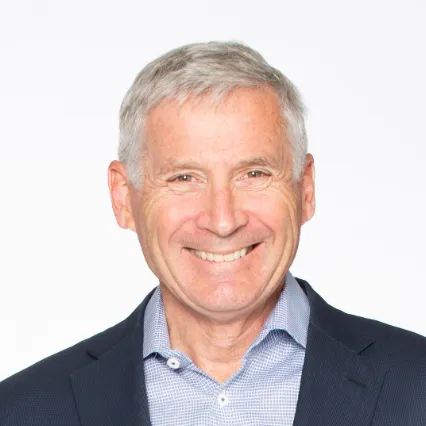
Speaker profile Gordon Bogden

Gordon Bogden

Chairman at VerAI Discoveries

Gordon has 35+ years of experience in mining development, mining finance and M&A, first as a geophysicist and co-founder of Quantec Geoscience, then as a senior investment banker with CIBC, N.M. Rothschild Canada, Newcrest Capital, National Bank Financial, and Gryphon Partners Canada, where he was a Co- Founder and Managing Partner. He was also the CEO of Alloycorp Mining Inc. and has served as director of a number of public mining companies including IAMGold, Royal Gold, NexGen Energy, and Volta Resources. Gordon is a Senior Advisor and Advisory Board Chair of Origin Merchant Partners, Chairman of VerAI Discoveries Inc., Chairman of Black Loop Group, and a Past Chair of Rethink Mining, formerly the Canada Mining Innovation Council (CMIC). In 2013, Gordon was awarded the Queen Elizabeth II Diamond Jubilee Medal for his work with Right To Play. He is also a recipient of the Robert Elver Mineral Economics Award by the Canadian Institute of Mining, Metallurgy and Petroleum. Gordon has a B.Sc. (Hons.) in Applied Science (Geology) from Queen’s University, is a Professional Engineer Ontario (P.Eng), and holds the ICD.D designation from the Institute of Corporate Directors.

More from 6ix