CRISIL Limited · NSE:CRISIL
CRISIL — Investor Presentation (April 2010)
8 slides from CRISIL's investor presentation, Apr 22, 2010
Slide 1: CRISIL Default Study 2009
CRISIL Default Study 2009 April 22, 2010
Slide 2: What is a default study?
What is a default study? • Default study is the report card of a Credit rating agency (CRA) • It is also: – A compilation of all the rating actions by the CRA over a given period of time – An assessment on whether behavior of ratings has met the investors’ expectations 2.
Slide 3: What do investors expect from a rating system?
What do investors expect from a rating system? • Ordinal default rates – Higher ratings should have a lower likelihood of default as compared to lower ratings • Ordinal stability rates – Ratings at a higher rating level should be more stable than those at lower rating levels • Stability in default a
Slide 4: Reliability of default studies
Reliability of default studies • Reliability of default studies is influenced by the quality of inputs – Differences in quality of input across agencies can produce ambiguous or misleading comparisons • Typical differences include – Default recognition policy Differential policy on recognition of
Slide 5: International best practices in default study publications
International best practices in default study publications • There are well-established international best practices on mitigating various input biases • These best practices are clearly articulated in Asian Development Bank’s (ADB) “Handbook on International Best Practices in Credit ratings” • CRIS
Slide 6: Features of 2009 default study
Features of 2009 default study • Covers the period 1987 to 2009; the longest available data on default history in India • Uses monthly static pools; the most conservative way to compute default statistics • Free from period bias; covers period of economic stress in late 1990’s and 2008-09 • Follows
Slide 7: Results and observations
Results and observations • Rating performance continues to be robust • No defaults in A and above rating categories • Most defaults witnessed in speculative grades; BB and below • Default and stability rates remained largely stable even through the turmoil of 2009 – 2009 saw a large number of rating
Slide 8: www.crisil.com
CRISIL Limited 8. www.crisil.com
Source: Internet Archive copy of crisil.com
More decks from CRISIL Limited
 Q3 2026 Earnings Presentation23 slides · Oct 23, 2026
 Q2 2026 Earnings Presentation23 slides · Jul 21, 2026
 Q1 FY2026 Earnings Presentation29 slides · Apr 17, 2026
 FY2025 Earnings Presentation23 slides · Feb 13, 2026
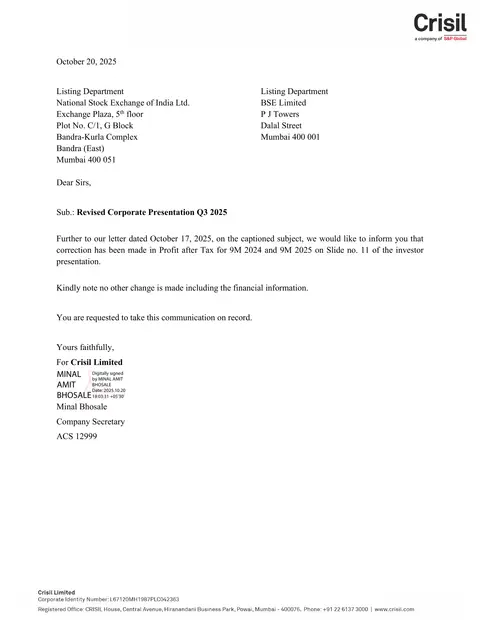 Q3 2025 Earnings Presentation24 slides · Oct 20, 2025
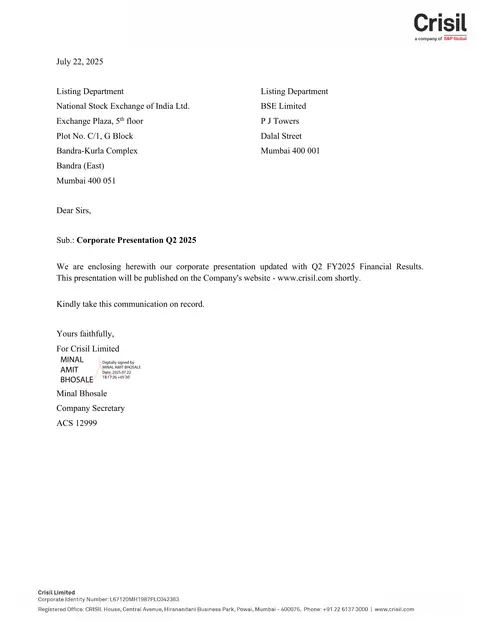 Q2 2025 Earnings Presentation24 slides · Jul 22, 2025