Modelon AB · OMXSTO:MODEL
Modelon AB — Technical Presentation (2011)
26 slides from Modelon AB's technical presentation, 2011
Slide 1: Nonlinear Model Predictive Control for Operation of a Post Combustion Absorption Unit
NONLINEAR MODEL PREDICTIVE CONTROL FOR OPERATION OF A POST COMBUSTION ABSORPTION UNIT J. Åkessona,b, G. Lavedana, K. Prölßa, H. Tummescheita, S. Veluta a) Modelon AB b) Department of Automatic Control, Lund University ICEPE Conference 2011, Frankfurt
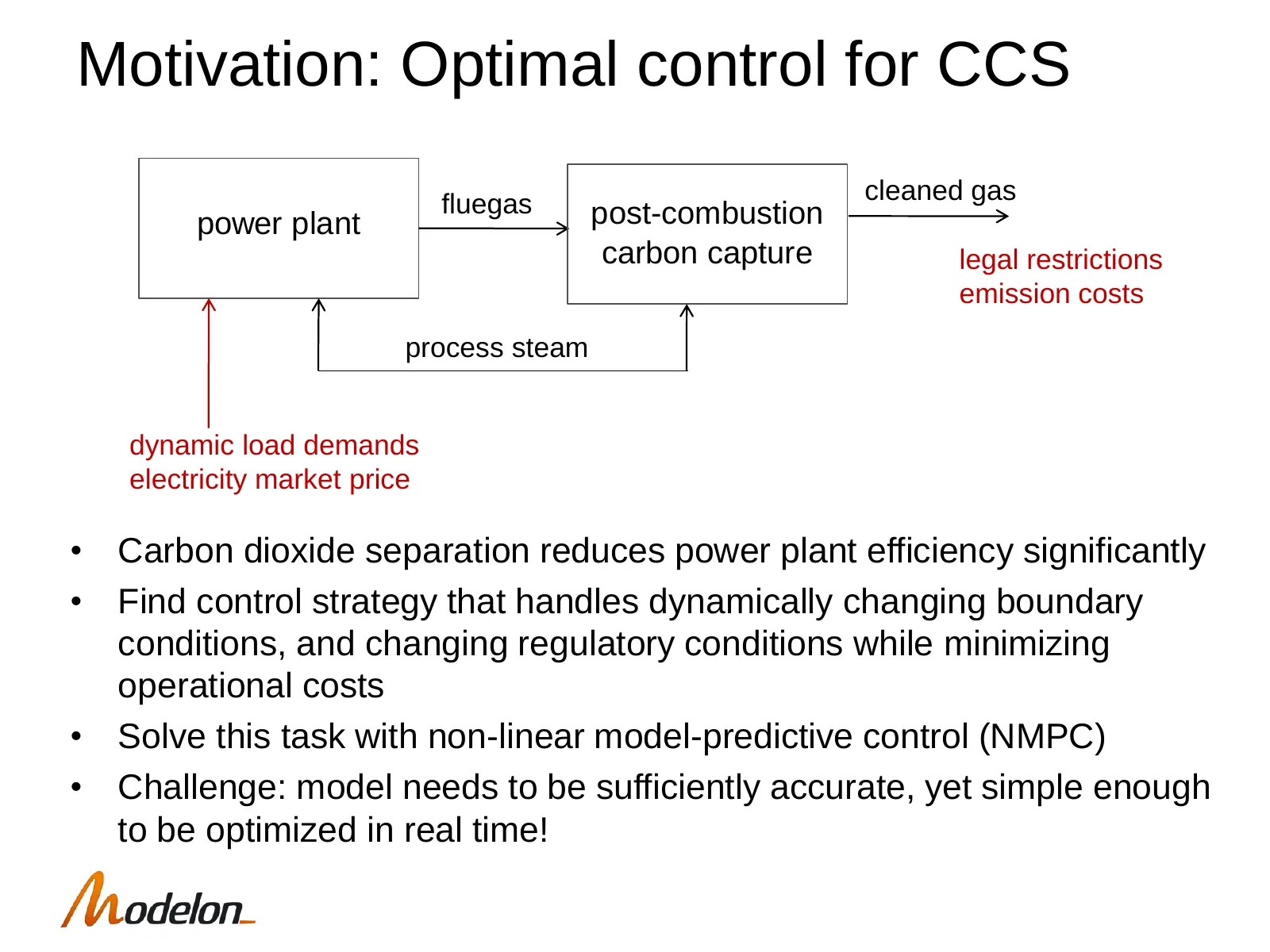
Slide 2: Motivation: Optimal control for CCS
Motivation: Optimal control for CCS fluegas cleaned gas power plant post-combustion carbon capture legal restrictions emission costs process steam dynamic load demands electricity market price • Carbon dioxide separation reduces power plant efficiency significantly • Find control strategy that handl
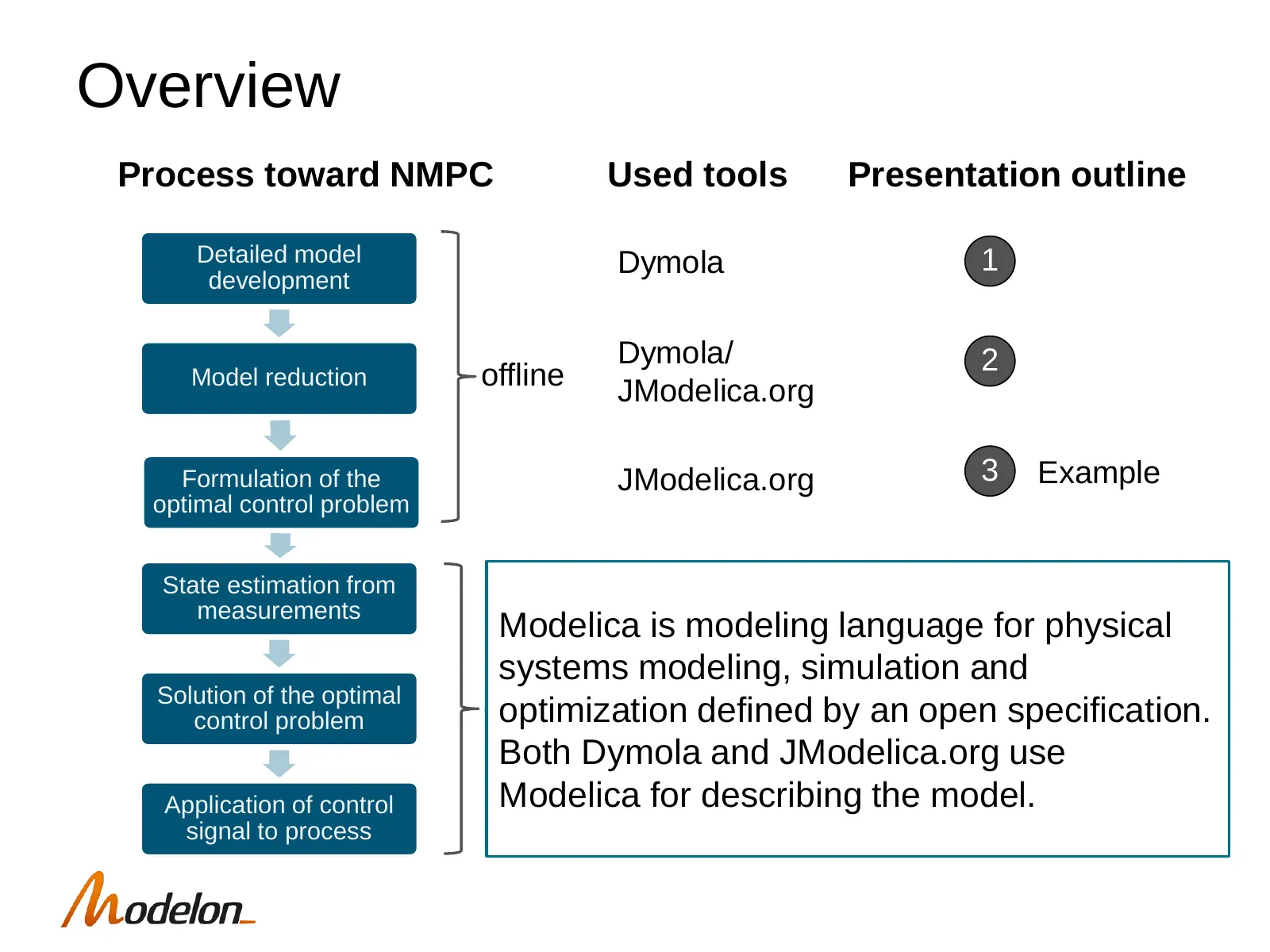
Slide 3: Overview
Overview Process toward NMPC Used tools Presentation outline Detailed model Dymola 1 development Dymola/ 2 Model reduction offline JModelica.org Formulation of the JModelica.org 3 Example optimal control problem State estimation from measurements Modelica is modeling language for physical systems mo
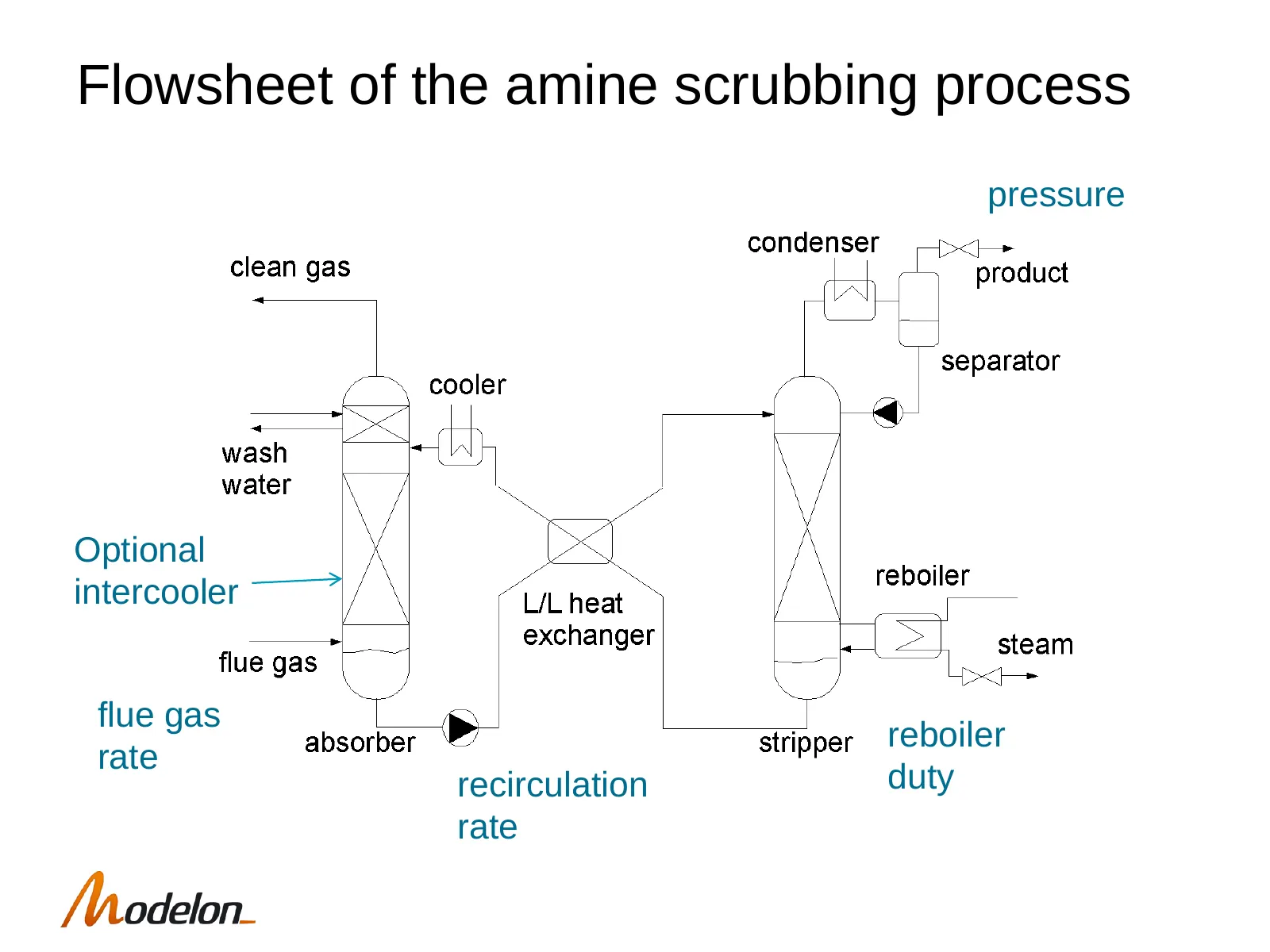
Slide 4: Flowsheet of the amine scrubbing process
Flowsheet of the amine scrubbing process pressure Optional intercooler flue gas reboiler rate recirculation duty rate
Slide 5: Model development
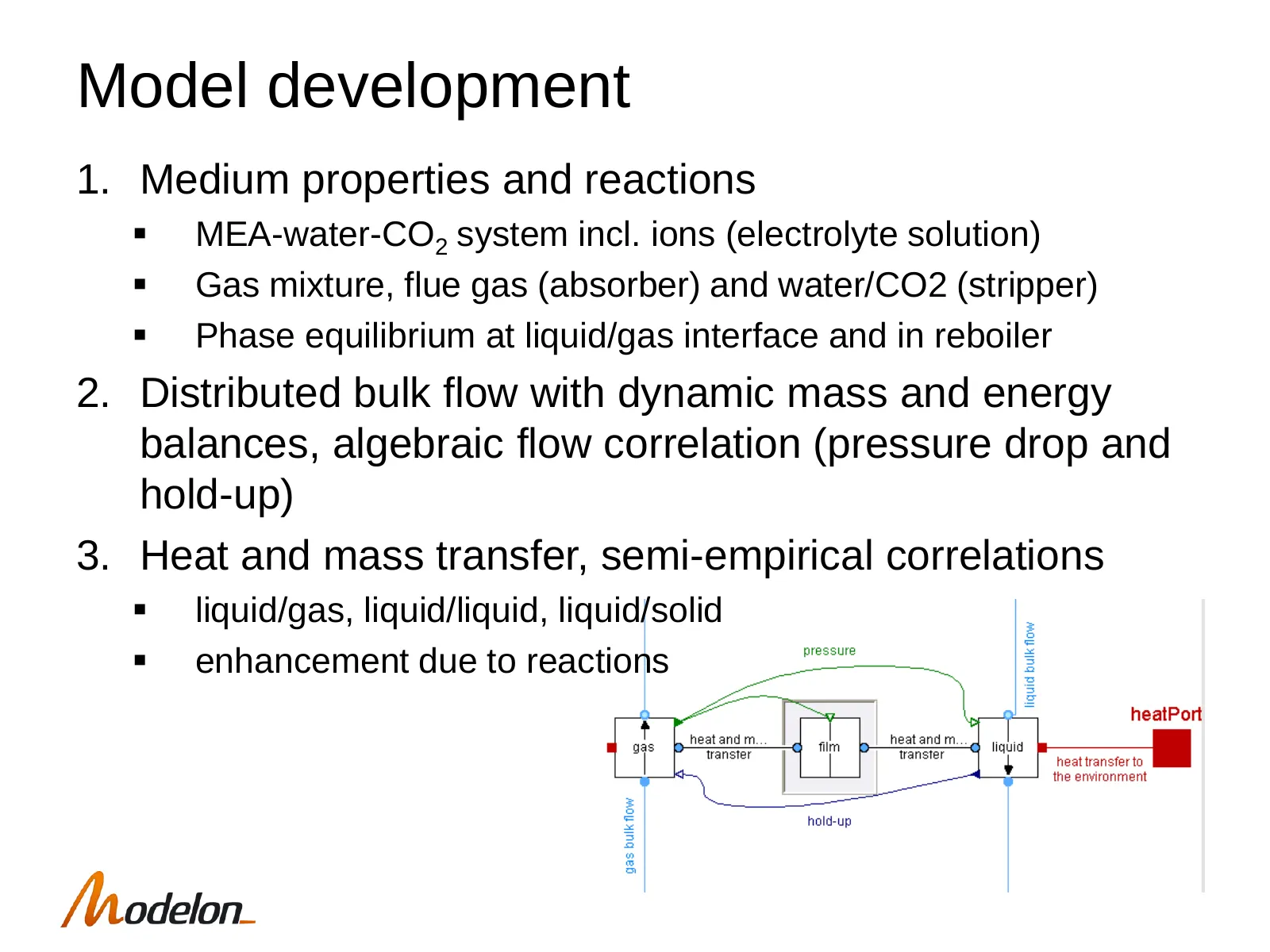
Model development 1. Medium properties and reactions MEA-water-CO2 system incl. ions (electrolyte solution) Gas mixture, flue gas (absorber) and water/CO2 (stripper) Phase equilibrium at liquid/gas interface and in reboiler 2. Distributed bulk flow with dynamic mass and energy balances, algebr
Slide 6: Assumptions and dynamics
Assumptions and dynamics • Discretization only in bulk flow direction • Gas/Liquid mass transfer with transfer coefficents and enhancement factors instead of discretized multi- component diffusion • Instantaneous reactions in the liquid phase reduce the number of states to four per liquid volume (am
Slide 7: Focus on column model
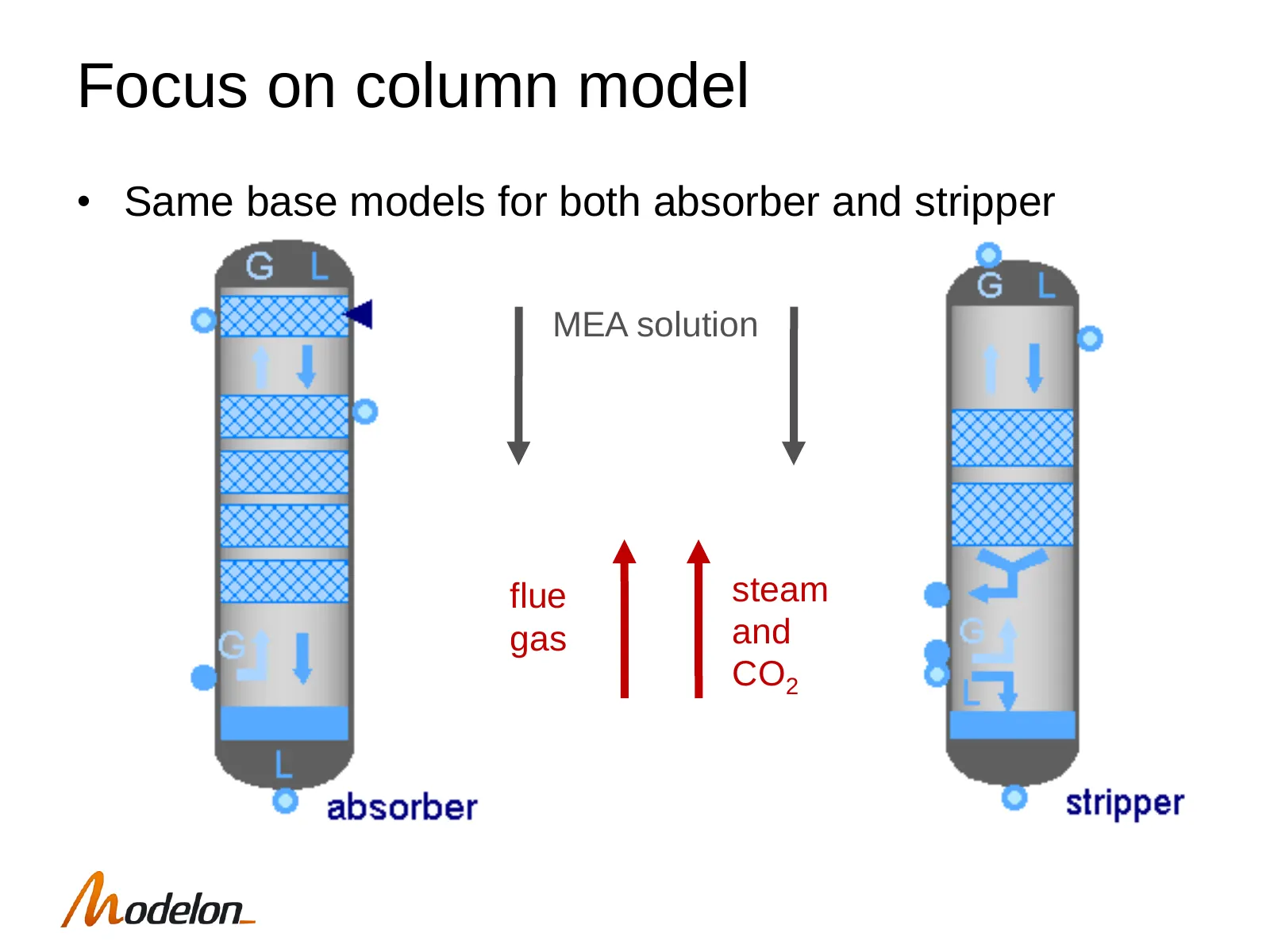
Focus on column model • Same base models for both absorber and stripper MEA solution flue steam gas and CO2
Slide 8: Chemical system in liquid phase
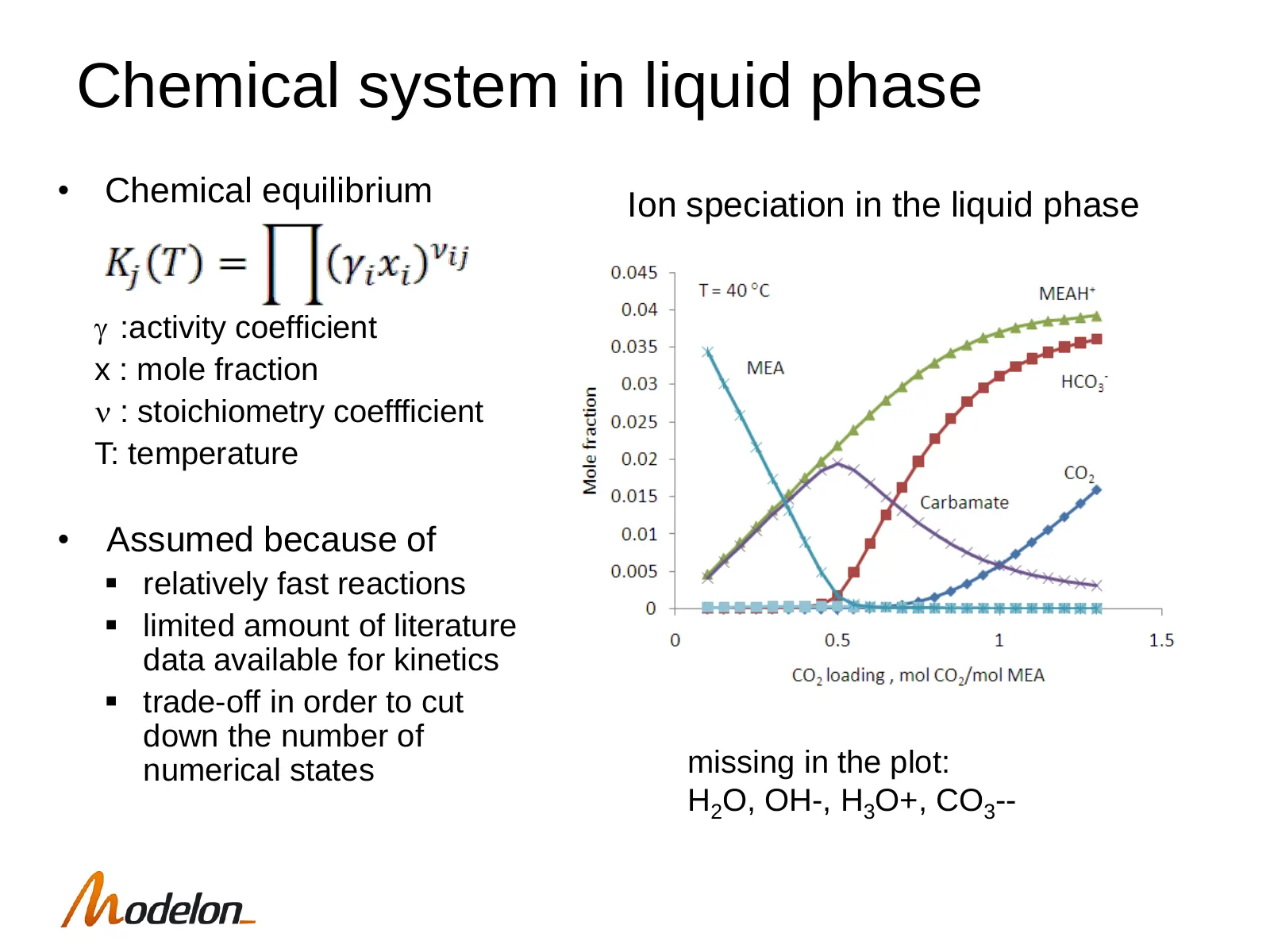
Chemical system in liquid phase • Chemical equilibrium Ion speciation in the liquid phase :activity coefficient x : mole fraction : stoichiometry coeffficient T: temperature • Assumed because of relatively fast reactions limited amount of literature data available for kinetics trade-off in
Slide 9: Model validation – Complete system
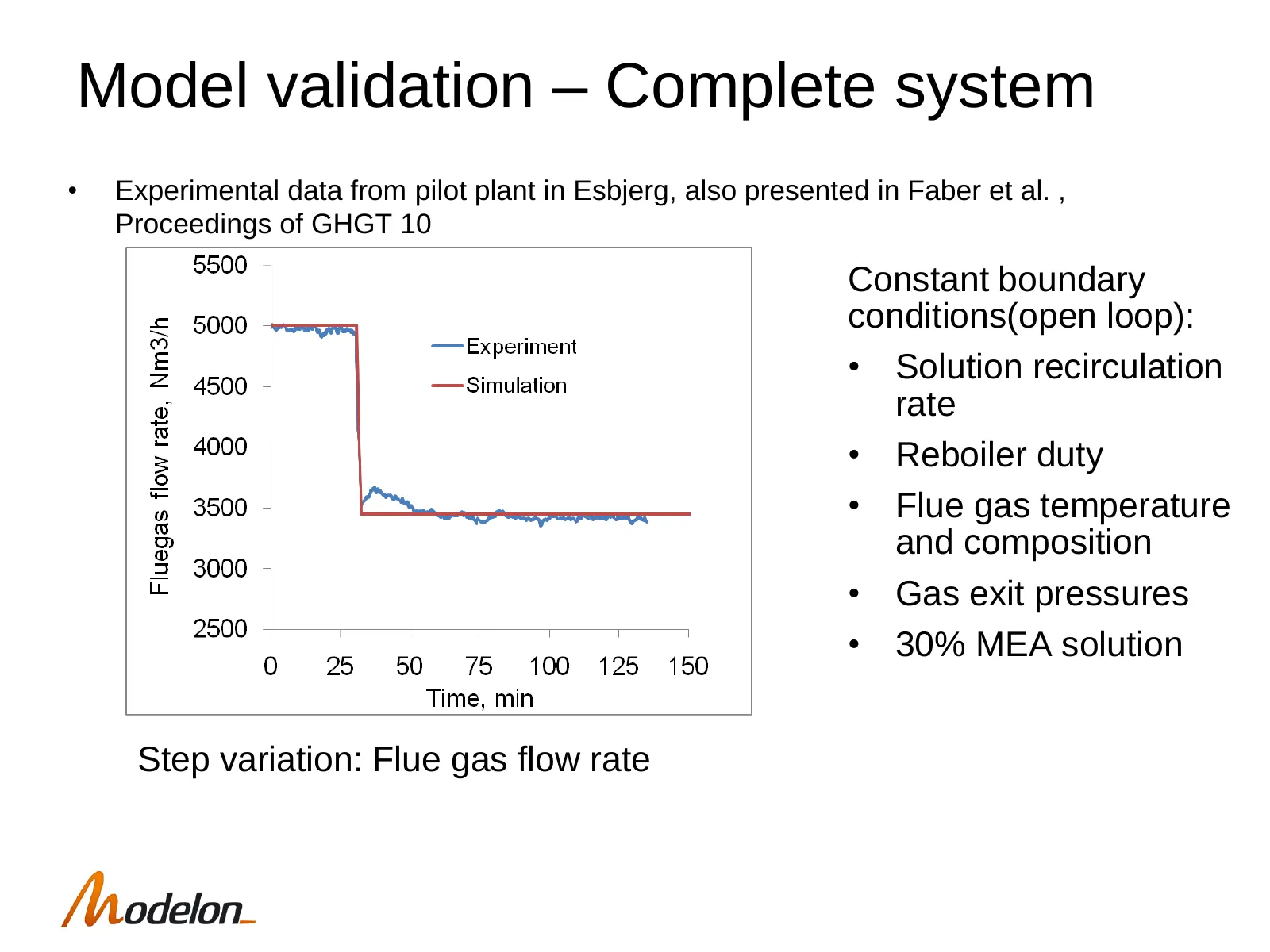
Model validation – Complete system • Experimental data from pilot plant in Esbjerg, also presented in Faber et al. , Proceedings of GHGT 10 Constant boundary conditions(open loop): • Solution recirculation rate • Reboiler duty • Flue gas temperature and composition • Gas exit pressures • 30% MEA sol
Slide 10: Model validation – Complete system
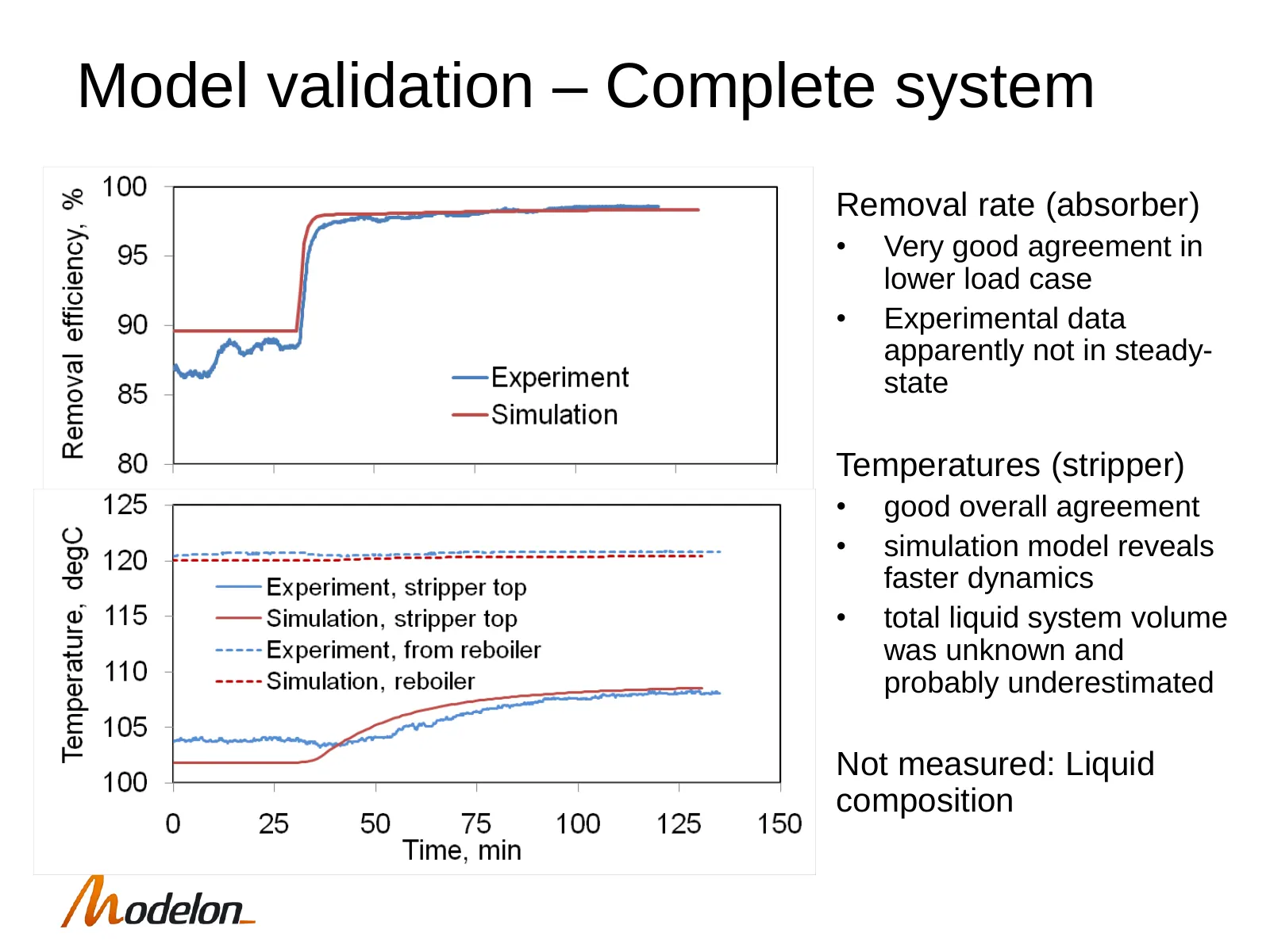
Model validation – Complete system Removal rate (absorber) • Very good agreement in lower load case • Experimental data apparently not in steady- state Temperatures (stripper) • good overall agreement • simulation model reveals faster dynamics • total liquid system volume was unknown and probably un
Slide 11: Model validation – Complete system
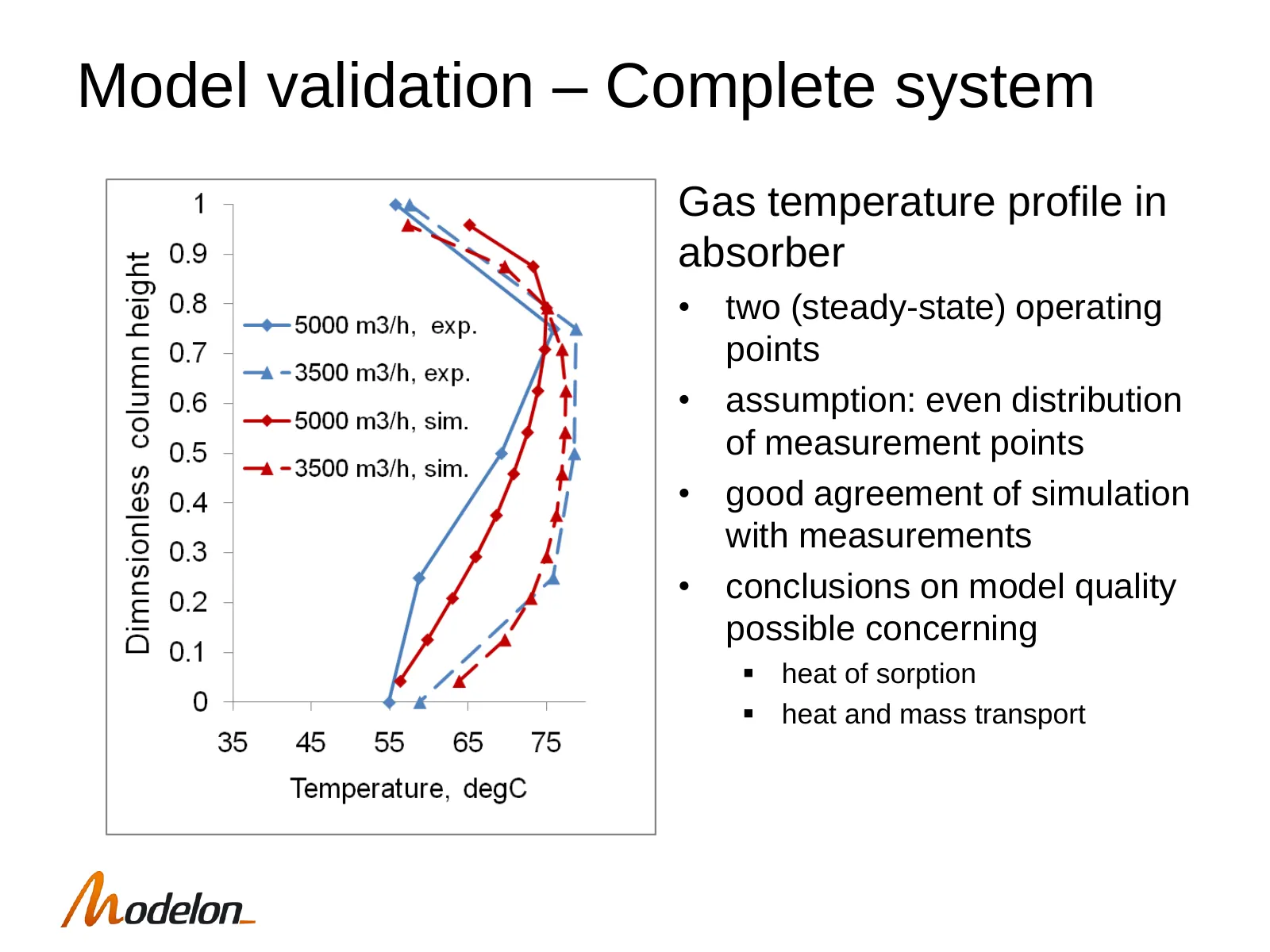
Model validation – Complete system Gas temperature profile in absorber • two (steady-state) operating points • assumption: even distribution of measurement points • good agreement of simulation with measurements • conclusions on model quality possible concerning heat of sorption heat and mass tr
Slide 12: Model validation - stripper
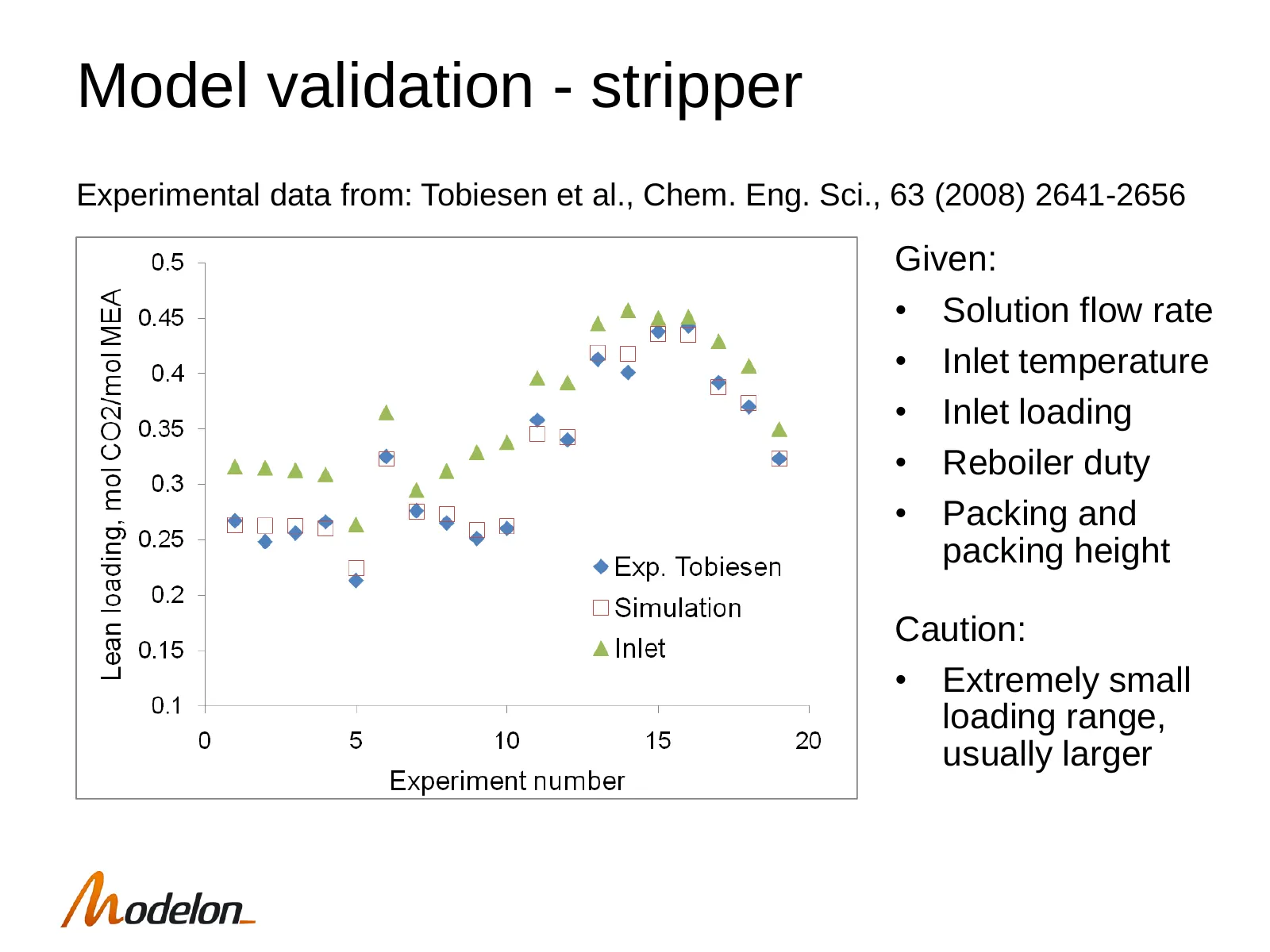
Model validation - stripper Experimental data from: Tobiesen et al., Chem. Eng. Sci., 63 (2008) 2641-2656 Given: • Solution flow rate • Inlet temperature • Inlet loading • Reboiler duty • Packing and packing height Caution: • Extremely small loading range, usually larger
Slide 13: Model reduction – Ion speciation
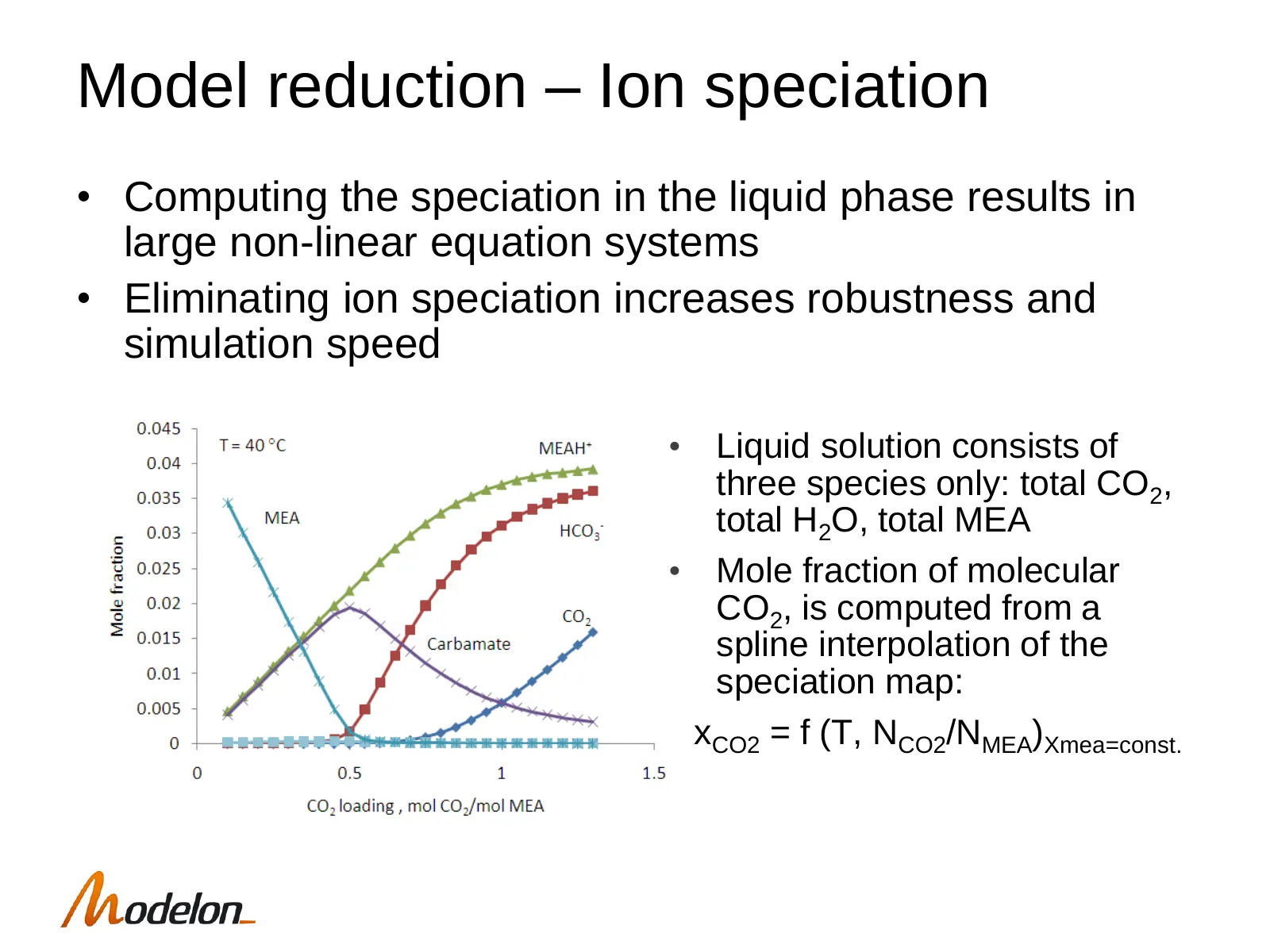
Model reduction – Ion speciation • Computing the speciation in the liquid phase results in large non-linear equation systems • Eliminating ion speciation increases robustness and simulation speed • Liquid solution consists of three species only: total CO2, total H2O, total MEA • Mole fraction of mol
Slide 14: Model reduction
Model reduction Further assumptions • Heat of sorption Important for correct reboiler duty Simplification: concentration independent • Heat and mass transfer Constant transfer coefficients, incl. enhancement • Constant heat capacities for each species in system • Constant density of liquid pha
Slide 15: System boundary reduced model
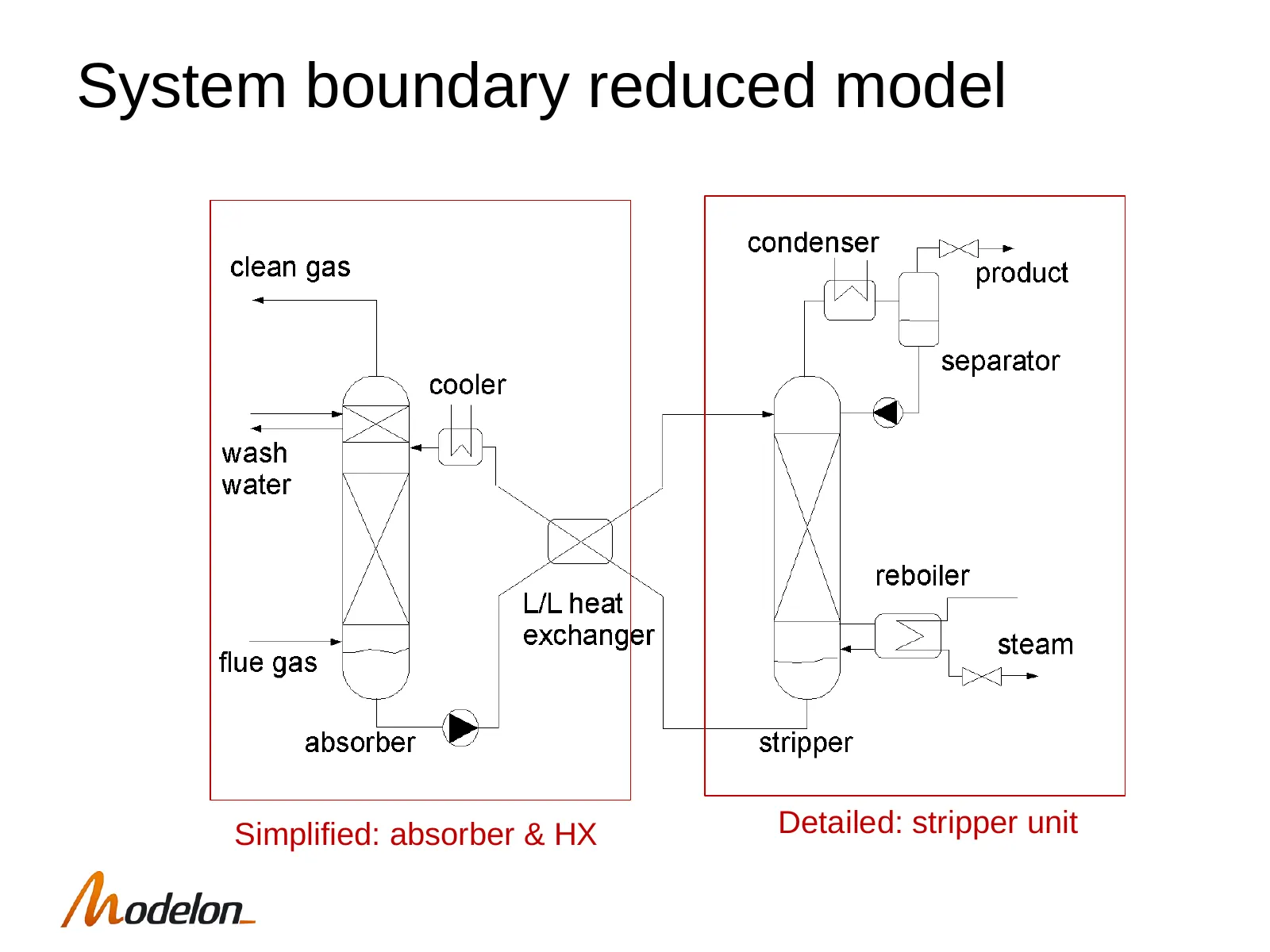
System boundary reduced model Simplified: absorber & HX Detailed: stripper unit
Slide 16: Stripper unit
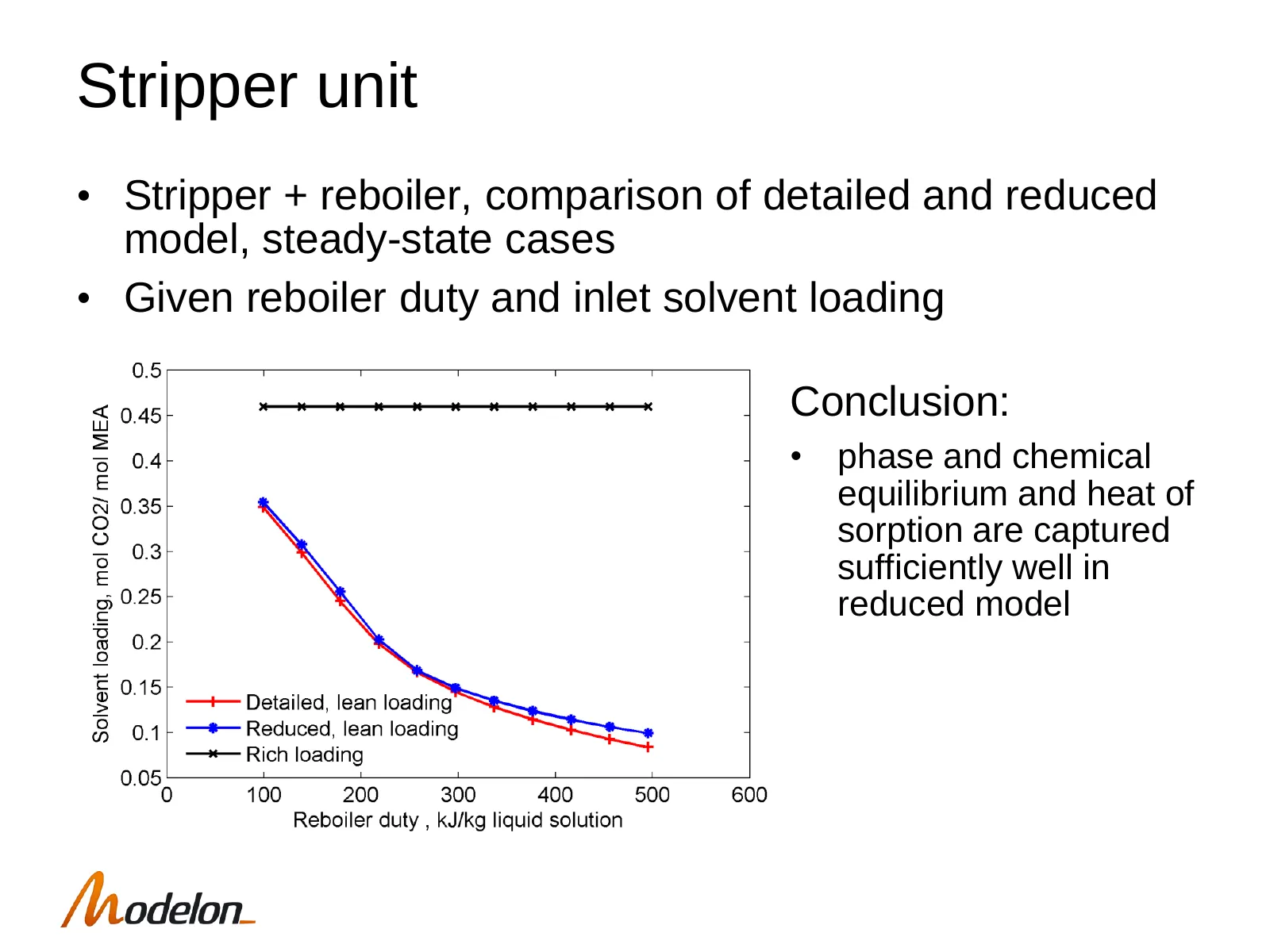
Stripper unit • Stripper + reboiler, comparison of detailed and reduced model, steady-state cases • Given reboiler duty and inlet solvent loading Conclusion: • phase and chemical equilibrium and heat of sorption are captured sufficiently well in reduced model
Slide 17: Optimization
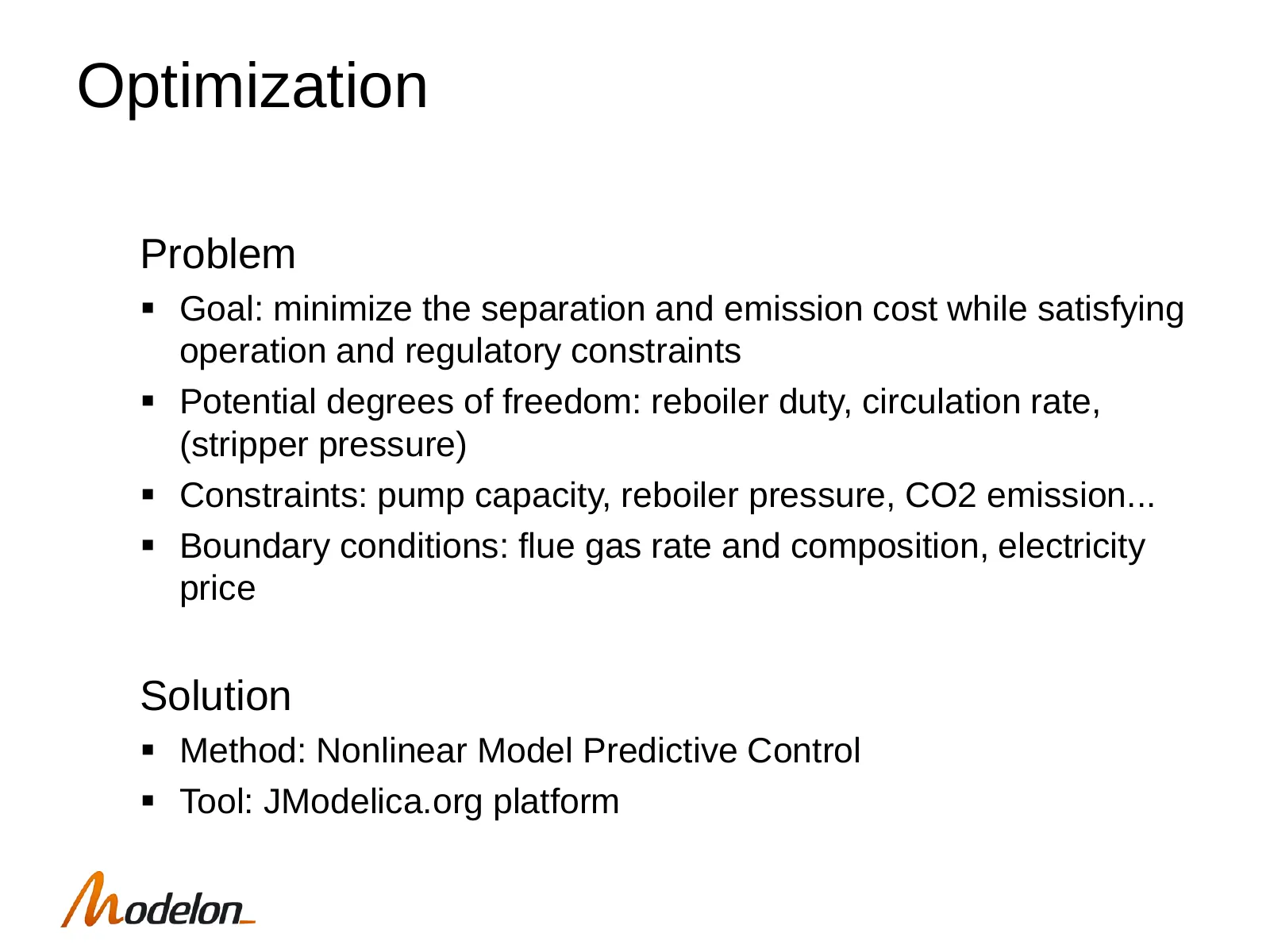
Optimization Problem Goal: minimize the separation and emission cost while satisfying operation and regulatory constraints Potential degrees of freedom: reboiler duty, circulation rate, (stripper pressure) Constraints: pump capacity, reboiler pressure, CO2 emission... Boundary conditions: fl
Slide 18: Towards NMPC
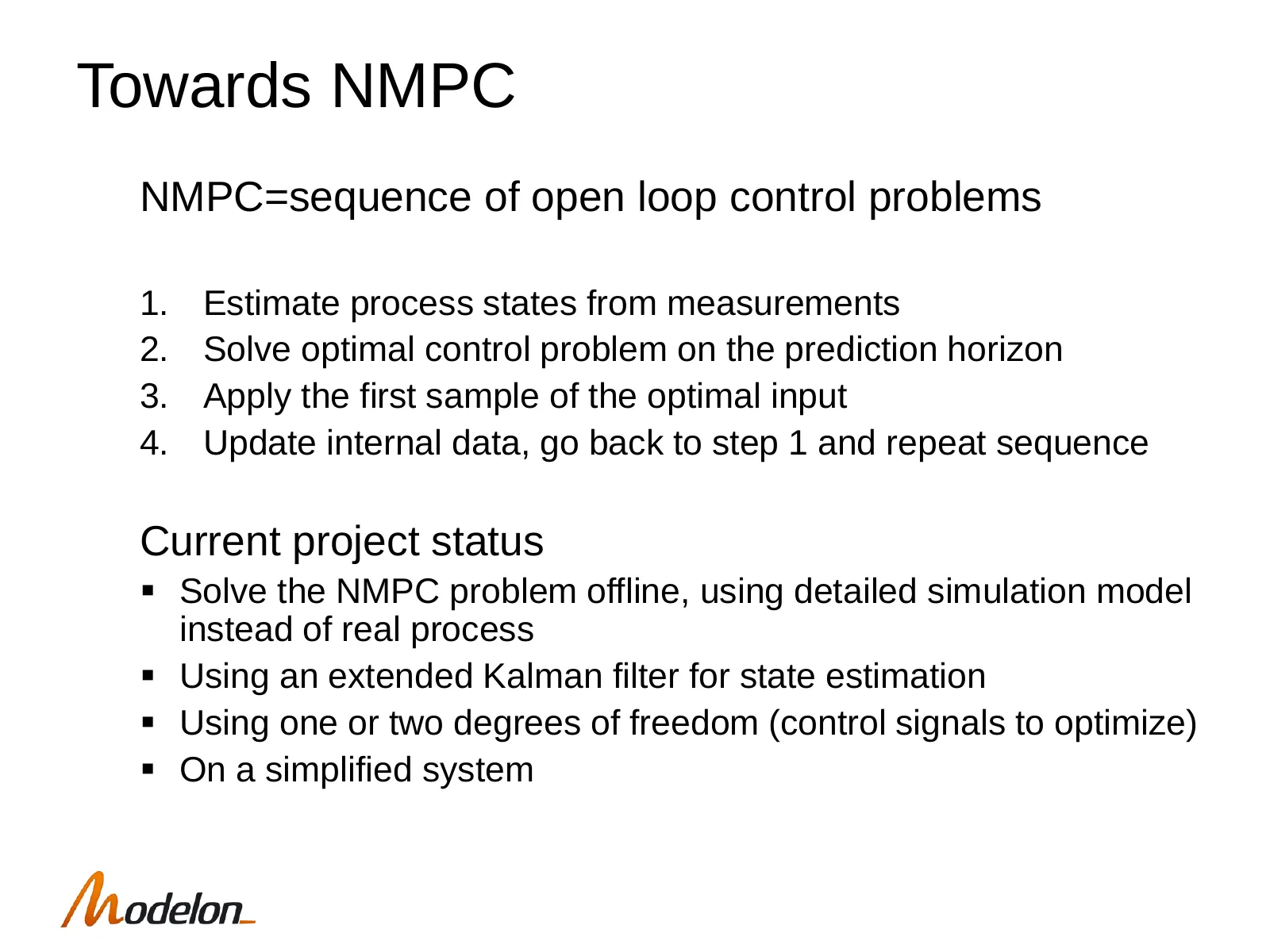
Towards NMPC NMPC=sequence of open loop control problems 1. Estimate process states from measurements 2. Solve optimal control problem on the prediction horizon 3. Apply the first sample of the optimal input 4. Update internal data, go back to step 1 and repeat sequence Current project status Solv
Slide 19: Interaction Structure
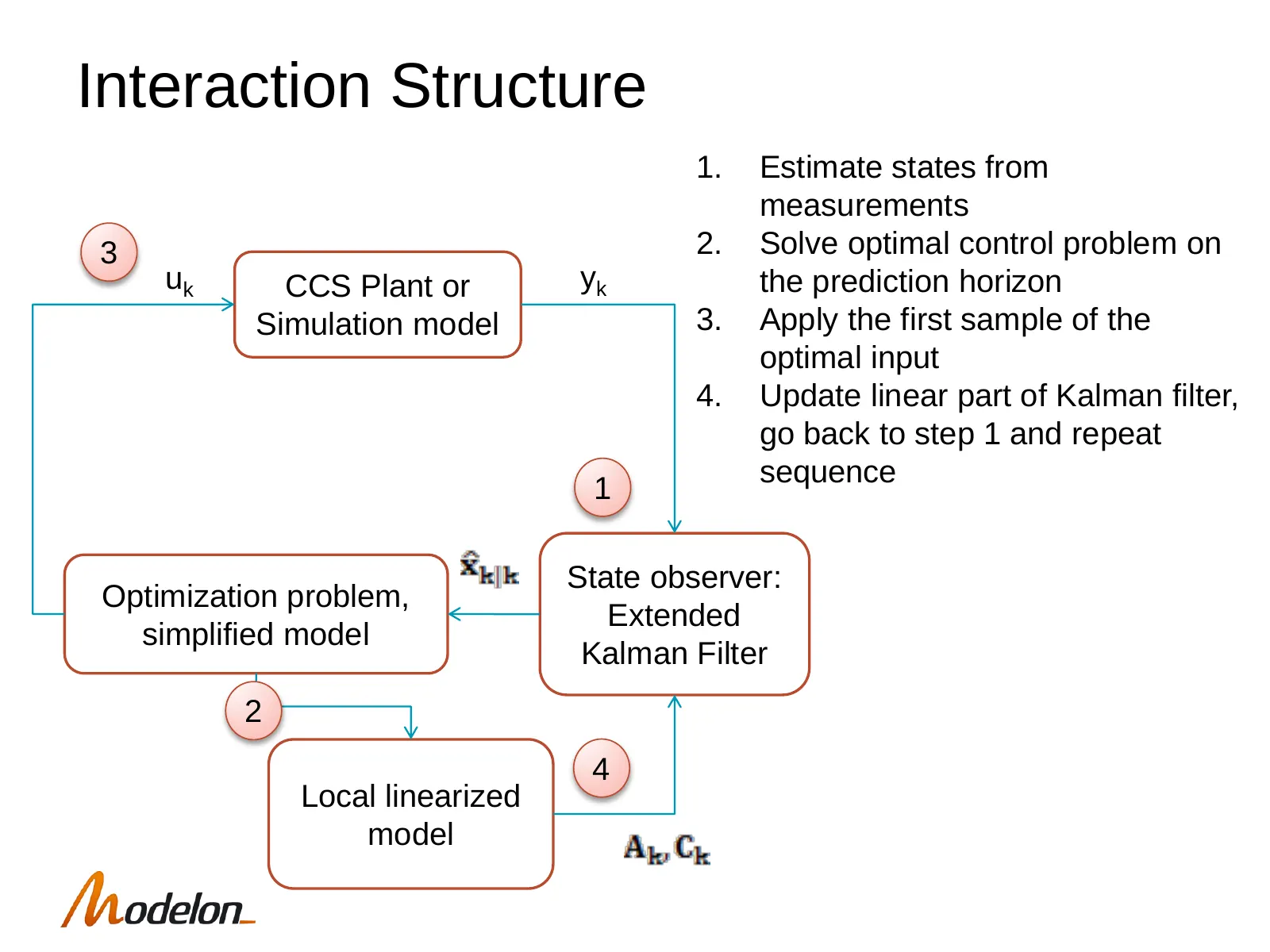
Interaction Structure 1. Estimate states from measurements 3 2. Solve optimal control problem on uk CCS Plant or yk the prediction horizon Simulation model 3. Apply the first sample of the optimal input 4. Update linear part of Kalman filter, go back to step 1 and repeat sequence 1 State observer: O
Slide 20: Simplified problem
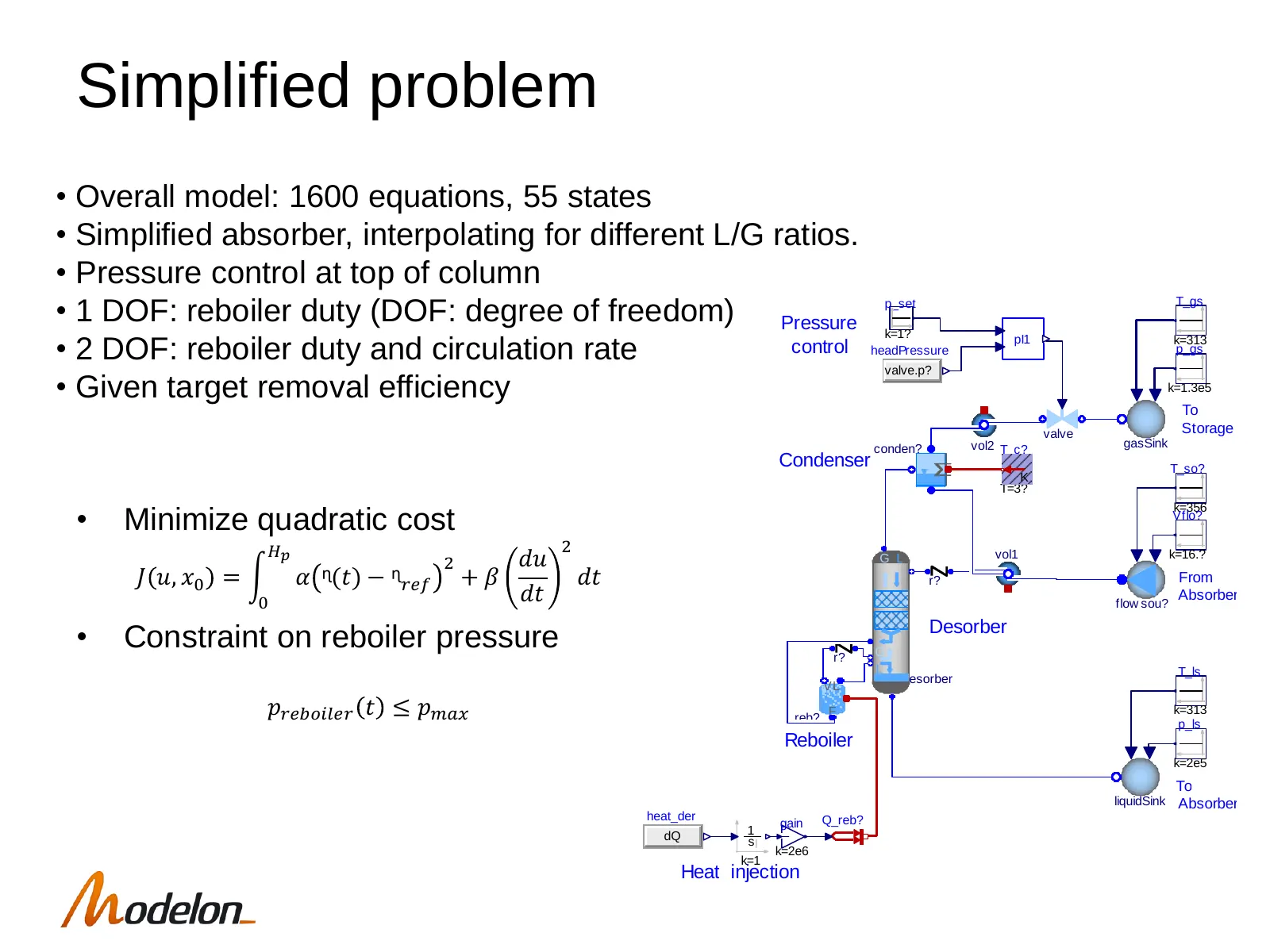
Simplified problem • Overall model: 1600 equations, 55 states • Simplified • Stripperabsorber, unit:1493interpolating for different L/G ratios. equ., 50 states • Pressure control at top of column • Absorber: equilibrium with flue gas leanSolut? • 1 DOF: reboiler duty (DOF: degree of freedom) p_set T
Slide 21: Jmodelica.org
Jmodelica.org Extensible open-source platform for simulation and optimization of Modelica models • Dynamic optimization • Modelica extension: Optimica • Direct collocation method • Large scale NLP • Solver: IPOPT • Python interface
Slide 22: Optimizing with JModelica.org
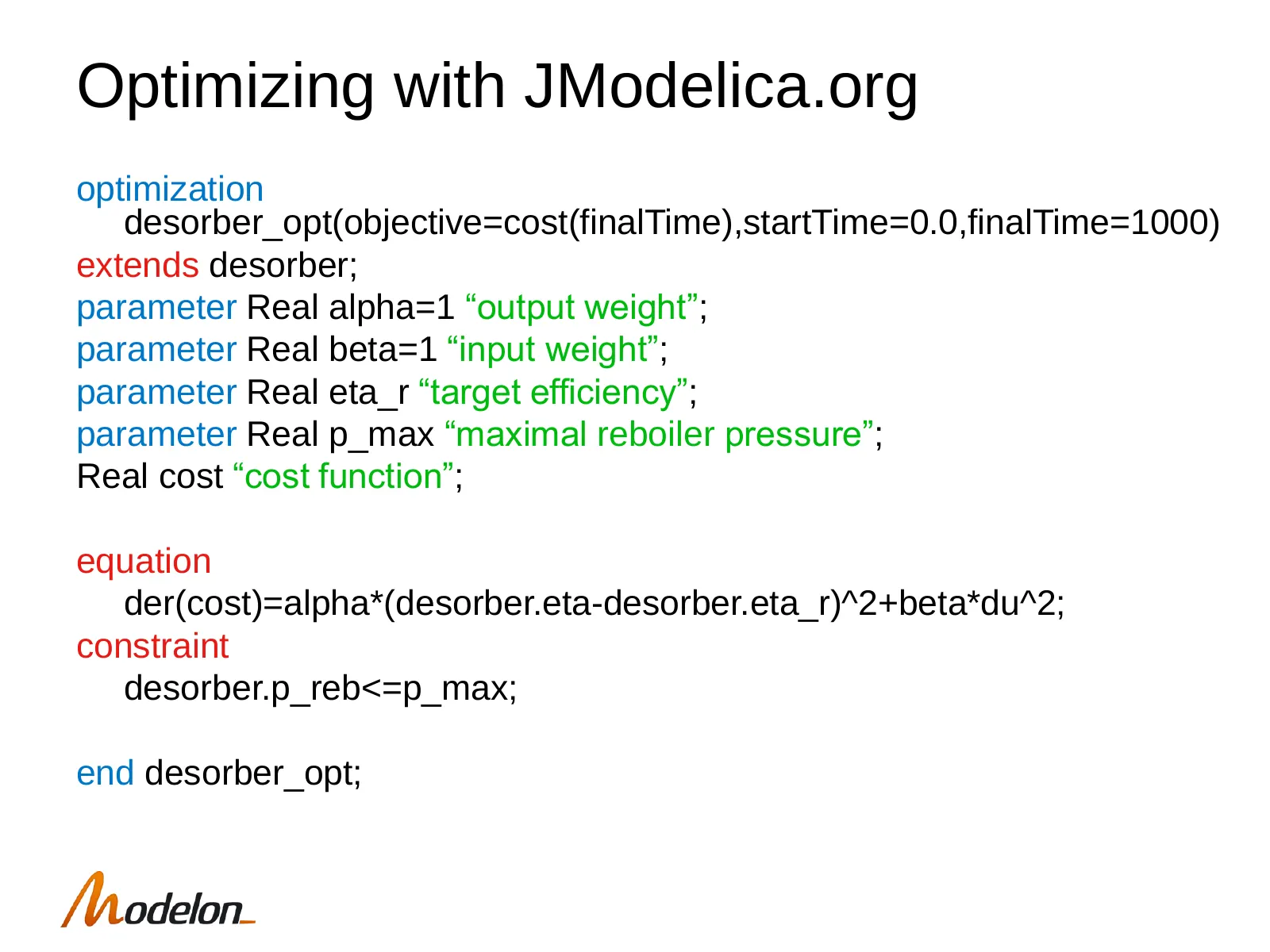
Optimizing with JModelica.org optimization desorber_opt(objective=cost(finalTime),startTime=0.0,finalTime=1000) extends desorber; parameter Real alpha=1 “output weight”; parameter Real beta=1 “input weight”; parameter Real eta_r “target efficiency”; parameter Real p_max “maximal reboiler pressure”;
Slide 23: Results: 1 DOF
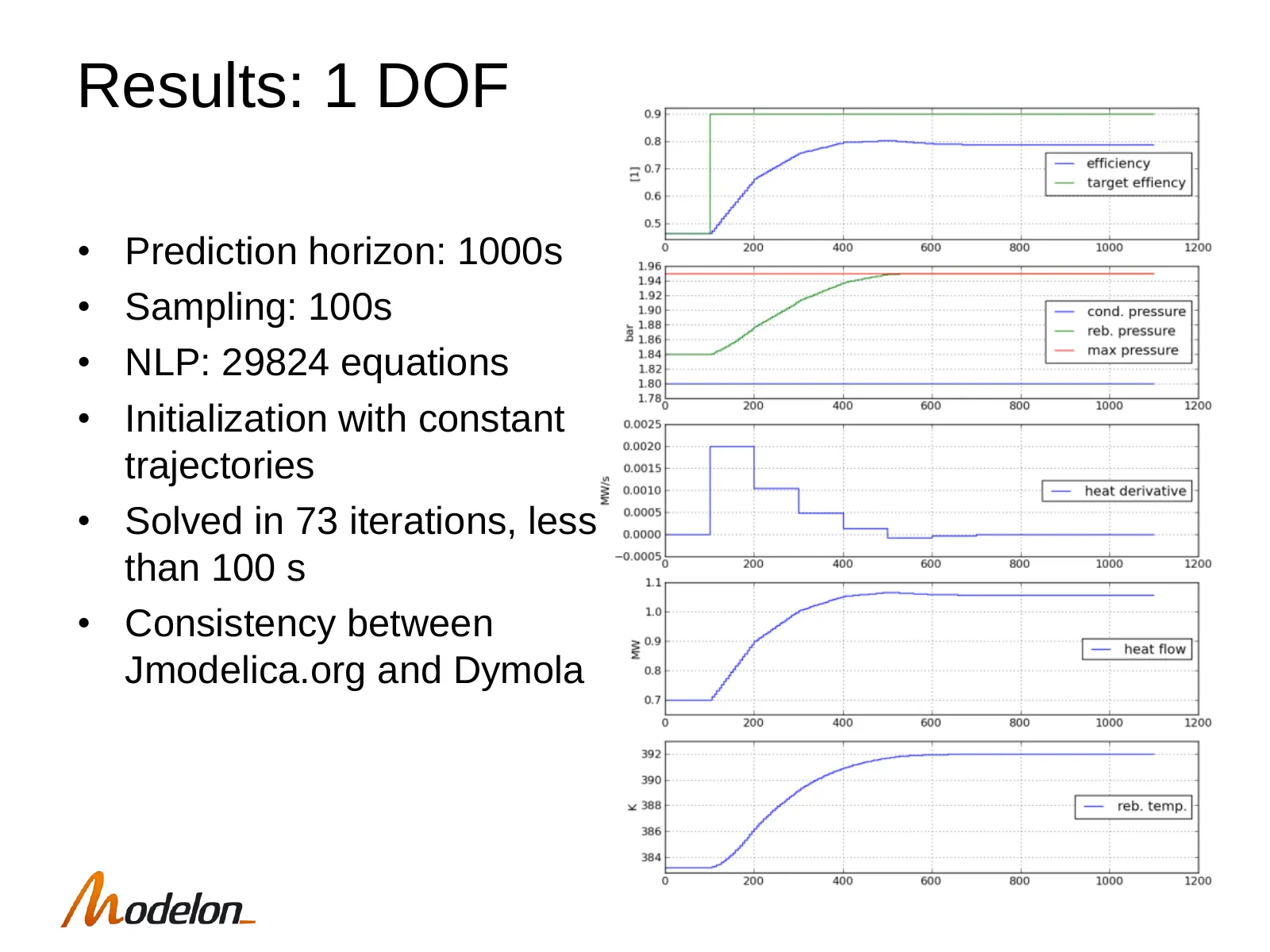
Results: 1 DOF • Prediction horizon: 1000s • Sampling: 100s • NLP: 29824 equations • Initialization with constant trajectories • Solved in 73 iterations, less than 100 s • Consistency between Jmodelica.org and Dymola
Slide 24: Results: 2 DOF
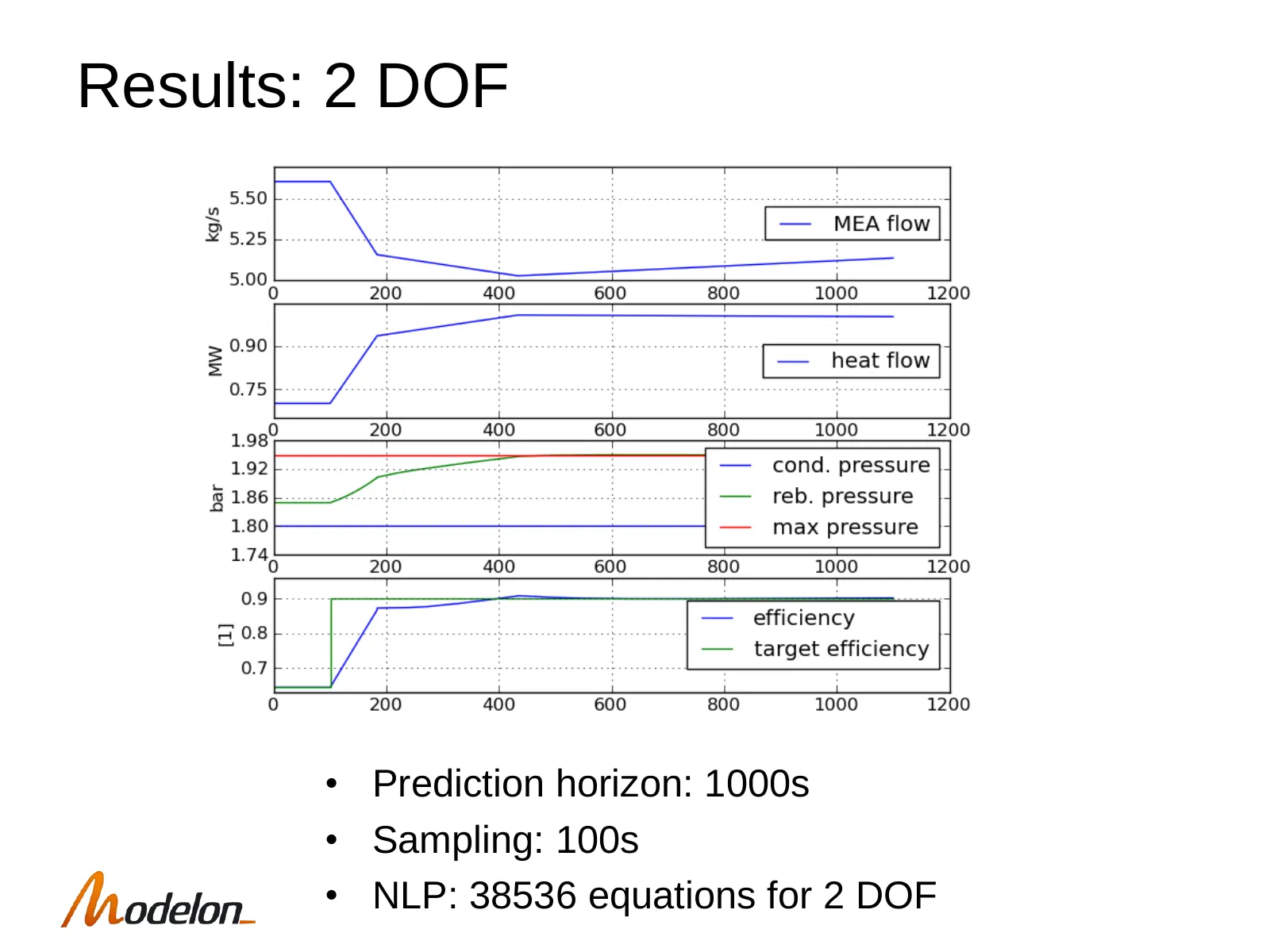
Results: 2 DOF • Prediction horizon: 1000s • Sampling: 100s • NLP: 38536 equations for 2 DOF
Slide 25: Summary
Summary • Results and Conclusions A validated Modelica model library for transient simulation of amine- based post-combustion capture The plant model was able to capture measured behavior of absorption process Physical model reduction leads to a model suitable for optimization JModelica.org
Slide 26: Acknowledgements
Acknowledgements • This work was partly funded by Vinnova
Source: Internet Archive copy of modelon.com
More decks from Modelon AB
 Technical Presentation (October 2022)39 slides · Oct 20, 2022
 Technical Presentation (October 2022)41 slides · Oct 20, 2022
 Technical Presentation (2022)15 slides · 2022
 Technical Presentation (July 2021)22 slides · July 2021
 Technical Presentation (July 2021)35 slides · July 2021
 Technical Presentation (2021)29 slides · 2021