Fennec Pharmaceuticals Inc. · NASDAQ:FENC
Fennec Pharmaceuticals — Investor Presentation (January 2016)
29 slides from Fennec Pharmaceuticals's investor presentation, January 2016
Slide 1: Corporate Presentation January 2016
Corporate Presentation January 2016
Slide 2: Safe Harbor Statement
Safe Harbor Statement During the course of this presentation we will make statements that constitute forward-looking statements. These statements may include operating expense projections, the initiation, timing and results of pending or future clinical trials, the actions or potential action of the
Slide 3: Company Overview
Company Overview • US based biopharmaceutical company focused on the development of Sodium Thiosulfate (STS) for the prevention of platinum-induced ototoxicity in children with cancer – Granted FDA Orphan Drug Designation – 7.5 years market exclusivity – Potential for European Market Exclusivity for
Slide 4: Sodium thiosulfate (STS)
Sodium thiosulfate (STS) • Approved in US and some EU countries (DE, CZ, EL) for the treatment of cyanide poisoning • Approved in France for the treatment of chronic inflammation of upper respiratory tract Toxicology: STS is generally recognized as safe (GRAS in US) STS protection against cisplatin
Slide 5: Platinum Hearing Loss is Frequent, Severe and Irreversible
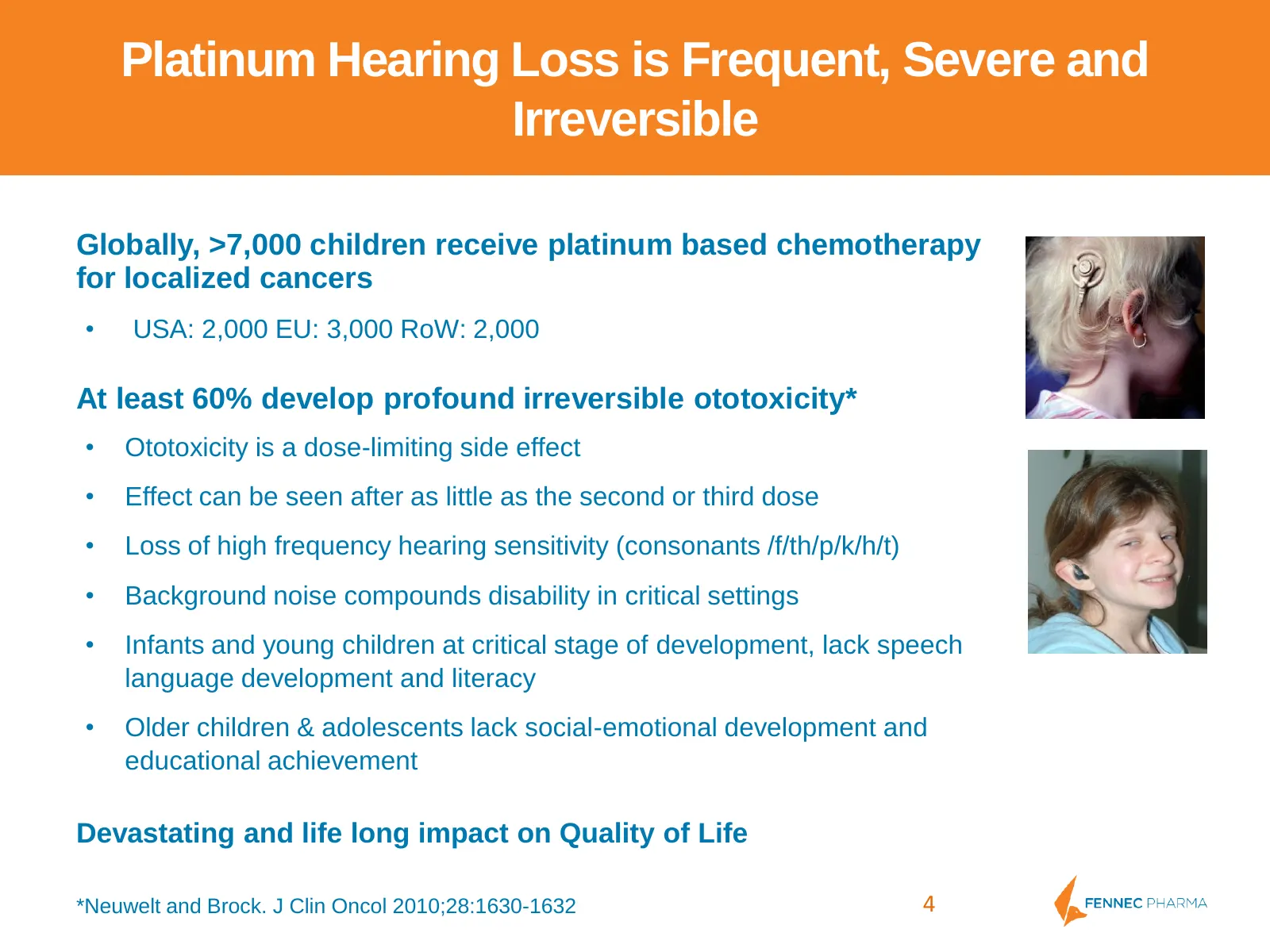
Platinum Hearing Loss is Frequent, Severe and Irreversible Globally, >7,000 children receive platinum based chemotherapy for localized cancers • USA: 2,000 EU: 3,000 RoW: 2,000 At least 60% develop profound irreversible ototoxicity* • Ototoxicity is a dose-limiting side effect • Effect can be seen a
Slide 6: Devastating Impact on Quality of Life
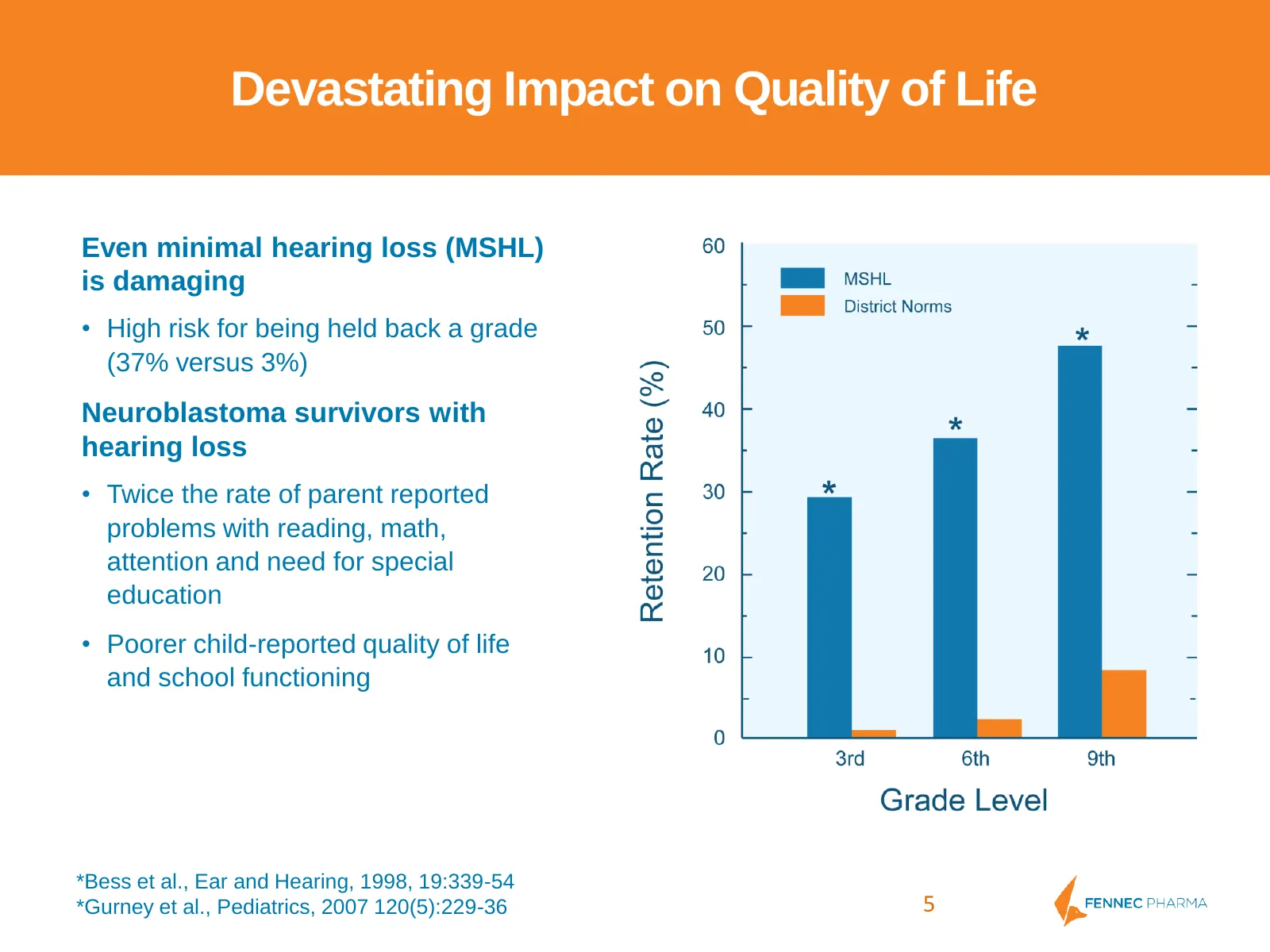
Devastating Impact on Quality of Life Even minimal hearing loss (MSHL) is damaging • High risk for being held back a grade (37% versus 3%) Neuroblastoma survivors with hearing loss • Twice the rate of parent reported problems with reading, math, attention and need for special education • Poorer chil
Slide 7: Ototoxicity in Children Treated with Cisplatin and/or Carboplatin
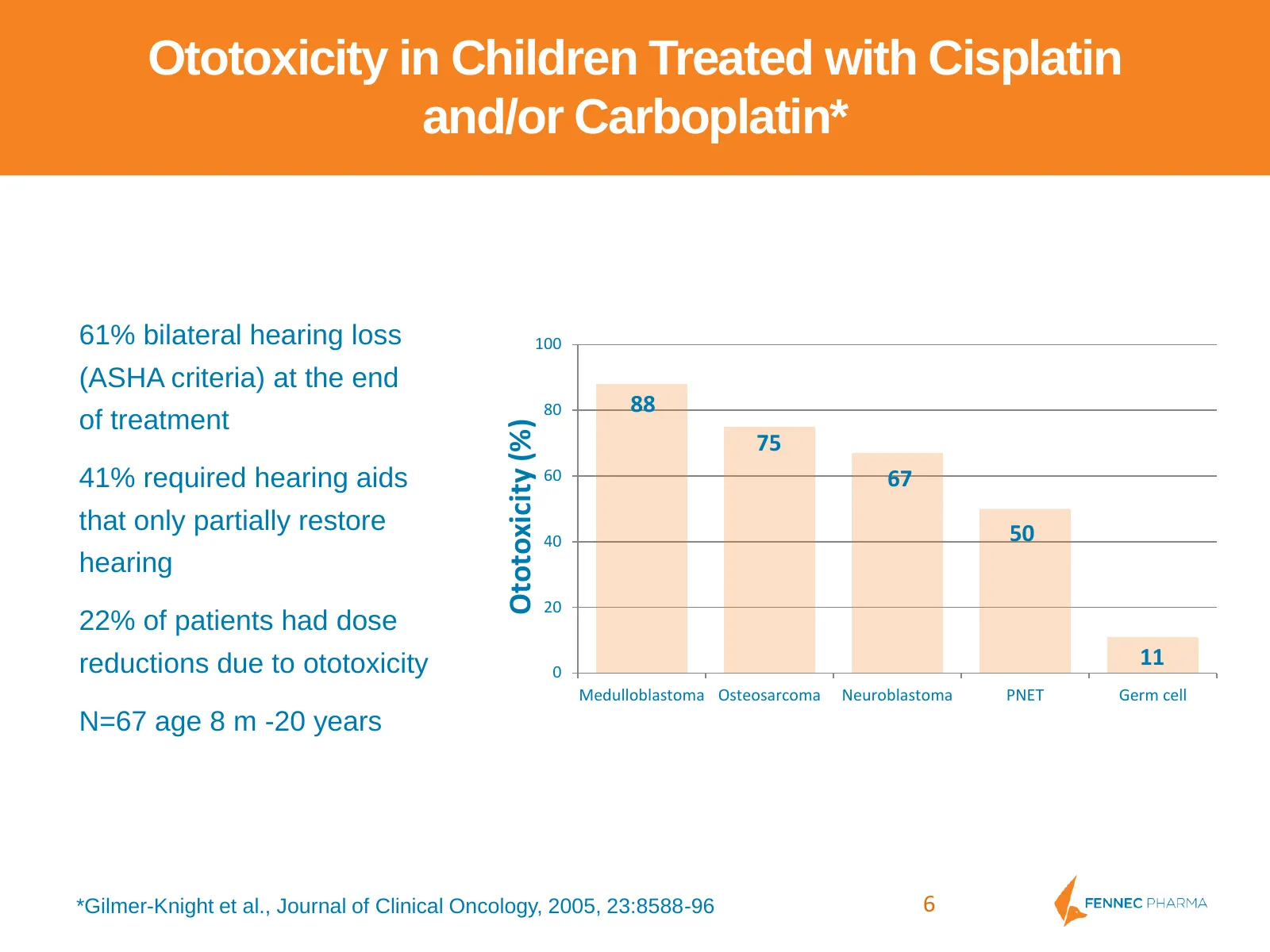
Ototoxicity in Children Treated with Cisplatin and/or Carboplatin* 61% bilateral hearing loss 100 (ASHA criteria) at the end 80 88 of treatment Ototoxicity (%) 75 41% required hearing aids 60 67 that only partially restore 50 40 hearing 20 22% of patients had dose reductions due to ototoxicity 11 0
Slide 8: SIOPEL 6 Objectives, Population, and Endpoints
SIOPEL 6 (ASCO 2015) Objectives, Population, and Endpoints Objectives • To assess the efficacy of STS to reduce the hearing impairment caused by Cisplatin in SR-HB • To carefully monitor any potential impact of STS on response (protocol pre-specified IDMC tumour response review at 20, 40, 60, 80 and
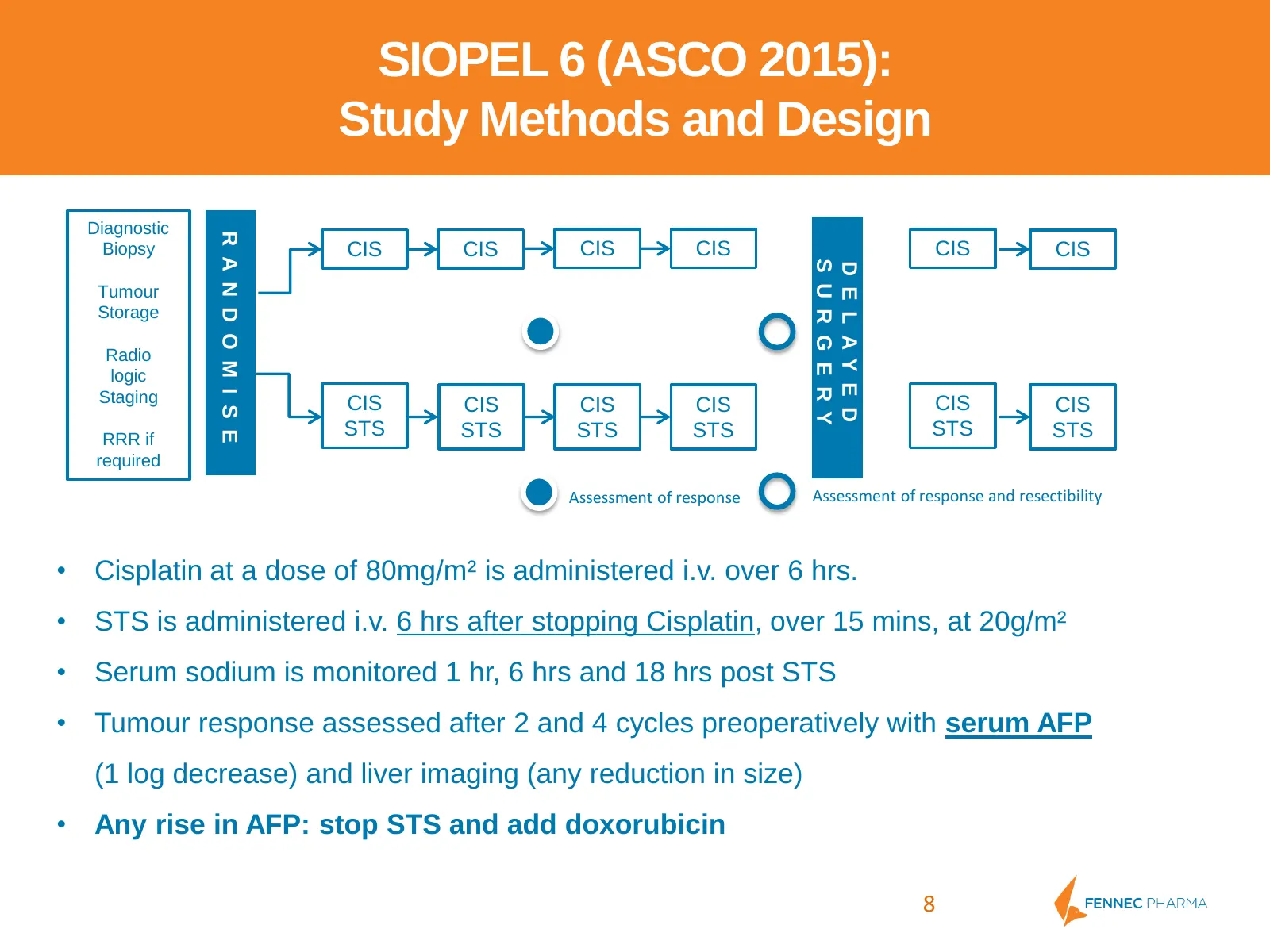
Slide 9: SIOPEL 6: Study Methods and Design
SIOPEL 6 (ASCO 2015): Study Methods and Design Diagnostic R A N D O M I S E Biopsy CIS CIS CIS CIS CIS CIS S U R G E R Y D E L AY E D Tumour Storage Radio logic Staging CIS CIS CIS CIS CIS CIS RRR if STS STS STS STS STS STS required Assessment of response Assessment of response and resectibility • C
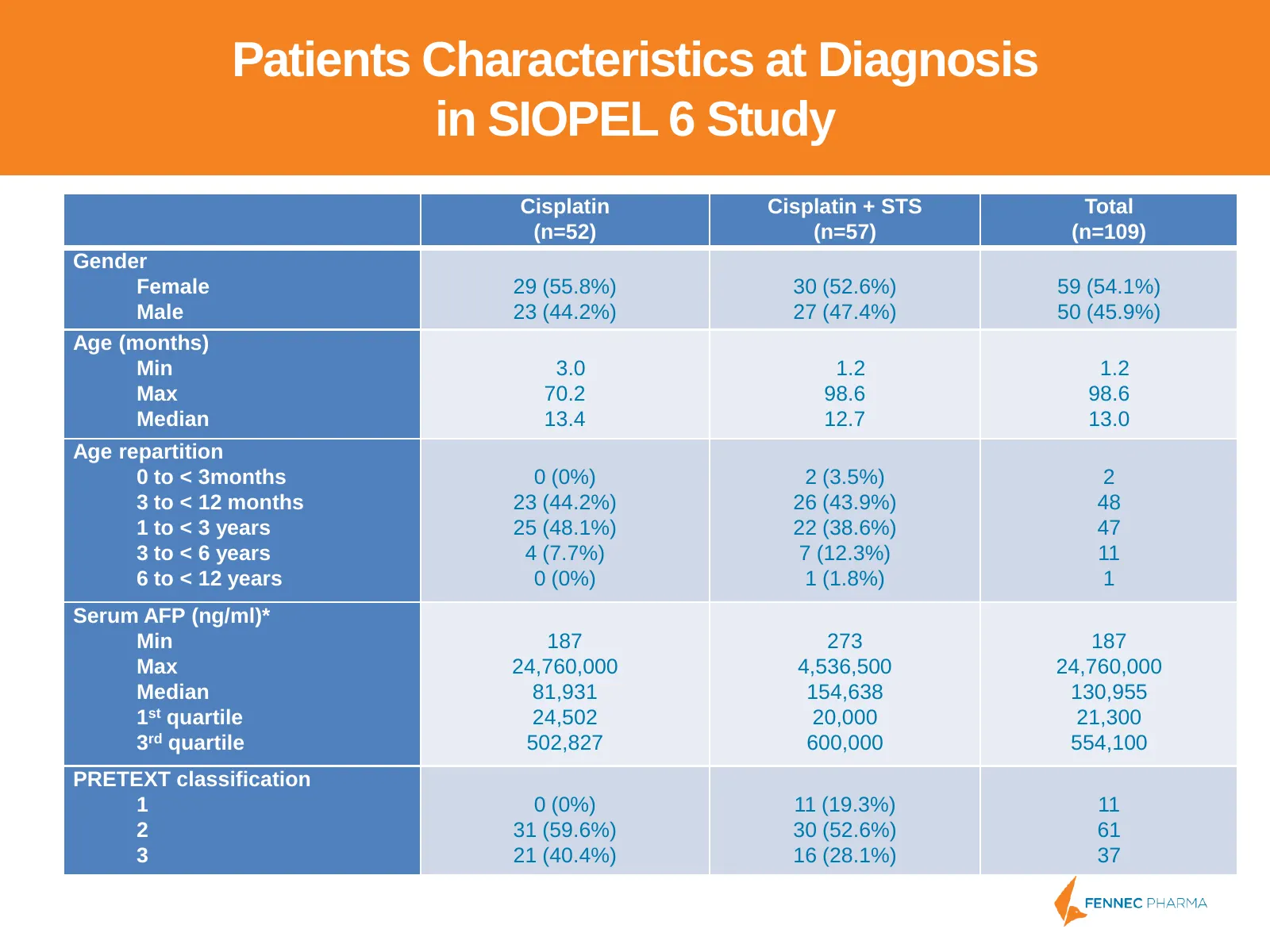
Slide 10: Patient Characteristics at Diagnosis in SIOPEL Study
Patients Characteristics at Diagnosis in SIOPEL 6 Study Cisplatin Cisplatin + STS Total (n=52) (n=57) (n=109) Gender Female 29 (55.8%) 30 (52.6%) 59 (54.1%) Male 23 (44.2%) 27 (47.4%) 50 (45.9%) Age (months) Min 3.0 1.2 1.2 Max 70.2 98.6 98.6 Median 13.4 12.7 13.0 Age repartition 0 to < 3months 0 (0
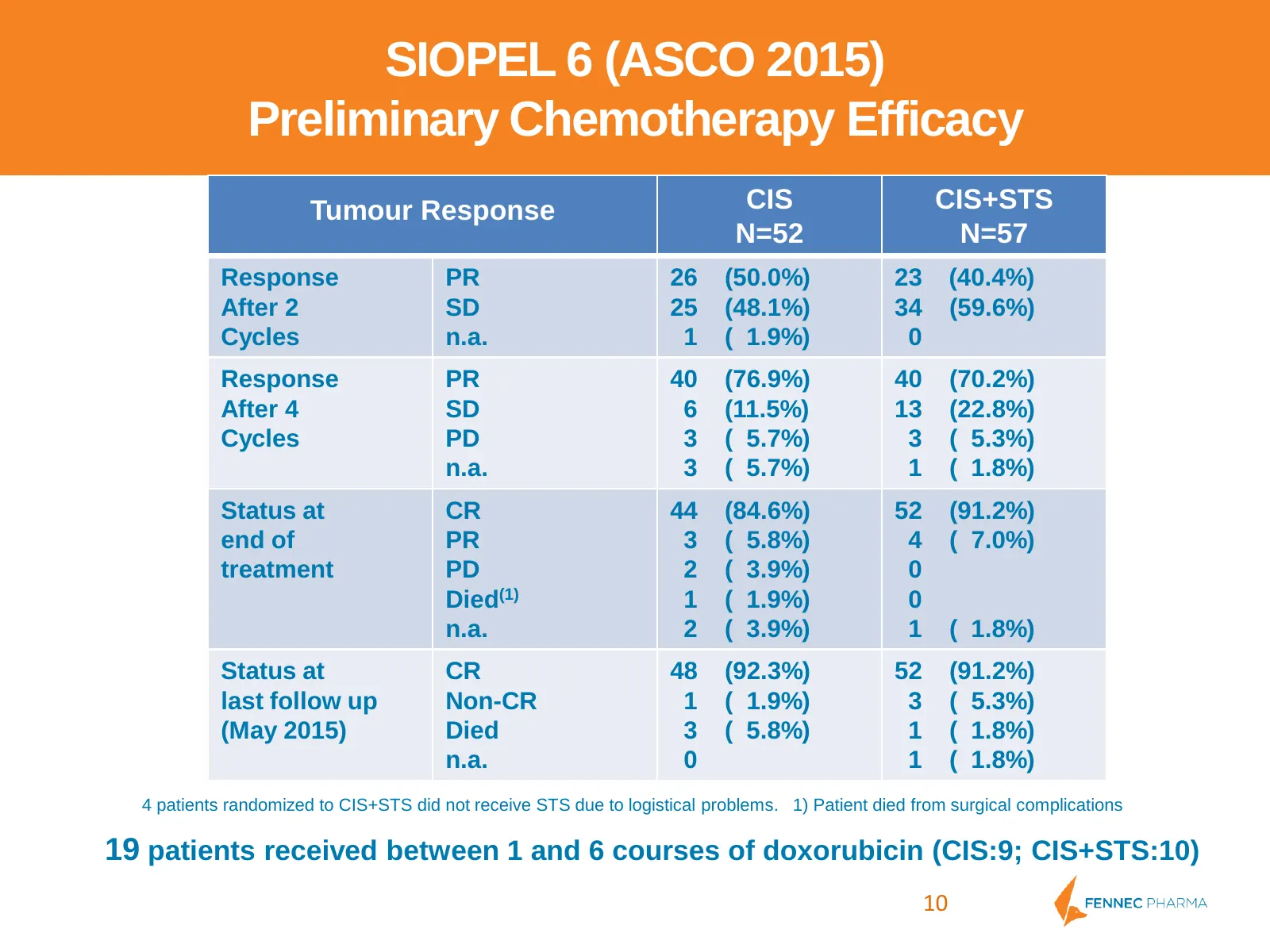
Slide 11: SIOPEL 6 Preliminary Chemotherapy Efficacy
SIOPEL 6 (ASCO 2015) Preliminary Chemotherapy Efficacy Tumour Response CIS CIS+STS N=52 N=57 Response PR 26 (50.0%) 23 (40.4%) After 2 SD 25 (48.1%) 34 (59.6%) Cycles n.a. 1 ( 1.9%) 0 Response PR 40 (76.9%) 40 (70.2%) After 4 SD 6 (11.5%) 13 (22.8%) Cycles PD 3 ( 5.7%) 3 ( 5.3%) n.a. 3 ( 5.7%) 1 ( 1
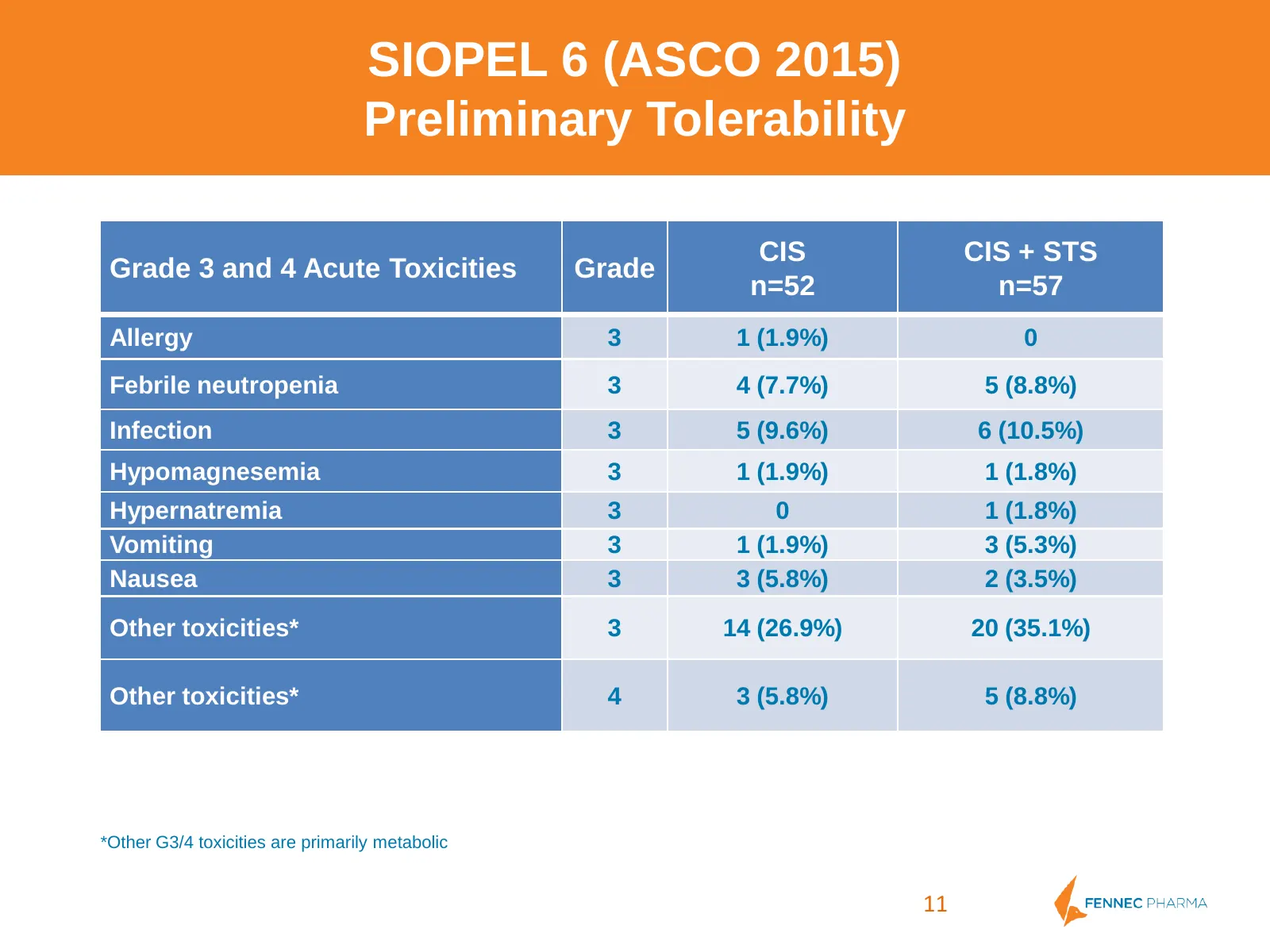
Slide 12: SIOPEL 6 Preliminary Tolerability
SIOPEL 6 (ASCO 2015) Preliminary Tolerability CIS CIS + STS Grade 3 and 4 Acute Toxicities Grade n=52 n=57 Allergy 3 1 (1.9%) 0 Febrile neutropenia 3 4 (7.7%) 5 (8.8%) Infection 3 5 (9.6%) 6 (10.5%) Hypomagnesemia 3 1 (1.9%) 1 (1.8%) Hypernatremia 3 0 1 (1.8%) Vomiting 3 1 (1.9%) 3 (5.3%) Nausea 3 3
Slide 13: SIOPEL 6 Preliminary Conclusions
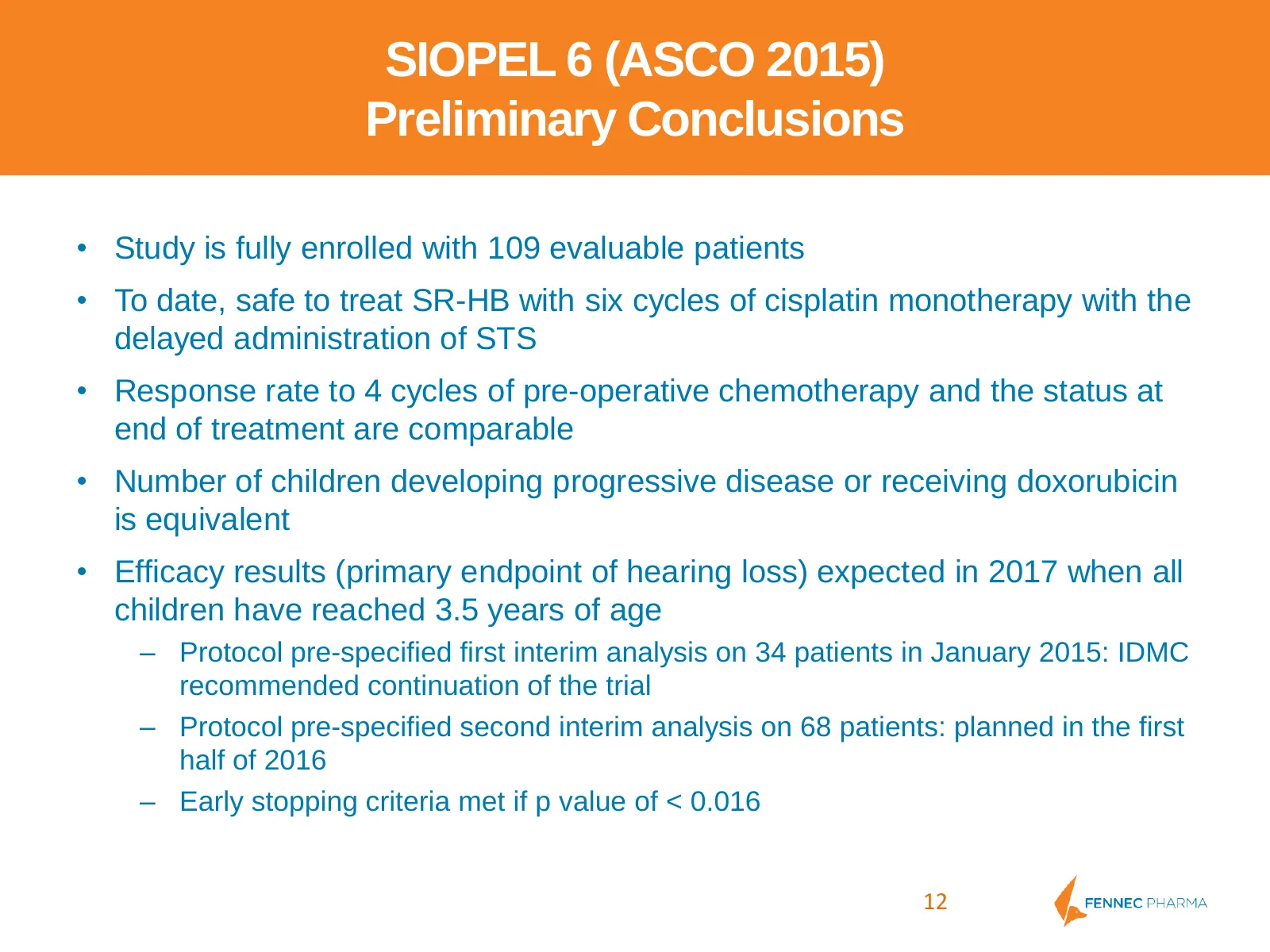
SIOPEL 6 (ASCO 2015) Preliminary Conclusions • Study is fully enrolled with 109 evaluable patients • To date, safe to treat SR-HB with six cycles of cisplatin monotherapy with the delayed administration of STS • Response rate to 4 cycles of pre-operative chemotherapy and the status at end of treatme
Slide 14: COG ACCL0431 Objectives, Population, Dosing
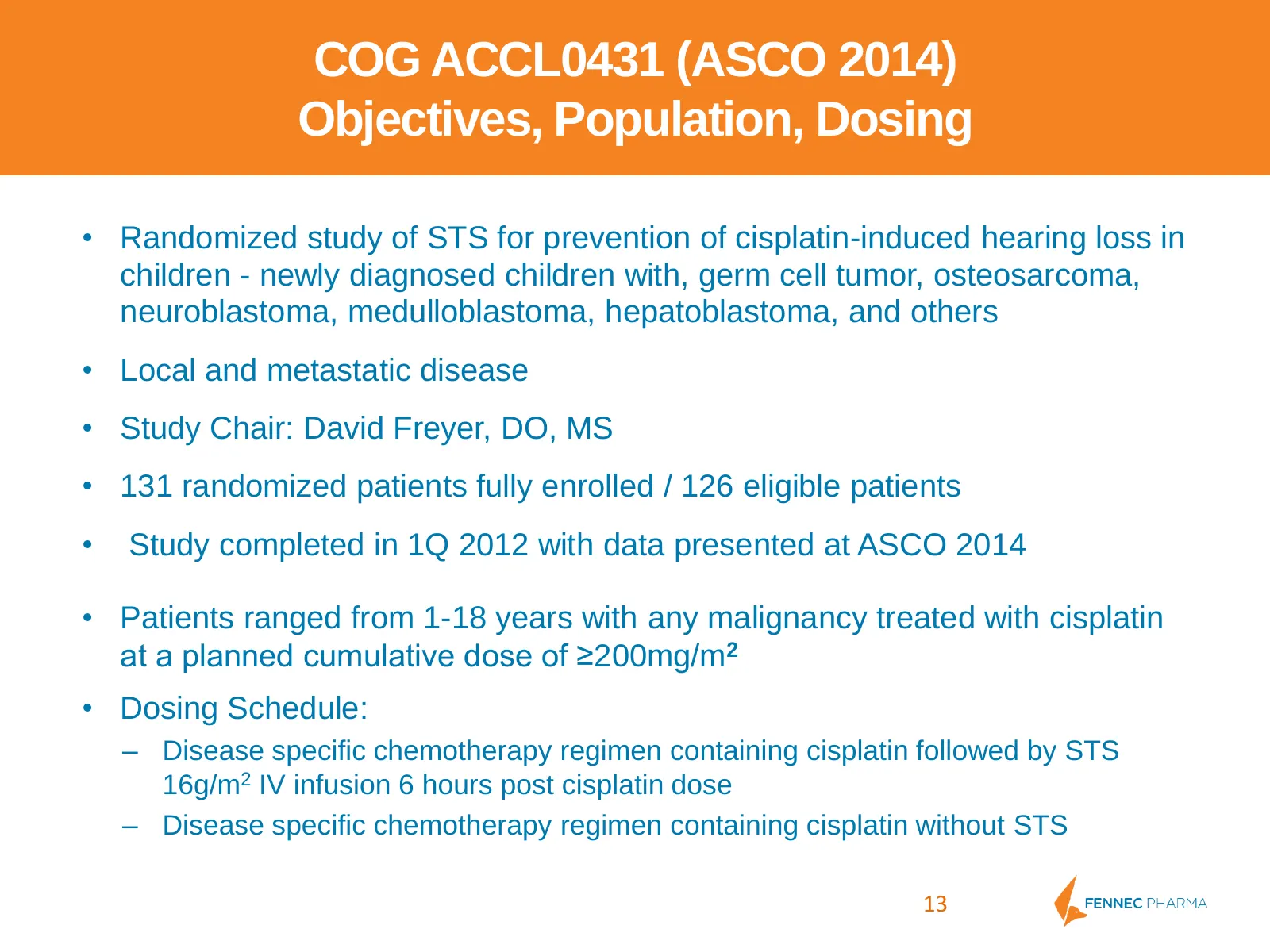
COG ACCL0431 (ASCO 2014) Objectives, Population, Dosing • Randomized study of STS for prevention of cisplatin-induced hearing loss in children - newly diagnosed children with, germ cell tumor, osteosarcoma, neuroblastoma, medulloblastoma, hepatoblastoma, and others • Local and metastatic disease • S
Slide 15: COG ACCL0431: Study Design
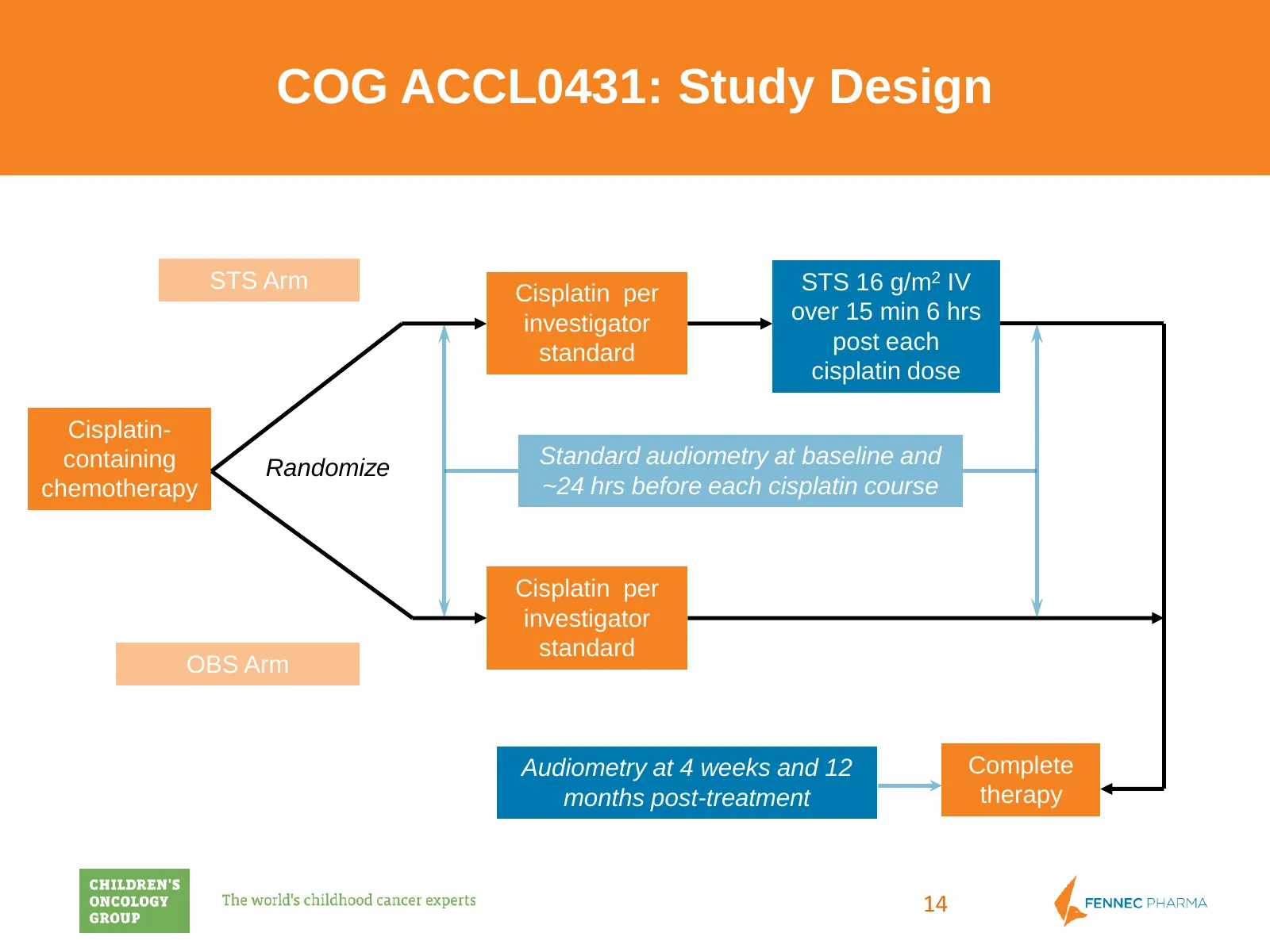
COG ACCL0431: Study Design STS Arm STS 16 g/m2 IV Cisplatin per investigator over 15 min 6 hrs standard post each cisplatin dose Cisplatin- containing Randomize Standard audiometry at baseline and chemotherapy ~24 hrs before each cisplatin course Cisplatin per investigator standard OBS Arm Audiometr
Slide 16: Patient Characteristics
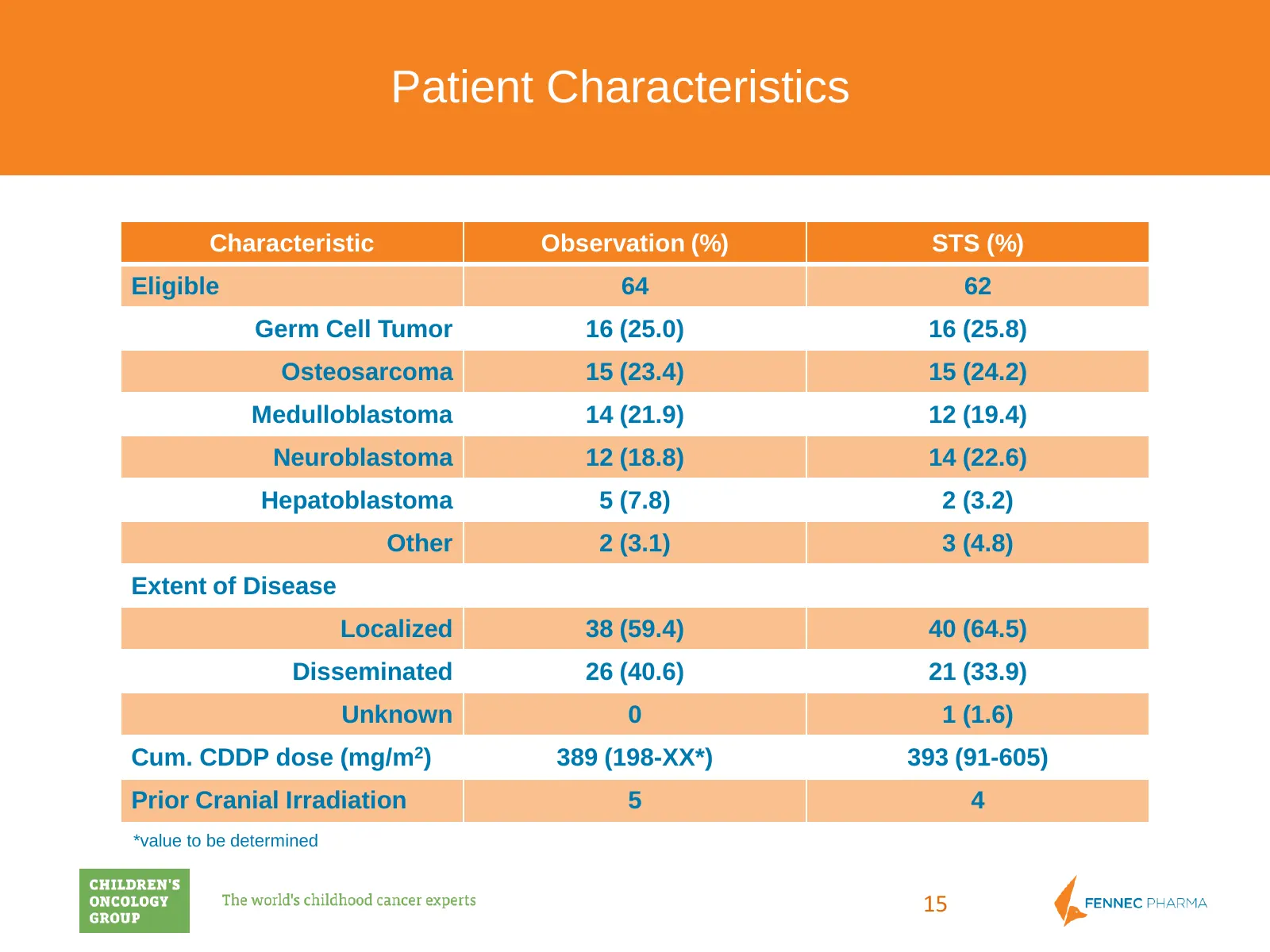
Patient Characteristics Characteristic Observation (%) STS (%) Eligible 64 62 Germ Cell Tumor 16 (25.0) 16 (25.8) Osteosarcoma 15 (23.4) 15 (24.2) Medulloblastoma 14 (21.9) 12 (19.4) Neuroblastoma 12 (18.8) 14 (22.6) Hepatoblastoma 5 (7.8) 2 (3.2) Other 2 (3.1) 3 (4.8) Extent of Disease Localized 38
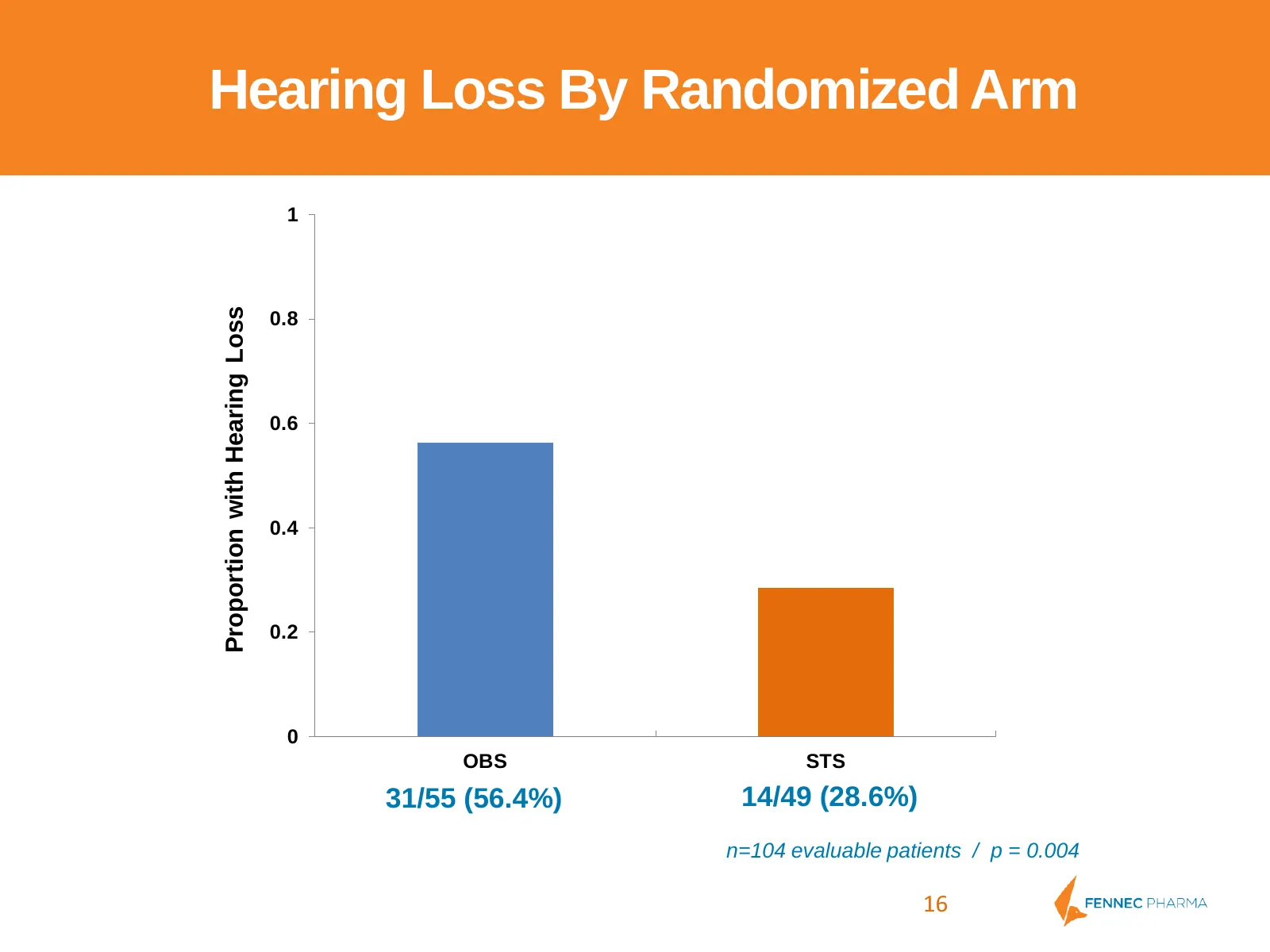
Slide 17: Hearing Loss By Randomized Arm
Hearing Loss By Randomized Arm 1 Proportion with Hearing Loss 0.8 0.6 0.4 0.2 0 OBS STS 31/55 (56.4%) 14/49 (28.6%) n=104 evaluable patients / p = 0.004 16
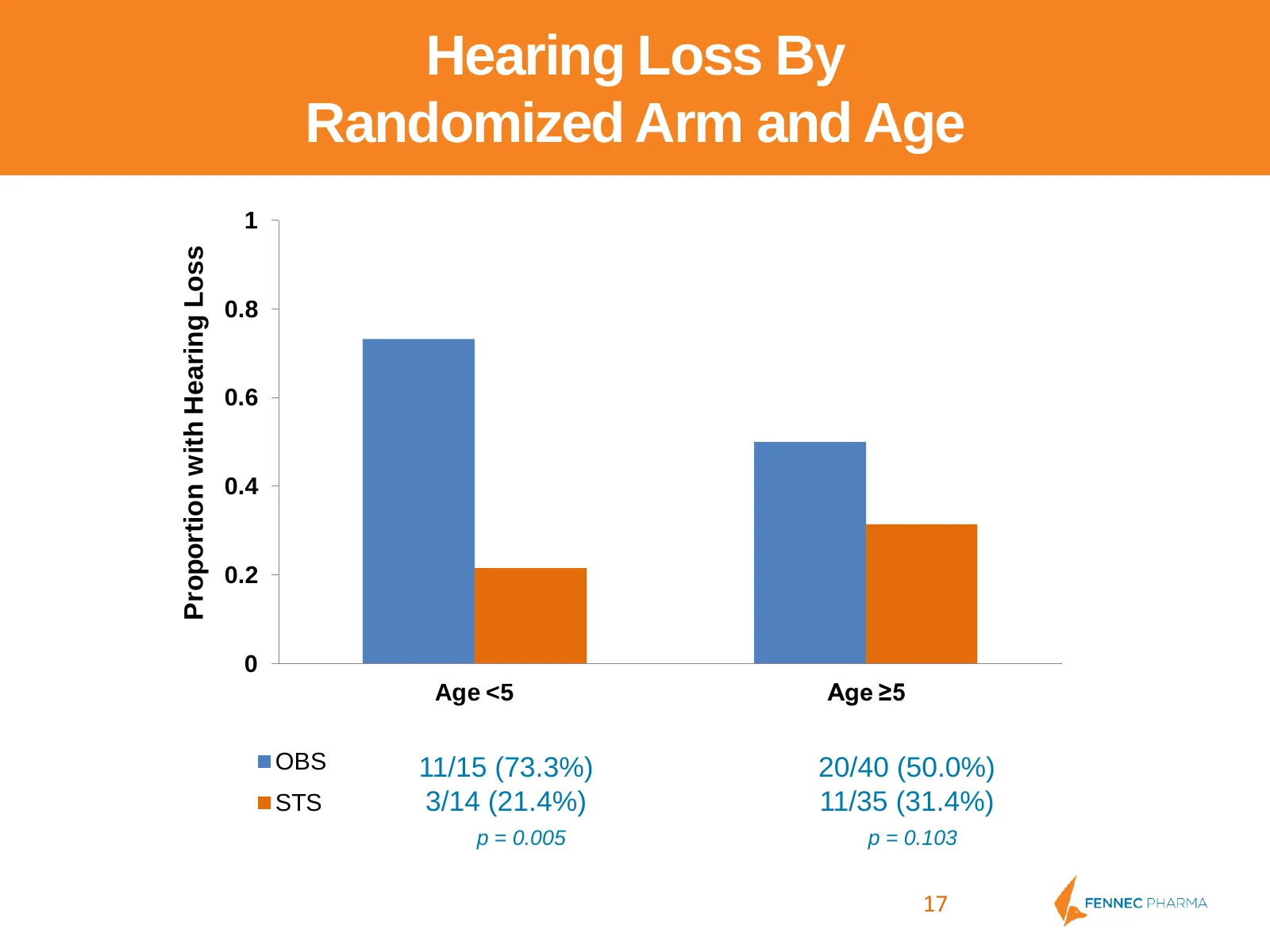
Slide 18: Hearing Loss By Randomized Arm and Age
Hearing Loss By Randomized Arm and Age 1 Proportion with Hearing Loss 0.8 0.6 0.4 0.2 0 Age <5 Age ≥5 OBS 11/15 (73.3%) 20/40 (50.0%) STS 31/55 (56.4%) 3/14 (21.4%) 14/49 11/35 (28.6%) (31.4%) p = 0.005 p = 0.103 17
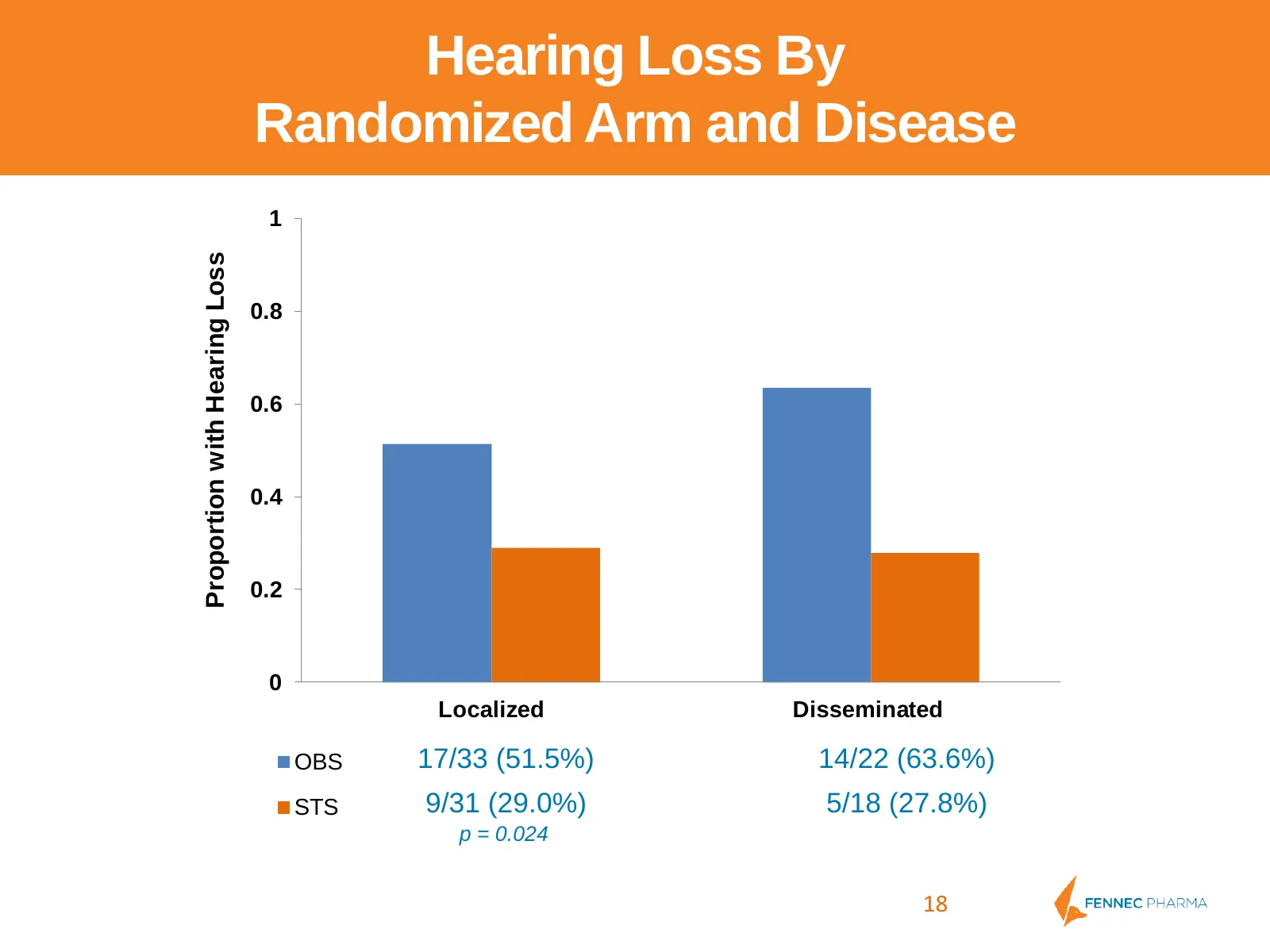
Slide 19: Hearing Loss By Randomized Arm and Disease
Hearing Loss By Randomized Arm and Disease Proportion with Hearing Loss 1 0.8 0.6 0.4 0.2 0 Localized Disseminated OBS 17/33 (56.4%) 31/55 (51.5%) 14/22 14/49 (63.6%) (28.6%) STS 9/31 (29.0%) 5/18p =(27.8%) 0.067 p = 0.024 18
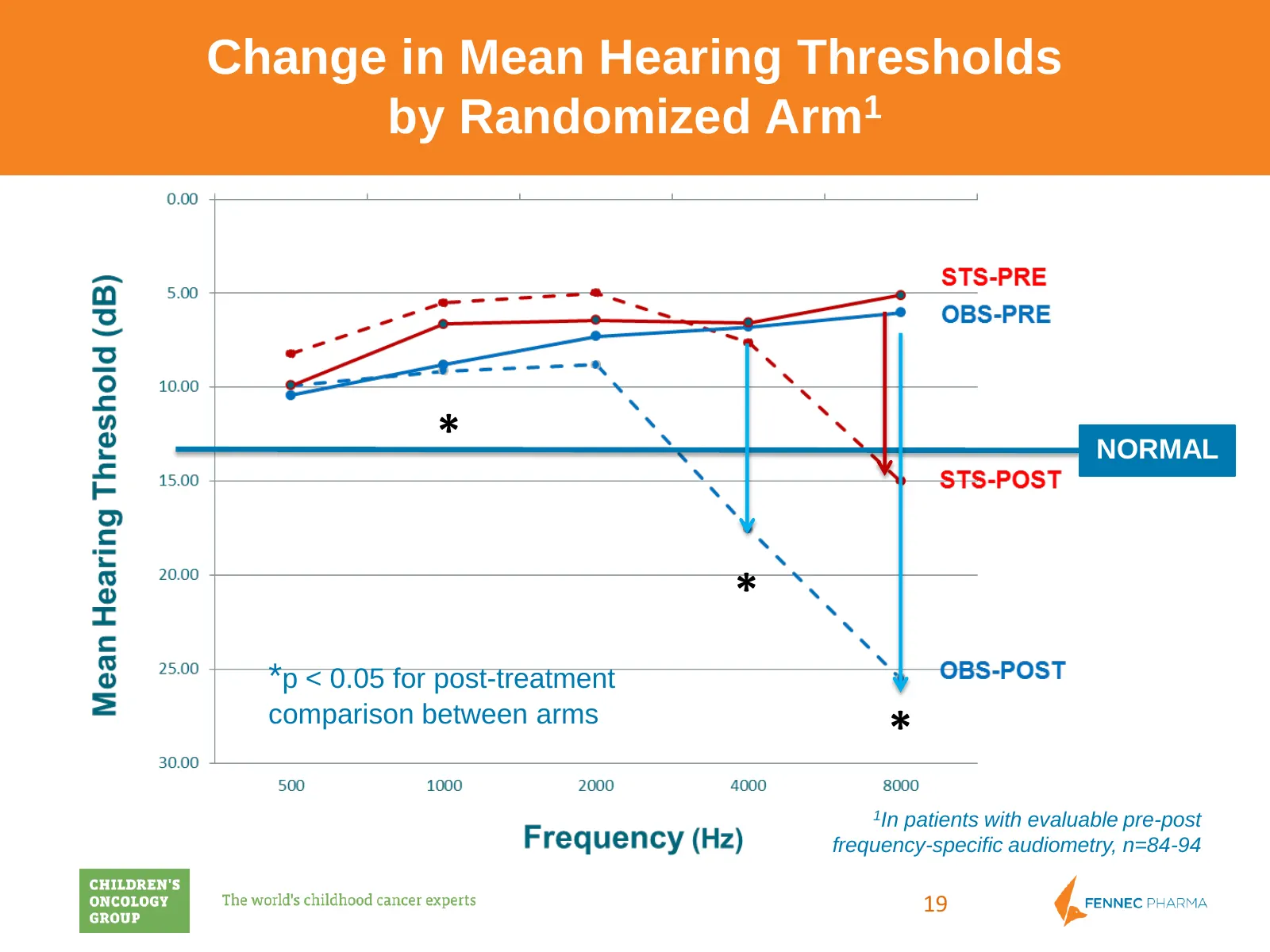
Slide 20: Change in Mean Hearing Thresholds by Randomized Arm
Change in Mean Hearing Thresholds by Randomized Arm1 * NORMAL * *p < 0.05 for post-treatment comparison between arms * 1In patients with evaluable pre-post frequency-specific audiometry, n=84-94 19
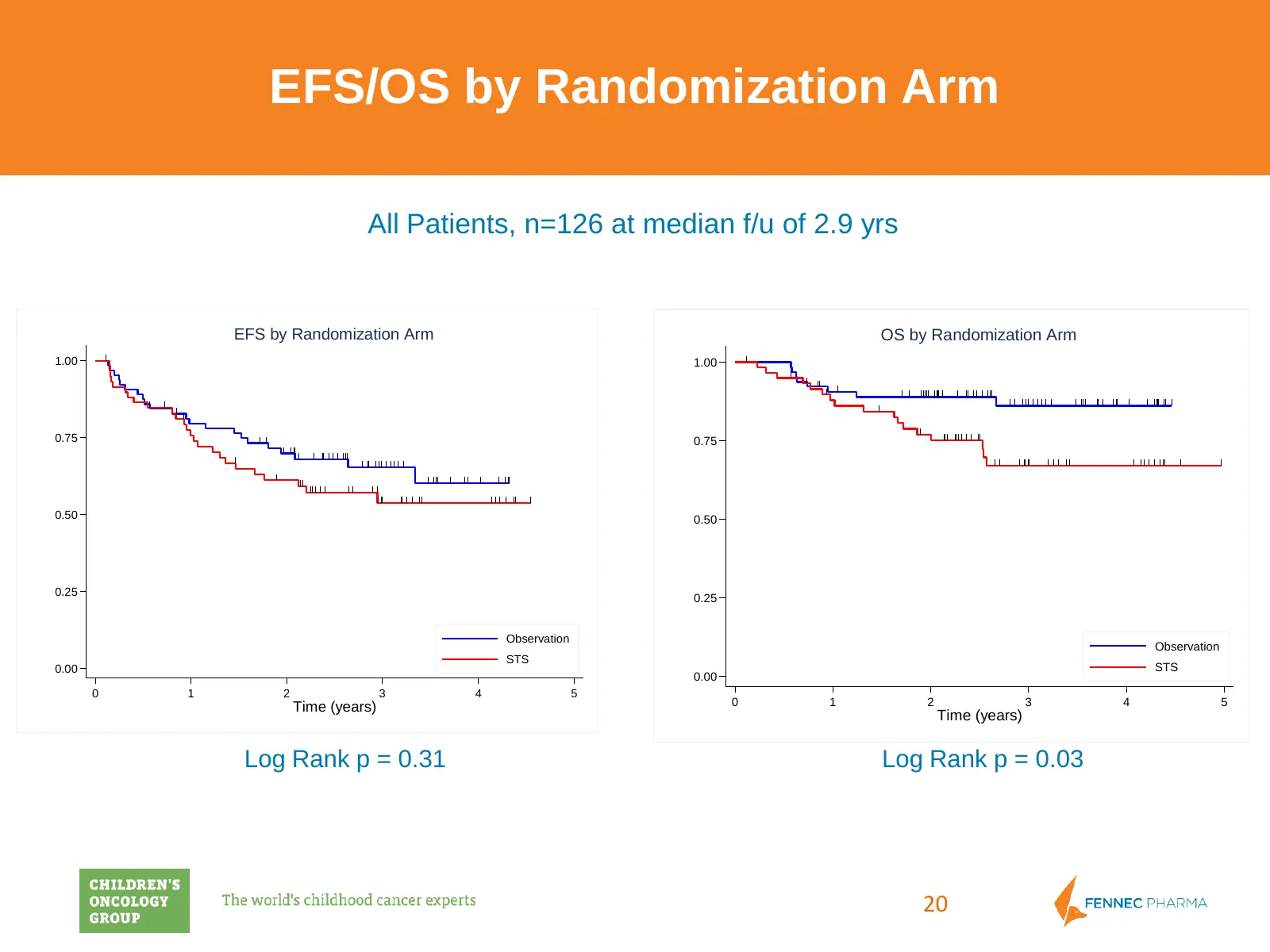
Slide 21: EFS/OS by Randomization Arm: All Patients
EFS/OS by Randomization Arm All Patients, n=126 at median f/u of 2.9 yrs EFS by Randomization Arm OS by Randomization Arm 1.00 1.00 0.75 0.75 Estimated Proportion 0.50 0.50 0.25 0.25 Observation Observation STS 0.00 STS 0.00 0 1 2 3 4 5 Time (years) 0 1 2 3 4 5 Time (years) Log Rank p = 0.31 Log Ran
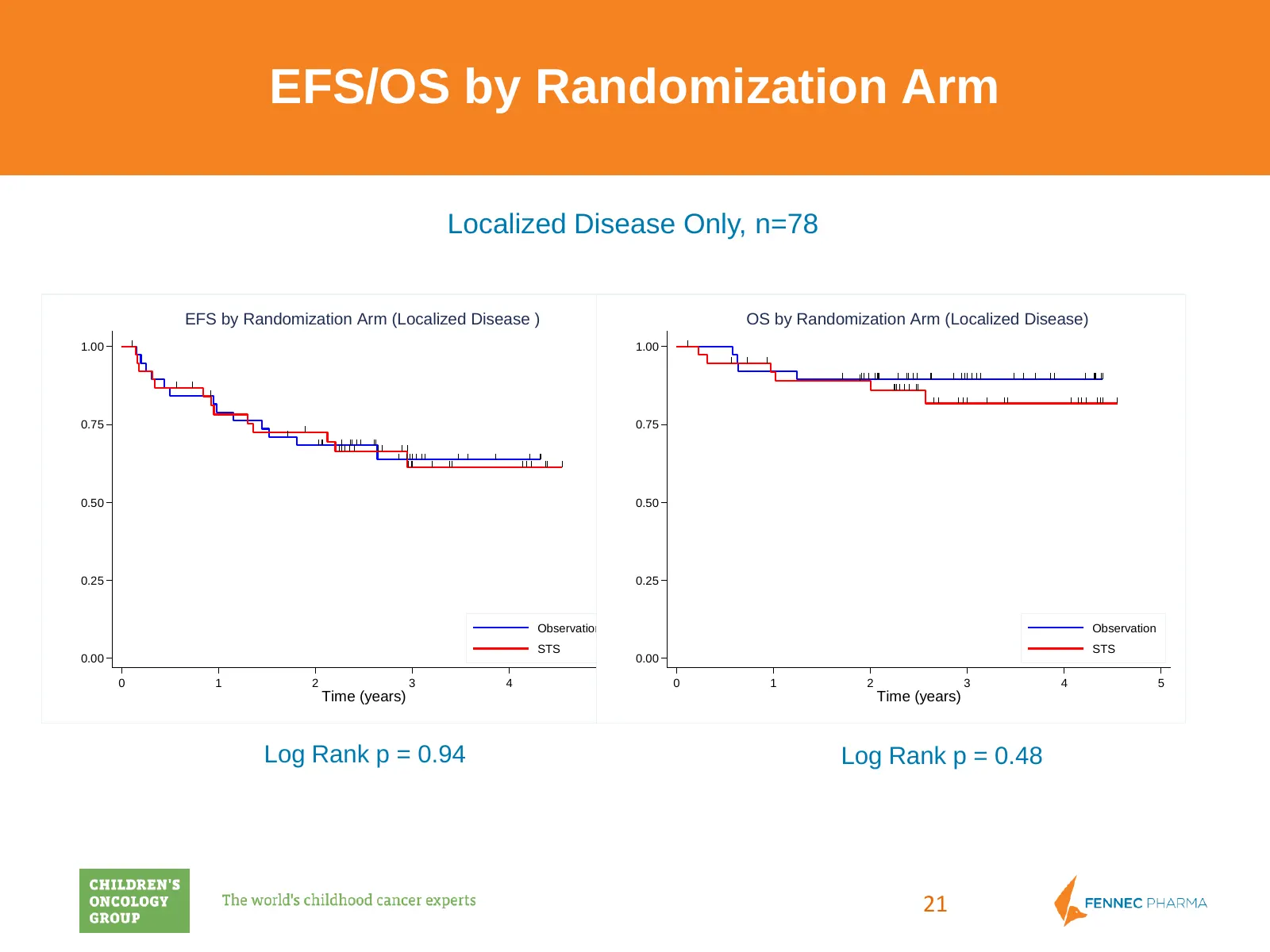
Slide 22: EFS/OS by Randomization Arm: Localized Disease
EFS/OS by Randomization Arm Localized Disease Only, n=78 EFS by Randomization Arm (Localized Disease ) OS by Randomization Arm (Localized Disease) 1.00 1.00 0.75 Estimated Proportion 0.75 0.50 0.50 0.25 0.25 Observation Observation STS STS 0.00 0.00 0 1 2 3 4 5 0 1 2 3 4 5 Time (years) Time (years)
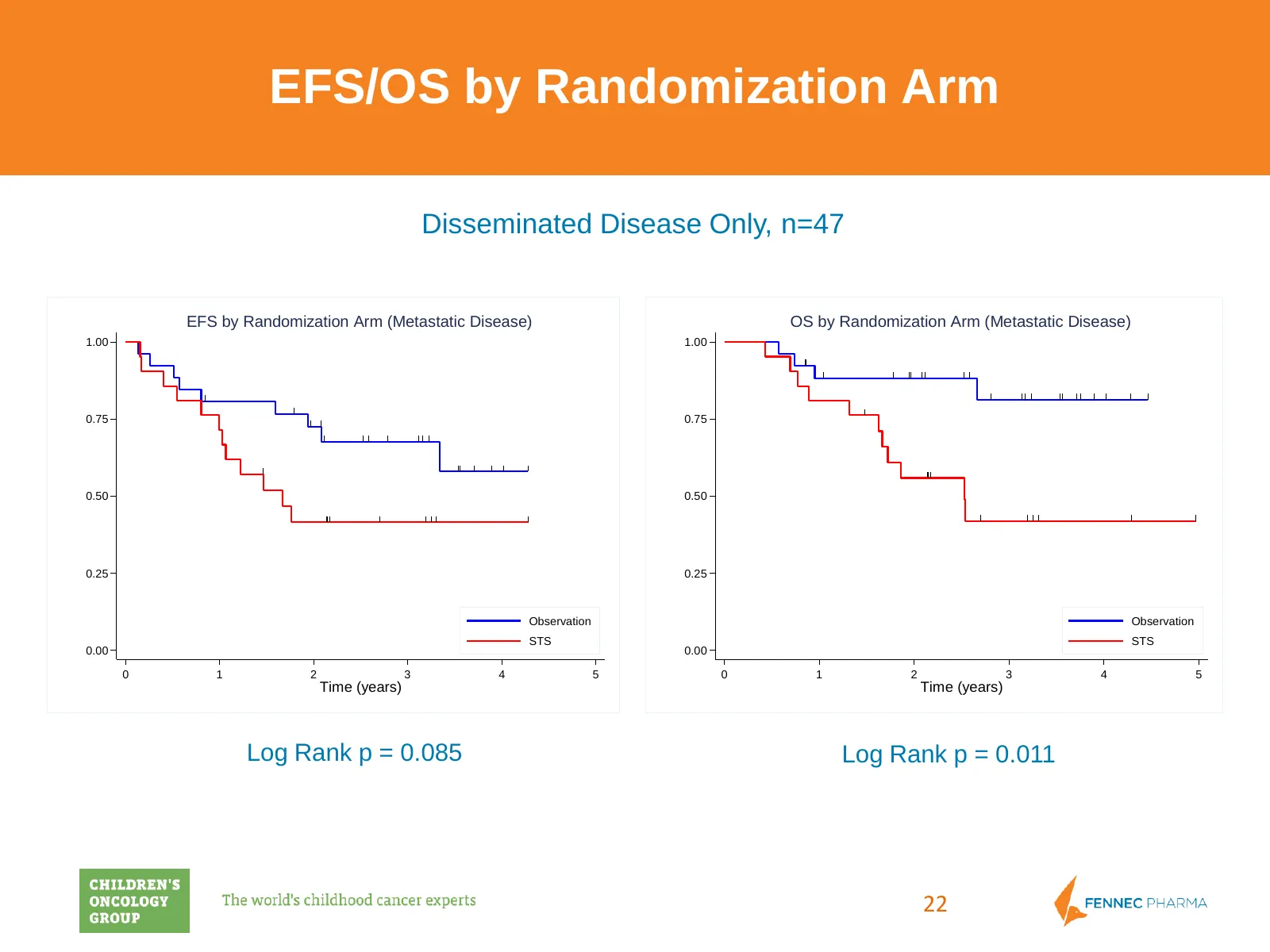
Slide 23: EFS/OS by Randomization Arm: Disseminated Disease
EFS/OS by Randomization Arm Disseminated Disease Only, n=47 EFS by Randomization Arm (Metastatic Disease) OS by Randomization Arm (Metastatic Disease) 1.00 1.00 0.75 0.75 Estimated Proportion 0.50 0.50 0.25 0.25 Observation Observation STS STS 0.00 0.00 0 1 2 3 4 5 0 1 2 3 4 5 Time (years) Time (yea
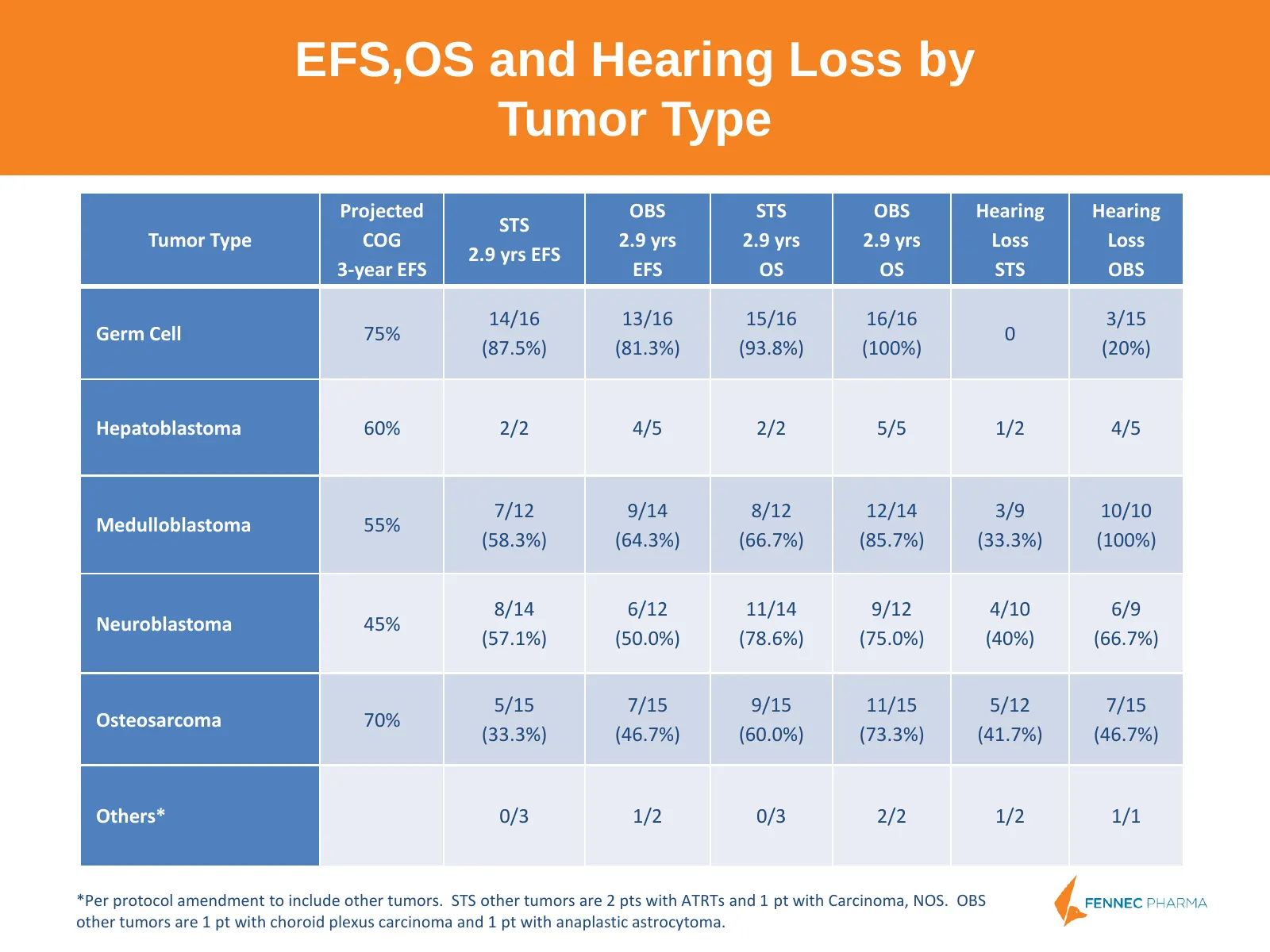
Slide 24: EFS, OS and Hearing Loss by Tumor Type
EFS,OS and Hearing Loss by Tumor Type Projected OBS STS OBS Hearing Hearing STS Tumor Type COG 2.9 yrs 2.9 yrs 2.9 yrs Loss Loss 2.9 yrs EFS 3-year EFS EFS OS OS STS OBS 14/16 13/16 15/16 16/16 3/15 Germ Cell 75% 0 (87.5%) (81.3%) (93.8%) (100%) (20%) Hepatoblastoma 60% 2/2 4/5 2/2 5/5 1/2 4/5 7/12
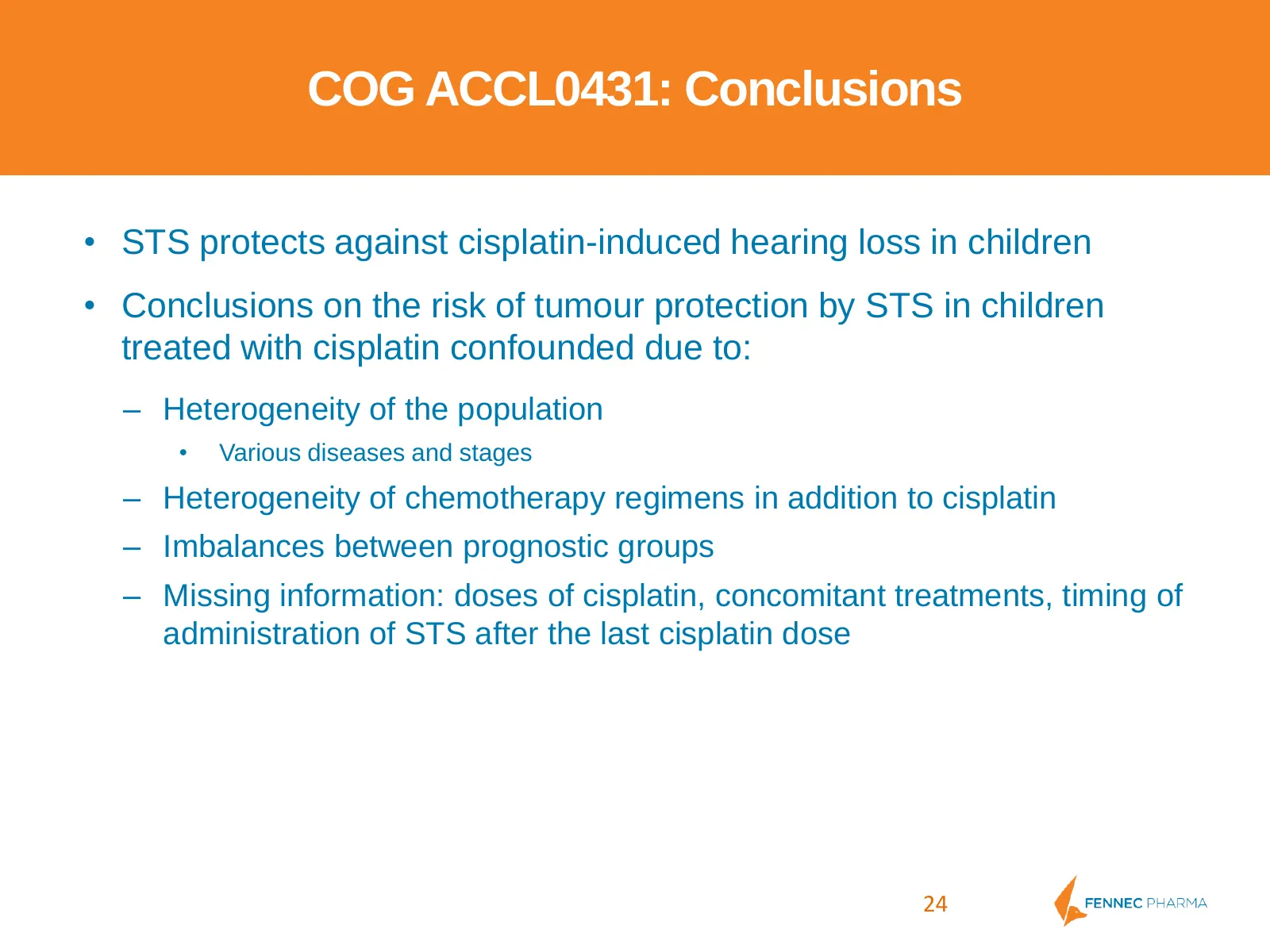
Slide 25: COG ACCL0431: Conclusions
COG ACCL0431: Conclusions • STS protects against cisplatin-induced hearing loss in children • Conclusions on the risk of tumour protection by STS in children treated with cisplatin confounded due to: – Heterogeneity of the population • Various diseases and stages – Heterogeneity of chemotherapy regi
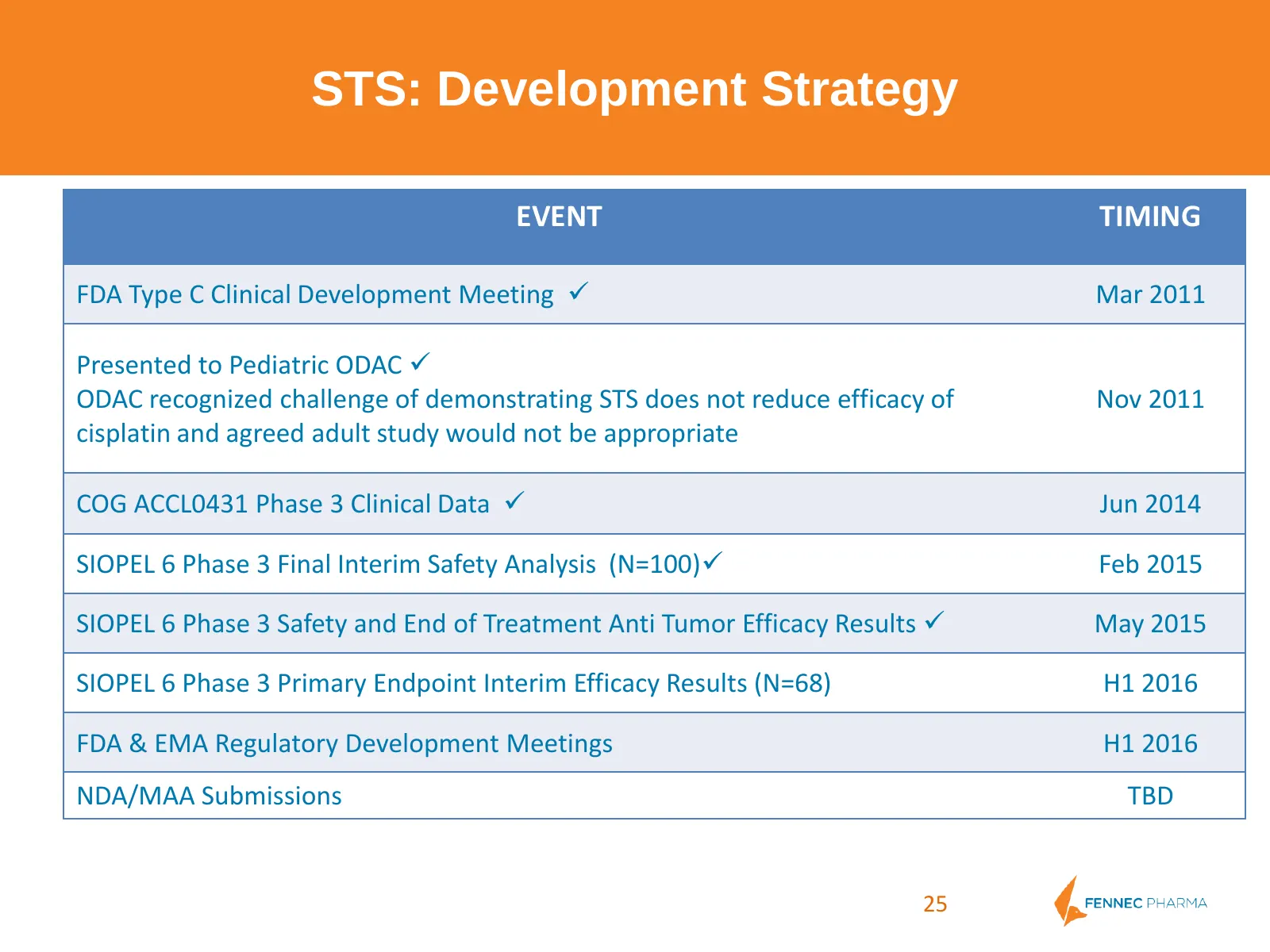
Slide 26: STS: Development Strategy
STS: Development Strategy EVENT TIMING FDA Type C Clinical Development Meeting Mar 2011 Presented to Pediatric ODAC ODAC recognized challenge of demonstrating STS does not reduce efficacy of Nov 2011 cisplatin and agreed adult study would not be appropriate COG ACCL0431 Phase 3 Clinical Data J
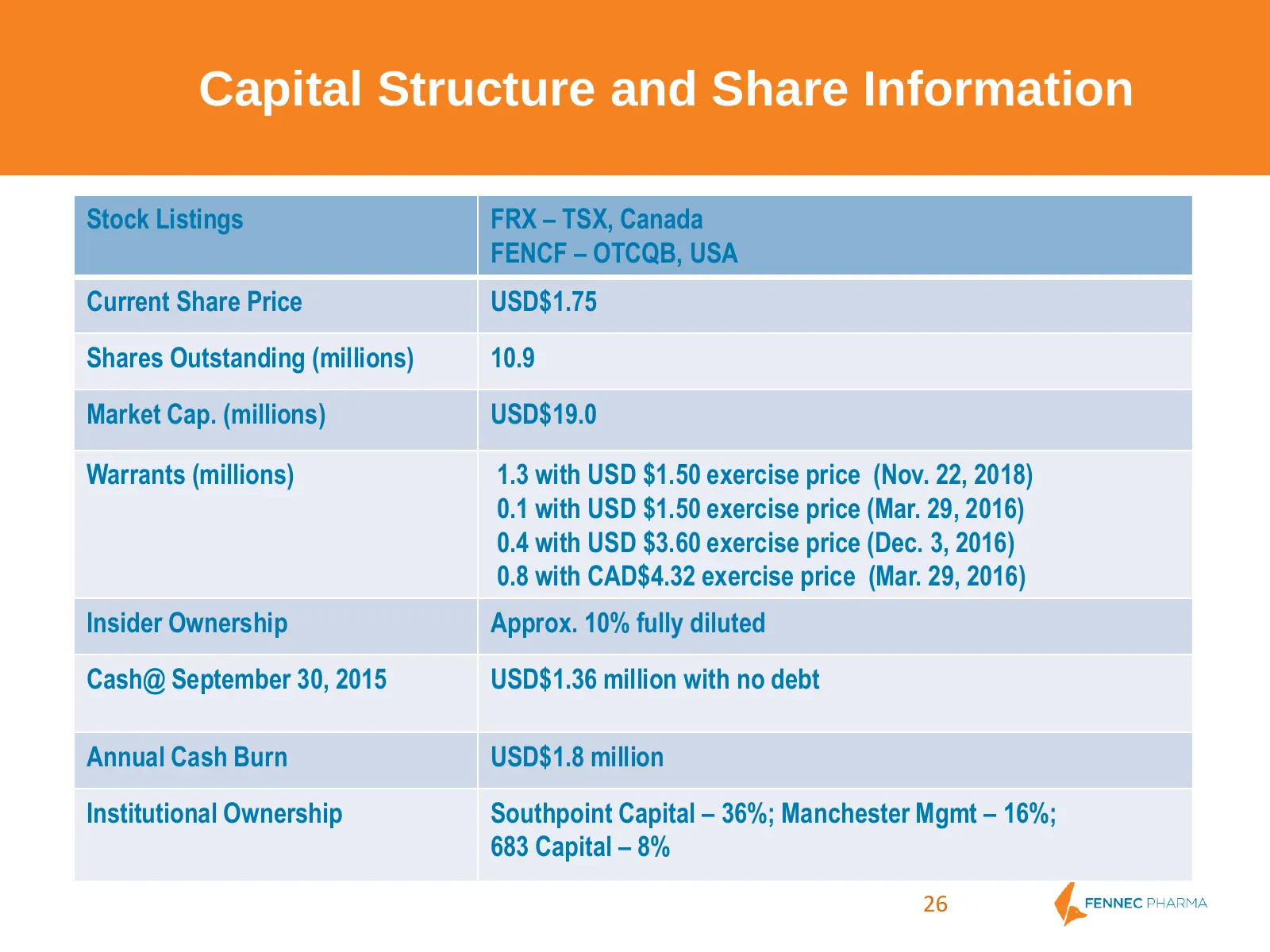
Slide 27: Capital Structure and Share Information
Capital Structure and Share Information Stock Listings FRX – TSX, Canada FENCF – OTCQB, USA Current Share Price USD$1.75 Shares Outstanding (millions) 10.9 Market Cap. (millions) USD$19.0 Warrants (millions) 1.3 with USD $1.50 exercise price (Nov. 22, 2018) 0.1 with USD $1.50 exercise price (Mar. 29
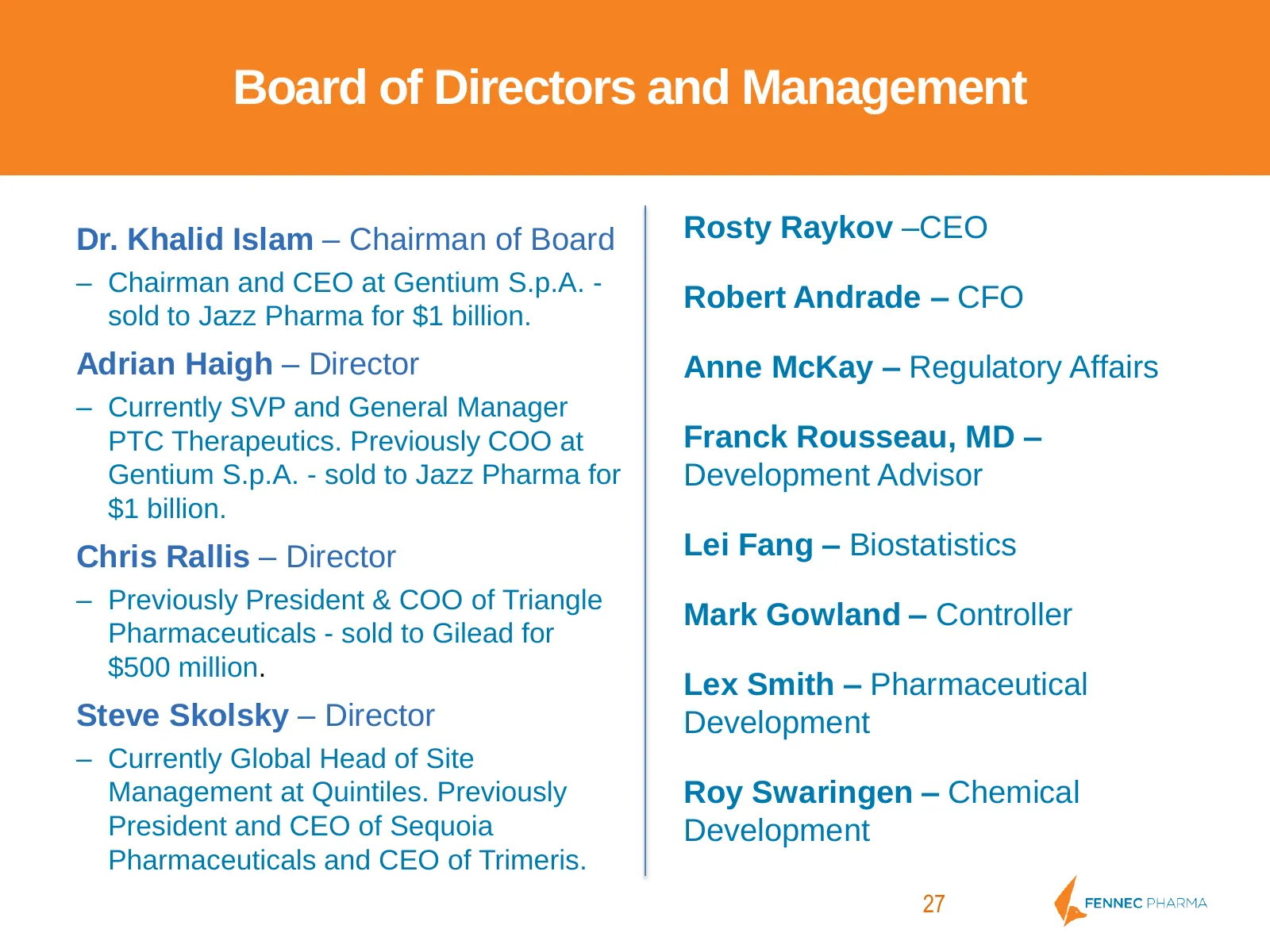
Slide 28: Board of Directors and Management
Board of Directors and Management Dr. Khalid Islam – Chairman of Board Rosty Raykov –CEO – Chairman and CEO at Gentium S.p.A. - Robert Andrade – CFO sold to Jazz Pharma for $1 billion. Adrian Haigh – Director Anne McKay – Regulatory Affairs – Currently SVP and General Manager PTC Therapeutics. Previ
Slide 29: STS Investment Highlights
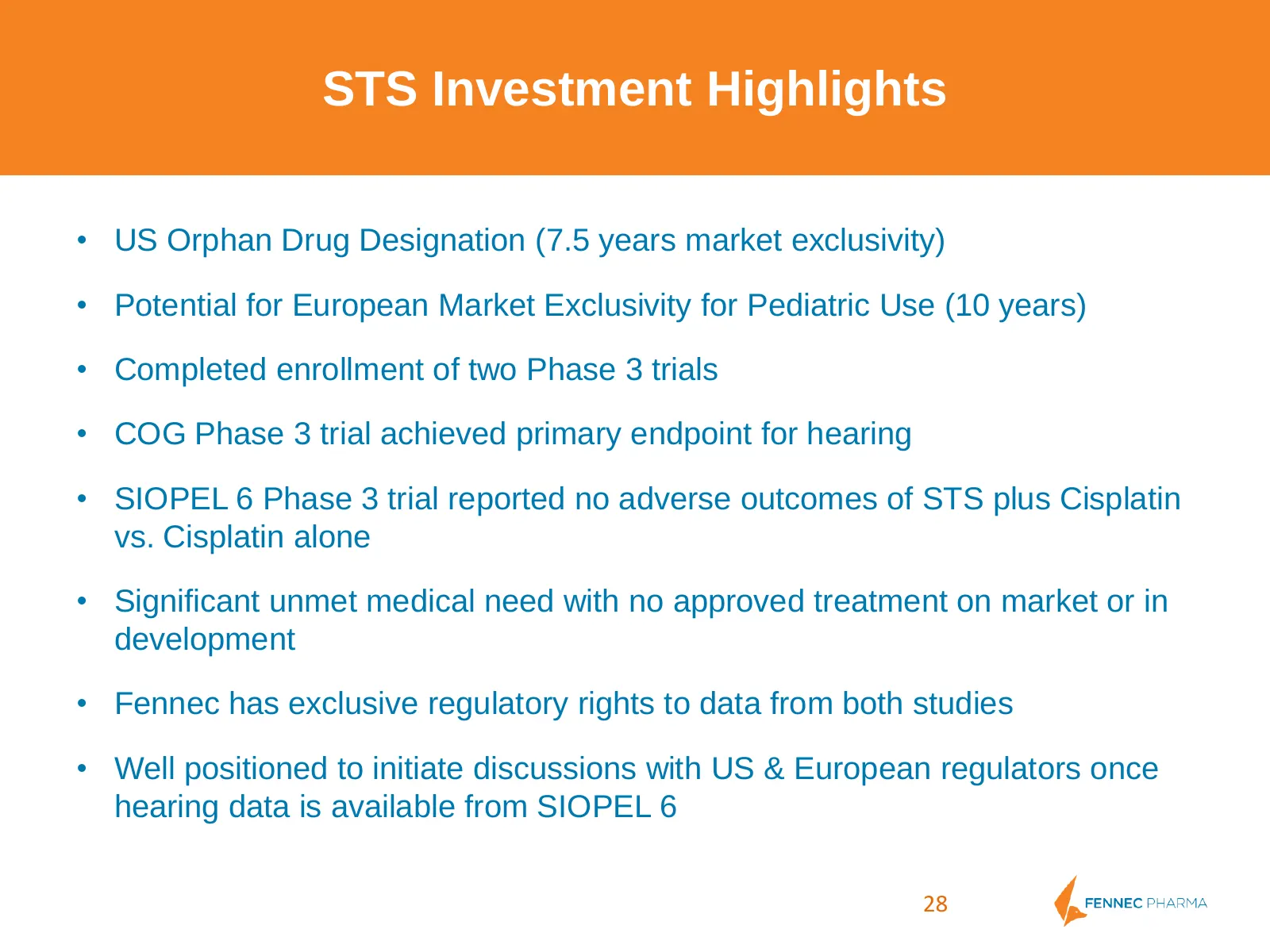
STS Investment Highlights • US Orphan Drug Designation (7.5 years market exclusivity) • Potential for European Market Exclusivity for Pediatric Use (10 years) • Completed enrollment of two Phase 3 trials • COG Phase 3 trial achieved primary endpoint for hearing • SIOPEL 6 Phase 3 trial reported no a
Source: Internet Archive copy of fennecpharma.com
More decks from Fennec Pharmaceuticals Inc.
 Investor Presentation (August 2026)31 slides · August 2026
 Investor Presentation (August 2022)31 slides · August 2022
 Investor Presentation (February 2022)31 slides · February 2022
 Investor Presentation (January 2022)31 slides · January 2022
 Investor Presentation (November 2021)31 slides · November 2021
 Investor Presentation (August 2021)31 slides · August 2021