Recce Pharmaceuticals Ltd. · ASX:RCE
Recce Pharmaceuticals — Investor Presentation (February 2020)
32 slides from Recce Pharmaceuticals's investor presentation, February 2020
Slide 1: Corporate Presentation February 2020
Corporate Presentation ASX:RCE February 2020
Slide 2: Disclaimer
Disclaimer DISCLAIMER This presentation has been prepared by Recce Pharmaceuticals Ltd (the “Company”). It does not purport to contain all the information that a prospective investor may require in connection with any potential investment in the Company. You should not treat the contents of this pre
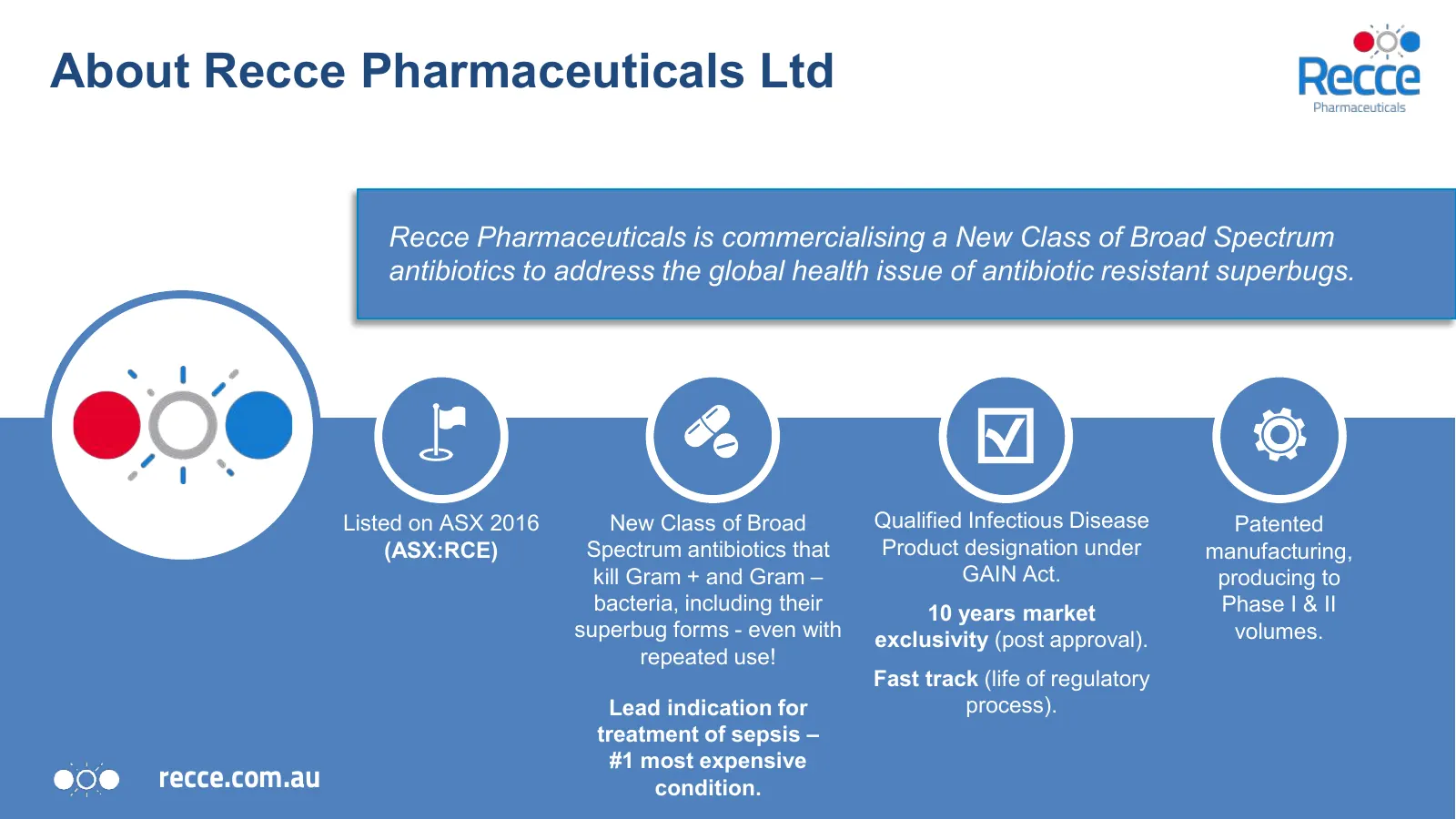
Slide 3: About Recce Pharmaceuticals Ltd
About Recce Pharmaceuticals Ltd Recce Pharmaceuticals is commercialising a New Class of Broad Spectrum antibiotics to address the global health issue of antibiotic resistant superbugs. Listed on ASX 2016 New Class of Broad Qualified Infectious Disease Patented (ASX:RCE) Spectrum antibiotics that Pro
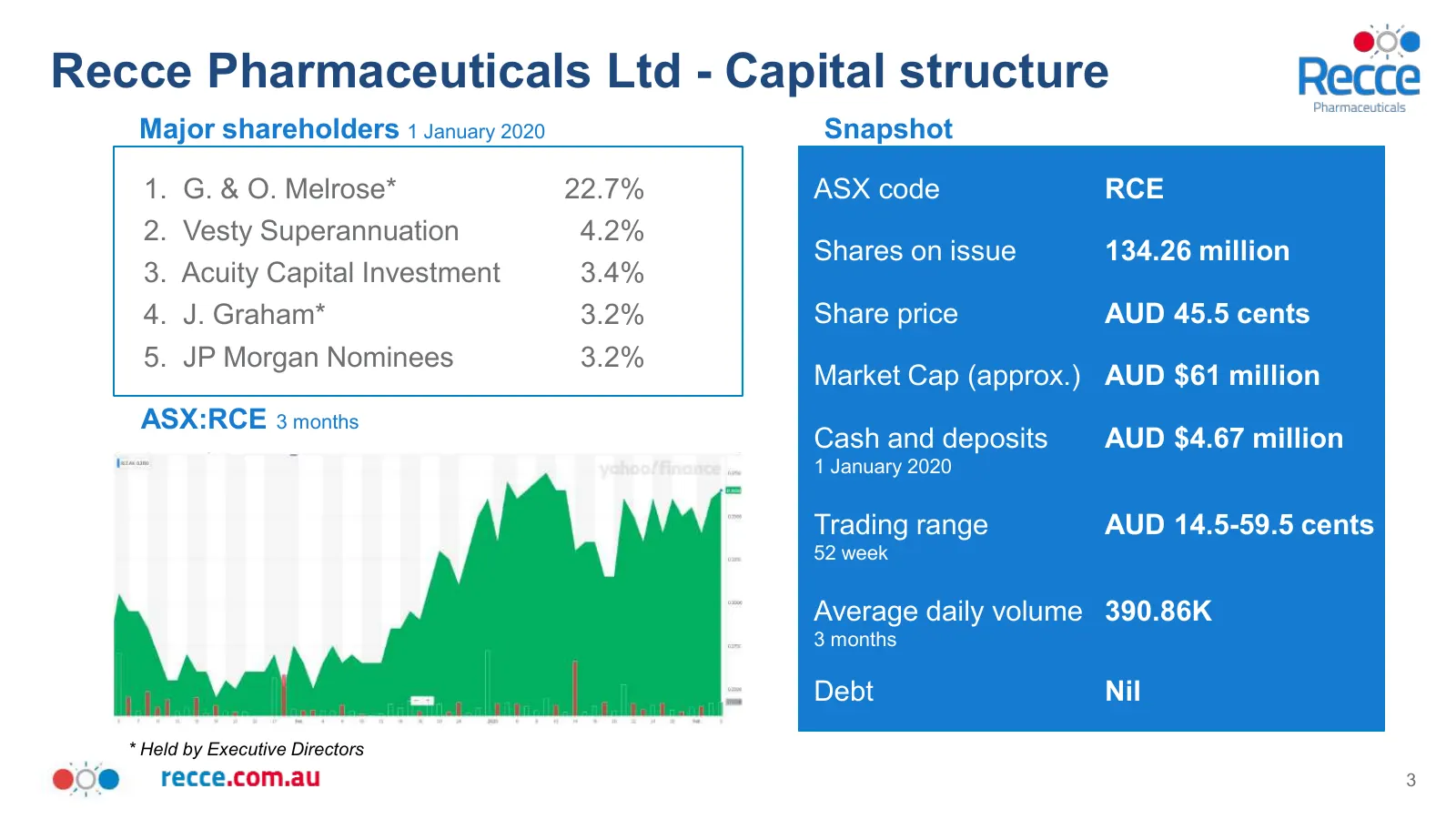
Slide 4: Recce Pharmaceuticals Ltd - Capital structure
Recce Pharmaceuticals Ltd - Capital structure Major shareholders 1 January 2020 Snapshot 1. G. & O. Melrose* 22.7% ASX code RCE 2. Vesty Superannuation 4.2% Shares on issue 134.26 million 3. Acuity Capital Investment 3.4% 4. J. Graham* 3.2% Share price AUD 45.5 cents 5. JP Morgan Nominees 3.2% Marke
Slide 5: Tackling superbugs – RECCE® (video)
Tackling superbugs – RECCE® 327 (video) 4
Slide 6: Sepsis – it's a big problem!
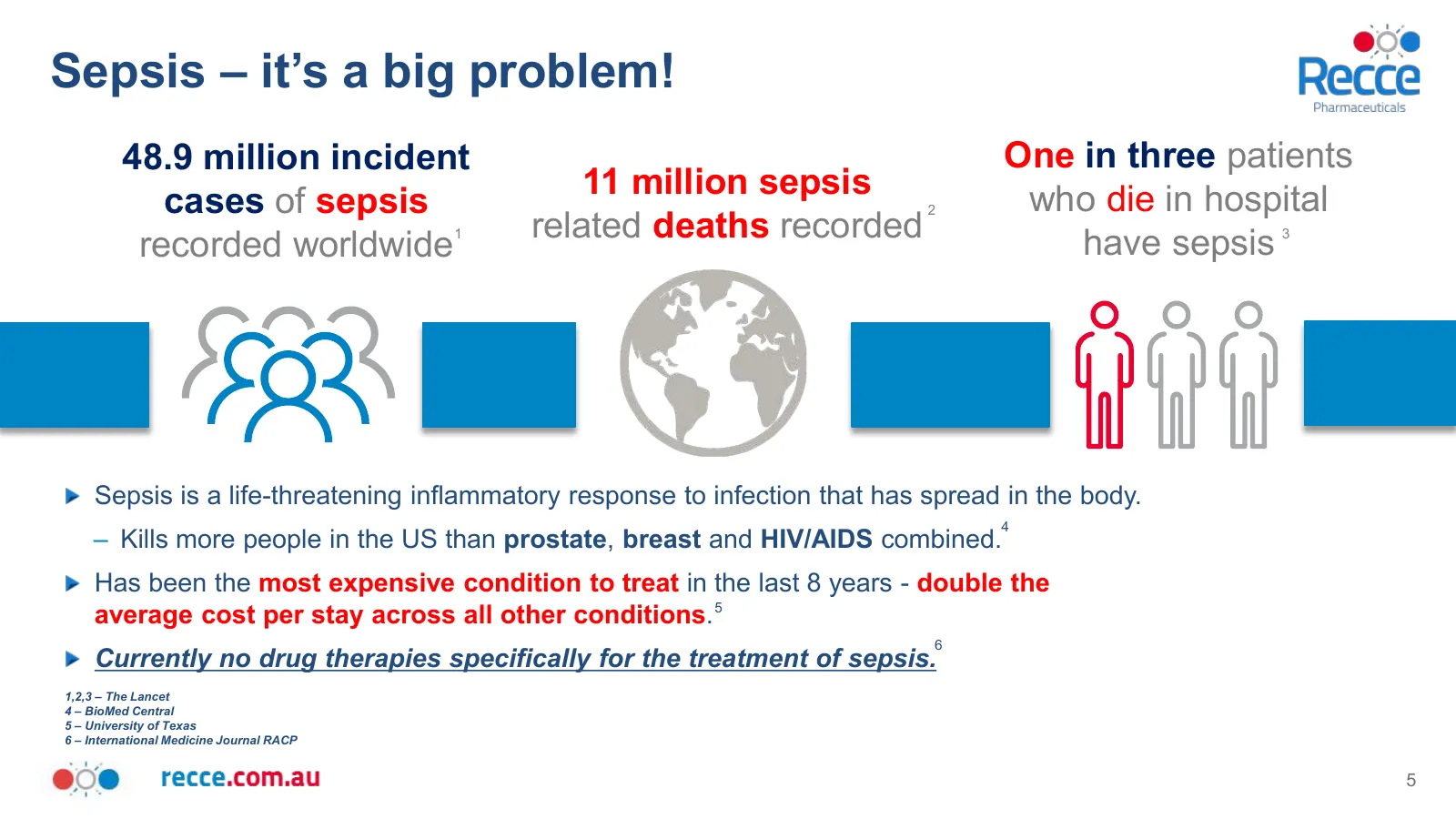
Sepsis – it’s a big problem! 48.9 million incident One in three patients 11 million sepsis who die in hospital cases of sepsis related deaths recorded 2 recorded worldwide 1 have sepsis 3 Sepsis is a life-threatening inflammatory response to infection that has spread in the body. 4 ‒ Kills more peop
Slide 7: Natural Antibiotics vs Synthetic Antibiotics
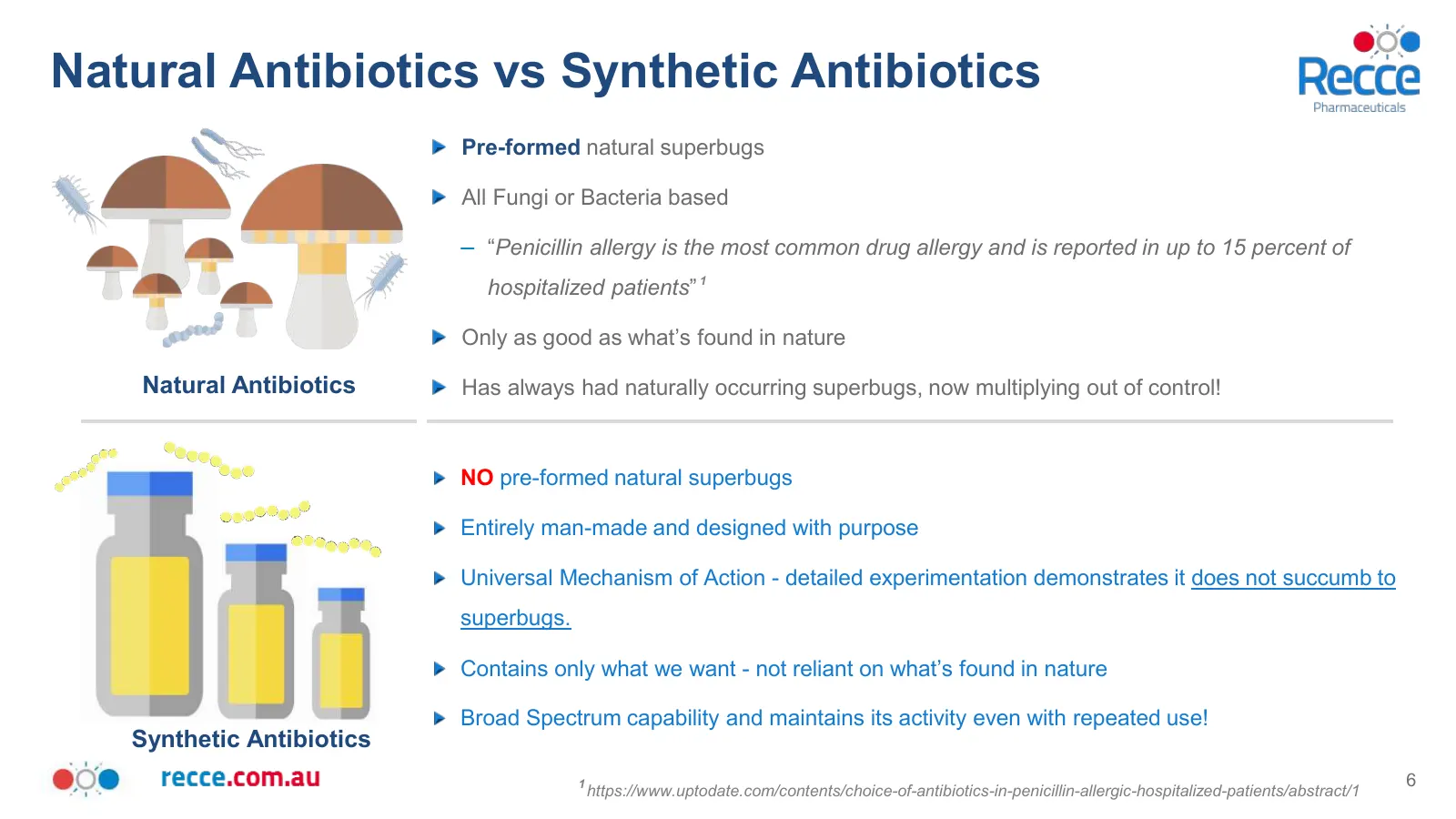
Natural Antibiotics vs Synthetic Antibiotics Pre-formed natural superbugs All Fungi or Bacteria based ‒ “Penicillin allergy is the most common drug allergy and is reported in up to 15 percent of hospitalized patients” 1 Only as good as what’s found in nature Natural Antibiotics Has always had natura
Slide 8: RECCE® – Multiple Antibiotic Applications
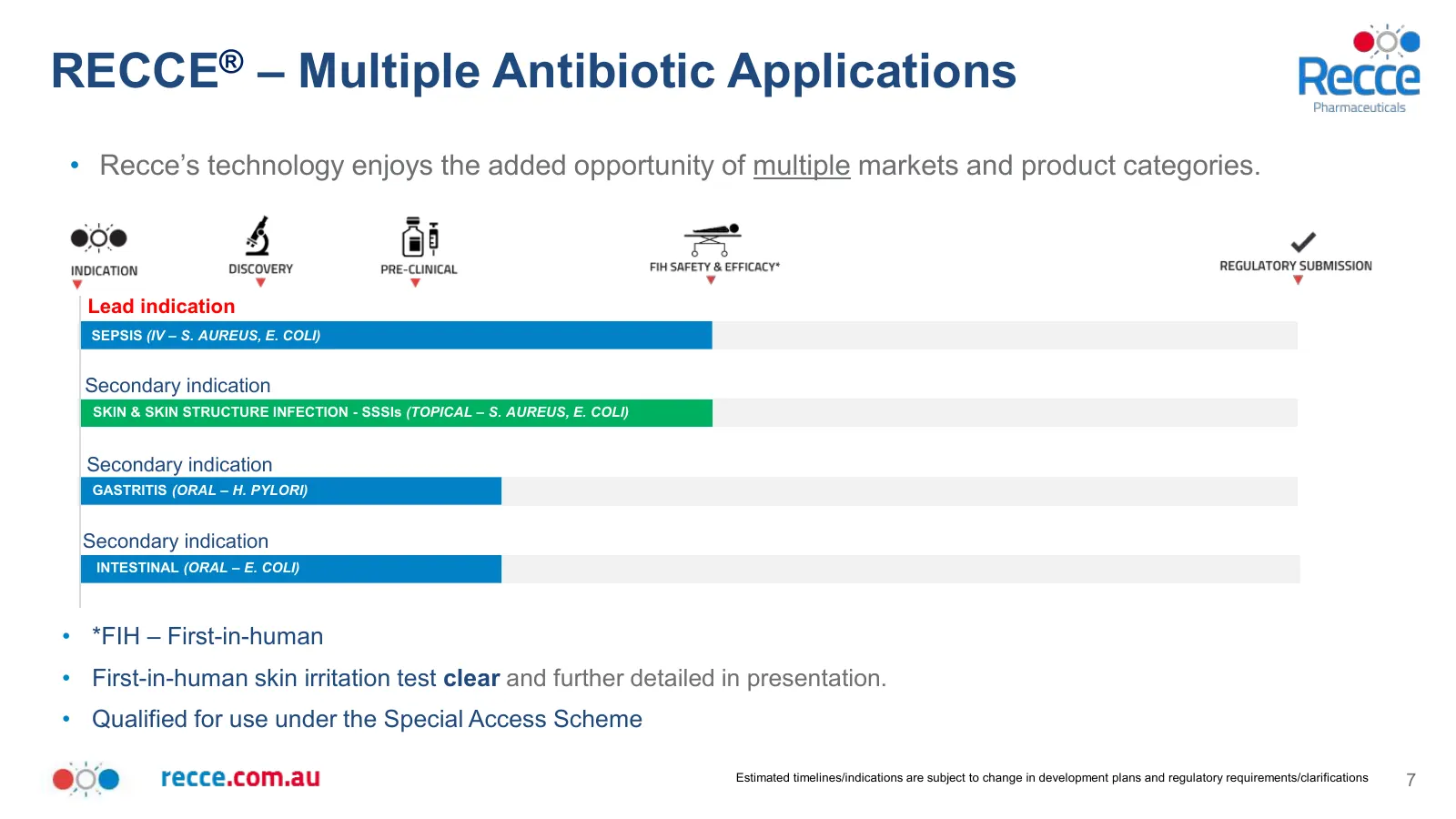
RECCE® – Multiple Antibiotic Applications • Recce’s technology enjoys the added opportunity of multiple markets and product categories. Lead indication SEPSIS (IV – S. AUREUS, E. COLI) Secondary indication SKIN & SKIN STRUCTURE INFECTION - SSSIs (TOPICAL – S. AUREUS, E. COLI) Secondary indication GA
Slide 9: RECCE® Antibiotics – Sepsis IV Curative Study
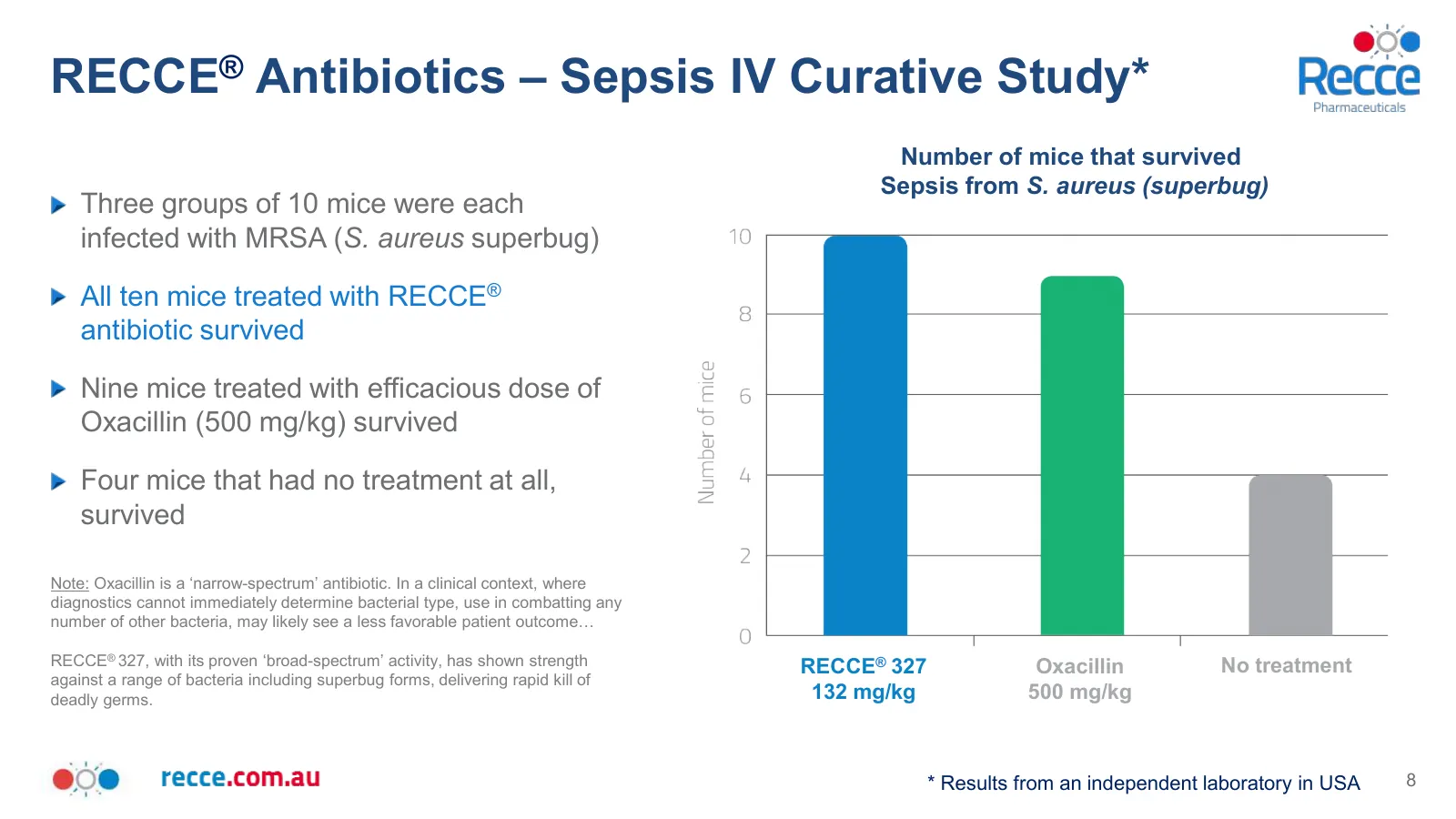
RECCE® Antibiotics – Sepsis IV Curative Study* Number of mice that survived Sepsis from S. aureus (superbug) Three groups of 10 mice were each infected with MRSA (S. aureus superbug) All ten mice treated with RECCE® antibiotic survived Nine mice treated with efficacious dose of Oxacillin (500 mg/kg)
Slide 10: RECCE® Antibiotics – Infection IV Preventative Study
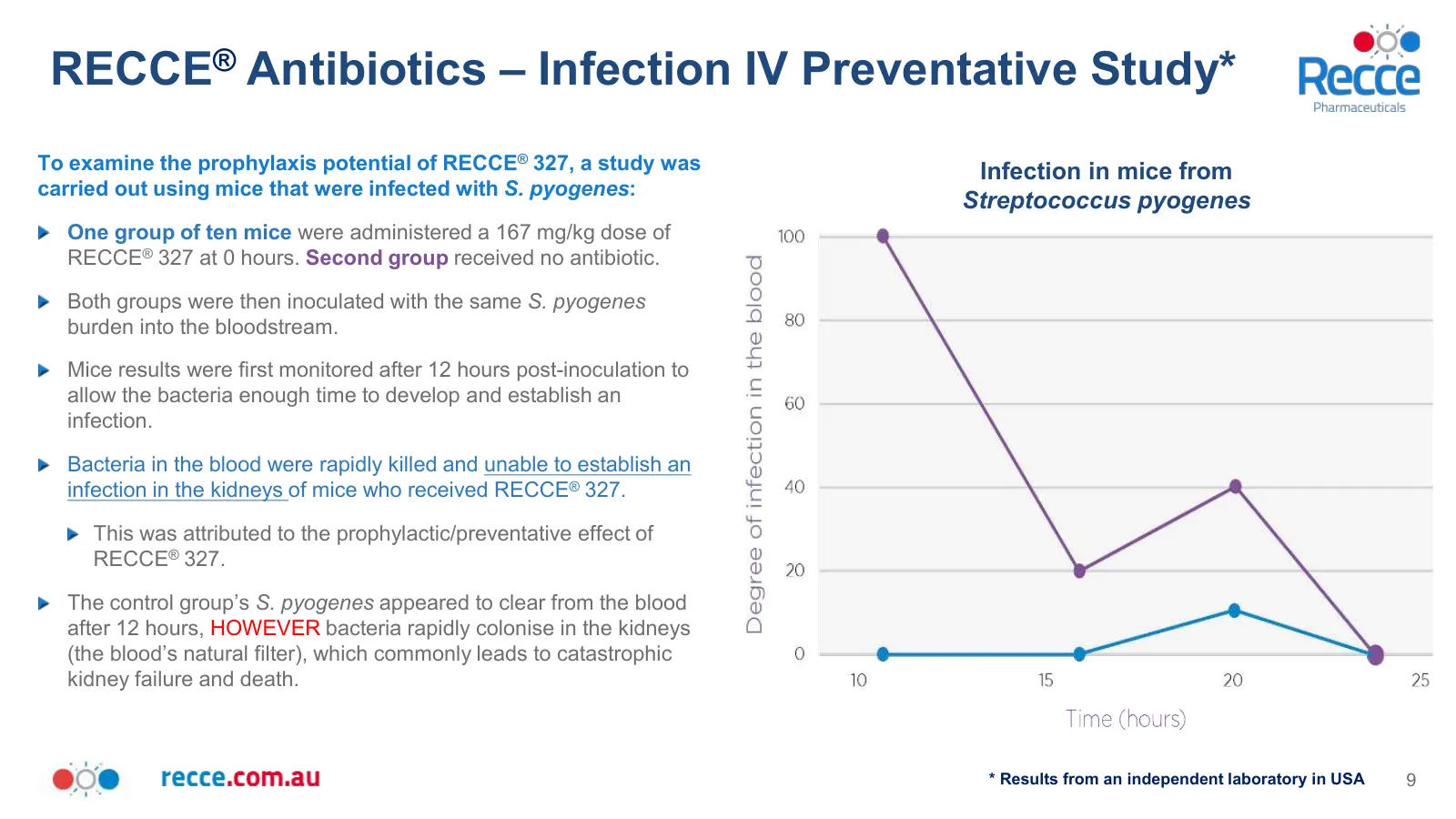
RECCE® Antibiotics – Infection IV Preventative Study* To examine the prophylaxis potential of RECCE® 327, a study was Infection in mice from carried out using mice that were infected with S. pyogenes: Streptococcus pyogenes One group of ten mice were administered a 167 mg/kg dose of RECCE® 327 at 0
Slide 11: IV Toxicity Study – Sprague Dawley Rats
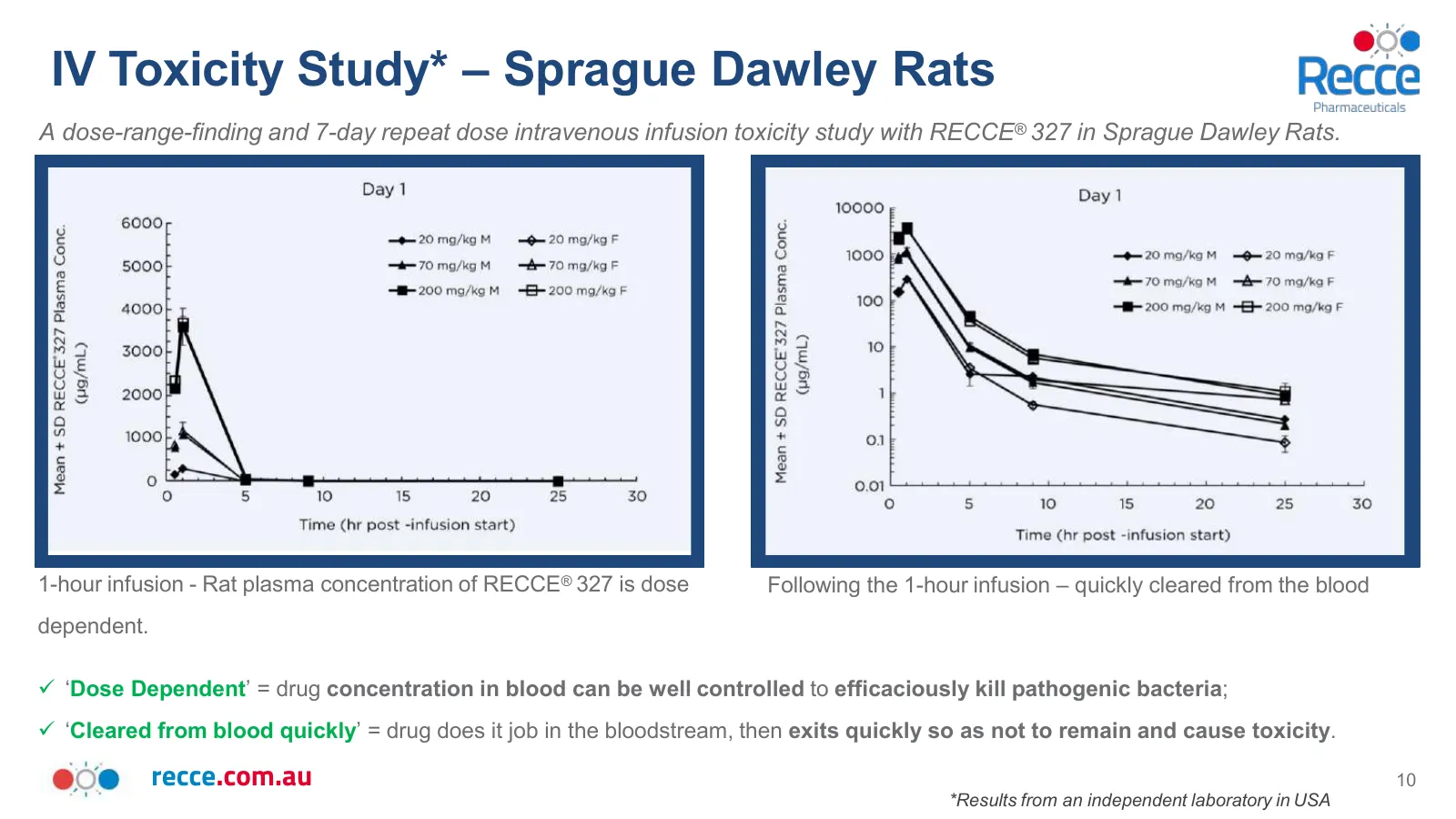
IV Toxicity Study* – Sprague Dawley Rats A dose-range-finding and 7-day repeat dose intravenous infusion toxicity study with RECCE® 327 in Sprague Dawley Rats. 1-hour infusion - Rat plasma concentration of RECCE® 327 is dose Following the 1-hour infusion – quickly cleared from the blood dependent.
Slide 12: IV Toxicity Study – Beagle Dogs
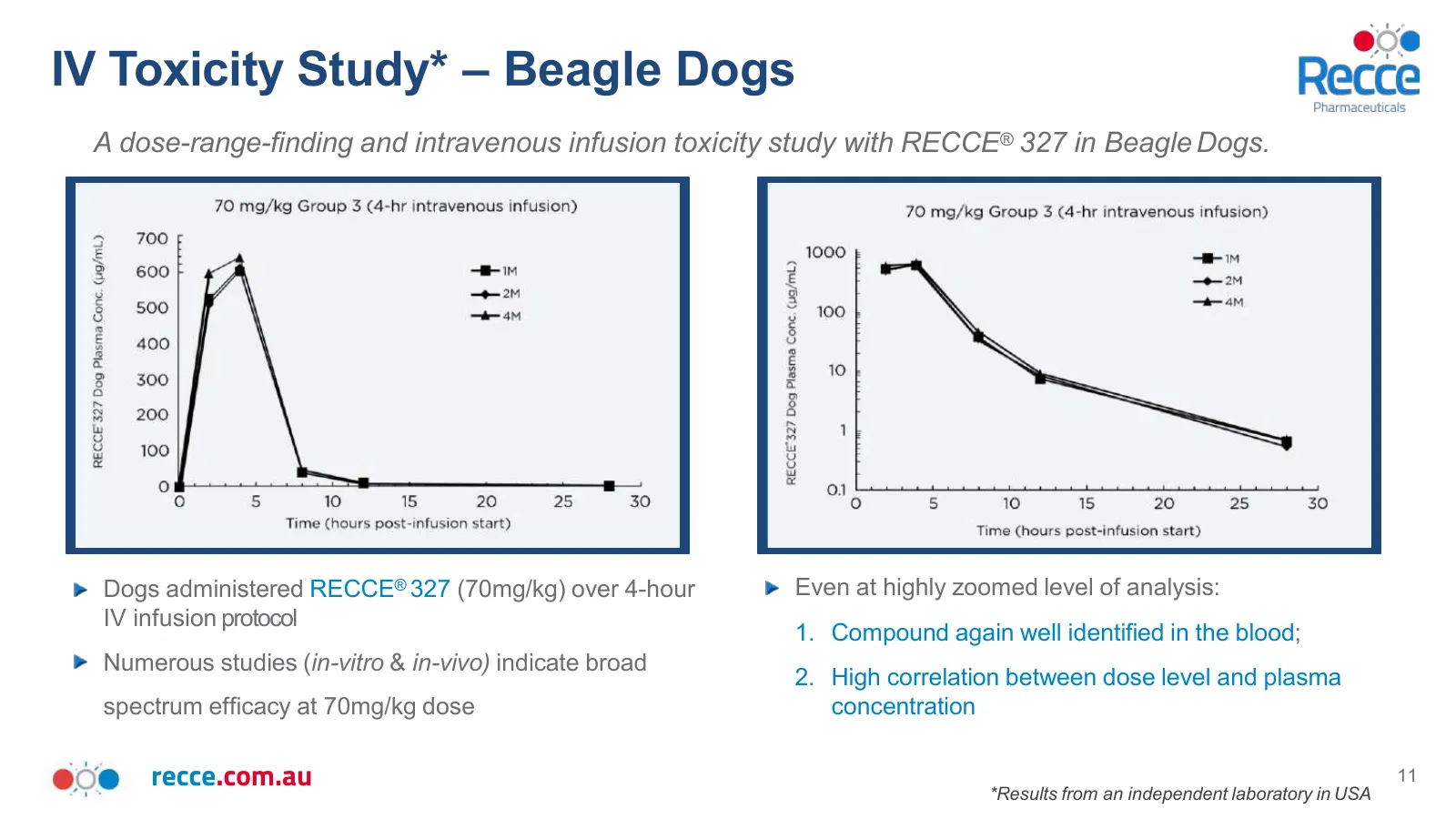
IV Toxicity Study* – Beagle Dogs A dose-range-finding and intravenous infusion toxicity study with RECCE® 327 in Beagle Dogs. Dogs administered RECCE® 327 (70mg/kg) over 4-hour Even at highly zoomed level of analysis: IV infusion protocol 1. Compound again well identified in the blood; Numerous stud
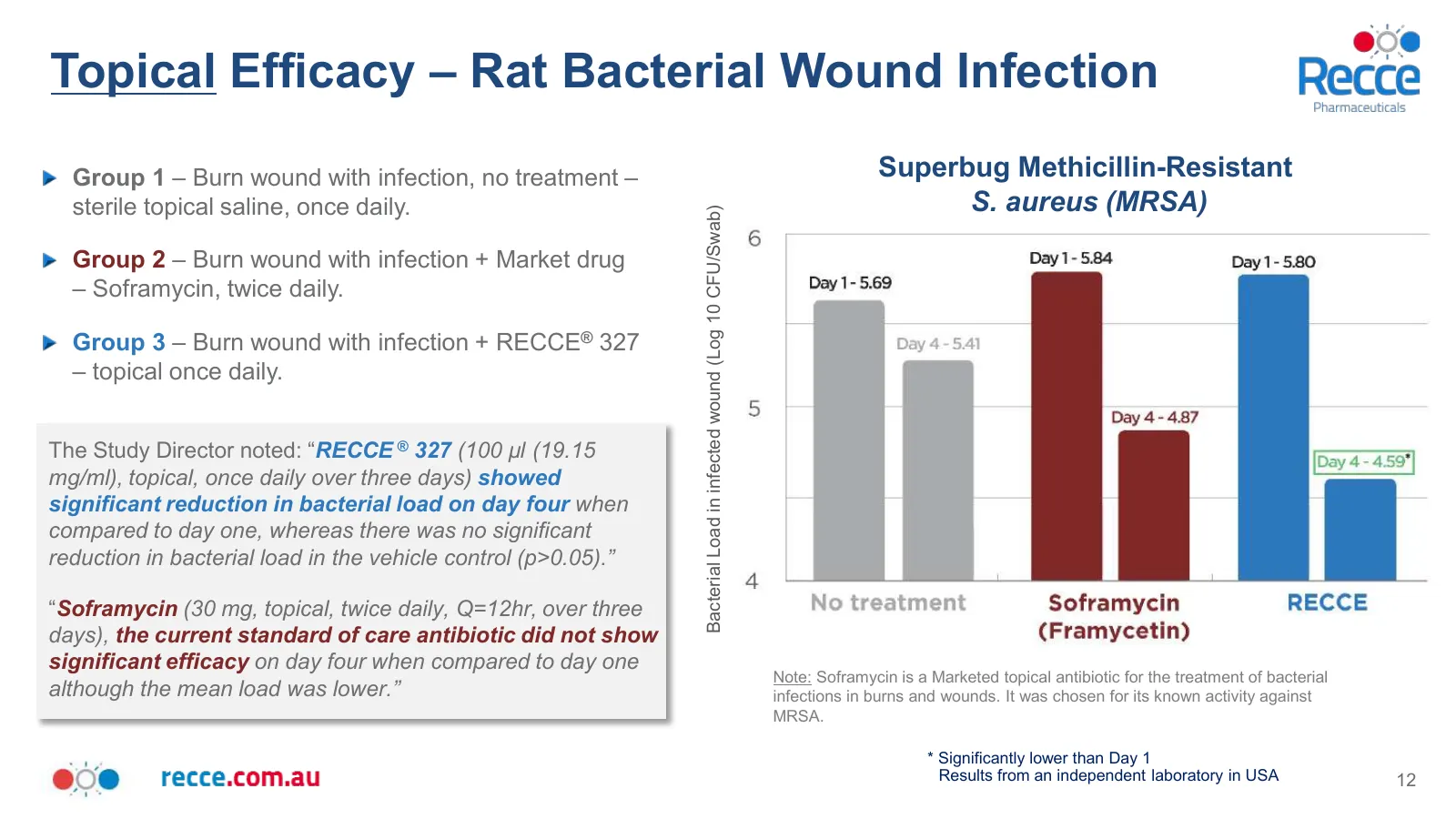
Slide 13: Topical Efficacy – Rat Bacterial Wound Infection
Topical Efficacy – Rat Bacterial Wound Infection Group 1 – Burn wound with infection, no treatment – Superbug Methicillin-Resistant sterile topical saline, once daily. S. aureus (MRSA) Bacterial Load in infected wound (Log 10 CFU/Swab) Group 2 – Burn wound with infection + Market drug – Soframycin,
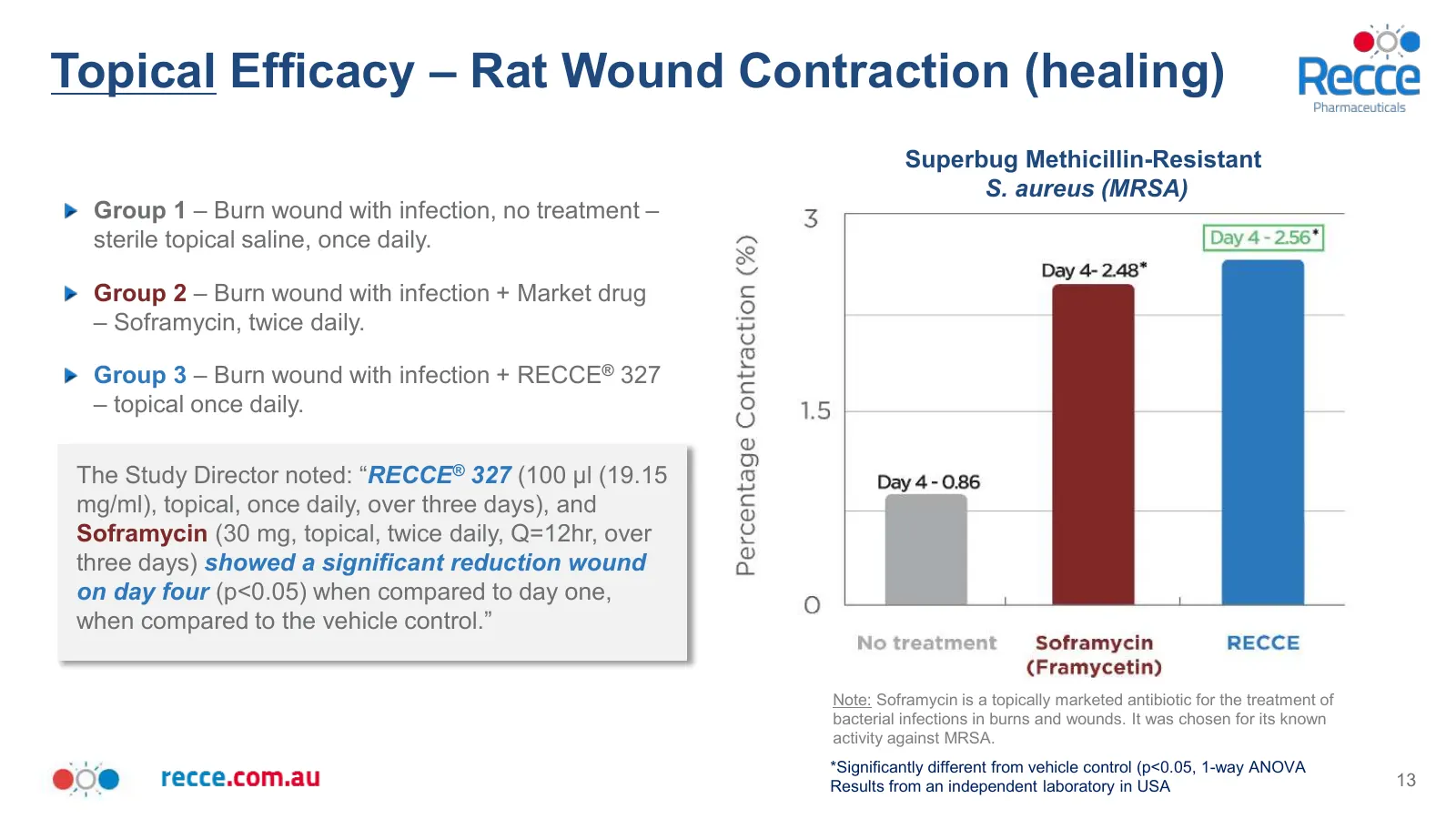
Slide 14: Topical Efficacy – Rat Wound Contraction (healing)
Topical Efficacy – Rat Wound Contraction (healing) Superbug Methicillin-Resistant S. aureus (MRSA) Group 1 – Burn wound with infection, no treatment – sterile topical saline, once daily. Group 2 – Burn wound with infection + Market drug – Soframycin, twice daily. Group 3 – Burn wound with infection
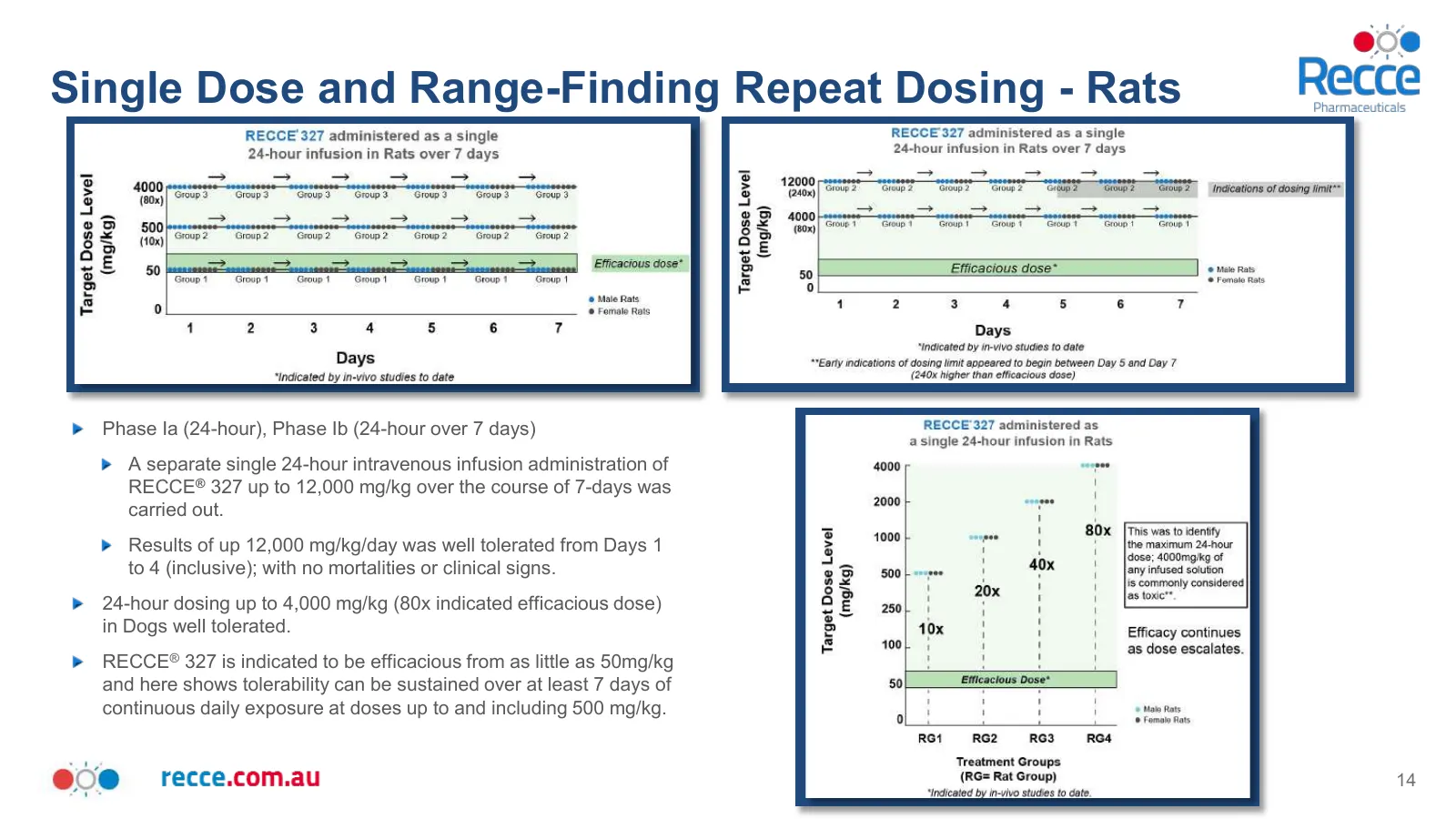
Slide 15: Single Dose and Range-Finding Repeat Dosing - Rats
Single Dose and Range-Finding Repeat Dosing - Rats Phase Ia (24-hour), Phase Ib (24-hour over 7 days) A separate single 24-hour intravenous infusion administration of RECCE® 327 up to 12,000 mg/kg over the course of 7-days was carried out. Results of up 12,000 mg/kg/day was well tolerated from Days
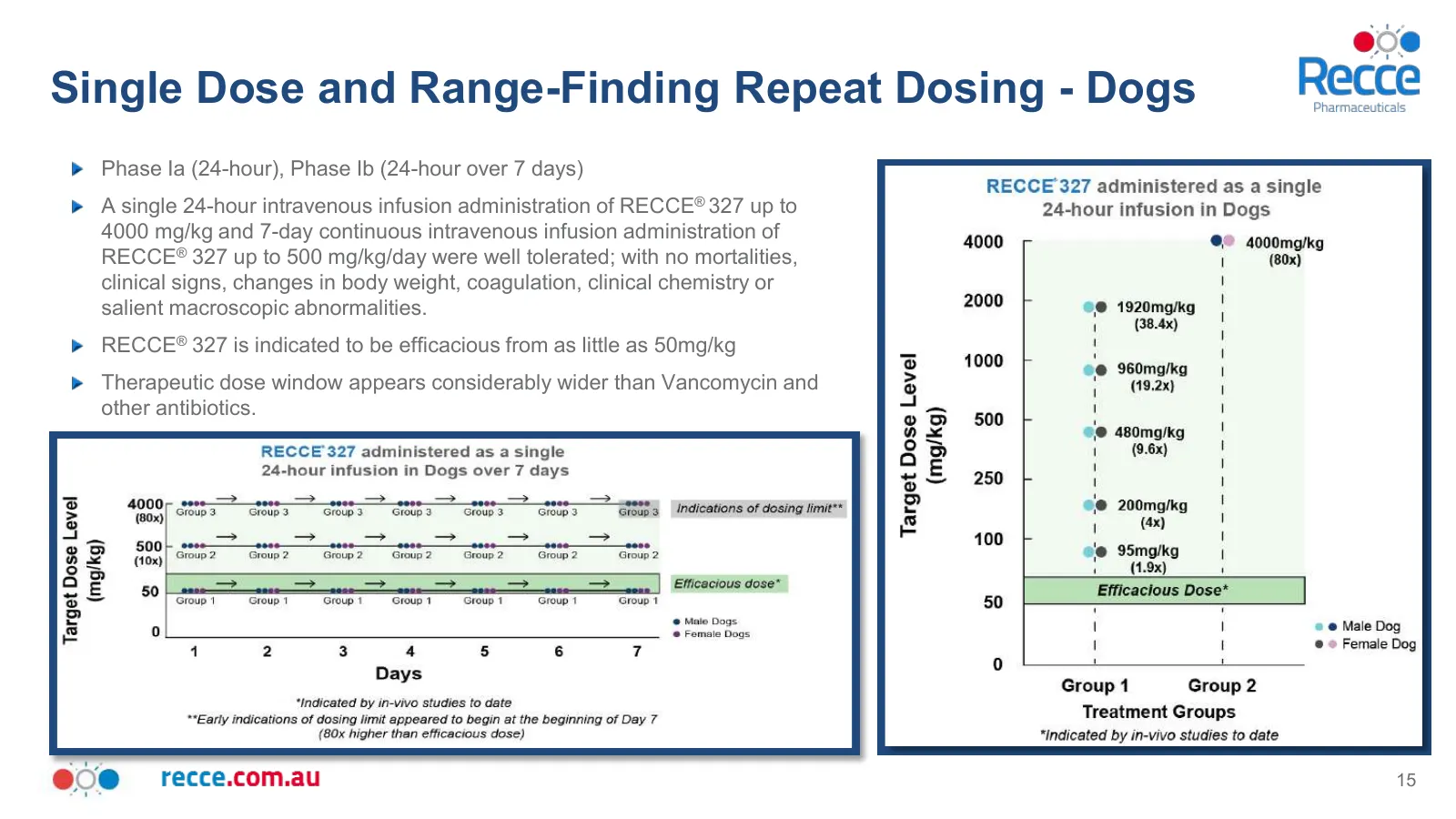
Slide 16: Single Dose and Range-Finding Repeat Dosing - Dogs
Single Dose and Range-Finding Repeat Dosing - Dogs Phase Ia (24-hour), Phase Ib (24-hour over 7 days) A single 24-hour intravenous infusion administration of RECCE® 327 up to 4000 mg/kg and 7-day continuous intravenous infusion administration of RECCE® 327 up to 500 mg/kg/day were well tolerated; wi
Slide 17: Human Clinical Skin Irritation Test
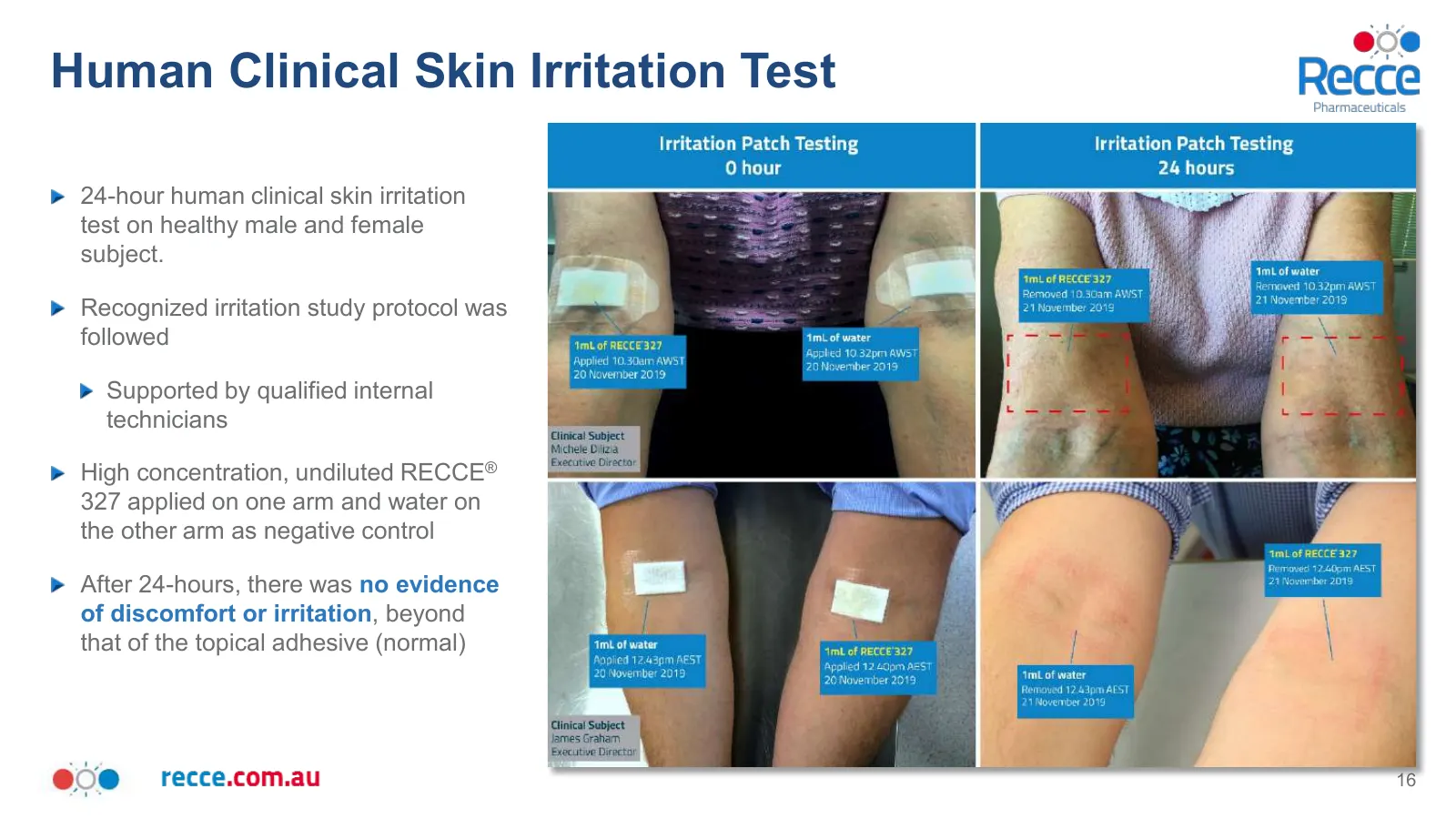
Human Clinical Skin Irritation Test 24-hour human clinical skin irritation test on healthy male and female subject. Recognized irritation study protocol was followed Supported by qualified internal technicians High concentration, undiluted RECCE® 327 applied on one arm and water on the other arm as
Slide 18: RECCE® antibiotics kill at practical speeds
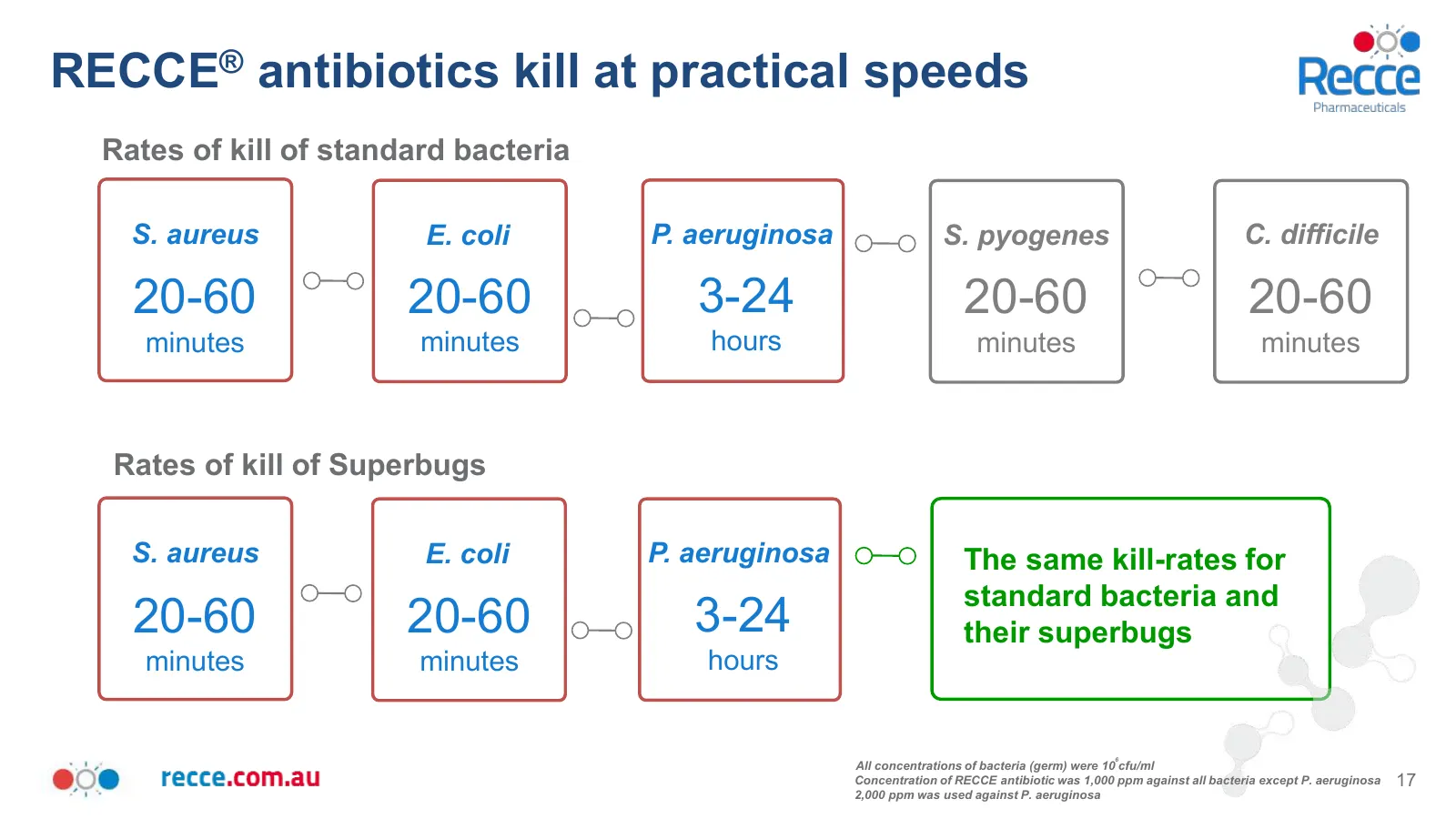
RECCE® antibiotics kill at practical speeds Rates of kill of standard bacteria S. aureus E. coli P. aeruginosa S. pyogenes C. difficile 20-60 20-60 3-24 20-60 20-60 minutes minutes hours minutes minutes Rates of kill of Superbugs S. aureus E. coli P. aeruginosa The same kill-rates for standard bacte
Slide 19: RECCE® antibiotics do not Fail
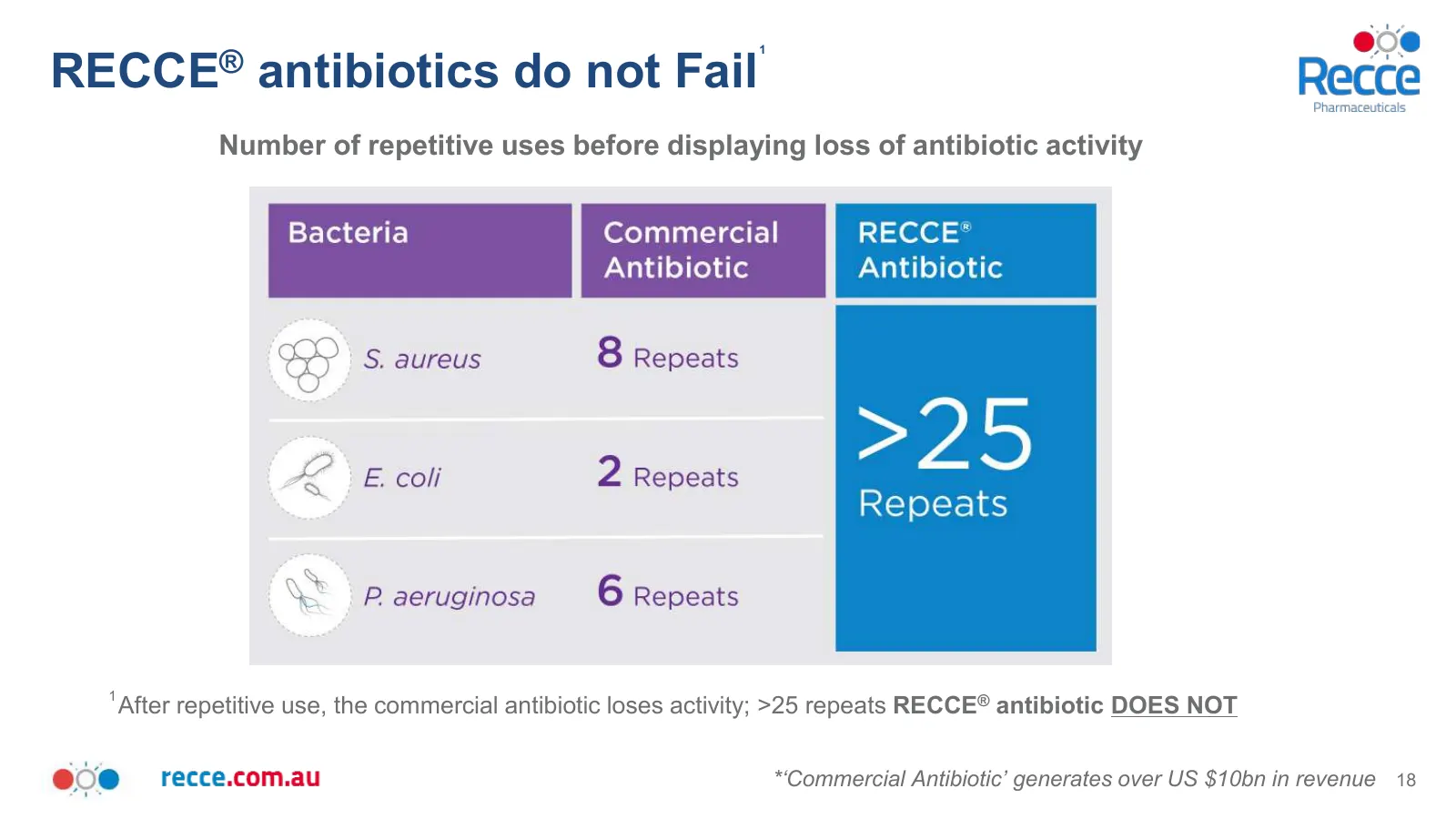
RECCE® antibiotics do not Fail 1 Number of repetitive uses before displaying loss of antibiotic activity 1 After repetitive use, the commercial antibiotic loses activity; >25 repeats RECCE® antibiotic DOES NOT *‘Commercial Antibiotic’ generates over US $10bn in revenue 18
Slide 20: How Existing Antibiotics Become Resistant
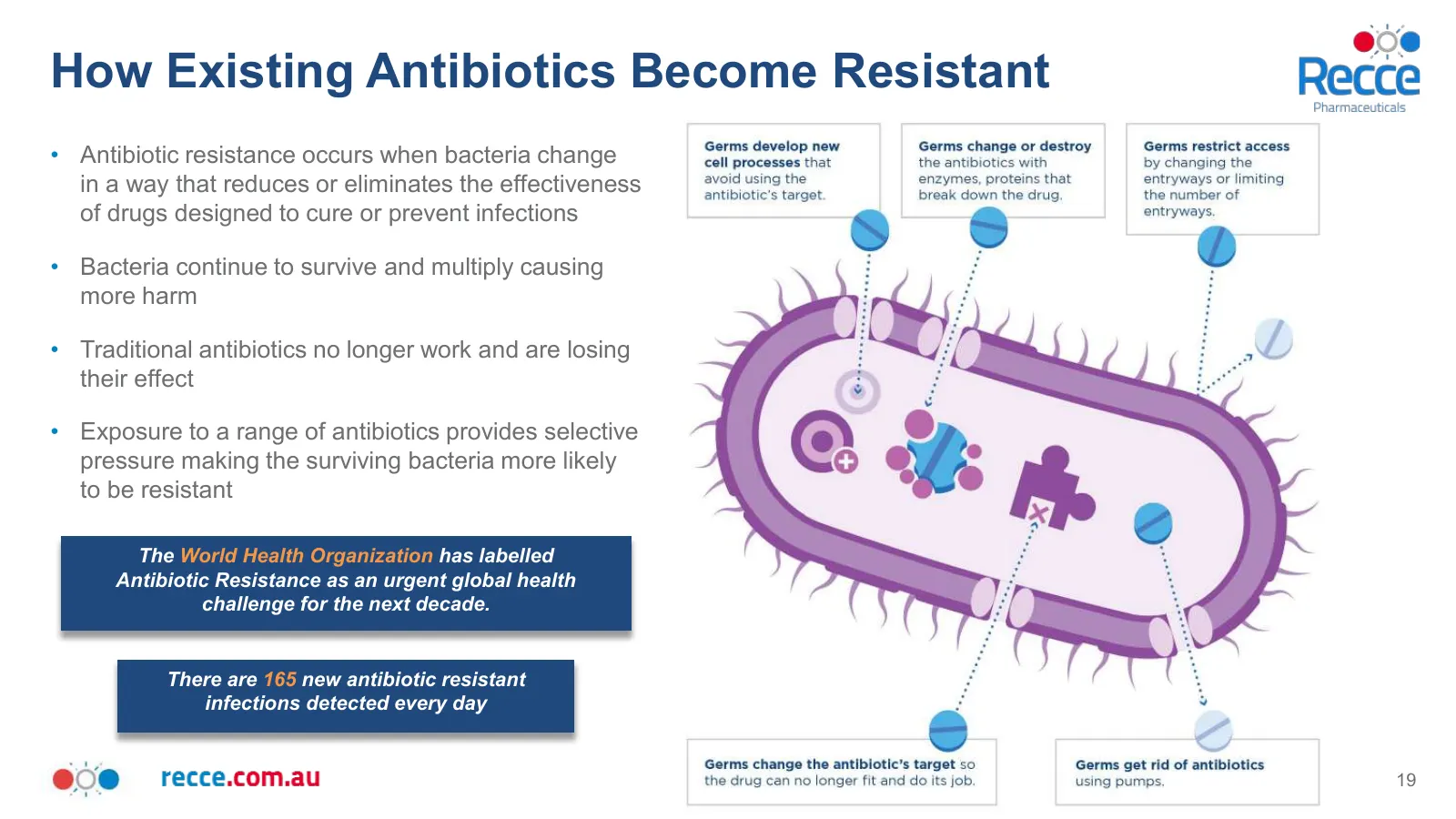
How Existing Antibiotics Become Resistant • Antibiotic resistance occurs when bacteria change in a way that reduces or eliminates the effectiveness of drugs designed to cure or prevent infections • Bacteria continue to survive and multiply causing more harm • Traditional antibiotics no longer work a
Slide 21: RECCE® – how it works (in more detail)
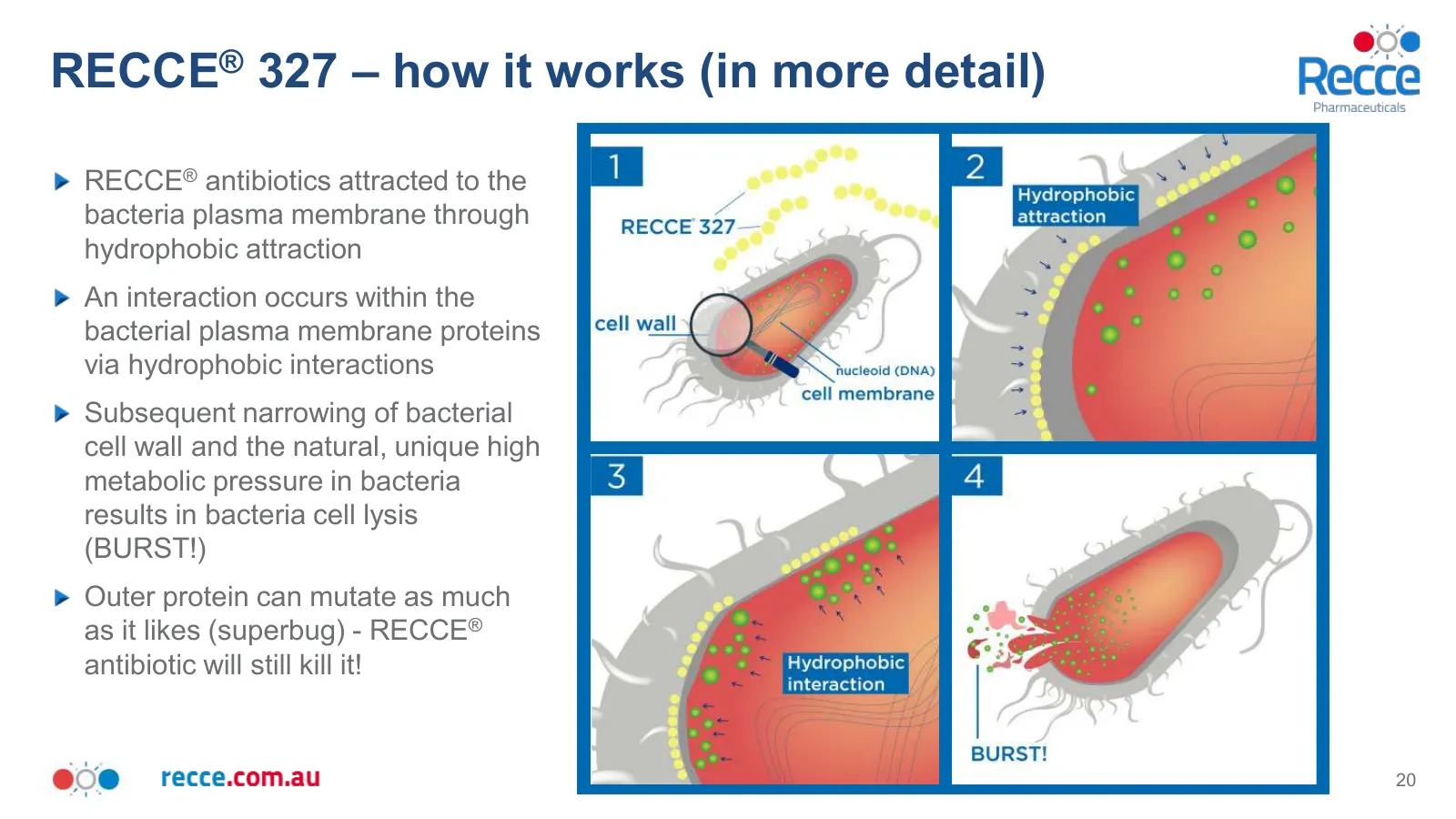
RECCE® 327 – how it works (in more detail) RECCE® antibiotics attracted to the bacteria plasma membrane through hydrophobic attraction An interaction occurs within the bacterial plasma membrane proteins via hydrophobic interactions Subsequent narrowing of bacterial cell wall and the natural, unique
Slide 22: RECCE® Mechanism of Action in practice
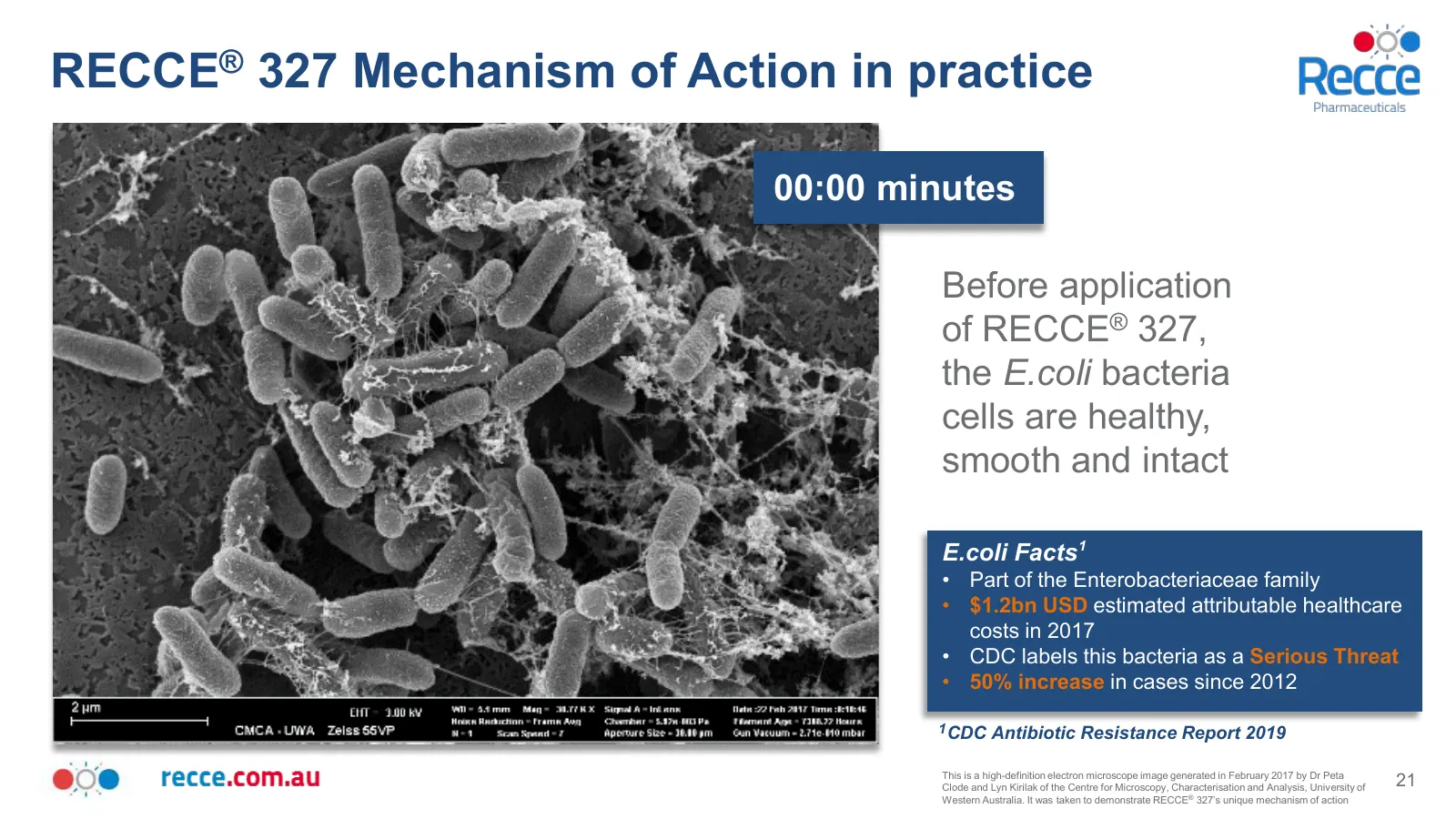
RECCE® 327 Mechanism of Action in practice 00:00 minutes Before application of RECCE® 327, the E.coli bacteria cells are healthy, smooth and intact E.coli Facts 1 • Part of the Enterobacteriaceae family • $1.2bn USD estimated attributable healthcare costs in 2017 • CDC labels this bacteria as a Seri
Slide 23: RECCE® Mechanism of Action in practice
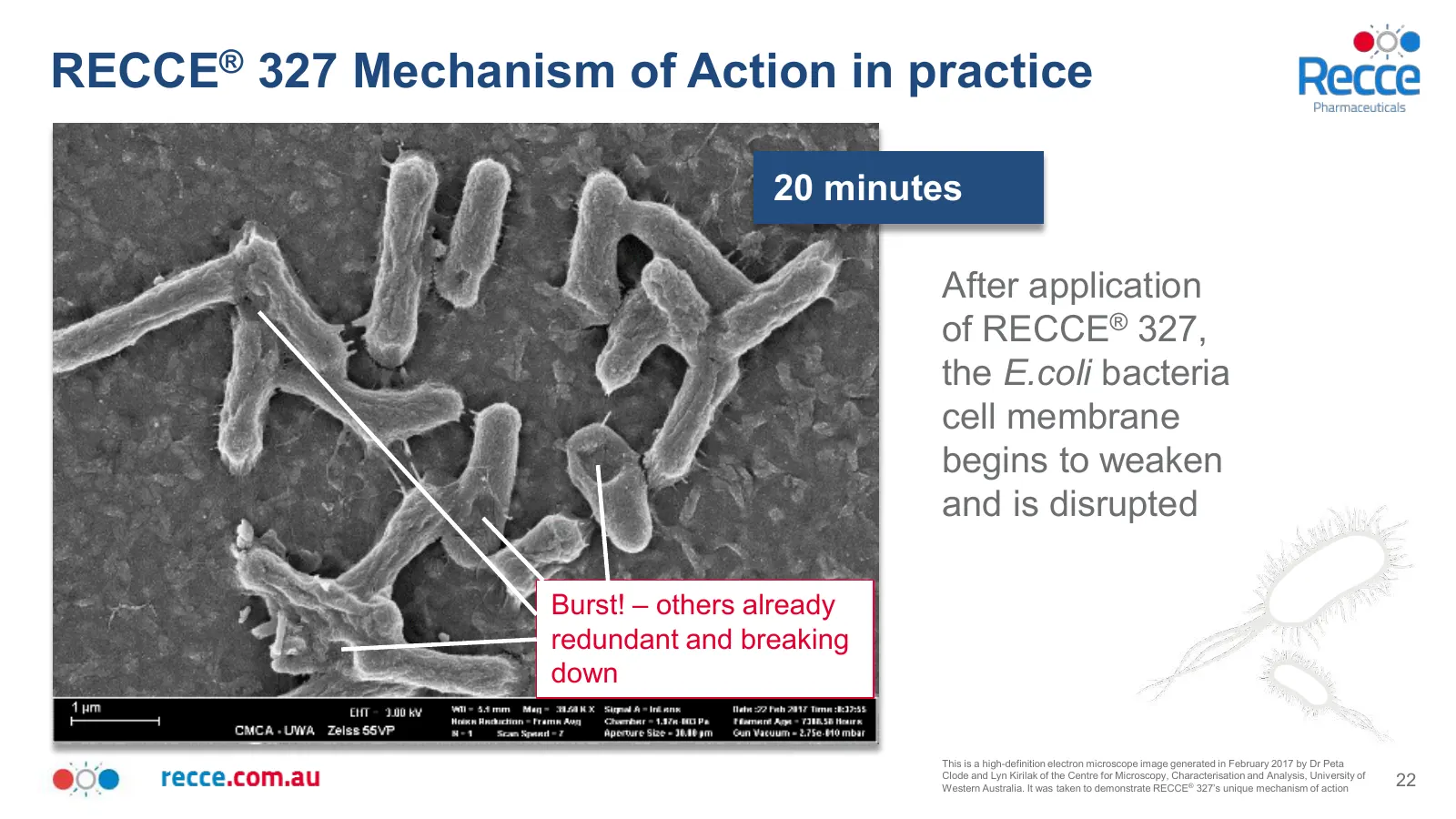
RECCE® 327 Mechanism of Action in practice 20 minutes After application of RECCE® 327, the E.coli bacteria cell membrane begins to weaken and is disrupted Burst! – others already redundant and breaking down This is a high-definition electron microscope image generated in February 2017 by Dr Peta Clo
Slide 24: RECCE® Mechanism of Action in practice
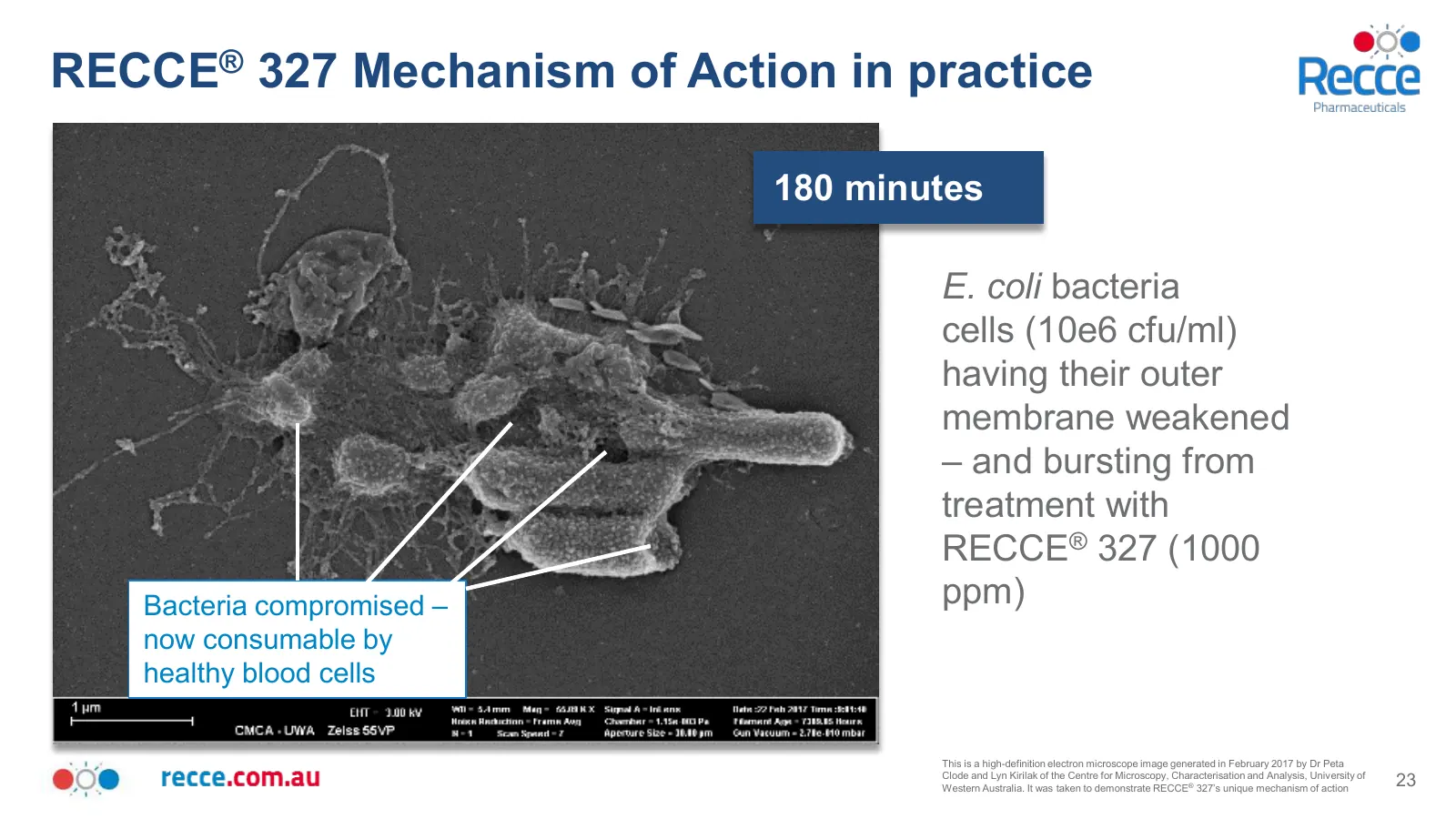
RECCE® 327 Mechanism of Action in practice 180 minutes E. coli bacteria cells (10e6 cfu/ml) having their outer membrane weakened – and bursting from treatment with RECCE® 327 (1000 Bacteria compromised – ppm) now consumable by healthy blood cells This is a high-definition electron microscope image g
Slide 25: New Antibiotic Checklist – Snapshot for RECCE®
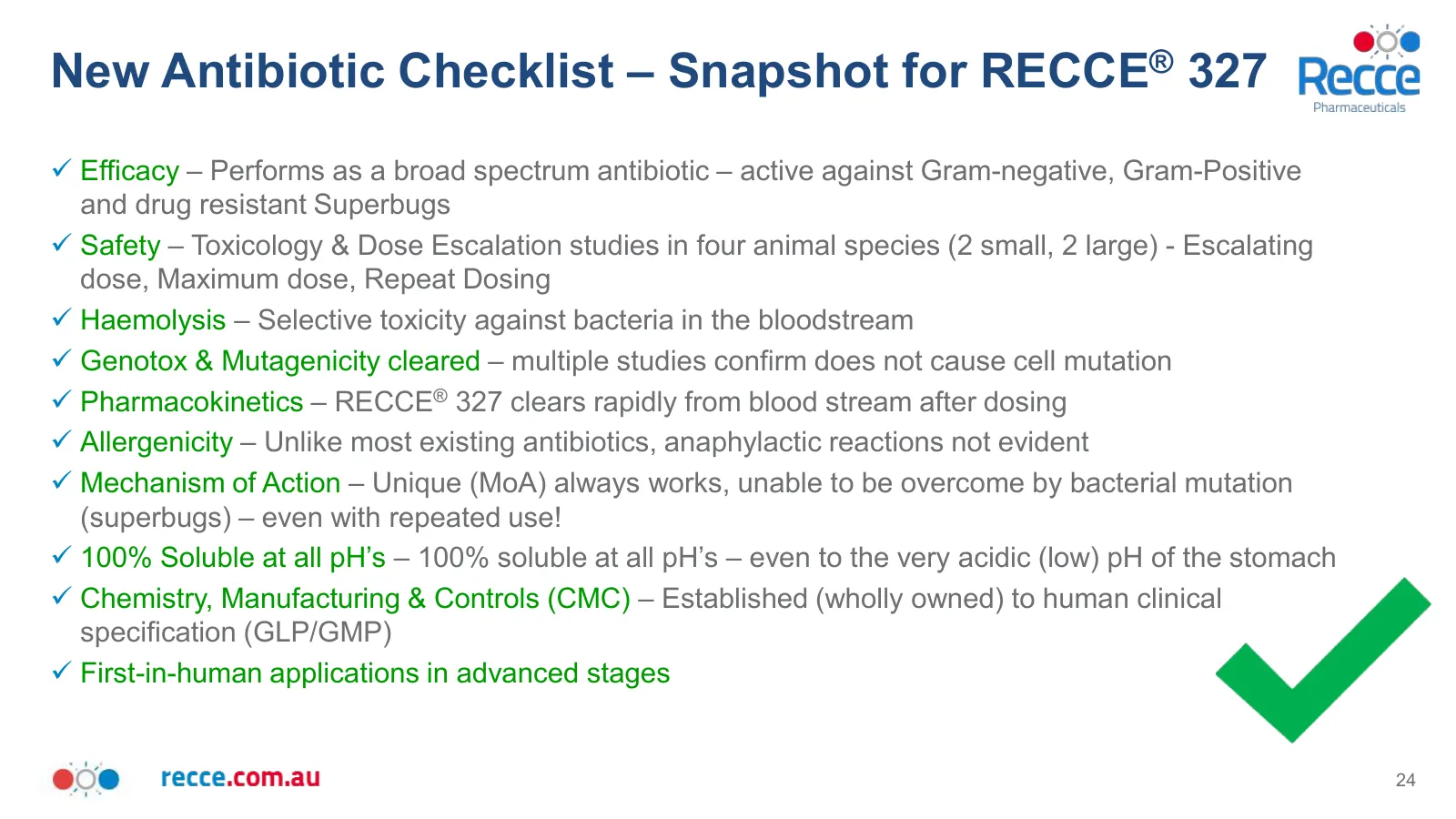
New Antibiotic Checklist – Snapshot for RECCE® 327 Efficacy – Performs as a broad spectrum antibiotic – active against Gram-negative, Gram-Positive and drug resistant Superbugs Safety – Toxicology & Dose Escalation studies in four animal species (2 small, 2 large) - Escalating dose, Maximum dose
Slide 26: What is Qualified Infectious Disease Product?
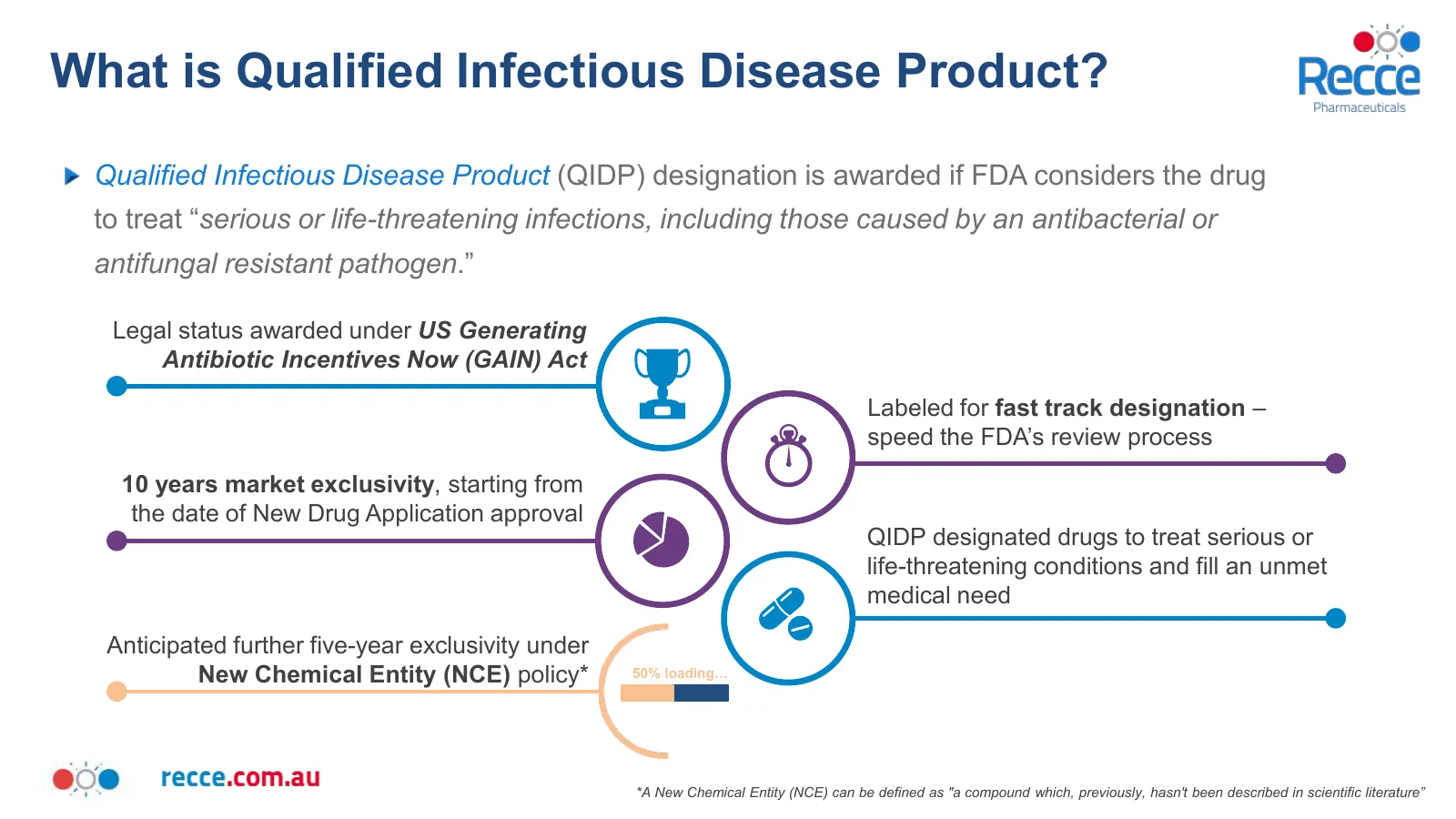
What is Qualified Infectious Disease Product? Qualified Infectious Disease Product (QIDP) designation is awarded if FDA considers the drug to treat “serious or life-threatening infections, including those caused by an antibacterial or antifungal resistant pathogen.” Legal status awarded under US Gen
Slide 27: Patents and trademarks
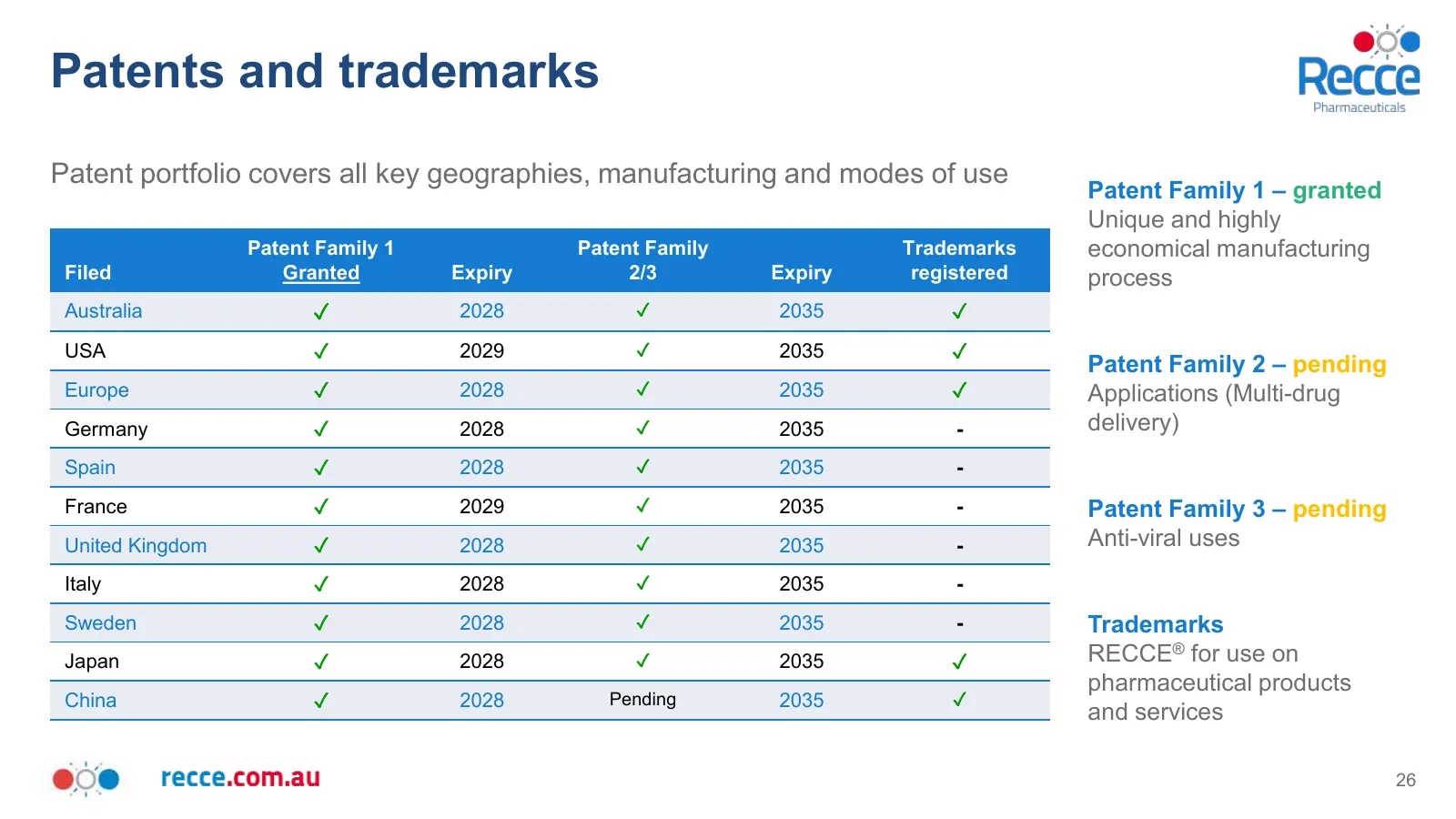
Patents and trademarks Patent portfolio covers all key geographies, manufacturing and modes of use Patent Family 1 – granted Unique and highly Patent Family 1 Patent Family Trademarks economical manufacturing Filed Granted Expiry 2/3 Expiry registered process Australia ✓ 2028 ✓ 2035 ✓ USA ✓ 2029 ✓ 2
Slide 28: Manufacturing and Production
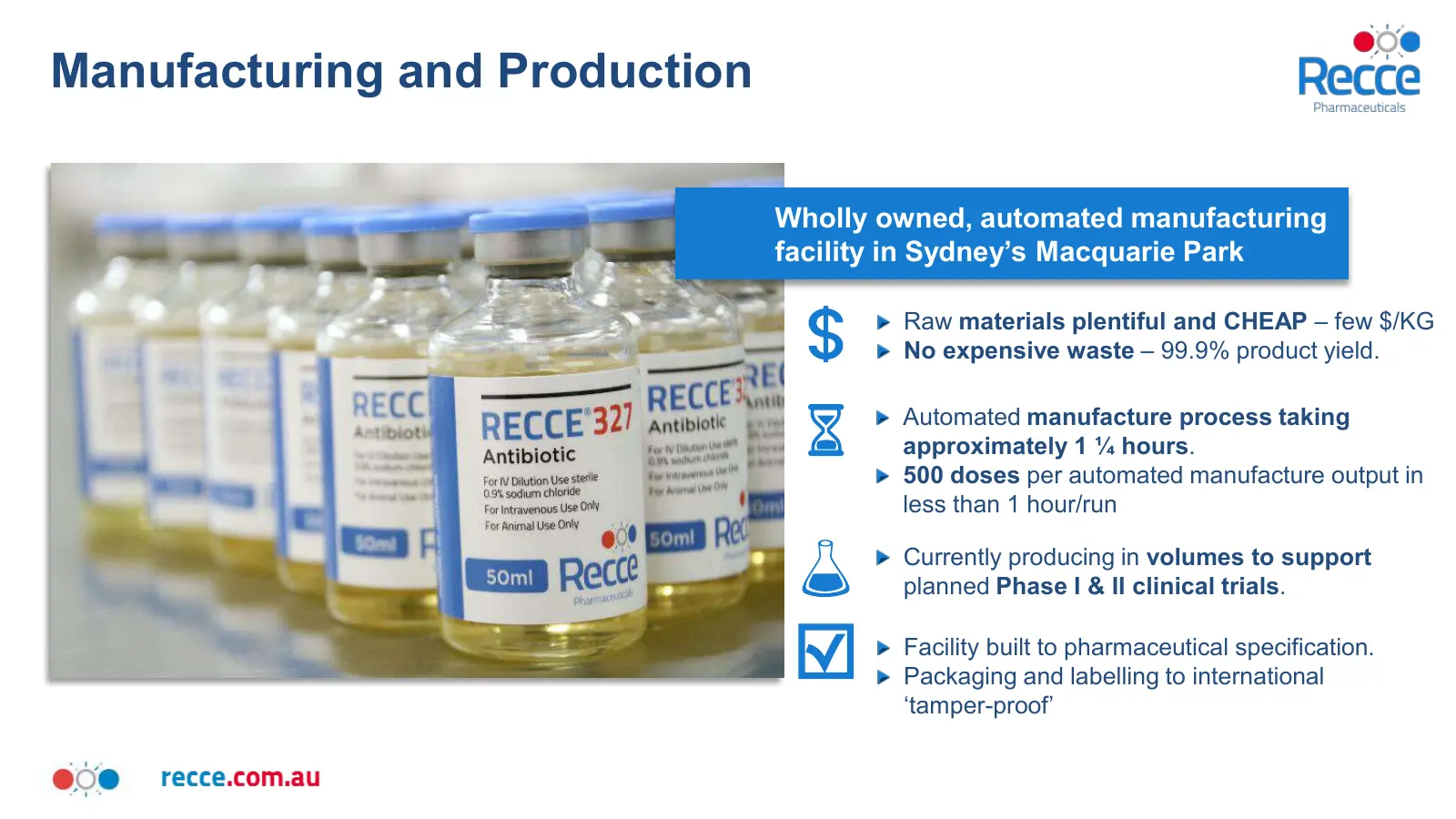
Manufacturing and Production Wholly owned, automated manufacturing facility in Sydney’s Macquarie Park Raw materials plentiful and CHEAP – few $/KG No expensive waste – 99.9% product yield. Automated manufacture process taking approximately 1 ¼ hours. 500 doses per automated manufacture output in le
Slide 29: Board and management structure
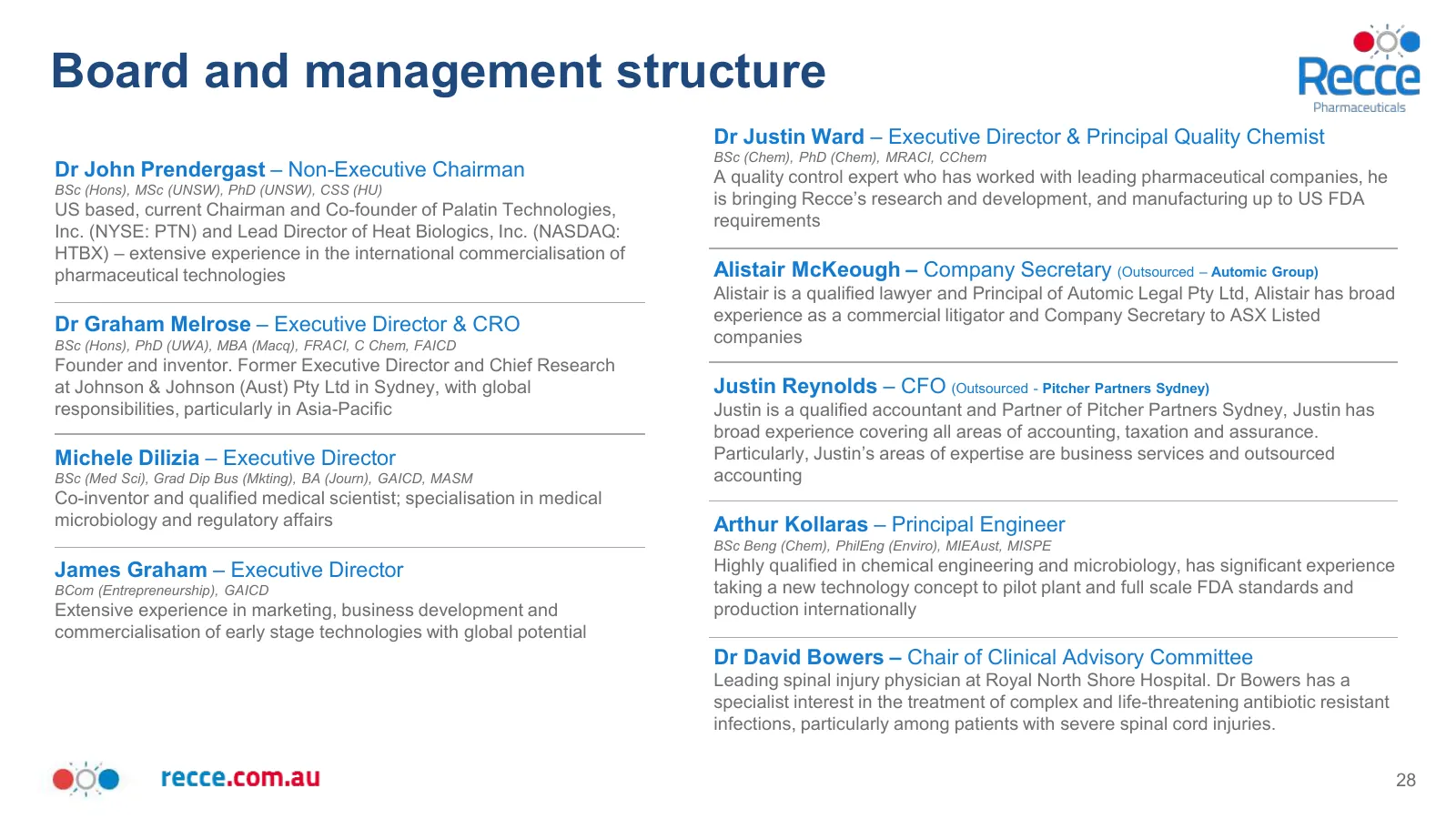
Board and management structure Dr Justin Ward – Executive Director & Principal Quality Chemist BSc (Chem), PhD (Chem), MRACI, CChem Dr John Prendergast – Non-Executive Chairman A quality control expert who has worked with leading pharmaceutical companies, he BSc (Hons), MSc (UNSW), PhD (UNSW), CSS (
Slide 30: TGA Special Access Scheme
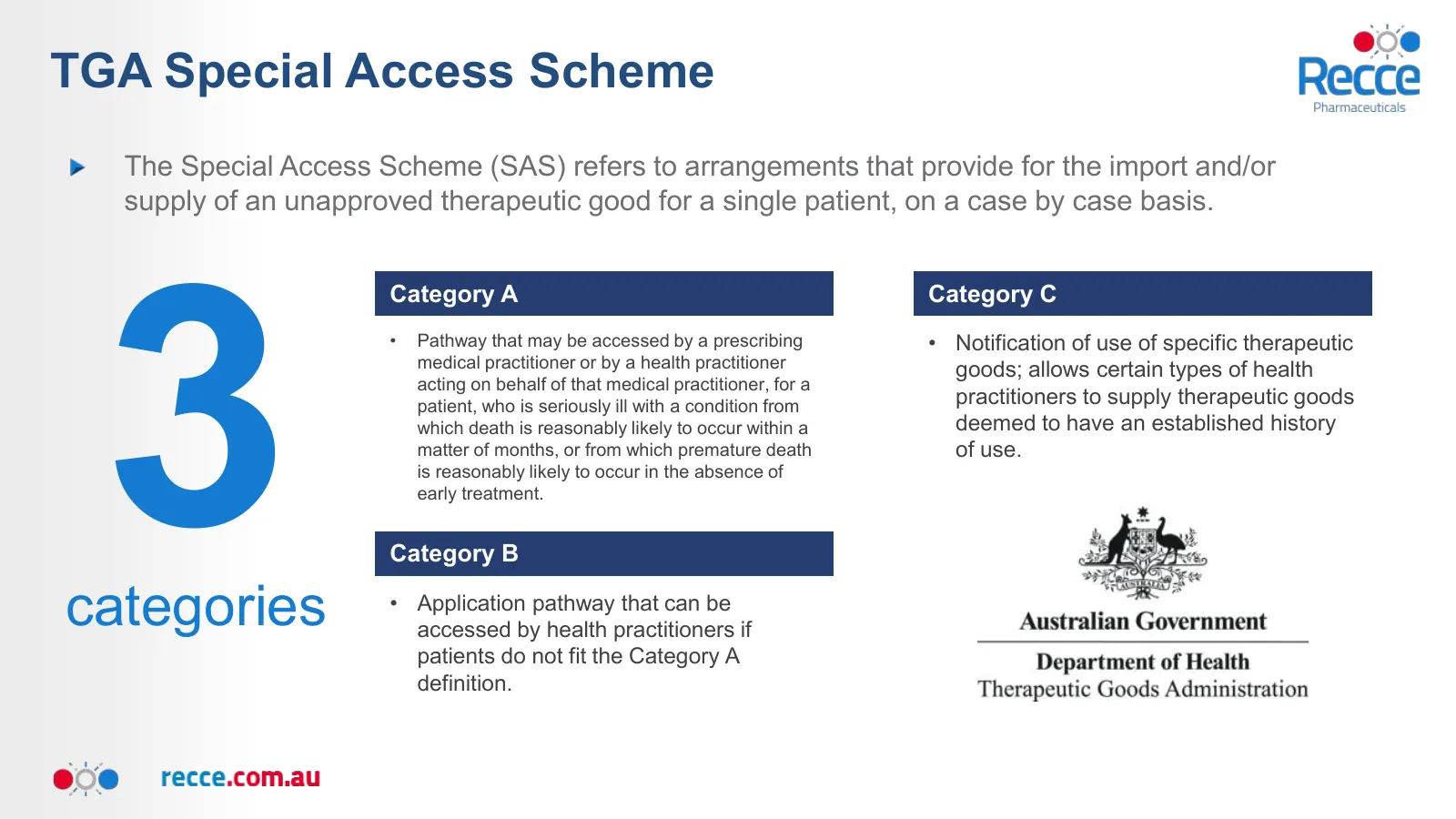
TGA Special Access Scheme The Special Access Scheme (SAS) refers to arrangements that provide for the import and/or 3 supply of an unapproved therapeutic good for a single patient, on a case by case basis. Category A Category C • Pathway that may be accessed by a prescribing • Notification of use of
Slide 31: Investment summary
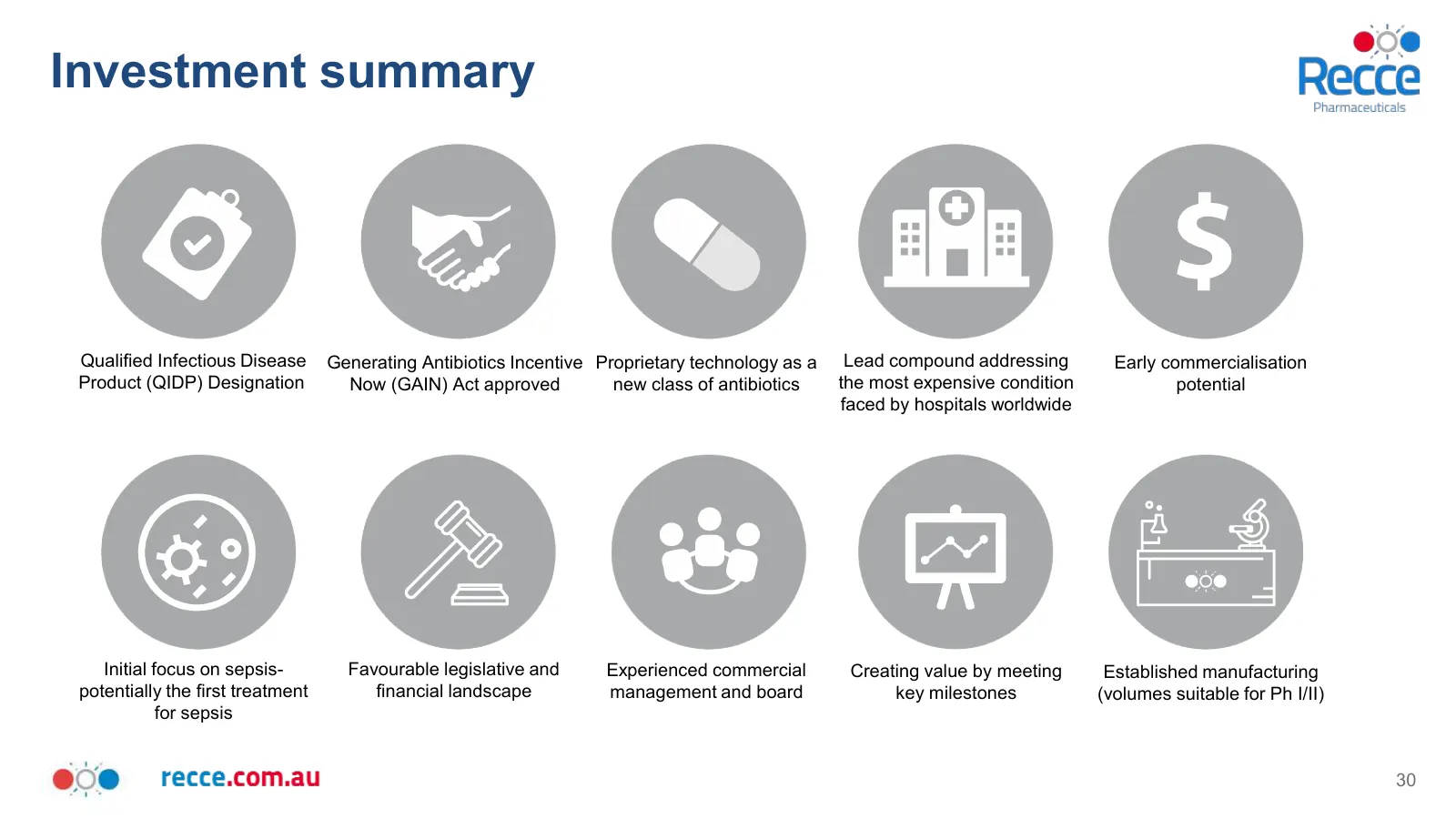
Investment summary Qualified Infectious Disease Generating Antibiotics Incentive Proprietary technology as a Lead compound addressing Early commercialisation Product (QIDP) Designation Now (GAIN) Act approved new class of antibiotics the most expensive condition potential faced by hospitals worldwid

Slide 32: Thank you
Thank you James Graham Executive Director – Recce Pharmaceuticals +61 2 8075 4585 +61 431 978 682 james.graham@recce.com.au recce.com.au
Source: Internet Archive copy of recce.com.au
More decks from Recce Pharmaceuticals Ltd.
 Shareholder Meeting (November 2026)19 slides · Nov 6, 2026
 Investor Presentation (November 2026)45 slides · November 2026
 Investor Presentation (October 2026)42 slides · October 2026
 Shareholder Meeting (September 2026)10 slides · Sep 2, 2026
 Investor Presentation (September 2026)42 slides · September 2026
 Investor Presentation (August 2026)40 slides · August 2026