Nuvation Bio Inc. · NYSE:NUVB
Nuvation Bio — Investor Presentation (October 2024)
40 slides from Nuvation Bio's investor presentation, October 2024
Slide 1: Driven by Science, Focused on Life
DRIVEN BY SCIENCE FOCUSED ON LIFE October 2024
Slide 2: Forward looking statements
Forward looking statements Certain statements included in this presentation (this “Presentation”) that are not historical facts are forward-looking statements for purposes of the safe harbor provisions under the United States Private Securities Litigation Reform Act of 1995. Forward-looking statemen
Slide 3: Nuvation Bio is tackling some of the greatest unmet needs in oncology
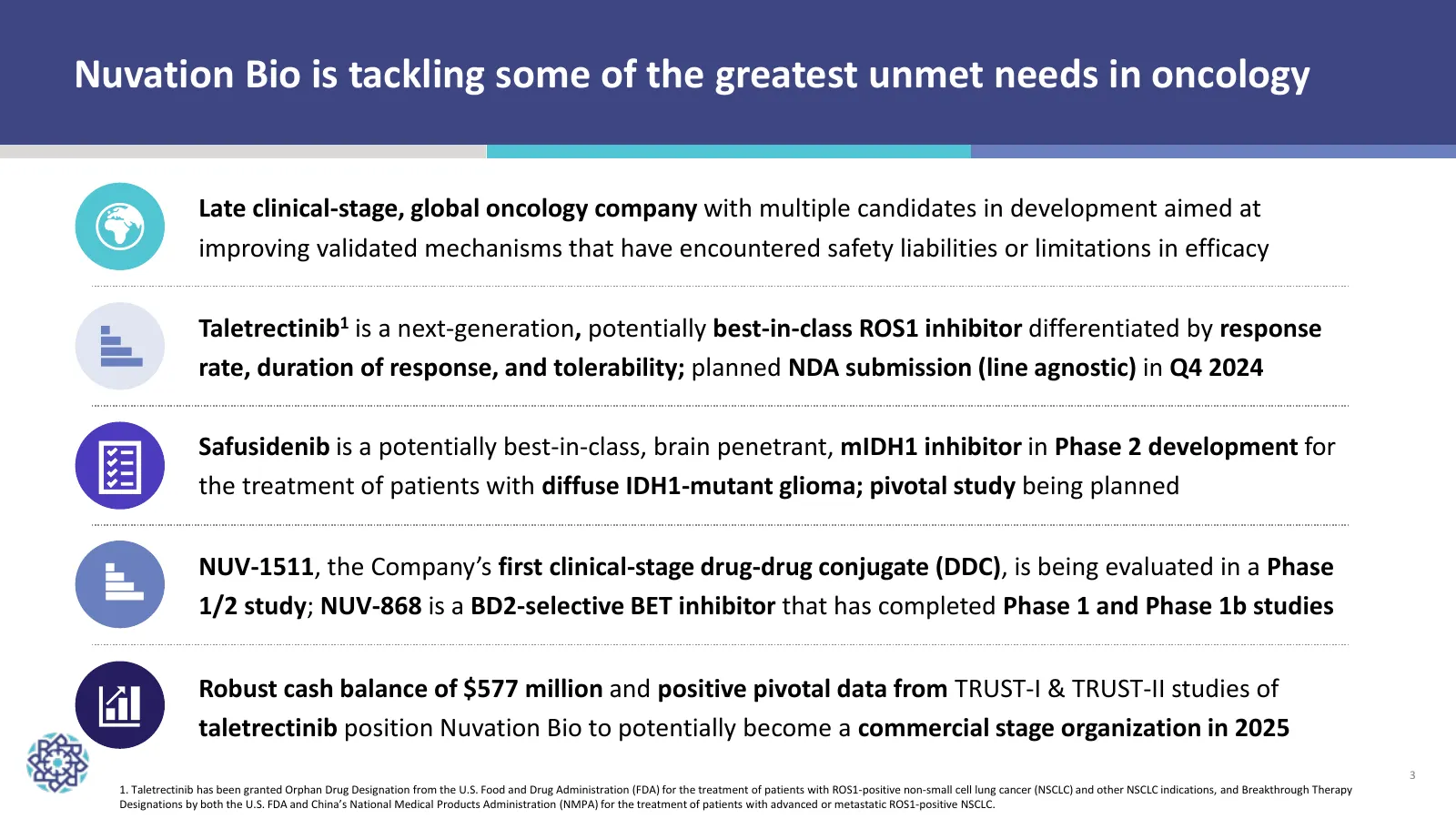
Nuvation Bio is tackling some of the greatest unmet needs in oncology Late clinical-stage, global oncology company with multiple candidates in development aimed at improving validated mechanisms that have encountered safety liabilities or limitations in efficacy Taletrectinib1 is a next-generation,
Slide 4: Nuvation Bio is developing a broad pipeline of differentiated and novel therapeutic candidates
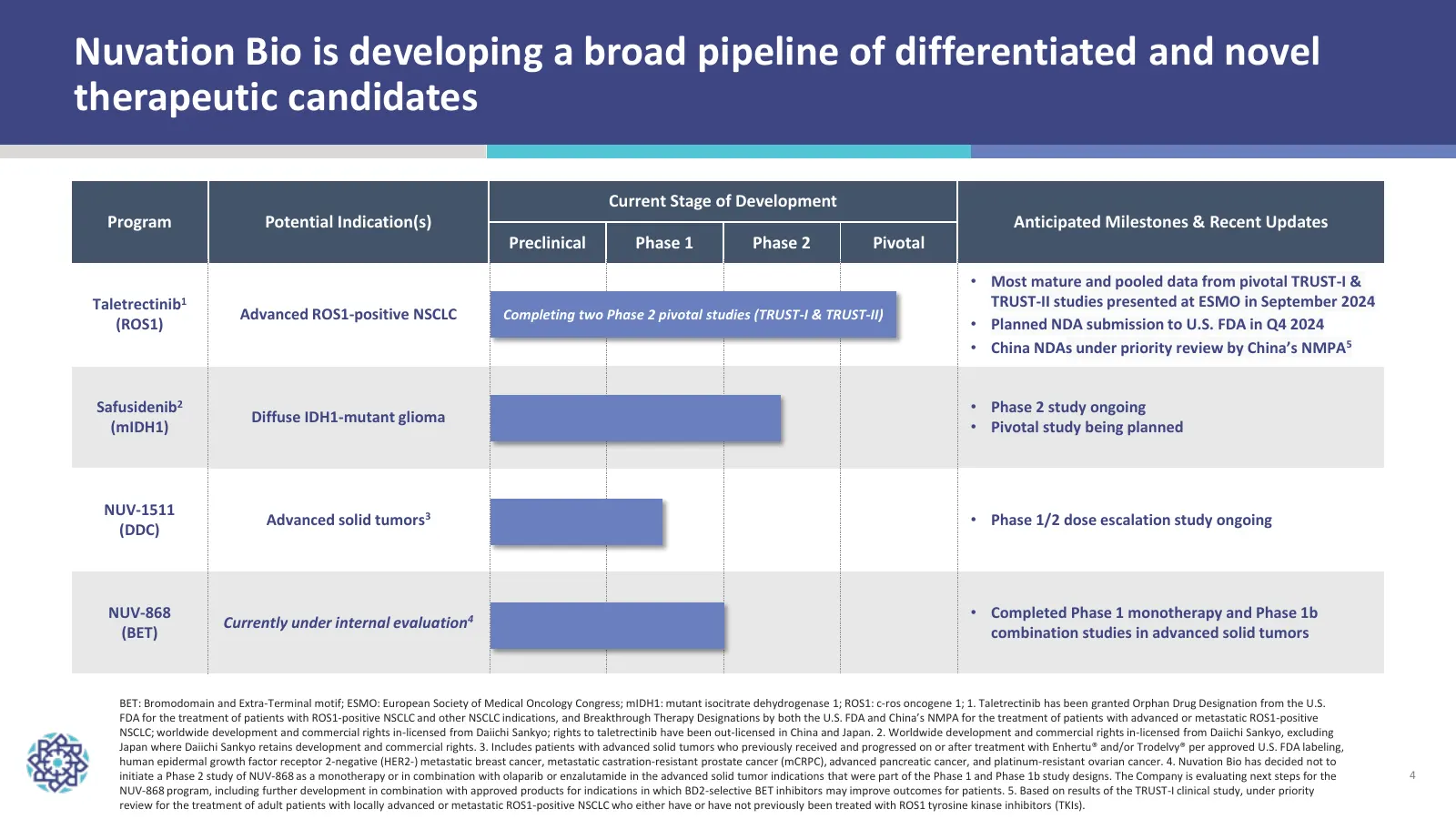
Nuvation Bio is developing a broad pipeline of differentiated and novel therapeutic candidates Current Stage of Development Program Potential Indication(s) Anticipated Milestones & Recent Updates Preclinical Phase 1 Phase 2 Pivotal • Most mature and pooled data from pivotal TRUST-I & Taletrectinib1

Slide 5: Taletrectinib | ROS1i
Taletrectinib | ROS1i Advanced ROS1- Planned NDA positive NSCLC submission in Q4 2024 5
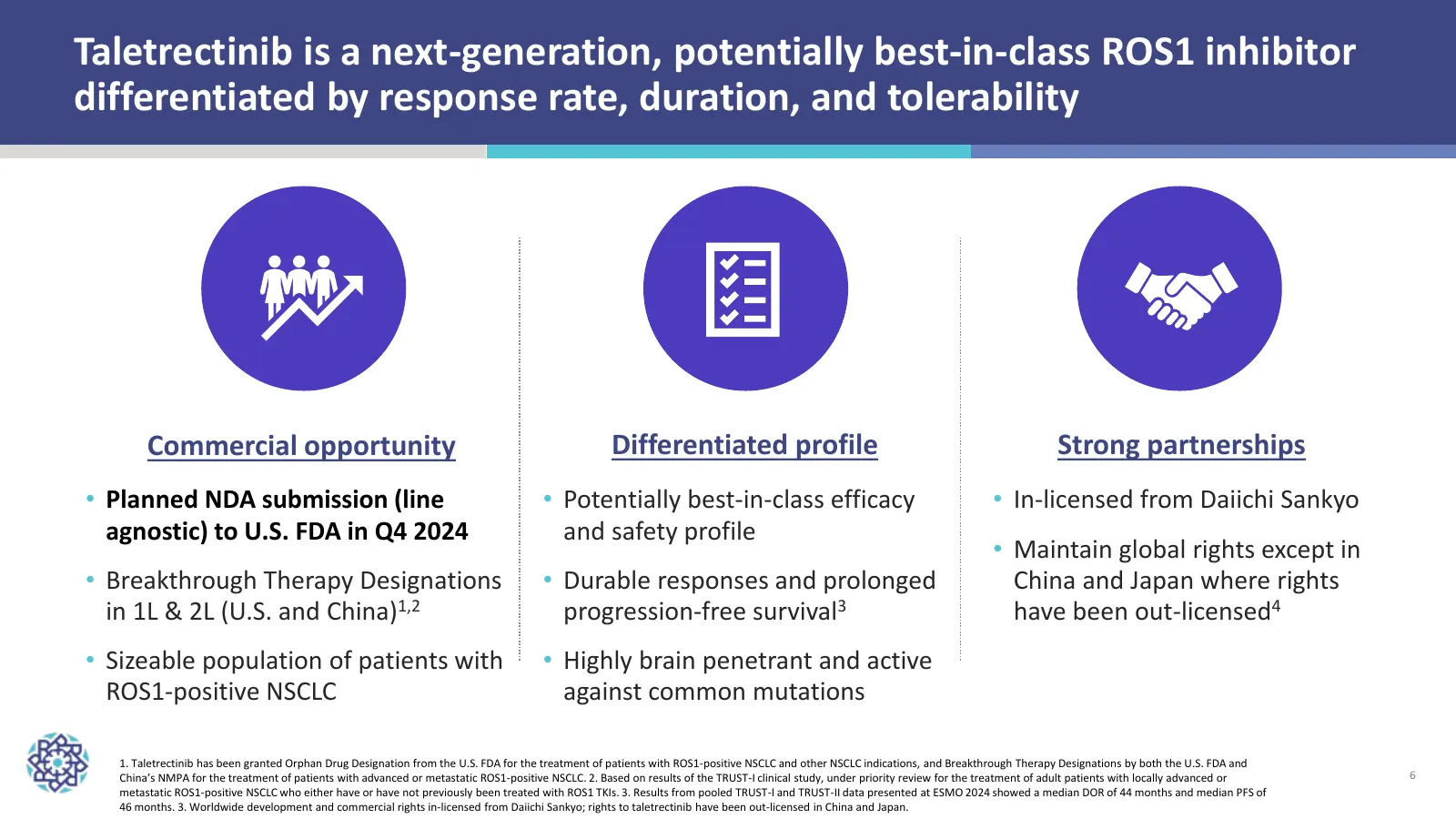
Slide 6: Taletrectinib is a next-generation, potentially best-in-class ROS1 inhibitor
Taletrectinib is a next-generation, potentially best-in-class ROS1 inhibitor differentiated by response rate, duration, and tolerability Commercial opportunity Differentiated profile Strong partnerships • Planned NDA submission (line • Potentially best-in-class efficacy • In-licensed from Daiichi Sa
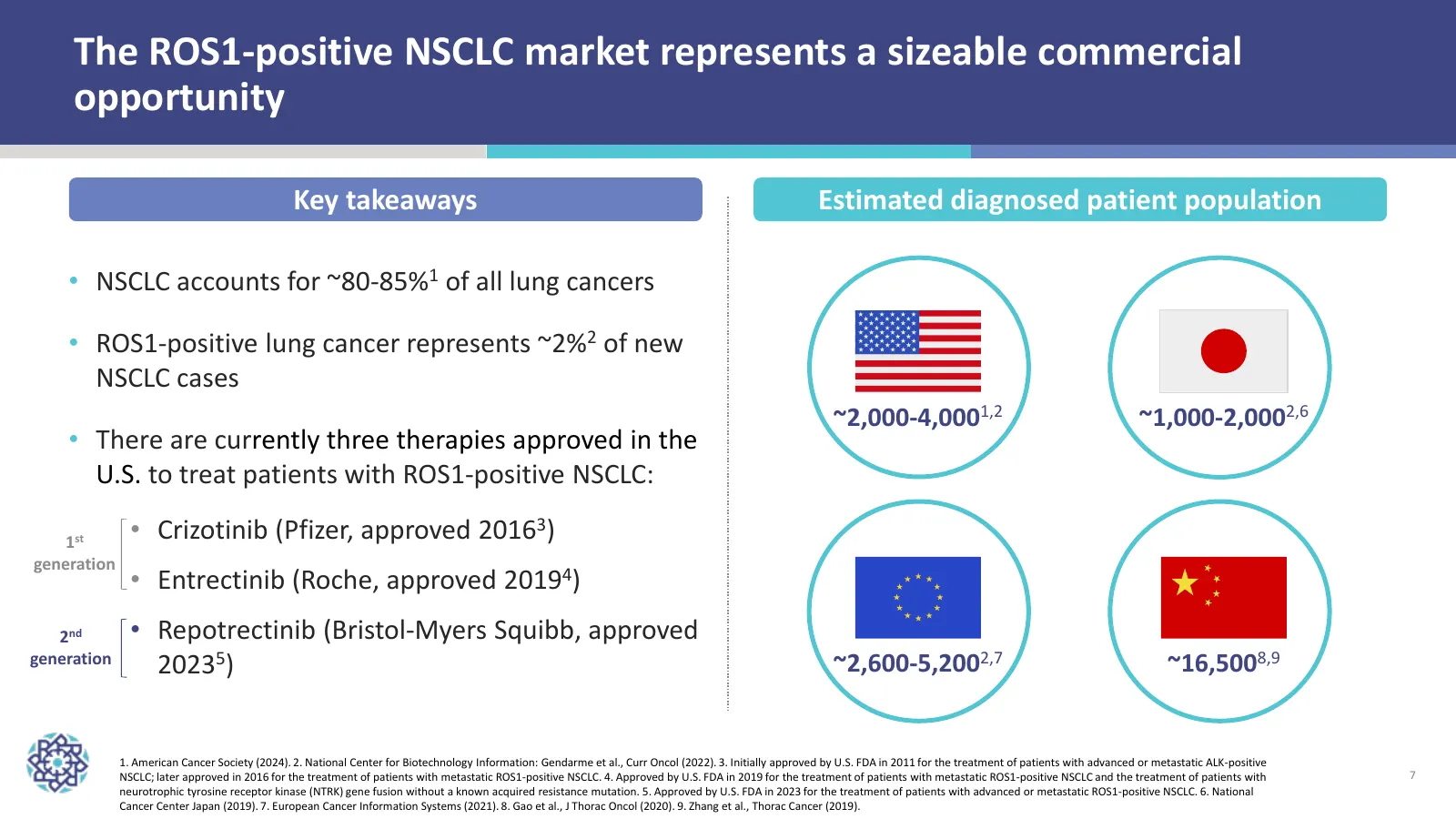
Slide 7: The ROS1-positive NSCLC market represents a sizeable commercial opportunity
The ROS1-positive NSCLC market represents a sizeable commercial opportunity Key takeaways Estimated diagnosed patient population • NSCLC accounts for ~80-85%1 of all lung cancers • ROS1-positive lung cancer represents ~2%2 of new NSCLC cases ~2,000-4,0001,2 ~1,000-2,0002,6 • There are currently thre
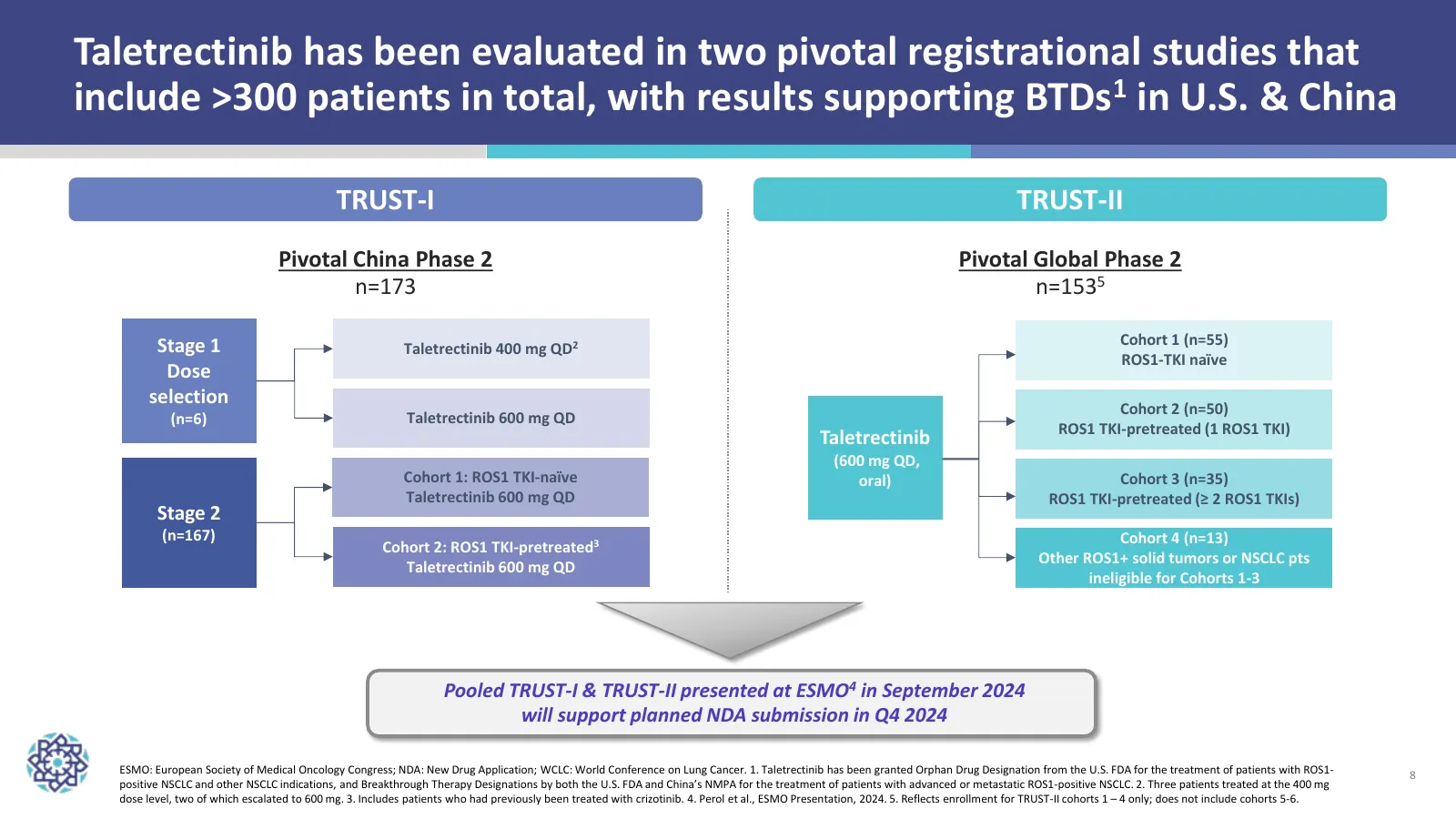
Slide 8: Taletrectinib evaluated in two pivotal registrational studies, >300 patients
Taletrectinib has been evaluated in two pivotal registrational studies that include >300 patients in total, with results supporting BTDs1 in U.S. & China TRUST-I TRUST-II Pivotal China Phase 2 Pivotal Global Phase 2 n=173 n=1535 Stage 1 Cohort 1 (n=55) Taletrectinib 400 mg QD2 ROS1-TKI naïve Dose se
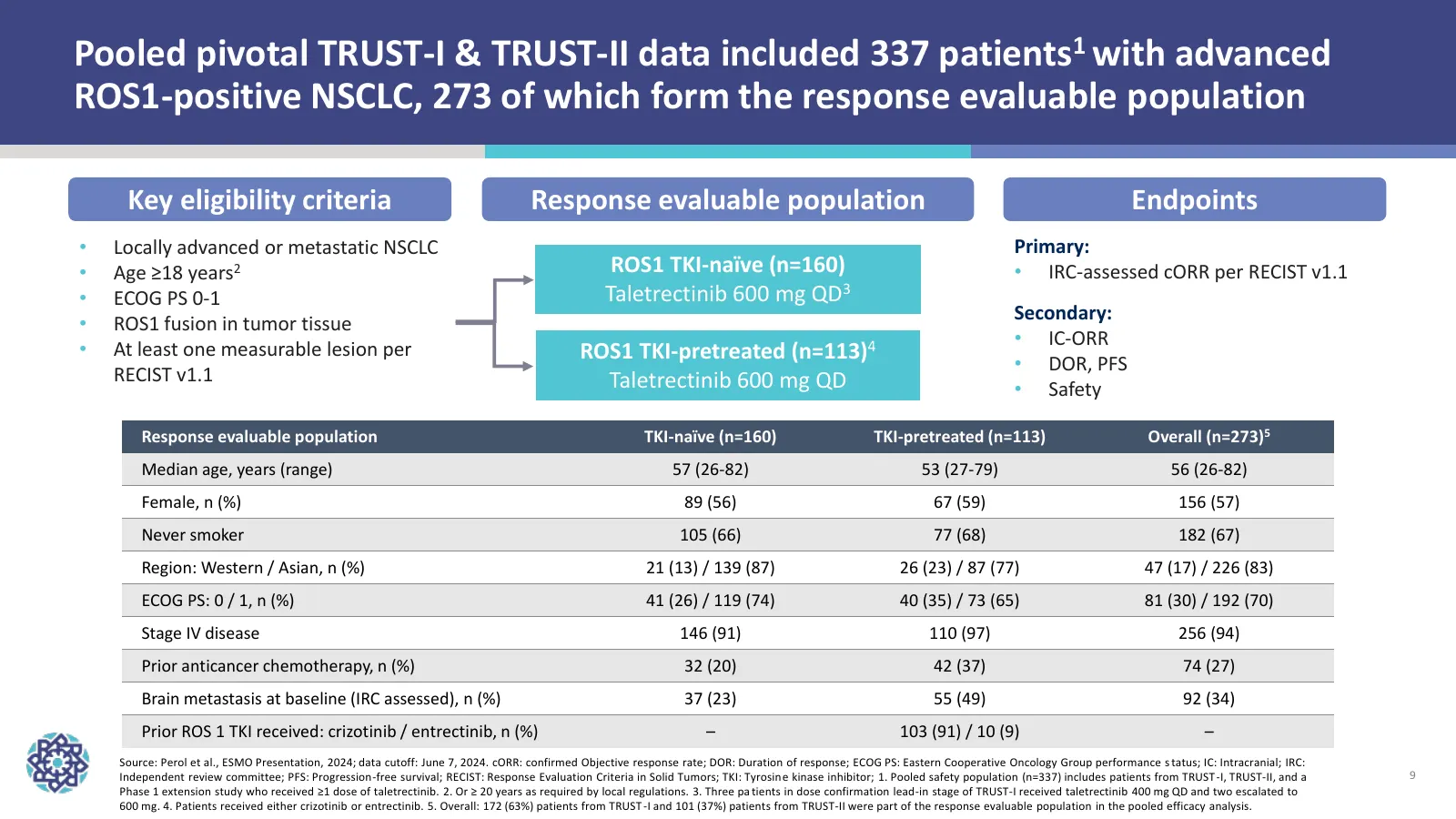
Slide 9: Pooled pivotal TRUST-I & TRUST-II data in advanced ROS1-positive NSCLC
Pooled pivotal TRUST-I & TRUST-II data included 337 patients1 with advanced ROS1-positive NSCLC, 273 of which form the response evaluable population Key eligibility criteria Response evaluable population Endpoints • Locally advanced or metastatic NSCLC Primary: • Age ≥18 years2 ROS1 TKI-naïve (n=160
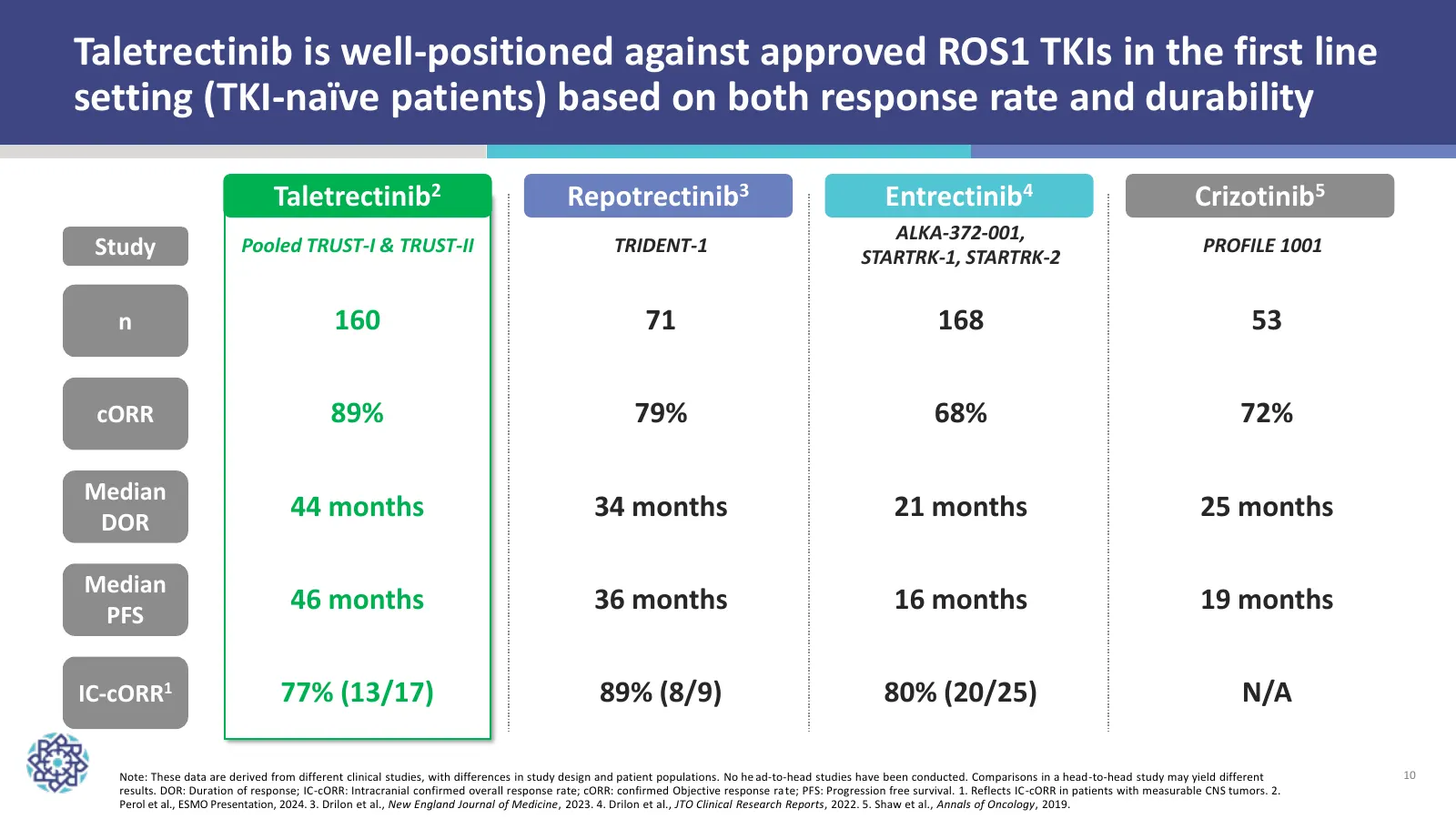
Slide 10: Taletrectinib well-positioned against approved ROS1 TKIs in first line
Taletrectinib is well-positioned against approved ROS1 TKIs in the first line setting (TKI-naïve patients) based on both response rate and durability Taletrectinib2 Repotrectinib3 Entrectinib4 Crizotinib5 ALKA-372-001, Study Pooled TRUST-I & TRUST-II TRIDENT-1 STARTRK-1, STARTRK-2 PROFILE 1001 n 160
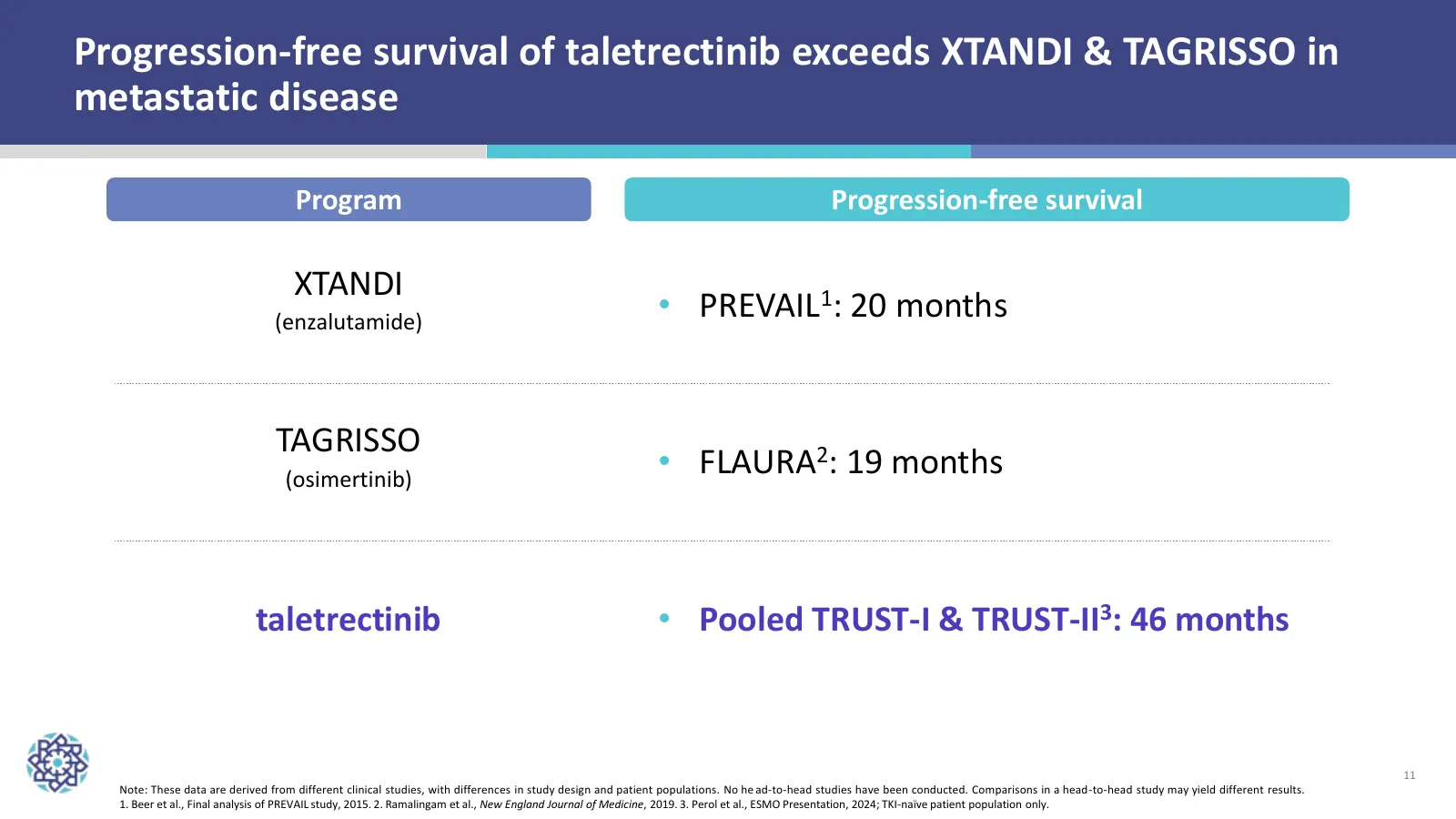
Slide 11: Progression-free survival of taletrectinib exceeds XTANDI & TAGRISSO in metastatic disease
Progression-free survival of taletrectinib exceeds XTANDI & TAGRISSO in metastatic disease Program Progression-free survival XTANDI (enzalutamide) • PREVAIL1: 20 months TAGRISSO (osimertinib) • FLAURA2: 19 months taletrectinib • Pooled TRUST-I & TRUST-II3: 46 months 11 Note: These data are derived f
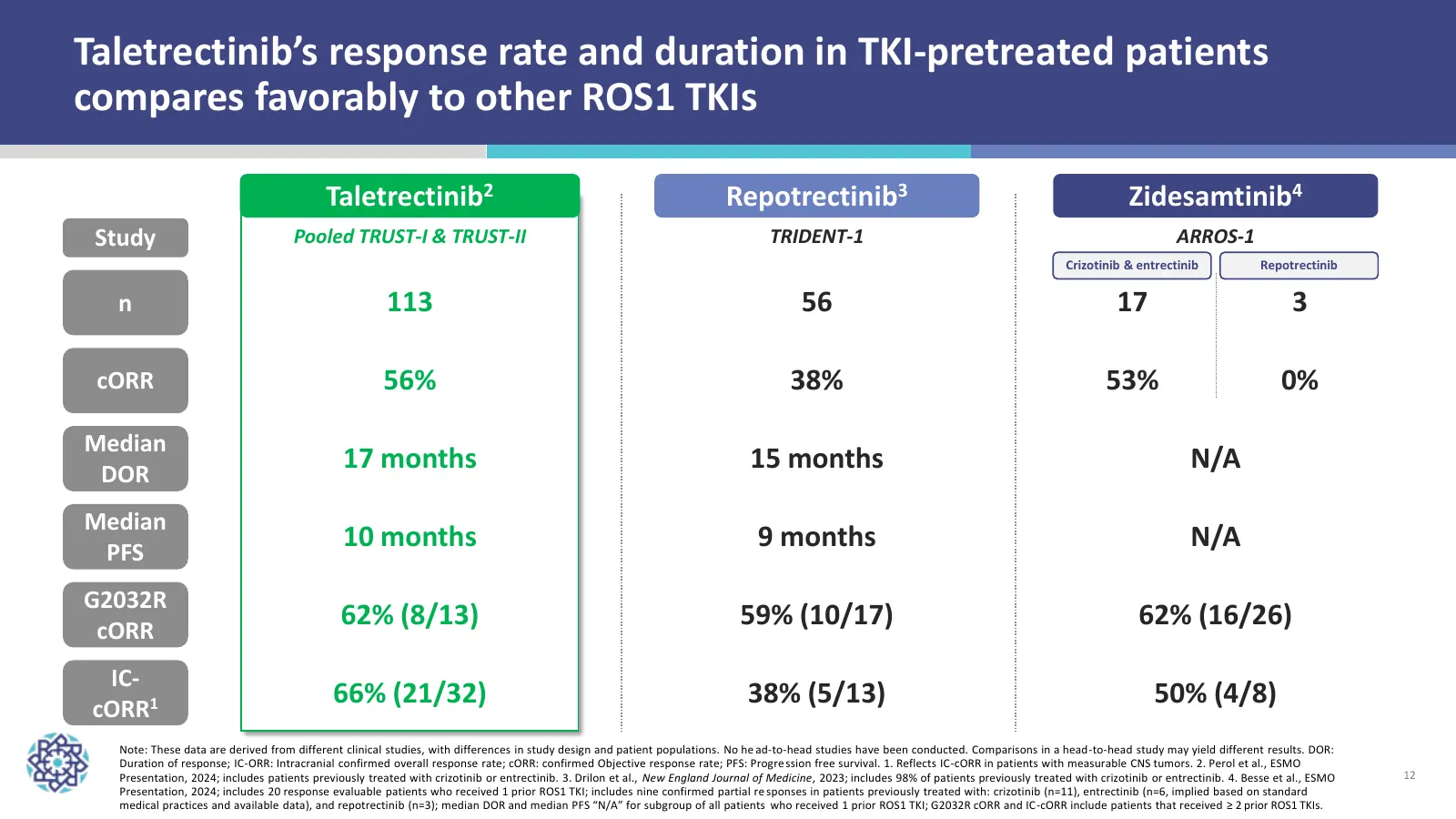
Slide 12: Taletrectinib response in TKI-pretreated patients compares favorably to other ROS1 TKIs
Taletrectinib’s response rate and duration in TKI-pretreated patients compares favorably to other ROS1 TKIs Taletrectinib2 Repotrectinib3 Zidesamtinib4 Study Pooled TRUST-I & TRUST-II TRIDENT-1 ARROS-1 Crizotinib & entrectinib Repotrectinib n 113 56 17 3 cORR 56% 38% 53% 0% Median DOR 17 months 15 m
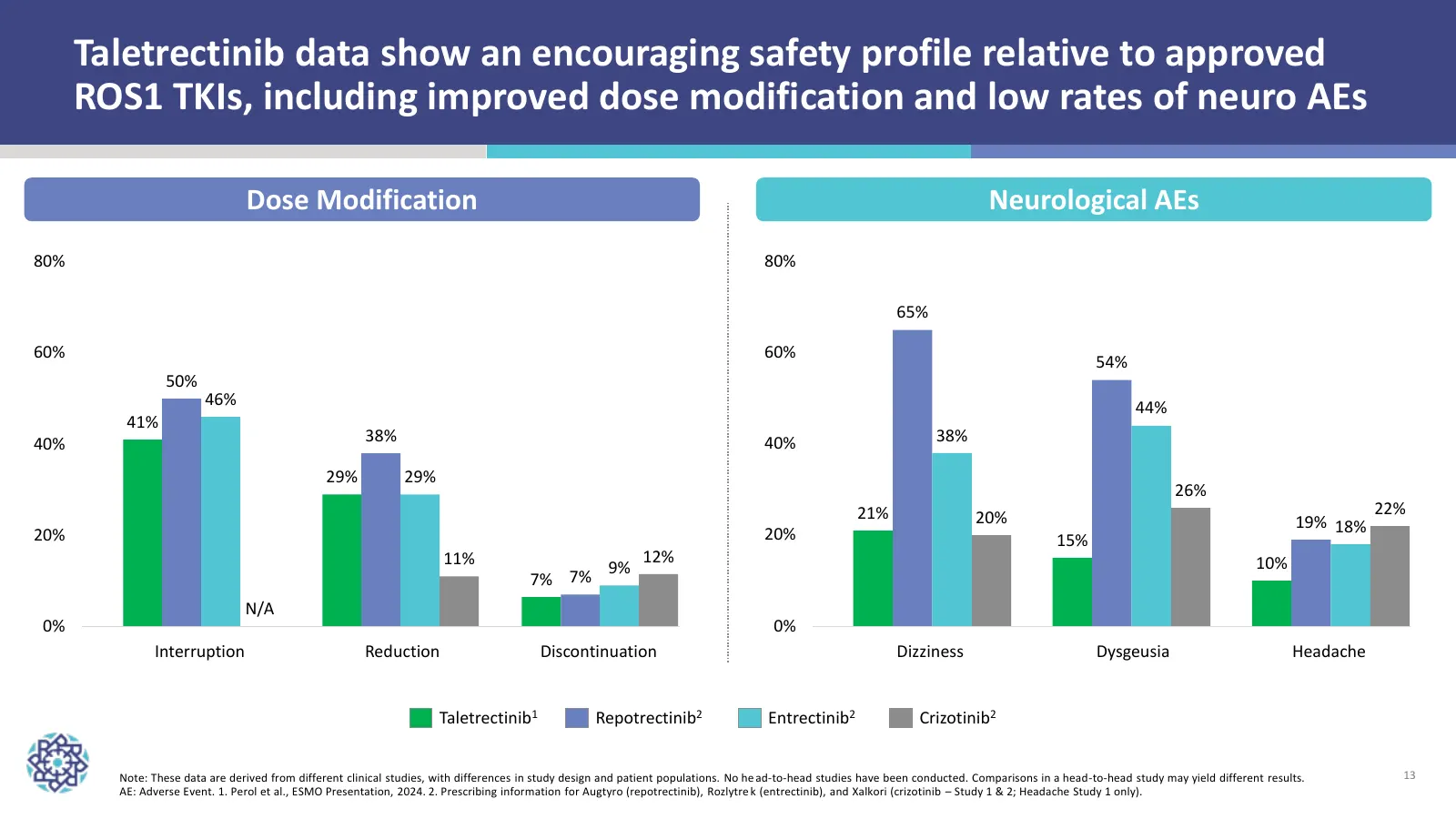
Slide 13: Taletrectinib shows encouraging safety profile relative to approved ROS1 TKIs
Taletrectinib data show an encouraging safety profile relative to approved ROS1 TKIs, including improved dose modification and low rates of neuro AEs Dose Modification Neurological AEs 80% 80% 65% 60% 60% 54% 50% 46% 44% 41% 40% 38% 40% 38% 29% 29% 26% 21% 20% 22% 19% 18% 20% 20% 15% 11% 12% 10% 9%
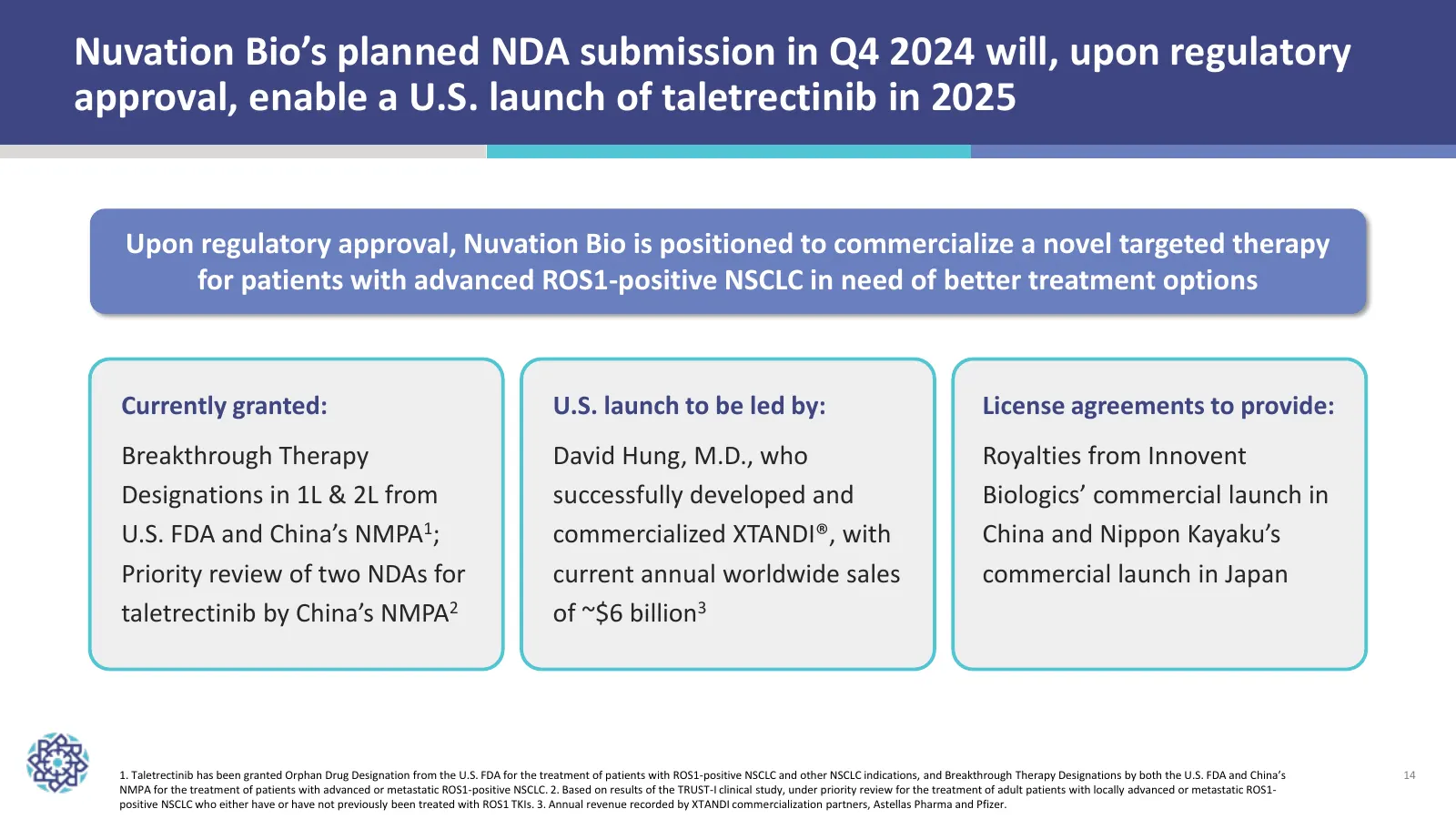
Slide 14: Planned Q4 2024 NDA will enable U.S. launch of taletrectinib in 2025
Nuvation Bio’s planned NDA submission in Q4 2024 will, upon regulatory approval, enable a U.S. launch of taletrectinib in 2025 Upon regulatory approval, Nuvation Bio is positioned to commercialize a novel targeted therapy for patients with advanced ROS1-positive NSCLC in need of better treatment opt

Slide 15: Safusidenib | mIDH1i
Safusidenib | mIDH1i Diffuse Phase 2 study ongoing IDH1-mutant glioma 15
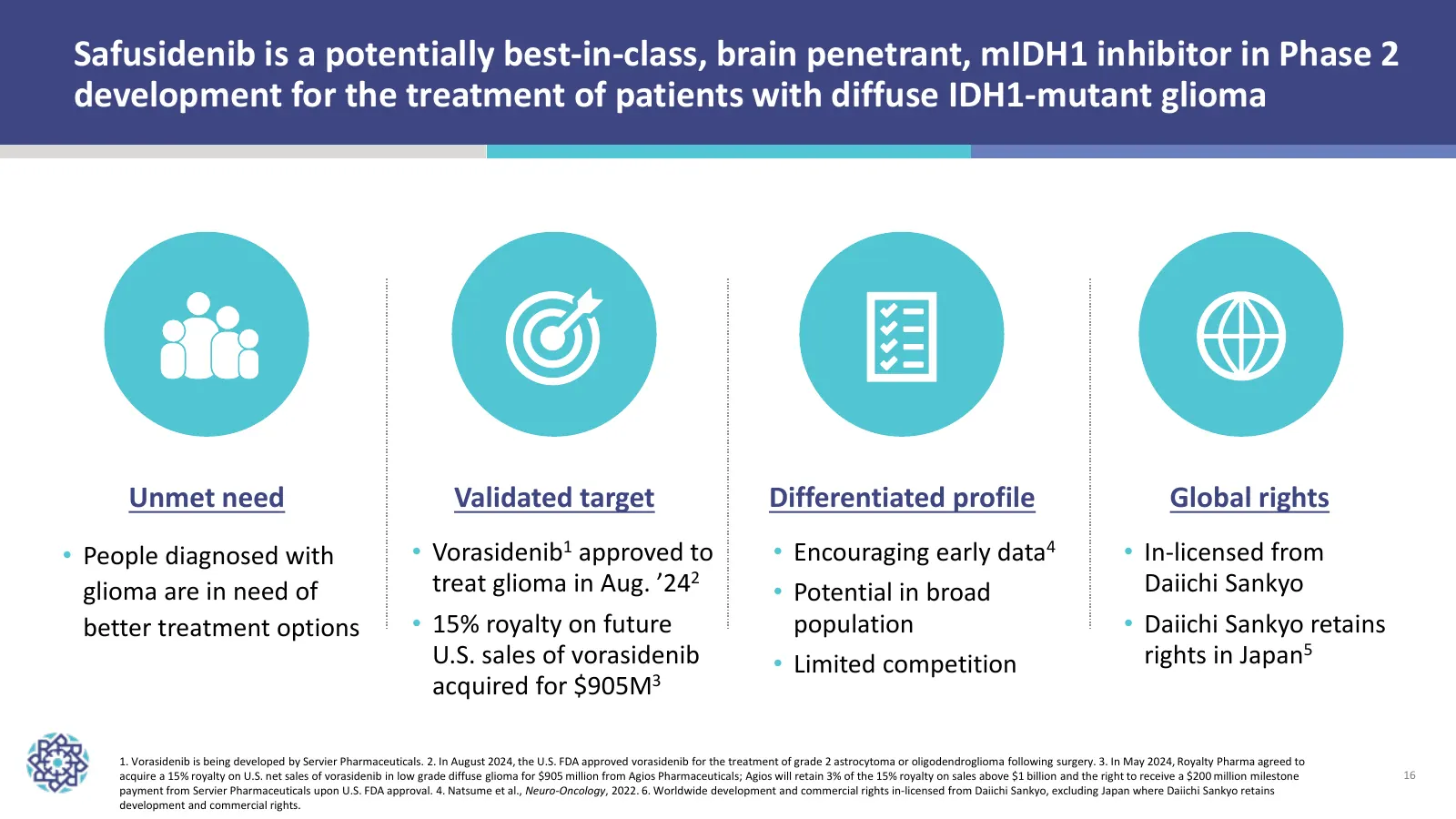
Slide 16: Safusidenib is a potentially best-in-class, brain penetrant, mIDH1 inhibitor
Safusidenib is a potentially best-in-class, brain penetrant, mIDH1 inhibitor in Phase 2 development for the treatment of patients with diffuse IDH1-mutant glioma Unmet need Validated target Differentiated profile Global rights • People diagnosed with • Vorasidenib1 approved to • Encouraging early da
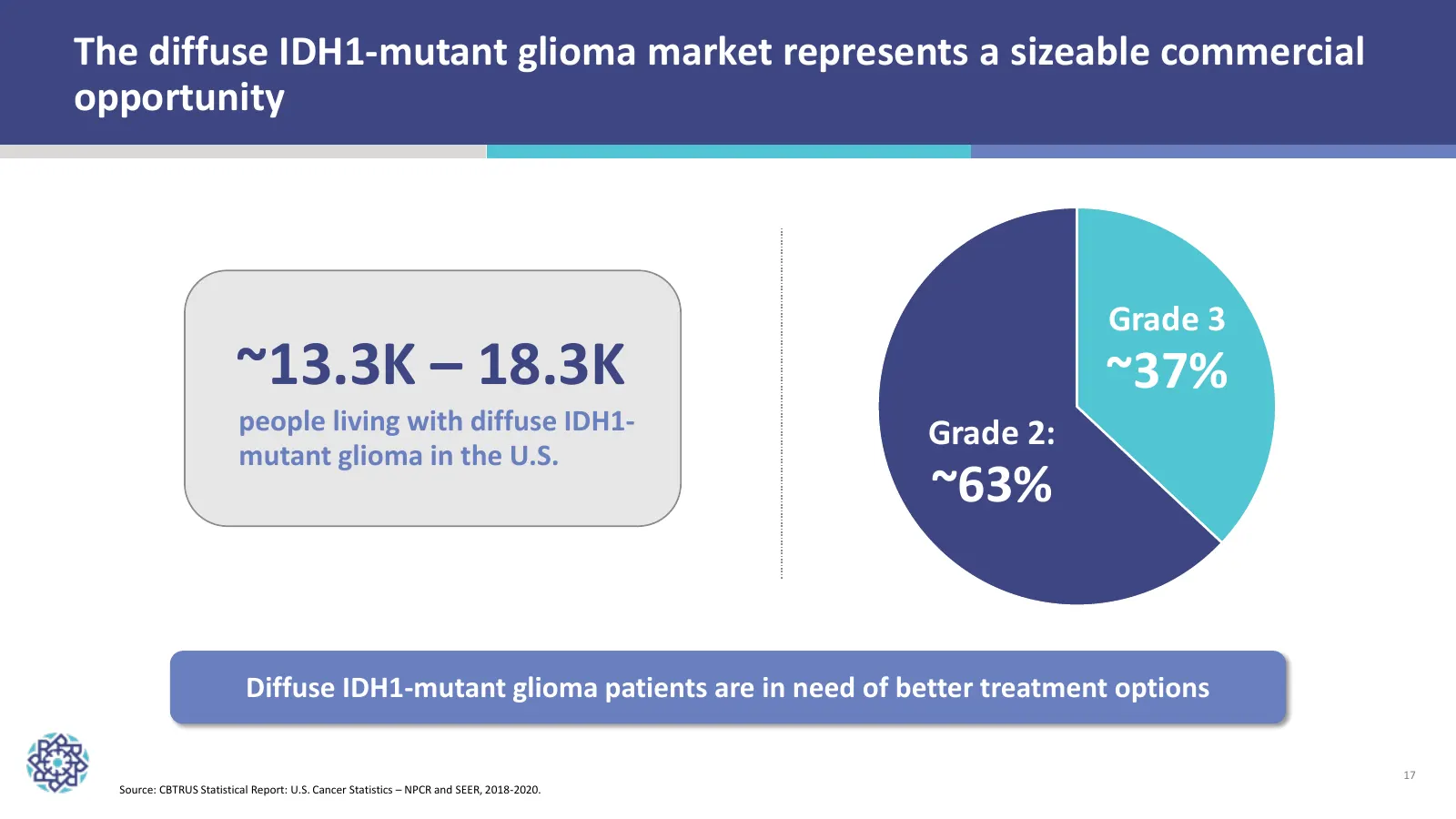
Slide 17: The diffuse IDH1-mutant glioma market represents a sizeable commercial opportunity
The diffuse IDH1-mutant glioma market represents a sizeable commercial opportunity Grade 3 ~13.3K – 18.3K ~37% people living with diffuse IDH1- Grade 2: mutant glioma in the U.S. ~63% Diffuse IDH1-mutant glioma patients are in need of better treatment options 17 Source: CBTRUS Statistical Report: U.
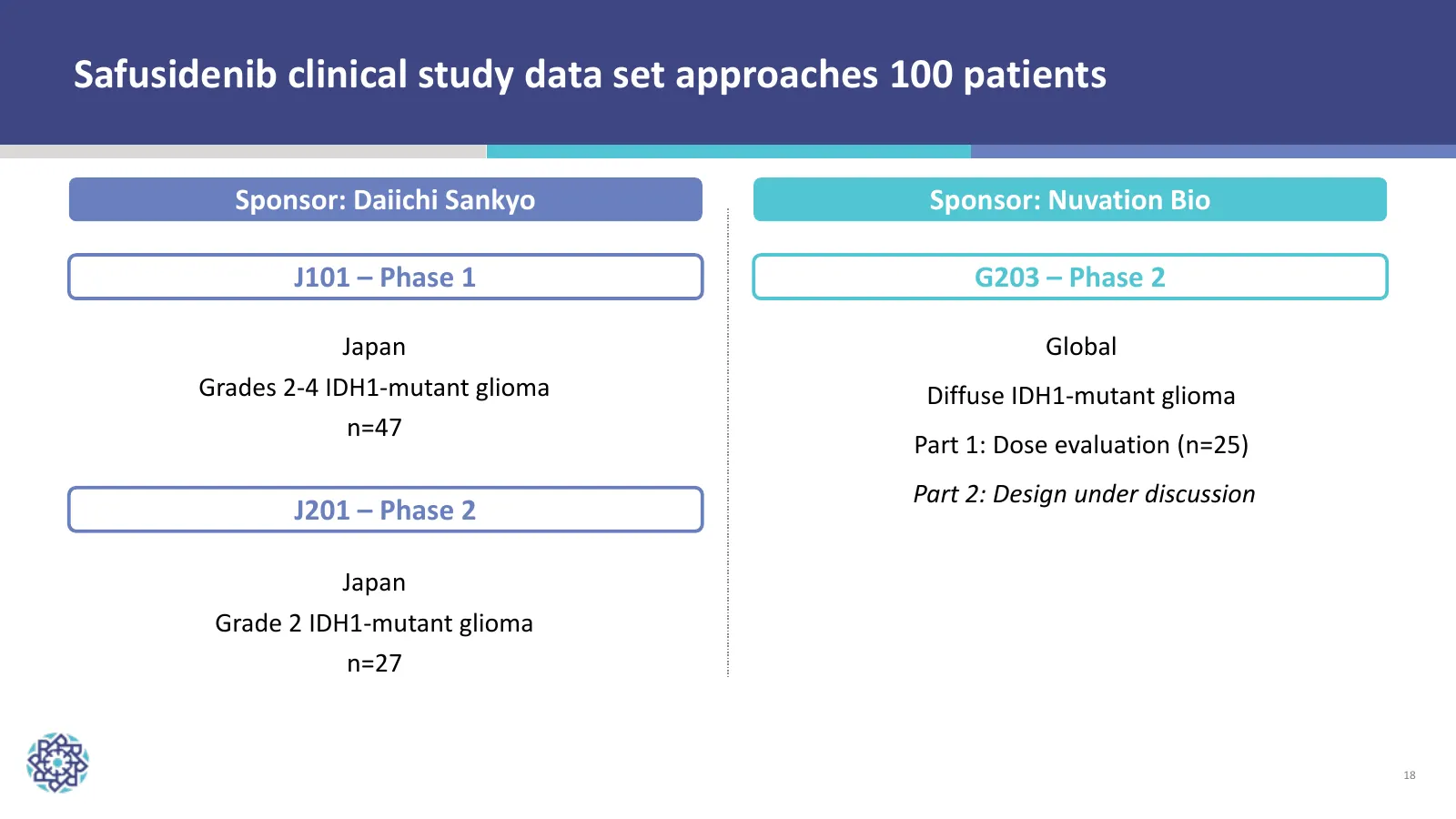
Slide 18: Safusidenib clinical study data set approaches 100 patients
Safusidenib clinical study data set approaches 100 patients Sponsor: Daiichi Sankyo Sponsor: Nuvation Bio J101 – Phase 1 G203 – Phase 2 Japan Global Grades 2-4 IDH1-mutant glioma Diffuse IDH1-mutant glioma n=47 Part 1: Dose evaluation (n=25) Part 2: Design under discussion J201 – Phase 2 Japan Grade
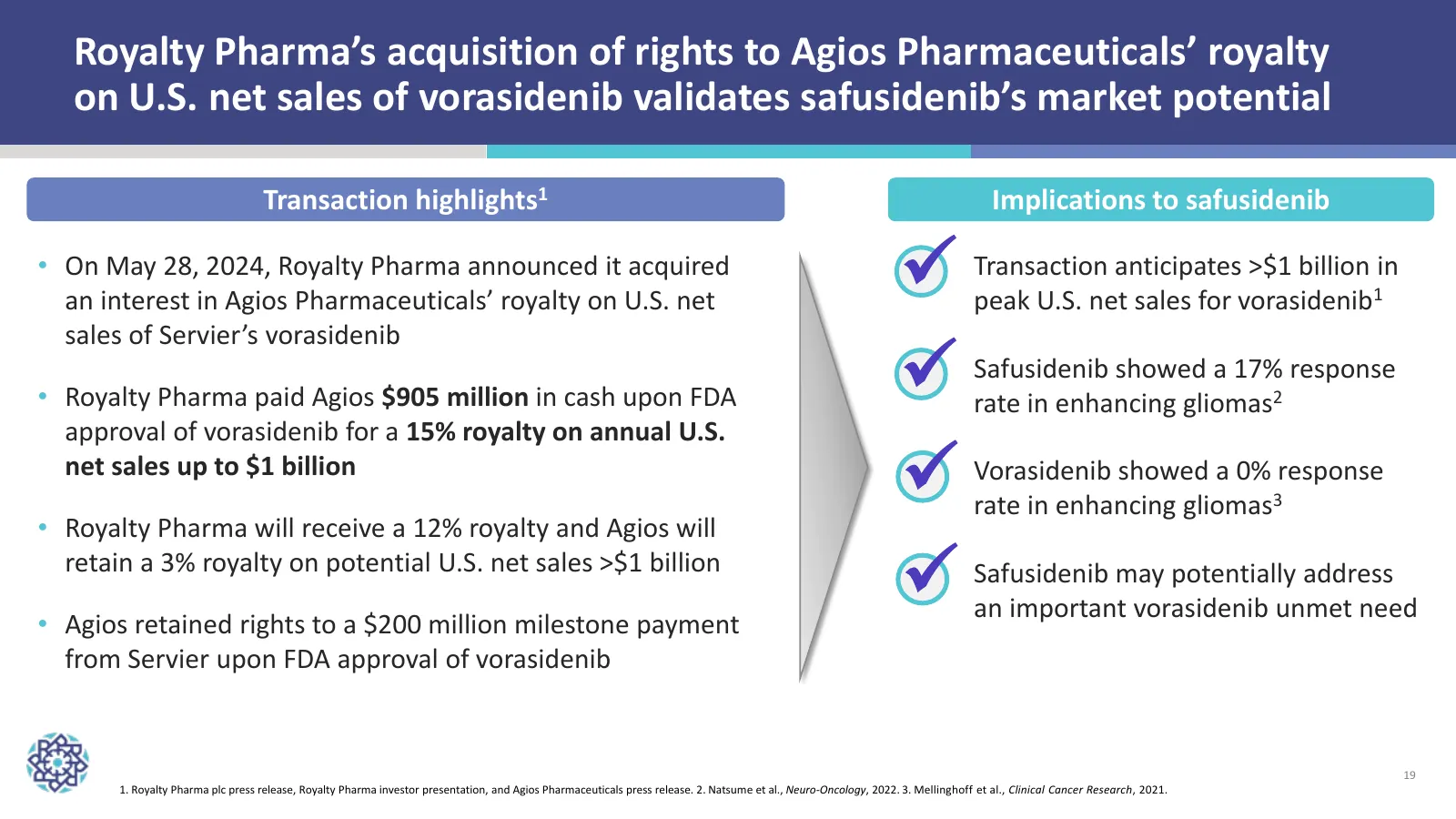
Slide 19: Royalty Pharma's acquisition of vorasidenib royalty validates safusidenib's market potential
Royalty Pharma’s acquisition of rights to Agios Pharmaceuticals’ royalty on U.S. net sales of vorasidenib validates safusidenib’s market potential Transaction highlights1 Implications to safusidenib • On May 28, 2024, Royalty Pharma announced it acquired an interest in Agios Pharmaceuticals’ royalty
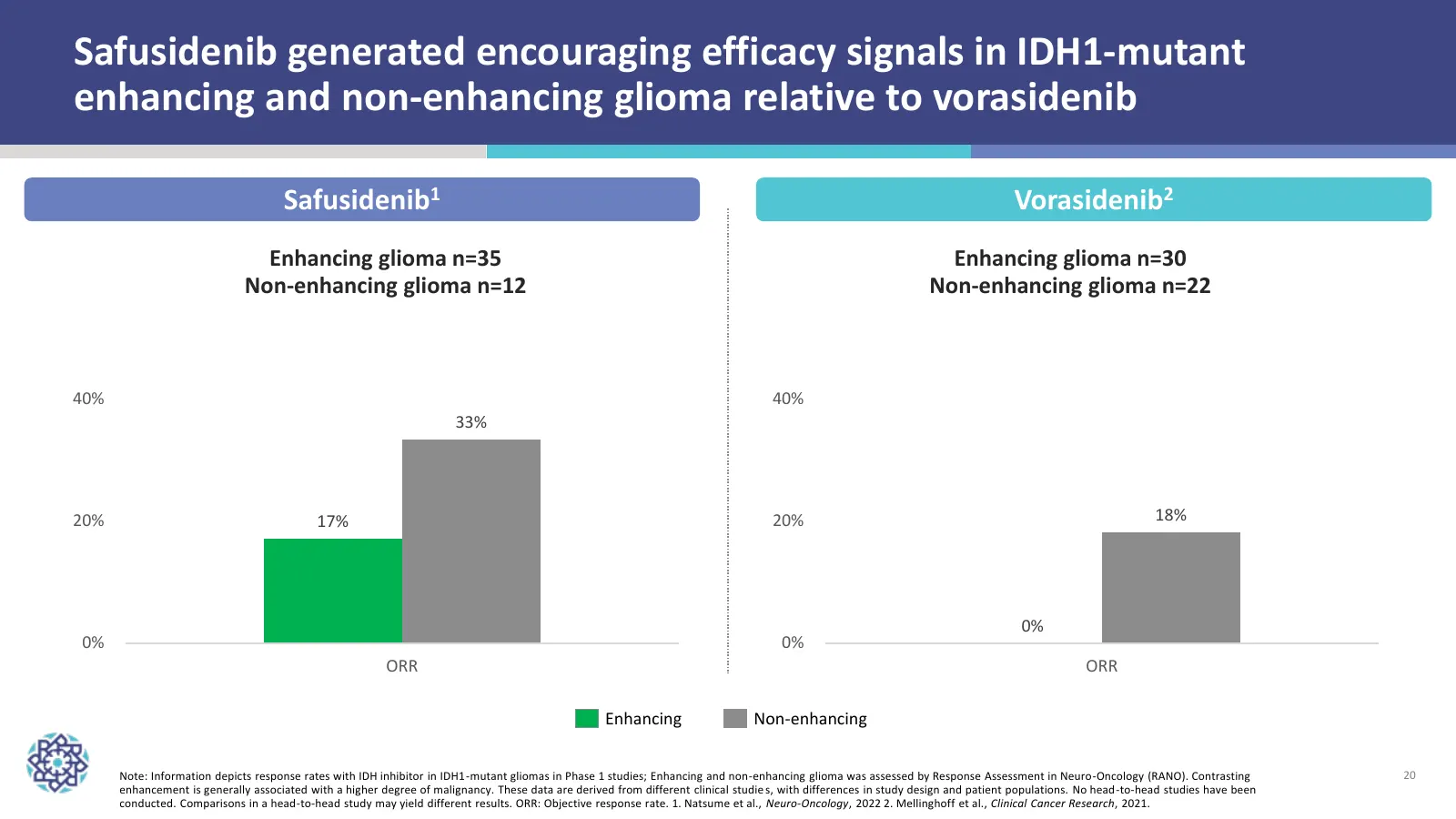
Slide 20: Safusidenib efficacy signals in enhancing and non-enhancing glioma relative to vorasidenib
Safusidenib generated encouraging efficacy signals in IDH1-mutant enhancing and non-enhancing glioma relative to vorasidenib Safusidenib1 Vorasidenib2 Enhancing glioma n=35 Enhancing glioma n=30 Non-enhancing glioma n=12 Non-enhancing glioma n=22 40% 40% 33% 20% 17% 20% 18% 0% 0% 0% ORR ORR Enhancin

Slide 21: NUV-1511 | DDC
NUV-1511 | DDC Advanced solid Phase 1/2 study ongoing tumors 21
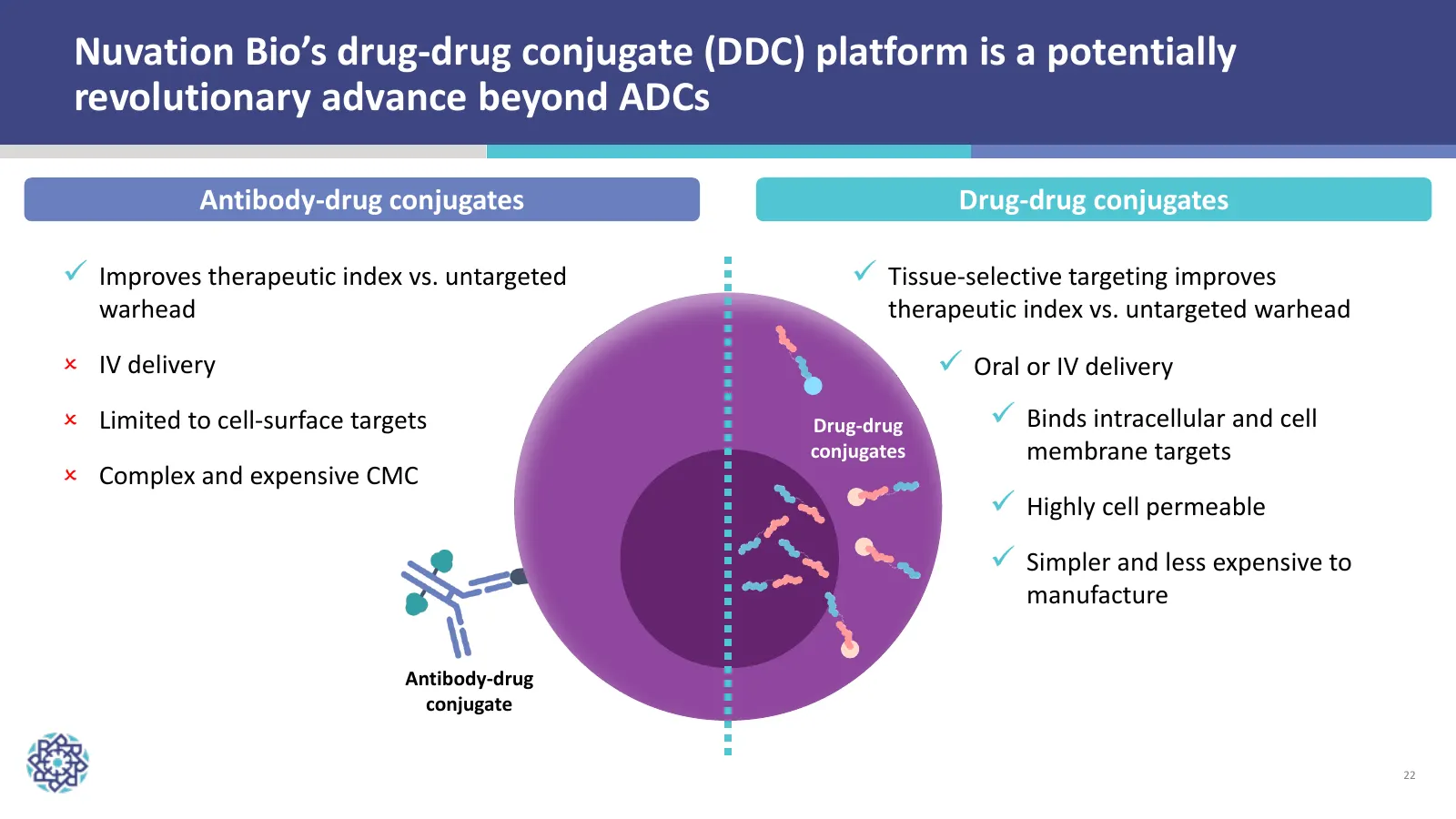
Slide 22: Drug-drug conjugate platform is a potential advance beyond ADCs
Nuvation Bio’s drug-drug conjugate (DDC) platform is a potentially revolutionary advance beyond ADCs Antibody-drug conjugates Drug-drug conjugates ✓ Improves therapeutic index vs. untargeted ✓ Tissue-selective targeting improves warhead therapeutic index vs. untargeted warhead IV delivery ✓ Oral o
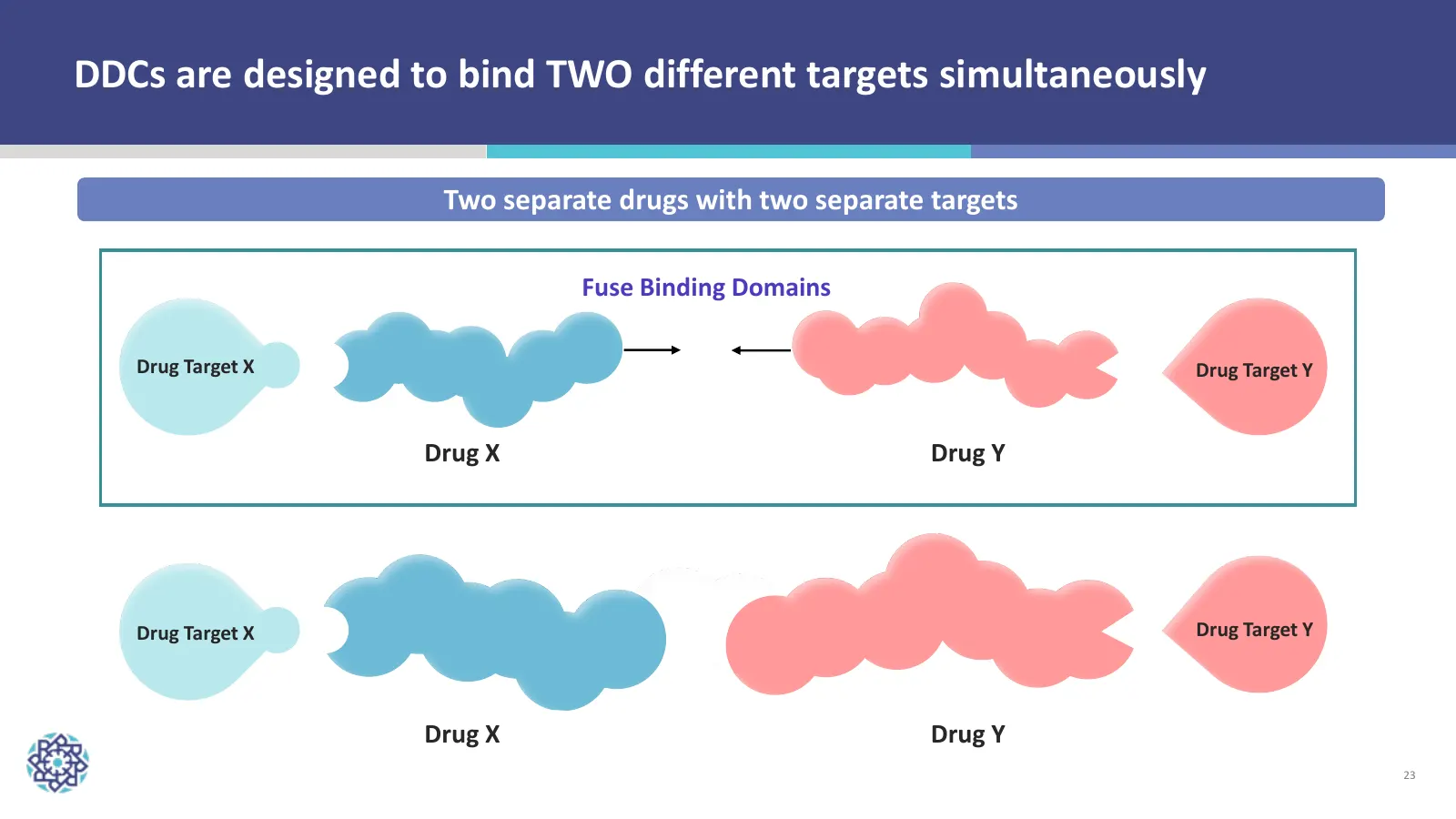
Slide 23: DDCs are designed to bind two different targets simultaneously
DDCs are designed to bind TWO different targets simultaneously Two separate drugs with two separate targets Fuse Binding Domains Drug Target X Drug Target Y Drug X Drug Y Drug Target X Drug Target Y Drug X Drug Y 23
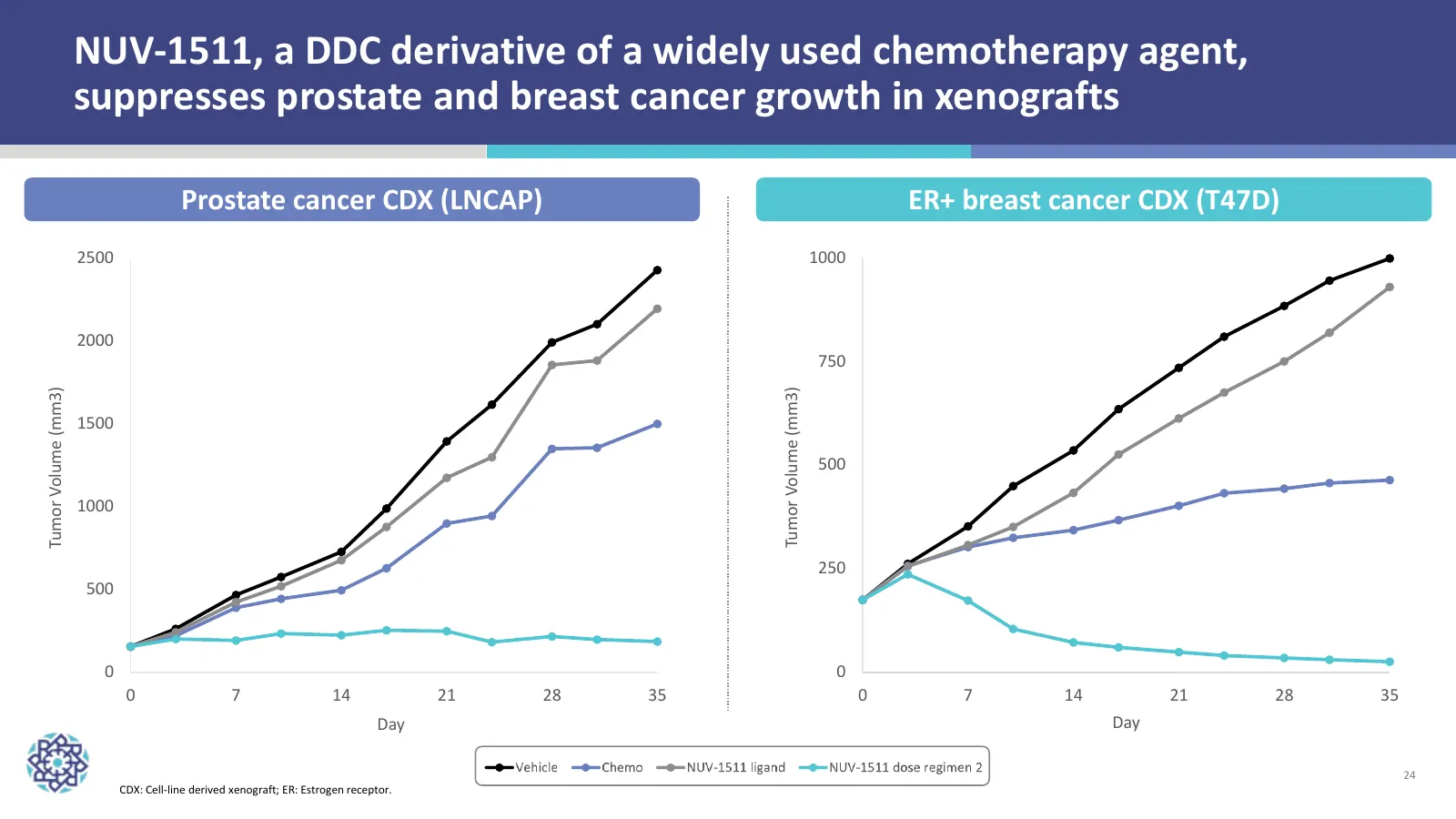
Slide 24: NUV-1511 suppresses prostate and breast cancer growth in xenografts
NUV-1511, a DDC derivative of a widely used chemotherapy agent, suppresses prostate and breast cancer growth in xenografts Prostate cancer CDX (LNCAP) ER+ breast cancer CDX (T47D) 2500 1000 2000 750 Tumor Volume (mm3) Tumor Volume (mm3) 1500 500 1000 250 500 0 0 0 7 14 21 28 35 0 7 14 21 28 35 Day D
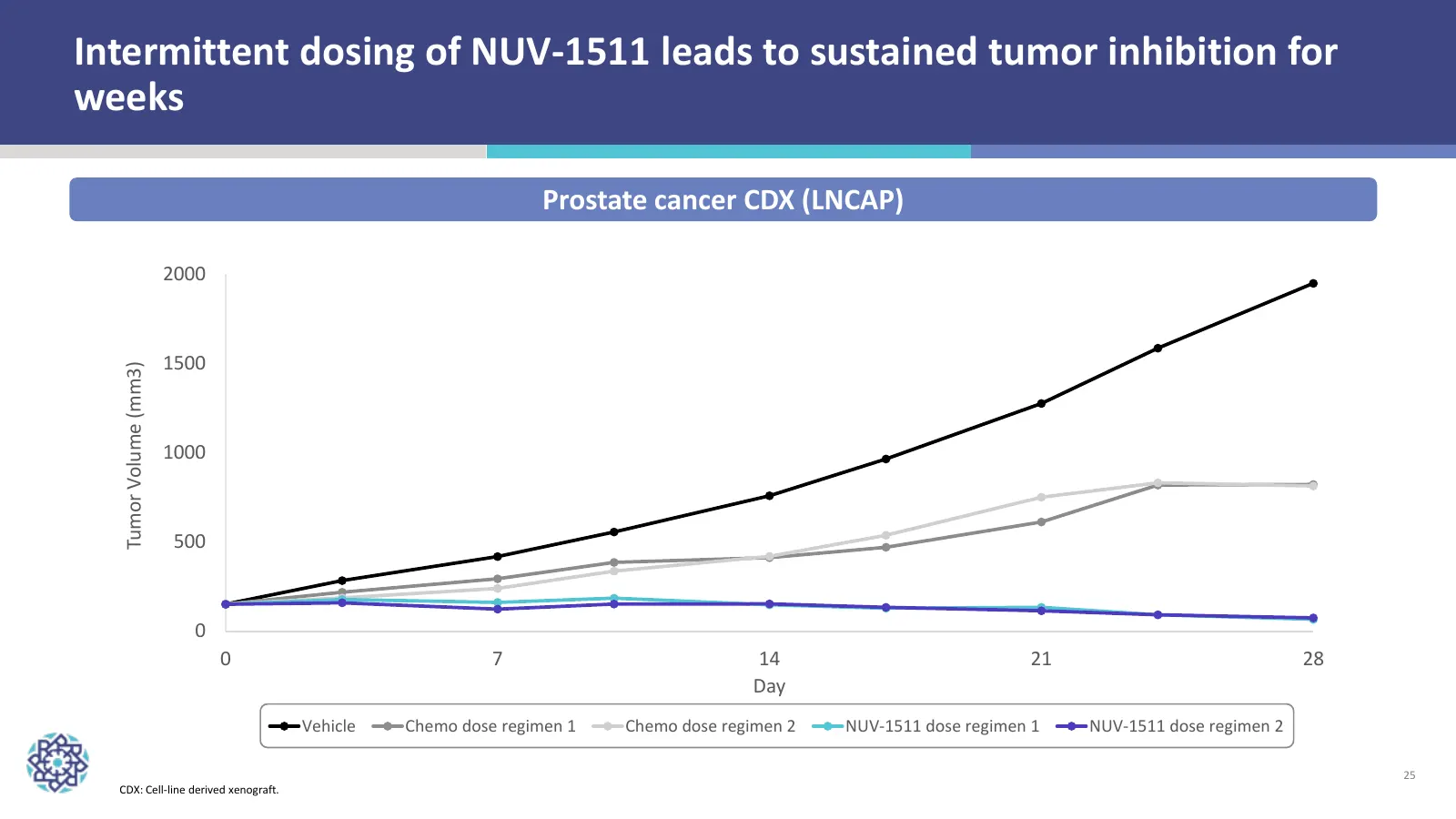
Slide 25: Intermittent dosing of NUV-1511 leads to sustained tumor inhibition
Intermittent dosing of NUV-1511 leads to sustained tumor inhibition for weeks Prostate cancer CDX (LNCAP) 2000 1500 Tumor Volume (mm3) 1000 500 0 0 7 14 21 28 Day Vehicle Chemo dose regimen 1 Chemo dose regimen 2 NUV-1511 dose regimen 1 NUV-1511 dose regimen 2 25 CDX: Cell-line derived xenograft.
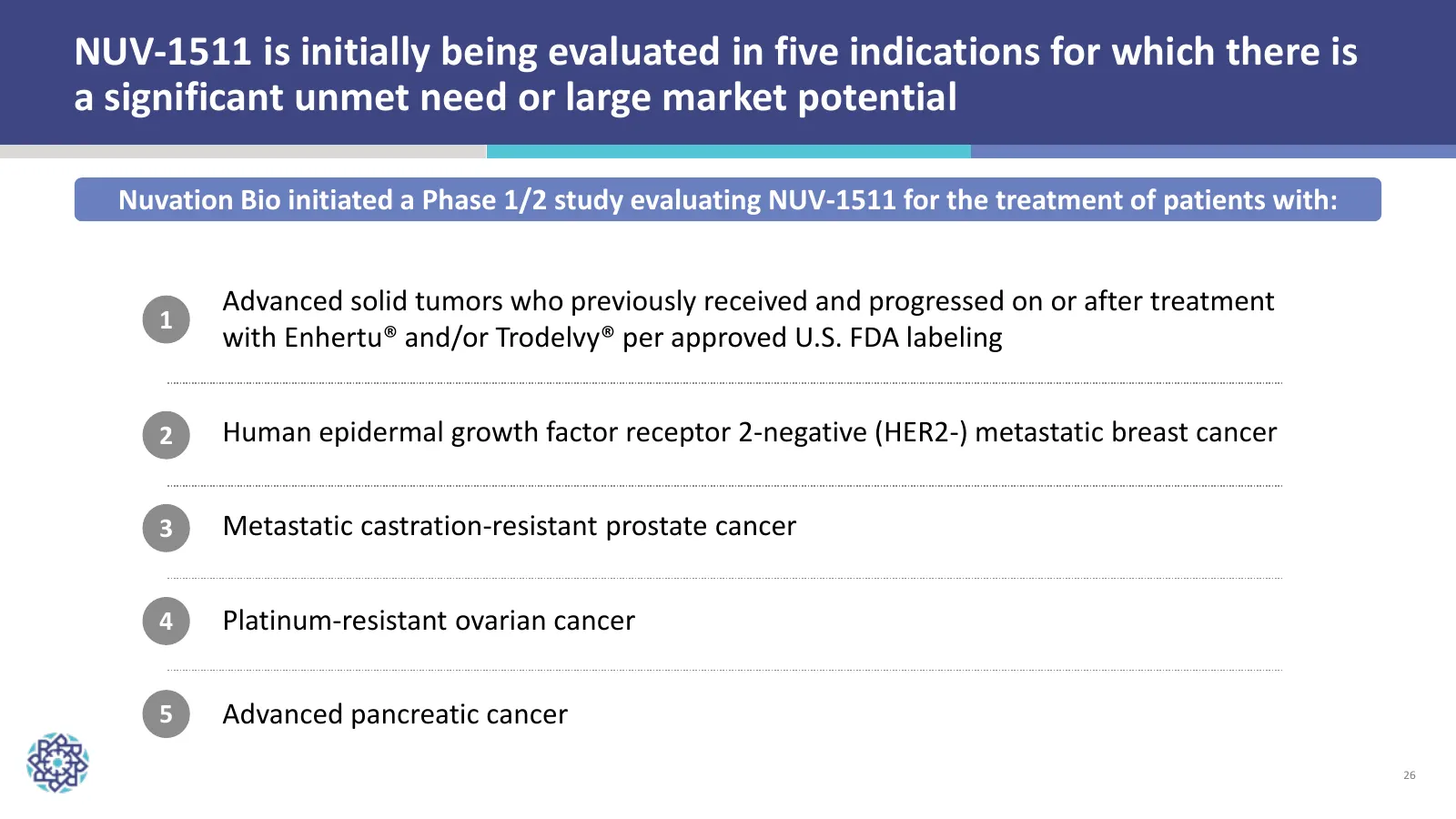
Slide 26: NUV-1511 initially evaluated in five indications
NUV-1511 is initially being evaluated in five indications for which there is a significant unmet need or large market potential Nuvation Bio initiated a Phase 1/2 study evaluating NUV-1511 for the treatment of patients with: Advanced solid tumors who previously received and progressed on or after tr

Slide 27: NUV-868 | BETi
NUV-868 | BETi Advanced solid Completed Phase 1 tumors and Phase 1b studies Currently evaluating Future indications next steps for program 27
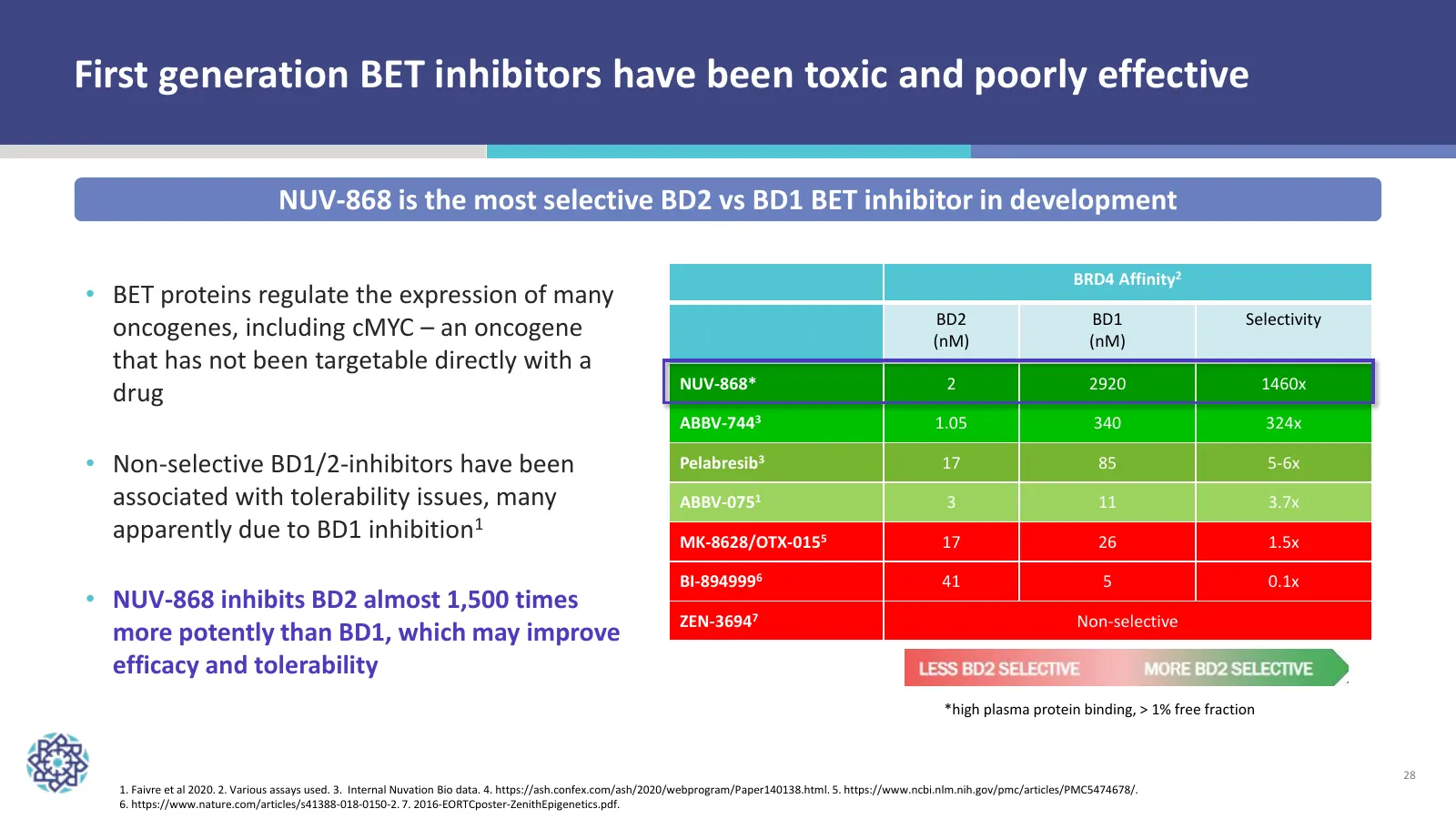
Slide 28: First generation BET inhibitors have been toxic and poorly effective
First generation BET inhibitors have been toxic and poorly effective NUV-868 is the most selective BD2 vs BD1 BET inhibitor in development BRD4 Affinity2 • BET proteins regulate the expression of many BD2 BD1 Selectivity oncogenes, including cMYC – an oncogene (nM) (nM) that has not been targetable
Slide 29: Committed team tackling the greatest unmet needs in oncology
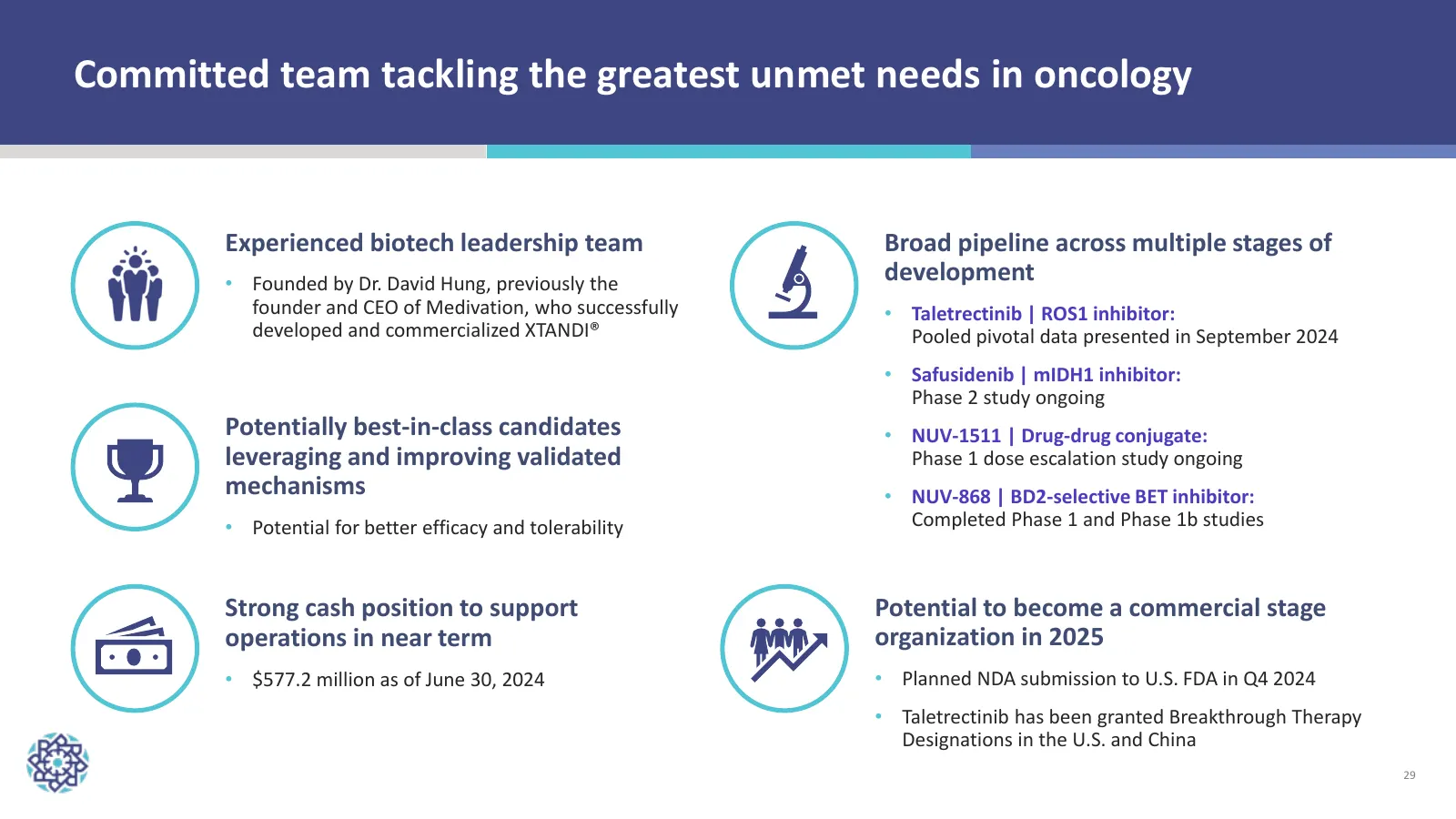
Committed team tackling the greatest unmet needs in oncology Experienced biotech leadership team Broad pipeline across multiple stages of • Founded by Dr. David Hung, previously the development founder and CEO of Medivation, who successfully • Taletrectinib | ROS1 inhibitor: developed and commercial
Slide 30: Appendix
Appendix spo ey Nuvation Bio SVE
Slide 31: Taletrectinib (ROS1i)
Taletrectinib (ROS1i) Summary of data from pooled TRUST-I & TRUST-II studies 31
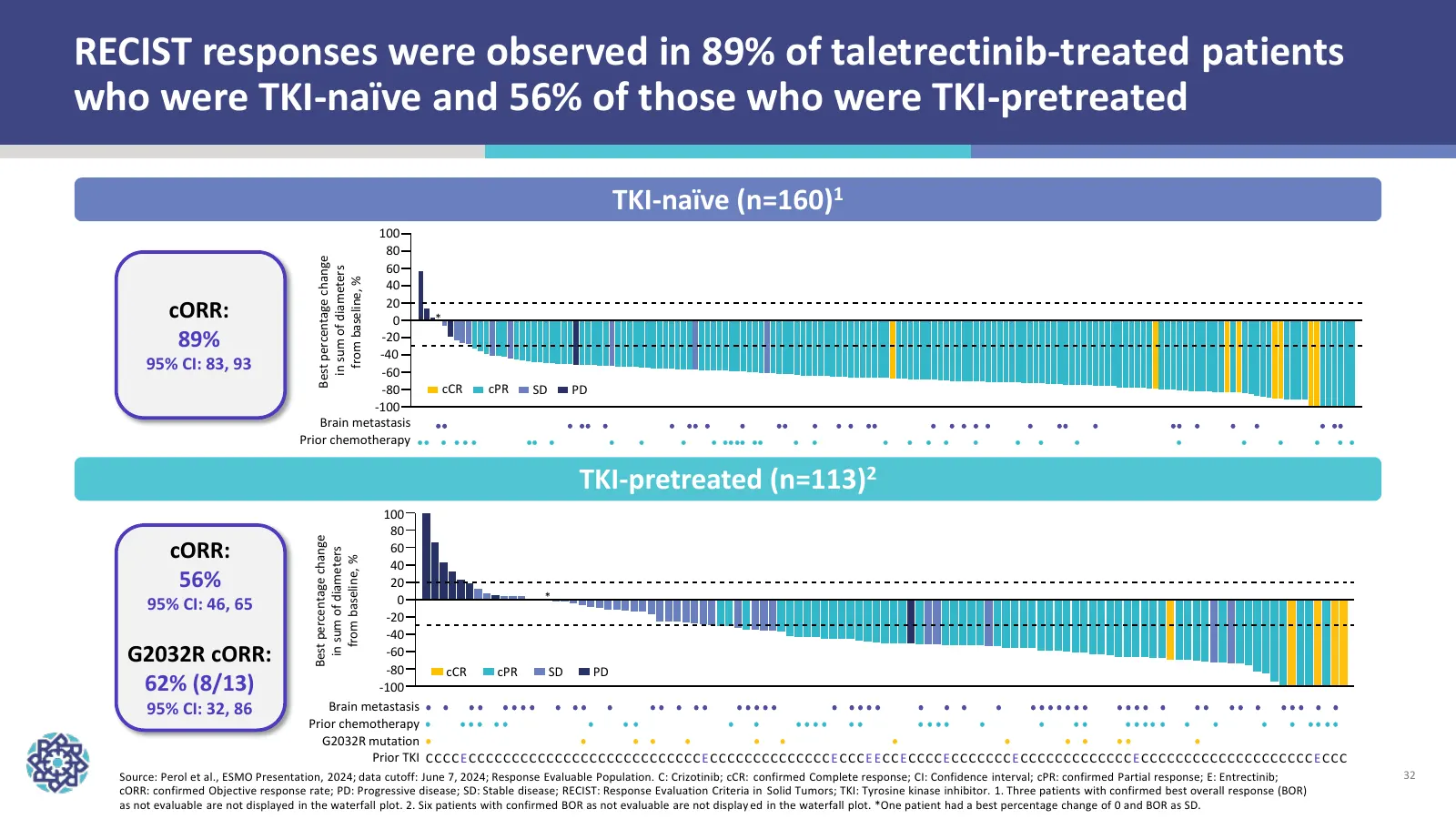
Slide 32: RECIST responses in 89% of TKI-naïve and 56% of TKI-pretreated patients
RECIST responses were observed in 89% of taletrectinib-treated patients who were TKI-naïve and 56% of those who were TKI-pretreated TKI-naïve (n=160)1 100 80 Best percentage change 60 in sum of diameters from baseline, % 40 20 cORR: 0 * 89% -20 -40 95% CI: 83, 93 -60 -80 cCR cPR SD PD -100 Brain met
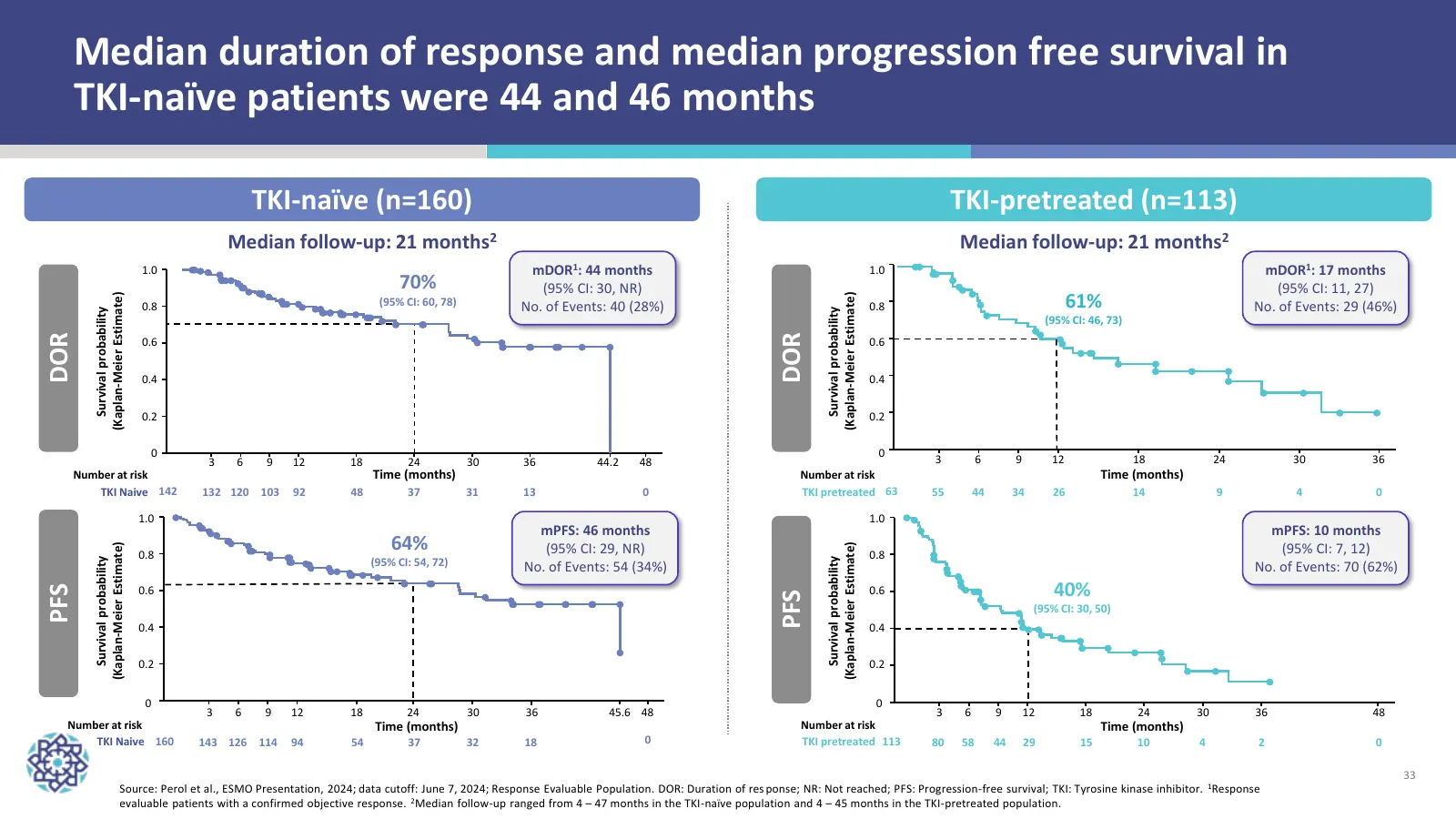
Slide 33: Median duration of response and PFS in TKI-naïve patients were 44 and 46 months
Median duration of response and median progression free survival in TKI-naïve patients were 44 and 46 months TKI-naïve (n=160) TKI-pretreated (n=113) Median follow-up: 21 months2 Median follow-up: 21 months2 1.0 mDOR1: 44 months 1.0 mDOR1: 17 months 70% (95% CI: 30, NR) (95% CI: 11, 27) 61% (Kaplan-
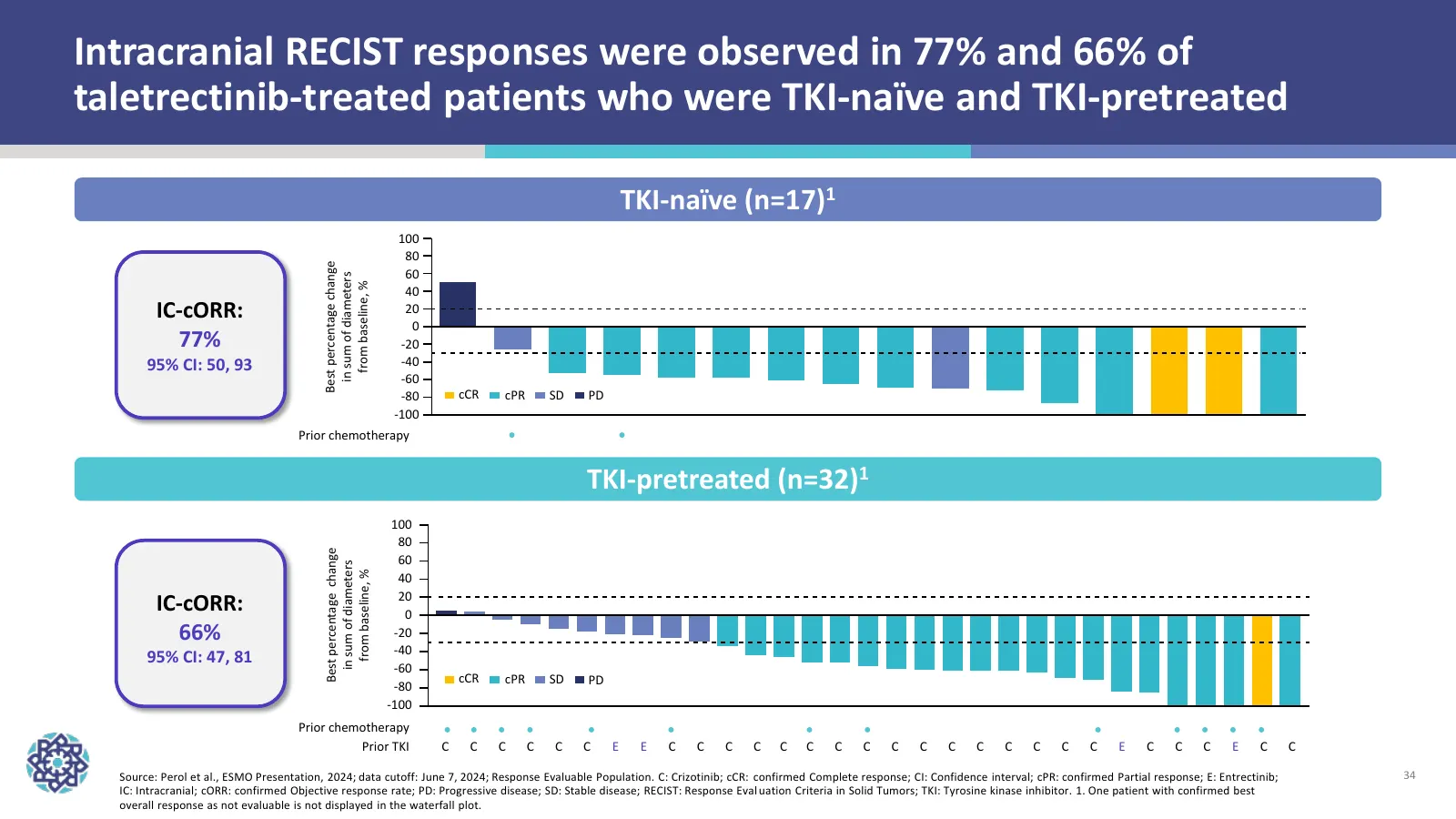
Slide 34: Intracranial RECIST responses in 77% and 66% of patients
Intracranial RECIST responses were observed in 77% and 66% of taletrectinib-treated patients who were TKI-naïve and TKI-pretreated TKI-naïve (n=17)1 100 80 Best percentage change 60 in sum of diameters from baseline, % 40 IC-cORR: 20 0 77% -20 95% CI: 50, 93 -40 -60 -80 cCR cPR SD PD -100 Prior chem
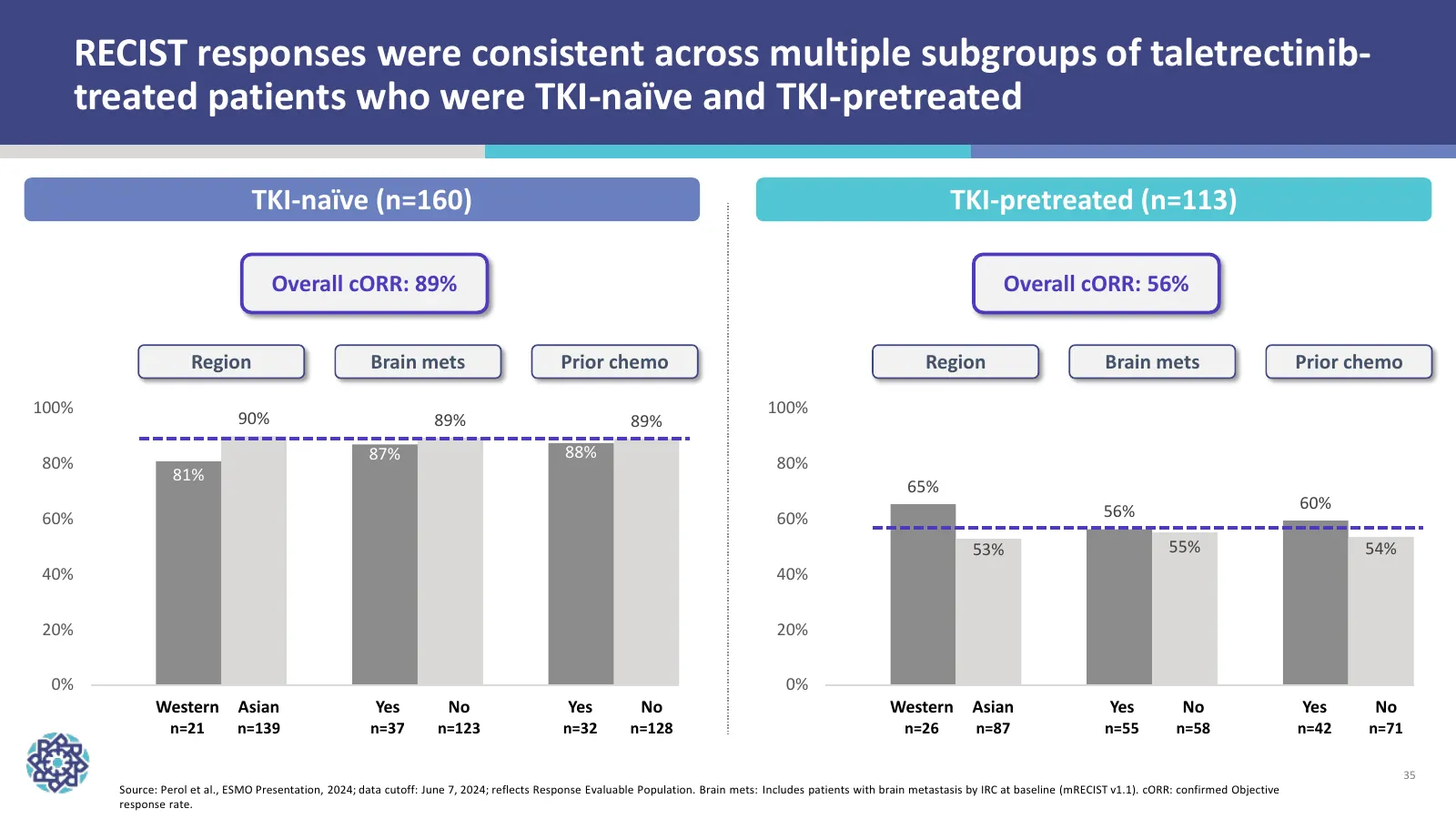
Slide 35: RECIST responses consistent across multiple subgroups
RECIST responses were consistent across multiple subgroups of taletrectinib- treated patients who were TKI-naïve and TKI-pretreated TKI-naïve (n=160) TKI-pretreated (n=113) Overall cORR: 89% Overall cORR: 56% Region Brain mets Prior chemo Region Brain mets Prior chemo 100% 100% 90% 89% 89% 87% 88% 8
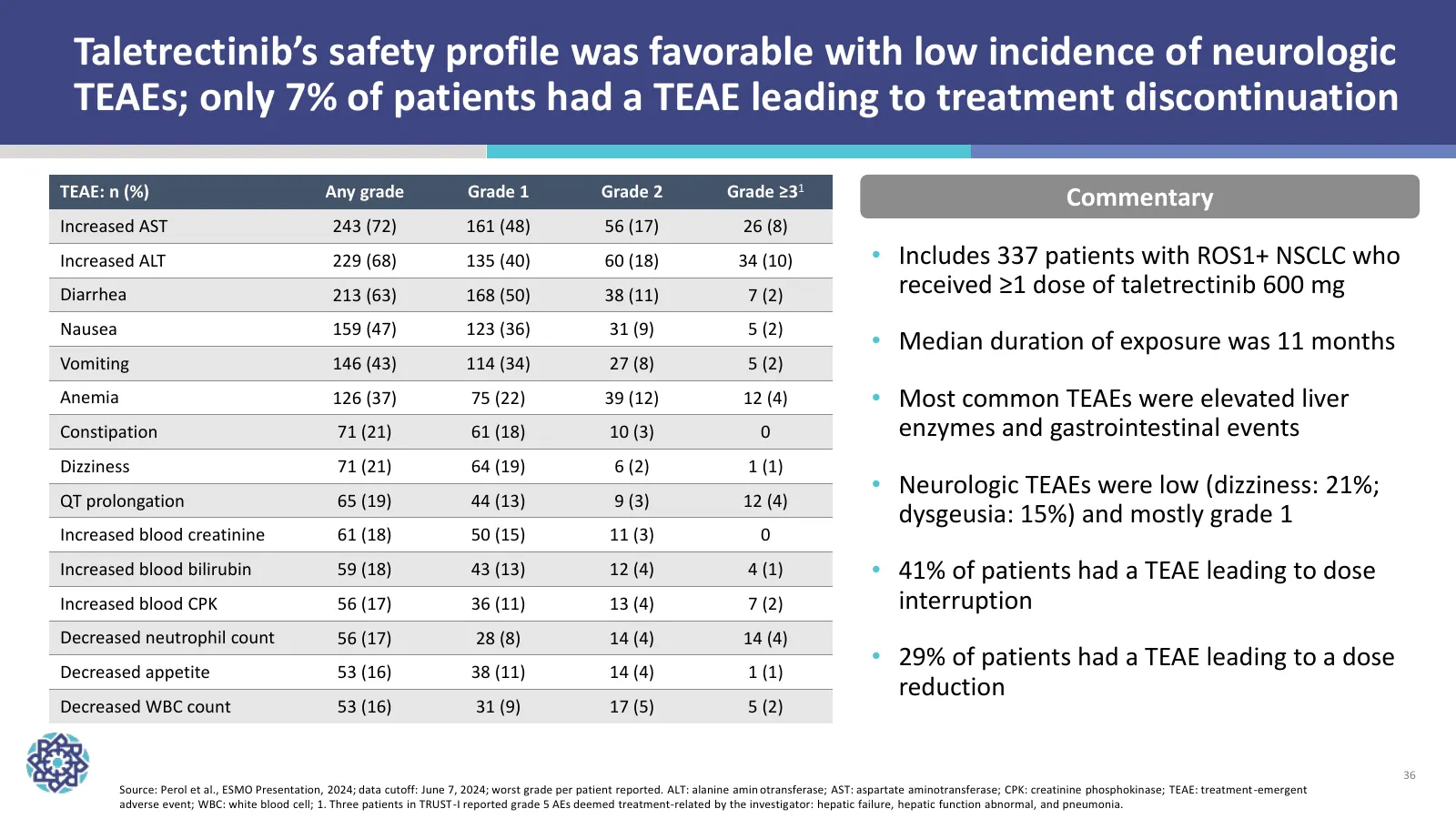
Slide 36: Taletrectinib safety profile favorable with low incidence of neurologic TEAEs
Taletrectinib’s safety profile was favorable with low incidence of neurologic TEAEs; only 7% of patients had a TEAE leading to treatment discontinuation TEAE: n (%) Any grade Grade 1 Grade 2 Grade ≥31 Commentary Increased AST 243 (72) 161 (48) 56 (17) 26 (8) Increased ALT 229 (68) 135 (40) 60 (18) 3
Slide 37: NUV-1511 (DDC)
NUV-1511 (DDC) Phase 1 study protocol 37
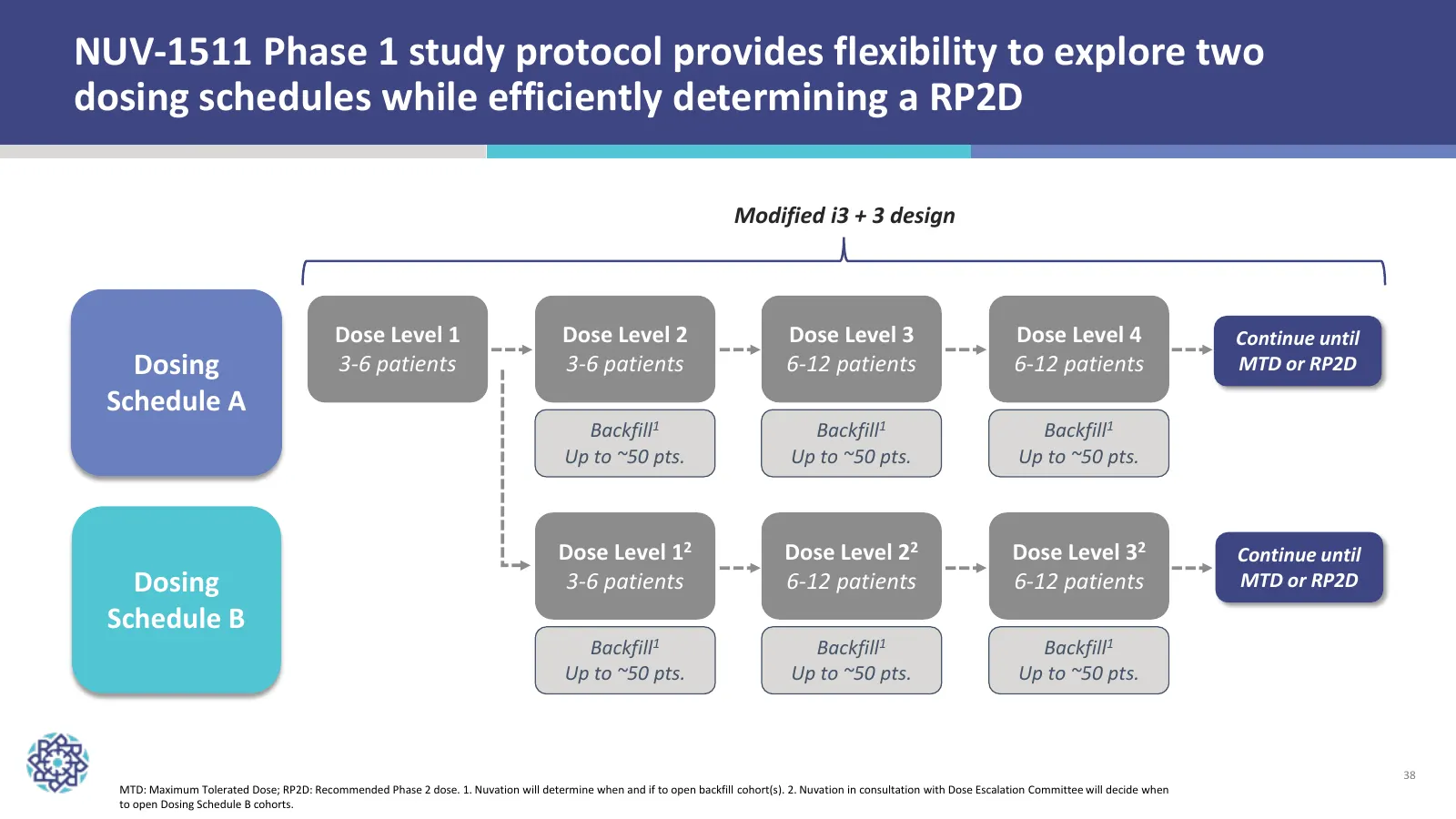
Slide 38: NUV-1511 Phase 1 study protocol explores two dosing schedules
NUV-1511 Phase 1 study protocol provides flexibility to explore two dosing schedules while efficiently determining a RP2D Modified i3 + 3 design Dose Level 1 Dose Level 2 Dose Level 3 Dose Level 4 Continue until Dosing 3-6 patients 3-6 patients 6-12 patients 6-12 patients MTD or RP2D Schedule A Back
Slide 39: NUV-868 (BETi)
NUV-868 (BETi) BD2 inhibition 39
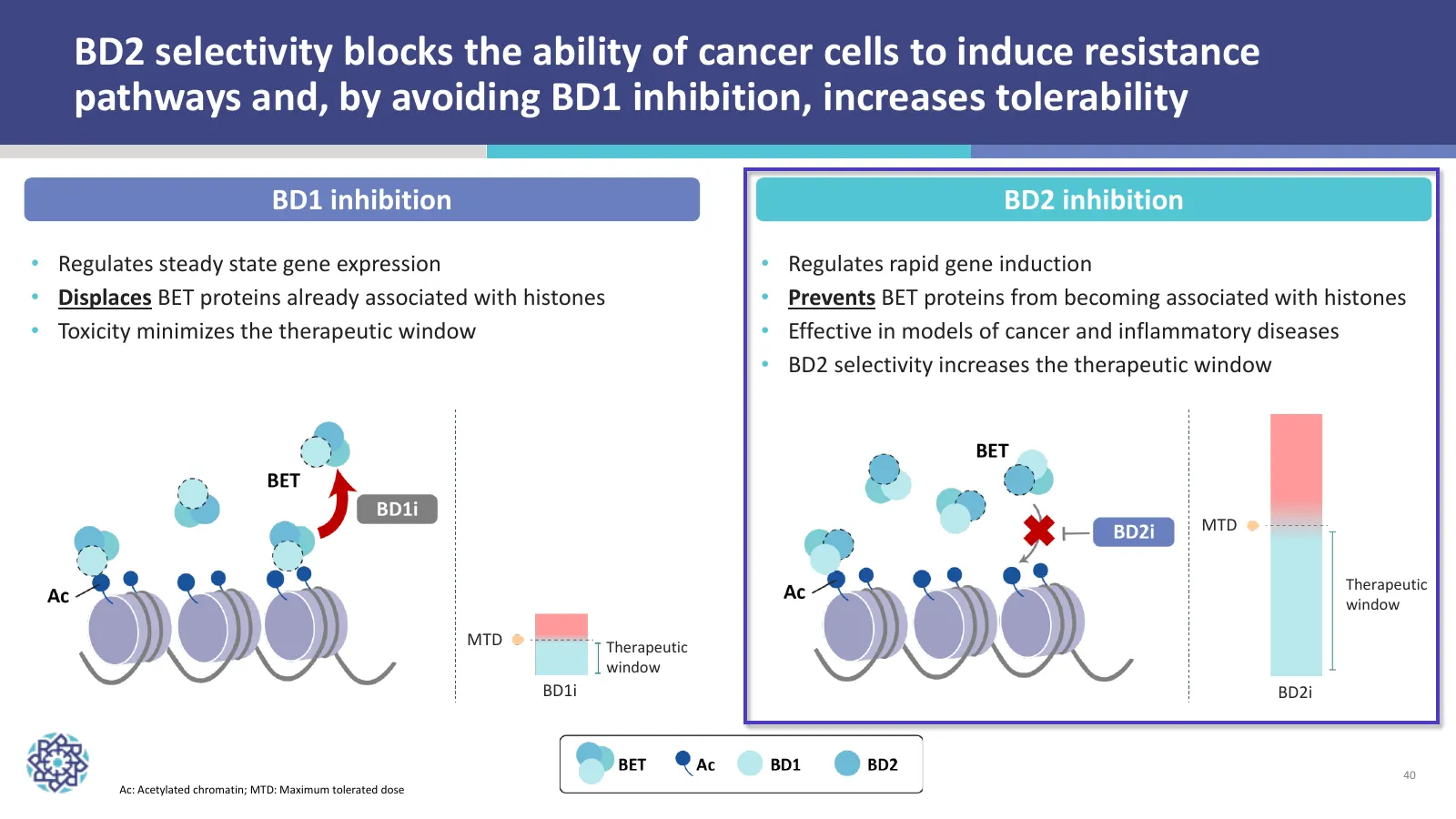
Slide 40: BD2 selectivity blocks resistance pathways and increases tolerability
BD2 selectivity blocks the ability of cancer cells to induce resistance pathways and, by avoiding BD1 inhibition, increases tolerability BD1 inhibition BD2 inhibition • Regulates steady state gene expression • Regulates rapid gene induction • Displaces BET proteins already associated with histones •
Source: Internet Archive copy of s27.q4cdn.com
More decks from Nuvation Bio Inc.
 Q2 2026 Earnings Presentation34 slides · Aug 6, 2026
 Q1 2026 Earnings Presentation34 slides · May 4, 2026
 Investor Presentation (January 2026)37 slides · January 2026
 Investor Presentation (November 2025)36 slides · Nov 26, 2025
 Investor Presentation (November 2025)39 slides · Nov 17, 2025
 Q2 2025 Earnings Presentation6 slides · Aug 7, 2025