SUSS MicroTec SE · XETR:SMHN
SUSS MicroTec — Honeywell Electronic Materials — Peaks in Packaging 2003
22 slides from SUSS MicroTec's conference presentation, 2003
Slide 1: Alpha Radiation Sources in Low Alpha Materials: Pb Free Materials Refining and Alpha Flux Reduction
SEMITOOL SEMITOOL Peaks in Packaging 2003 Alpha Radiation Sources in Low Alpha Materials: Pb Free Materials Refining and Alpha Flux reduction Brett Clark Metrology Development Scientist Honeywell Electronic Materials Spokane, WA Clark, Honeywell Electronic Materials - Slide 1
Slide 2: Outline
SEMITOOL SEMITOOL Outline Peaks in Packaging 2003 • Alpha radiation: sources and soft errors • 210Pb model Experiments • Results and consequences for Pb Free solders • Alpha Emission in Pb Free materials • Alpha Emission reduction in Low Alpha materials • Refining results • Conclusions Clark, Honeyw
Slide 3: Soft Error Upsets
SEMITOOL SEMITOOL Soft Error Upsets Peaks in Packaging 2003 • Charge deposition in sensitive regions causes logic state change • Smaller device geometry/solder proximity • Cosmic Rays • Alpha particles from solder bumps – 210Pb – U, Th, and decay daughters – Manufacturers turning to low alpha materi
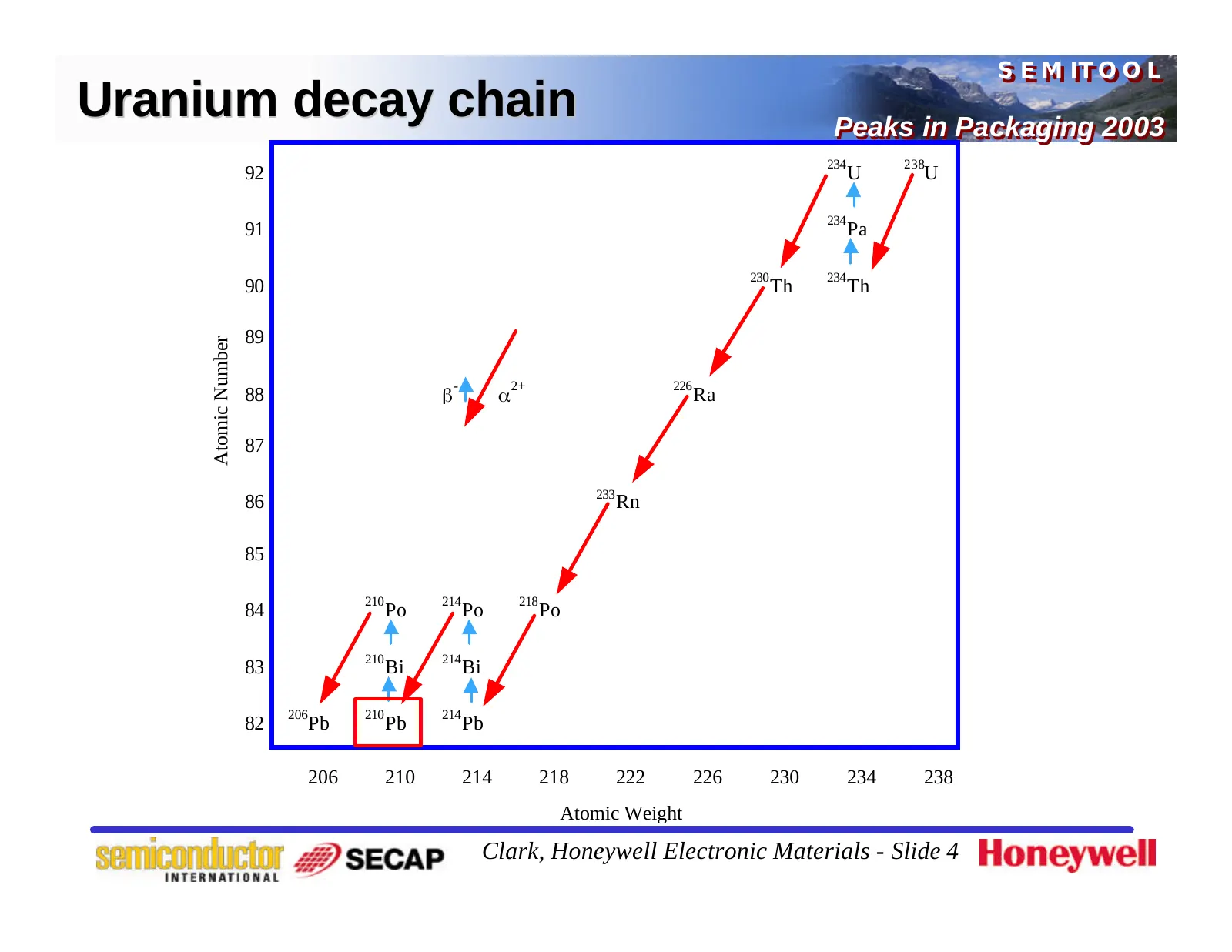
Slide 4: Uranium decay chain
SEMITOOL SEMITOOL Uranium decay chain Peaks in Packaging 2003 234 238 92 U U 234 91 Pa 230 234 90 Th Th 89 Atomic Number - 2+ 226 88 β α Ra 87 233 86 Rn 85 210 214 218 84 Po Po Po 210 214 83 Bi Bi 206 210 214 82 Pb Pb Pb 206 210 214 218 222 226 230 234 238 Atomic Weight Clark, Honeywell Electronic M
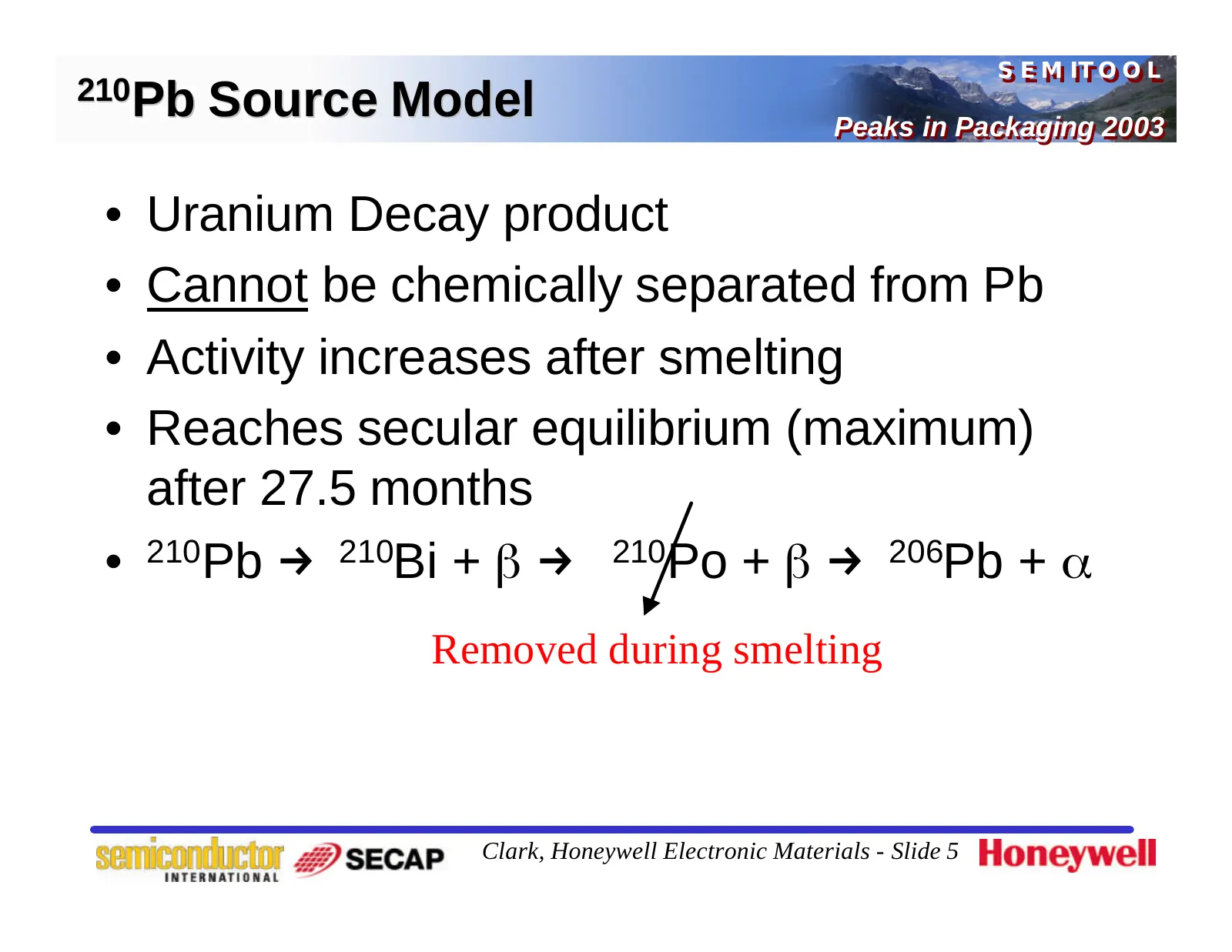
Slide 5: 210Pb Source Model
SEMITOOL SEMITOOL 210Pb Source Model Peaks in Packaging 2003 • Uranium Decay product • Cannot be chemically separated from Pb • Activity increases after smelting • Reaches secular equilibrium (maximum) after 27.5 months • 210Pb → 210Bi + β → 210Po + β → 206Pb + α Removed during smelting Clark, Honey
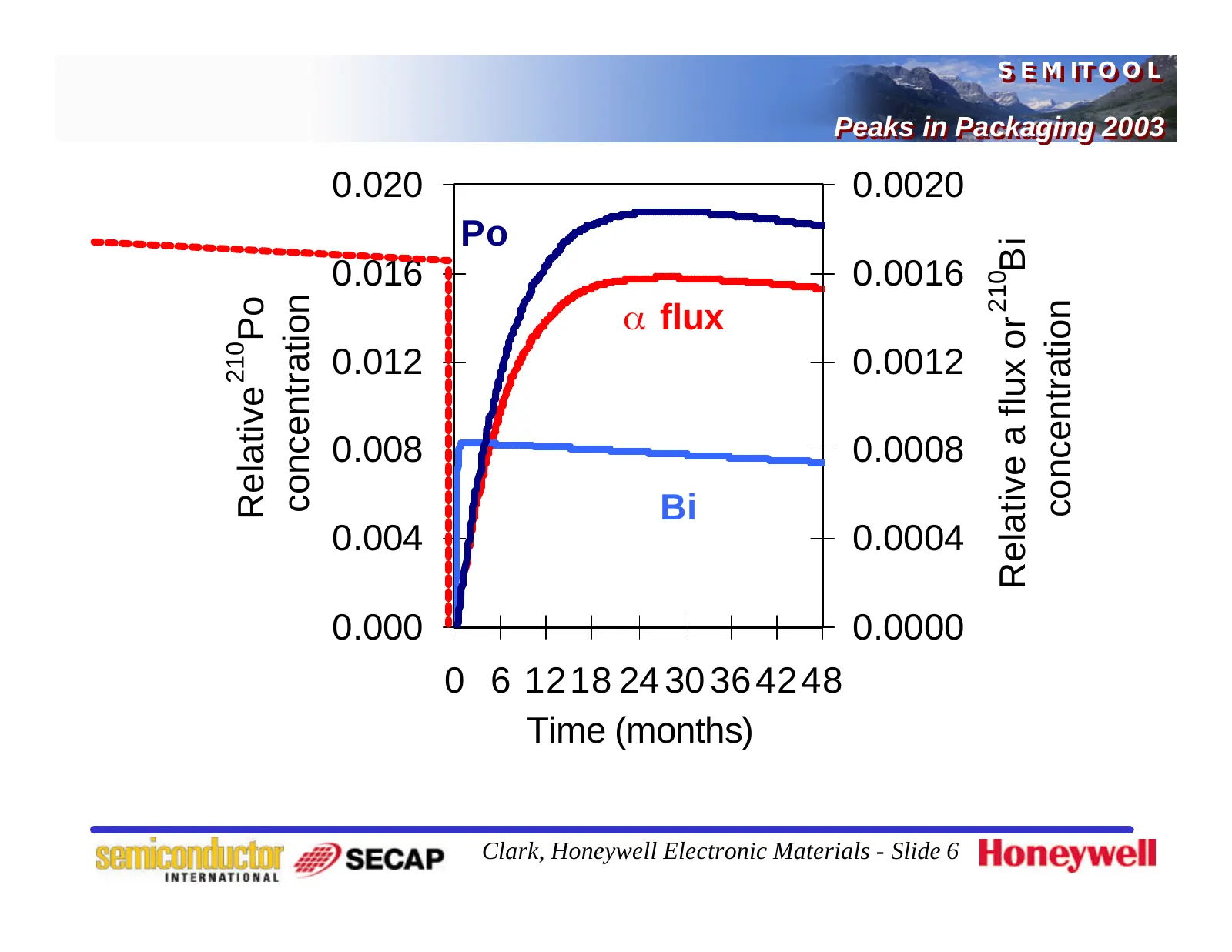
Slide 6: Relative alpha flux and 210Po/210Bi concentration over time
SEMITOOL SEMITOOL Peaks in Packaging 2003 0.020 0.0020 Po Relative a flux or Bi 0.016 0.0016 210 α flux concentration Relative Po concentration 210 0.012 0.0012 0.008 0.0008 Bi 0.004 0.0004 0.000 0.0000 0 6 12 18 24 30 36 42 48 Time (months) Clark, Honeywell Electronic Materials - Slide 6
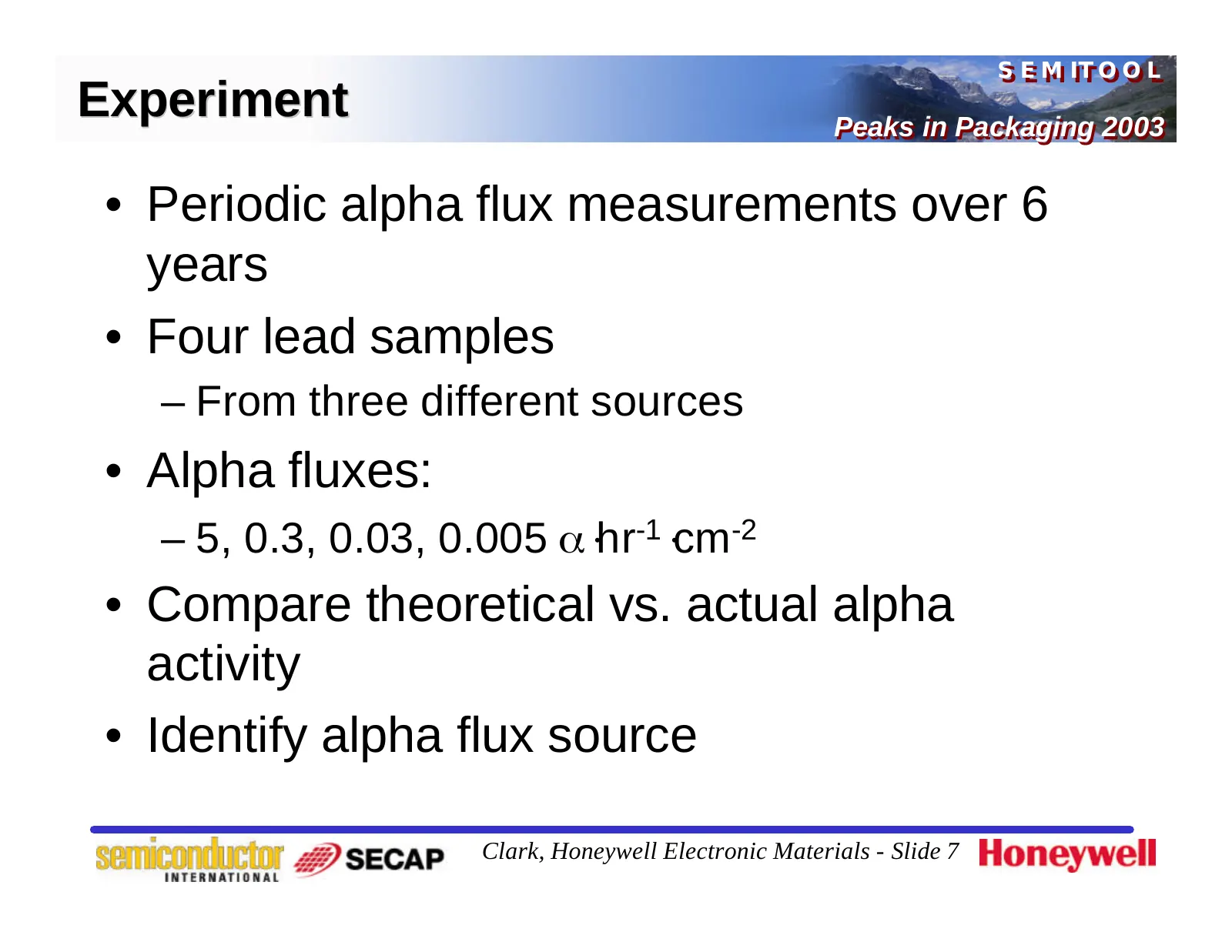
Slide 7: Experiment: Periodic alpha flux measurements over years
SEMITOOL SEMITOOL Experiment Peaks in Packaging 2003 • Periodic alpha flux measurements over 6 years • Four lead samples – From three different sources • Alpha fluxes: – 5, 0.3, 0.03, 0.005 α⋅hr-1⋅cm-2 • Compare theoretical vs. actual alpha activity • Identify alpha flux source Clark, Honeywell Elec
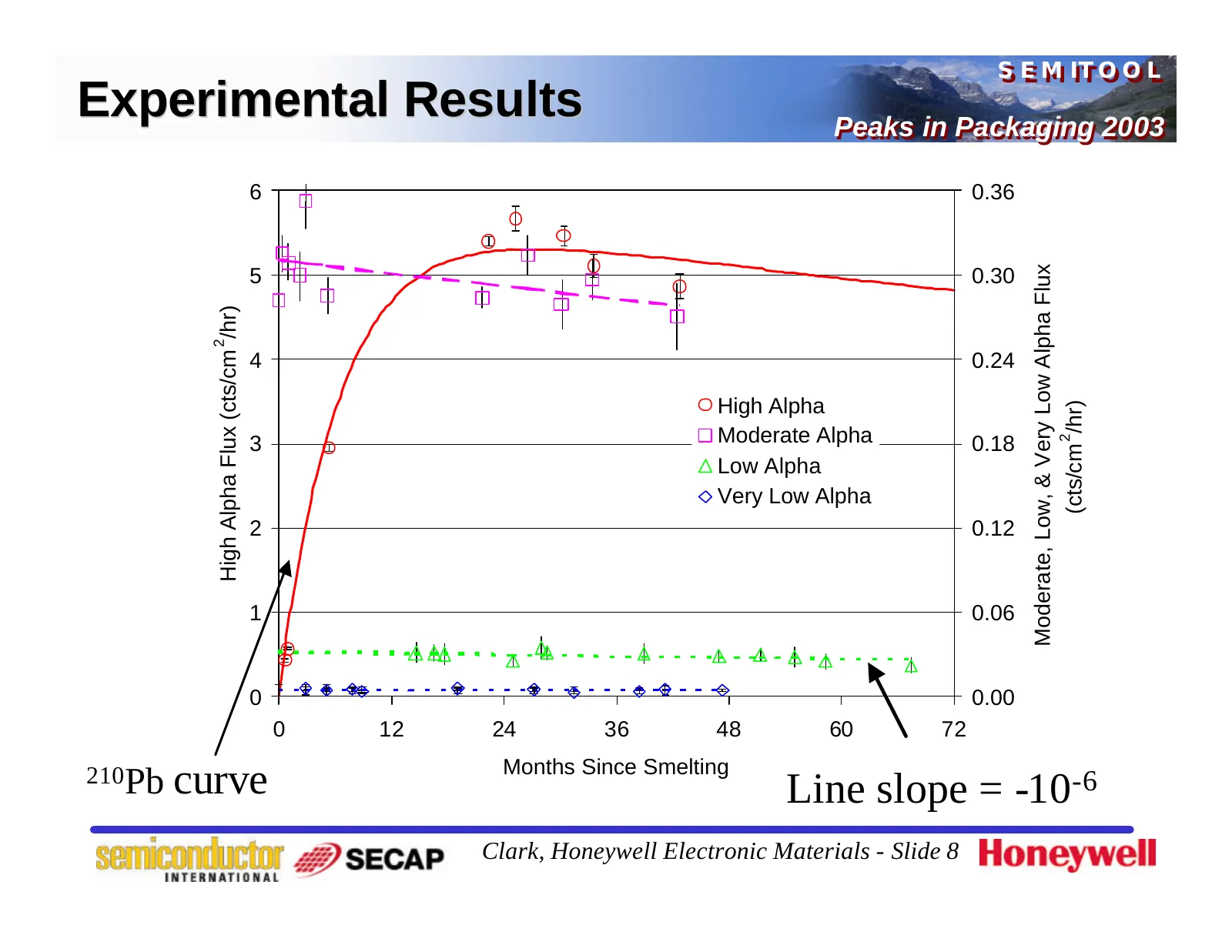
Slide 8: Experimental Results
SEMITOOL SEMITOOL Experimental Results Peaks in Packaging 2003 6 0.36 Moderate, Low, & Very Low Alpha Flux 5 0.30 High Alpha Flux (cts/cm /hr) 2 4 0.24 High Alpha (cts/cm /hr) Moderate Alpha 2 3 0.18 Low Alpha Very Low Alpha 2 0.12 1 0.06 0 0.00 0 12 24 36 48 60 72 Months Since Smelting 210Pb curve
Slide 9: Results
SEMITOOL SEMITOOL Results Peaks in Packaging 2003 • High activity sample follows secular equilibrium model – Alpha source is 210Pb – Smelting significantly effected activity • Moderate, Low and very low alpha materials – Do not follow secular equilibrium model – Measurement error is greater than fit
Slide 10: Data Interpretation
SEMITOOL SEMITOOL Data Interpretation Peaks in Packaging 2003 • No significant increase in low alpha lead activity over 6 years • High alpha and very low alpha samples from same supplier – Why is one changed and the other not? – Processing does disturb secular equilibrium • No Alpha activity change
Slide 11: Alpha flux vs emitter level
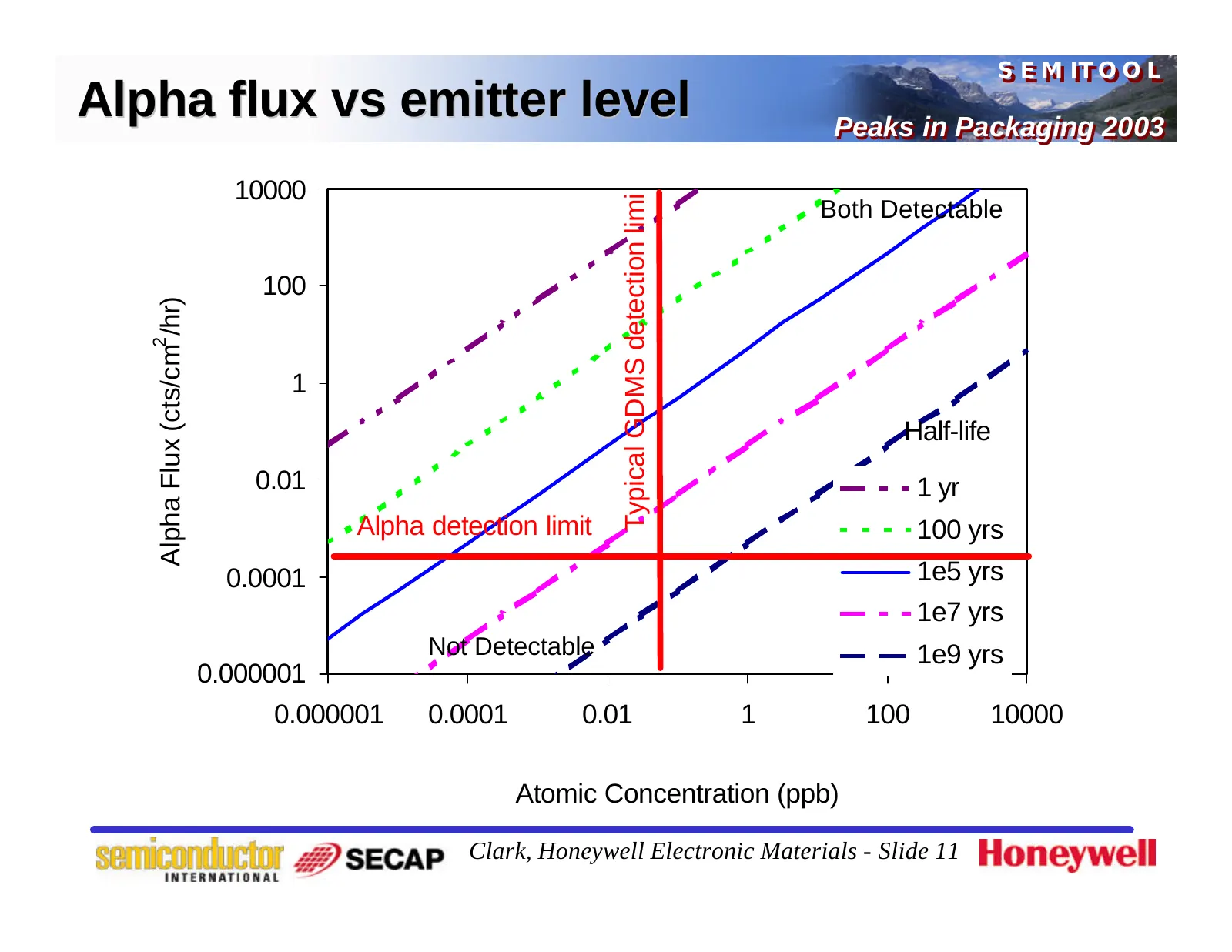
SEMITOOL SEMITOOL Alpha flux vs emitter level Peaks in Packaging 2003 10000 Typical GDMS detection limit Both Detectable 100 Alpha Flux (cts/cm /hr) 2 1 Half-life 0.01 1 yr Alpha detection limit 100 yrs 0.0001 1e5 yrs 1e7 yrs Not Detectable 1e9 yrs 0.000001 0.000001 0.0001 0.01 1 100 10000 Atomic Co
Slide 12: Trace impurity observations
SEMITOOL SEMITOOL Trace impurity observations Peaks in Packaging 2003 • Radioisotopes in the ppt range can significantly effect alpha flux – 8 alpha particles result from every U decay • At or below trace element analytical detection limits • 99.999999% (8N) purity can still fail alpha flux specific
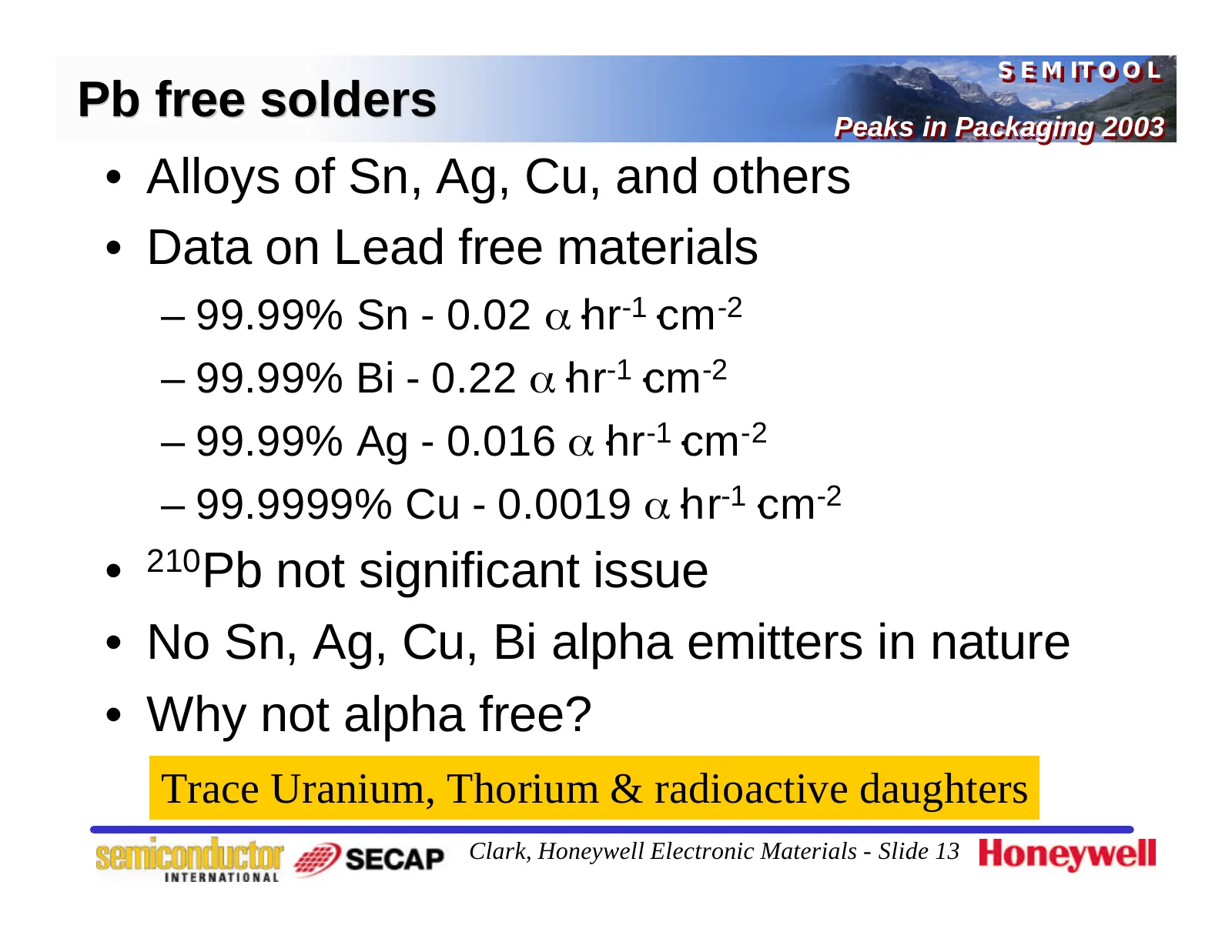
Slide 13: Pb free solders
SEMITOOL SEMITOOL Pb free solders Peaks in Packaging 2003 • Alloys of Sn, Ag, Cu, and others • Data on Lead free materials – 99.99% Sn - 0.02 α⋅hr-1⋅cm -2 – 99.99% Bi - 0.22 α⋅hr-1⋅cm-2 – 99.99% Ag - 0.016 α⋅hr-1⋅cm-2 – 99.9999% Cu - 0.0019 α⋅hr-1⋅cm-2 • 210Pb not significant issue • No Sn, Ag, Cu,
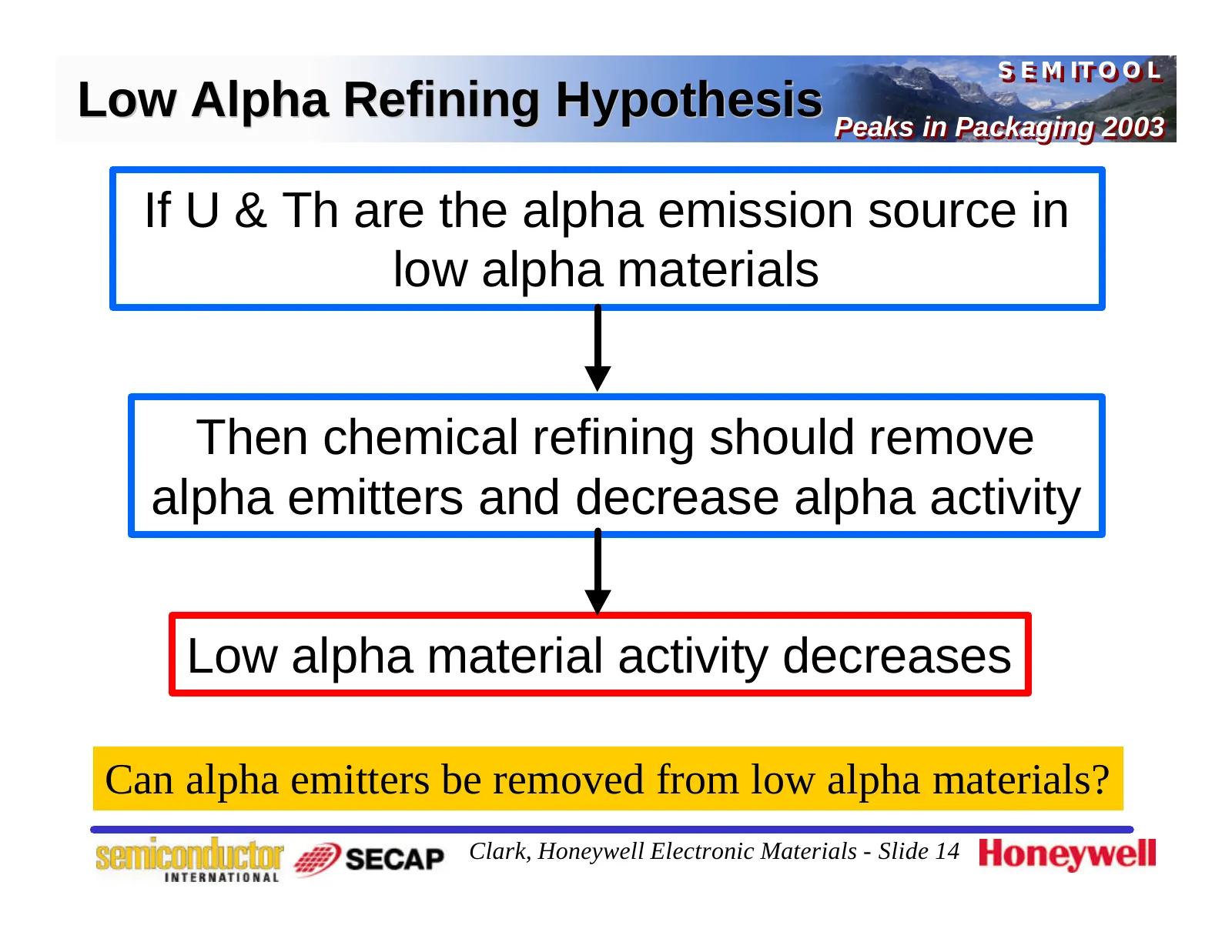
Slide 14: Low Alpha Refining Hypothesis
SEMITOOL SEMITOOL Low Alpha Refining Hypothesis Peaks in Packaging 2003 If U & Th are the alpha emission source in low alpha materials Then chemical refining should remove alpha emitters and decrease alpha activity Low alpha material activity decreases Can alpha emitters be removed from low alpha ma
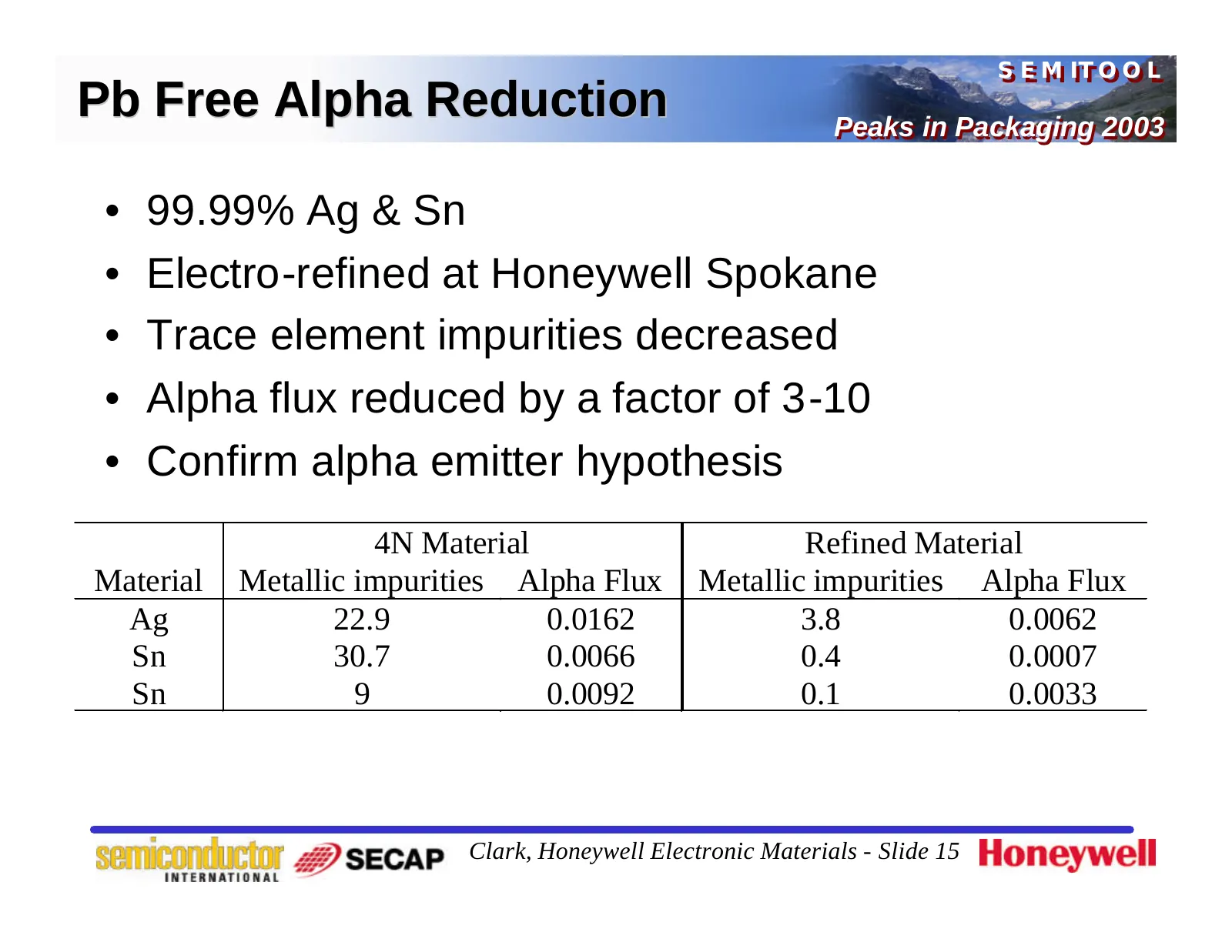
Slide 15: Pb Free Alpha Reduction
SEMITOOL SEMITOOL Pb Free Alpha Reduction Peaks in Packaging 2003 • 99.99% Ag & Sn • Electro-refined at Honeywell Spokane • Trace element impurities decreased • Alpha flux reduced by a factor of 3-10 • Confirm alpha emitter hypothesis 4N Material Refined Material Material Metallic impurities Alpha F
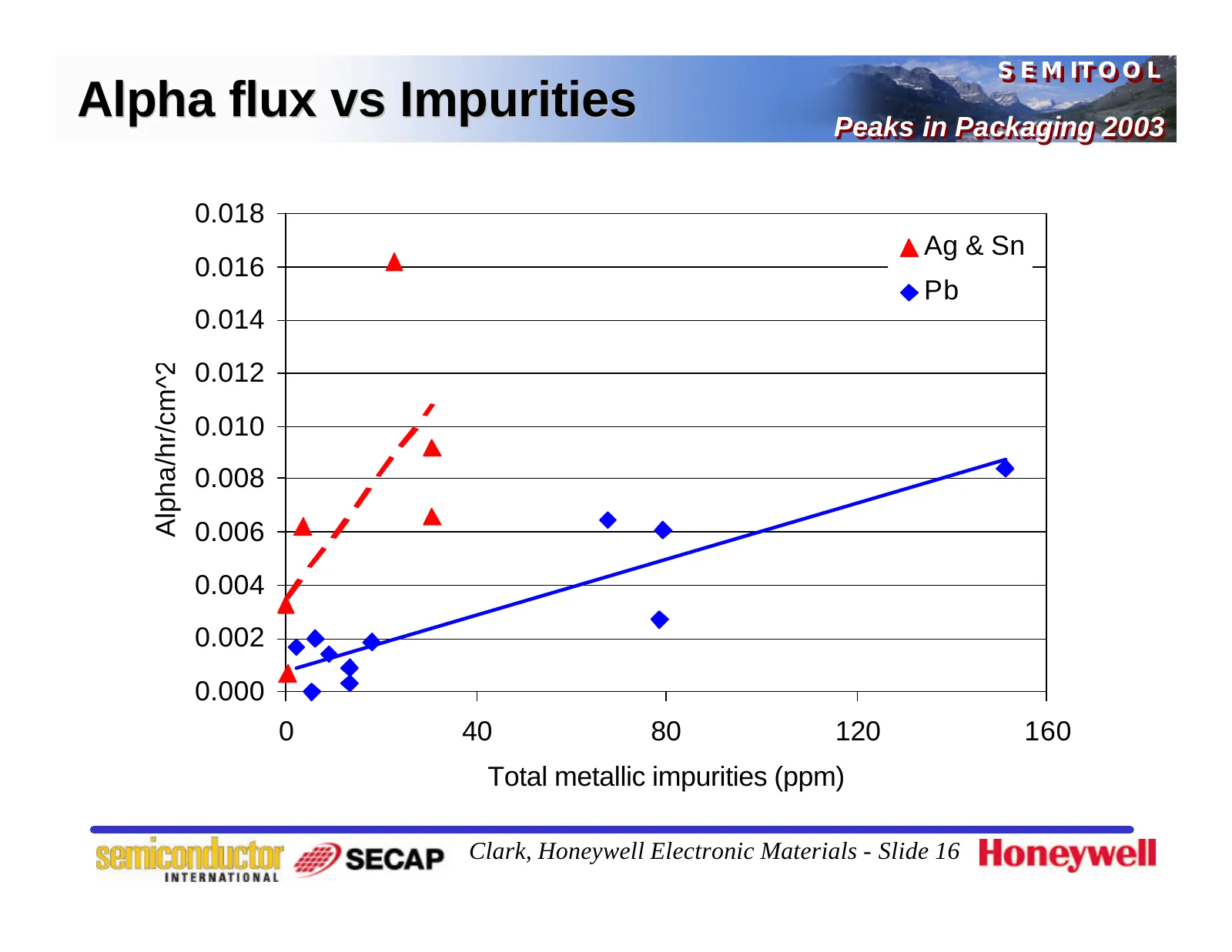
Slide 16: Alpha flux vs Impurities
SEMITOOL SEMITOOL Alpha flux vs Impurities Peaks in Packaging 2003 0.018 Ag & Sn 0.016 Pb 0.014 Alpha/hr/cm^2 0.012 0.010 0.008 0.006 0.004 0.002 0.000 0 40 80 120 160 Total metallic impurities (ppm) Clark, Honeywell Electronic Materials - Slide 16
Slide 17: Questions to be answered
SEMITOOL SEMITOOL Questions to be answered Peaks in Packaging 2003 • Removal mechanism? – Electrical: Reduction potentials – Chemical: Solubility in refining bath • Difference in slopes between Pb and Ag/Sn? – 210Pb component? – Varying selectivity for different trace elements • Different selectivit
Slide 18: Conclusions
SEMITOOL SEMITOOL Conclusions Peaks in Packaging 2003 • Low alpha Pb from three different sources does not follow 210Pb model – Alpha activity does not increase – 210Pb is not the alpha source in these low alpha materials • Significant alpha emissions in Pb free materials • Alpha source in low alpha
Slide 19: Conclusions
SEMITOOL SEMITOOL Conclusions Peaks in Packaging 2003 • U & Th contamination hazard increases with lower activity materials • Electro-refining removes a significant fraction of alpha emitters in a single pass • Confirmation that alpha source in Pb free materials is U & Th • Honeywell has a patent pe
Slide 20: Future Work
SEMITOOL SEMITOOL Future Work Peaks in Packaging 2003 • Process optimization – Address contamination hazards • Evaluate capabilities to reach 0.0001 material and lower • Improved detector technology • Focus on Pb free materials Clark, Honeywell Electronic Materials - Slide 20

Slide 21: Honeywell Team
SEMITOOL SEMITOOL Honeywell Team Peaks in Packaging 2003 Marty Weiser - Black Belt Ron Fleming - Metrology Manager Nancy Dean - Development Manager Mike Bossio - Production Manager Patrick Flint - Development Engineer Clark, Honeywell Electronic Materials - Slide 21
Slide 22: JEDEC Invitation
SEMITOOL SEMITOOL JEDEC Invitation Peaks in Packaging 2003 • Organizing JC13.4 subcommittee to write standard low alpha measurement procedure for industry • Increasingly necessary as material specifications decrease • Open to JEDEC Members • Contact: Brett.Clark@Honeywell.com • Committee assembled b
Source: Internet Archive copy of suss.com
More decks from SUSS MicroTec SE
 9M 2026 Earnings Presentation23 slides · Nov 5, 2026
 Investor Presentation (October 2026)41 slides · October 2026
 H1 2026 Earnings Presentation24 slides · Aug 6, 2026
 Q1 2026 Earnings Presentation19 slides · May 7, 2026
 FY2025 Earnings Presentation26 slides · Mar 30, 2026
 Investor Presentation (March 2026)42 slides · Mar 1, 2026