Virbac SA · EURONEXT:VIRP
Virbac SA — Technical Presentation
34 slides from Virbac SA's technical presentation
Slide 1: “Global Worming”: What you can do to prevent anthelminthic meltdown
“Global Worming”: What you can do to prevent anthelminthic meltdown Joan Norton VMD DACVIM MBA
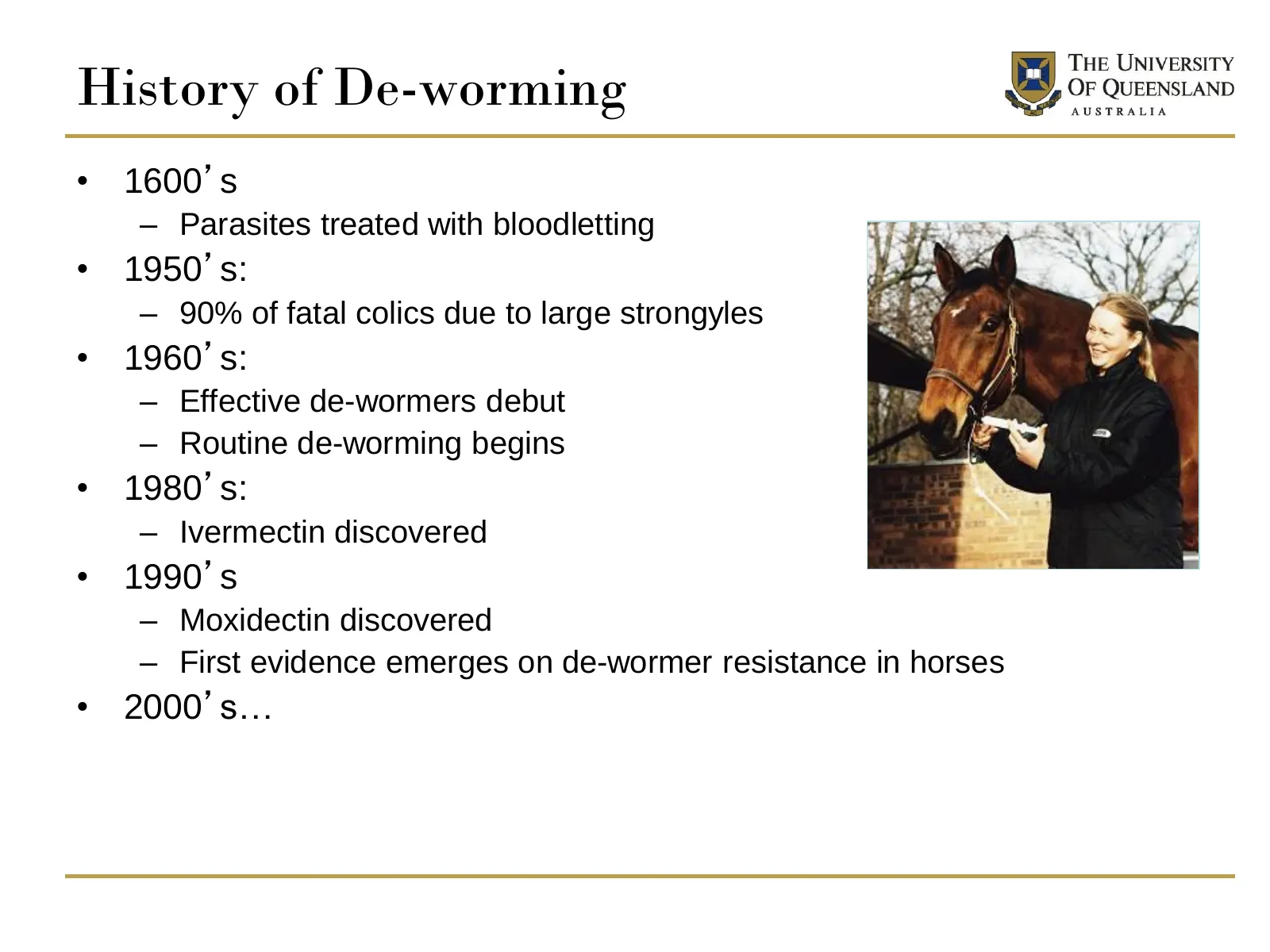
Slide 2: History of De-worming
History of De-worming • 1600’s – Parasites treated with bloodletting • 1950’s: – 90% of fatal colics due to large strongyles • 1960’s: – Effective de-wormers debut – Routine de-worming begins • 1980’s: – Ivermectin discovered • 1990’s – Moxidectin discovered – First evidence emerges on de-wormer res
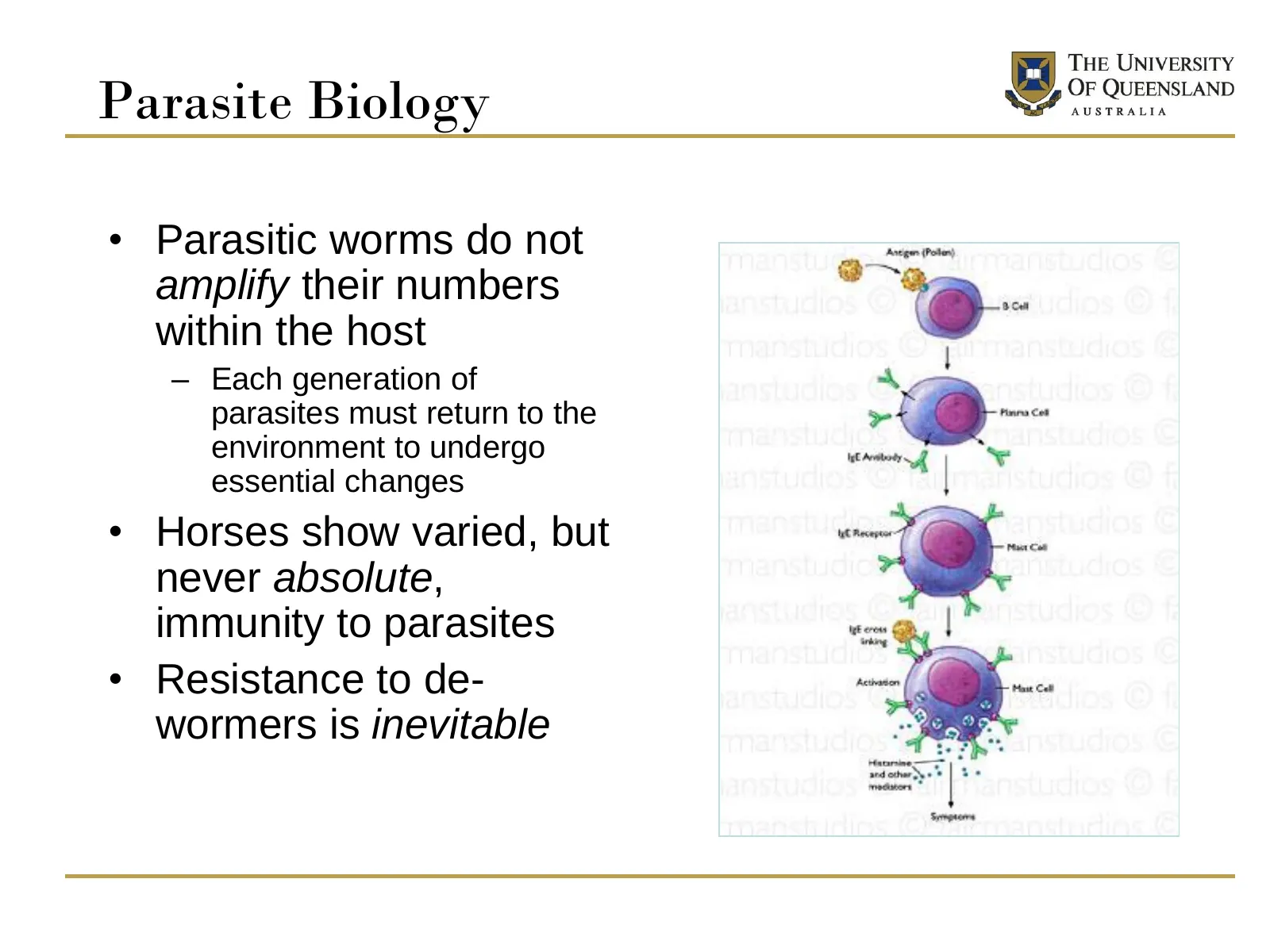
Slide 3: Parasite Biology
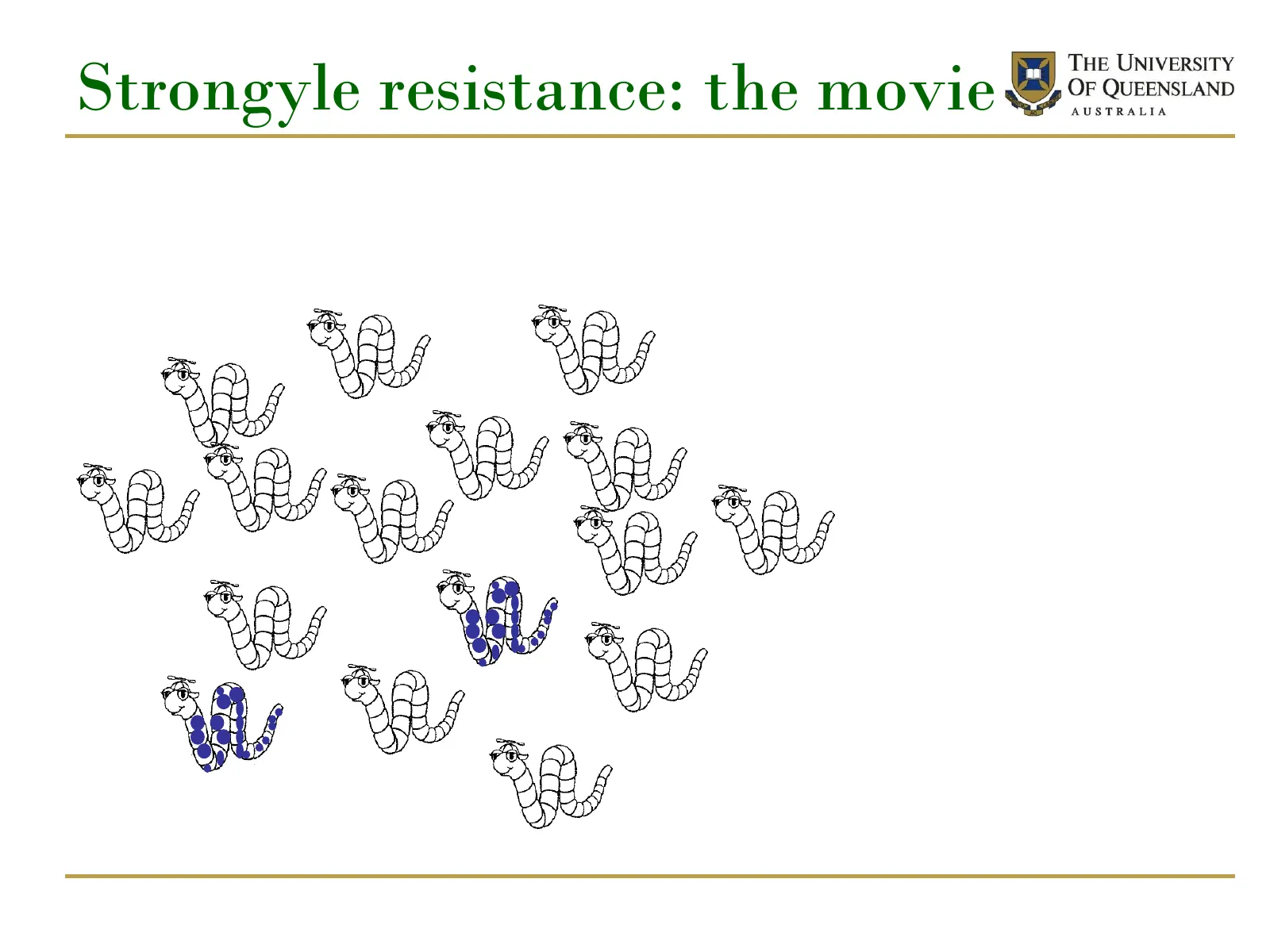
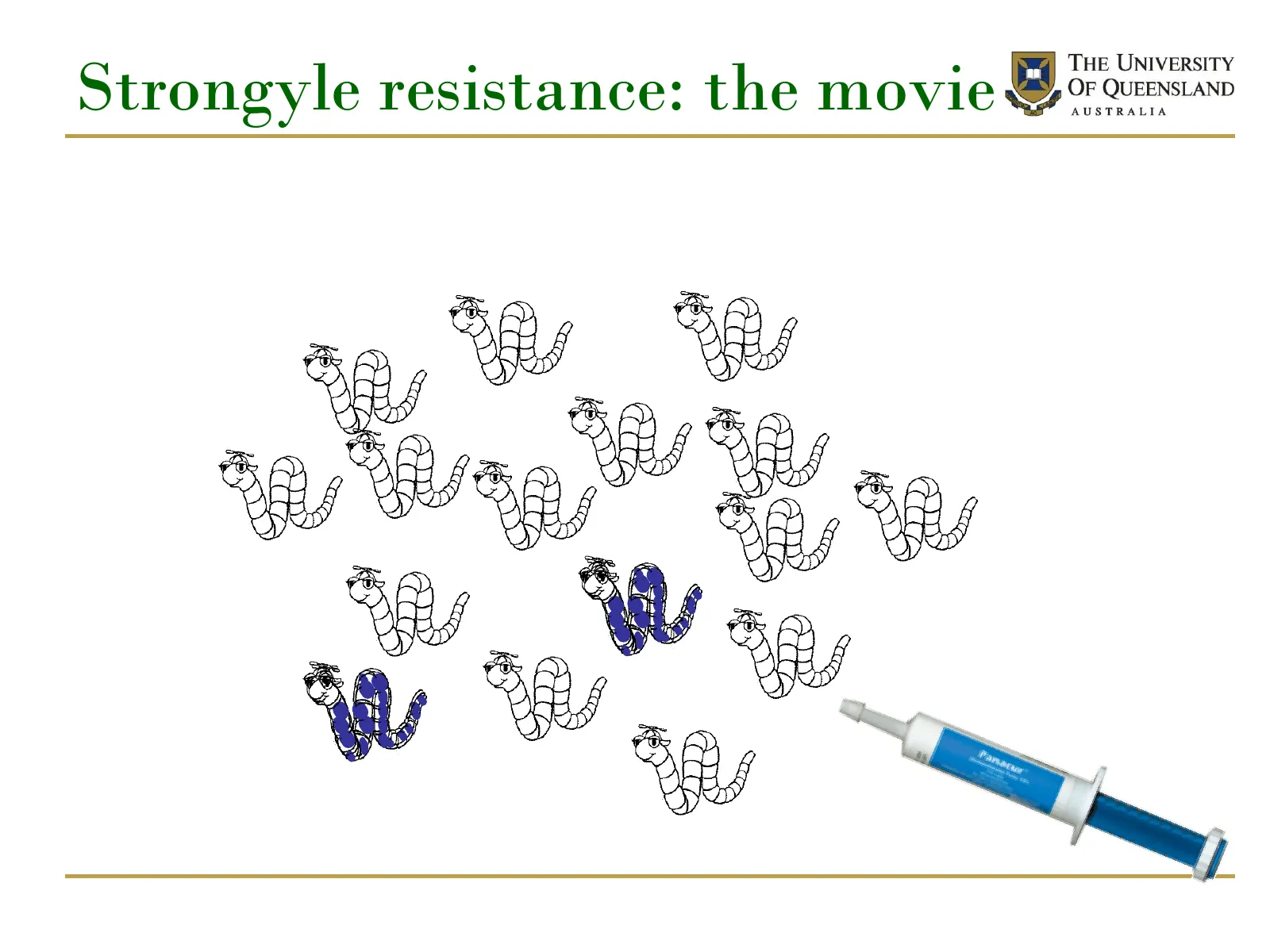
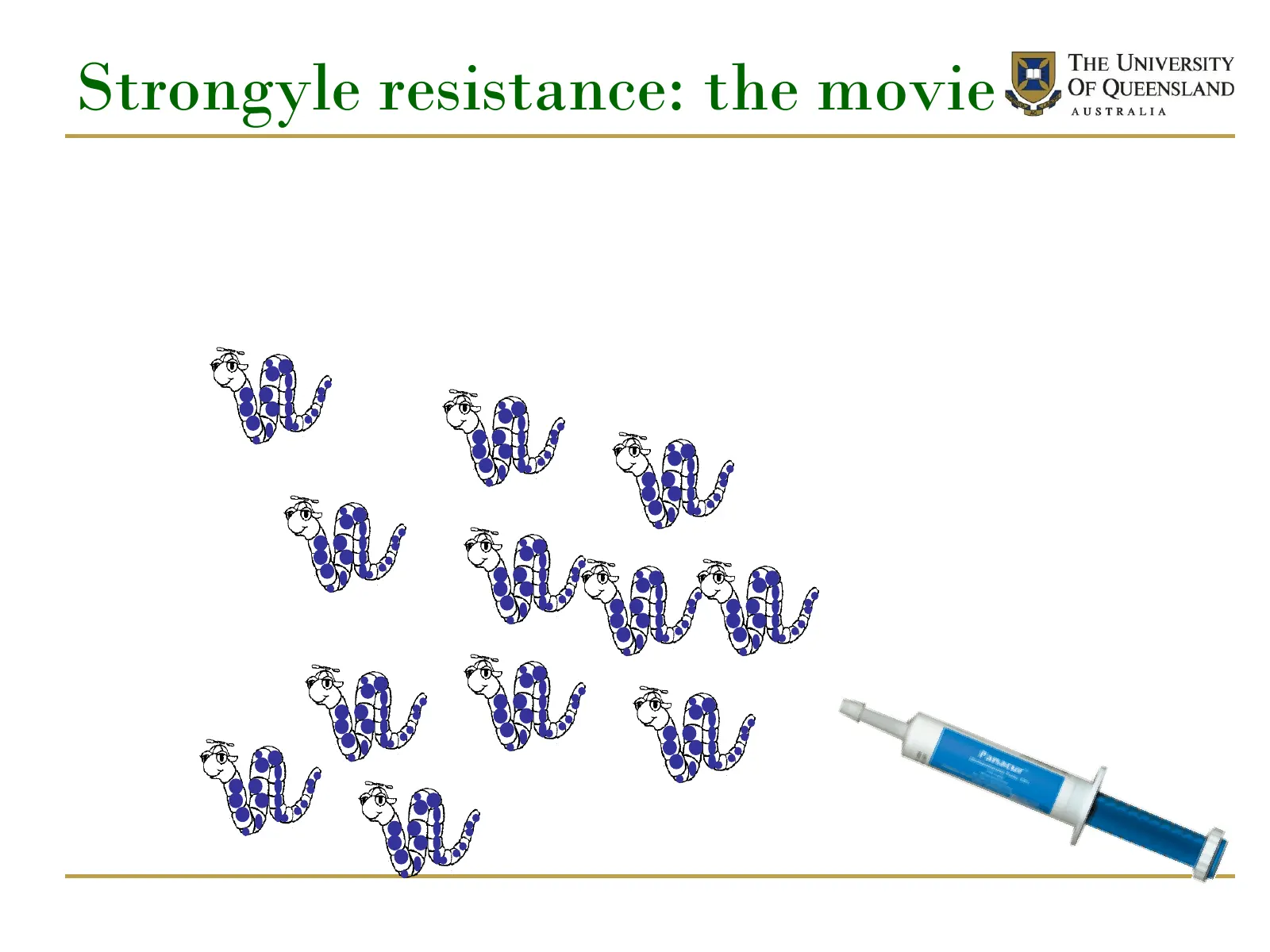
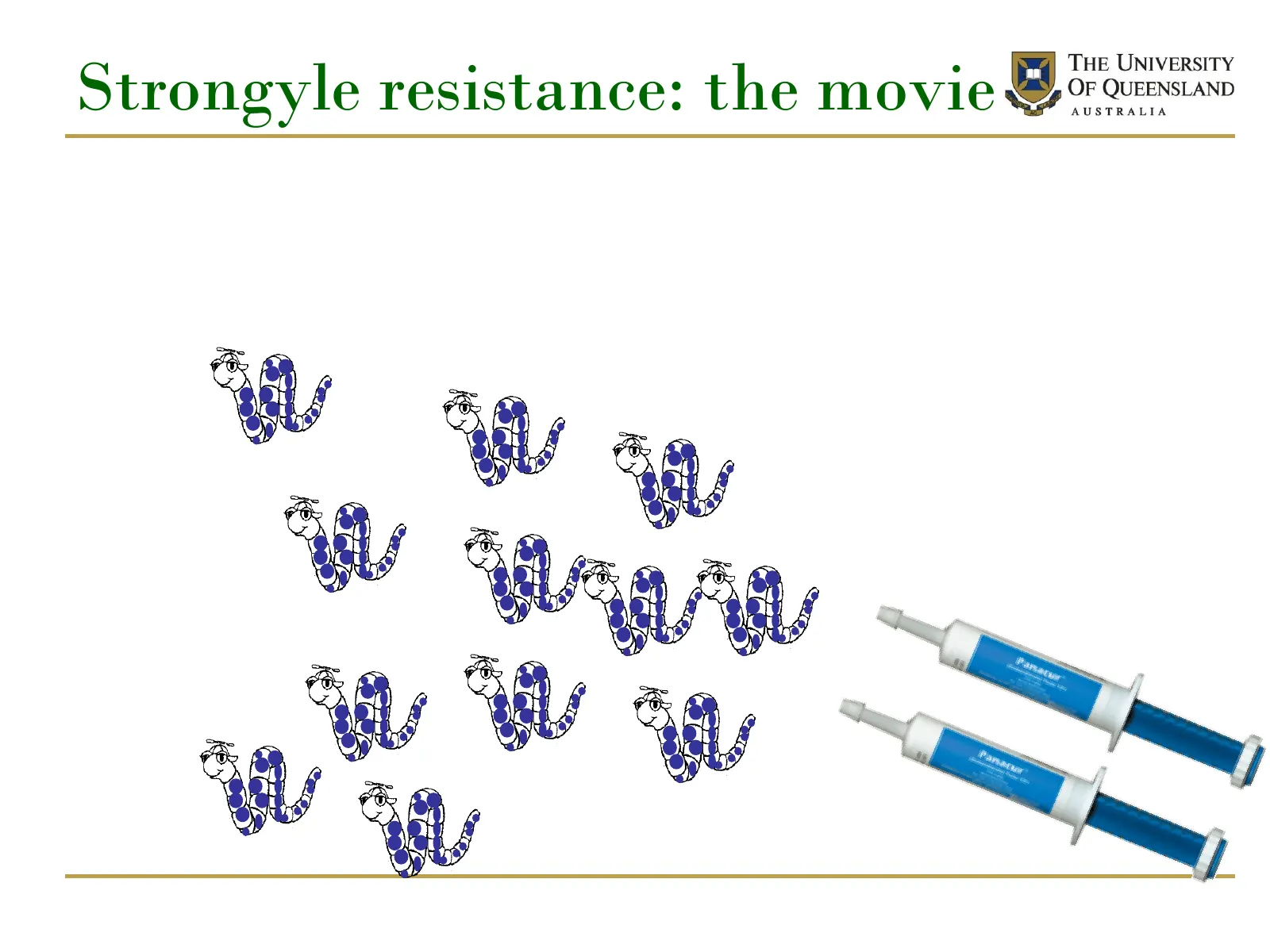
Parasite Biology • Parasitic worms do not amplify their numbers within the host – Each generation of parasites must return to the environment to undergo essential changes • Horses show varied, but never absolute, immunity to parasites • Resistance to de- wormers is inevitable
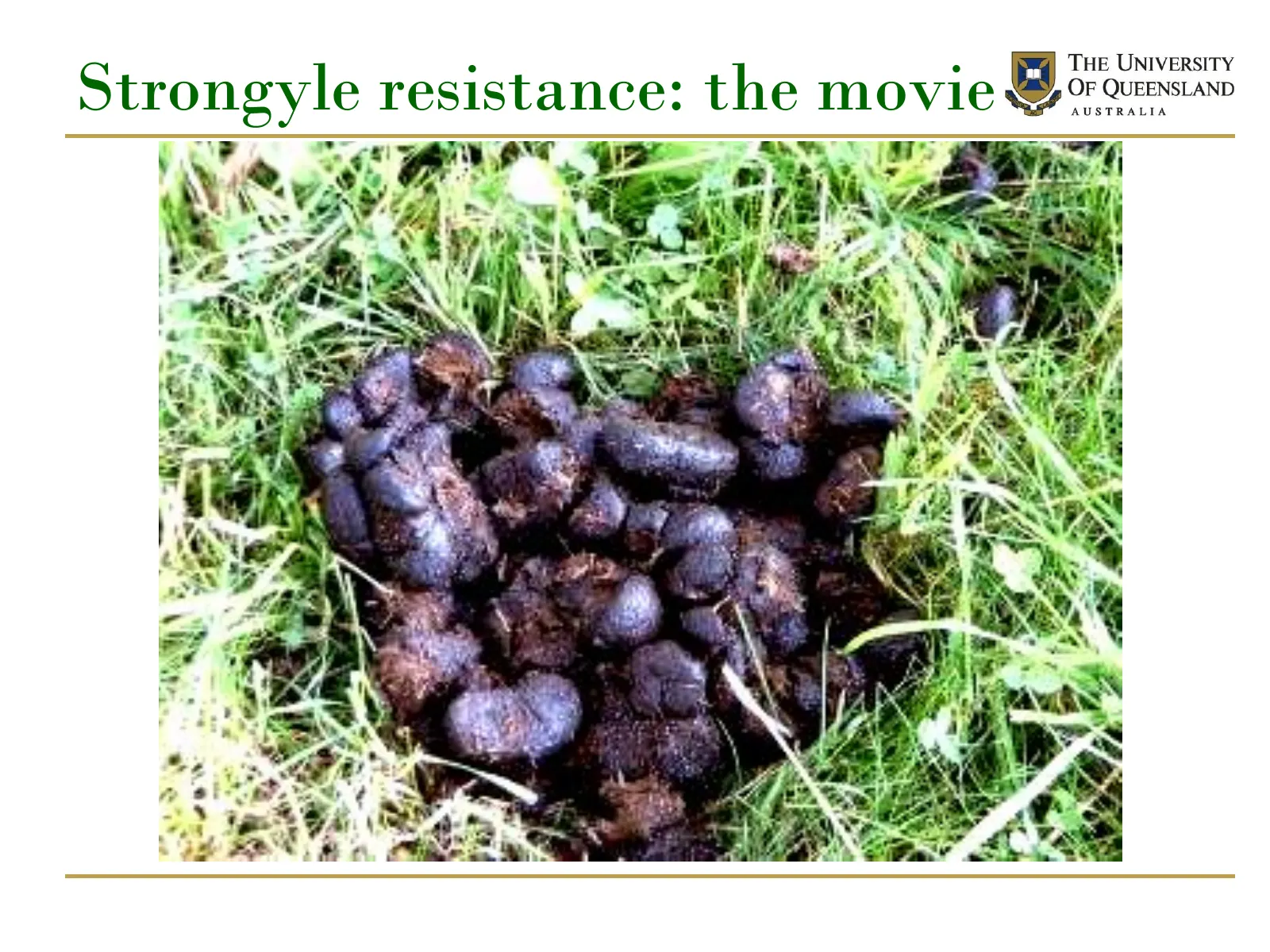
Slide 4: Strongyle resistance: the movie
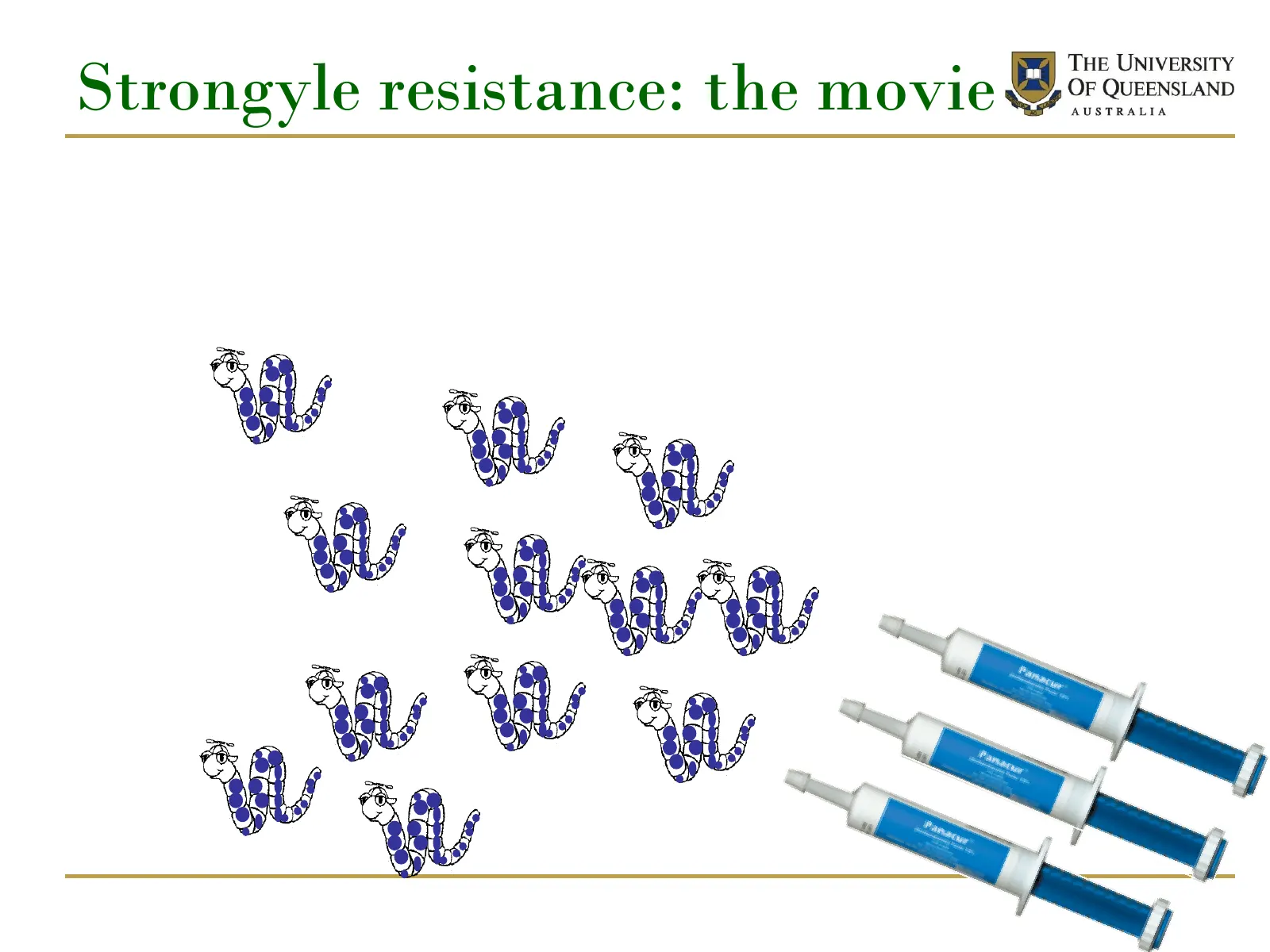
Strongyle resistance: the movie
Slide 5: Strongyle resistance: the movie
Strongyle resistance: the movie
Slide 6: Strongyle resistance: the movie
Strongyle resistance: the movie
Slide 7: Strongyle resistance: the movie
Strongyle resistance: the movie
Slide 8: Strongyle resistance: the movie
Strongyle resistance: the movie
Slide 9: Strongyle resistance: the movie
Strongyle resistance: the movie
Slide 10: Anthelminthic Resistance: An emerging threat
Anthelminthic Resistance: An emerging threat • In the past 25 years, no new classes of de-wormers have been developed for use in animals • In goats and sheep, there are now farms where worms are resistant to 100 % of known de-wormers • Horses?
Slide 11: Many de-wormers are already showing severe resistance
Many de-wormers are already showing severe resistance • Fenbendazole/Oxybendazole – As low as 0% effective against small strongyles! • Ivermectins – As low as 65% effective against roundworms
Slide 12: 10 steps you can take to prevent de-wormer meltdown
10 steps you can take to prevent de-wormer meltdown
Slide 13: Step #1: Acknowledge the problem
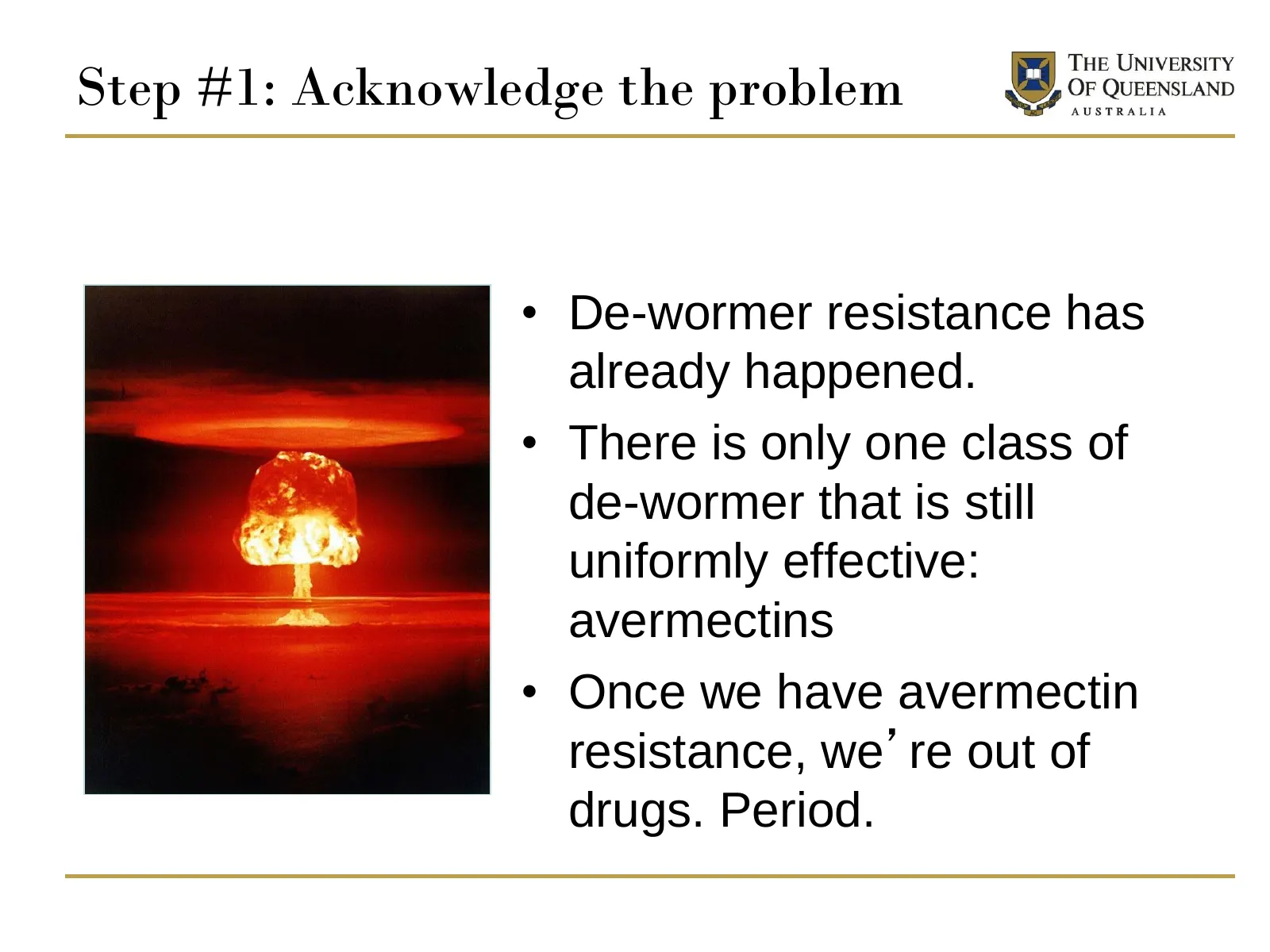
Step #1: Acknowledge the problem • De-wormer resistance has already happened. • There is only one class of de-wormer that is still uniformly effective: avermectins • Once we have avermectin resistance, we’re out of drugs. Period.
Slide 14: Goals – Parasite control
Goals – Parasite control 1. Prevent and treat parasite- related disease* 2. Prevent further resistance from developing *** Horses are never parasite-free; the goal is control, not eradication
Slide 15: Step #2: Start performing Fecal Egg Counts
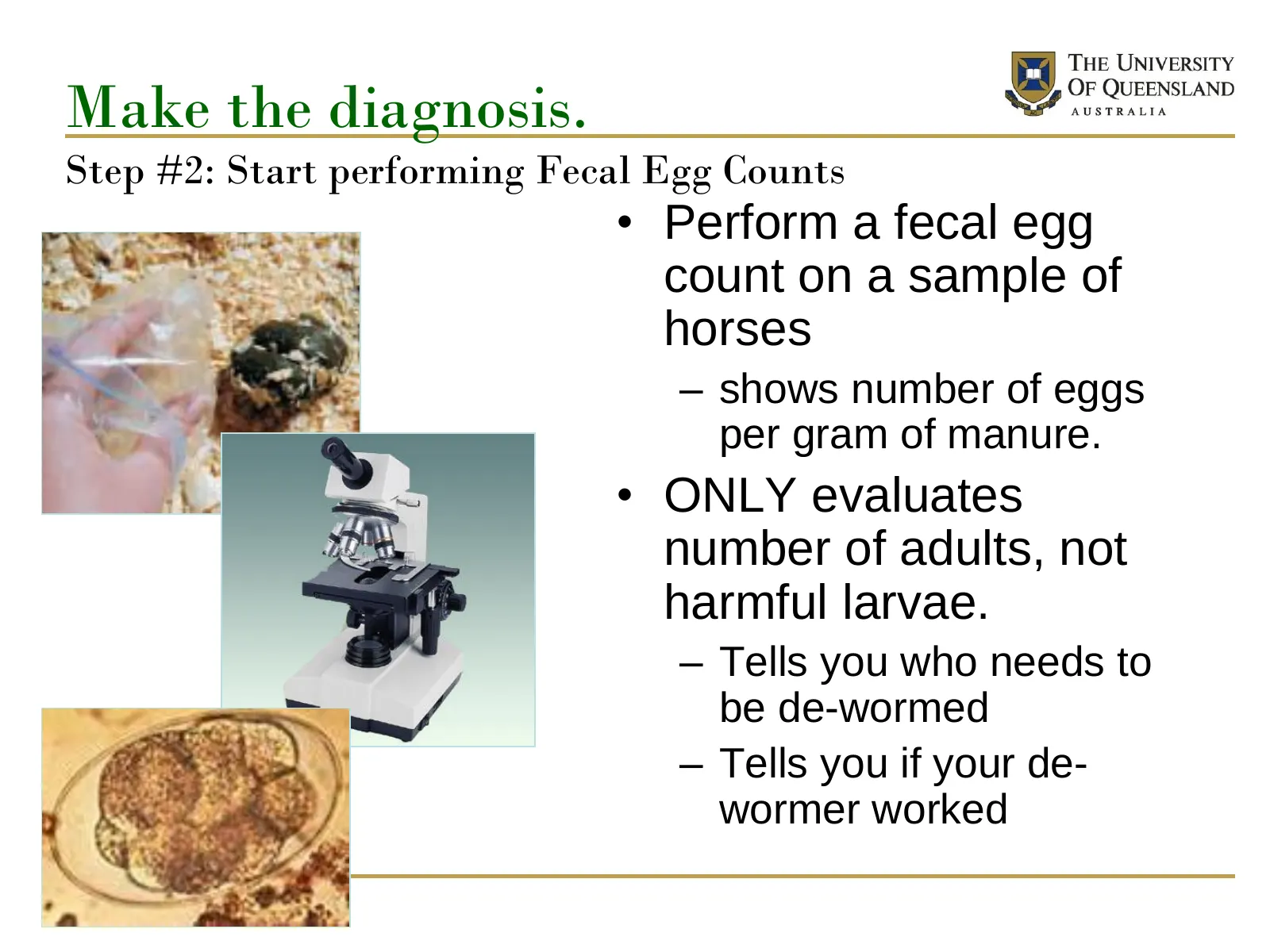
Make the diagnosis. Step #2: Start performing Fecal Egg Counts • Perform a fecal egg count on a sample of horses – shows number of eggs per gram of manure. • ONLY evaluates number of adults, not harmful larvae. – Tells you who needs to be de-wormed – Tells you if your de- wormer worked
Slide 16: Step #2: Fecal Egg Count Reduction Test
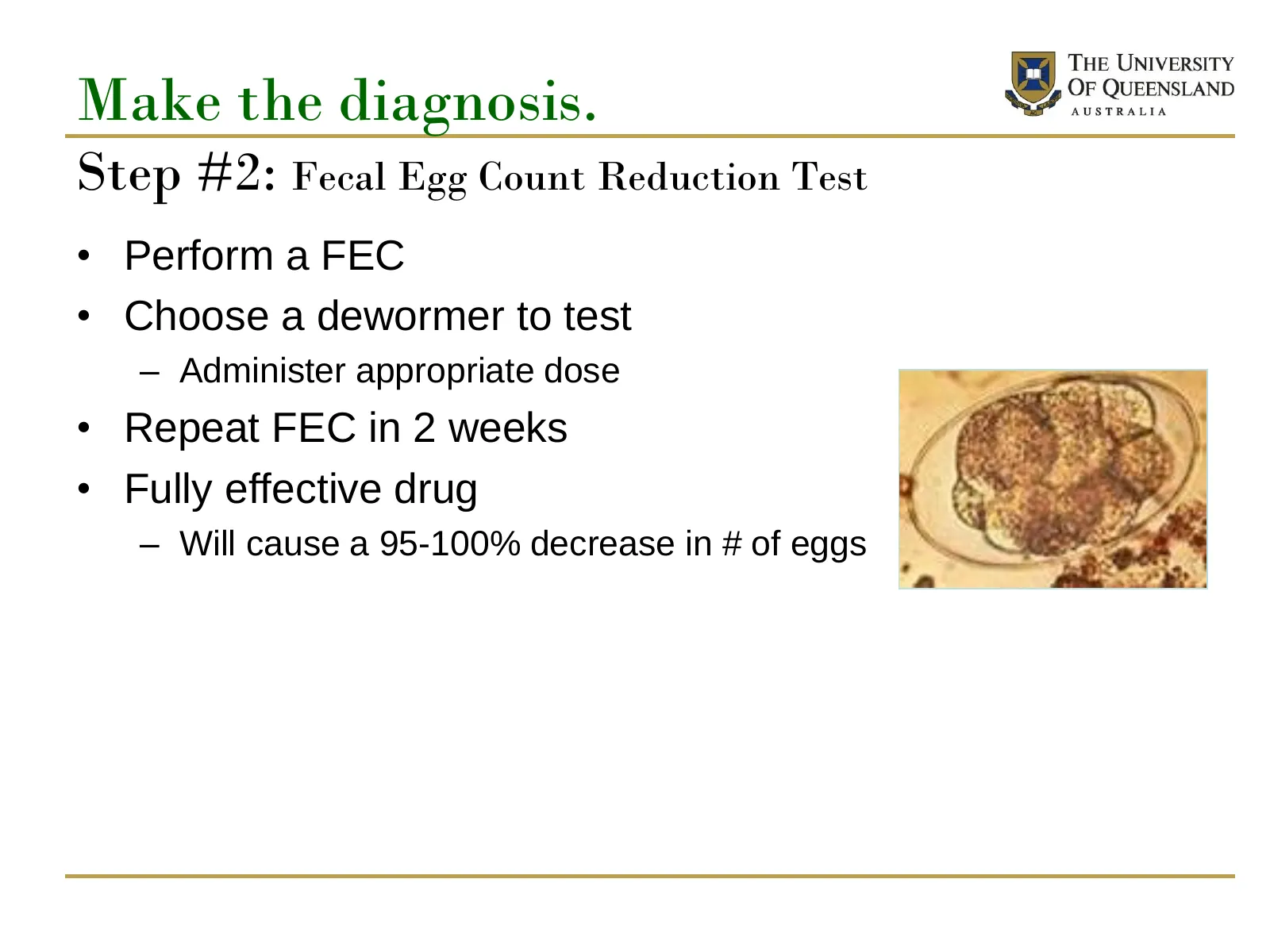
Make the diagnosis. Step #2: Fecal Egg Count Reduction Test • Perform a FEC • Choose a dewormer to test – Administer appropriate dose • Repeat FEC in 2 weeks • Fully effective drug – Will cause a 95-100% decrease in # of eggs
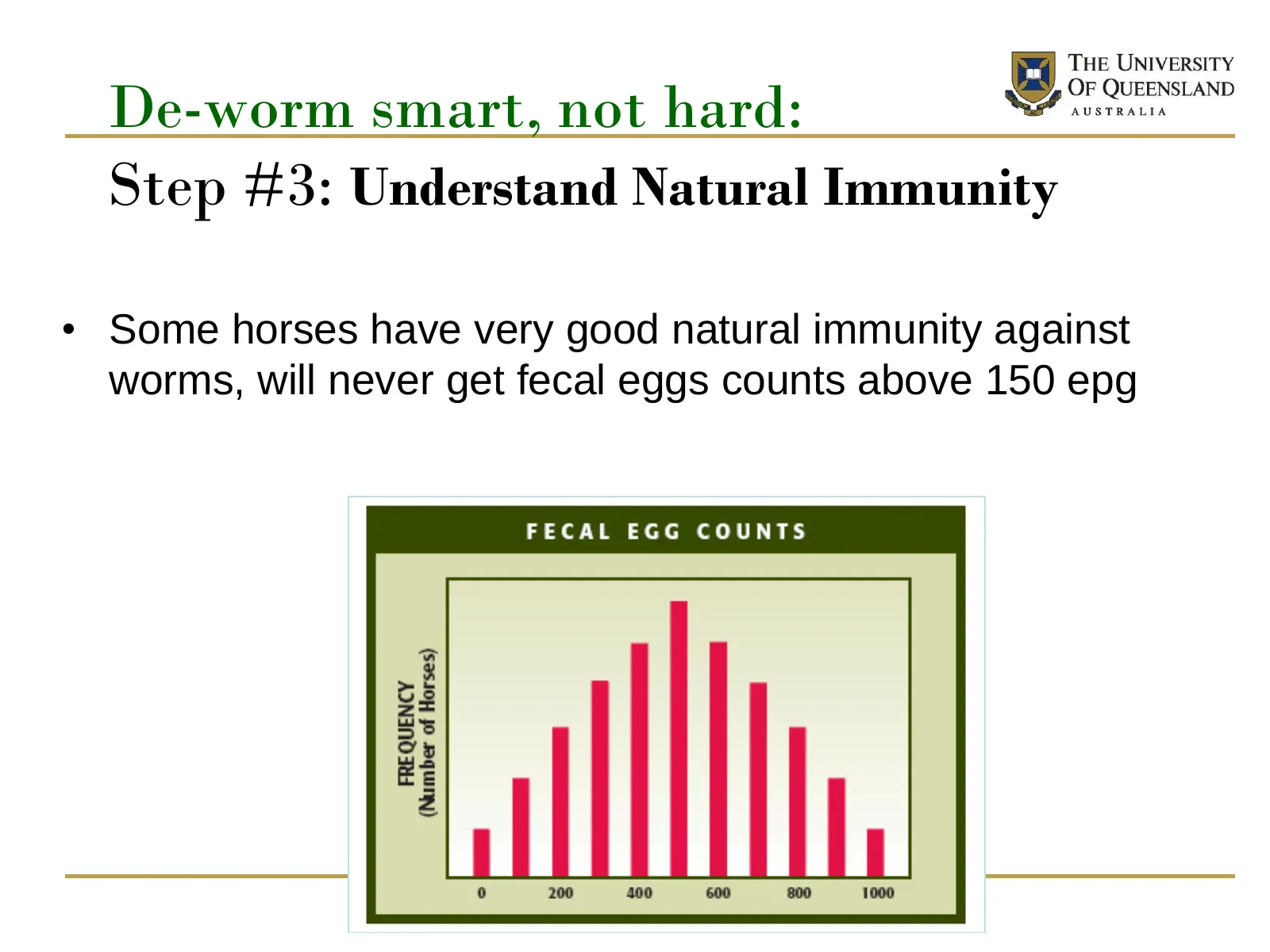
Slide 17: Step #3: Understand Natural Immunity
De-worm smart, not hard: Step #3: Understand Natural Immunity • Some horses have very good natural immunity against worms, will never get fecal eggs counts above 150 epg
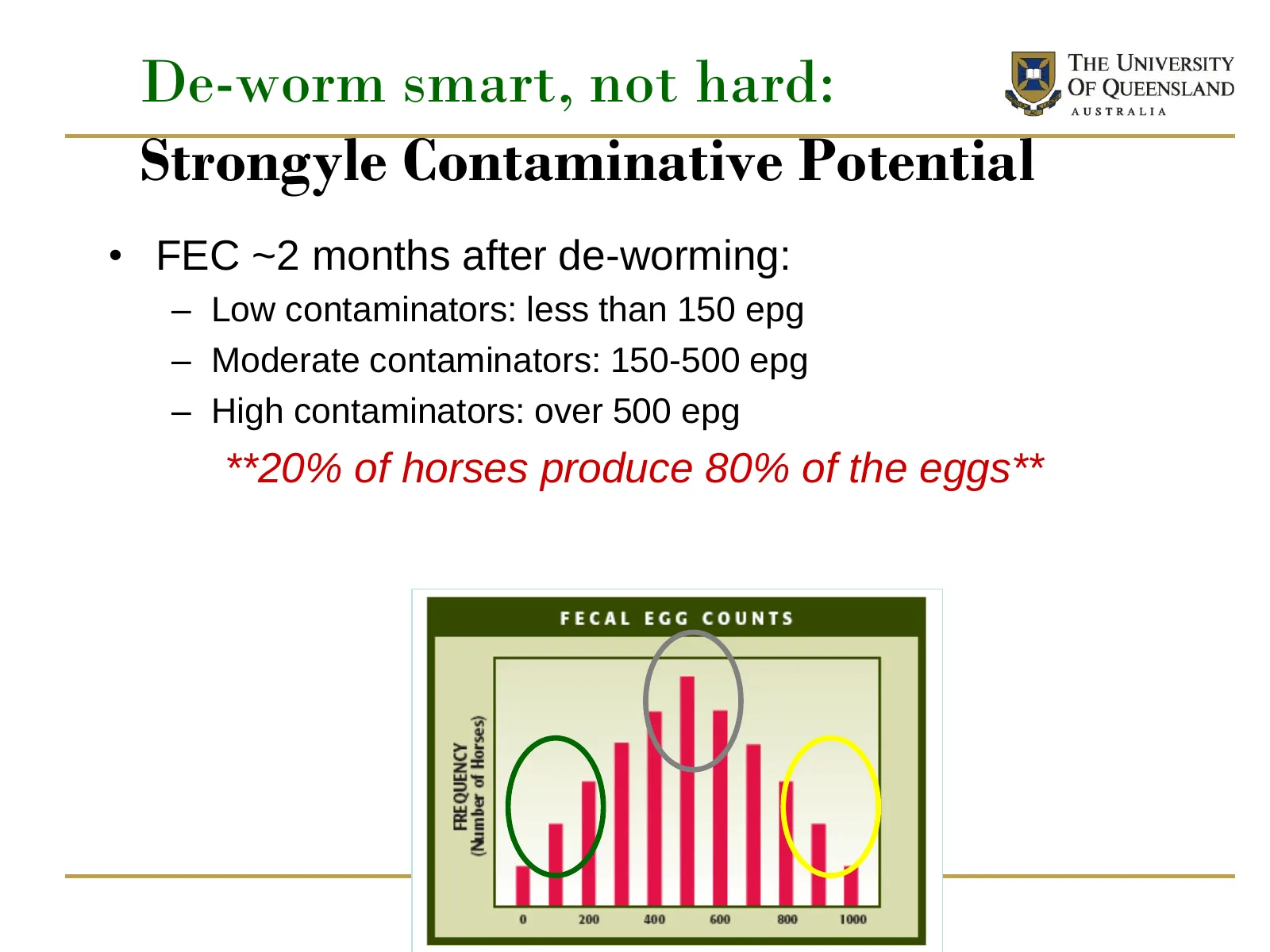
Slide 18: Strongyle Contaminative Potential
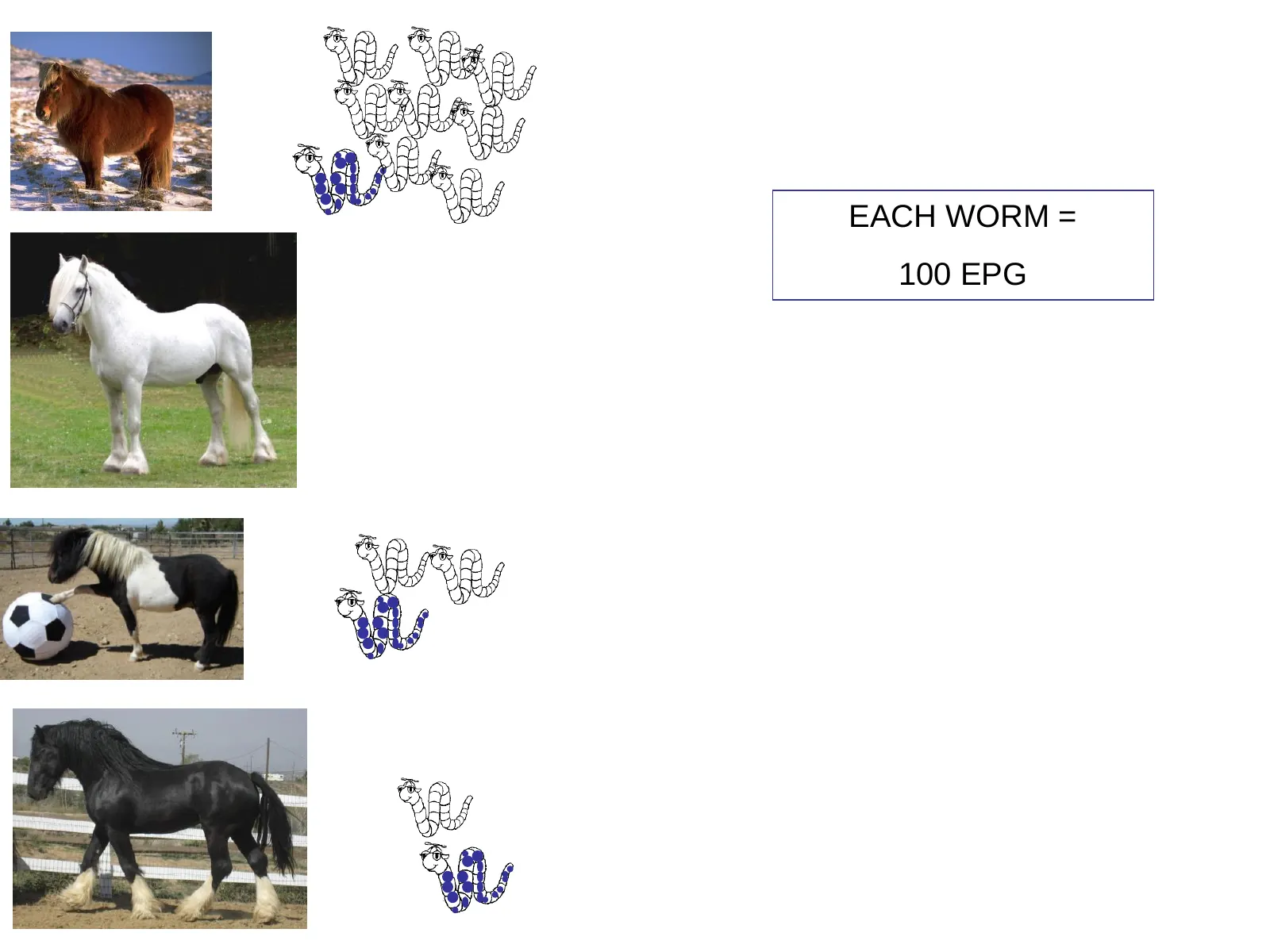
De-worm smart, not hard: Strongyle Contaminative Potential • FEC ~2 months after de-worming: – Low contaminators: less than 150 epg – Moderate contaminators: 150-500 epg – High contaminators: over 500 epg **20% of horses produce 80% of the eggs**
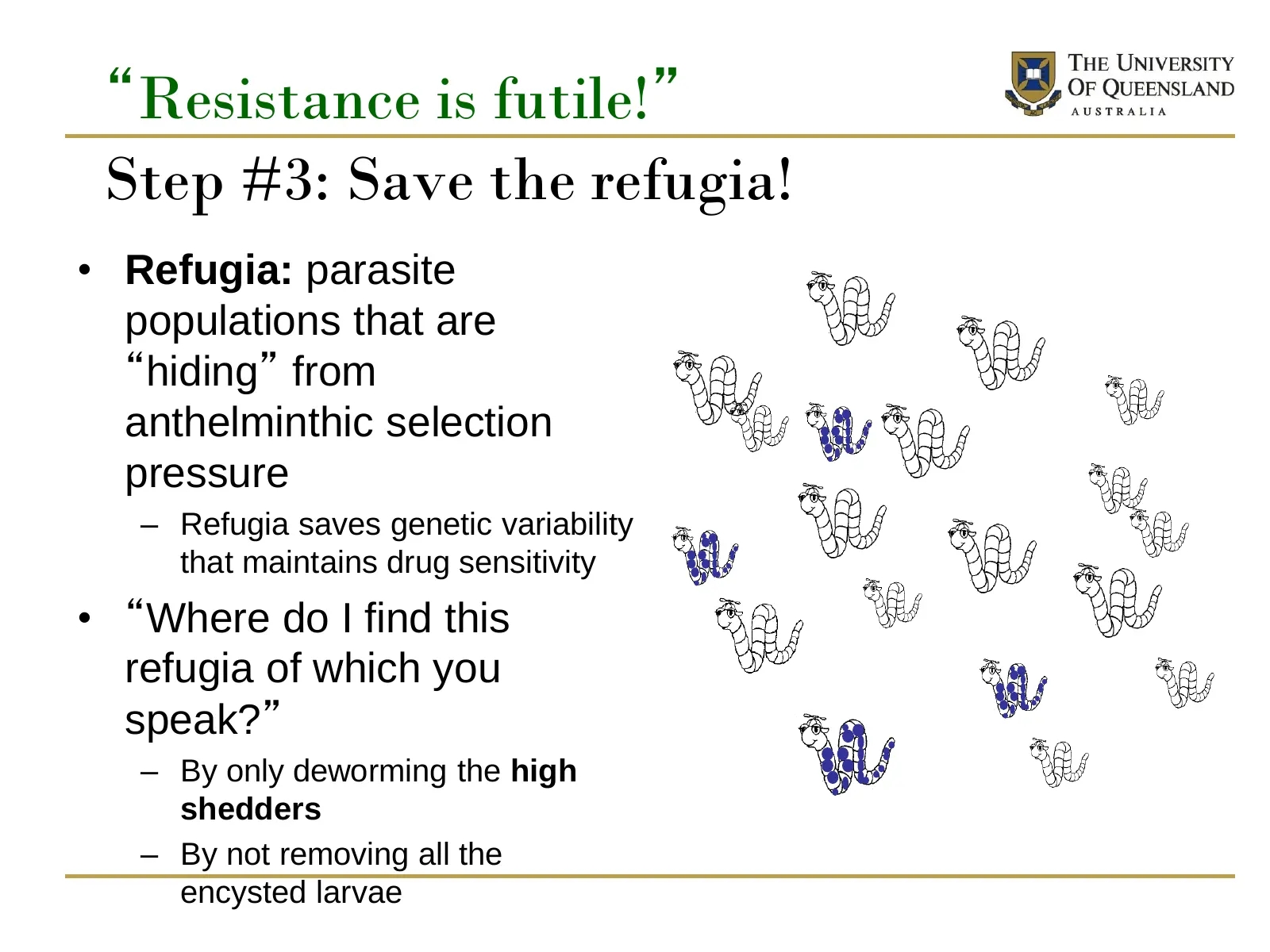
Slide 19: Step #3: Save the refugia!
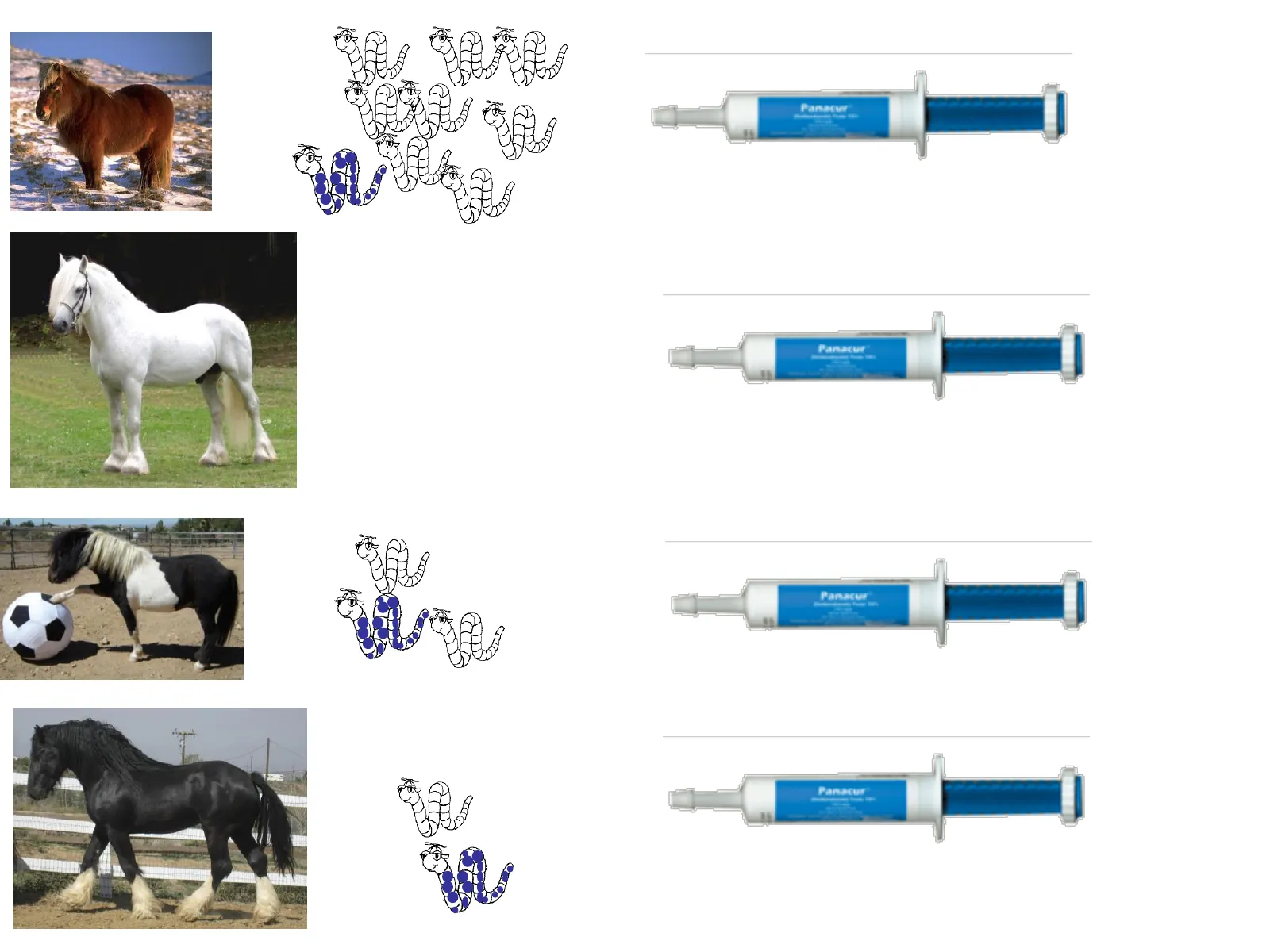
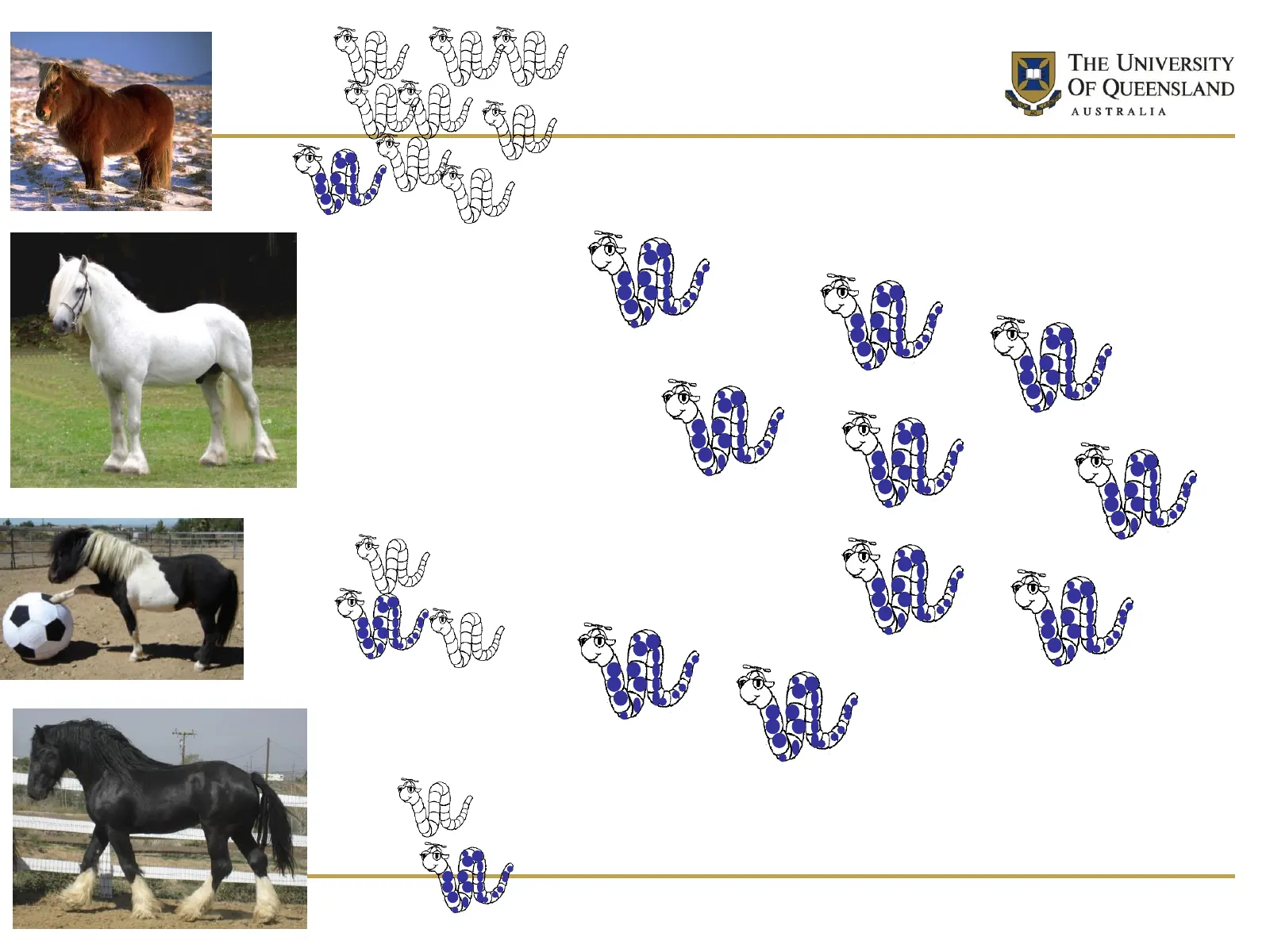
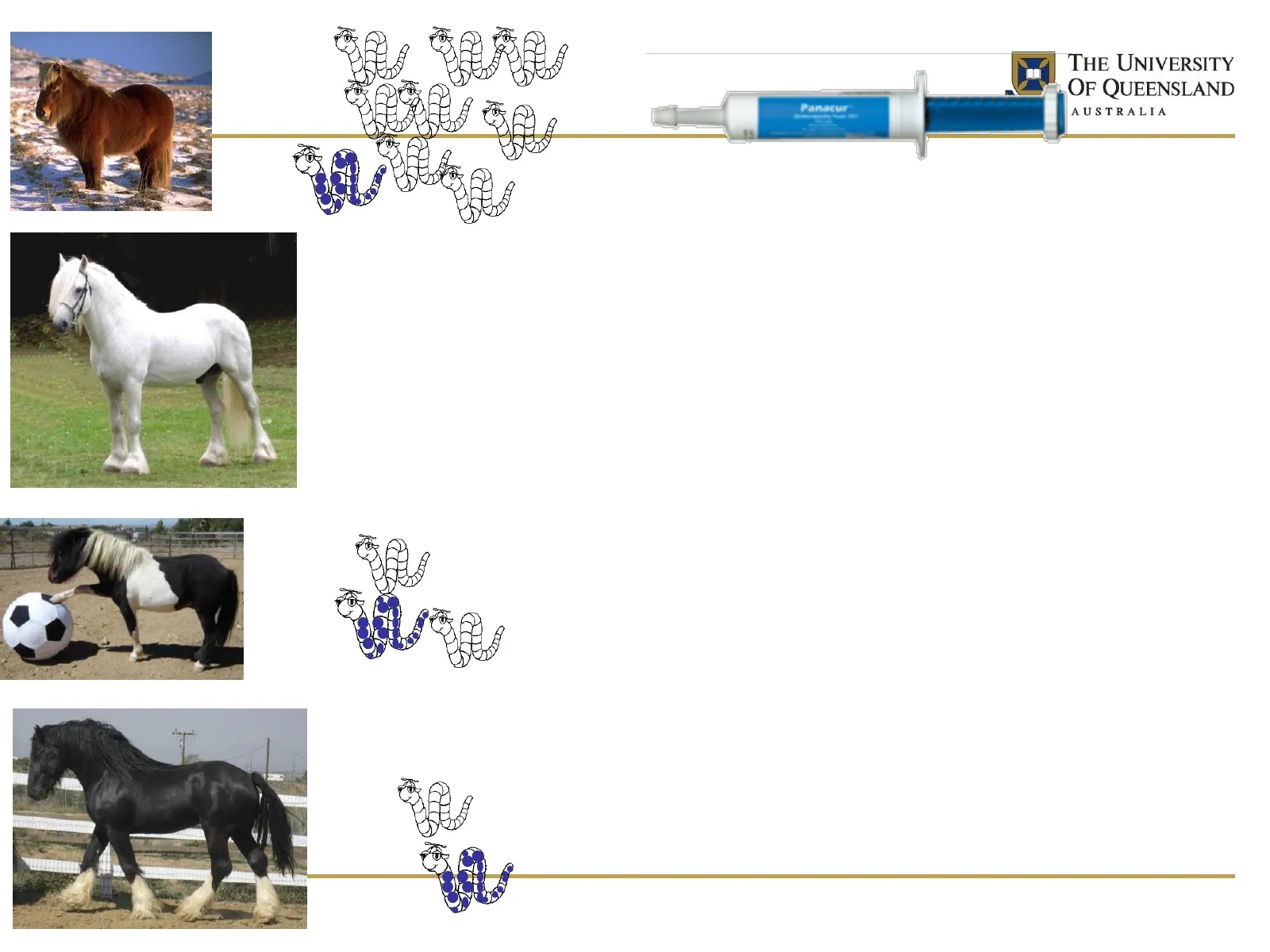
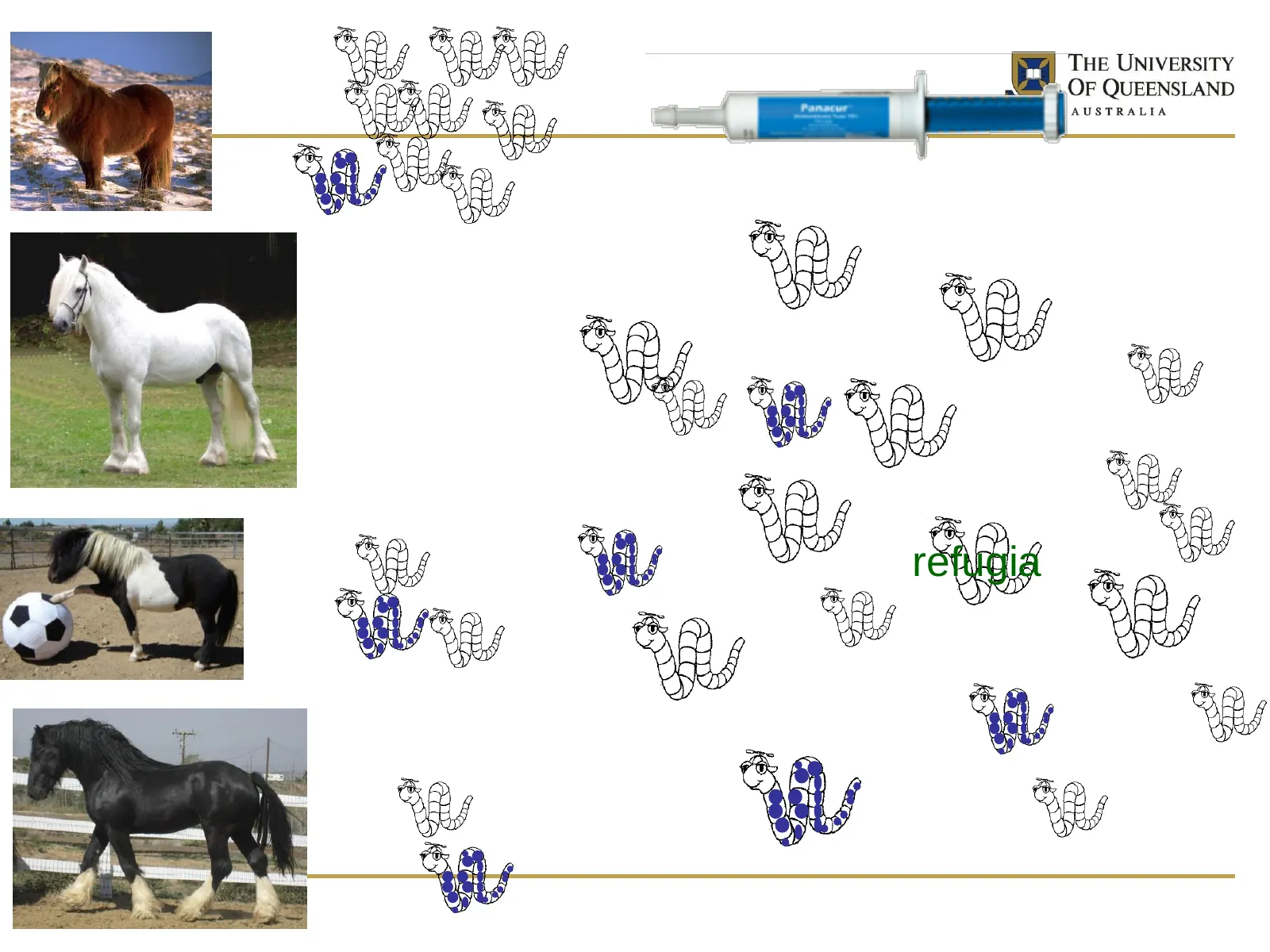
“Resistance is futile!” Step #3: Save the refugia! • Refugia: parasite populations that are “hiding” from anthelminthic selection pressure – Refugia saves genetic variability that maintains drug sensitivity • “Where do I find this refugia of which you speak?” – By only deworming the high shedders –
Slide 20: The University of Queensland Australia
THE UNIVERSITY 7, OF QUEENSLAND AUSTRALIA
Slide 21: Each worm = 100 EPG
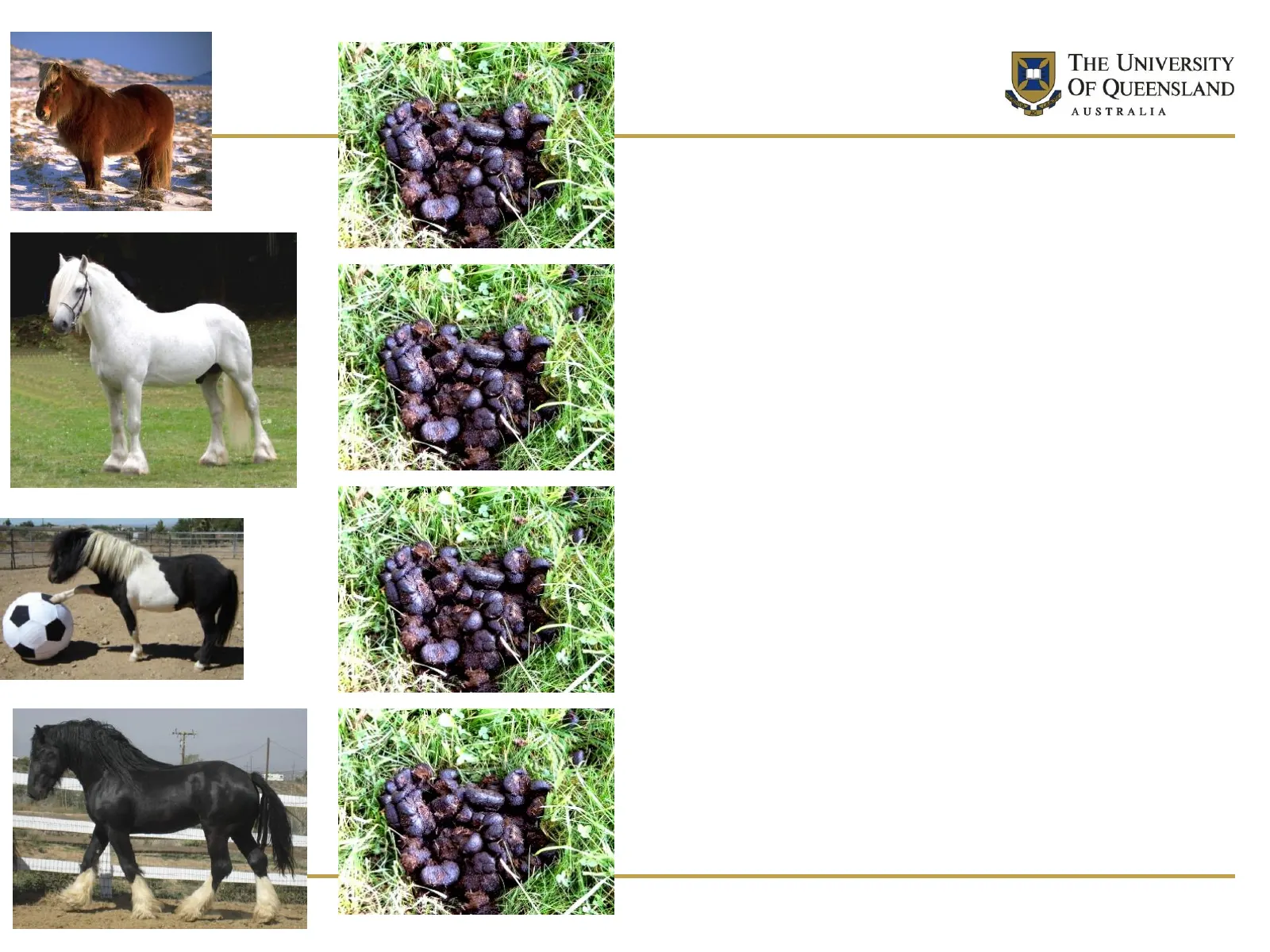
EACH WORM = 100 EPG
Slide 22: J
J
Slide 23: The University of Queensland Australia
THE UNIVERSITY OF QUEENSLAND AUSTRALIA 8
Slide 24: The University of Queensland Australia
THE UNIVERSITY OF QUEENSLAND AUSTRALIA
Slide 25: Refugia
THE UNIVERSITY OF QUEENSLAND AUSTRALIA
Slide 26: Step #5: Pick the right drug
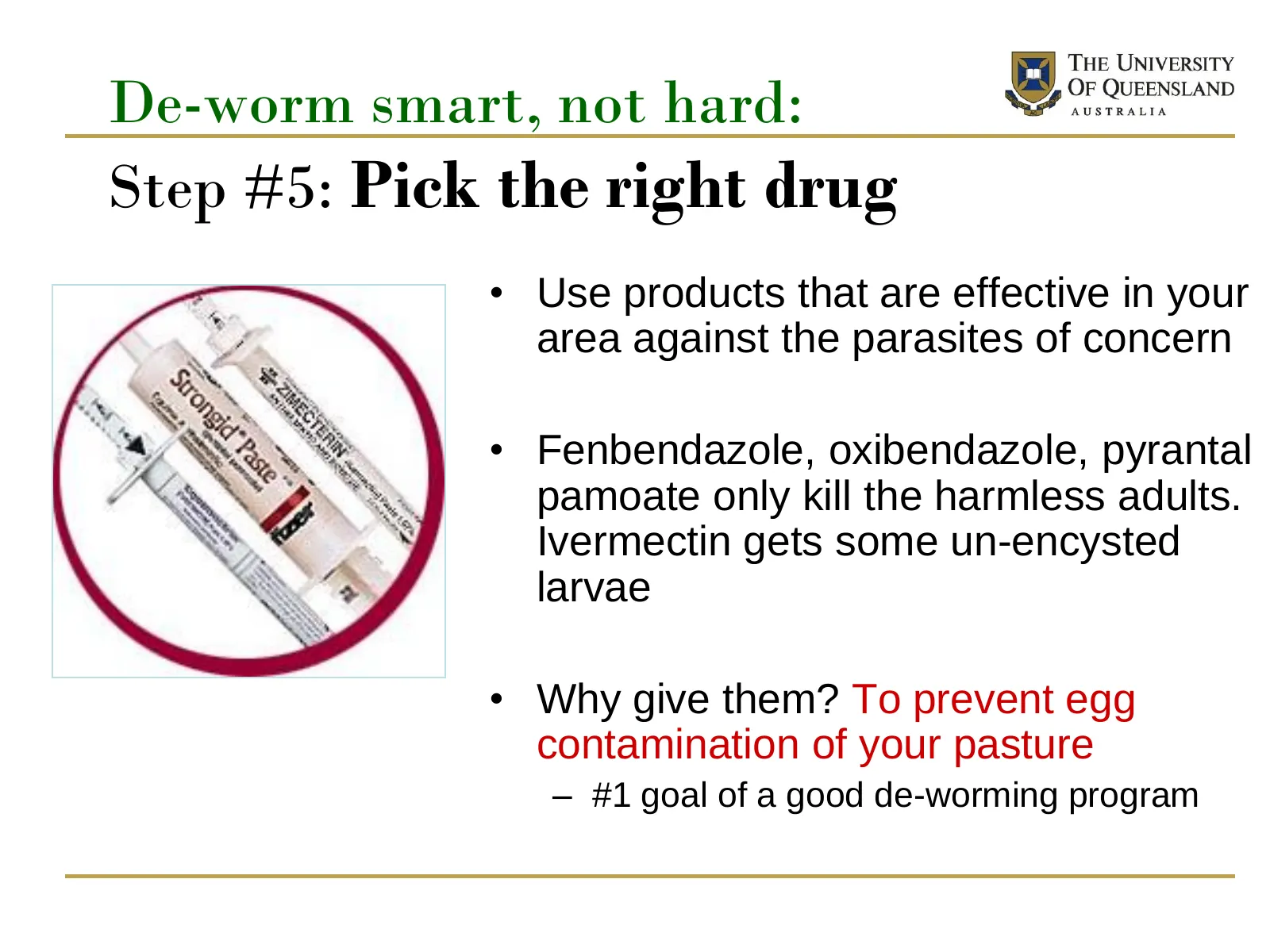
De-worm smart, not hard: Step #5: Pick the right drug • Use products that are effective in your area against the parasites of concern • Fenbendazole, oxibendazole, pyrantal pamoate only kill the harmless adults. Ivermectin gets some un-encysted larvae • Why give them? To prevent egg contamination of
Slide 27: Step #6: Use the correct dosing interval
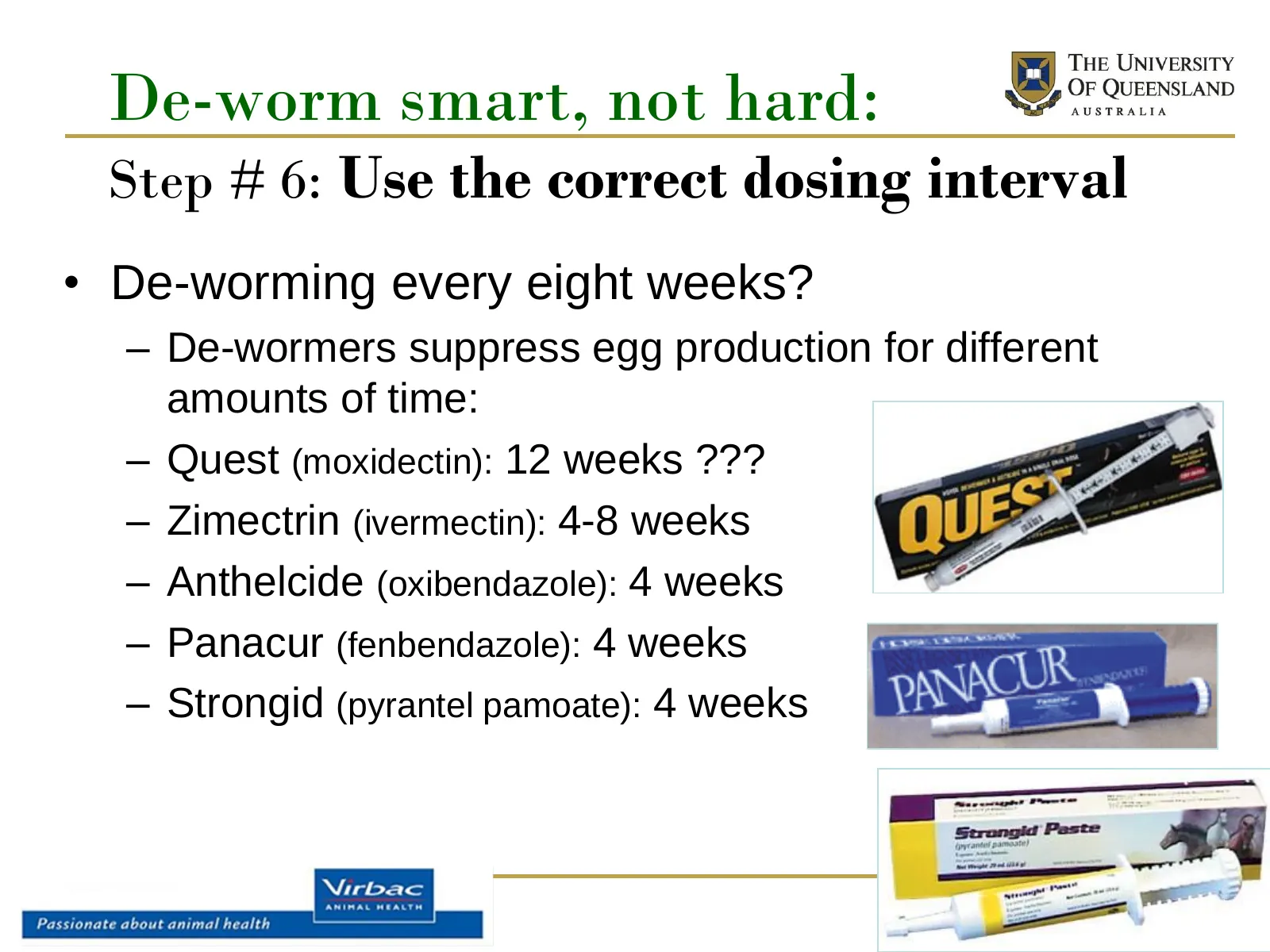
De-worm smart, not hard: Step # 6: Use the correct dosing interval • De-worming every eight weeks? – De-wormers suppress egg production for different amounts of time: – Quest (moxidectin): 12 weeks ??? – Zimectrin (ivermectin): 4-8 weeks – Anthelcide (oxibendazole): 4 weeks – Panacur (fenbendazole):
Slide 28: Step #7: Consider life stage of each patient
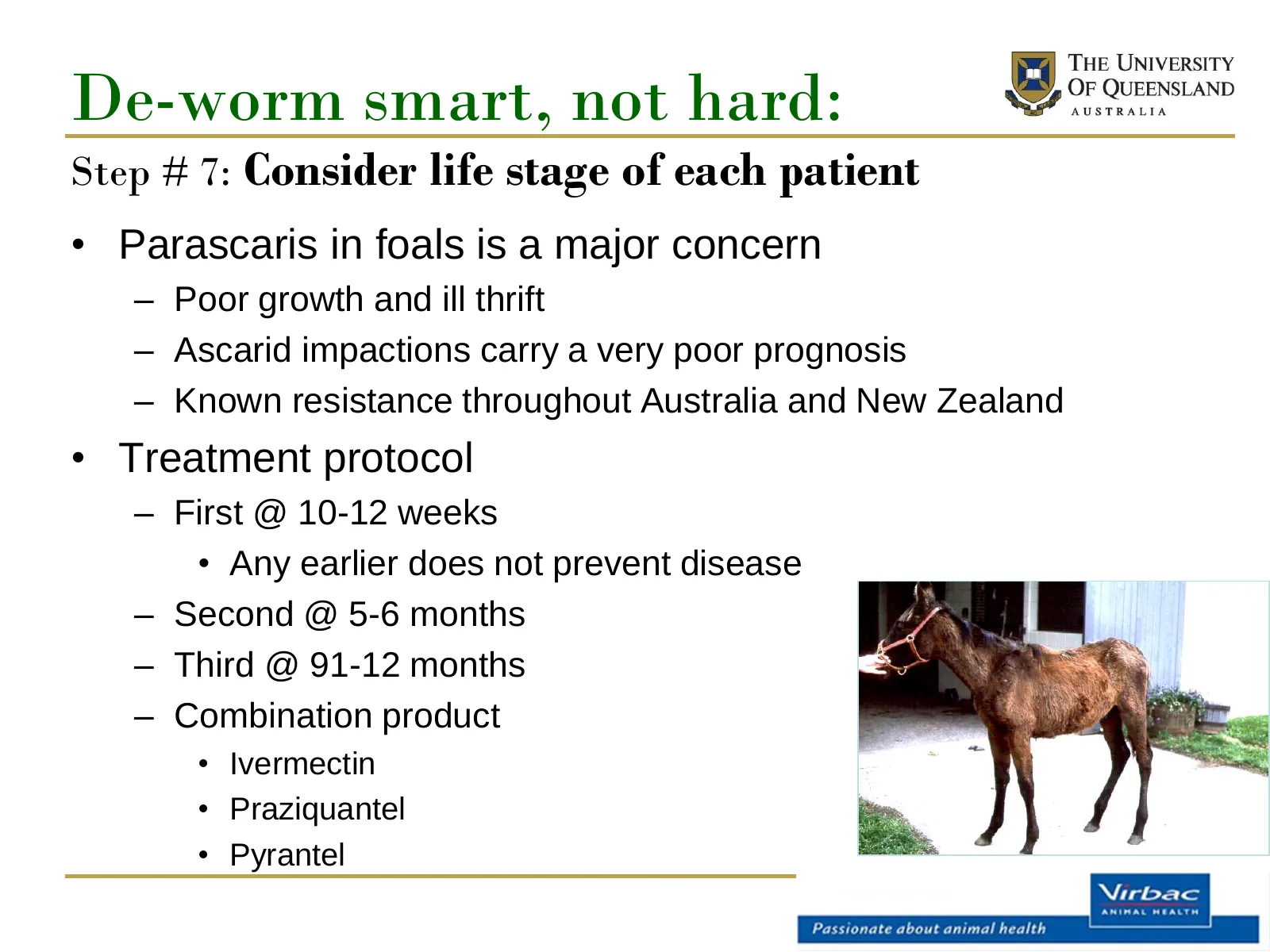
De-worm smart, not hard: Step # 7: Consider life stage of each patient • Parascaris in foals is a major concern – Poor growth and ill thrift – Ascarid impactions carry a very poor prognosis – Known resistance throughout Australia and New Zealand • Treatment protocol – First @ 10-12 weeks • Any earli
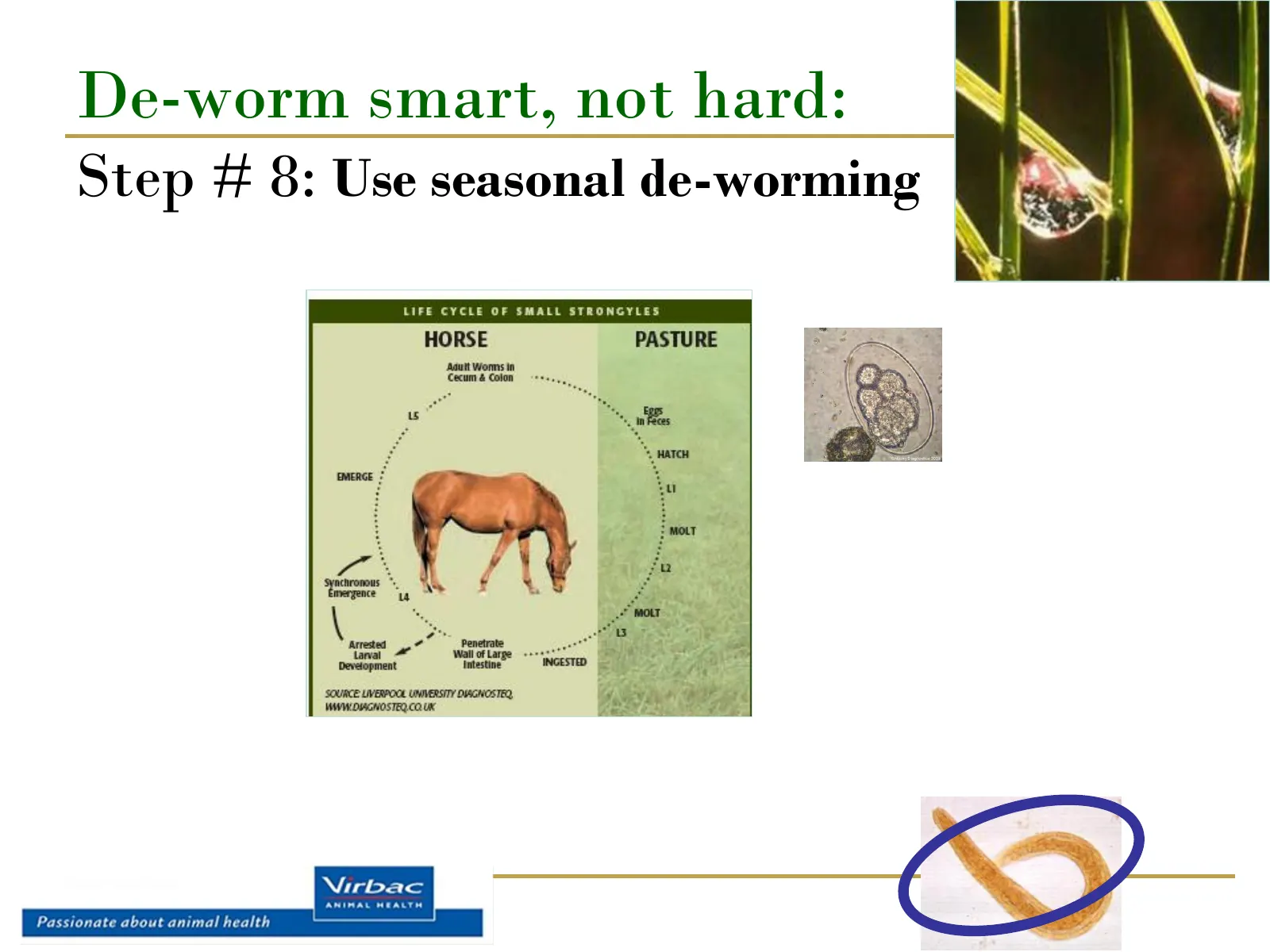
Slide 29: Step #8: Use seasonal de-worming
De-worm smart, not hard: Step # 8: Use seasonal de-worming
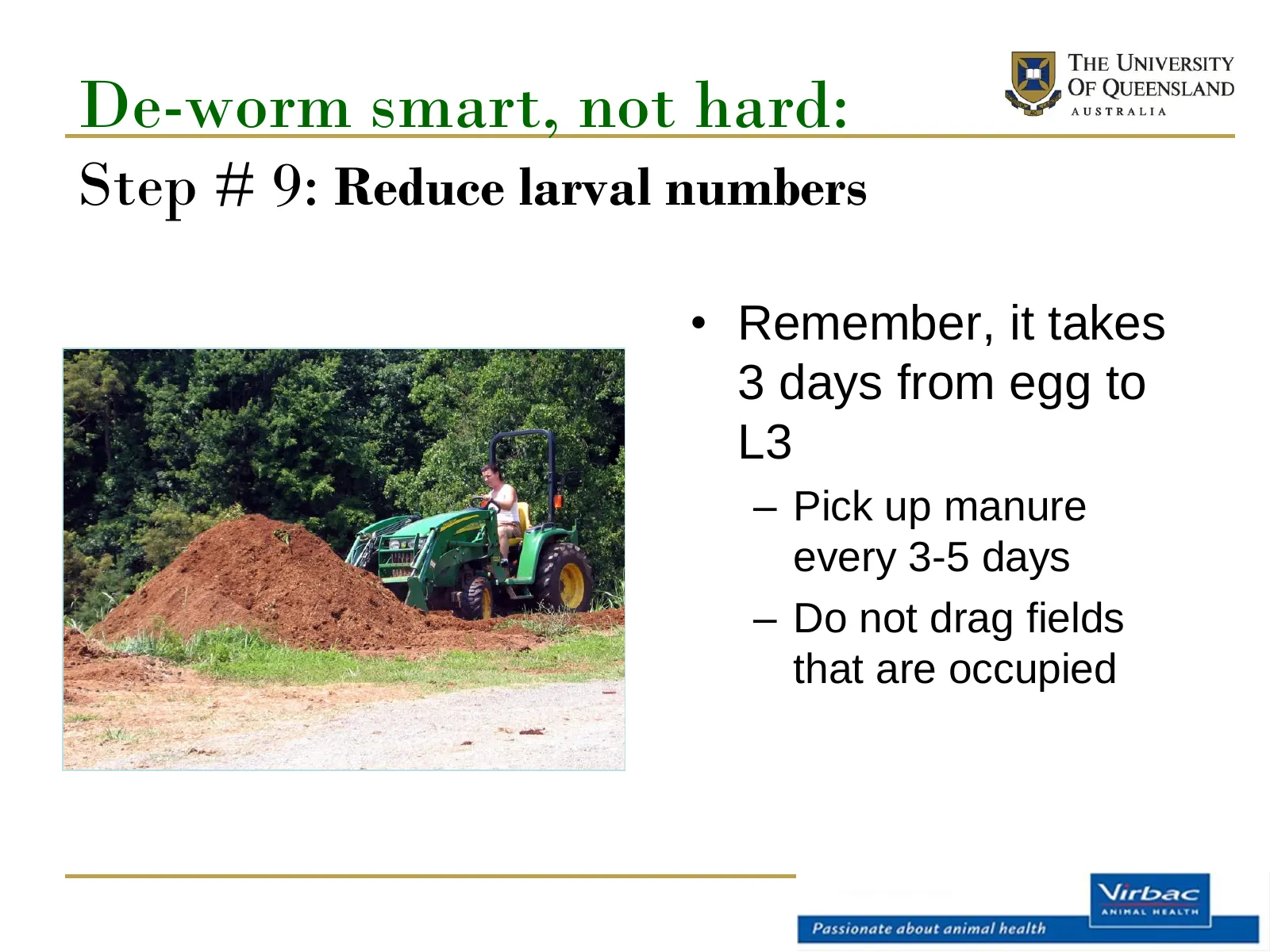
Slide 30: Step #9: Reduce larval numbers
De-worm smart, not hard: Step # 9: Reduce larval numbers • Remember, it takes 3 days from egg to L3 – Pick up manure every 3-5 days – Do not drag fields that are occupied
Slide 31: Step #10: Educate your friends!
De-worm smart, not hard: Step # 10: Educate your friends! • The bad old days – No good de-wormers – A lot of fatal colics • The good old days – New effective drugs, great control – “Recipe”/calendar approach very effective • The present time – Emerging resistance, no new drugs – New threats necessit
Slide 32: Ideal Adult Management
Ideal Adult Management • Perform FEC 2-3 times a year • Only deworm those who need it – High shedders – Horse with clinical signs • Use products that are seasonably logical • Use products that you can easily administer
Slide 33: Cost?
Cost? • Treating horses 6 times a year was similar in cost to doing FECs and treating only when needed. • An additional bonus: horses have better parasite control, and resistance is minimized.
Slide 34: Select the month you wish to begin worming
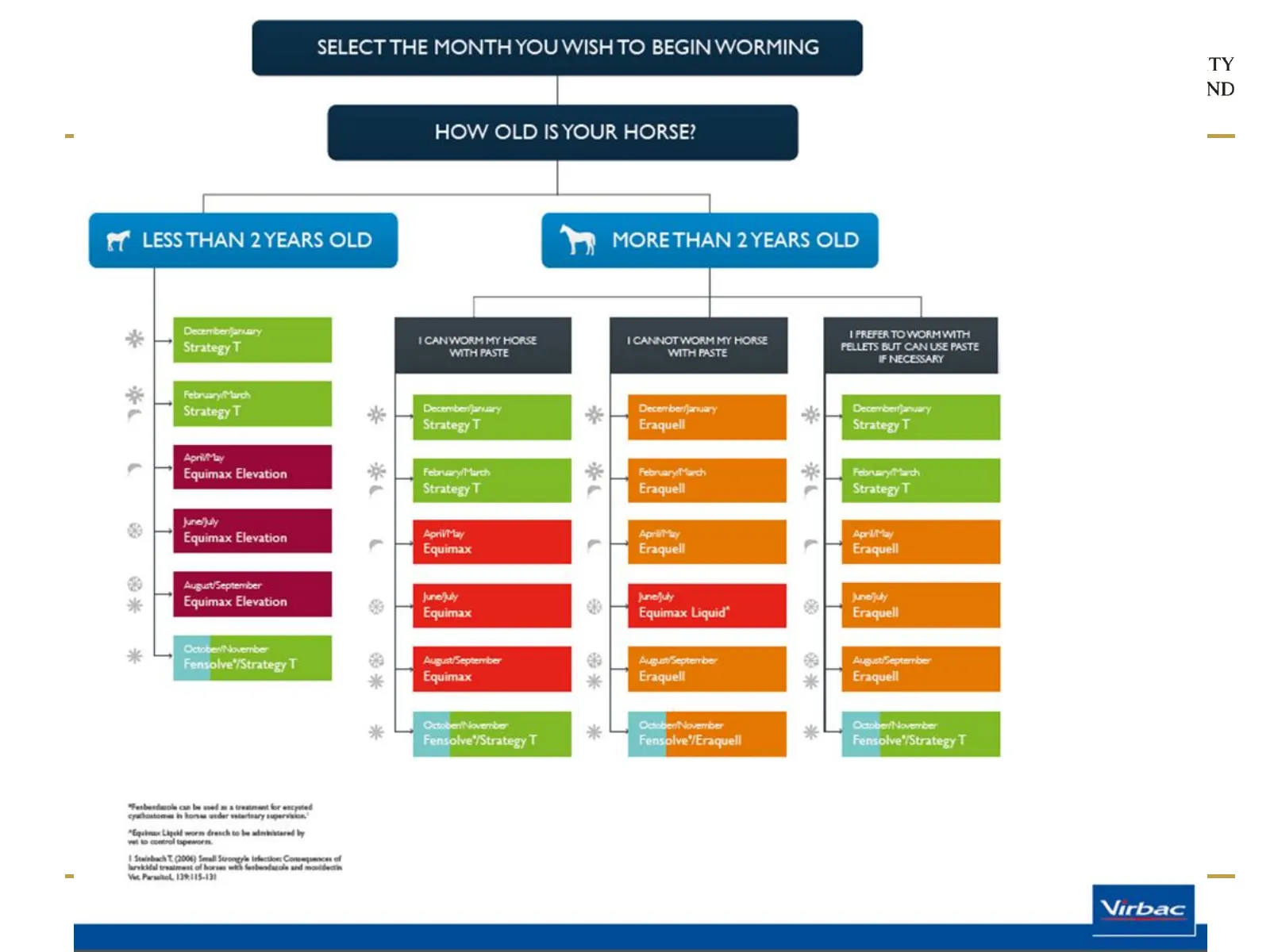
SELECT THE MONTH YOU WISH TO BEGIN WORMING TY ND HOW OLD IS YOUR HORSE? ff LESS THAN 2 YEARS OLD * MORE THAN 2 YEARS OLD Equimax Liquid “Fenbeadarol cat be seed 4 tresmant br oncpted cpebonowan Whores sede’ meornary Heracn, SEgermas Lapel woe drasch tbe wdetenared by aw teen pemne | Setnoch (2008) t
Source: Internet Archive copy of nz.virbac.com
More decks from Virbac SA
 2026 Jefferies Global Healthcare Conference7 slides · November 2026
 H1 2026 Earnings Presentation26 slides · September 2026
 FY2025 Earnings Presentation32 slides · March 2026
 H1 2025 Earnings Presentation29 slides · September 2025
 FY2024 Earnings Presentation32 slides · Mar 14, 2025
 H1 2024 Earnings Presentation33 slides · Sep 16, 2024