Bank of Greece SA · ATHEX:TELL
Bank of Greece SA — Investor Presentation (October 2009)
12 slides from Bank of Greece SA's investor presentation, Oct 16, 2009
Slide 1: Banking Systems of SEEEs: Crisis Effects, outlook and risks
Banking Systems of SEEEs : Crisis Effects, outlook and risks Radovan Jelašić, Governor - National Bank of Serbia Greece, 16th October 2009
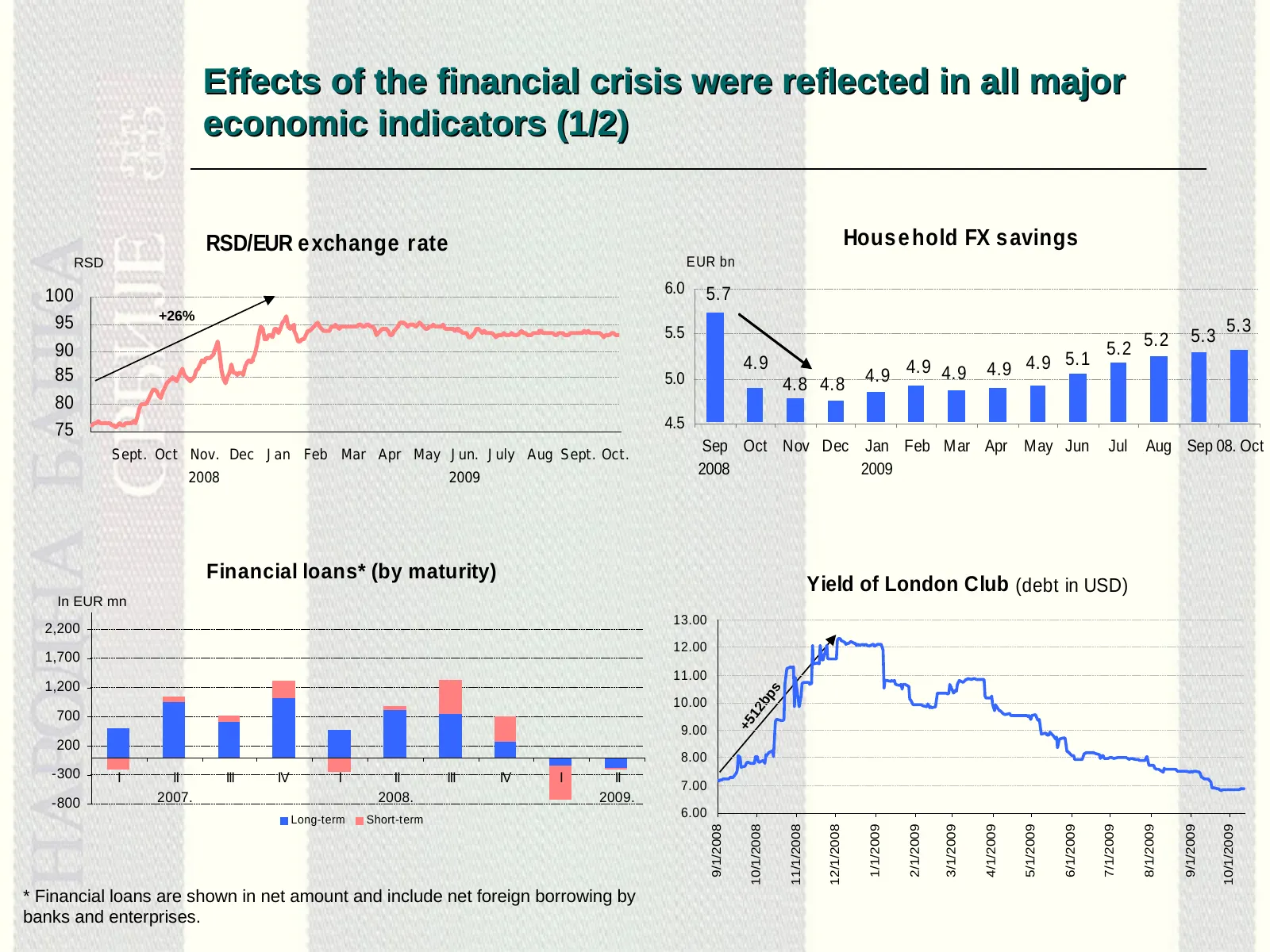
Slide 2: Effects of the financial crisis were reflected in all major economic indicators (1/2)
Effects of the financial crisis were reflected in all major economic indicators (1/2) RSD/EUR e xchange rate Hous e hold FX s avings RSD EUR bn 100 6.0 5.7 +26% 95 5.5 - 16% 5.3 5.3 90 5.2 5.2 4.9 5.1 85 5.0 4.9 4.9 4.9 4.9 4.9 4.8 4.8 80 75 4.5 S ept. Oct Nov. Dec J an Feb Mar Apr May J un. J uly A
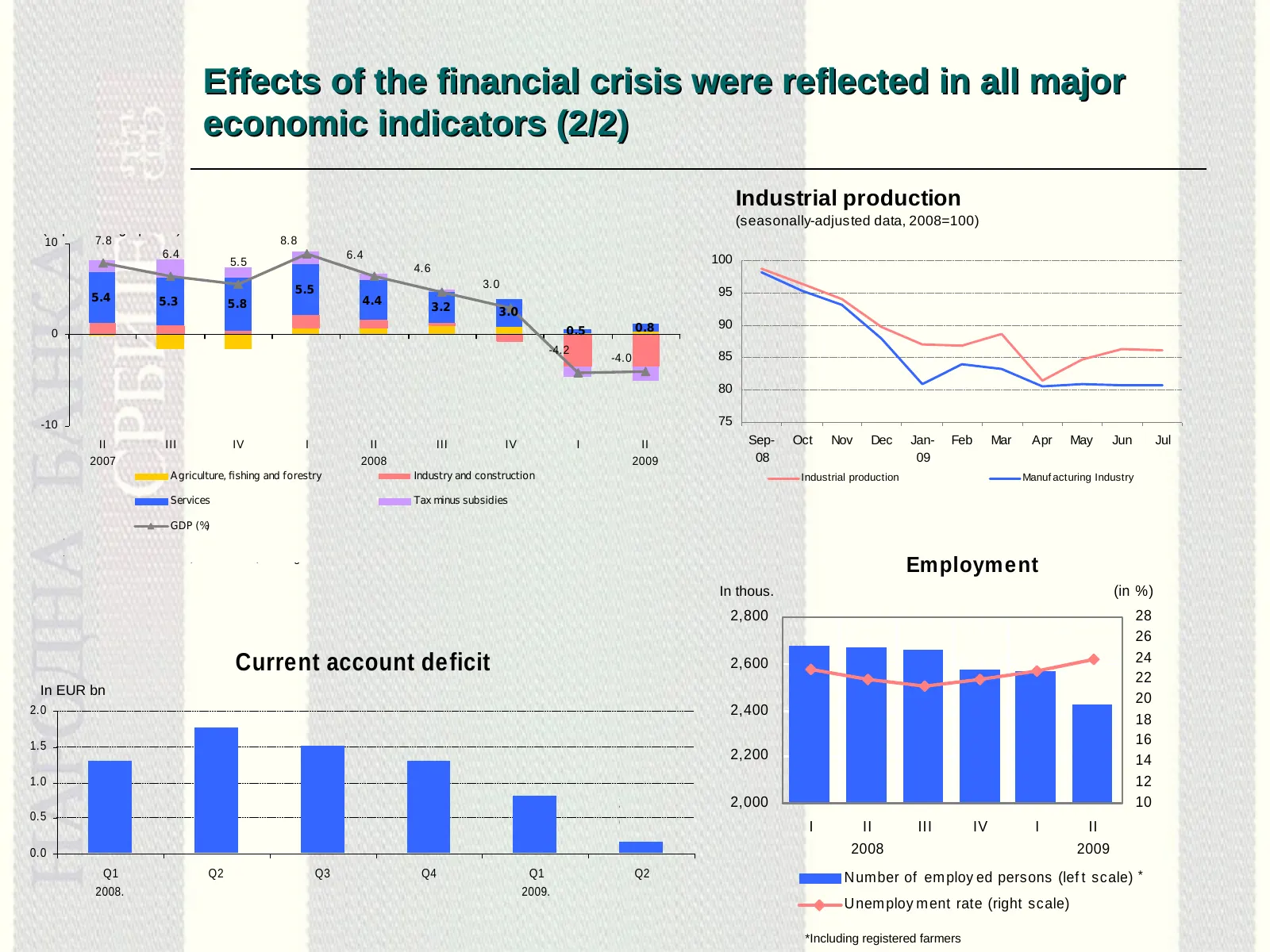
Slide 3: Effects of the financial crisis were reflected in all major economic indicators (2/2)
Effects of the financial crisis were reflected in all major economic indicators (2/2) Contribution to y-o-y GDP growth Industrial production (seasonally-adjusted data, 2008=100) (in percentage points) 10 7.8 8.8 6.4 6.4 5.5 100 4.6 5.5 3.0 5.4 95 5.3 5.8 4.4 3.2 3.0 0.5 0.8 90 0 -4.2 -4.0 85 80 -10
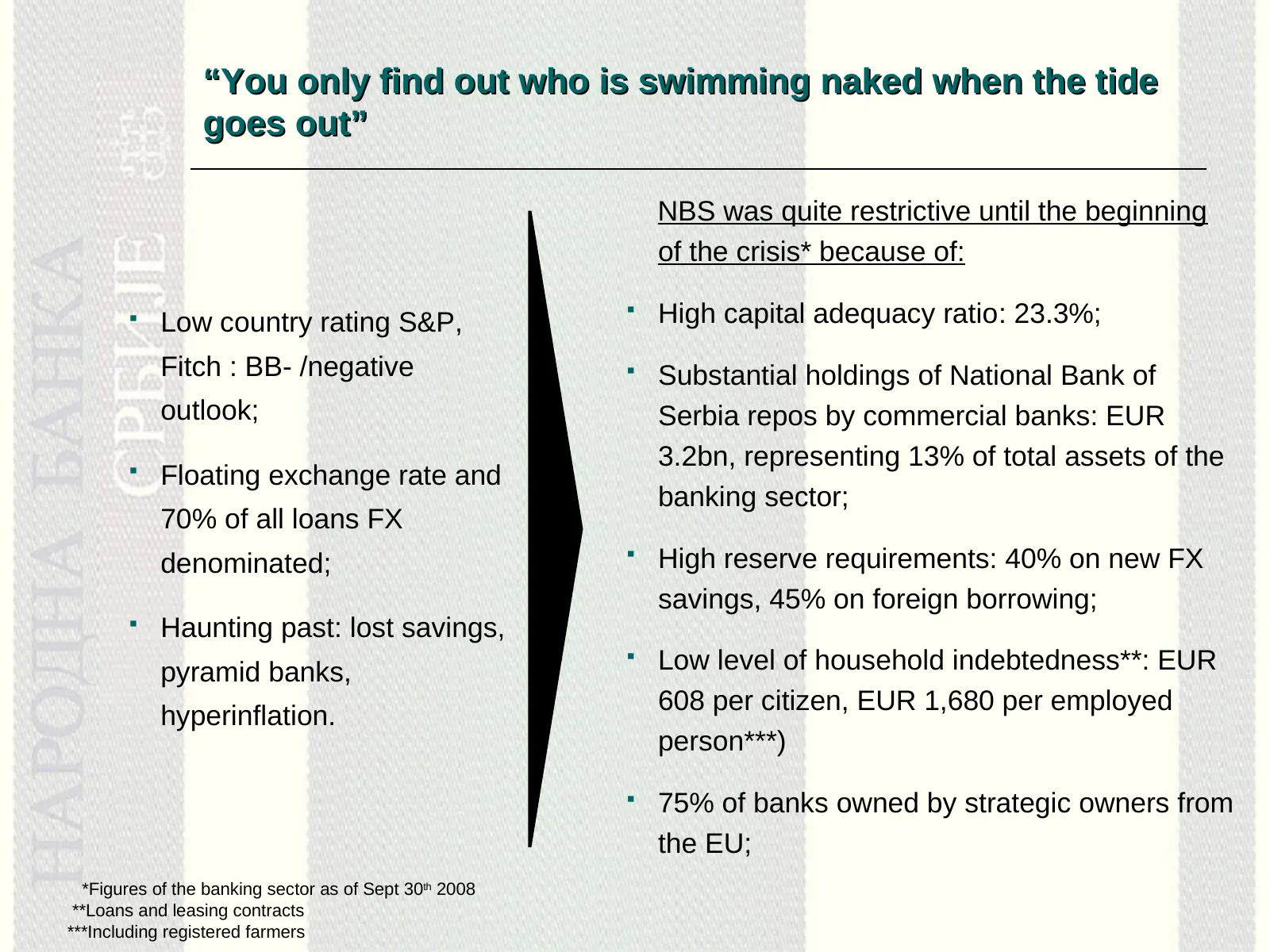
Slide 4: You only find out who is swimming naked when the tide goes out
“You only find out who is swimming naked when the tide goes out” NBS was quite restrictive until the beginning of the crisis* because of: Low country rating S&P, High capital adequacy ratio: 23.3%; Fitch : BB- /negative Substantial holdings of National Bank of outlook; Serbia repos by commerci
Slide 5: Stable banking sector saved the Serbian taxpayer
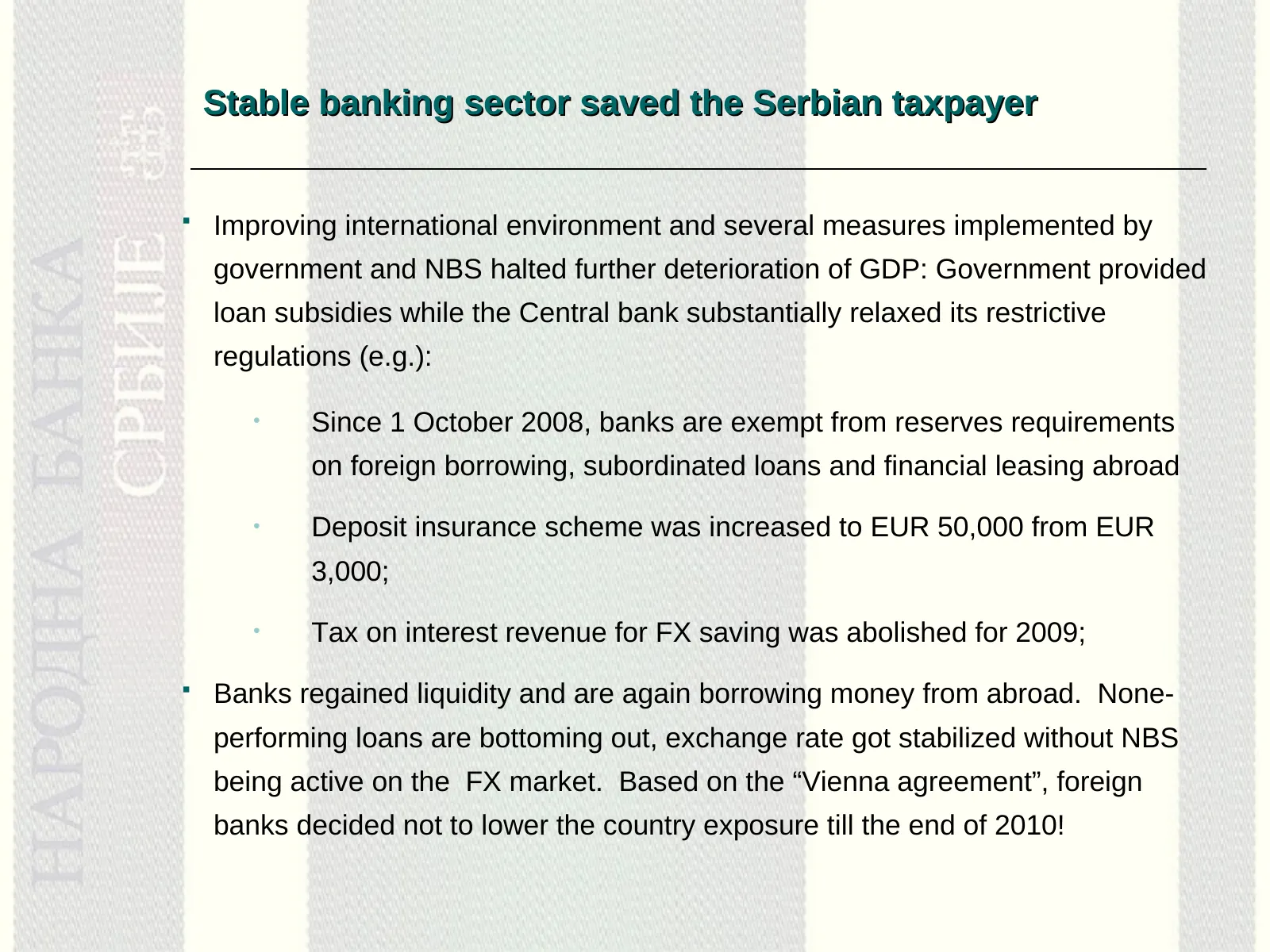
Stable banking sector saved the Serbian taxpayer Improving international environment and several measures implemented by government and NBS halted further deterioration of GDP: Government provided loan subsidies while the Central bank substantially relaxed its restrictive regulations (e.g.): • Sin
Slide 6: Bank stress tests have been carried out as part of the Vienna Initiative
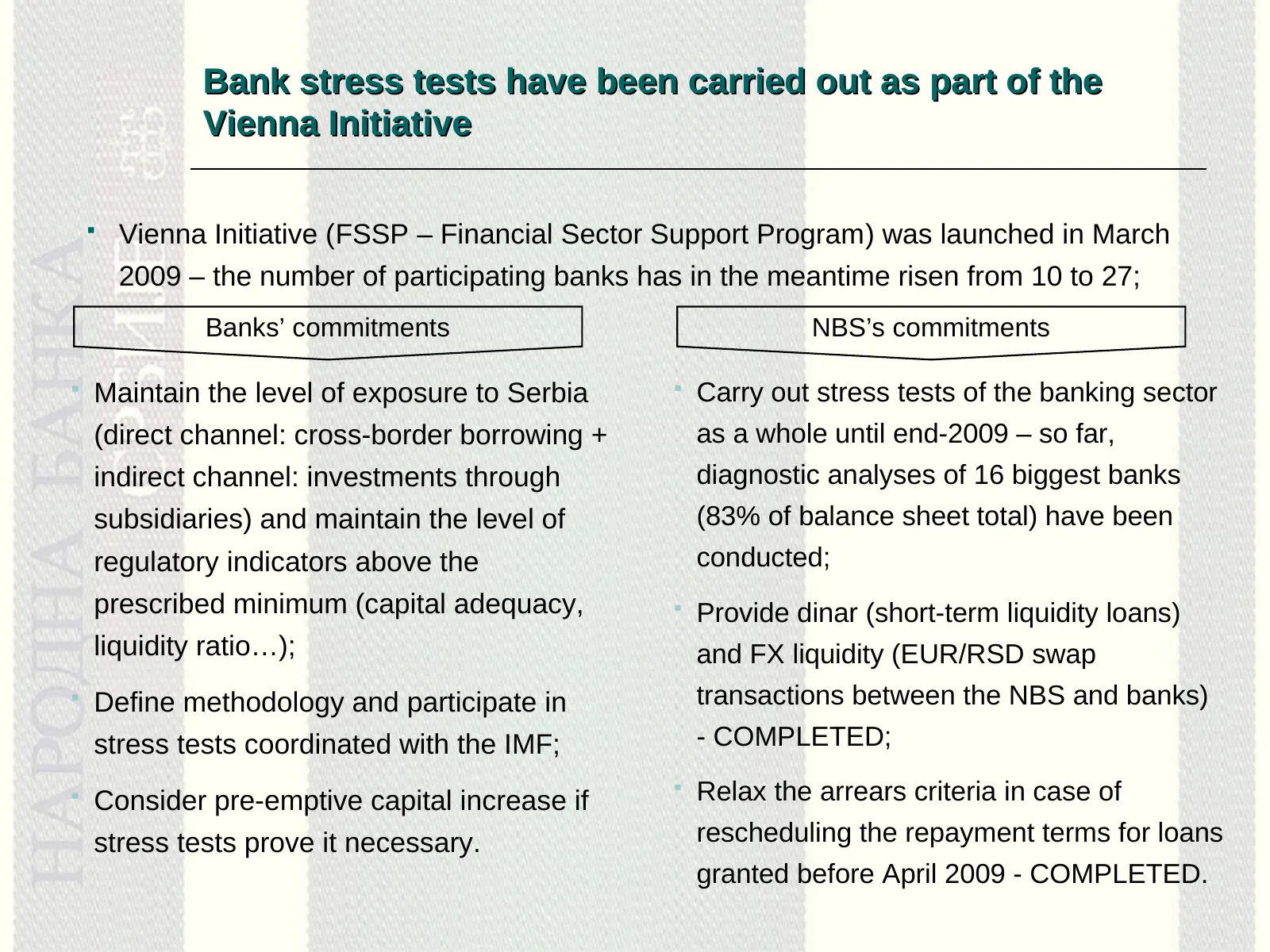
Bank stress tests have been carried out as part of the Vienna Initiative Vienna Initiative (FSSP – Financial Sector Support Program) was launched in March 2009 – the number of participating banks has in the meantime risen from 10 to 27; Banks’ commitments NBS’s commitments Maintain the level of
Slide 7: Model and assumptions
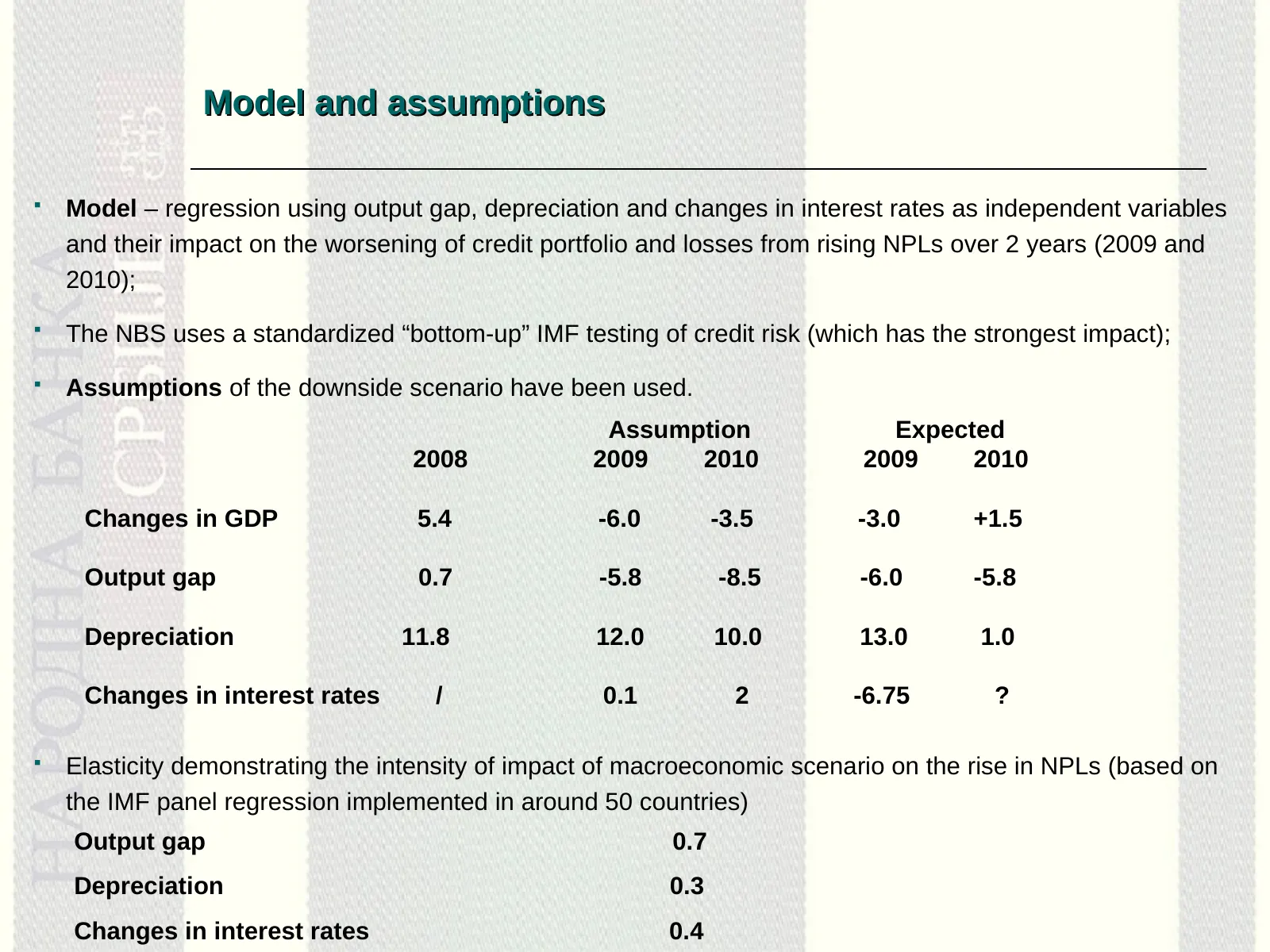
Model and assumptions Моdel – regression using output gap, depreciation and changes in interest rates as independent variables and their impact on the worsening of credit portfolio and losses from rising NPLs over 2 years (2009 and 2010); The NBS uses a standardized “bottom-up” IMF testing of cr
Slide 8: Composite results of bank stress testing are positive
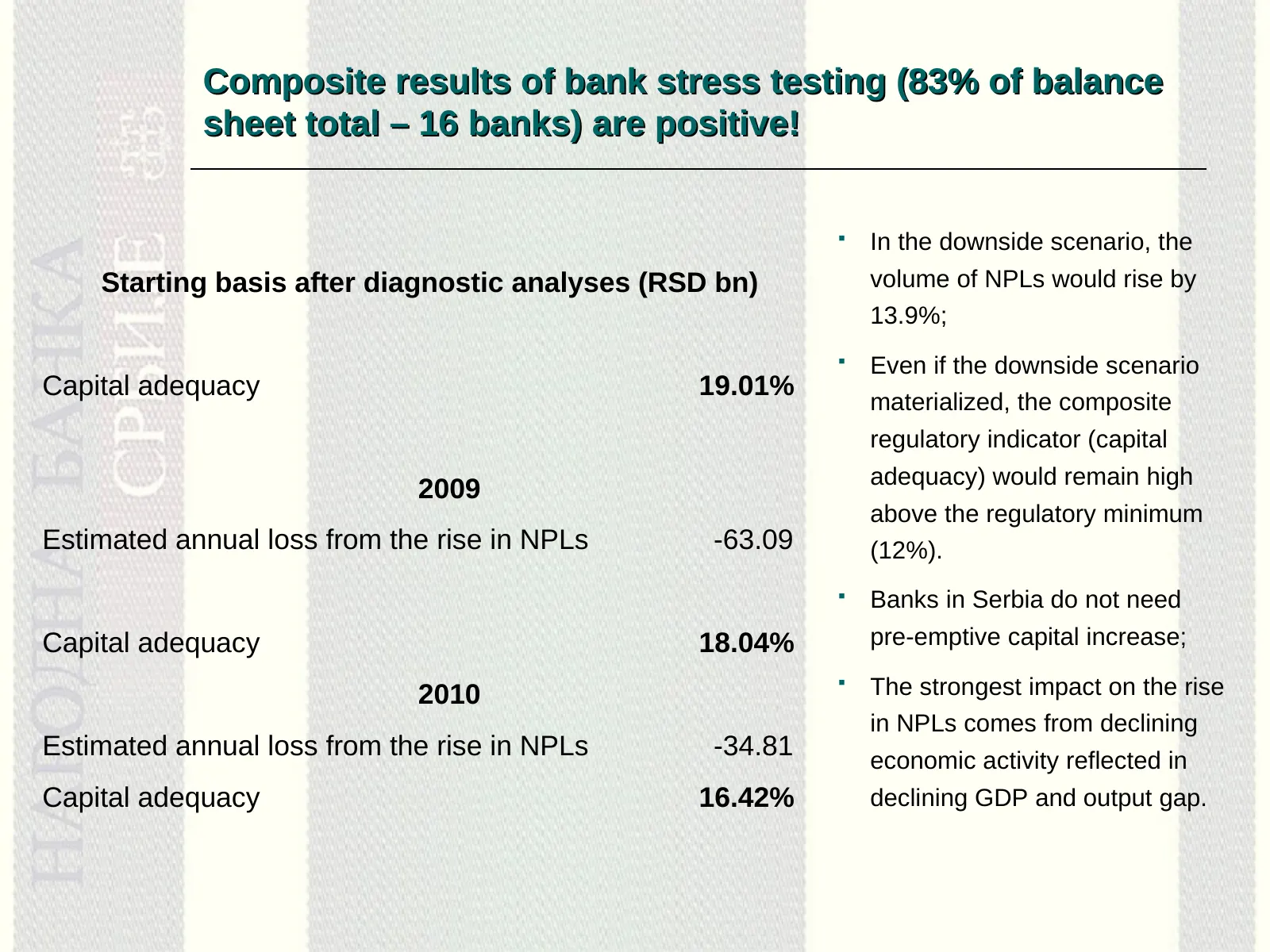
Composite results of bank stress testing (83% of balance sheet total – 16 banks) are positive! In the downside scenario, the Starting basis after diagnostic analyses (RSD bn) volume of NPLs would rise by 13.9%; Even if the downside scenario Capital adequacy 19.01% materialized, the composite reg
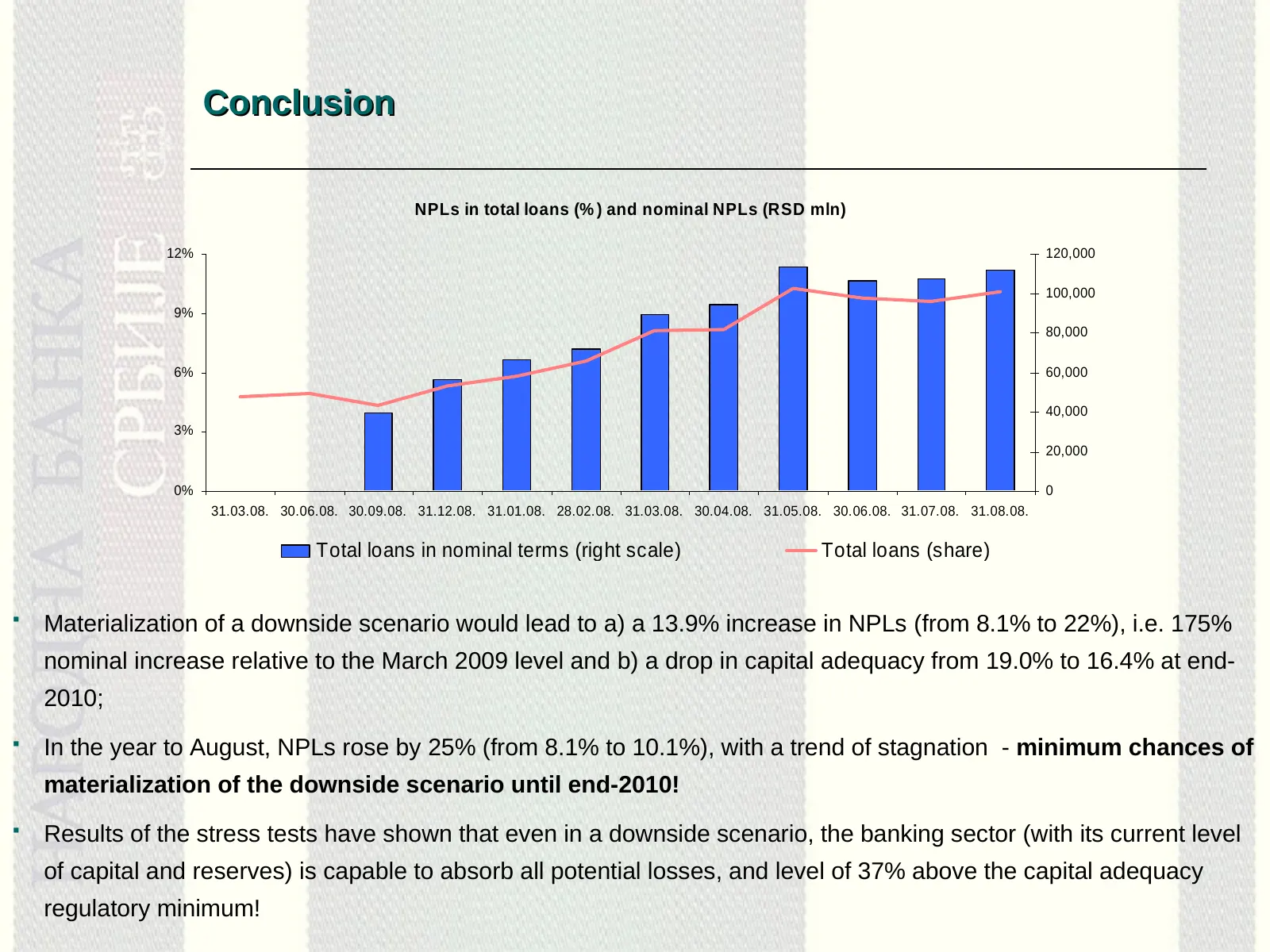
Slide 9: Conclusion
Conclusion NPLs in total loans (% ) and nominal NPLs (RSD mln) 12% 120,000 100,000 9% 80,000 6% 60,000 40,000 3% 20,000 0% 0 31.03.08. 30.06.08. 30.09.08. 31.12.08. 31.01.08. 28.02.08. 31.03.08. 30.04.08. 31.05.08. 30.06.08. 31.07.08. 31.08.08. Total loans in nominal terms (right scale) Total loans
Slide 10: Even today there are several key lessons regarding the effects of the crisis
Even today there are several key lessons regarding the effects of the crisis Bank shareholders are playing a key role in case of crisis a) strategic owners deserved the confidence; b) in Serbia, private owners (non-state) caused some concern; Countercyclical fiscal policy should be practiced als
Slide 11: Outlook for the banks in SEE will be determined by several factors
Outlook for the banks in SEE will be determined by several factors ! 1. Growth model: Domestic demand or more export driven growth model ? 2. Macroeconomic policies : To which extent will adjustment take place in fiscal or monetary policy ? 3. International capital market conditions : Will money be
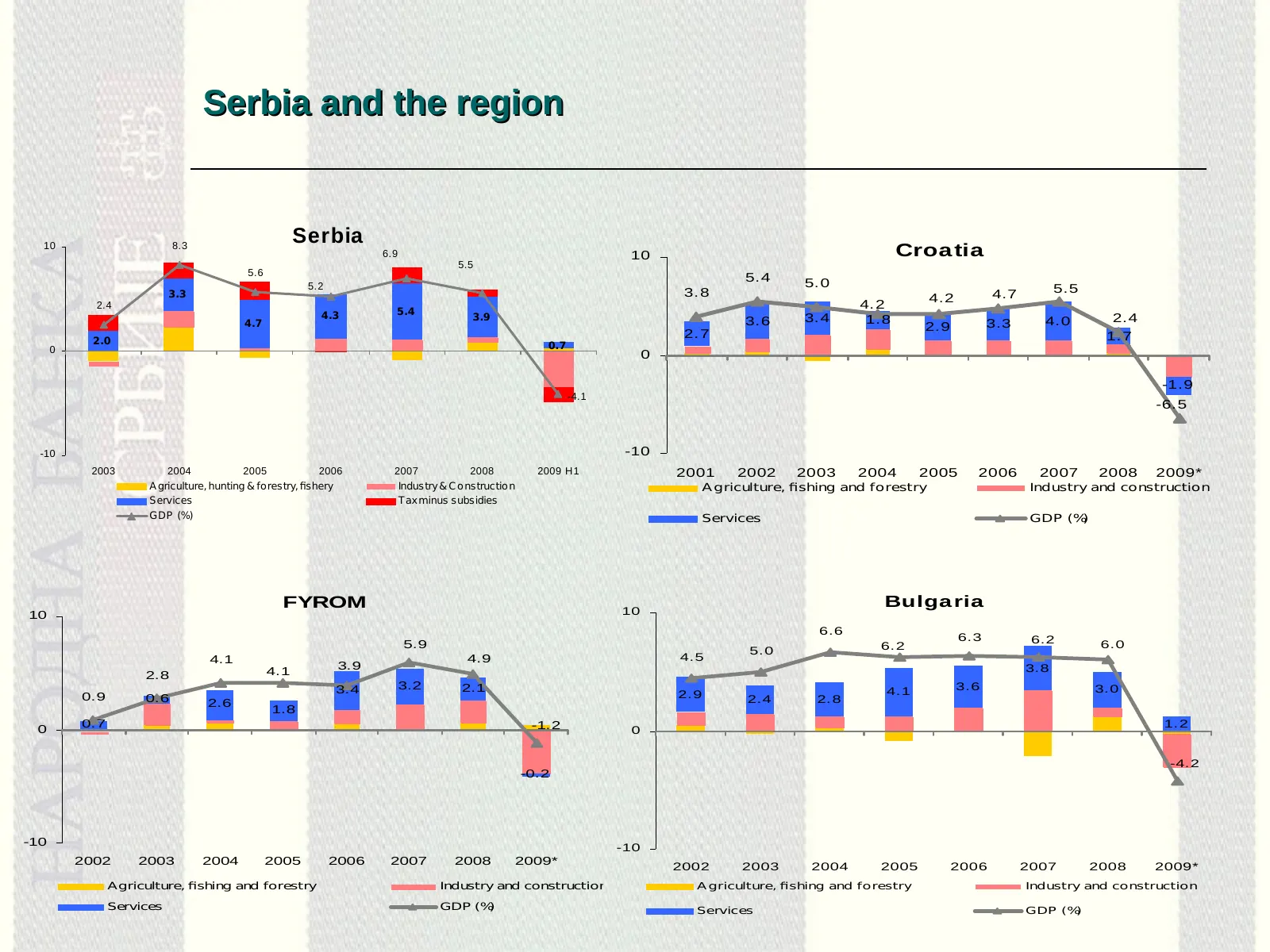
Slide 12: Serbia and the region
Serbia and the region Contribution to y-o-y GDP growth Co ntr ib ution to y-o -y GDP gr ow th (in percentage po ints ) (in percentage points) 10 8.3 Serbia 6.9 10 Croa tia 5.5 5.6 5.4 5. 0 5.2 5.5 3.3 3. 8 4.2 4.7 2.4 4. 2 4.3 5.4 4.7 3.9 3.6 3. 4 1.8 3.3 4.0 2.4 2.9 2. 7 1. 7 2.0 0.7 0 0 -1.9 -4.1
Source: Internet Archive copy of bankofgreece.gr
More decks from Bank of Greece SA
 Investor Presentation (September 2022)69 slides · Sep 30, 2022
 Technical Presentation (September 2022)49 slides · Sep 30, 2022
 Investor Presentation (September 2022)75 slides · Sep 30, 2022
 Investor Presentation (September 2022)44 slides · Sep 30, 2022
 Technical Presentation (September 2022)24 slides · Sep 30, 2022
 Technical Presentation (September 2022)27 slides · Sep 30, 2022