Agfa-Gevaert NV · EURONEXT:AGFB
Agfa-Gevaert NV — Technical Presentation (February 2016)
47 slides from Agfa-Gevaert NV's technical presentation, February 2016
Slide 1: Eric Janssens Februari 2016
Eric Janssens Februari 2016
Slide 2: Idealine: The PCB industry is in constant (r)evolution
Idealine The PCB industry is in constant (r)evolution • Lines & spaces will be smaller and smaller • Number of layers increases • Higher image quality required (impedance controlled design) • Smaller production batches • Higher yields • Environmental constraints The phototool is a key link in the pr
Slide 3: Phototooling is about
Phototooling is about Transferring a design from a CAD/CAM station to a resist, a solder mask, a cover layer, a screen,…. using a silver halide or diazo film
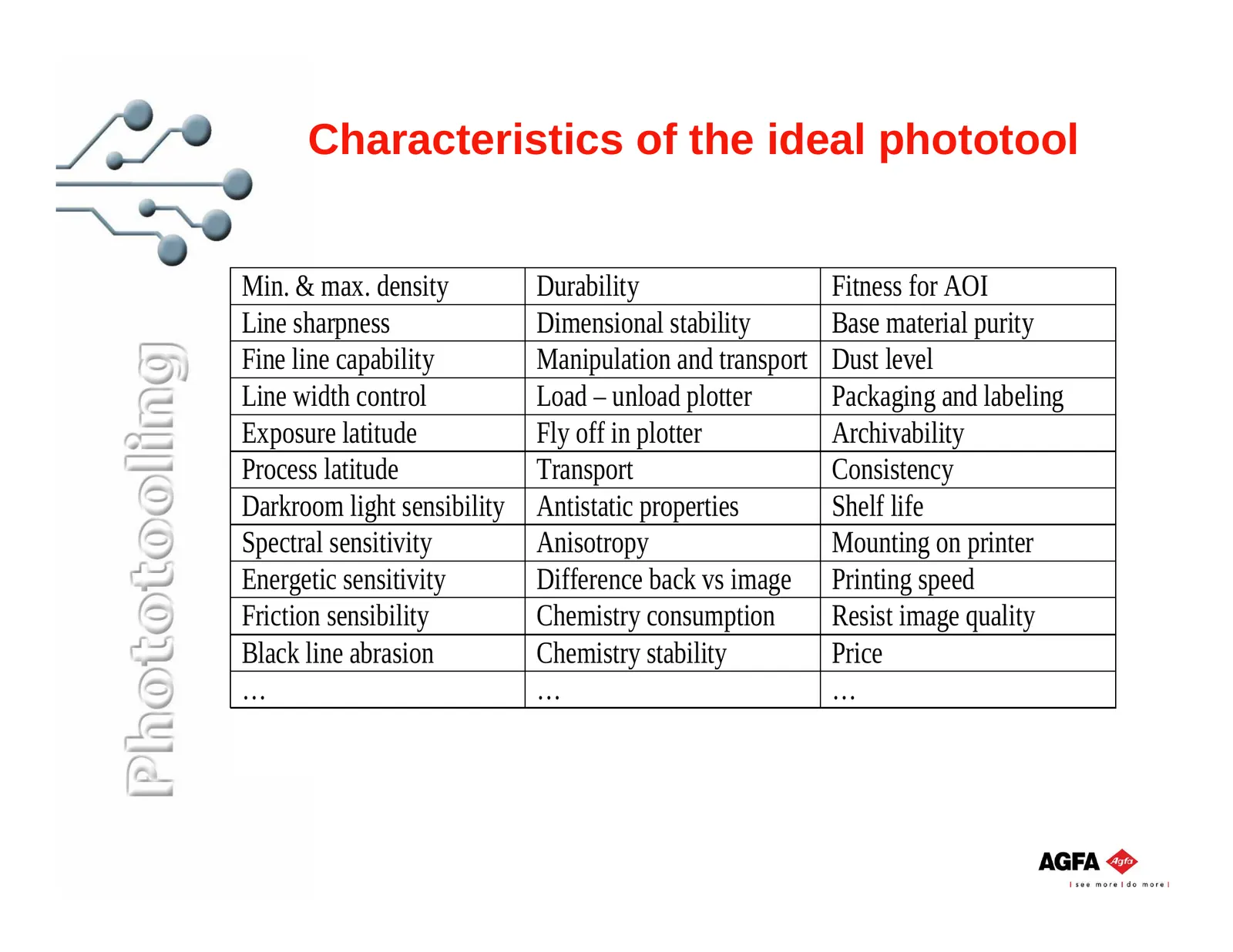
Slide 4: Characteristics of the ideal phototool
Characteristics of the ideal phototool Min. & max. density Durability Fitness for AOI Line sharpness Dimensional stability Base material purity Fine line capability Manipulation and transport Dust level Line width control Load – unload plotter Packaging and labeling Exposure latitude Fly off in plot
Slide 5: Structure
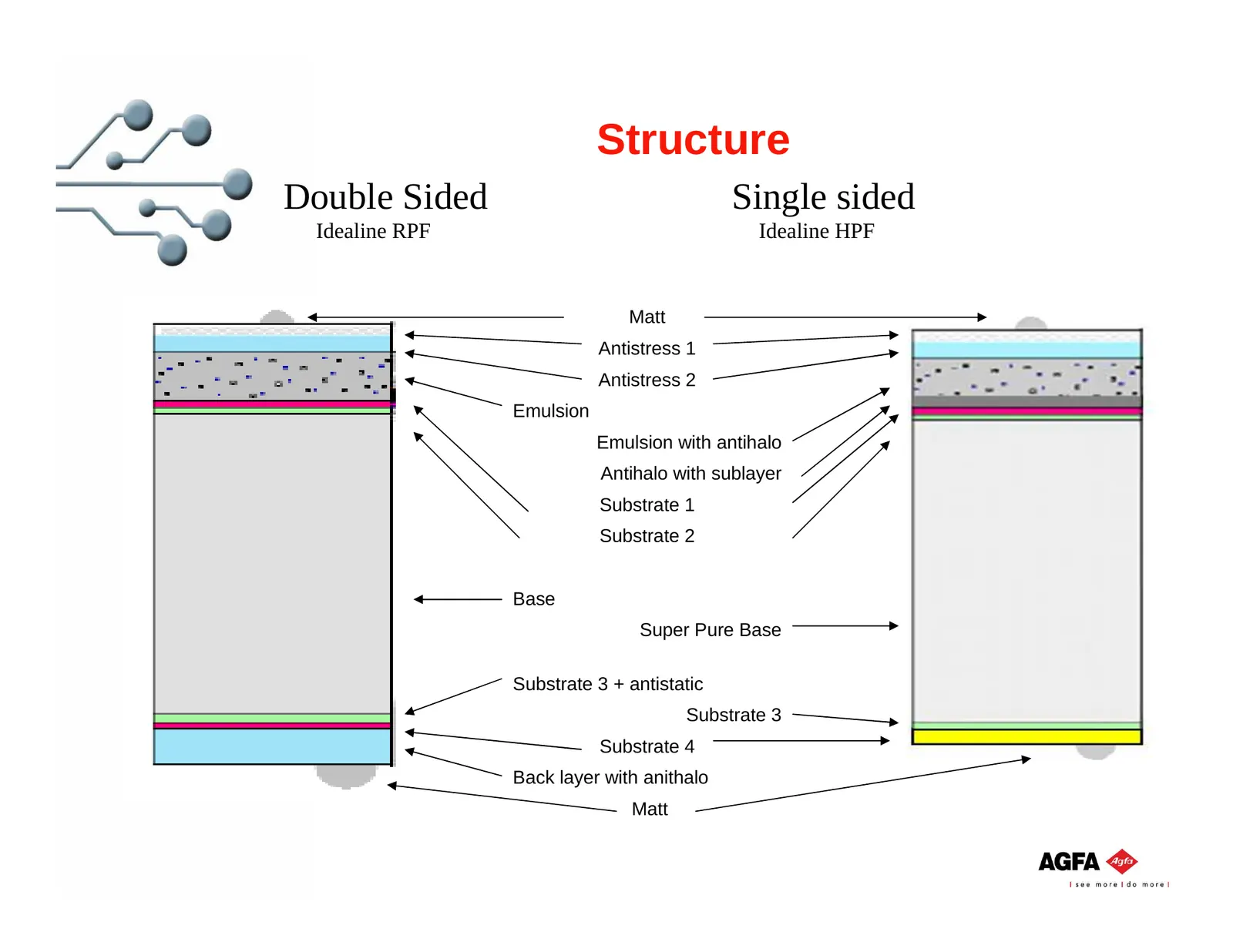
Structure Double Sided Single sided Idealine RPF Idealine HPF Matt Antistress 1 Antistress 2 Emulsion Emulsion with antihalo Antihalo with sublayer Substrate 1 Substrate 2 Base Super Pure Base Substrate 3 + antistatic Substrate 3 Substrate 4 Back layer with anithalo Matt
Slide 6: Structure
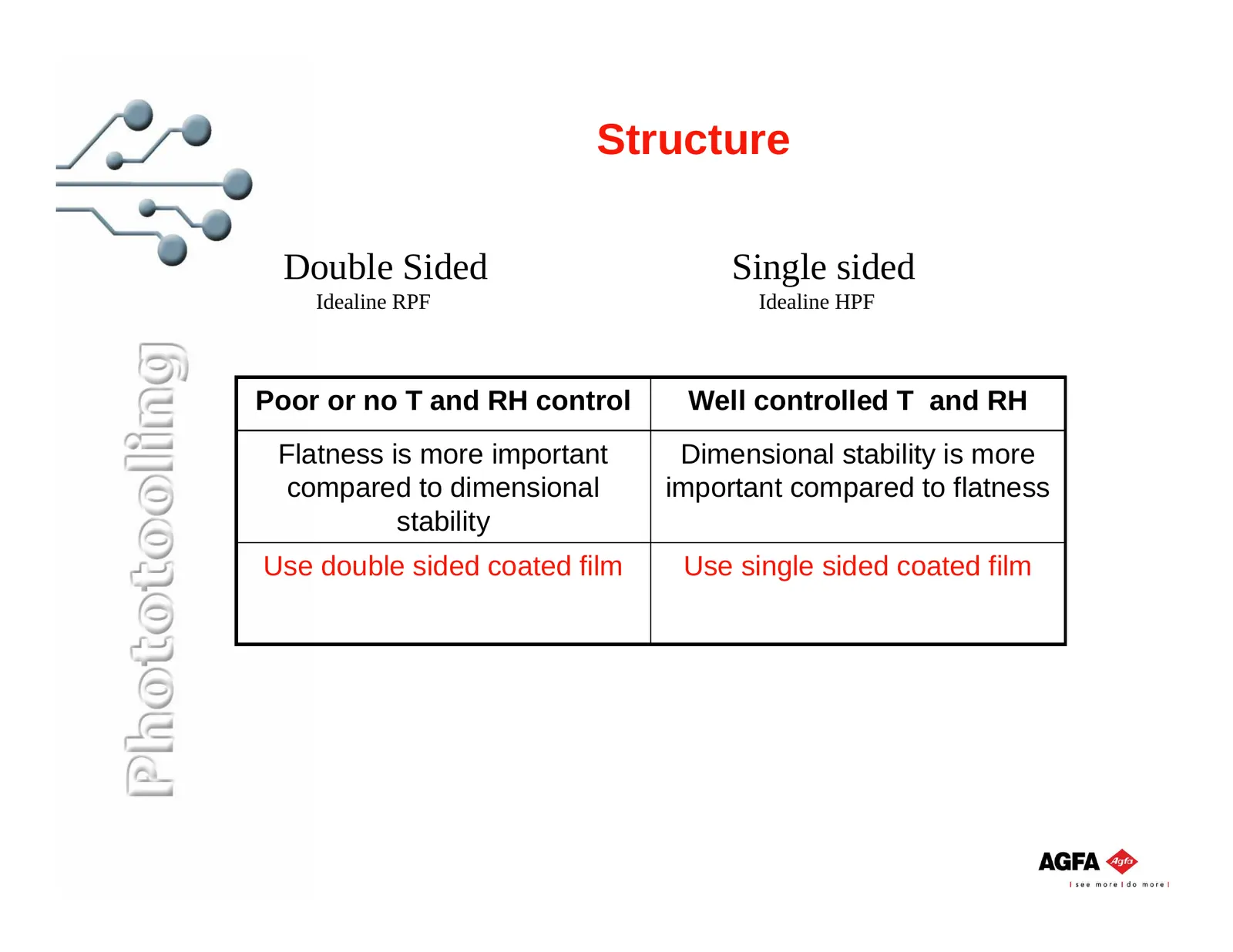
Structure Double Sided Single sided Idealine RPF Idealine HPF Poor or no T and RH control Well controlled T and RH Flatness is more important Dimensional stability is more compared to dimensional important compared to flatness stability Use double sided coated film Use single sided coated film
Slide 7: Image integrity
Characteristics Image integrity Line sharpness – line roughness – edge quality - image quality, … How good does the film represent the design
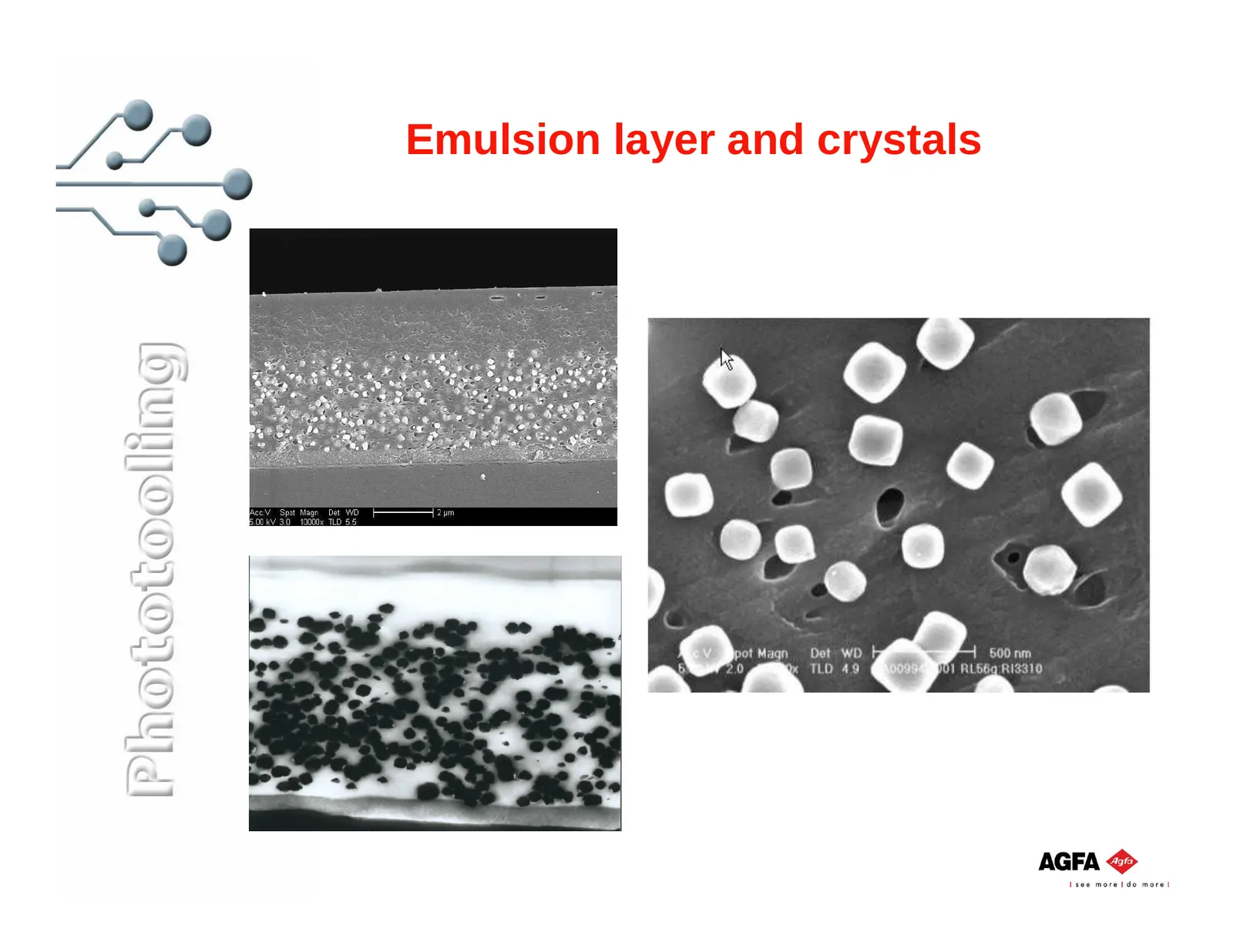
Slide 8: Emulsion layer and crystals
0t Magn Det WD ) 20 TLD 49 AGFA see moreldo more
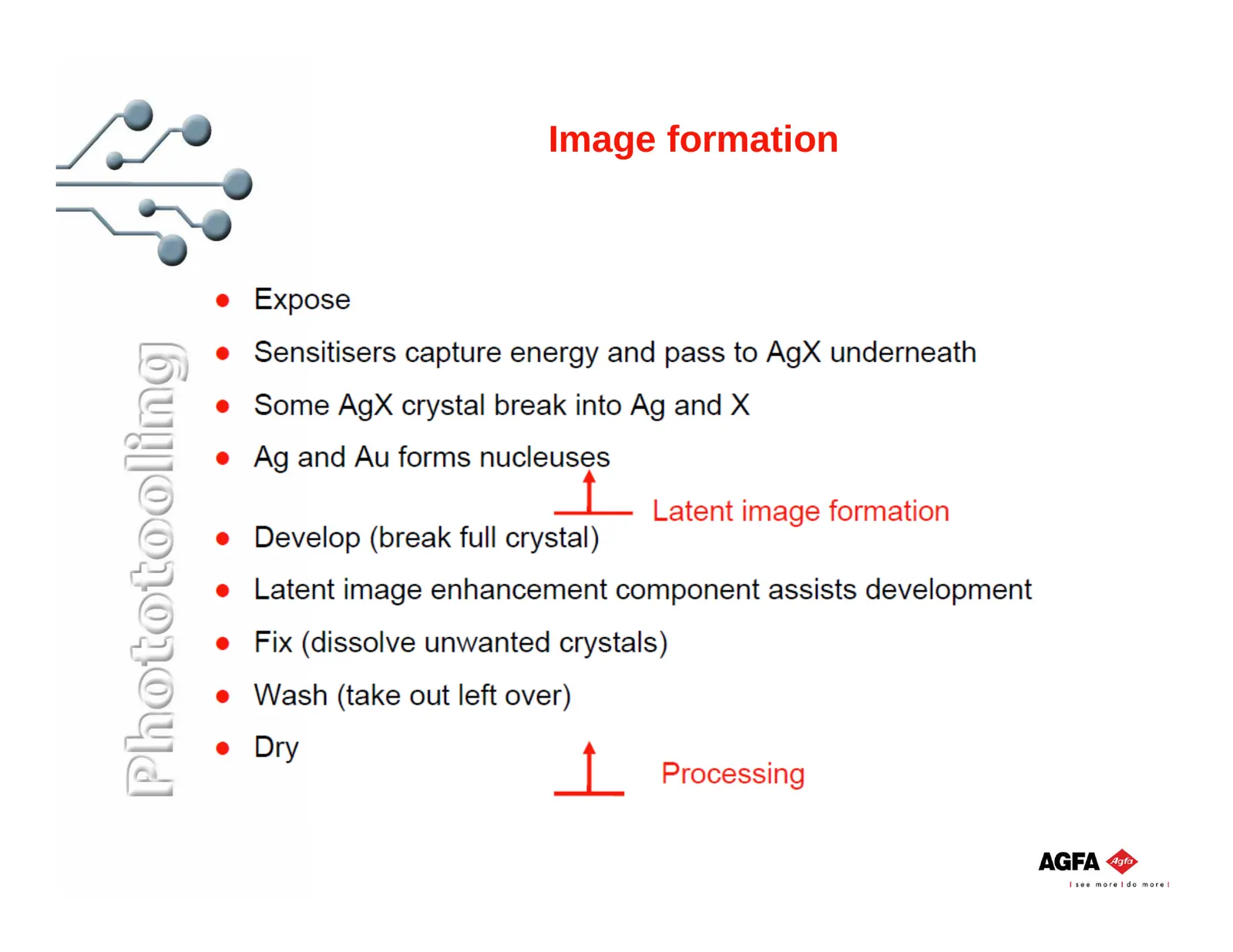
Slide 9: Image formation
e —_ e , hs e e f A 7 > e wf ed —J : e / ~ e me Image formation Expose Sensitisers capture energy and pass to AgX underneath Some AgX crystal break into Ag and X Ag and Au forms nucleuses Latent image formation Develop (break full crystal) Latent image enhancement component assists development Fix (
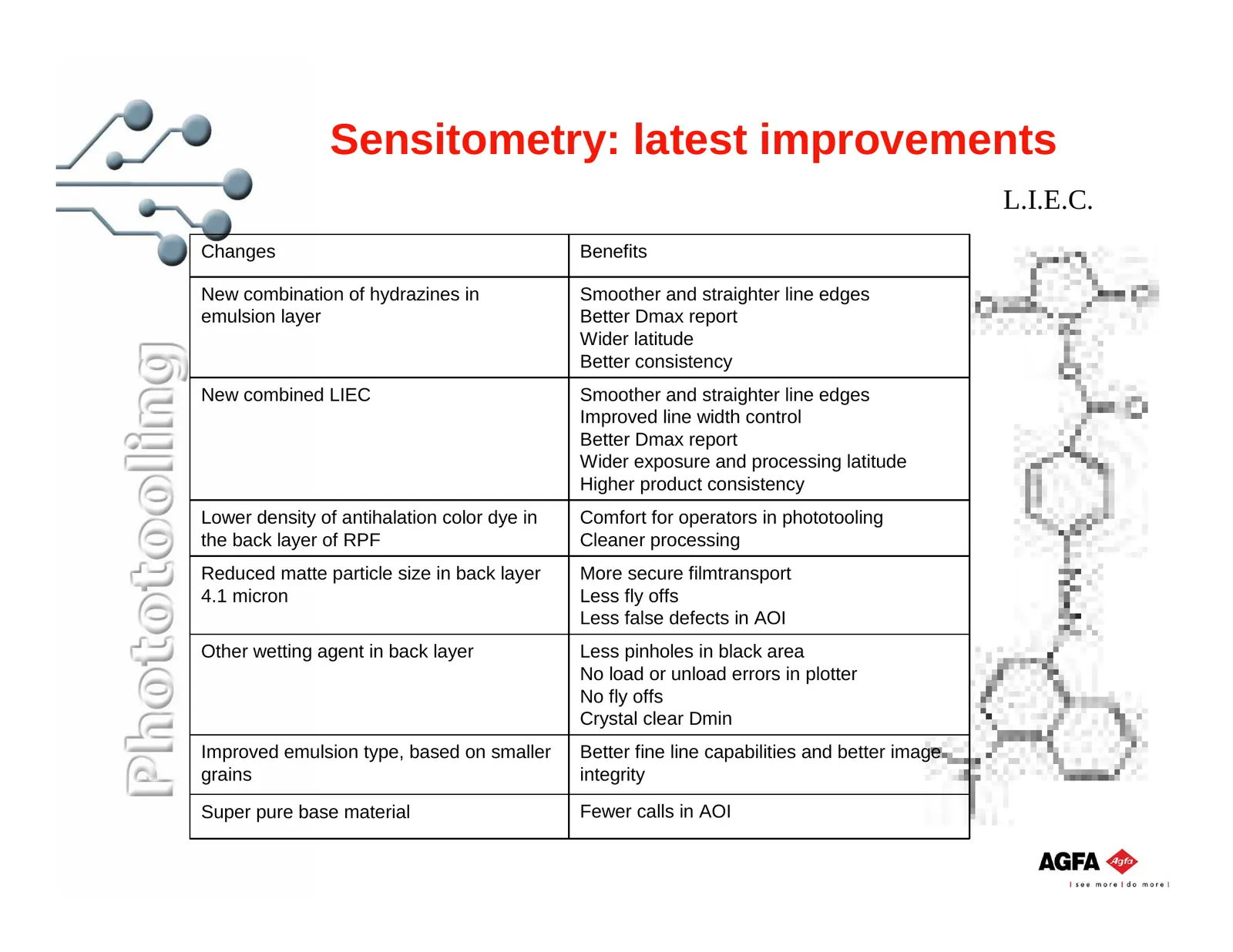
Slide 10: Sensitometry: latest improvements
Sensitometry: latest improvements L.I.E.C. Changes Benefits New combination of hydrazines in Smoother and straighter line edges emulsion layer Better Dmax report Wider latitude Better consistency New combined LIEC Smoother and straighter line edges Improved line width control Better Dmax report Wide
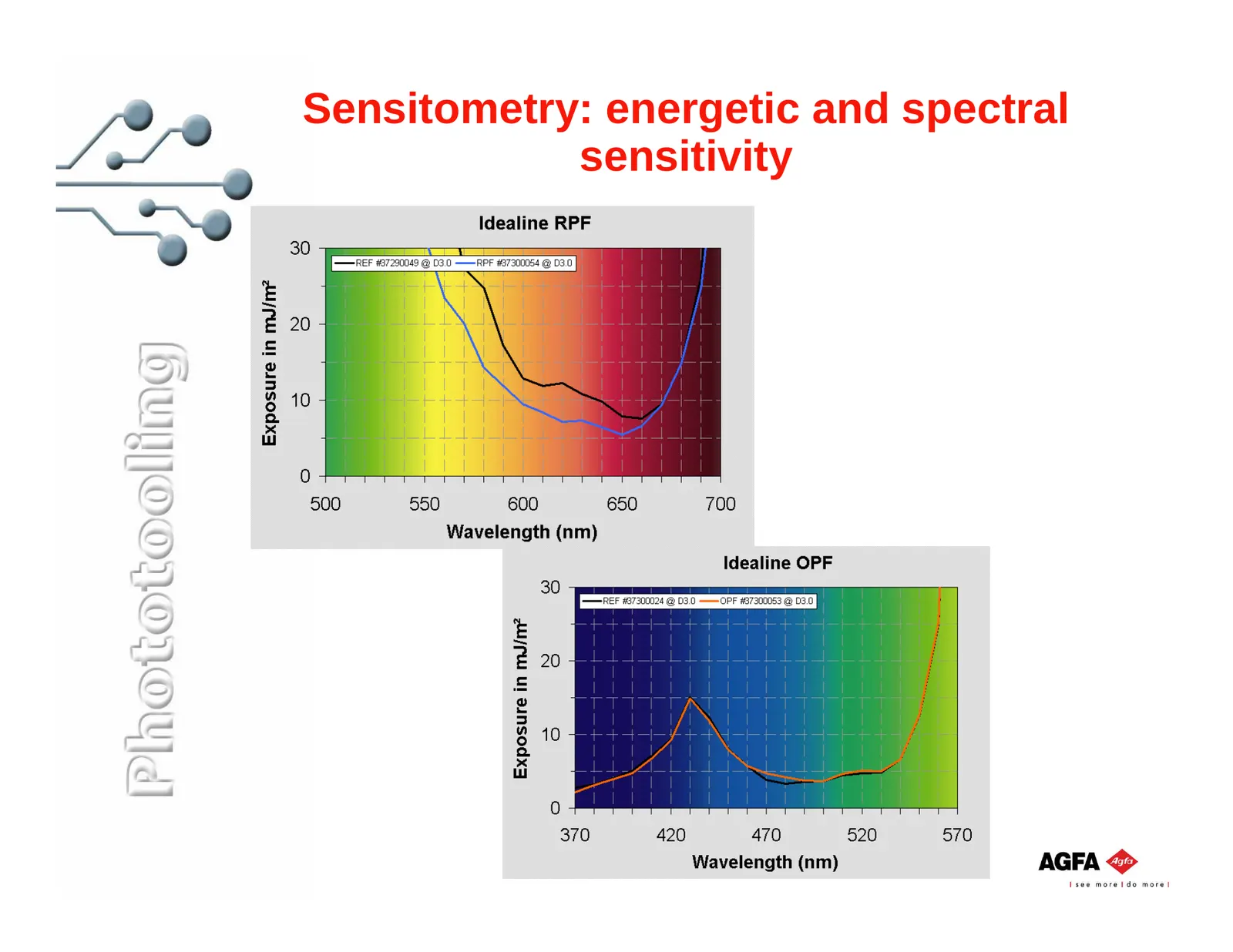
Slide 11: Sensitometry: energetic and spectral sensitivity
Sensitometry: energetic and spectral sensitivity
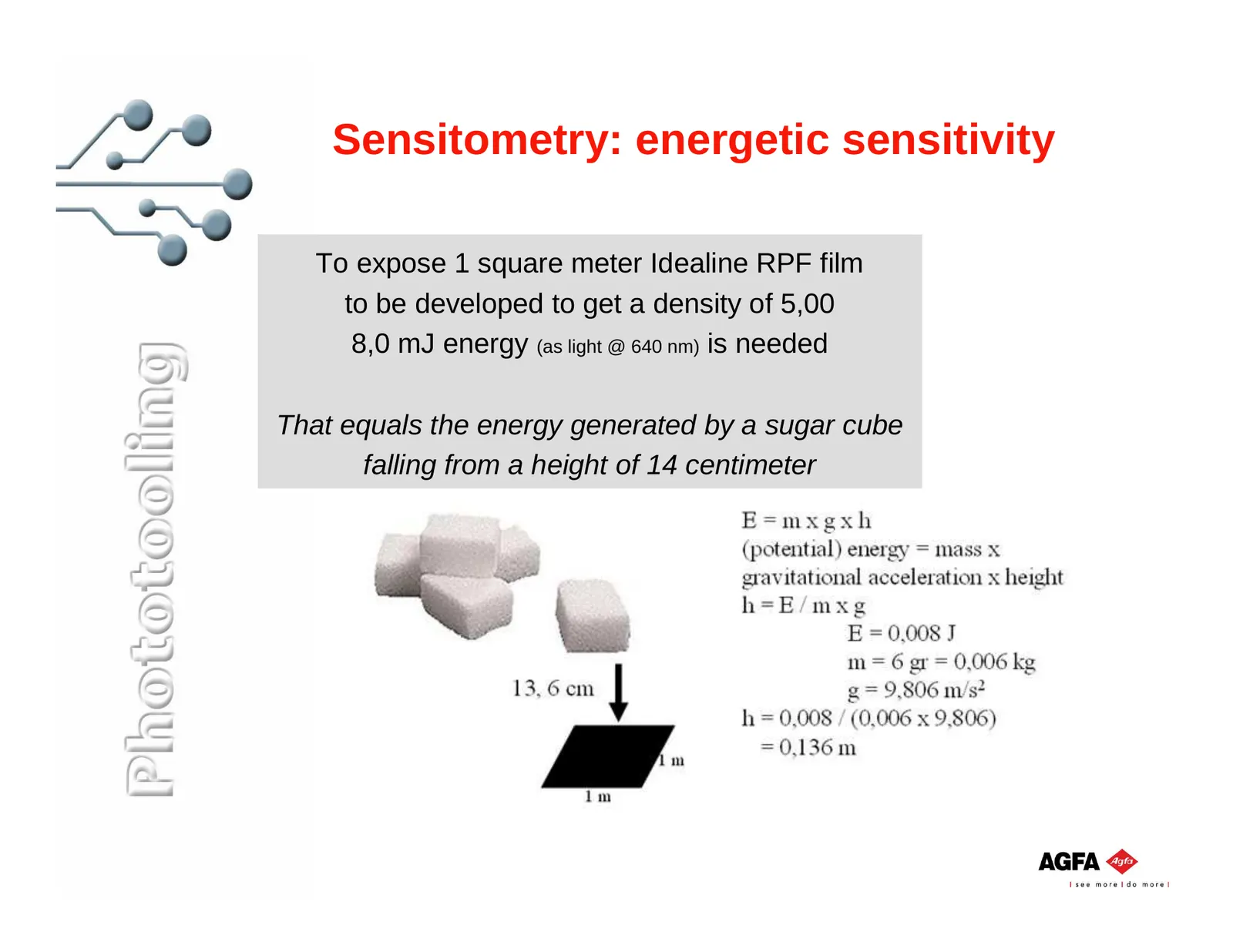
Slide 12: Sensitometry: energetic sensitivity
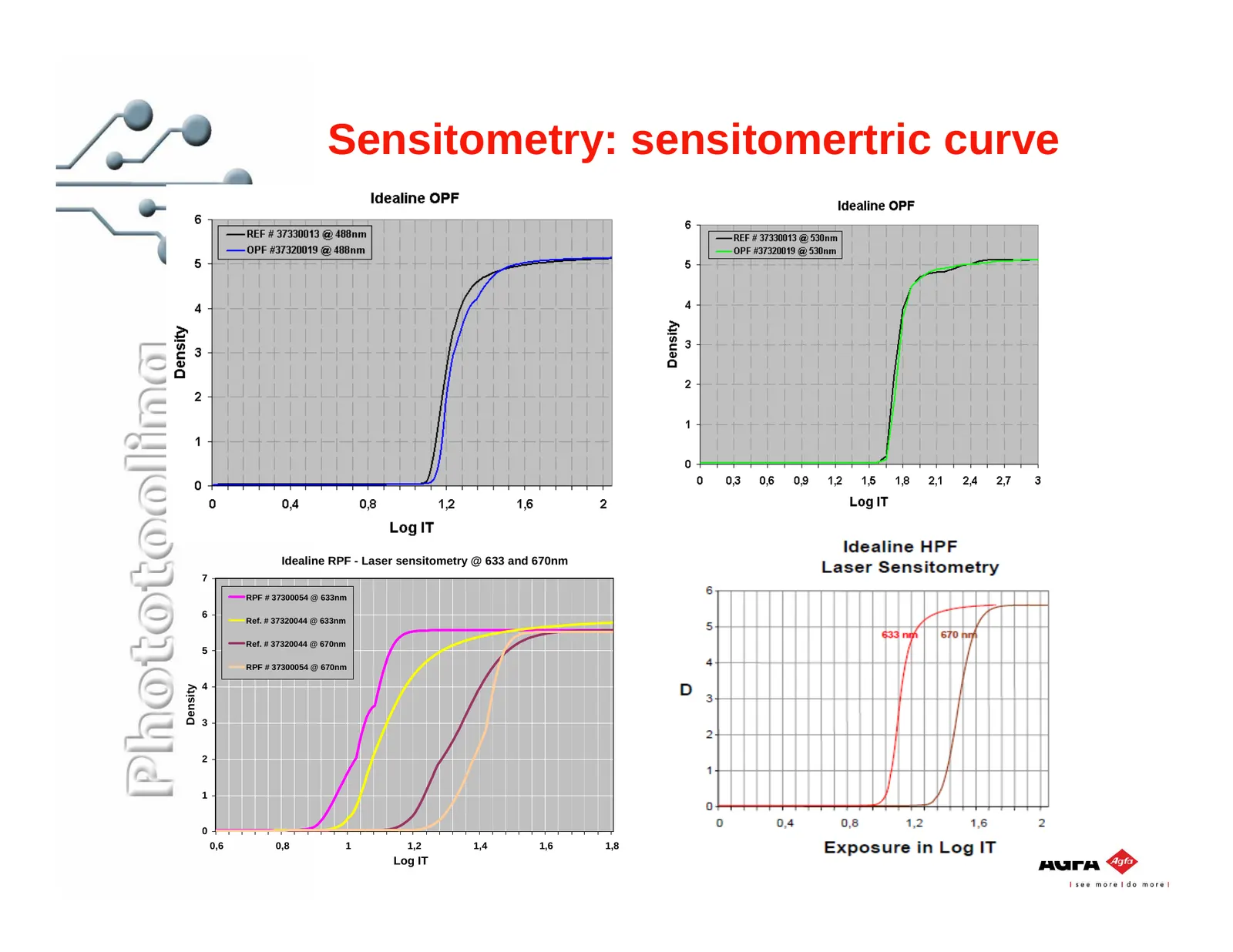
Sensitometry: energetic sensitivity To expose 1 square meter Idealine RPF film to be developed to get a density of 5,00 8,0 mJ energy (as light @ 640 nm) is needed That equals the energy generated by a sugar cube falling from a height of 14 centimeter X 230 000
Slide 13: Sensitometry: sensitometric curve
Sensitometry: sensitomertric curve Idealine RPF - Laser sensitometry @ 633 and 670nm 7 RPF # 37300054 @ 633nm 6 Ref. # 37320044 @ 633nm Ref. # 37320044 @ 670nm 5 RPF # 37300054 @ 670nm 4 Density 3 2 1 0 0,6 0,8 1 1,2 1,4 1,6 1,8 Log IT
Slide 14: Sensitometry: density
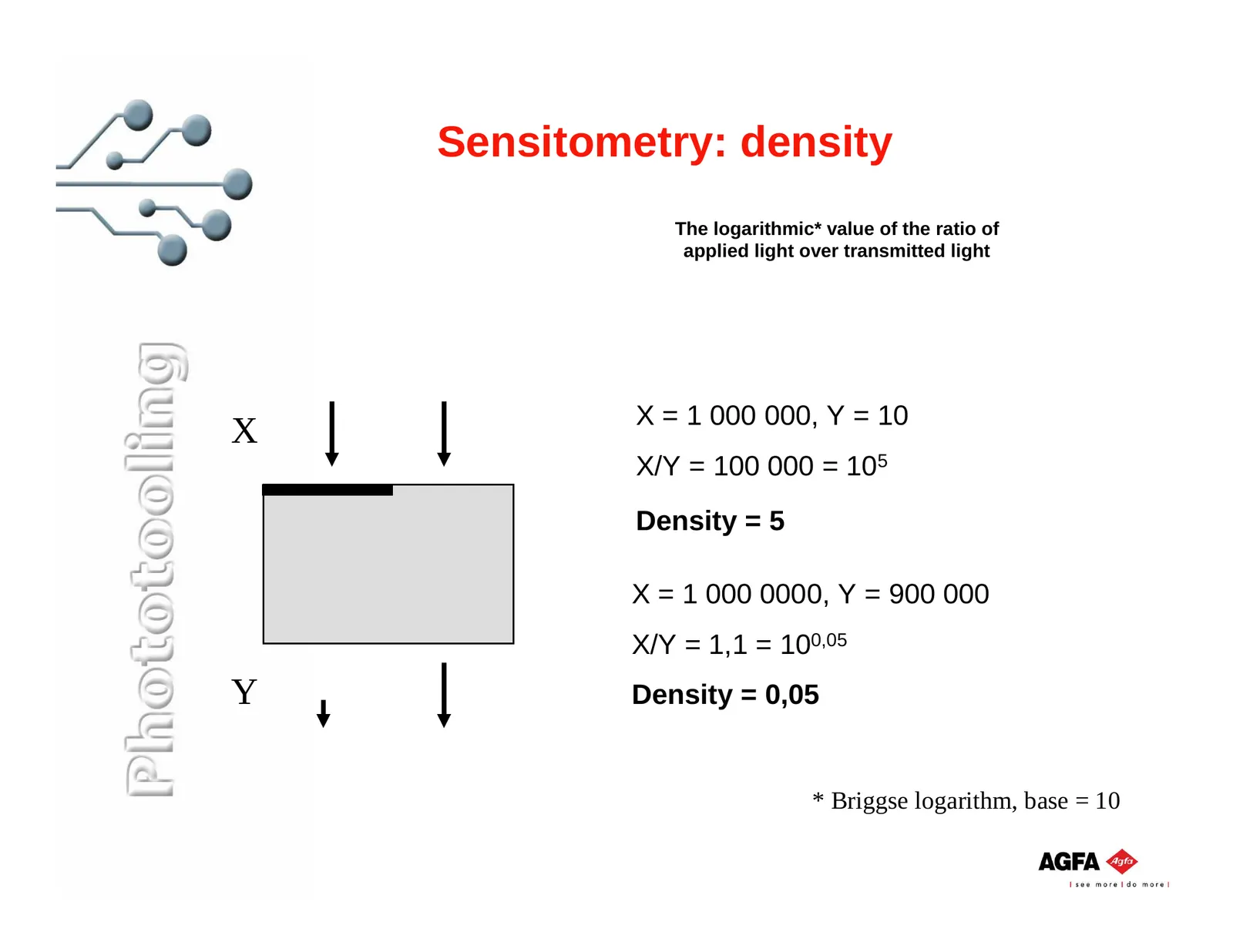
Sensitometry: density The logarithmic* value of the ratio of applied light over transmitted light X = 1 000 000, Y = 10 X X/Y = 100 000 = 105 Density = 5 X = 1 000 0000, Y = 900 000 X/Y = 1,1 = 100,05 Y Density = 0,05 * Briggse logarithm, base = 10
Slide 15: Image integrity
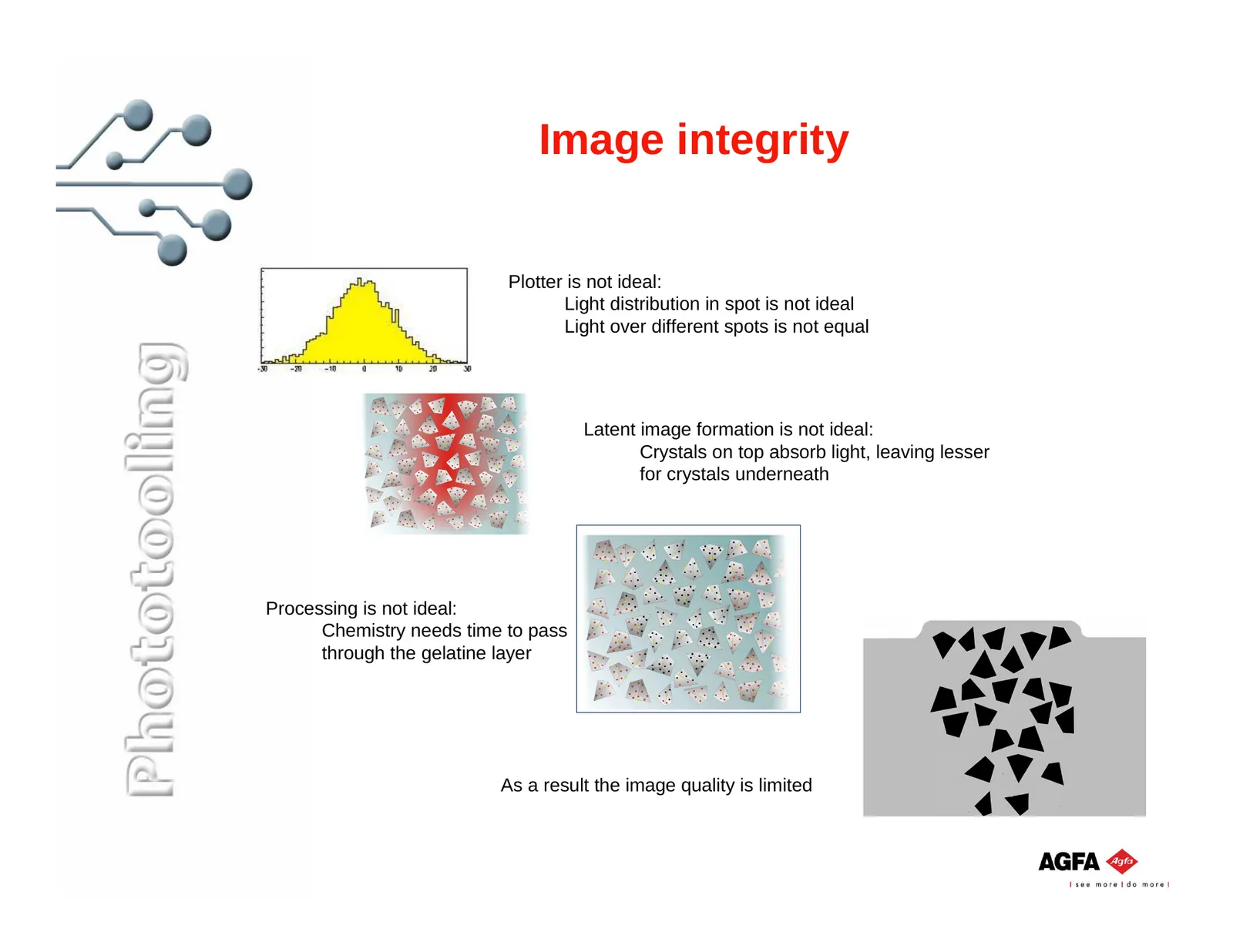
Image integrity Plotter is not ideal: Light distribution in spot is not ideal Light over different spots is not equal Latent image formation is not ideal: Crystals on top absorb light, leaving lesser for crystals underneath Processing is not ideal: Chemistry needs time to pass through the gelatine l
Slide 16: Image integrity: measurement
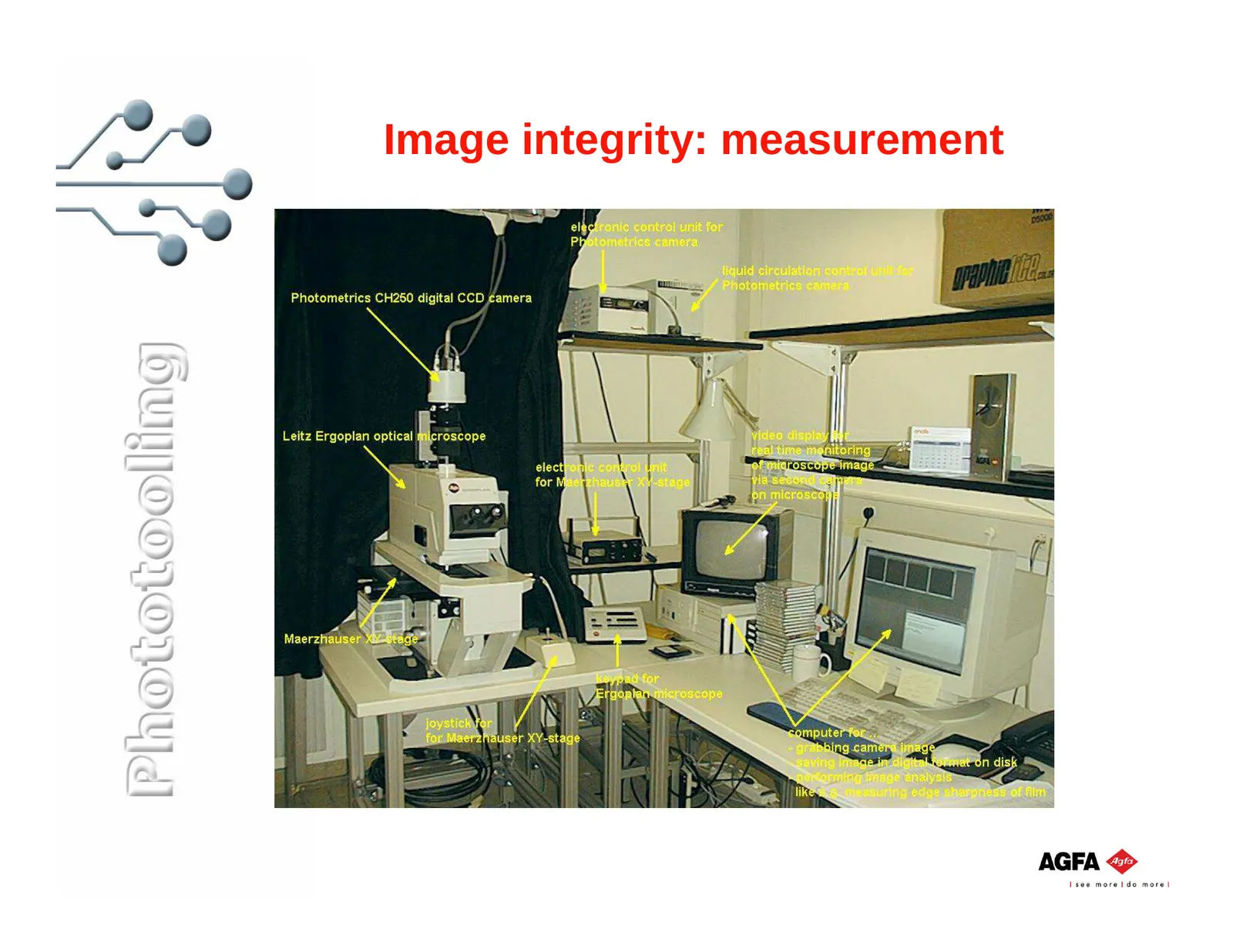
Image integrity: measurement
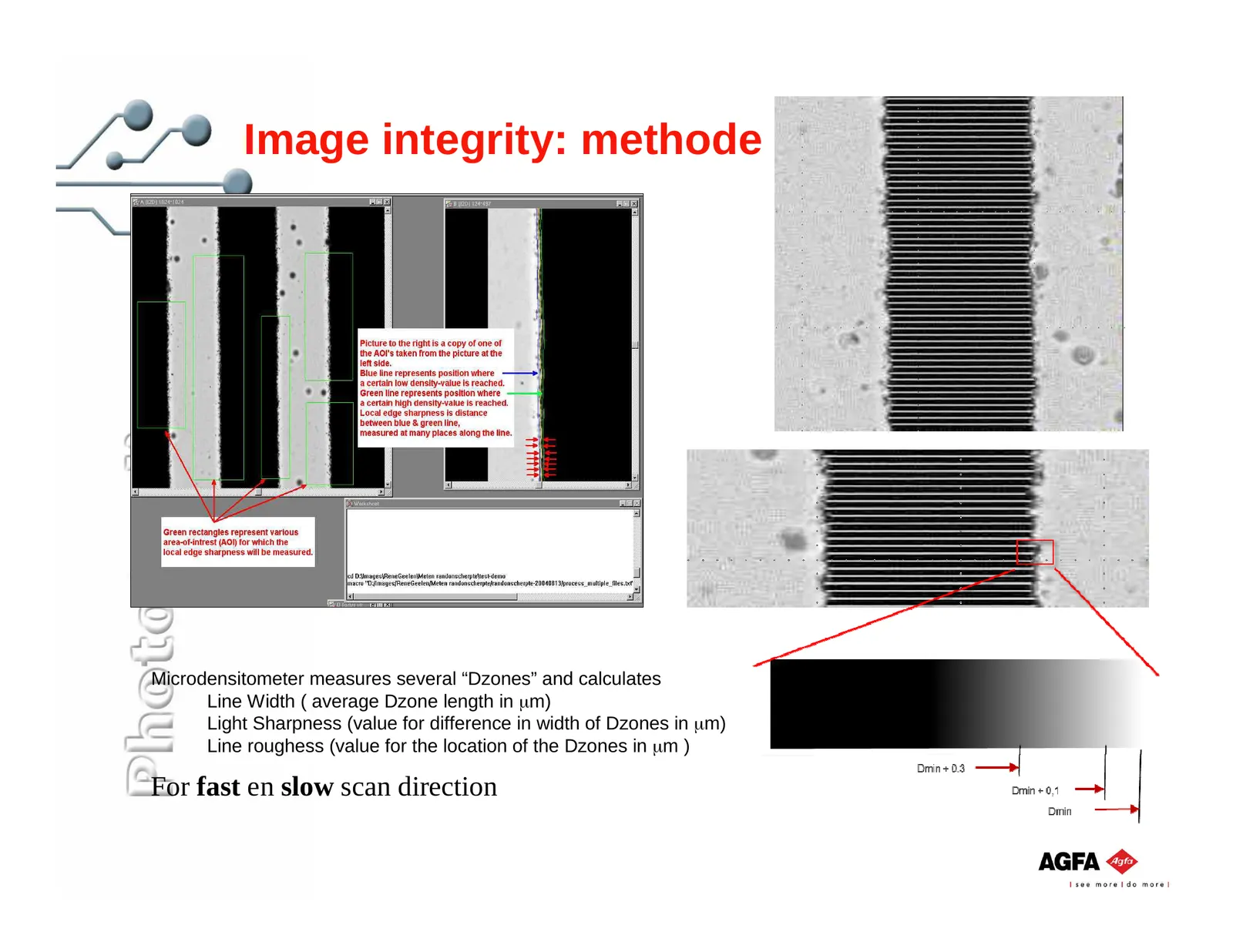
Slide 17: Image integrity: method
Image integrity: methode Microdensitometer measures several “Dzones” and calculates Line Width ( average Dzone length in µm) Light Sharpness (value for difference in width of Dzones in µm) Line roughess (value for the location of the Dzones in µm ) For fast en slow scan direction
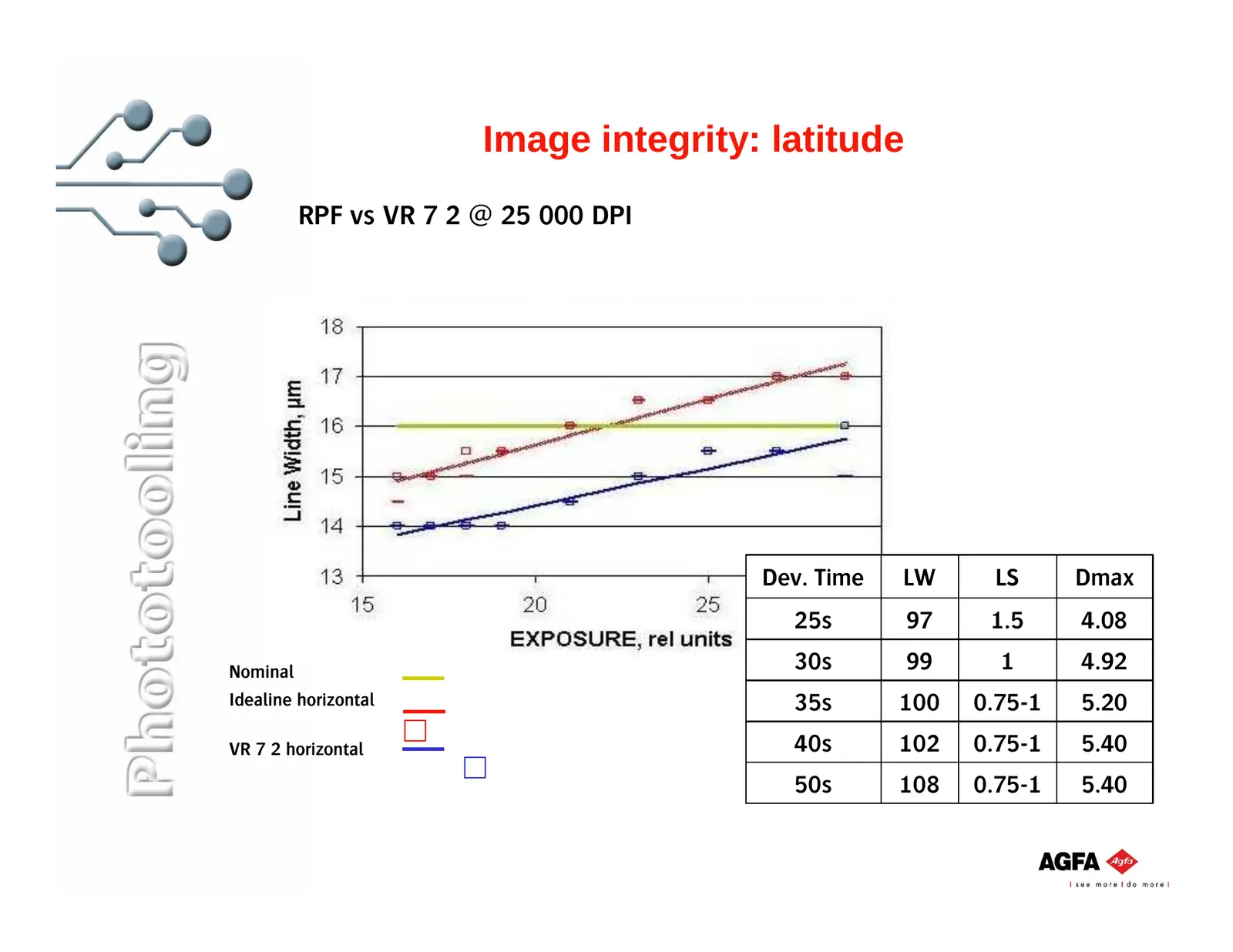
Slide 18: Image integrity: latitude
Image integrity: latitude RPF vs VR 7 2 @ 25 000 DPI Dev. Time LW LS Dmax 25s 97 1.5 4.08 Nominal 30s 99 1 4.92 Idealine horizontal 35s 100 0.75-1 5.20 VR 7 2 horizontal 40s 102 0.75-1 5.40 50s 108 0.75-1 5.40
Slide 19: Dimensional Stability
Characteristics Dimensional Stability Registering
Slide 20: Dimensional stability
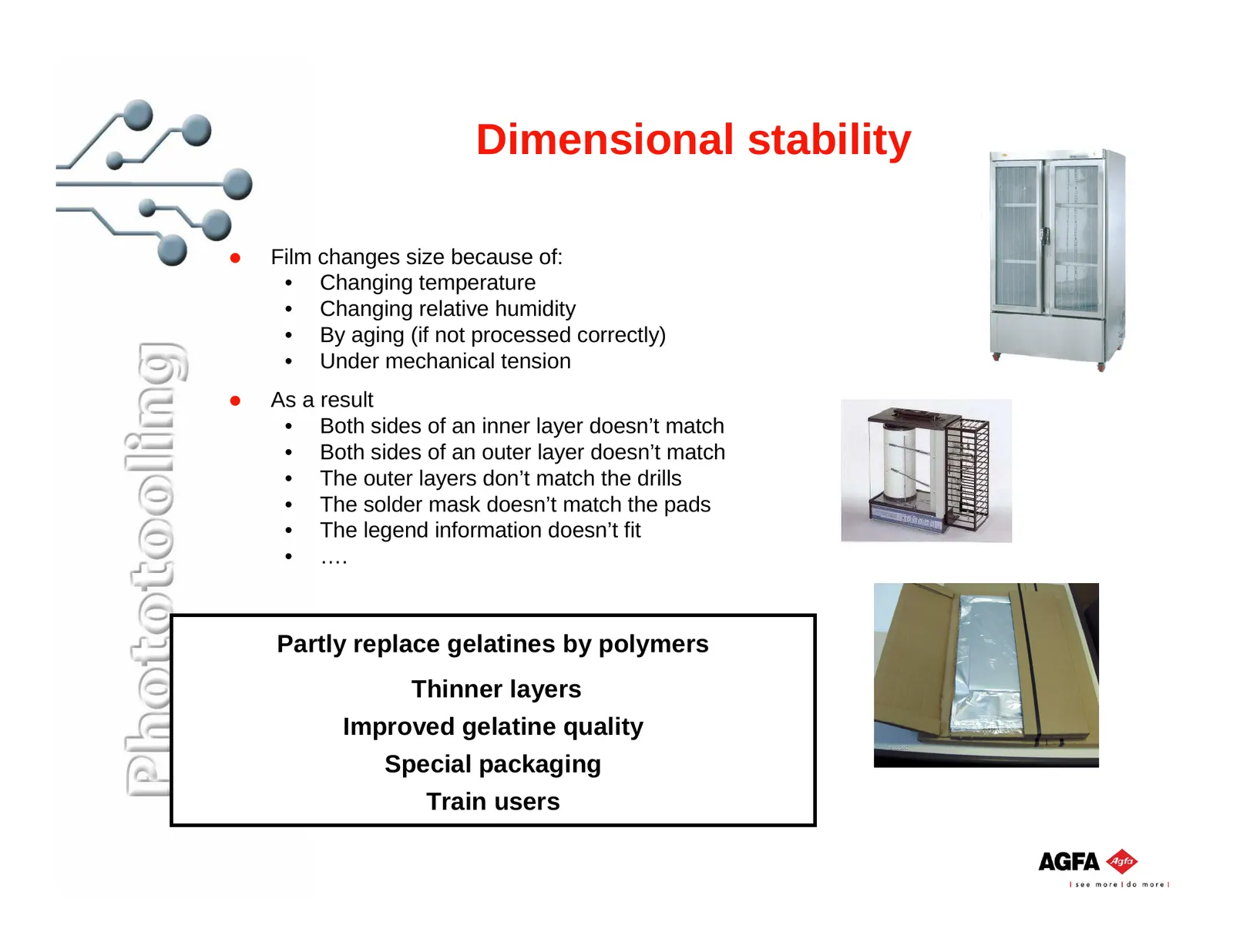
Dimensional stability Film changes size because of: • Changing temperature • Changing relative humidity • By aging (if not processed correctly) • Under mechanical tension As a result • Both sides of an inner layer doesn’t match • Both sides of an outer layer doesn’t match • The outer layers don’t ma
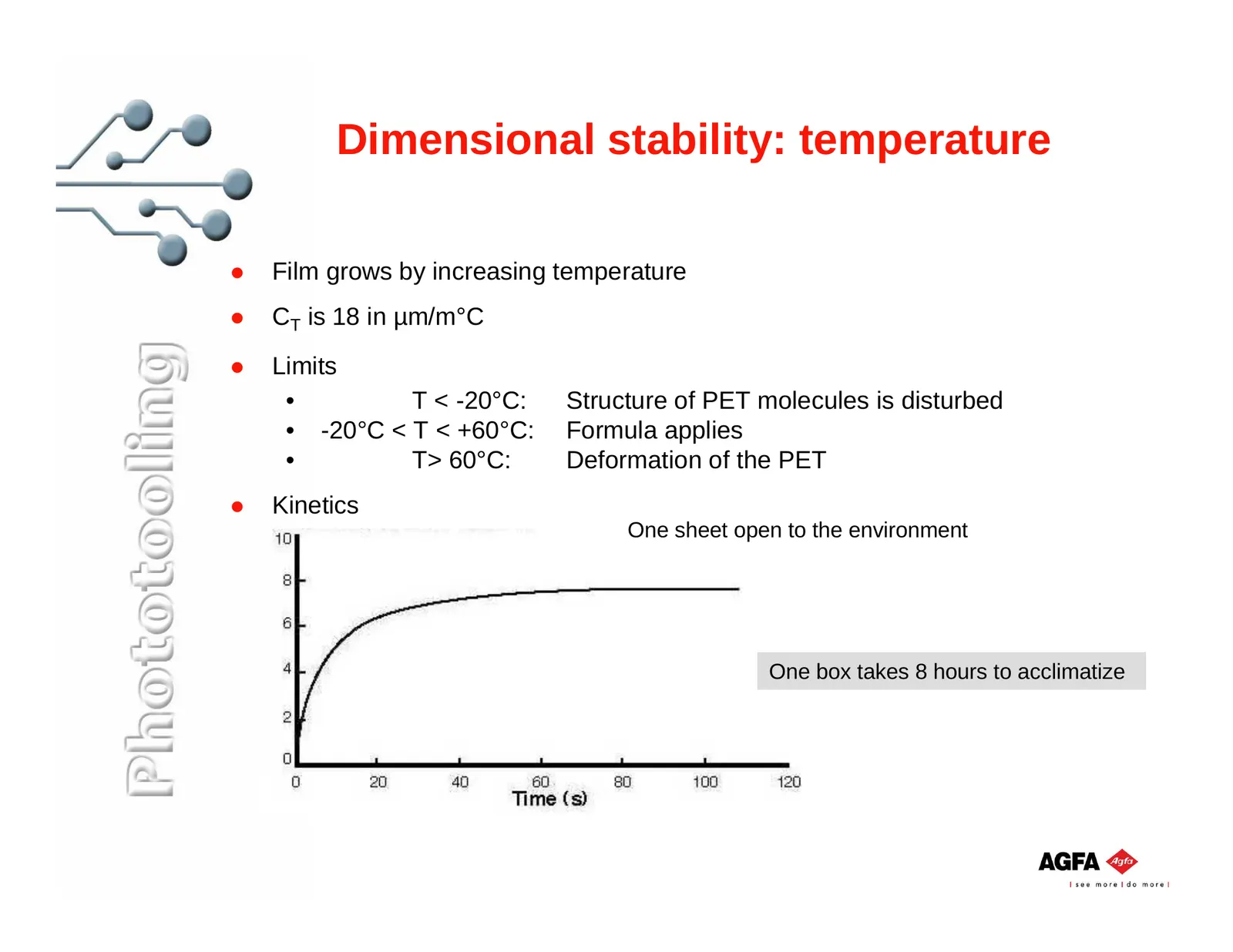
Slide 21: Dimensional stability: temperature
Dimensional stability: temperature Film grows by increasing temperature CT is 18 in µm/m°C Limits • T < -20°C: Structure of PET molecules is disturbed • -20°C < T < +60°C: Formula applies • T> 60°C: Deformation of the PET Kinetics One sheet open to the environment One box takes 8 hours to acclimatiz
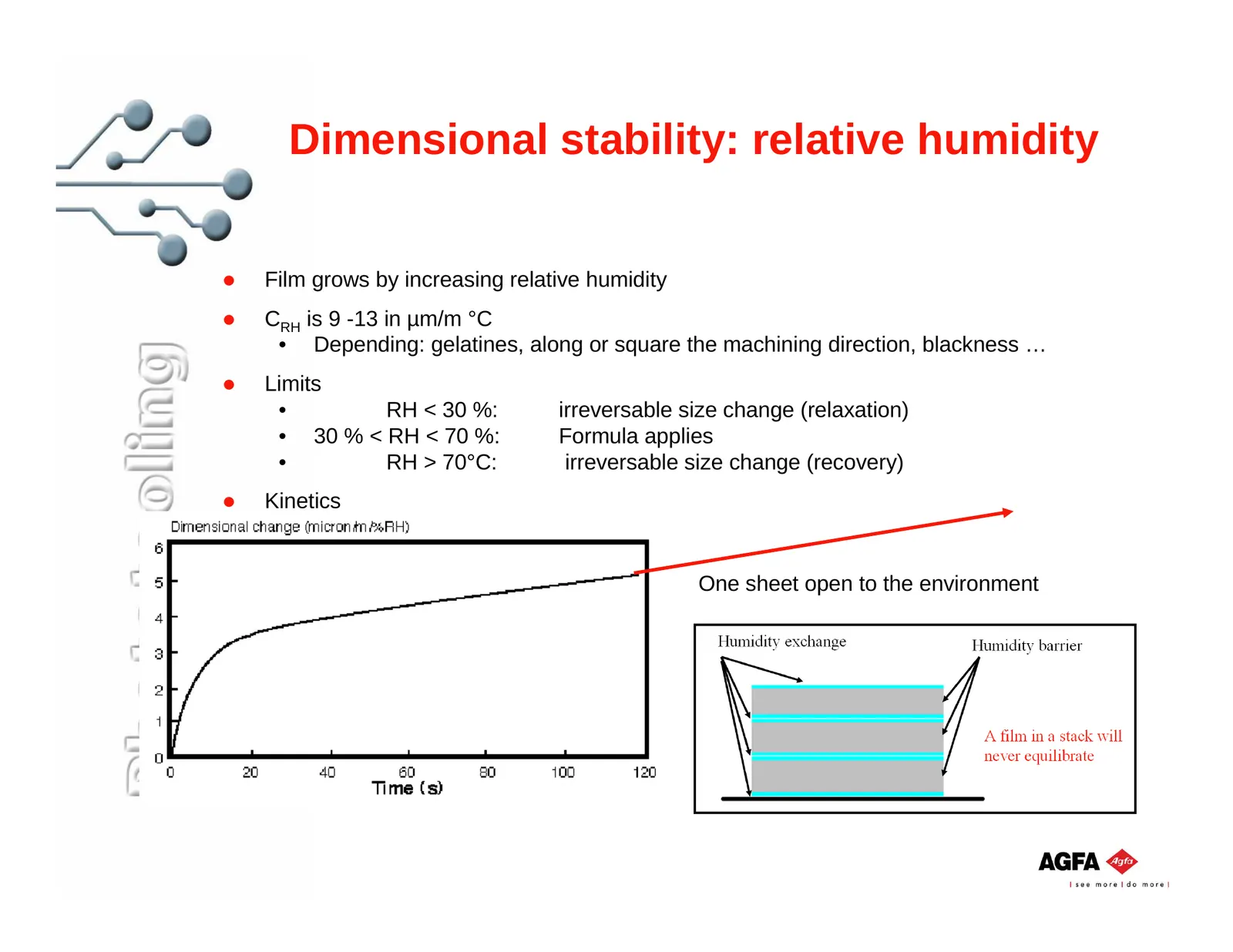
Slide 22: Dimensional stability: relative humidity
Dimensional stability: relative humidity Film grows by increasing relative humidity CRH is 9 -13 in µm/m °C • Depending: gelatines, along or square the machining direction, blackness … Limits • RH < 30 %: irreversable size change (relaxation) • 30 % < RH < 70 %: Formula applies • RH > 70°C: irrevers
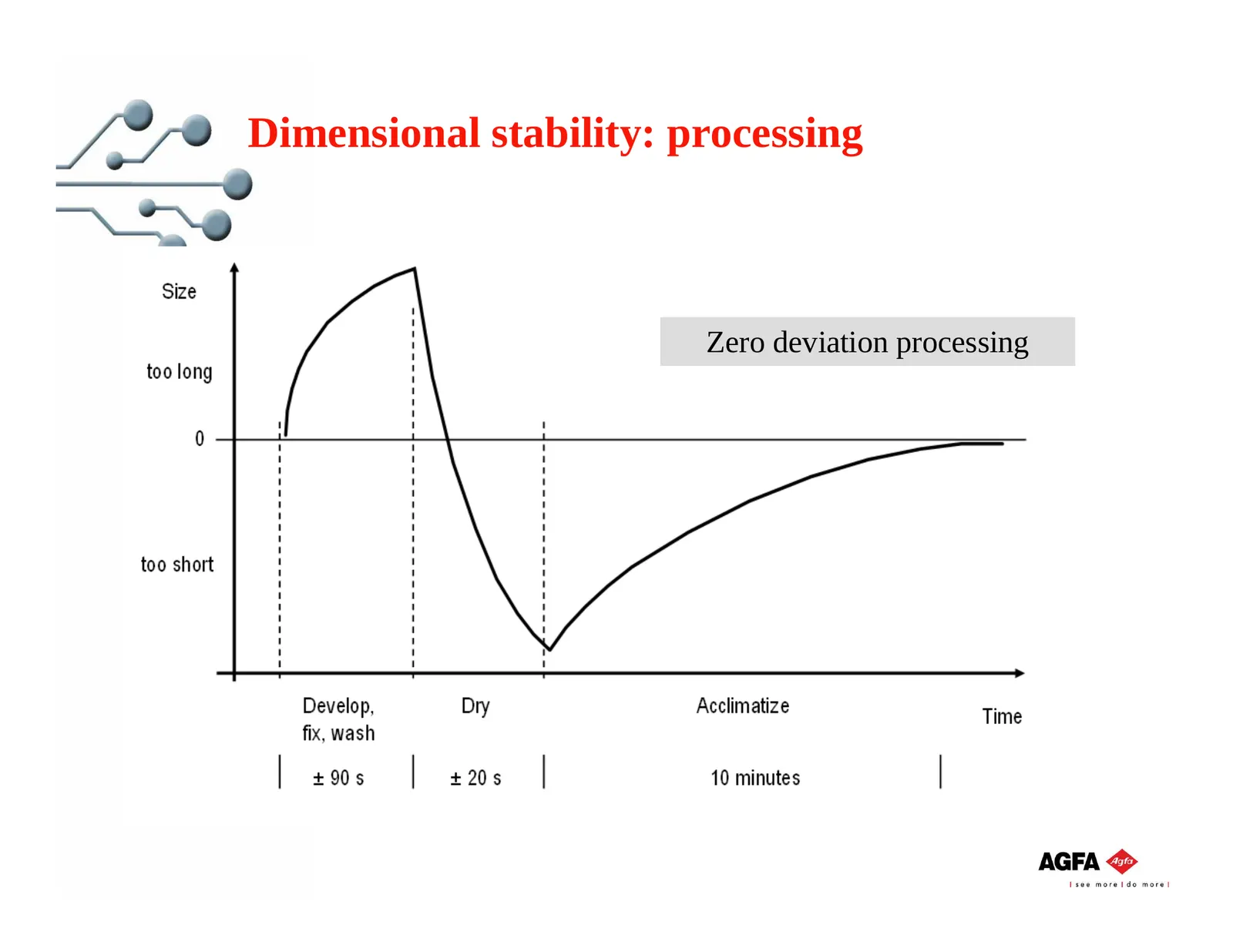
Slide 23: Dimensional stability: processing
Dimensional stability: processing Zero deviation processing
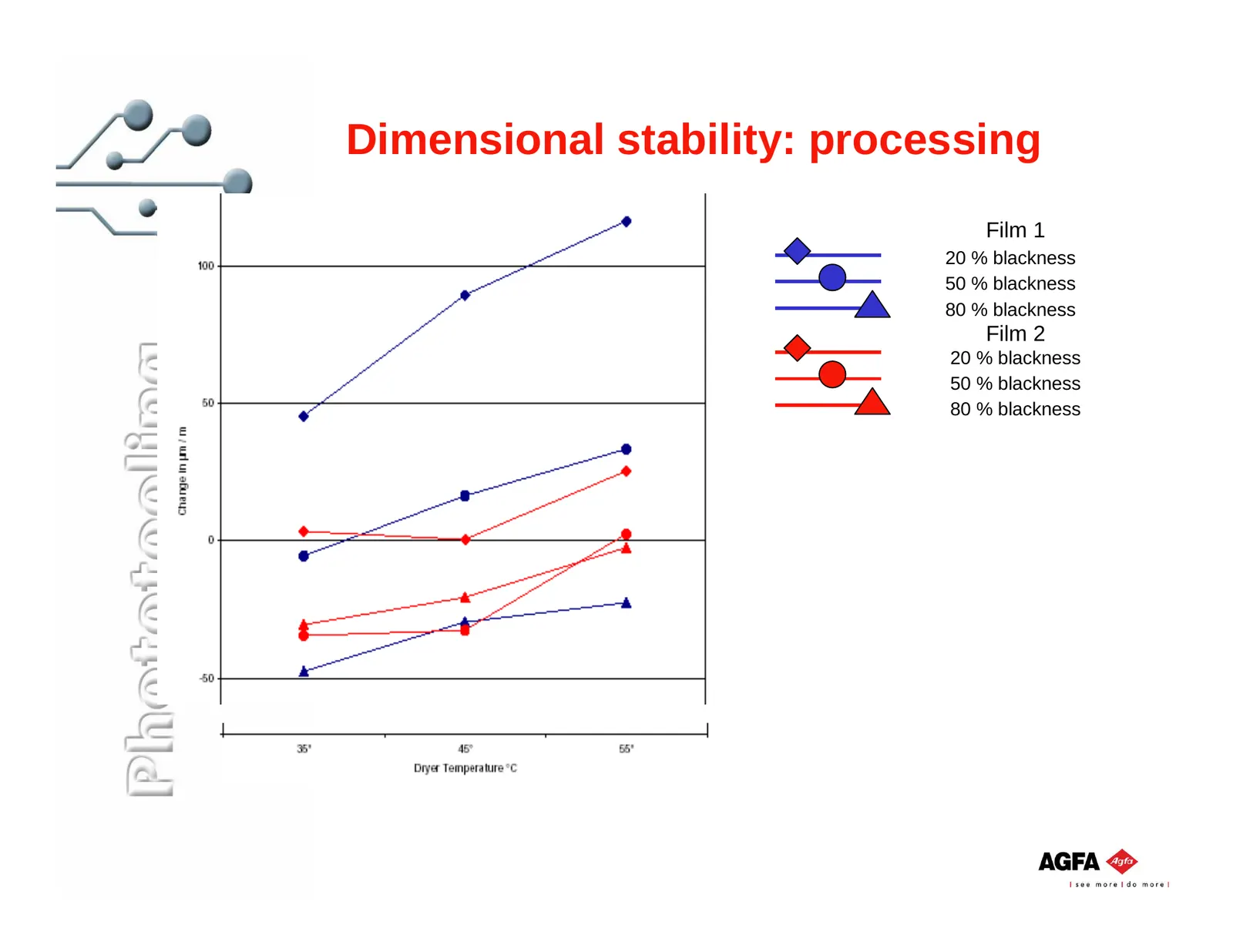
Slide 24: Dimensional stability: processing
Dimensional stability: processing Film 1 20 % blackness 50 % blackness 80 % blackness Film 2 20 % blackness 50 % blackness 80 % blackness
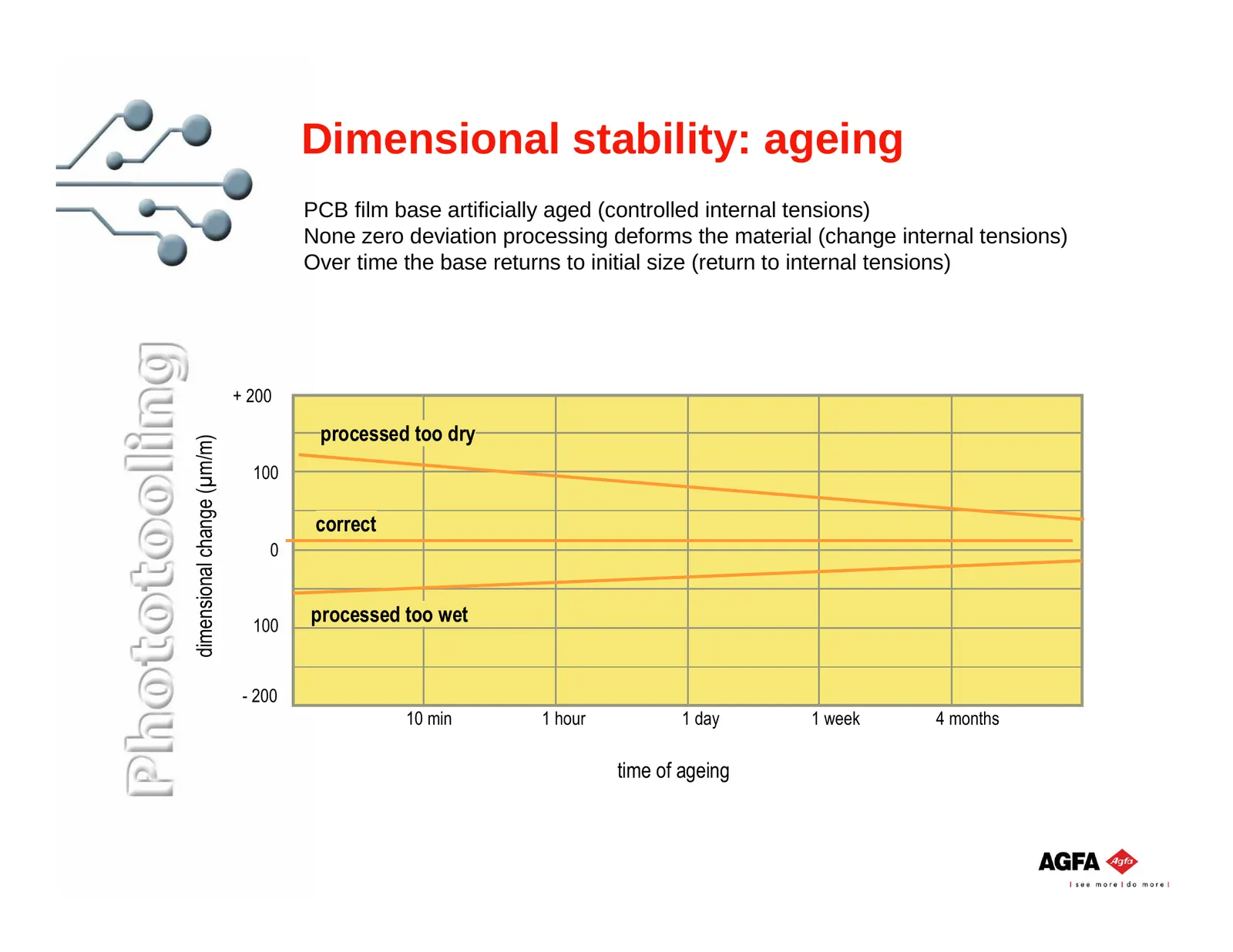
Slide 25: Dimensional stability: ageing
Dimensional stability: ageing PCB film base artificially aged (controlled internal tensions) None zero deviation processing deforms the material (change internal tensions) Over time the base returns to initial size (return to internal tensions) + 200 processed too dry dimensional change (µm/m) 100 c
Slide 26: Dimensional stability: mechanical tension
Dimensional stability: mechanical tension Material tends to expand when pulled, to shrink when compressed • Depending on thickness of the material, type of material and ε (elasticity modulus) In normal circumstances all size changes are reversal Size changes due to mechanical tensions can be compens
Slide 27: Dimensional stability: measurement
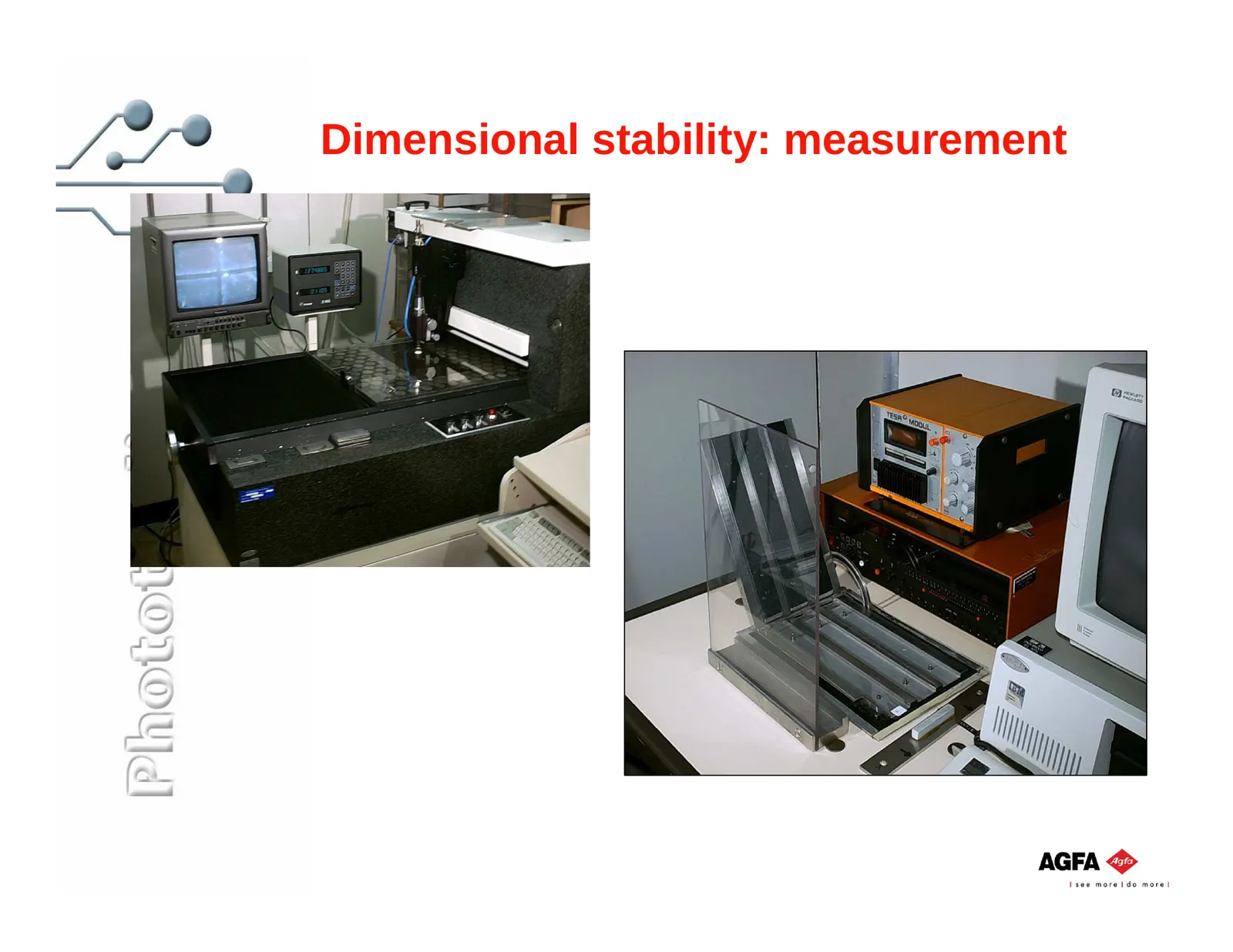
Dimensional stability: measurement
Slide 28: Durability
Characteristics Durability Hit rate
Slide 29: Durability
Durability It is hard to quantify the durability of a film in practice Which measurements • ANSI scratch resistance (needle test) • Circular abrasion resistance • Linear abrasion resistance Measured on: • Non exposed, non developed film (sensitizing) • Exposed, non developed film (de-sensitizing) •
Slide 30: Durability: needle test
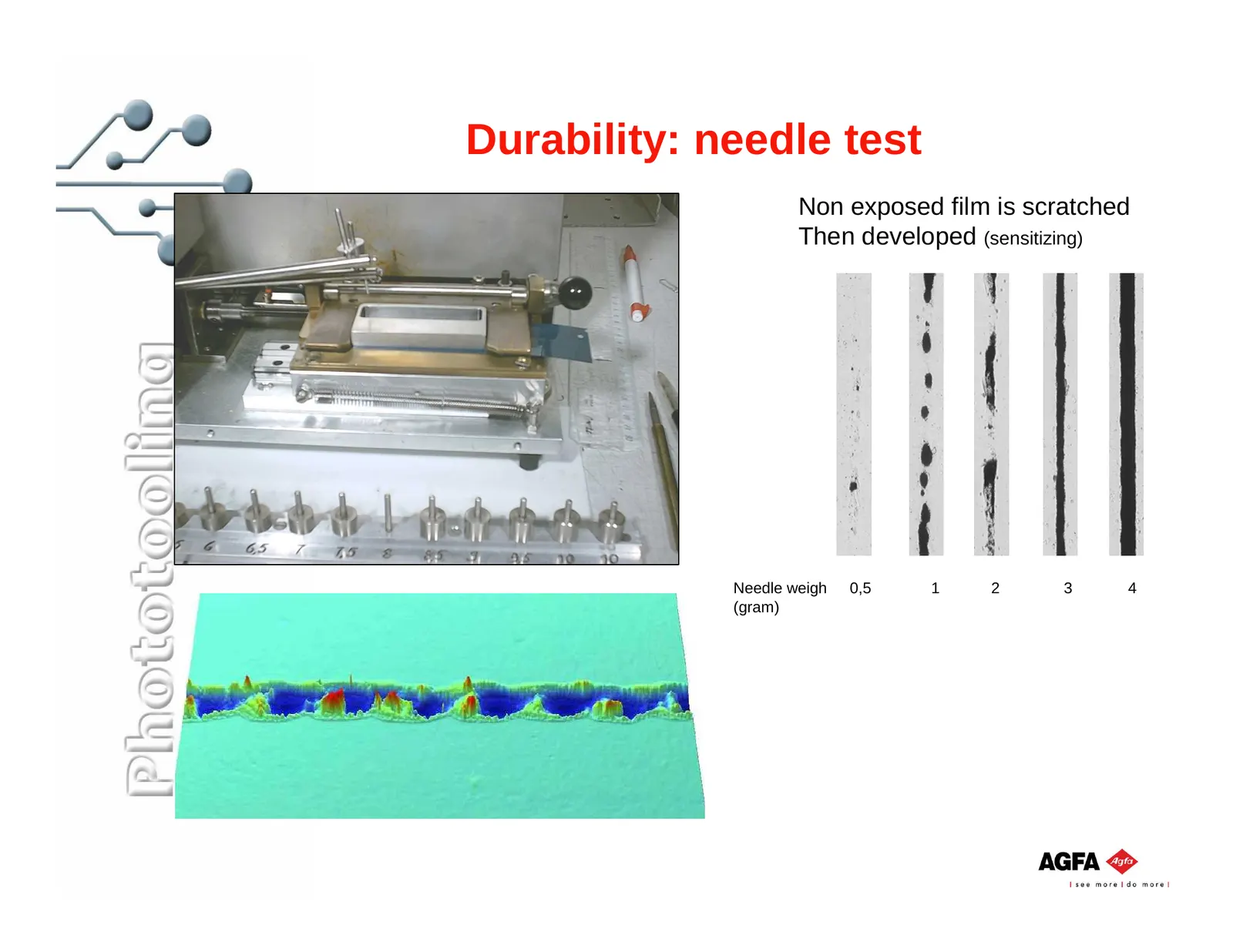
Durability: needle test Non exposed film is scratched Then developed (sensitizing) Needle weigh 0,5 1 2 3 4 (gram)
Slide 31: Durability: circular abrasion
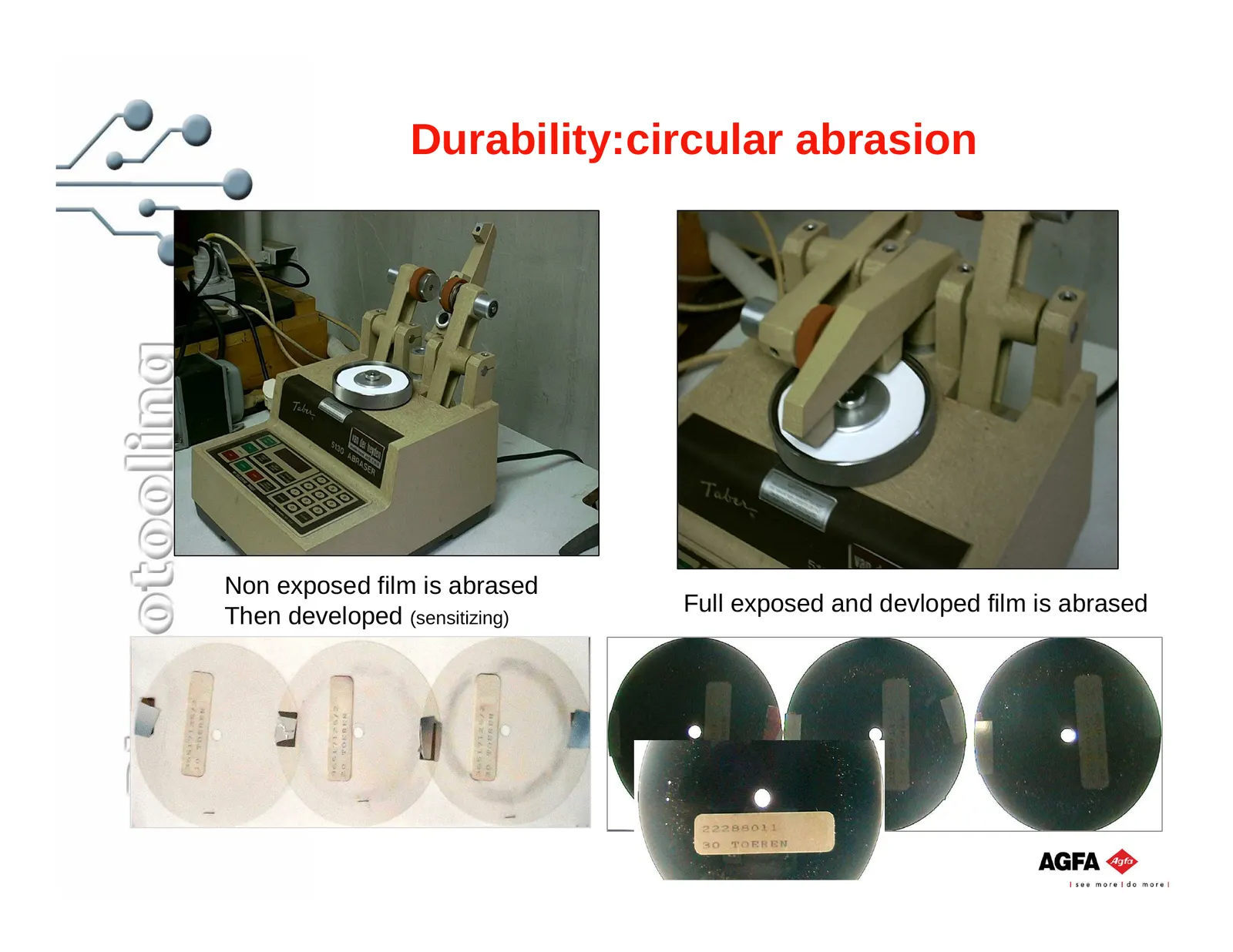
Durability:circular abrasion Non exposed film is abrased Full exposed and devloped film is abrased Then developed (sensitizing)
Slide 32: Durability: linear abrasion
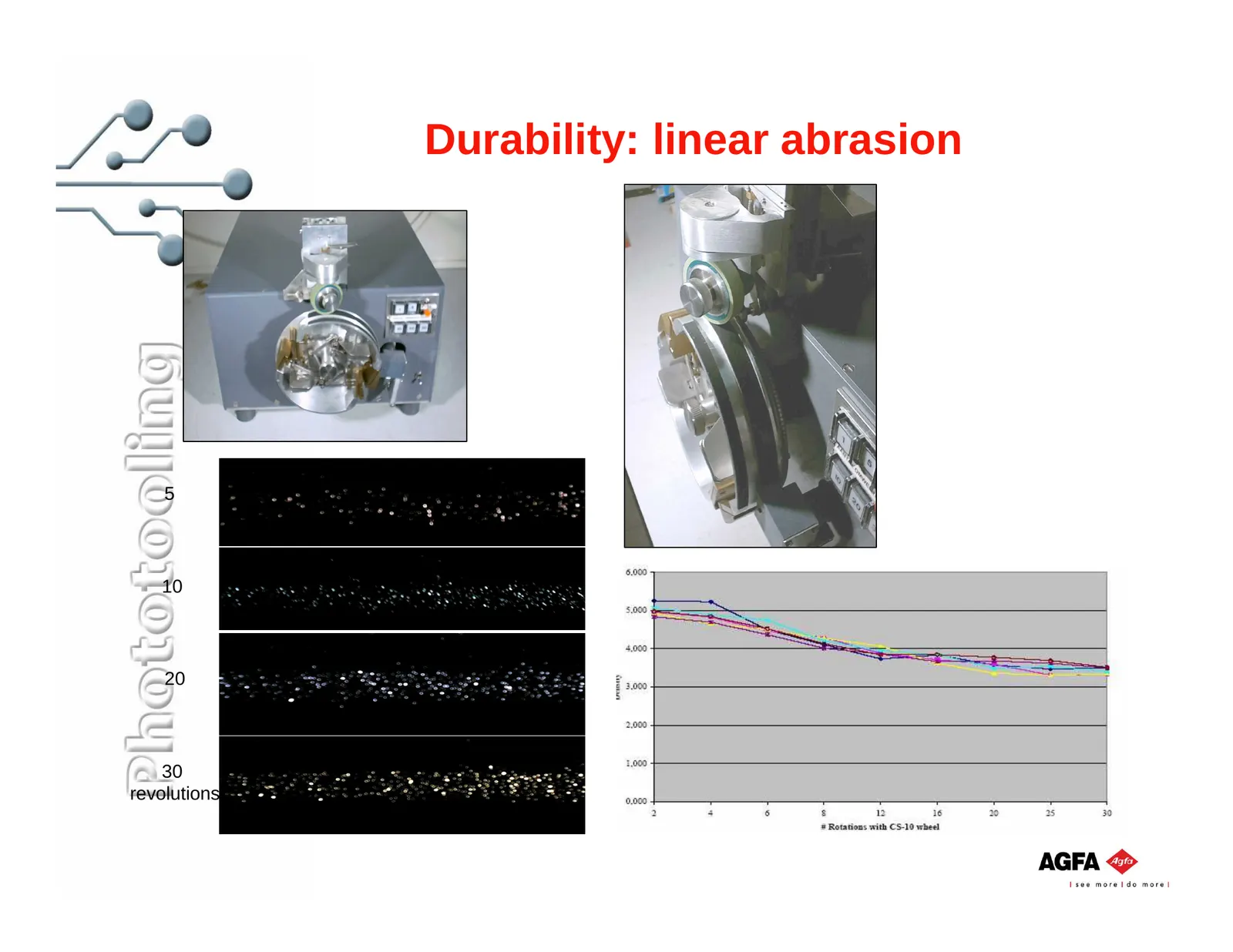
Durability: linear abrasion 5 10 20 30 revolutions
Slide 33: Vacuum behavior
Characteristics Vacuum behavior Pack and unpack Load and unload plotter Load, transport through and unload processor False calls on AOI Mounting on printer Vacuum on printer Fine line capability
Slide 34: Vacuum: measurement
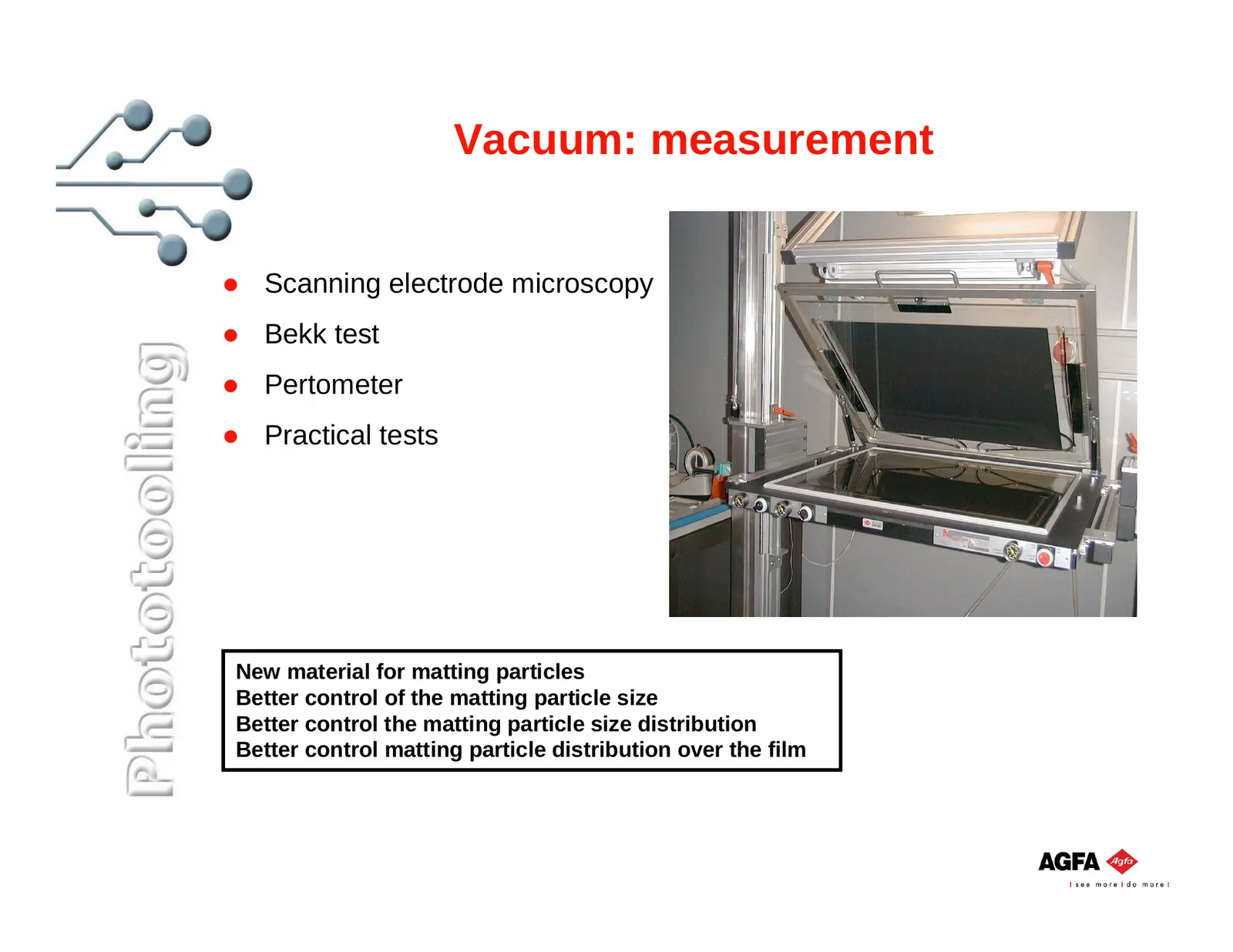
Vacuum: measurement Scanning electrode microscopy Bekk test Pertometer Practical tests New material for matting particles Better control of the matting particle size Better control the matting particle size distribution Better control matting particle distribution over the film
Slide 35: Vacuum
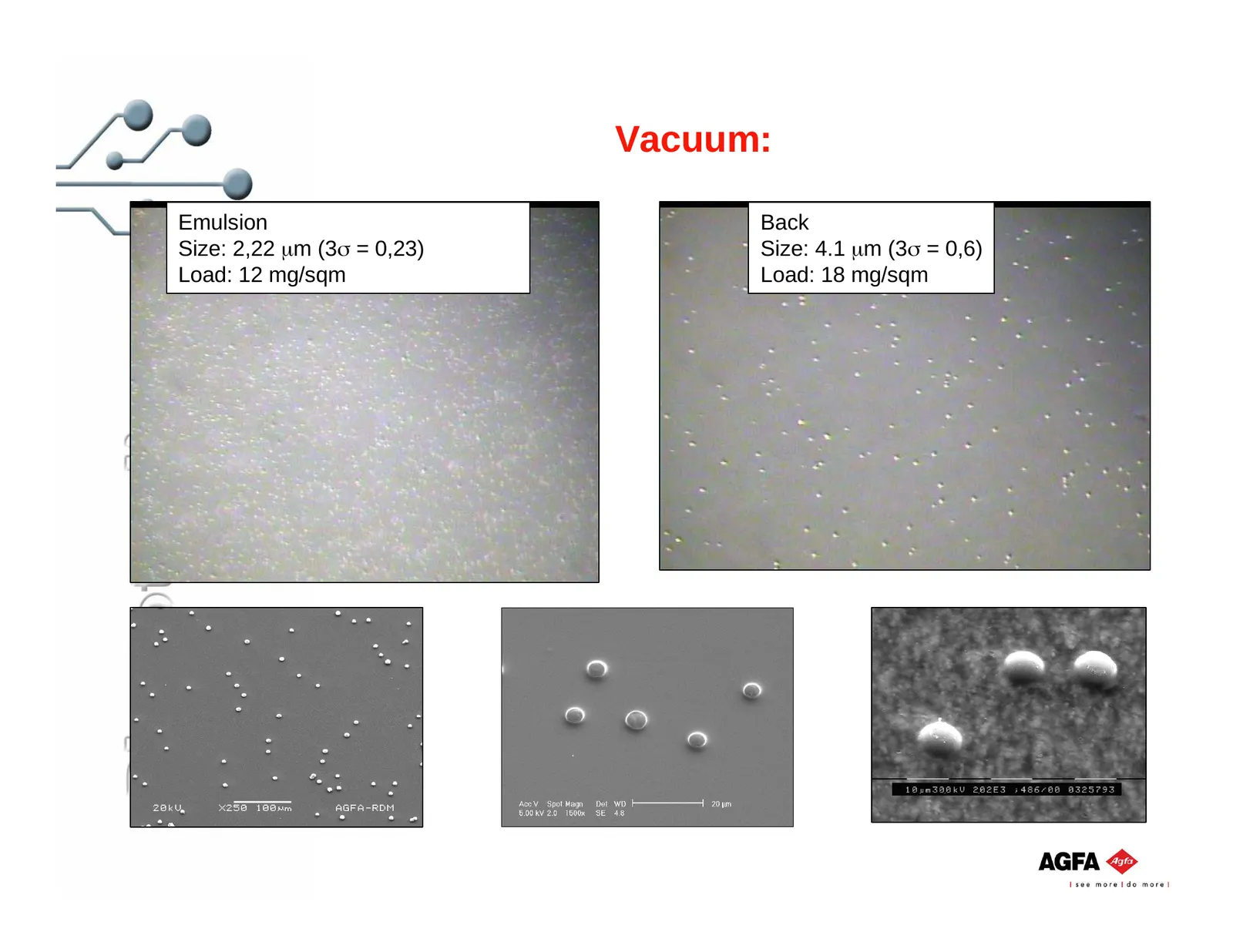
Vacuum: Emulsion Back Size: 2,22 µm (3σ = 0,23) Size: 4.1 µm (3σ = 0,6) Load: 12 mg/sqm Load: 18 mg/sqm
Slide 36: Antistatic
Characteristics Antistatic Attraction and fixing of dust
Slide 37: Antistatic: measurement
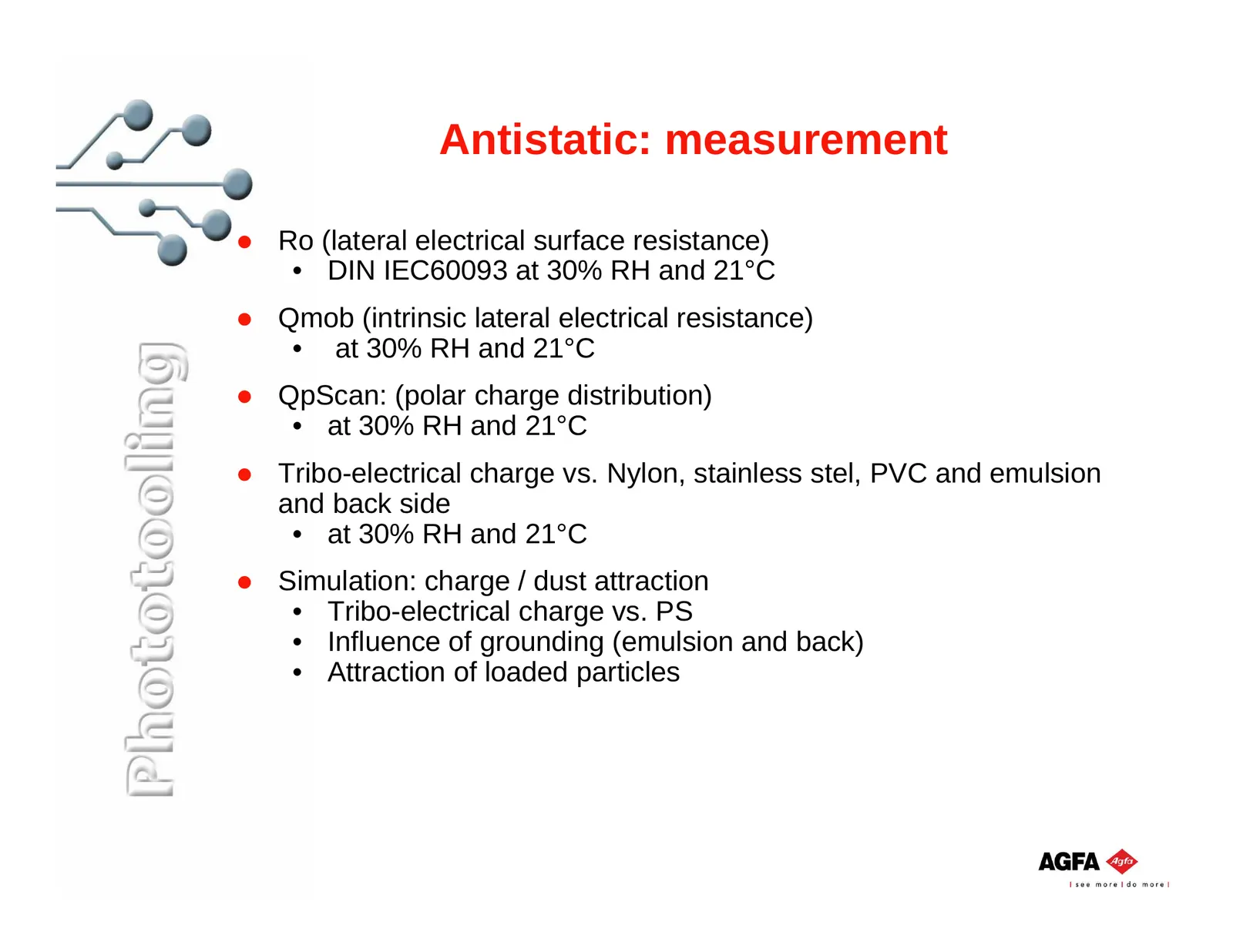
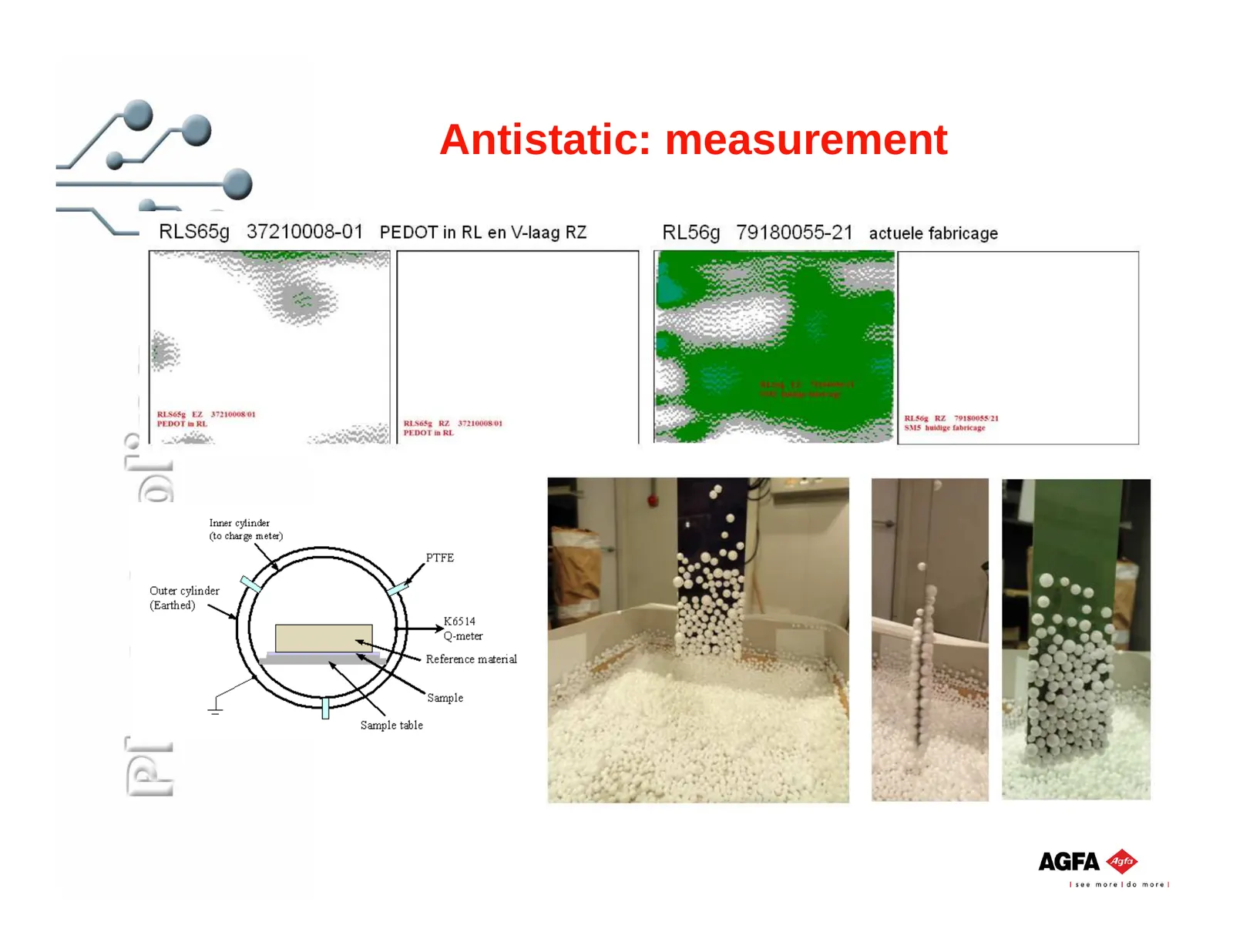
Antistatic: measurement Ro (lateral electrical surface resistance) • DIN IEC60093 at 30% RH and 21°C Qmob (intrinsic lateral electrical resistance) • at 30% RH and 21°C QpScan: (polar charge distribution) • at 30% RH and 21°C Tribo-electrical charge vs. Nylon, stainless stel, PVC and emulsion and ba
Slide 38: Antistatic: measurement
Antistatic: measurement ———_® — _ = RLS65g 37210008-01 PEDOT in RL en V-laag RZ RL56g 79180055-21 actuele fabricage RLS6Sg EZ 3721000801 RLS6g RZ 7918005821 PEDOT in RL ns cae) | RESSSE RZ s721000801 Shas teege eantenge | eit RANI | PEPOT RE - —| (= —) Inner cylinder (to charge meter) PTFE Outer cyl
Slide 39: Dust level
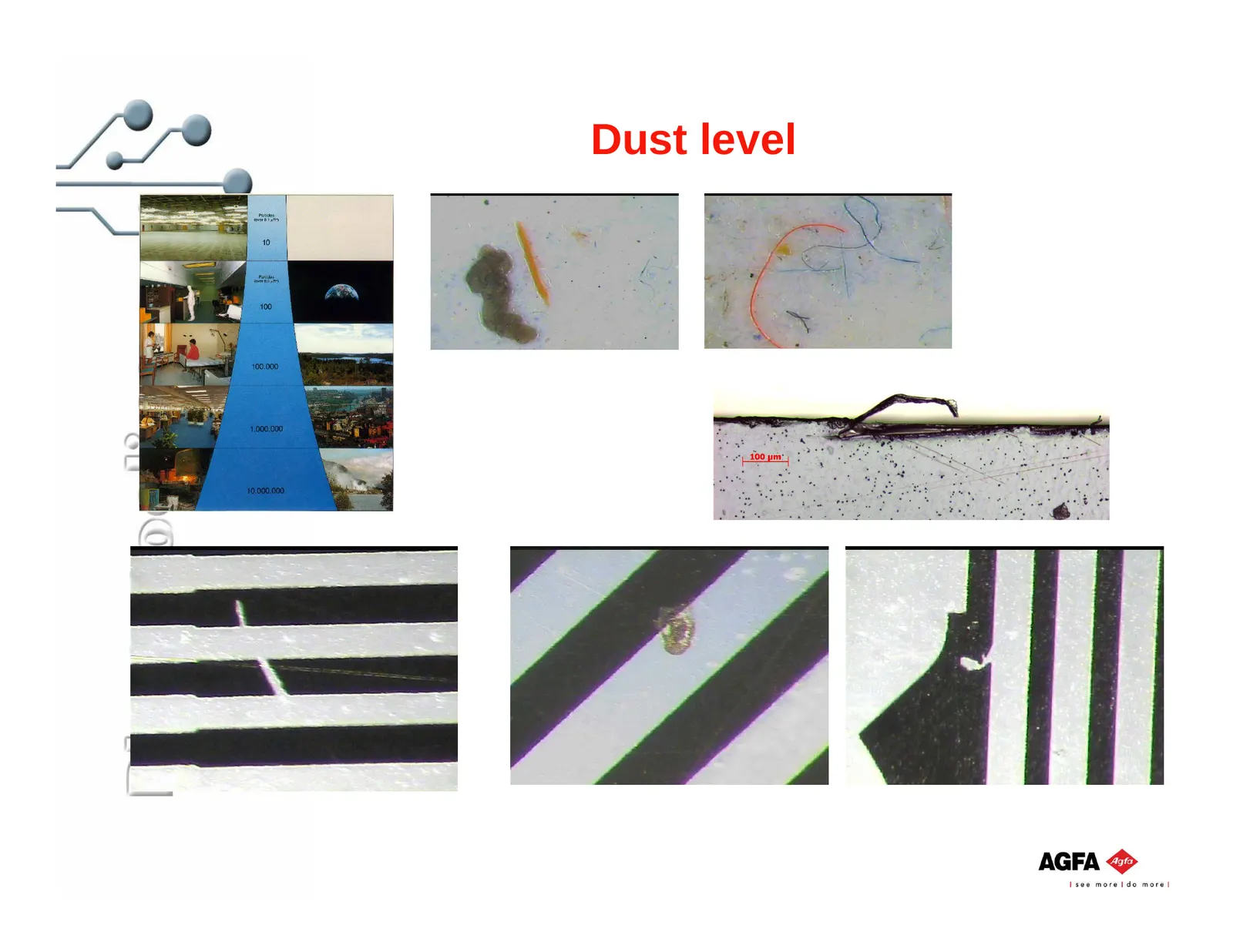
Characteristics Dust level Pin holes
Slide 40: Dust level
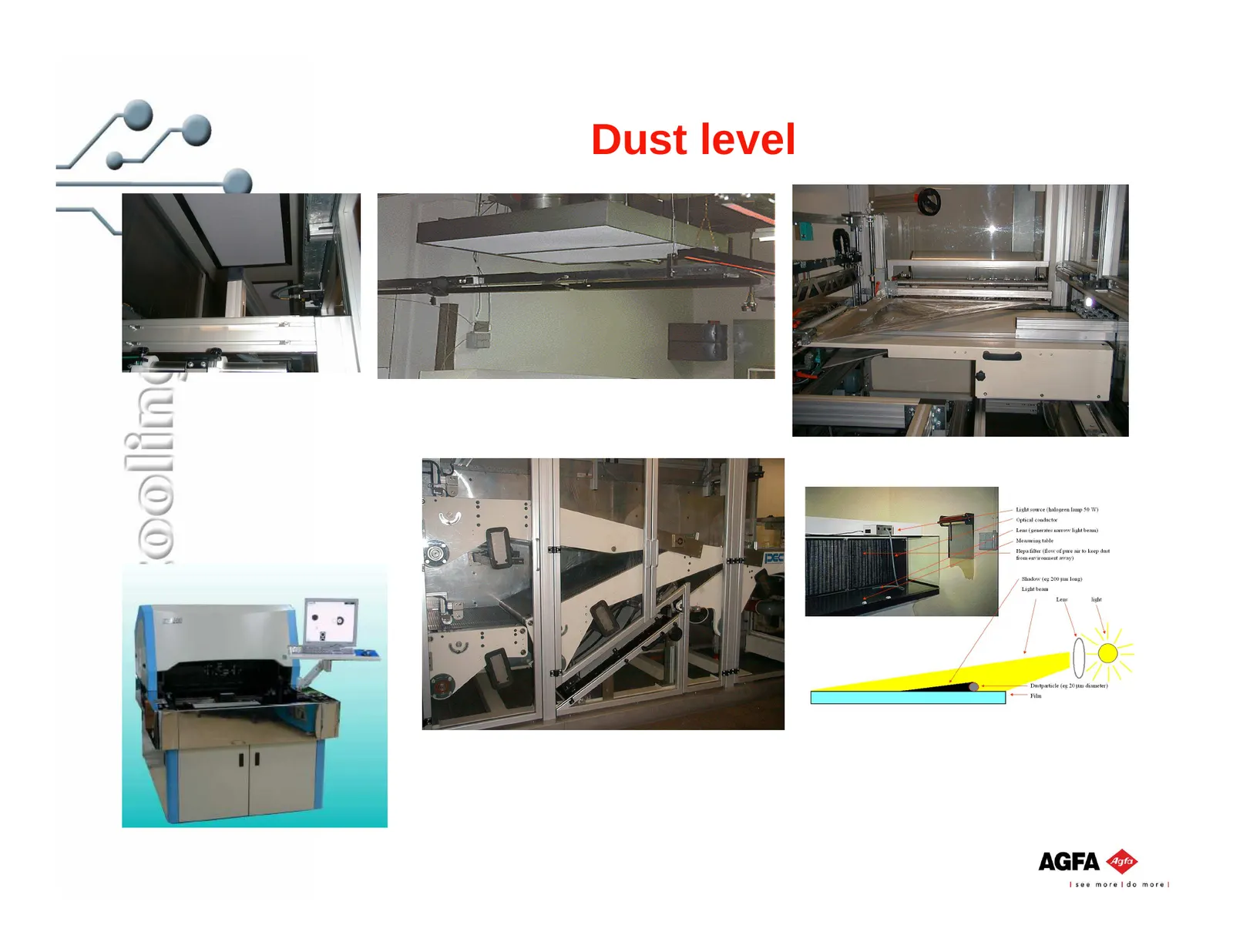
Dust level
Slide 41: Dust level
Dust level AGFA &
Slide 42: Quality control & Support
Characteristics Quality control & Support Consistency QC, SPC, Calibration Assistance from Agfa HQ
Slide 43: Consistency
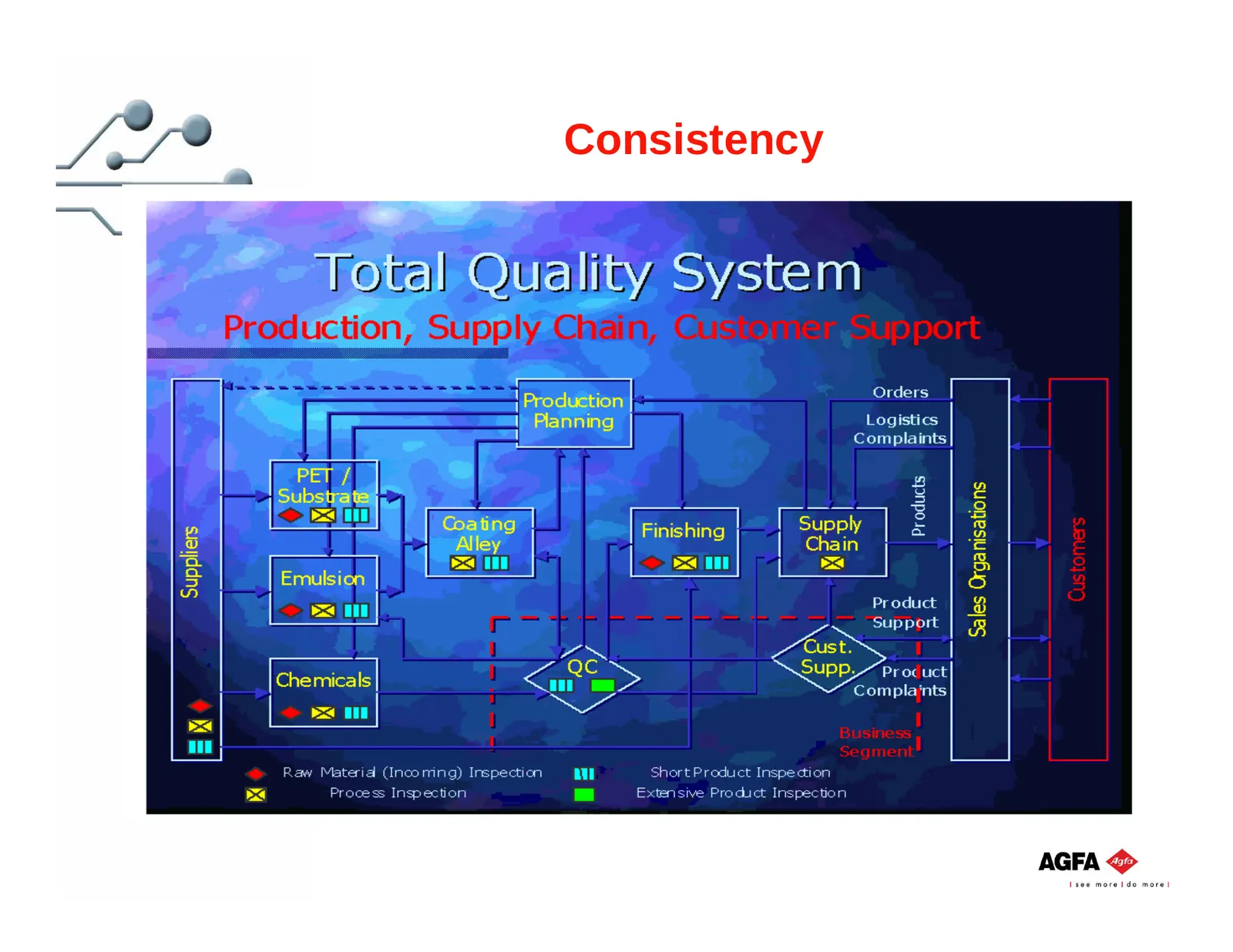
JS/y® Consistency = Hota Quality System Production, Supply.Chain, Guism Production Planning Logistics Complaints Product Support Proc uct Compla‘nts tring) Inspection Hi Short Product Inspection ction Extensive Product Inspection AGFA &
Slide 44: Consistency
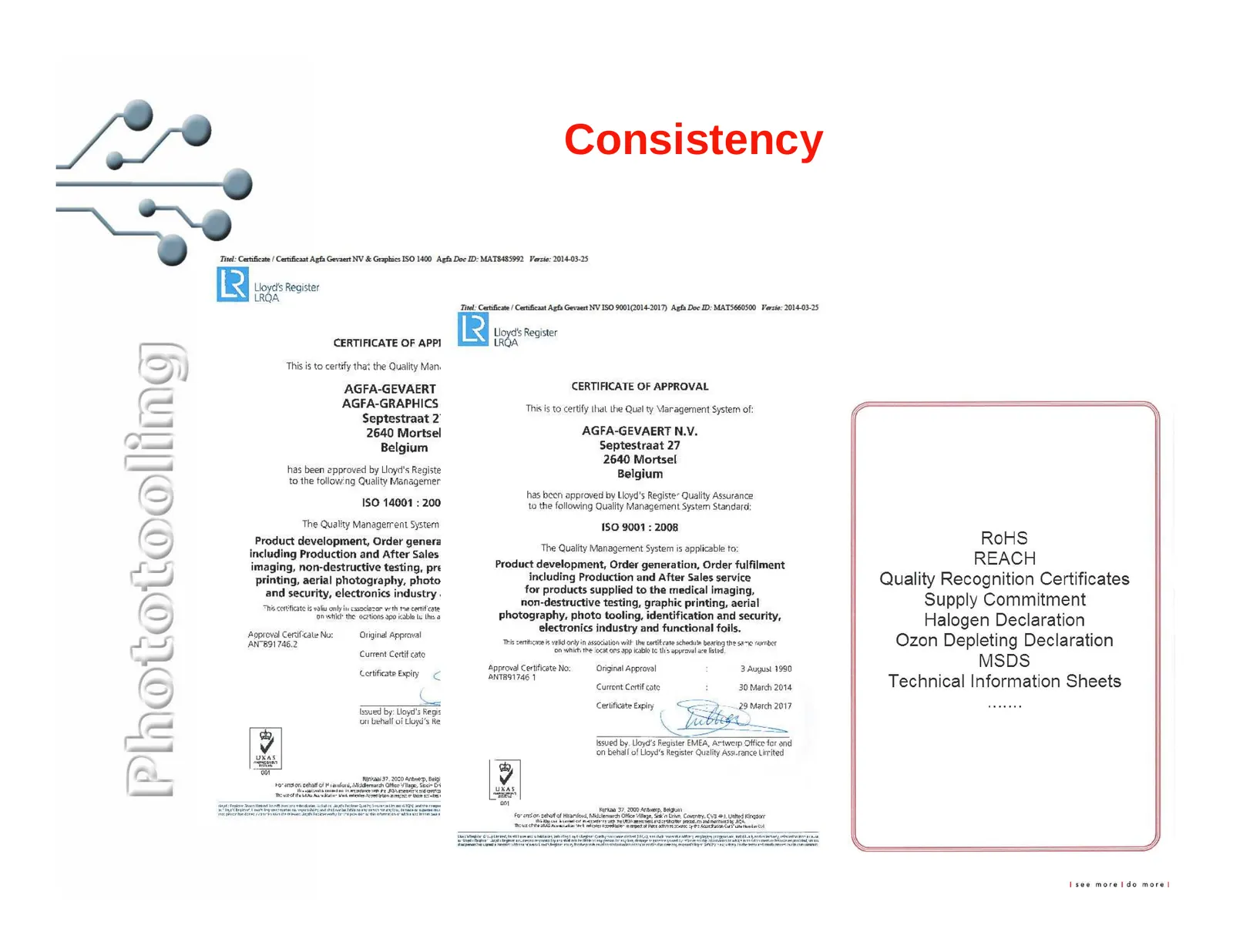
"8 10 | } LLWE Ool >)} | L L Moko } | < Lloyd's Register LRQA CERTIFICATE OF APP] This is to certify tha: the Quality Man. AGFA-GEVAERT AGFA-GRAPHICS Septestraat 2 2640 Mortsel Belgium has been zpproved by Lloyd's Registe to the following Quality Managemer ISO 14001 : 200 The Quality Managerrent Sys
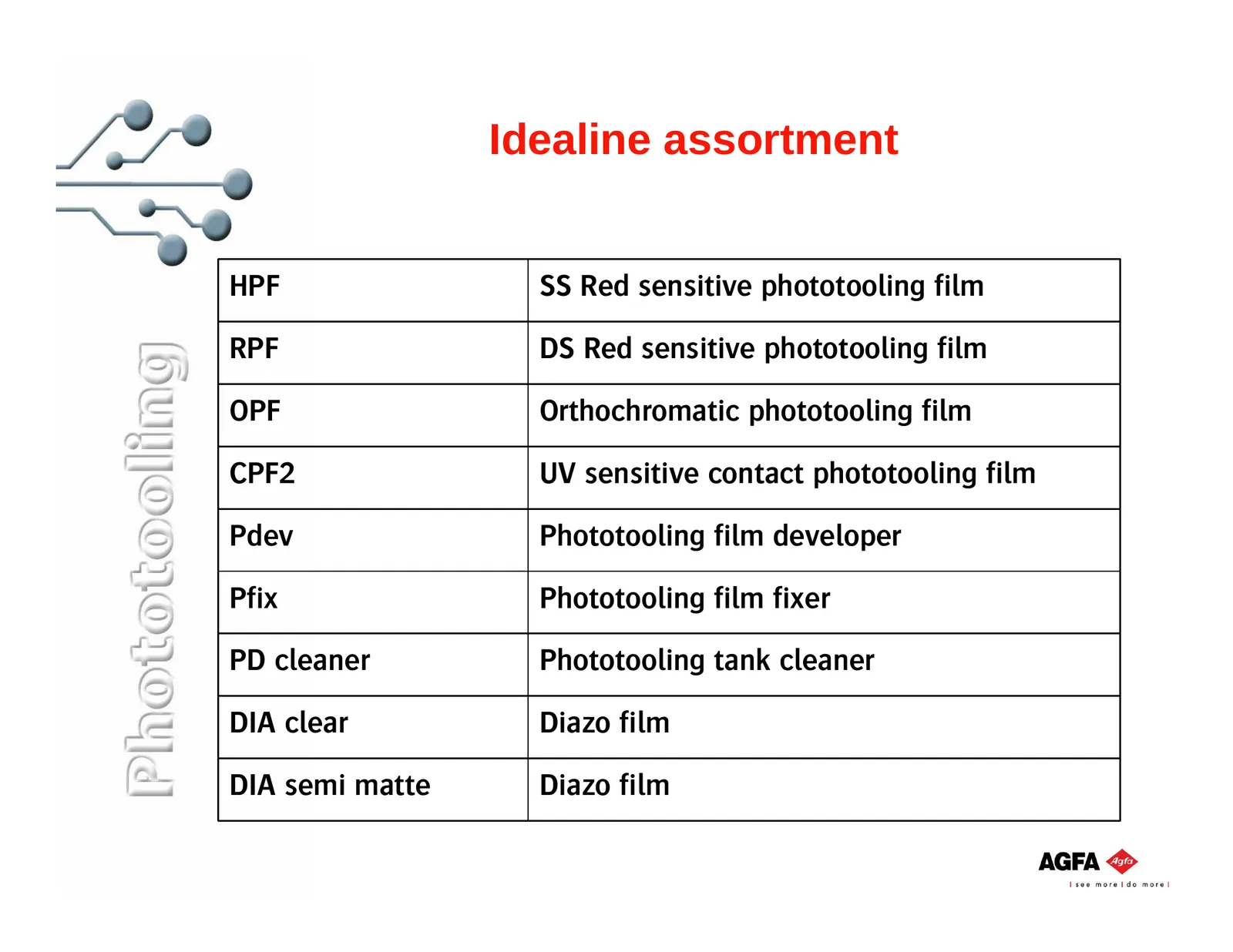
Slide 45: Idealine assortment
Idealine assortment HPF SS Red sensitive phototooling film RPF DS Red sensitive phototooling film OPF Orthochromatic phototooling film CPF2 UV sensitive contact phototooling film Pdev Phototooling film developer Pfix Phototooling film fixer PD cleaner Phototooling tank cleaner DIA clear Diazo film D
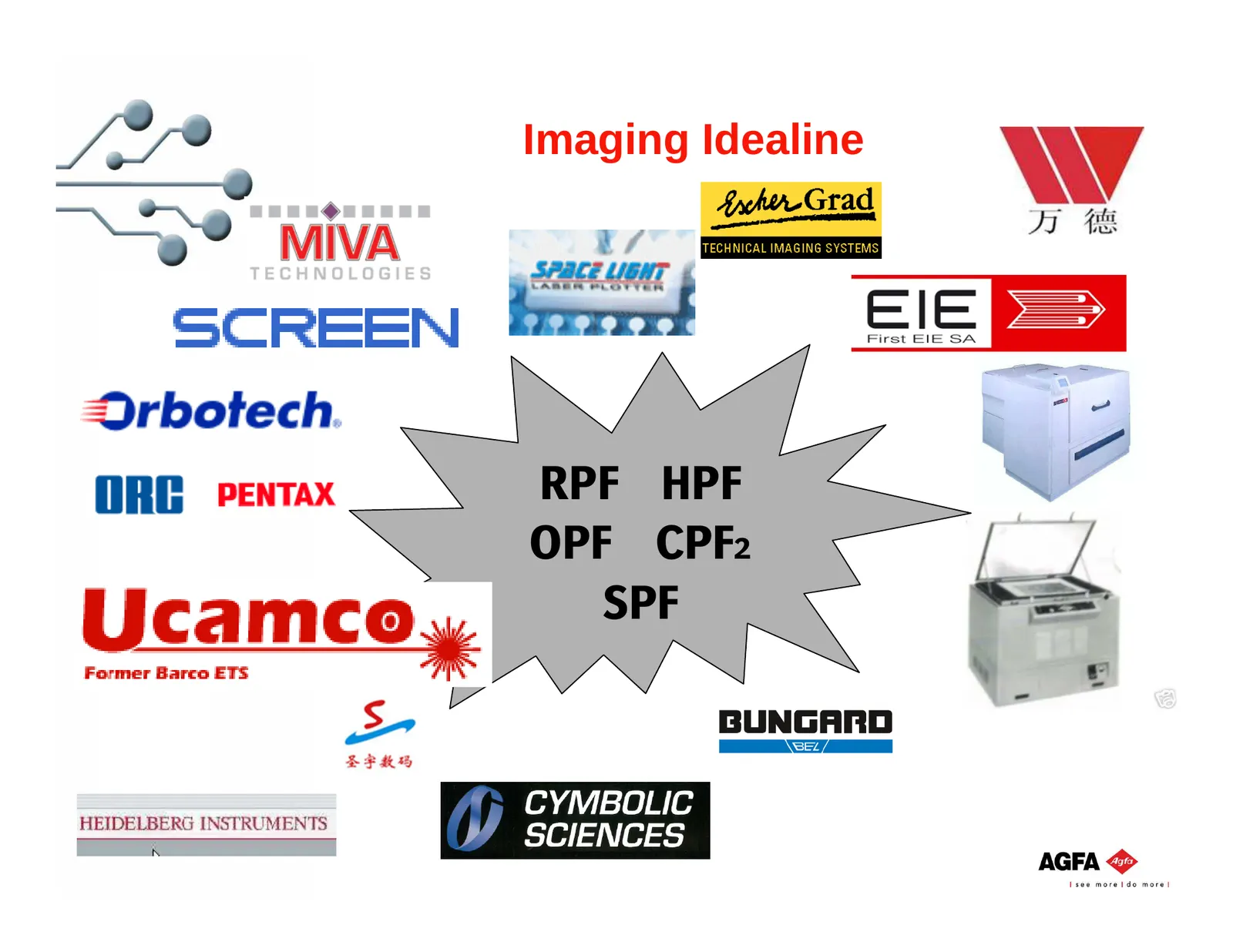
Slide 46: Imaging Idealine
Imaging Idealine RPF HPF OPF CPF2 SPF

Slide 47: The Phototool to Secure Your Business
The Phototool to Secure Your Business
Source: Internet Archive copy of agfa.com
More decks from Agfa-Gevaert NV
 Q3 2026 Earnings Presentation32 slides · Nov 10, 2026
 Merger or Acquisition (September 2026)11 slides · Sep 28, 2026
 Q2 2026 Earnings Presentation37 slides · Aug 26, 2026
 Q1 2026 Earnings Presentation37 slides · May 12, 2026
 FY 2025 Earnings Presentation42 slides · Mar 11, 2026
 Q3 2025 Earnings Presentation39 slides · Nov 13, 2025