Anavex Life Sciences Corp. · NASDAQ:AVXL
Anavex Life Sciences — 2016 Rett Syndrome Symposium
30 slides from Anavex Life Sciences's conference presentation, June 2016

Slide 1: Rettsyndrome.org Research Symposium 2016
Wo ulti ‘an Wy” I} | Gat wi 2 UNITY-STRENGTH~HVPE RETTSYNDROME.ORG « EAGLEWOOD RESORT, ILLINOIS * 2016 RESEARCH SYMPOSIUM (JUNE 22-24) Nothing ceplaces the experience of meeting face-to-face 14th Rettsyndrome.org Rett Syndrome Symposium, an international, interdisciplinary meeting focused on recent
Slide 2: ANAVEX 2-73 as a Potential Treatment for Rett Syndrome and Other Pediatric Disorders
ANAVEX 2-‐73 as a Poten2al Treatment for Re9 Syndrome and Other Pediatric or Infan2le Disorders with Seizure Pathology N. REBOWE1, J SPROUSE1, D. BRUNNER2, P. KABITZKE2, L. VELISEK3, M. BENSON3, J. VELISKOVA3, C. MISSLING1 1Anavex Life Sciences, New York, NY; 2Psychogenics, Tarrytown, NY; 3New York

Slide 3: Disclosure
Disclosure § Employee of Anavex Life Sciences § Shareholder of Anavex Life Sciences § Op8ons of Anavex Life Sciences 3
Slide 4: Safe Harbor
Safe Harbor This presenta8on contains forward-‐looking statements made within the meaning of the Private Securi8es Li8ga8on Reform Act of 1995 by Anavex™ Life Sciences Corp. and its representa8ves. These statements can be iden8fied by introductory words such as ``expects,'' ``plans,'' ``intends,'' `
Slide 5: ANAVEX 2-73
ANAVEX™ 2-‐73 § Currently in a Phase 2a clinical trial for Alzheimer’s disease (AD) § ANAVEX 2-‐73 is an orally available small molecule targe8ng protein misfolding, oxida8ve stress, mitochondrial dysfunc8on, inflamma8on and cellular stress, factors in neurodegenera2ve and neurodevelopmental dise
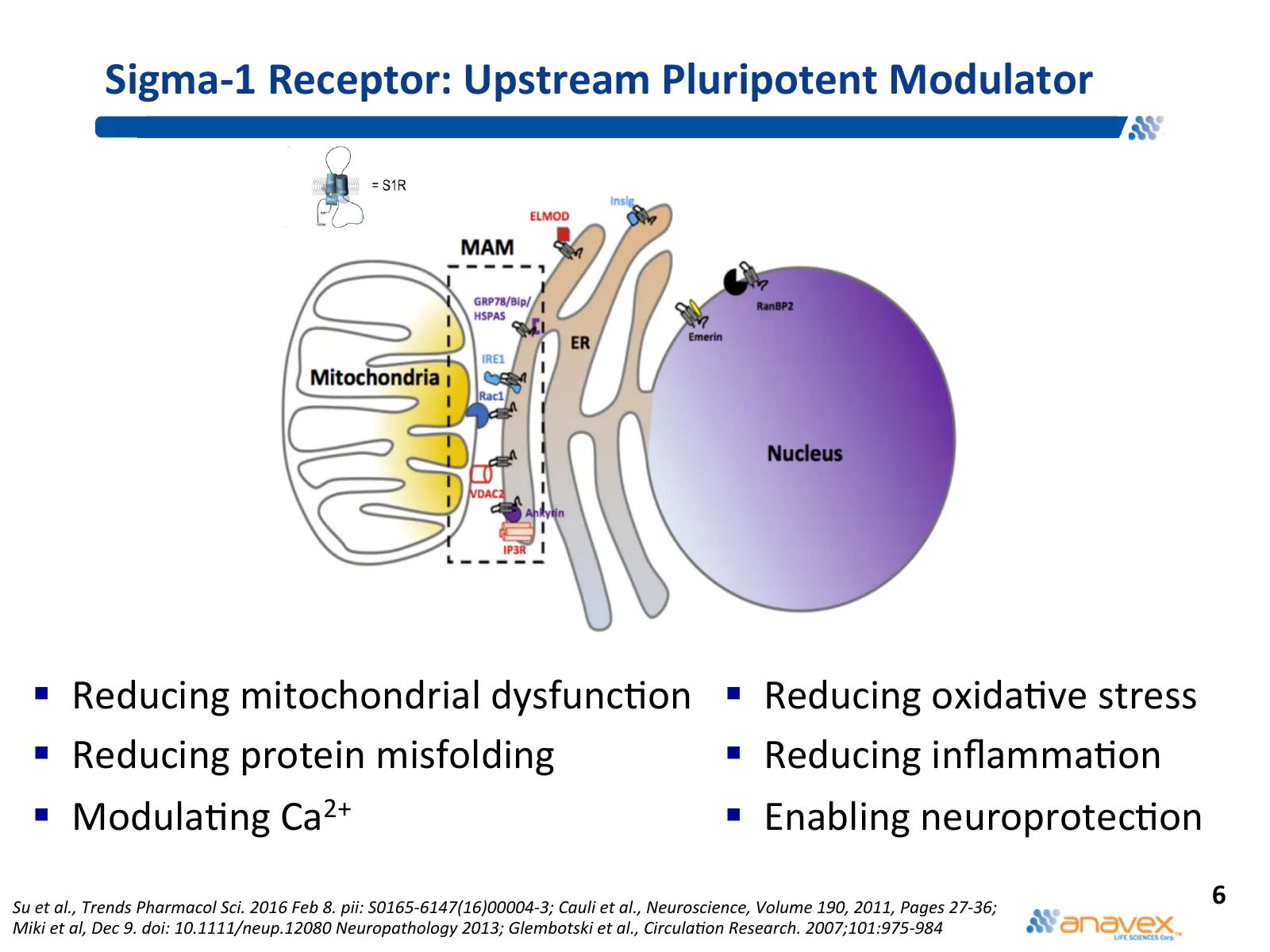
Slide 6: Sigma-1 Receptor: Upstream Pluripotent Modulator
Sigma-‐1 Receptor: Upstream Pluripotent Modulator § Reducing mitochondrial dysfunc8on § Reducing oxida8ve stress § Reducing protein misfolding § Reducing inflamma8on § Modula8ng Ca2+ § Enabling neuroprotec8on Su et al., Trends Pharmacol Sci. 2016 Feb 8. pii: S0165-‐6147(16)00004-‐3; Cauli et
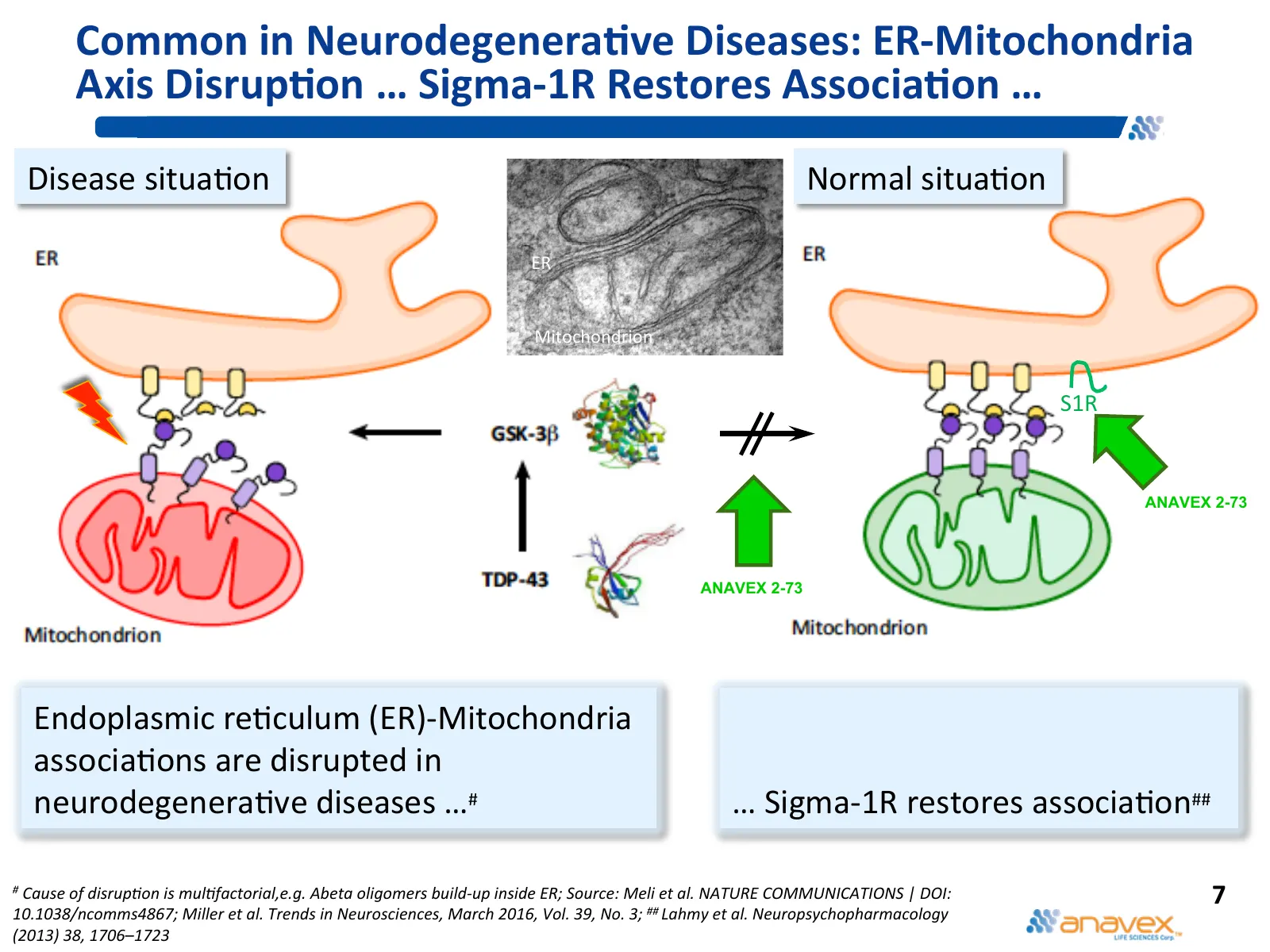
Slide 7: ER-Mitochondria Axis Disruption; Sigma-1R Restores Association
Common in Neurodegenera2ve Diseases: ER-‐Mitochondria Axis Disrup2on … Sigma-‐1R Restores Associa2on … Disease situa8on Normal situa8on ER Mitochondrion S1R ANAVEX 2-73 ANAVEX 2-73 Endoplasmic re8culum (ER)-‐Mitochondria associa8ons are disrupted in neurodegenera8ve diseases …# … Sigma-‐1R resto
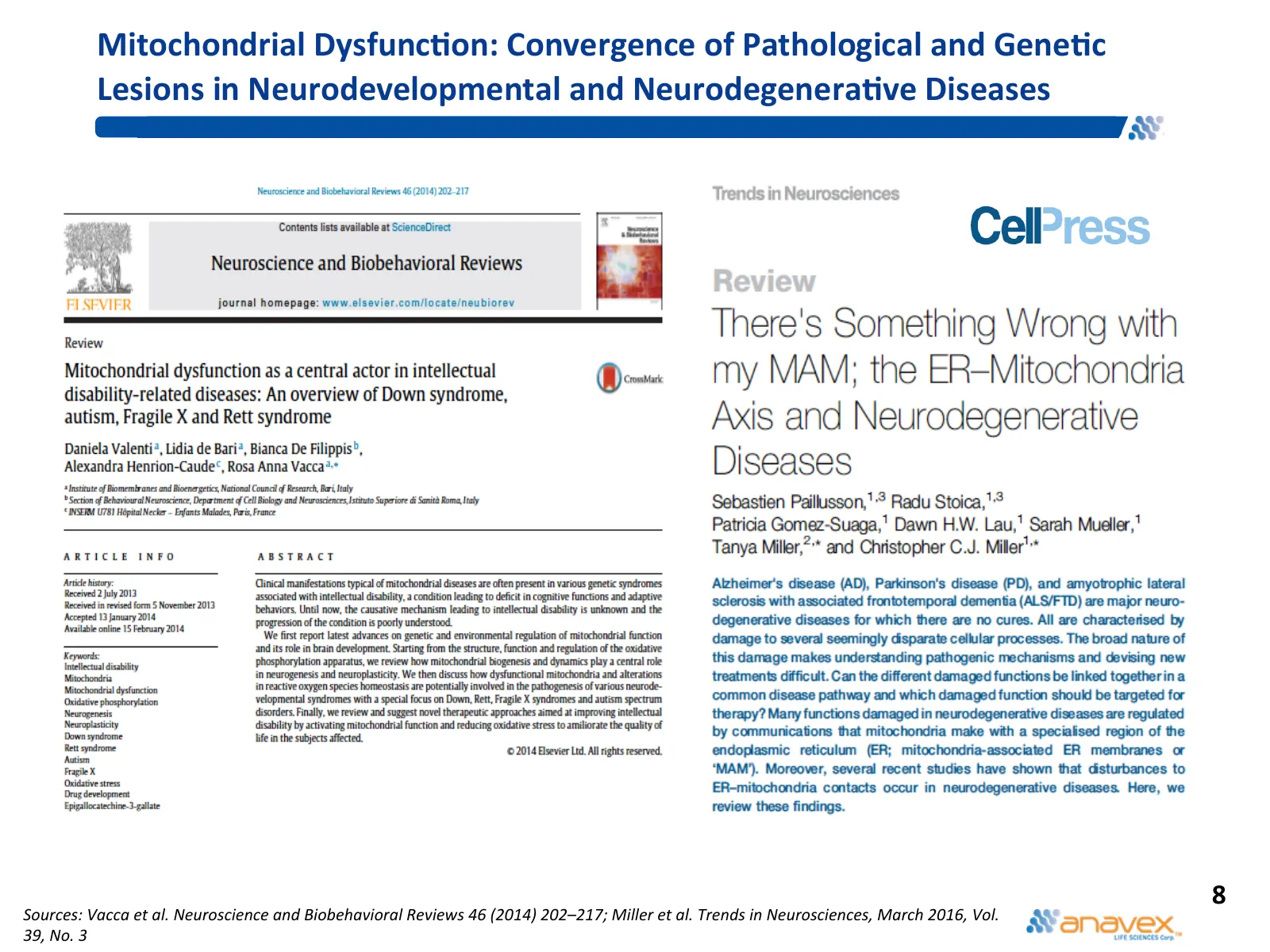
Slide 8: Mitochondrial Dysfunction in Neurodevelopmental and Neurodegenerative Diseases
Mitochondrial Dysfunc2on: Convergence of Pathological and Gene2c Lesions in Neurodevelopmental and Neurodegenera2ve Diseases 8 Sources: Vacca et al. Neuroscience and Biobehavioral Reviews 46 (2014) 202–217; Miller et al. Trends in Neurosciences, March 2016, Vol. 39, No. 3
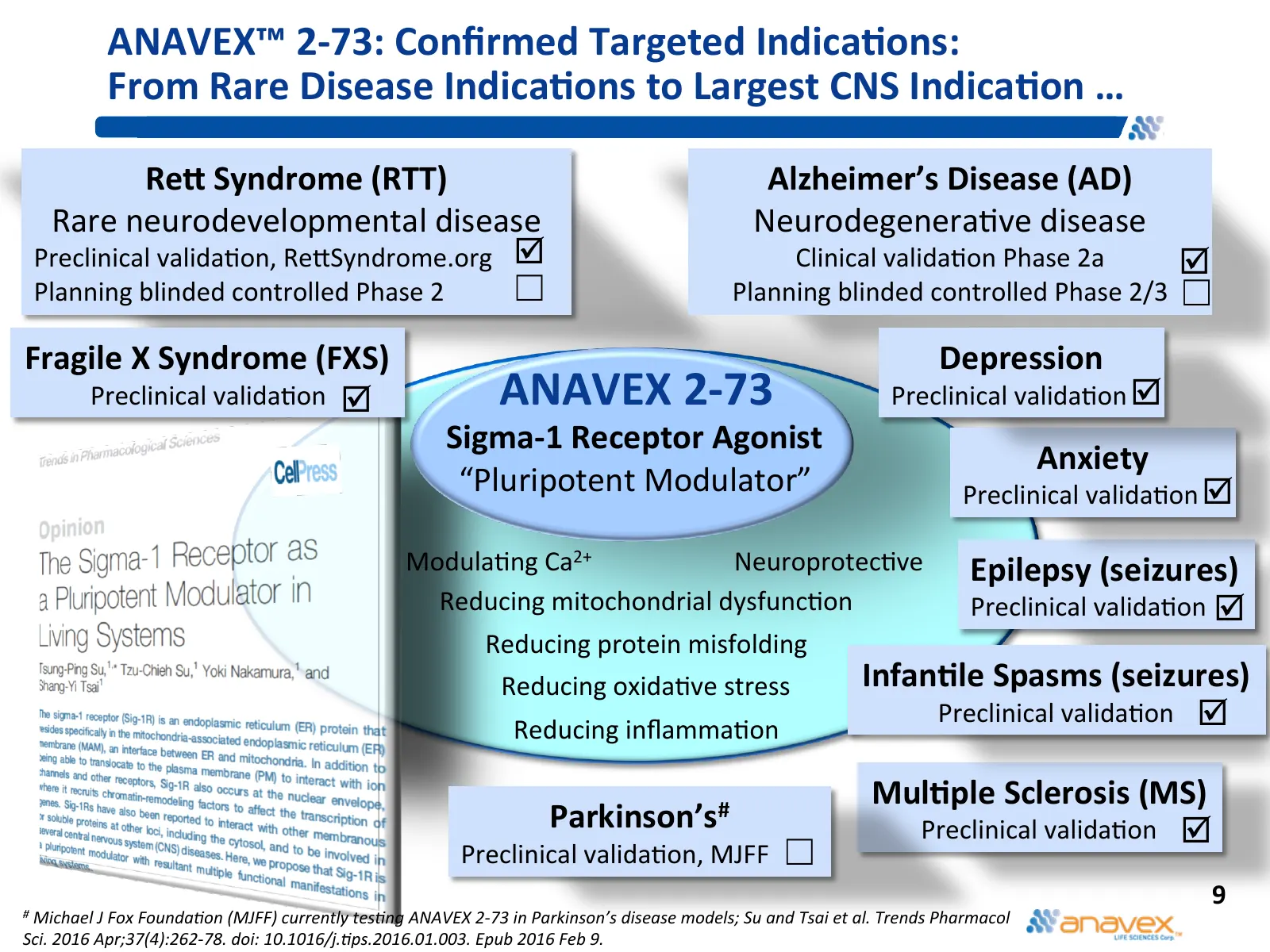
Slide 9: ANAVEX 2-73: Confirmed Targeted Indications
ANAVEX™ 2-‐73: Confirmed Targeted Indica2ons: From Rare Disease Indica2ons to Largest CNS Indica2on … Re9 Syndrome (RTT) Alzheimer’s Disease (AD) Rare neurodevelopmental disease Neurodegenera8ve disease Preclinical valida8on, RePSyndrome.org þ Clinical valida8on Phase 2a þ Planning blinded control
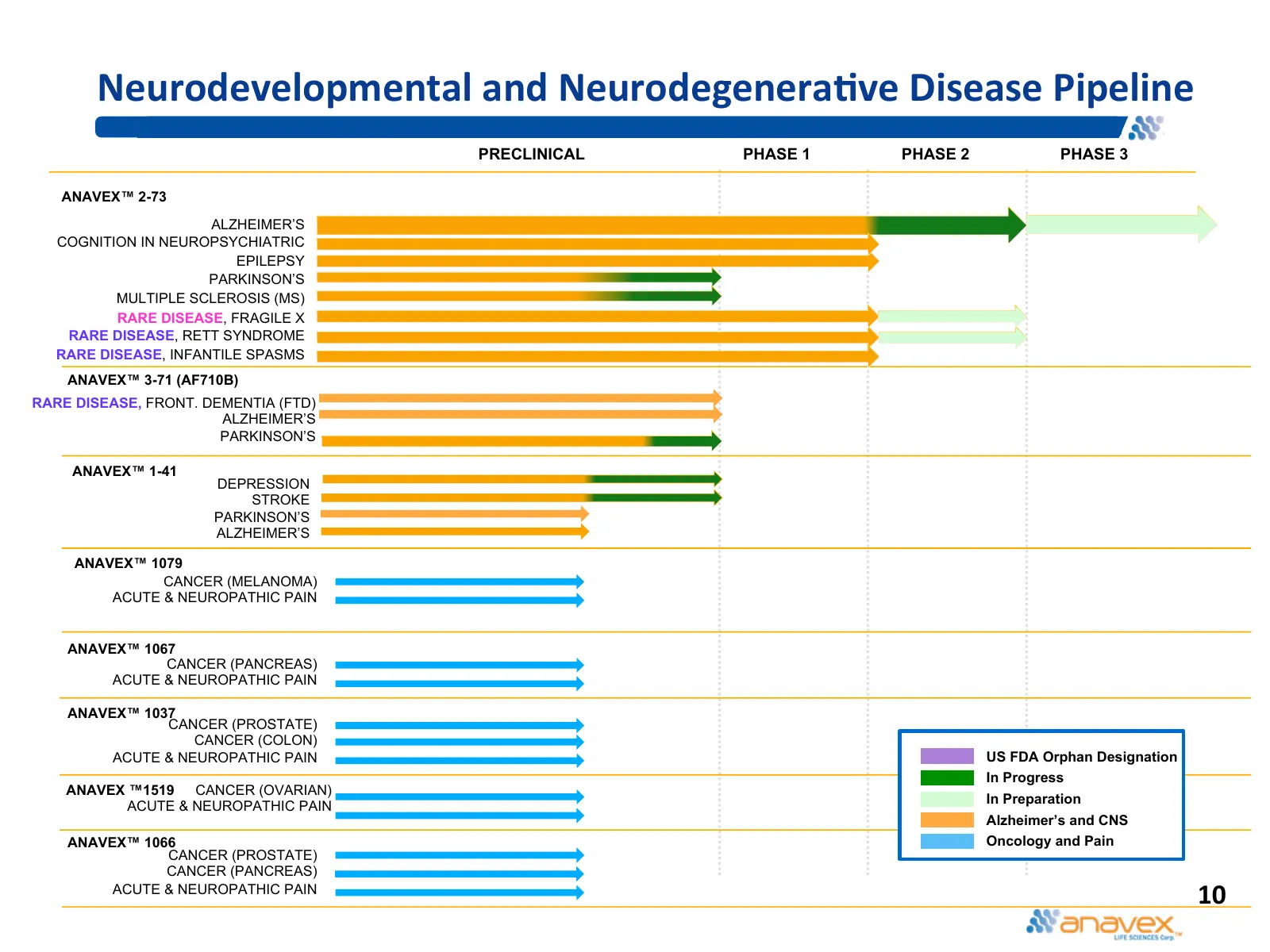
Slide 10: Neurodevelopmental and Neurodegenerative Disease Pipeline
Neurodevelopmental and Neurodegenera2ve Disease Pipeline ANAVEX™ 2-73 PRECLINICAL PHASE 1 PHASE 2 PHASE 3 ALZHEIMER’S COGNITION IN NEUROPSYCHIATRIC EPILEPSY PARKINSON’S MULTIPLE SCLEROSIS (MS) RARE DISEASE, FRAGILE X RARE DISEASE, RETT SYNDROME RARE DISEASE, INFANTILE SPASMS ANAVEX™ 3-71 (AF710B) RA
Slide 11: ANAVEX 2-73 Pre-Clinical Epilepsy Data
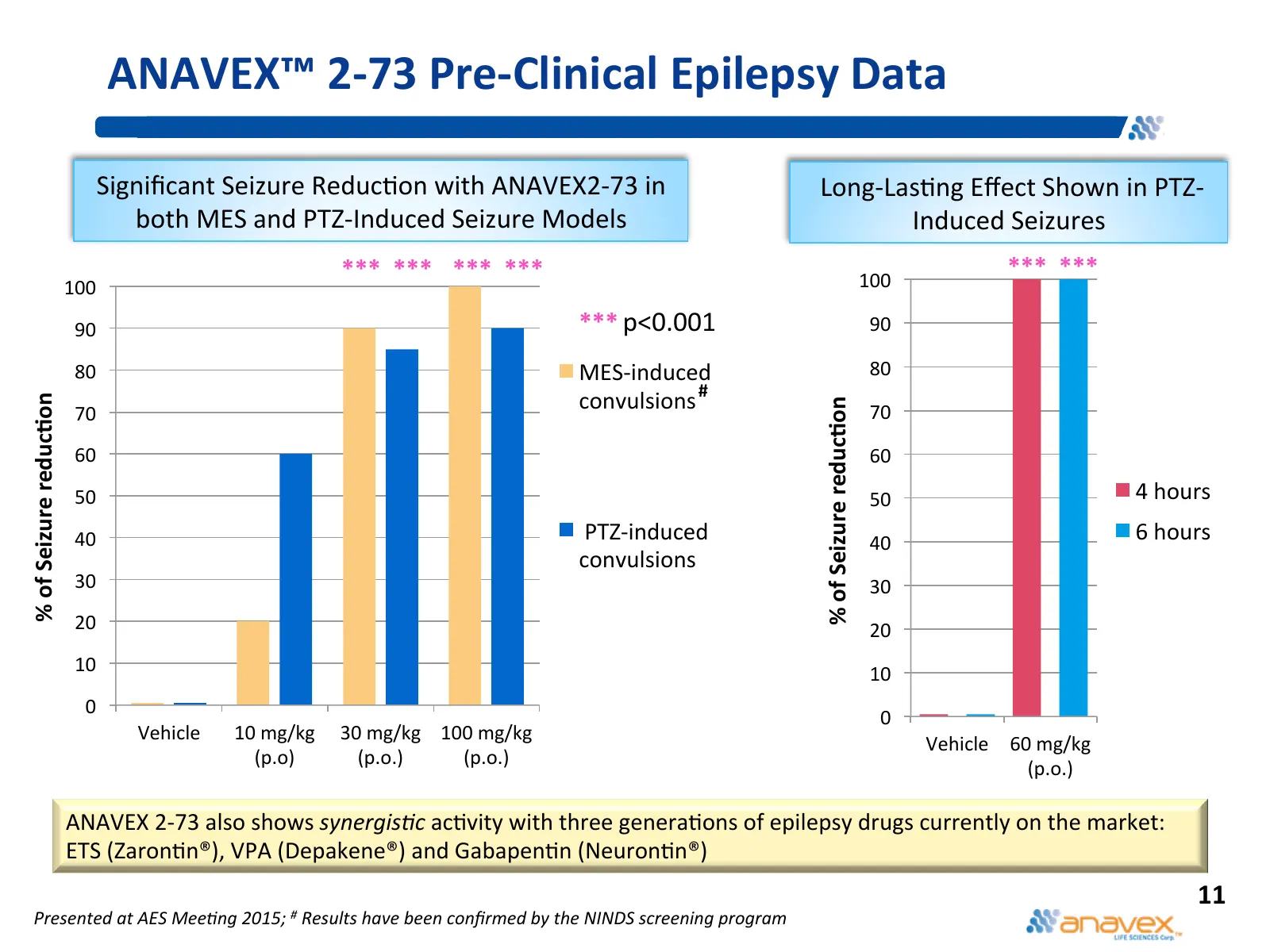
ANAVEX™ 2-‐73 Pre-‐Clinical Epilepsy Data Significant Seizure Reduc8on with ANAVEX2-‐73 in Long-‐Las8ng Effect Shown in PTZ-‐ both MES and PTZ-‐Induced Seizure Models Induced Seizures *** *** *** *** 100 *** *** 100 90 *** p<0.001 90 80 MES-‐induced 80 convulsions # % of Seizure reduc2on % of S
Slide 12: Anti-Depressant and Anti-Anxiety Effect of ANAVEX 2-73
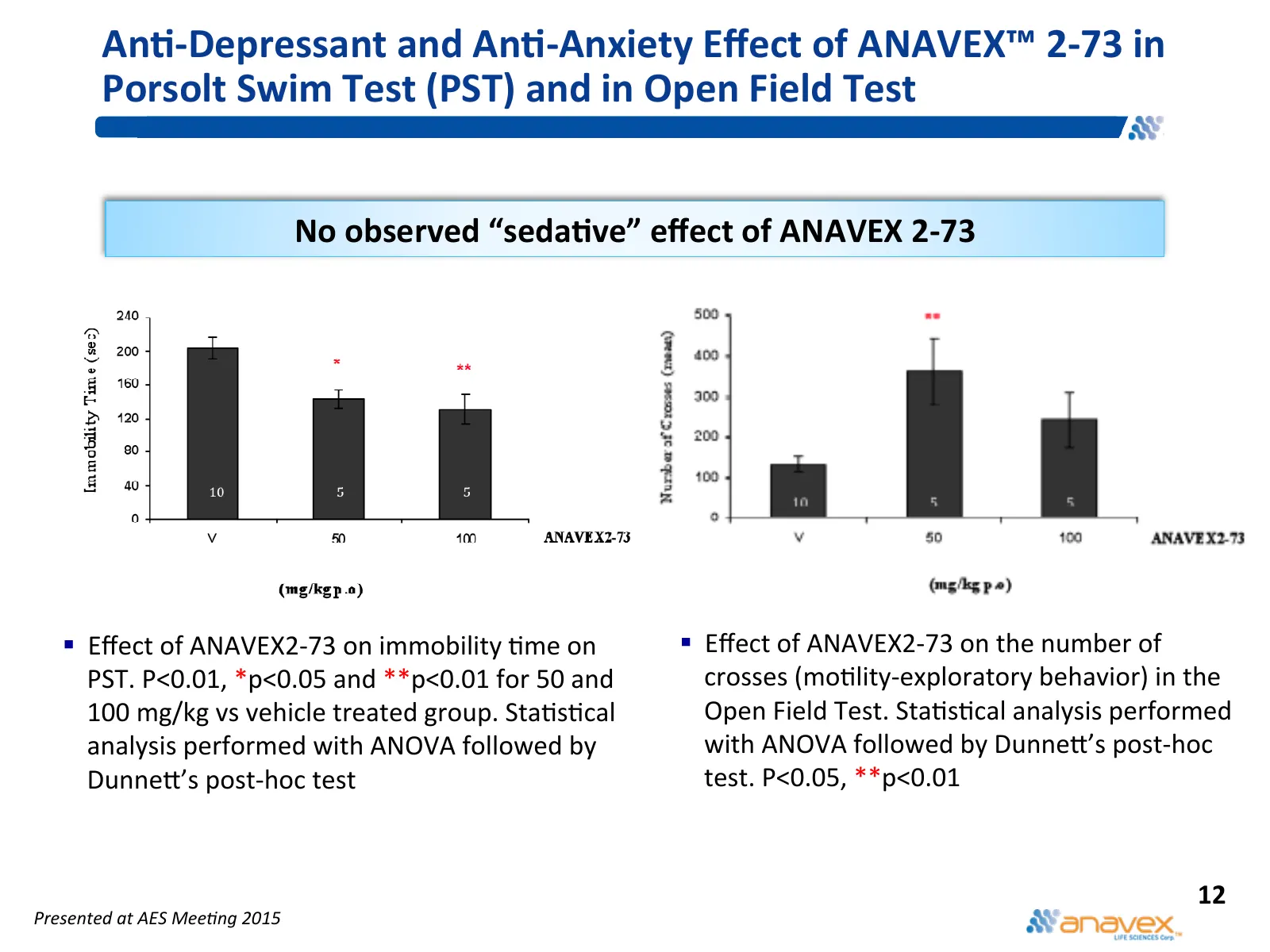
An2-‐Depressant and An2-‐Anxiety Effect of ANAVEX™ 2-‐73 in Porsolt Swim Test (PST) and in Open Field Test No observed “seda2ve” effect of ANAVEX 2-‐73 § Effect of ANAVEX2-‐73 on immobility 8me on § Effect of ANAVEX2-‐73 on the number of PST. P<0.01, *p<0.05 and **p<0.01 for 50 and crosses (mo8l
Slide 13: Autism Spectrum Disorders and Fragile X Syndrome
Au2sm Spectrum Disorders and Fragile X Syndrome § Au8sm spectrum disorders (ASD) occur in up to 2/3 of males and 1/3 of females with Fragile X syndrome (FXS) § FXS is the most common form of inherited intellectual disability and the most frequent single gene cause of au8sm, affec8ng approximately 1
Slide 14: ANAVEX 2-73 Reverses Hyperactivity and Learning Deficits in Fragile X Model
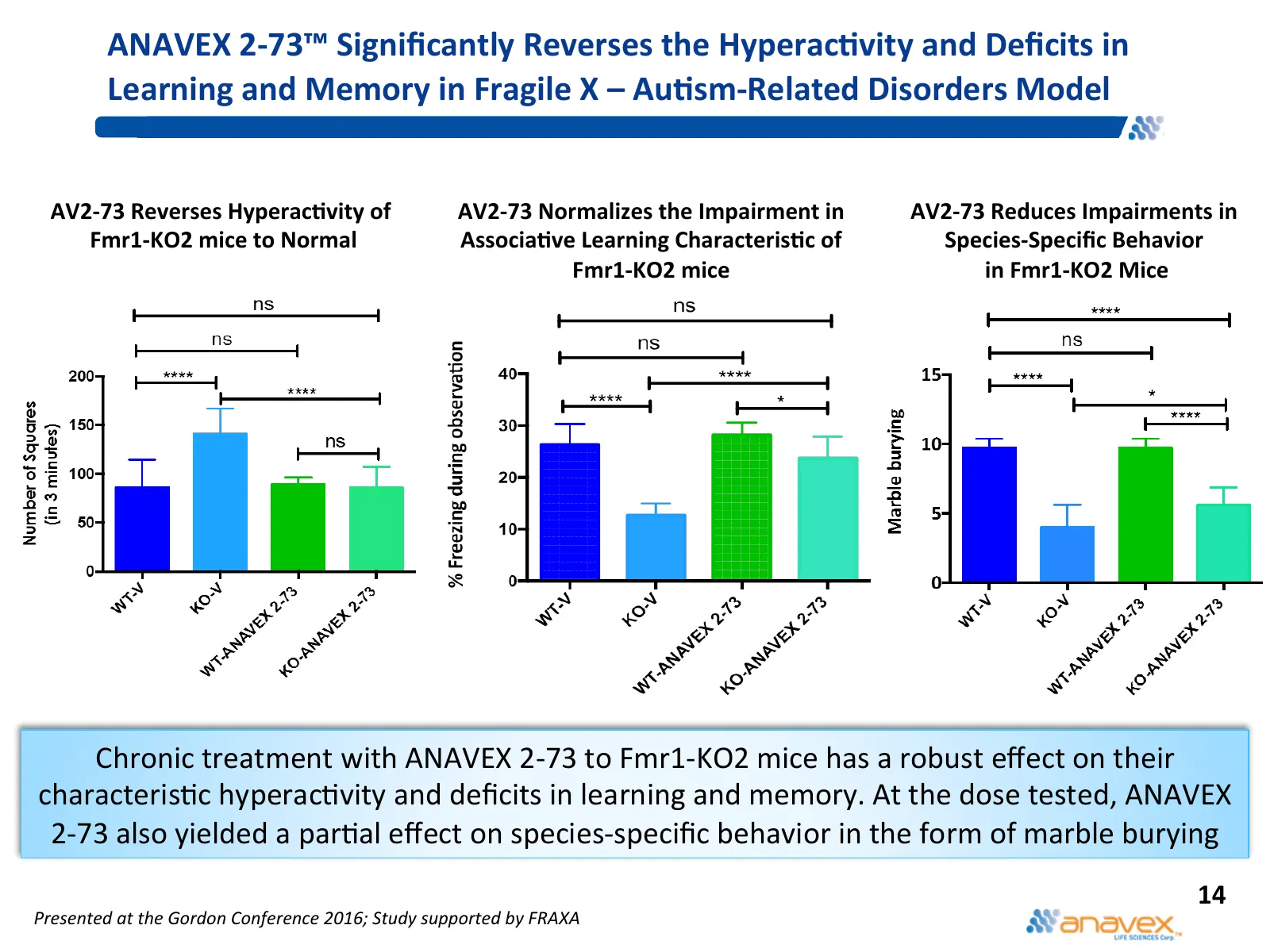
ANAVEX 2-‐73™ Significantly Reverses the Hyperac2vity and Deficits in Learning and Memory in Fragile X – Au2sm-‐Related Disorders Model AV2-‐73 Reverses Hyperac2vity of AV2-‐73 Normalizes the Impairment in AV2-‐73 Reduces Impairments in Fmr1-‐KO2 mice to Normal Associa2ve Learning Characteris2c
Slide 15: Infantile Spasms
Infan2le Spasms § A rare yet devasta8ng condi8on, infan8le spasms (IS) is a seizure disorder that typically occurs during the first 4-‐11 months of childhood § Children who develop IS are at great risk for developmental disability and au8sm § Most children who have infan8le spasms will have a ver
Slide 16: Preclinical Infantile Spasms
Preclinical Infan2le Spasms § The infan8le spasms rat model represents a clinically relevant animal model of infan8le spasms since the phenotype is developmentally specific and semiologically similar to human infan8le spasms, including clustering of spasms# § The phenotype of spasms persists only u
Slide 17: ANAVEX 2-73 Reduces Number of Spasms in Infant Rat Model
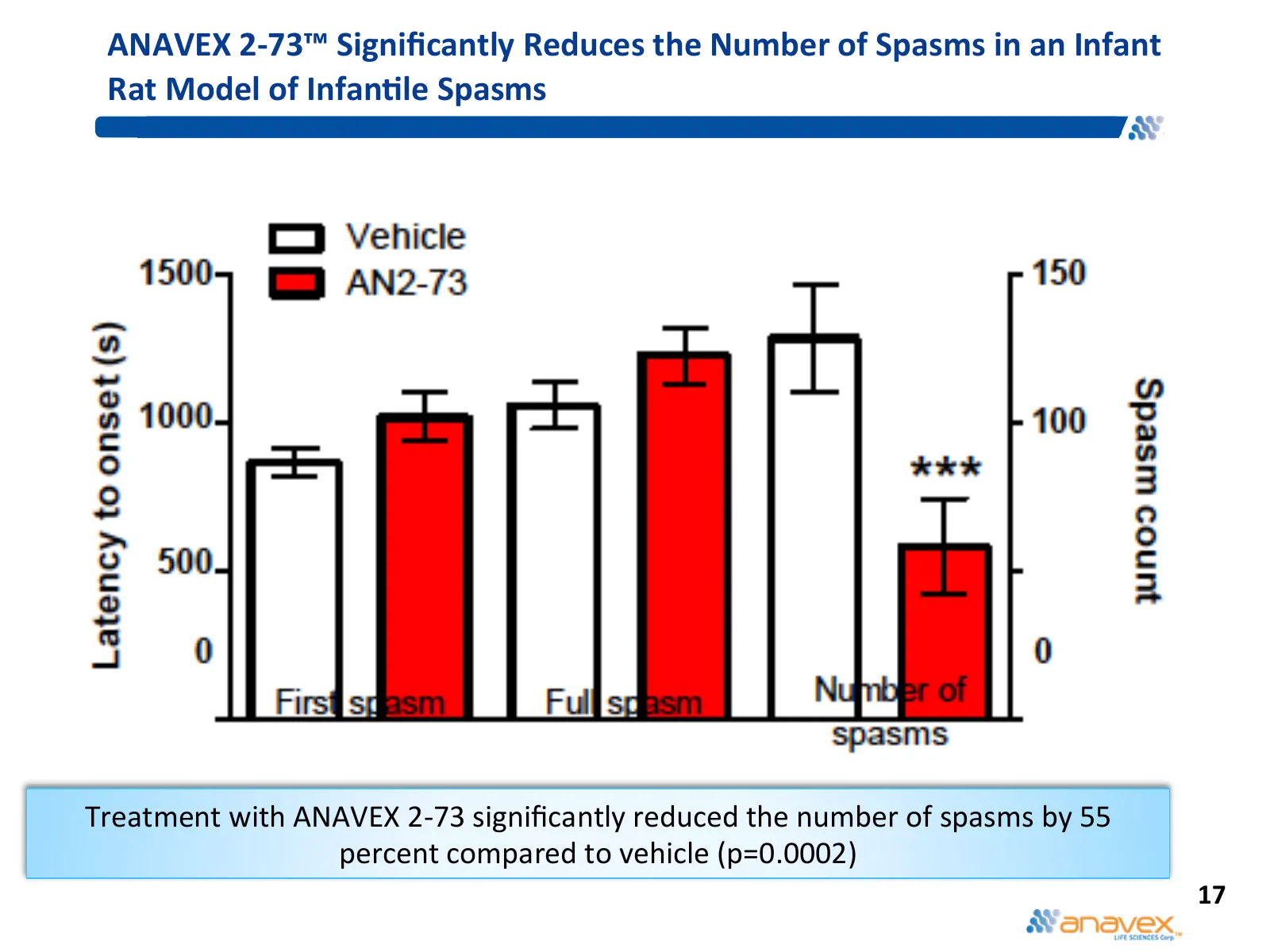
ANAVEX 2-‐73™ Significantly Reduces the Number of Spasms in an Infant Rat Model of Infan2le Spasms Treatment with ANAVEX 2-‐73 significantly reduced the number of spasms by 55 percent compared to vehicle (p=0.0002) 17
Slide 18: Rett Syndrome
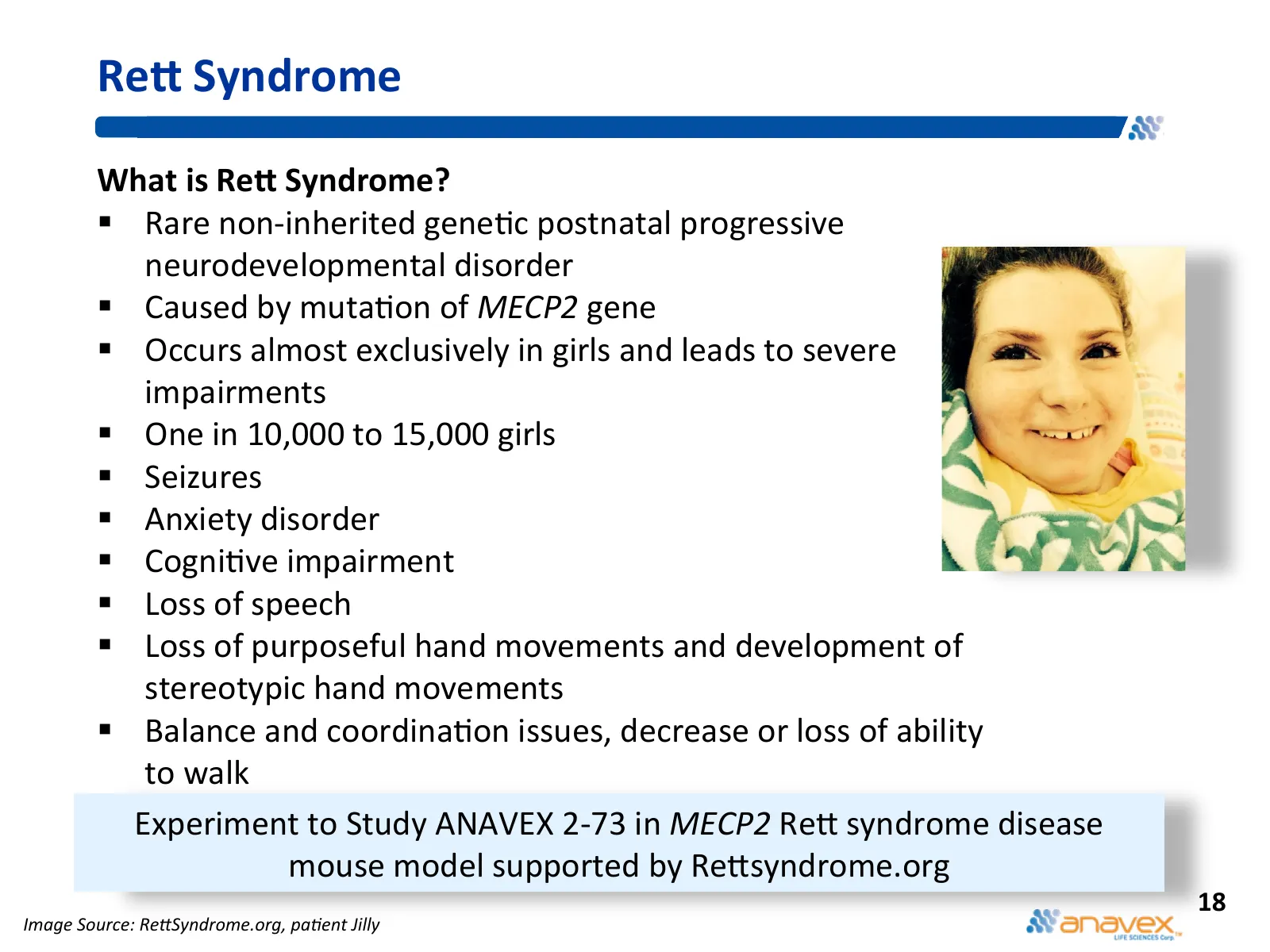
Re9 Syndrome What is Re9 Syndrome? § Rare non-‐inherited gene8c postnatal progressive neurodevelopmental disorder § Caused by muta8on of MECP2 gene § Occurs almost exclusively in girls and leads to severe impairments § One in 10,000 to 15,000 girls § Seizures § Anxiety disorder § Cogni8ve im
Slide 19: Preclinical Rett Syndrome
Preclinical Re9 Syndrome Breeding info § Female mice with heterozygous (HET) MECP2-‐null muta8on# § A mouse with a MECP2-‐null muta8on causes neurological symptoms that mimic ReP syndrome § Breeding done at Jackson Laboratories, mice provided at 4-‐5 weeks of age MECP2 females tes2ng at 8 and
Slide 20: Clasping
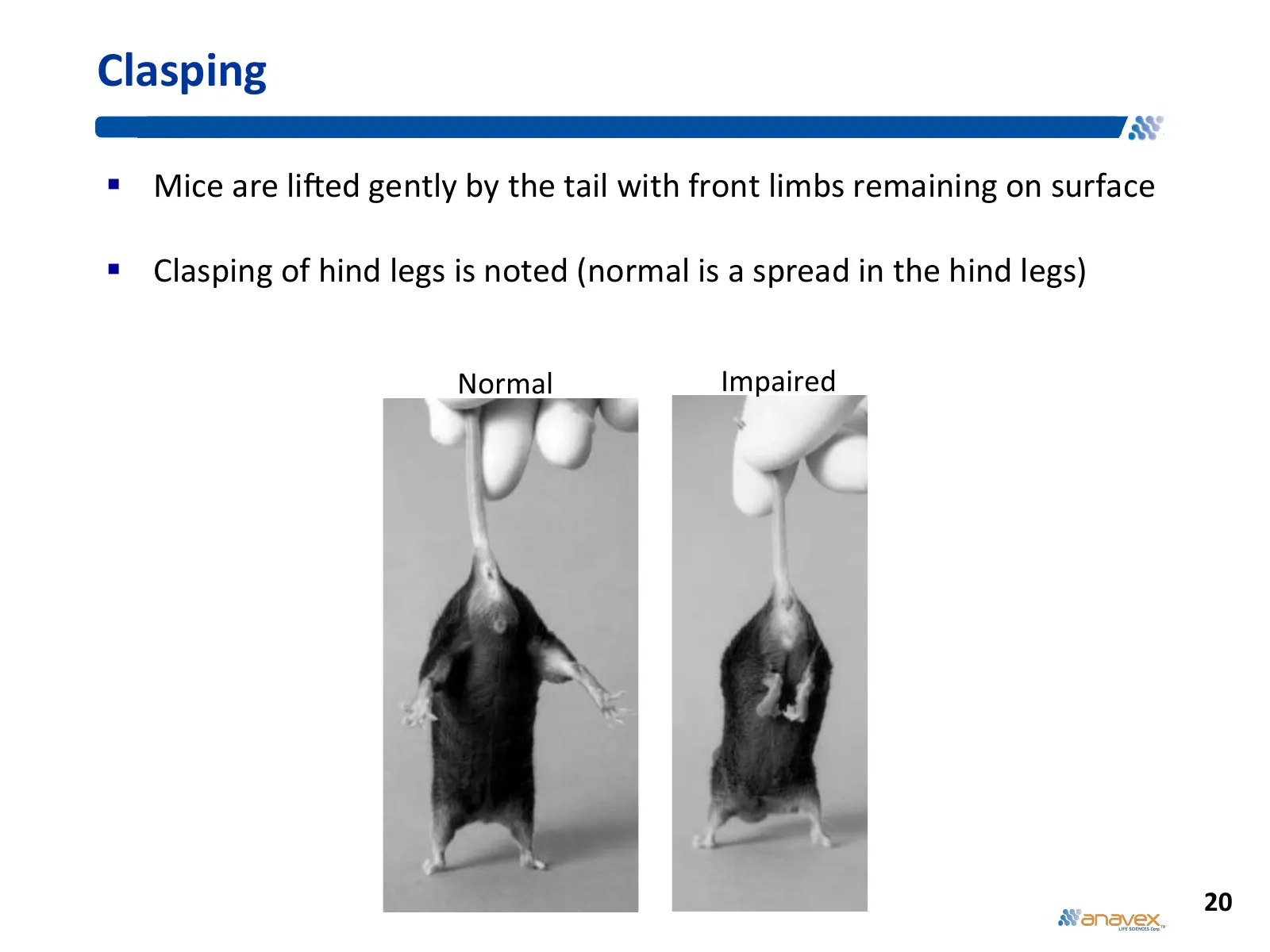
Clasping § Mice are li{ed gently by the tail with front limbs remaining on surface § Clasping of hind legs is noted (normal is a spread in the hind legs) Normal Impaired 20
Slide 21: Clasping at 8 and 12 Weeks
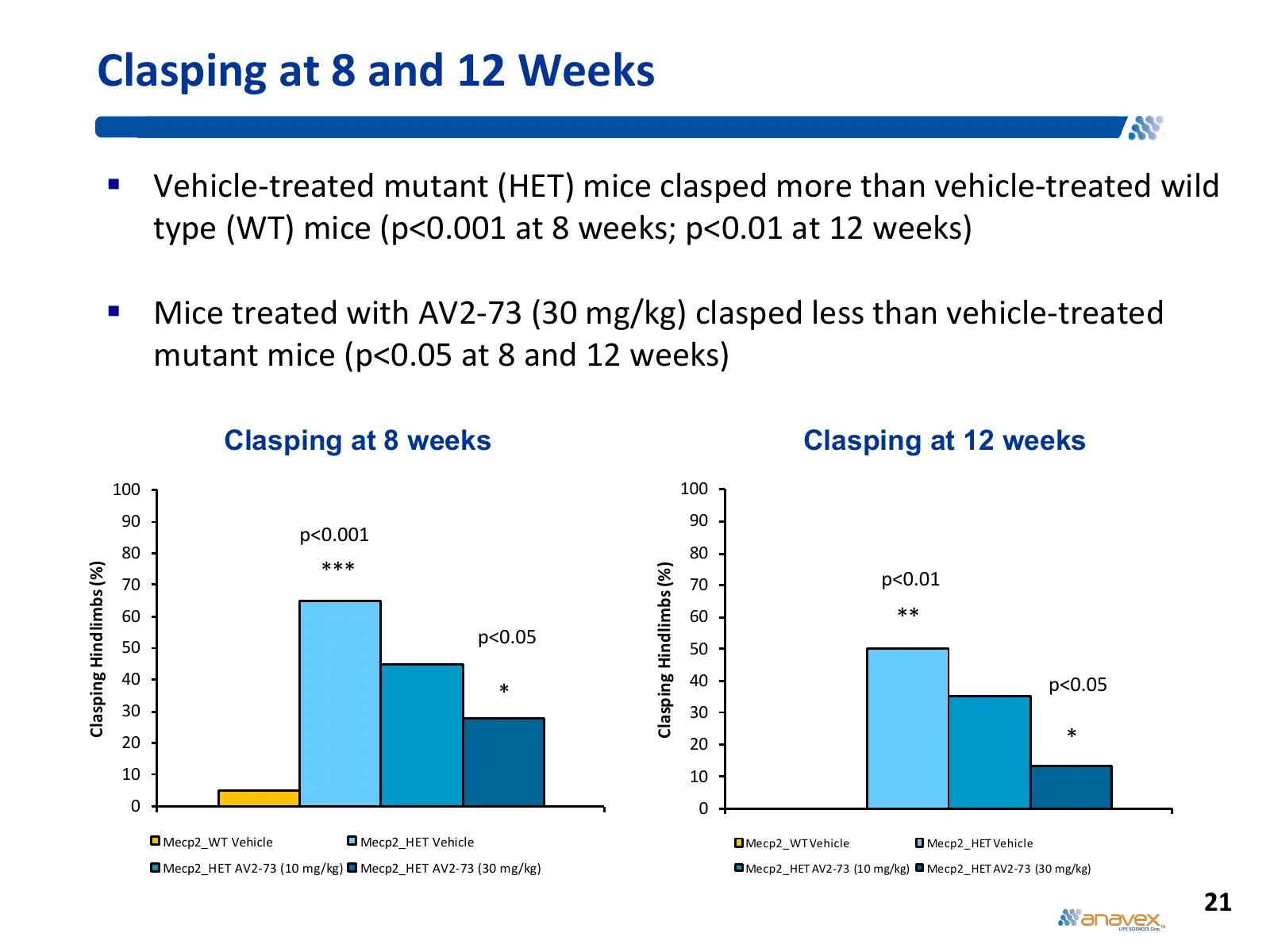
Clasping at 8 and 12 Weeks § Vehicle-‐treated mutant (HET) mice clasped more than vehicle-‐treated wild type (WT) mice (p<0.001 at 8 weeks; p<0.01 at 12 weeks) § Mice treated with AV2-‐73 (30 mg/kg) clasped less than vehicle-‐treated mutant mice (p<0.05 at 8 and 12 weeks) Clasping at 8 weeks C
Slide 22: Startle
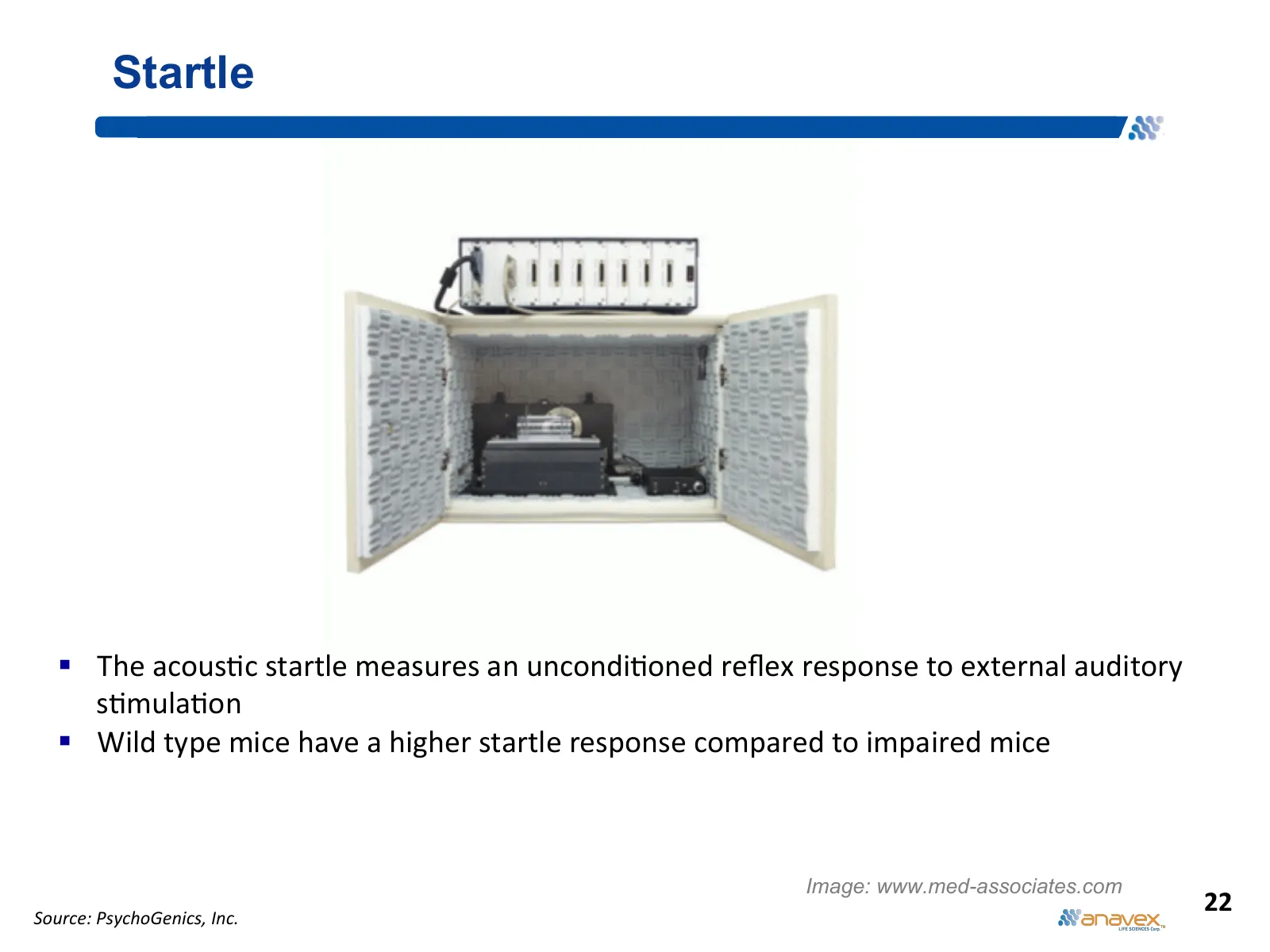
Startle § The acous8c startle measures an uncondi8oned reflex response to external auditory s8mula8on § Wild type mice have a higher startle response compared to impaired mice Image: www.med-associates.com Source: PsychoGenics, Inc. 22
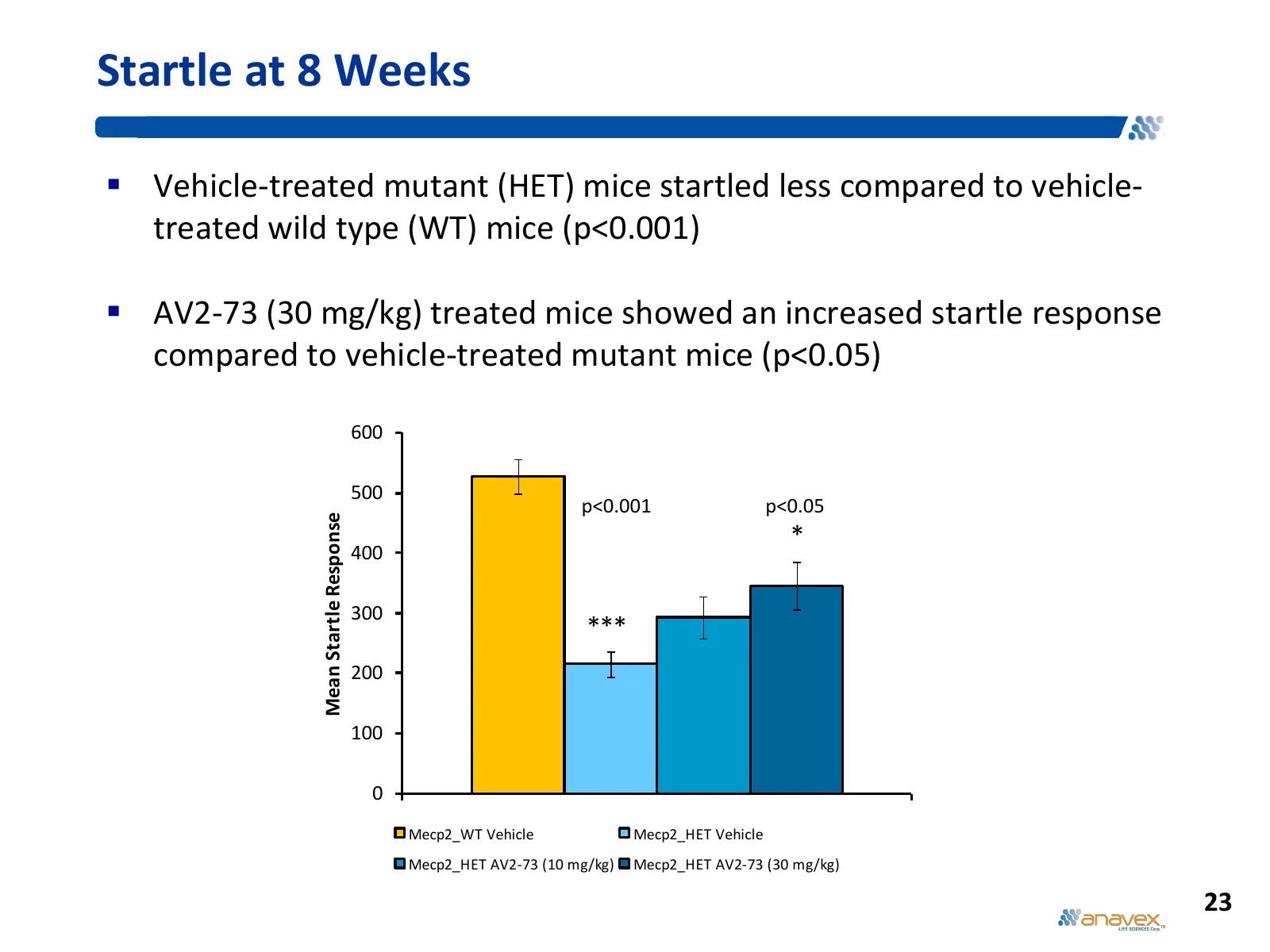
Slide 23: Startle at 8 Weeks
Startle at 8 Weeks § Vehicle-‐treated mutant (HET) mice startled less compared to vehicle-‐ treated wild type (WT) mice (p<0.001) § AV2-‐73 (30 mg/kg) treated mice showed an increased startle response compared to vehicle-‐treated mutant mice (p<0.05) 600 500 p<0.001 p<0.05 Mean Startle Respons
Slide 24: Rotarod
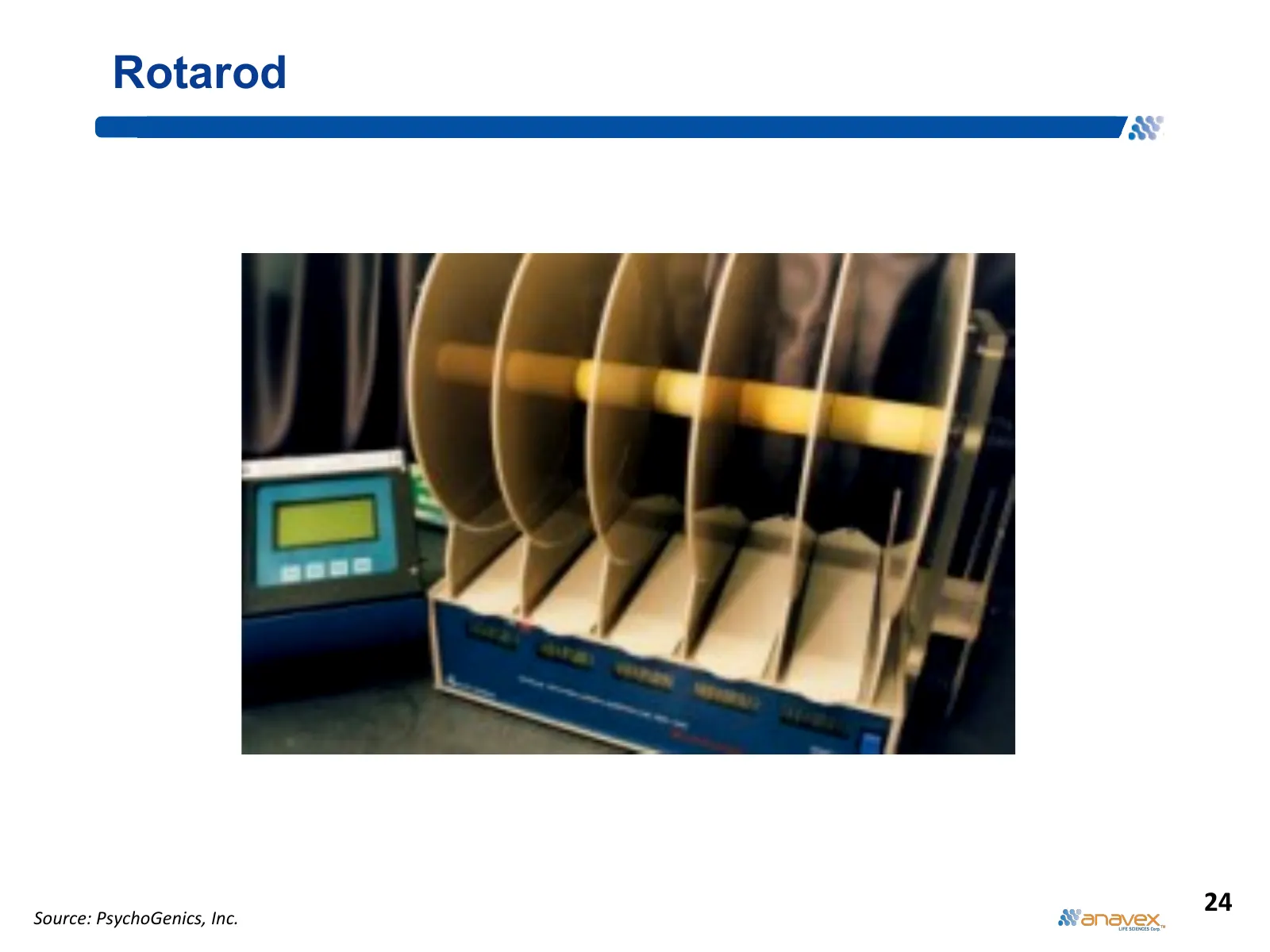
Rotarod Source: PsychoGenics, Inc. 24
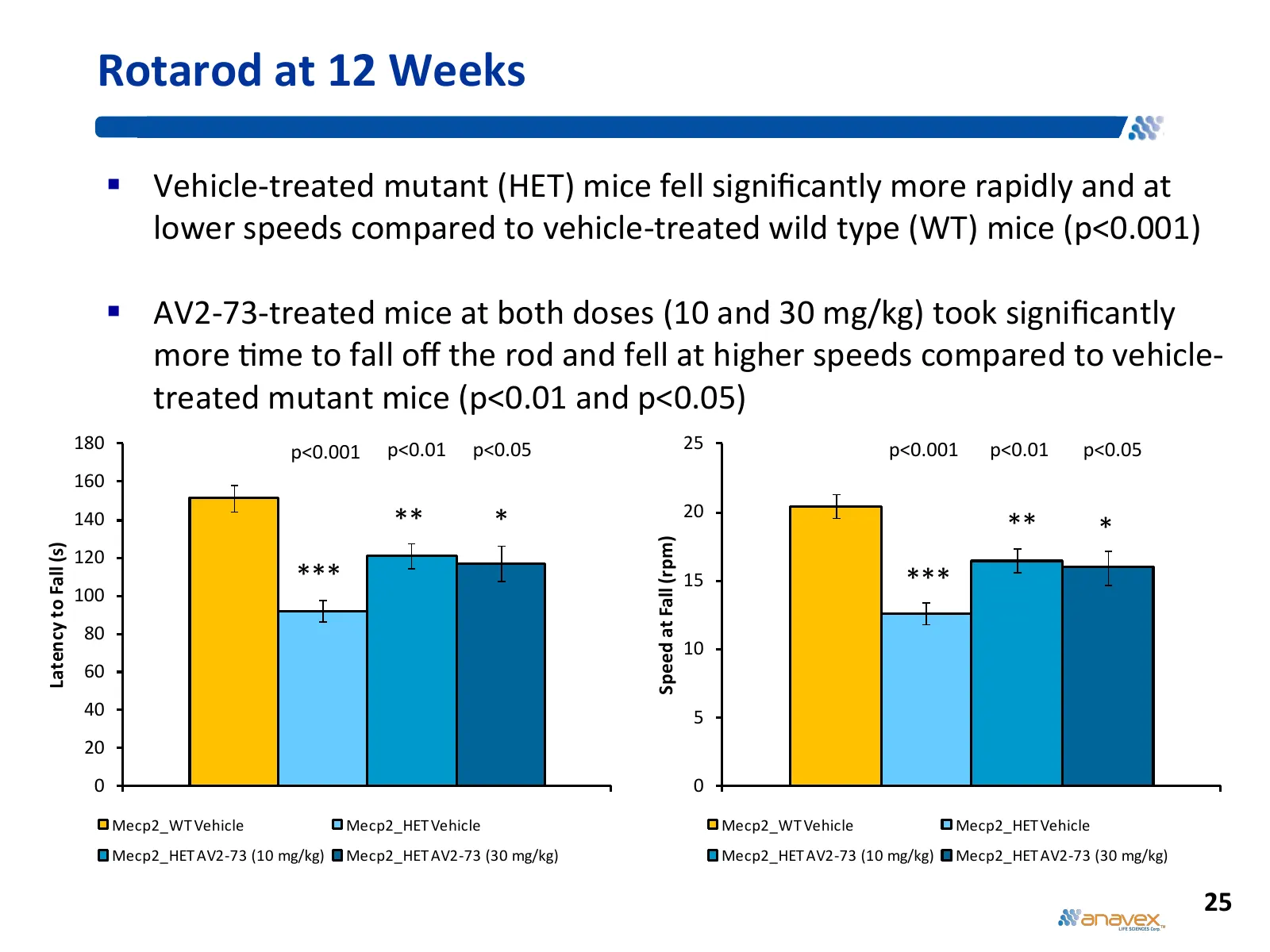
Slide 25: Rotarod at 12 Weeks
Rotarod at 12 Weeks § Vehicle-‐treated mutant (HET) mice fell significantly more rapidly and at lower speeds compared to vehicle-‐treated wild type (WT) mice (p<0.001) § AV2-‐73-‐treated mice at both doses (10 and 30 mg/kg) took significantly more 8me to fall off the rod and fell at higher speeds
Slide 26: NeuroCube
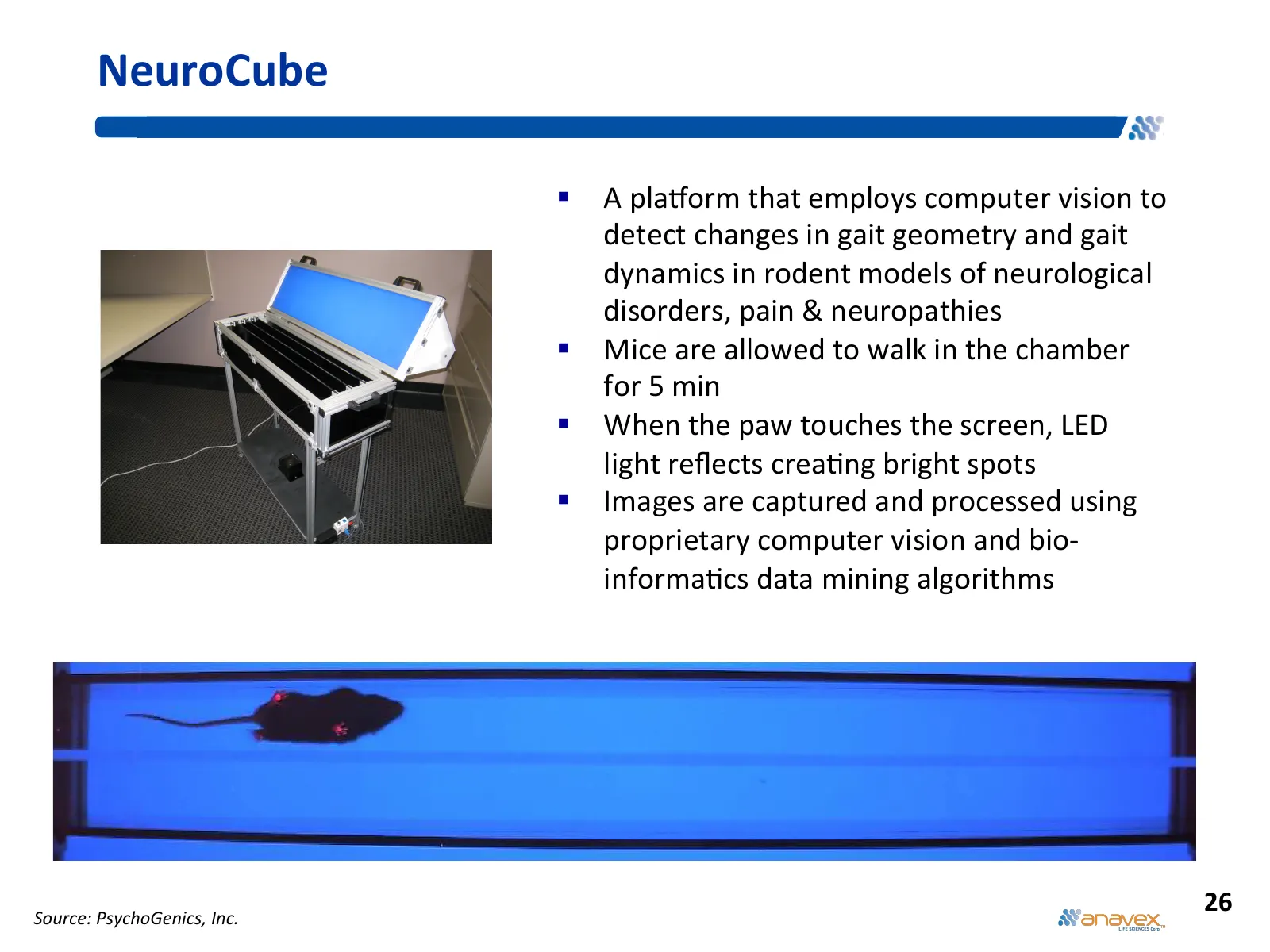
NeuroCube § A pla|orm that employs computer vision to detect changes in gait geometry and gait dynamics in rodent models of neurological disorders, pain & neuropathies § Mice are allowed to walk in the chamber for 5 min § When the paw touches the screen, LED light reflects crea8ng bright spots §
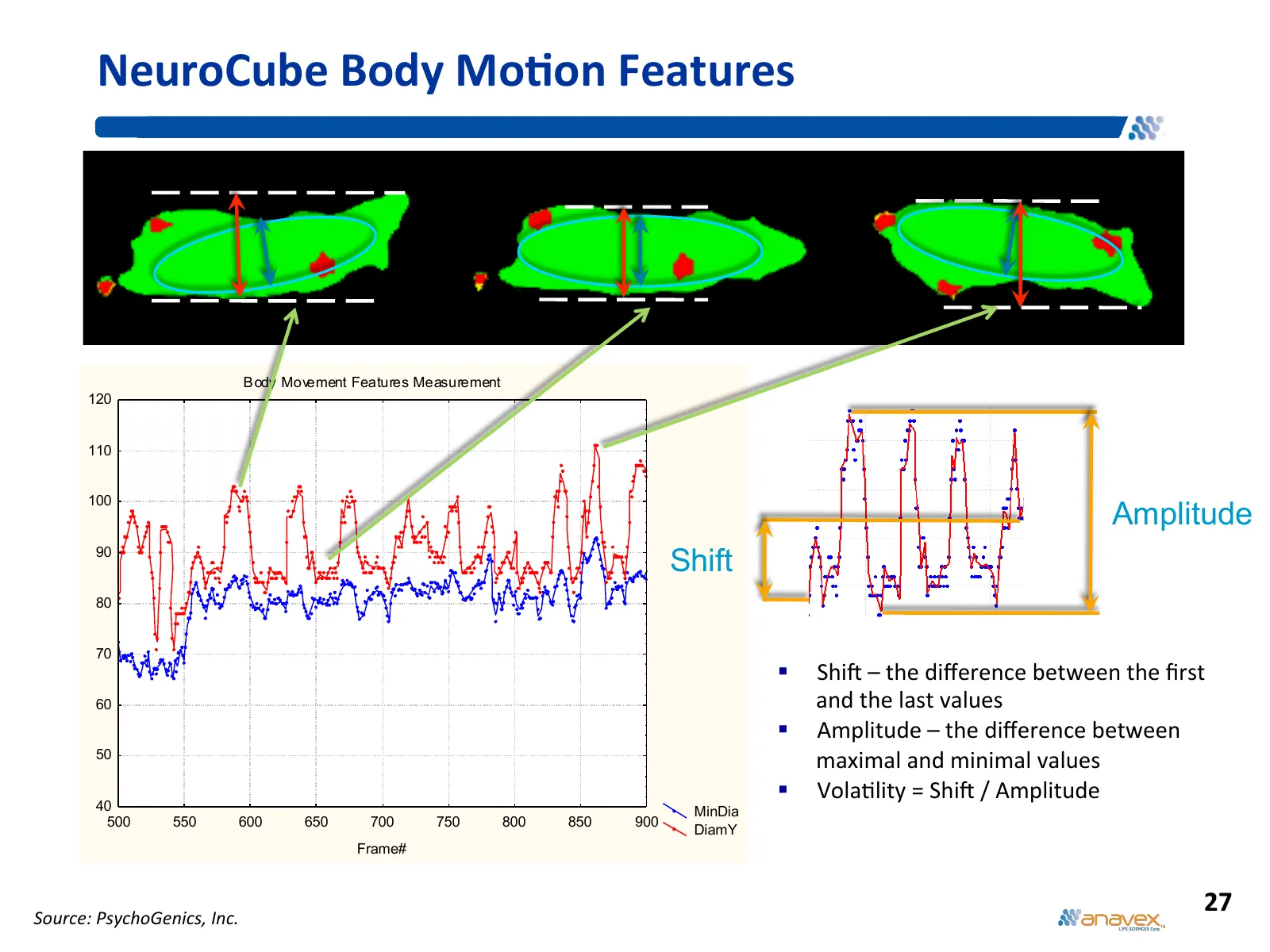
Slide 27: NeuroCube Body Motion Features
NeuroCube Body Mo2on Features B ody Movement Features Measurement 120 110 100 Amplitude 90 Shift 80 70 § Shi{ – the difference between the first 60 and the last values § Amplitude – the difference between 50 maximal and minimal values § Vola8lity = Shi{ / Amplitude 40 MinDia 500 550 600 650 700 750
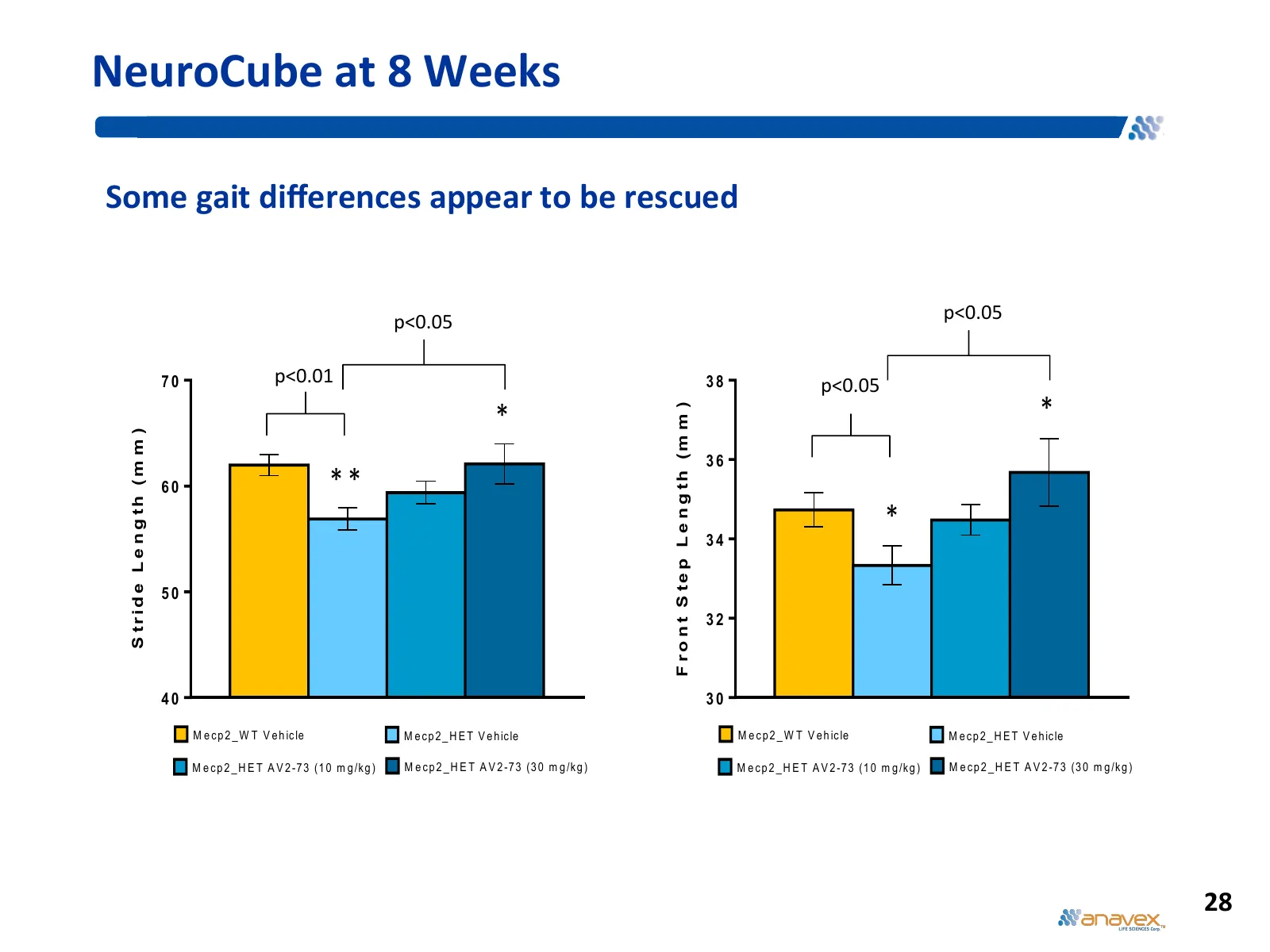
Slide 28: NeuroCube at 8 Weeks
NeuroCube at 8 Weeks Some gait differences appear to be rescued p<0.05 p<0.05 70 p<0.01 38 p<0.05 * * F ro n t S te p L e n g th (m m ) S tr id e L e n g th (m m ) 36 60 ** * 34 50 32 40 30 M e c p 2 _ W T V e h ic le M e c p 2 _ H E T V e h icle M e c p 2 _ W T V e h ic le M e c p 2 _ H E T V e h ic
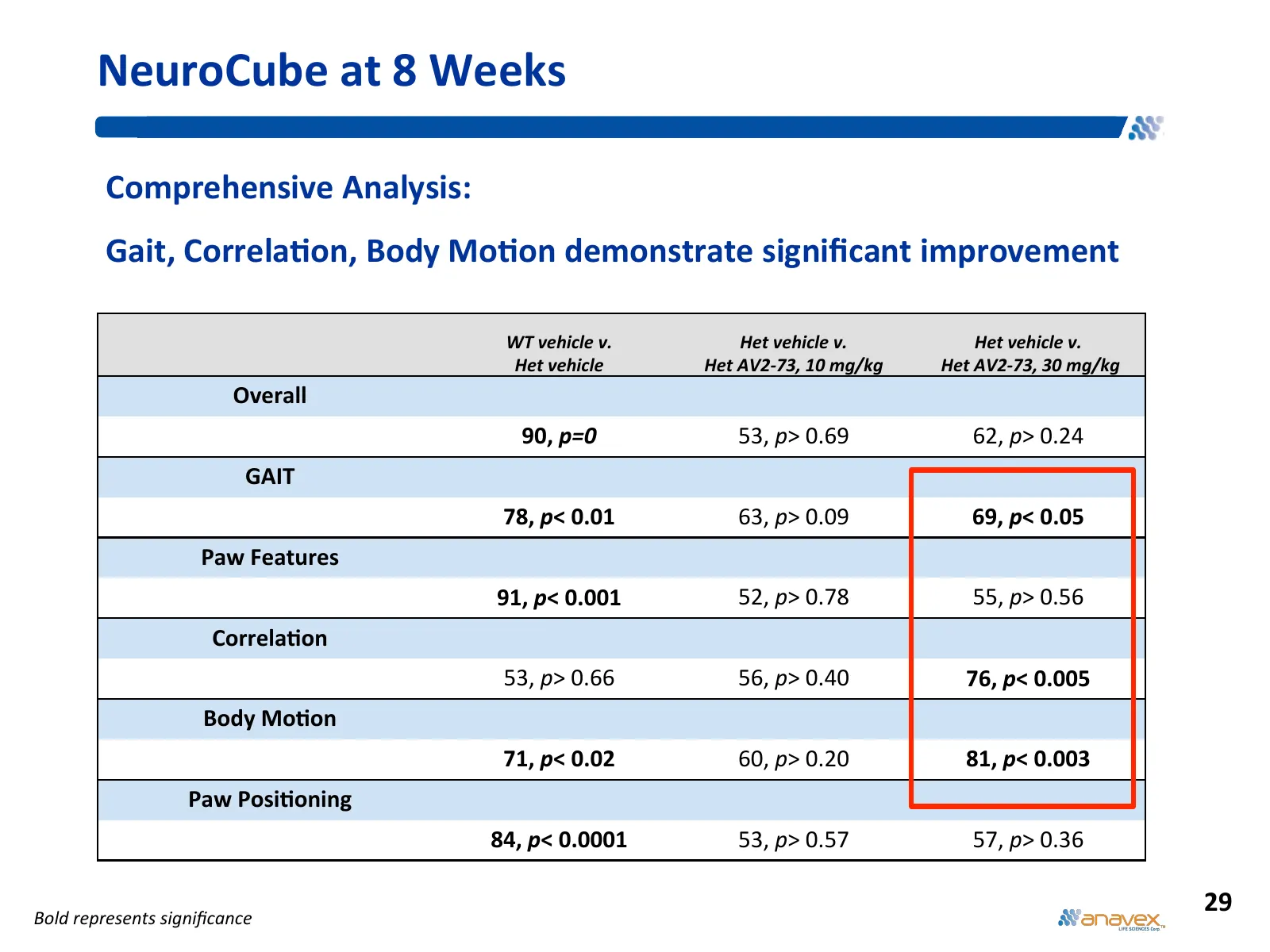
Slide 29: NeuroCube at 8 Weeks: Comprehensive Analysis
NeuroCube at 8 Weeks Comprehensive Analysis: Gait, Correla2on, Body Mo2on demonstrate significant improvement WT vehicle v. Het vehicle v. Het vehicle v. Het vehicle Het AV2-‐73, 10 mg/kg Het AV2-‐73, 30 mg/kg Overall 90, p=0 53, p> 0.69 62, p> 0.24 GAIT 78, p< 0.01 63, p> 0.09 69, p< 0.05 Paw Feat
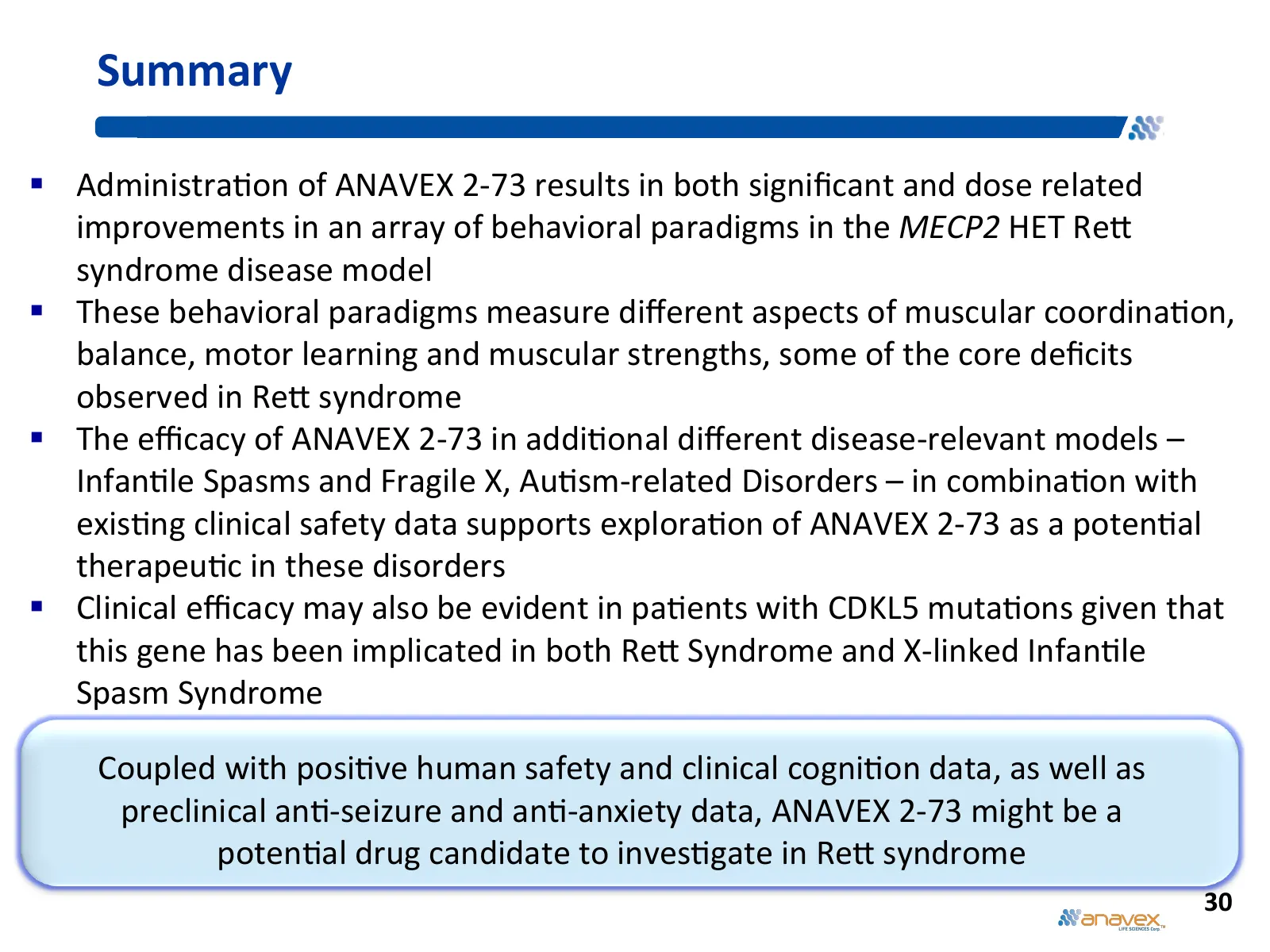
Slide 30: Summary
Summary § Administra8on of ANAVEX 2-‐73 results in both significant and dose related improvements in an array of behavioral paradigms in the MECP2 HET ReP syndrome disease model § These behavioral paradigms measure different aspects of muscular coordina8on, balance, motor learning and muscular stre
Source: Internet Archive copy of anavex.com
More decks from Anavex Life Sciences Corp.
 Proxy Contest (September 2026)25 slides · September 2026
 AD/PD 2026, Copenhagen27 slides · Mar 21, 2026
 Investor Presentation (February 2026)37 slides · February 2026
 Investor Presentation (January 2026)37 slides · January 2026
 Technical Presentation (February 2022)24 slides · Feb 2, 2022
 Investor Presentation (September 2021)43 slides · Sep 13, 2021