Waters Corporation · NYSE:WAT
Waters — Technical Presentation (2012)
53 slides from Waters's technical presentation, 2012
Slide 1: Waters Amide Column Technology For Food Analysis
Waters Amide Column Technology For Food Analysis Euan Ross Business Development Manager Chemistry Operations Europe ©2012 Waters Corporation 1
Slide 2: Overview
Overview Overview of HILIC Retention mechanisms and characteristics Practical considerations Implementing the Approach: Water Soluble Vitamins What is the Amide Chemistry BEH/Xbridge Amide – Carbohydrate Analysis Further BEH/Xbridge Amide Application examples ©2012 Waters Corporation 2
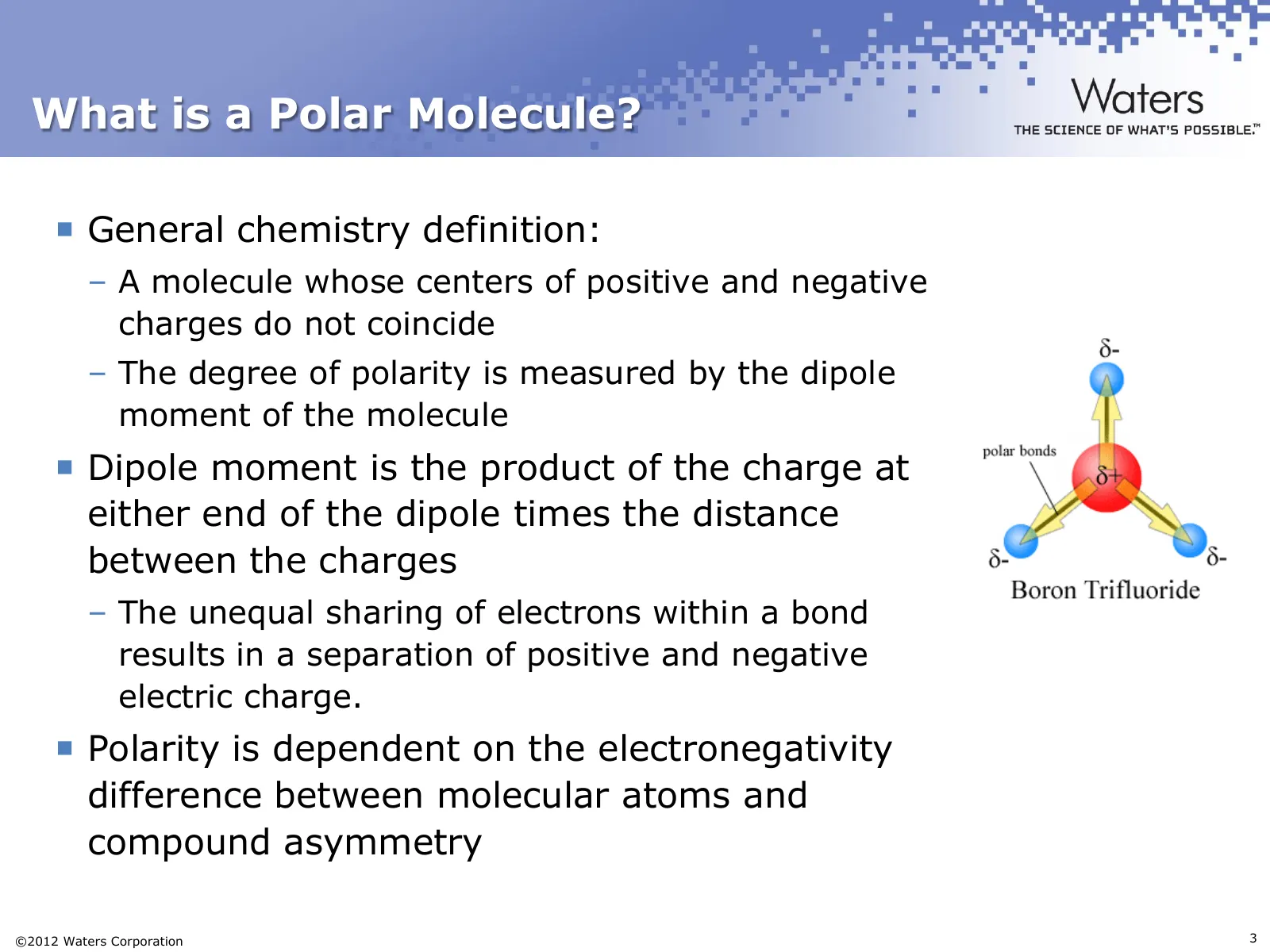
Slide 3: What is a Polar Molecule?
What is a Polar Molecule? General chemistry definition: – A molecule whose centers of positive and negative charges do not coincide – The degree of polarity is measured by the dipole moment of the molecule Dipole moment is the product of the charge at either end of the dipole times the distance
Slide 4: What is HILIC?
What is HILIC? HILIC - Hydrophilic Interaction Chromatography – Term coined in 1990 to distinguish from normal-phase* HILIC is a variation of normal-phase chromatography without the disadvantages of using solvents that are not miscible in water – “Reverse reversed-phase” or “aqueous normal-phase
Slide 5: Benefits of HILIC
Benefits of HILIC Retention of highly polar analytes not retained by reversed-phase —Less interference from non-polar matrix components Complementary selectivity to reversed-phase —Polar metabolites/impurities/degradants retain more than parent compound Enhanced sensitivity in mass spectrometr
Slide 6: Traditional SPE Methods for Reversed-Phase Chromatography
Traditional SPE Methods for Reversed-Phase Chromatography Traditional SPE methods often contain an elution step that consists of high organic content To make this extracted sample compatible with your mobile phase, you must first evaporate the high organic eluent then reconstitute in some portio
Slide 7: When to Use HILIC
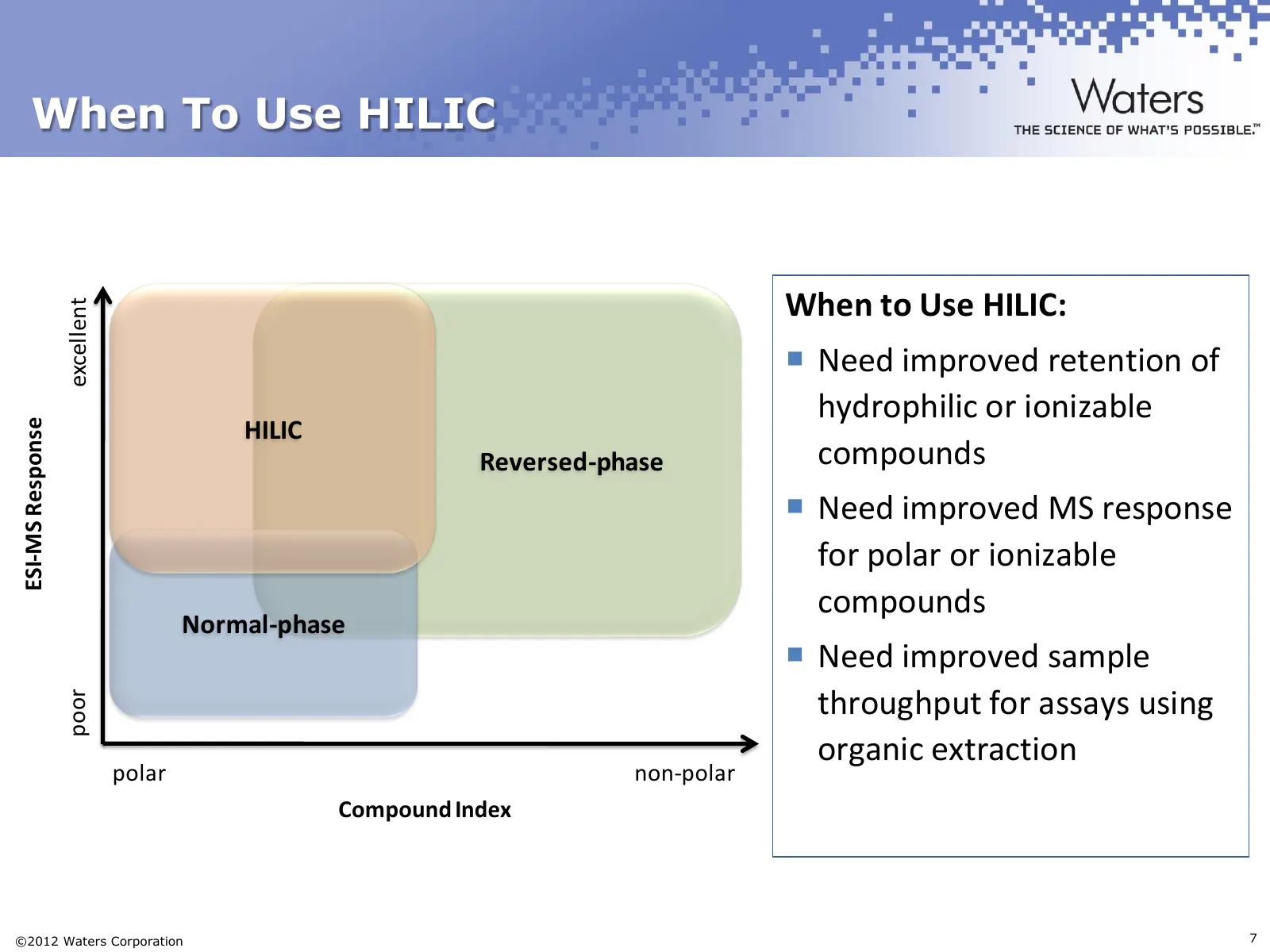
When To Use HILIC When to Use HILIC: excellent Need improved retention of hydrophilic or ionizable ESI-MS Response HILIC Reversed-phase compounds Need improved MS response for polar or ionizable compounds Normal-phase Need improved sample throughput for assays using poor organic extraction pol
Slide 8: Elution Strength in HILIC
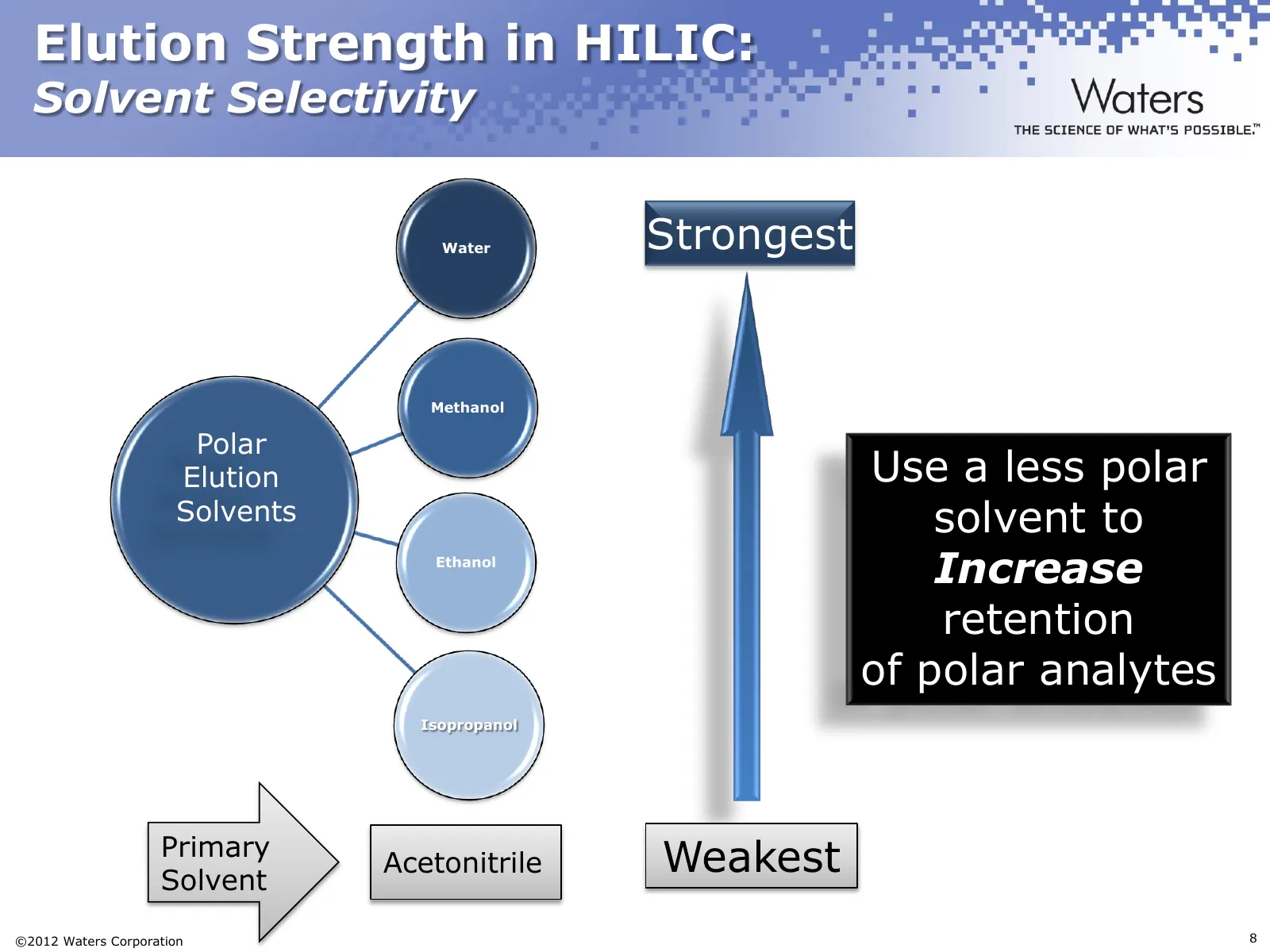
Elution Strength in HILIC: Solvent Selectivity Water Strongest Methanol Polar Elution Use a less polar Solvents solvent to Ethanol Increase retention of polar analytes Isopropanol Primary Solvent Acetonitrile Weakest ©2012 Waters Corporation 8
Slide 9: Overview
Overview Overview of HILIC Retention mechanisms and characteristics Practical considerations Implementing the Approach: Water Soluble Vitamins What is the Amide Chemistry BEH/Xbridge Amide – Carbohydrate Analysis Further BEH/Xbridge Amide Application examples ©2012 Waters Corporation 9
Slide 10: HILIC Retention Mechanisms are Complex
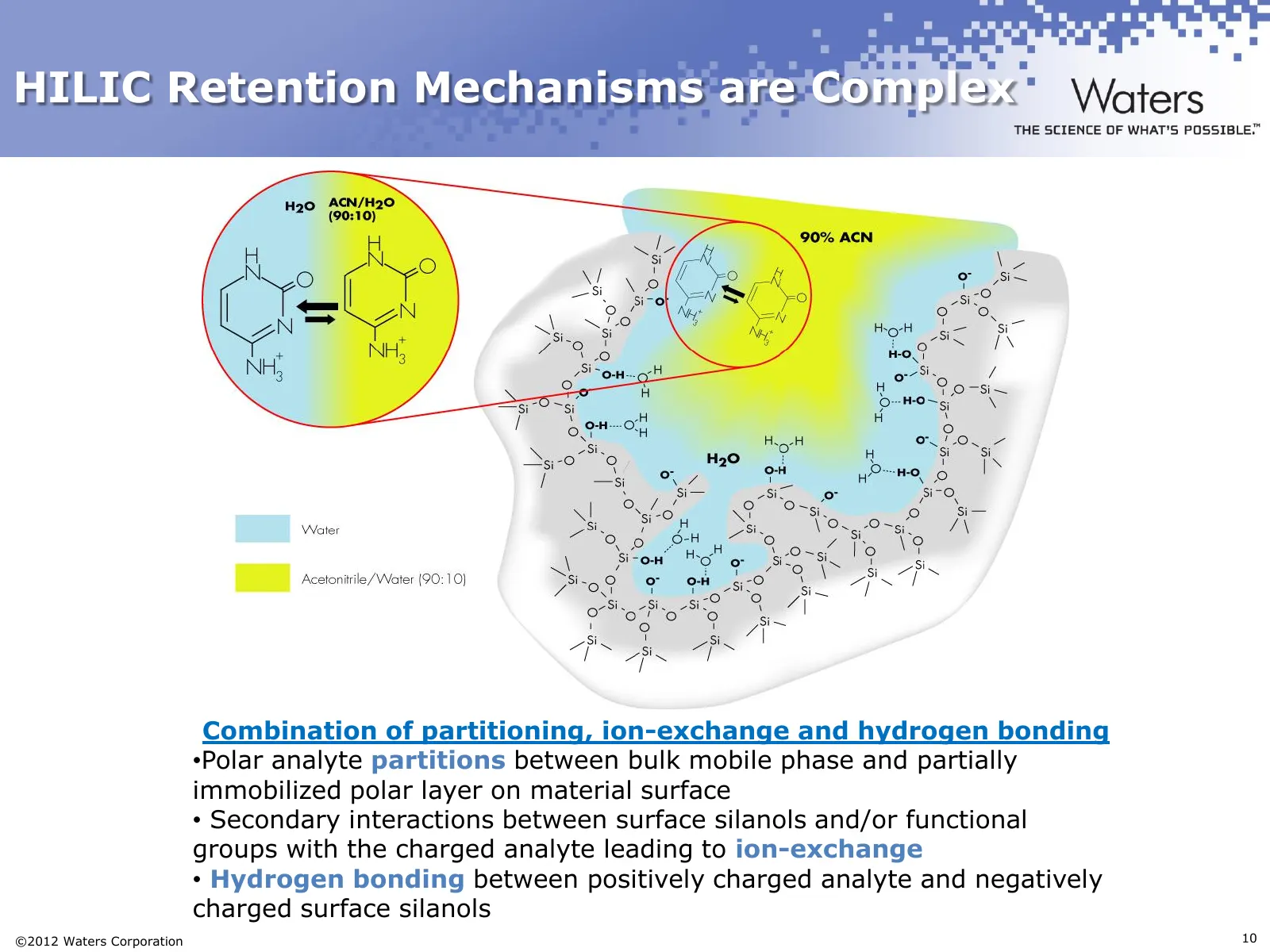
HILIC Retention Mechanisms are Complex Combination of partitioning, ion-exchange and hydrogen bonding •Polar analyte partitions between bulk mobile phase and partially immobilized polar layer on material surface • Secondary interactions between surface silanols and/or functional groups with the char
Slide 11: Stationary Phases for HILIC separations
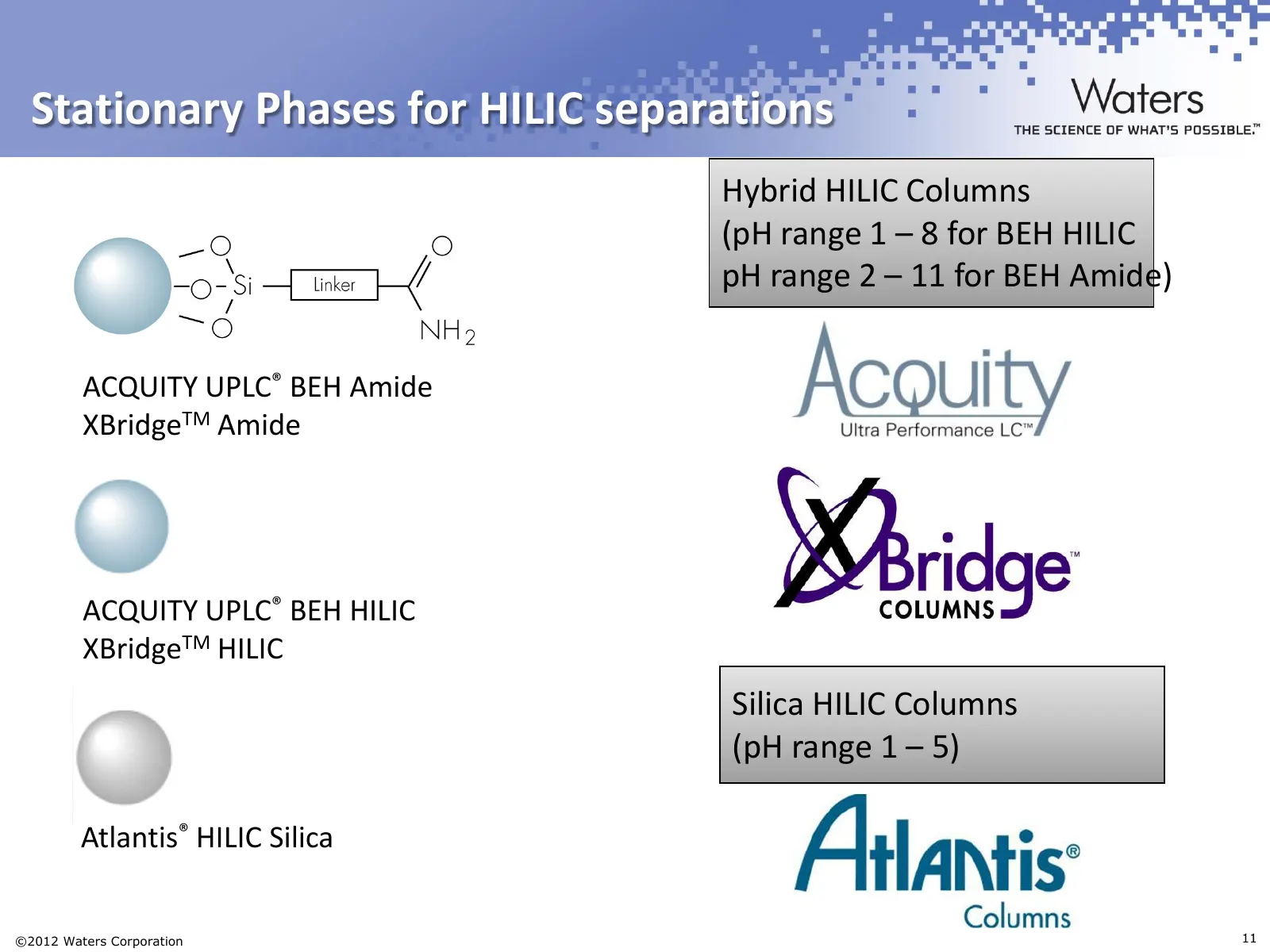
Stationary Phases for HILIC separations Hybrid HILIC Columns (pH range 1 – 8 for BEH HILIC pH range 2 – 11 for BEH Amide) ACQUITY UPLC® BEH Amide XBridgeTM Amide ACQUITY UPLC® BEH HILIC XBridgeTM HILIC Silica HILIC Columns (pH range 1 – 5) Atlantis® HILIC Silica ©2012 Waters Corporation 11
Slide 12: 2nd Generation Hybrid Particles: Ethylene Bridged Hybrid (BEH) Particles
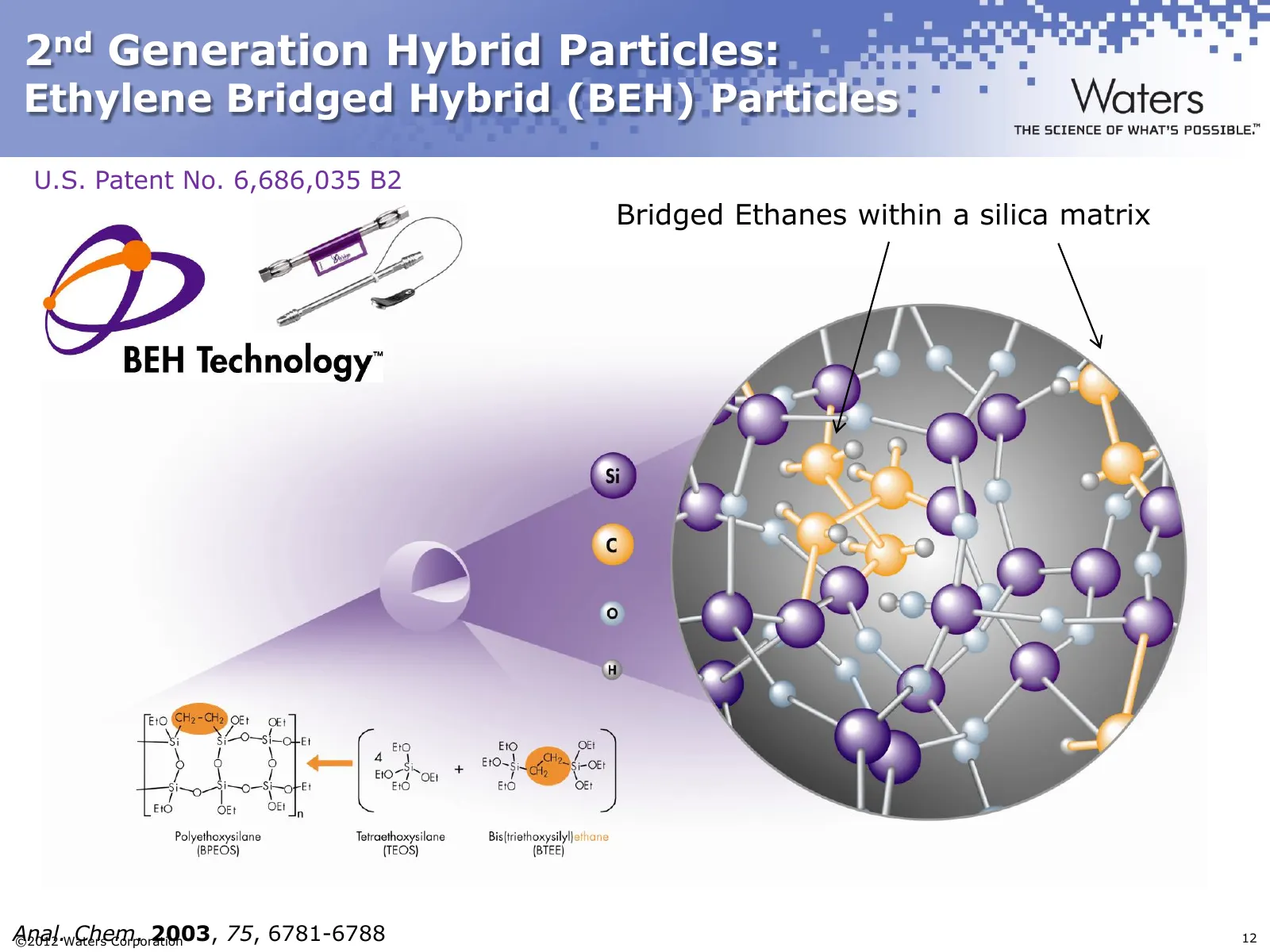
2nd Generation Hybrid Particles: Ethylene Bridged Hybrid (BEH) Particles U.S. Patent No. 6,686,035 B2 Bridged Ethanes within a silica matrix Anal. Chem. ©2012 Waters 2003, 75, 6781-6788 Corporation 12
Slide 13: What is the BEH/Xbridge Amide Chemistry?
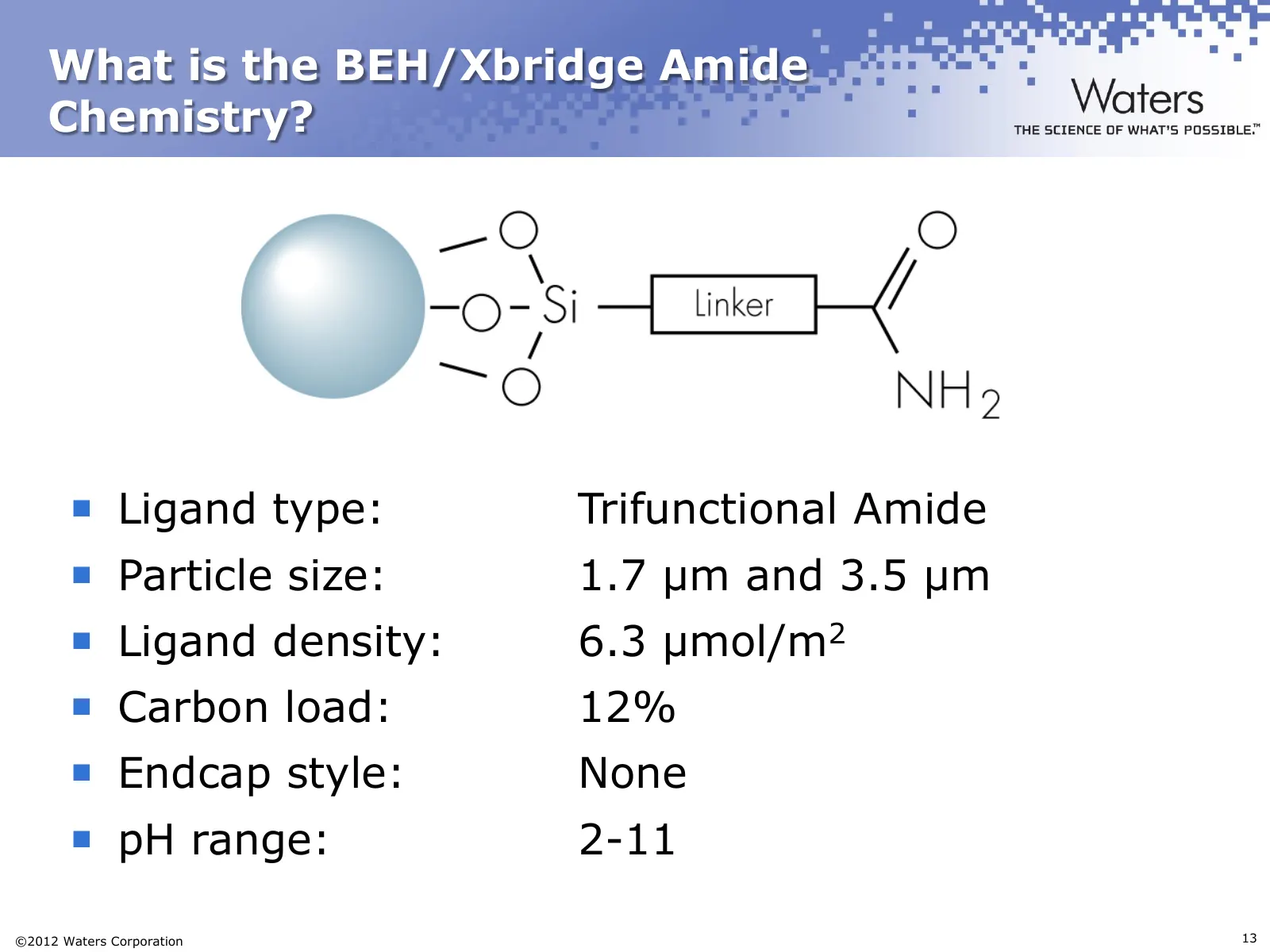
What is the BEH/Xbridge Amide Chemistry? Ligand type: Trifunctional Amide Particle size: 1.7 µm and 3.5 µm Ligand density: 6.3 µmol/m2 Carbon load: 12% Endcap style: None pH range: 2-11 ©2012 Waters Corporation 13
Slide 14: Influence of Stationary Phase on Retention
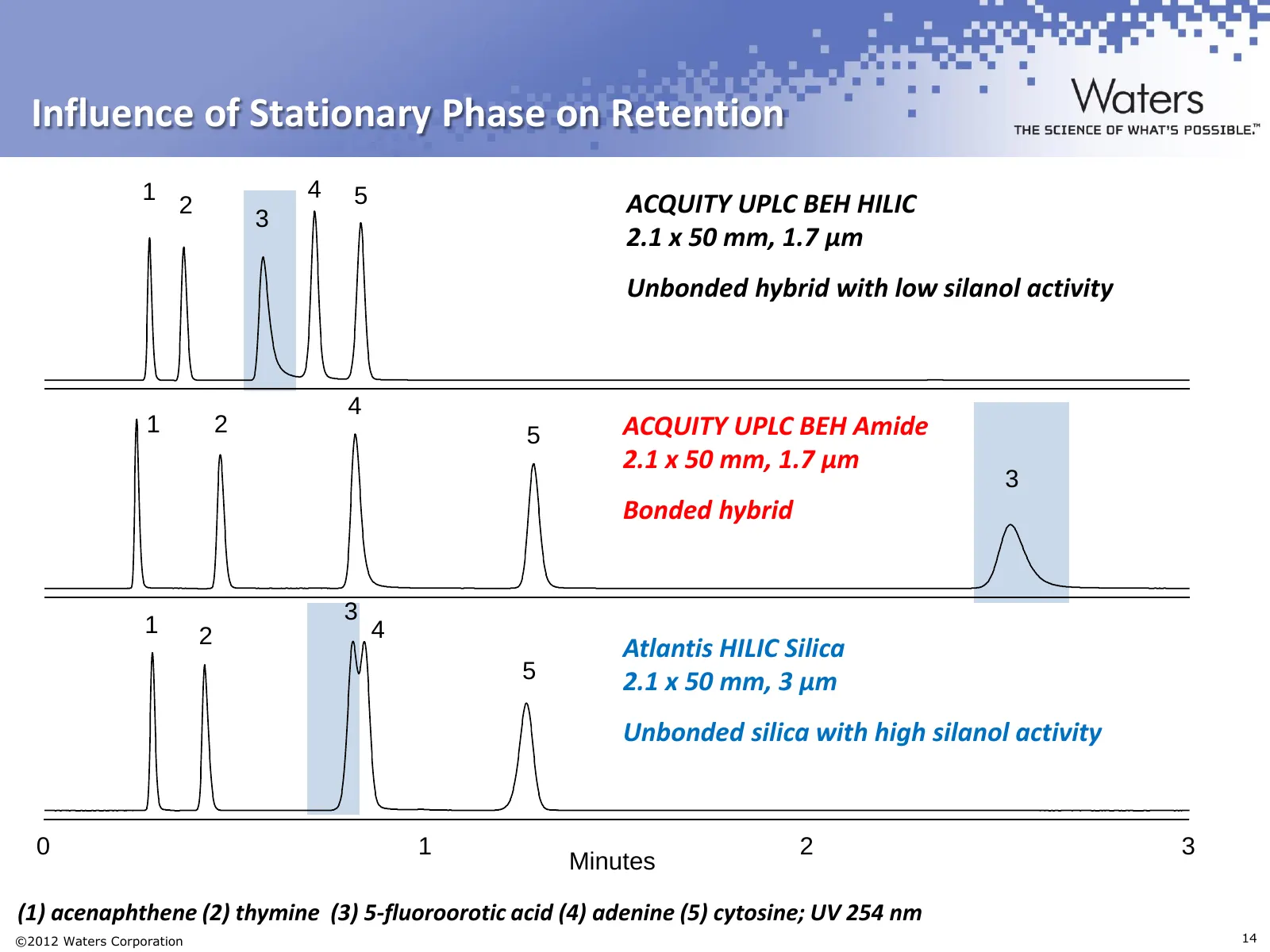
Influence of Stationary Phase on Retention 1 4 5 2 ACQUITY UPLC BEH HILIC 3 2.1 x 50 mm, 1.7 µm Unbonded hybrid with low silanol activity 4 1 2 5 ACQUITY UPLC BEH Amide 2.1 x 50 mm, 1.7 µm 3 Bonded hybrid 3 1 2 4 Atlantis HILIC Silica 5 2.1 x 50 mm, 3 µm Unbonded silica with high silanol activity 0
Slide 15: Overview
Overview Overview of HILIC Retention mechanisms and characteristics Practical considerations Implementing the Approach: Water Soluble Vitamins What is the Amide Chemistry Hilic Amide – Carbohydrate Analysis Further Application examples ©2012 Waters Corporation 15
Slide 16: Before You Start: Common HILIC mobile phases
Before You Start: Common HILIC mobile phases Common buffers/additives* – Ammonium formate, ammonium acetate – Formic acid, ammonium hydroxide, acetic acid – Phosphate salt buffers ARE NOT recommended due to precipitation in the highly organic mobile phase (phosphoric acid is OK) Recommended buff
Slide 17: Before You Start: Column Equilibration and Wash Solvents
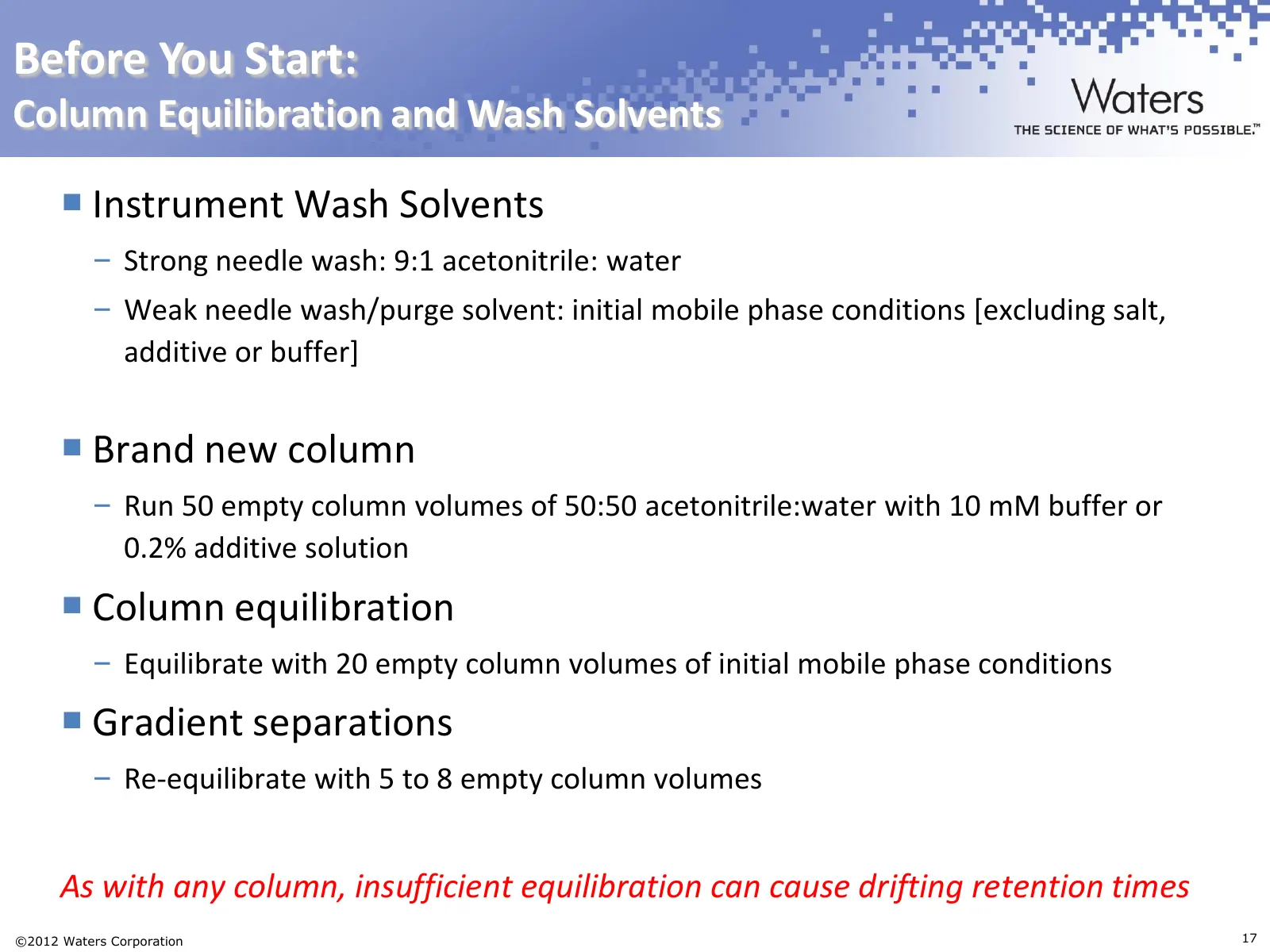
Before You Start: Column Equilibration and Wash Solvents Instrument Wash Solvents – Strong needle wash: 9:1 acetonitrile: water – Weak needle wash/purge solvent: initial mobile phase conditions [excluding salt, additive or buffer] Brand new column – Run 50 empty column volumes of 50:50 acetonitr
Slide 18: Before You Start: Influence of Sample Diluent
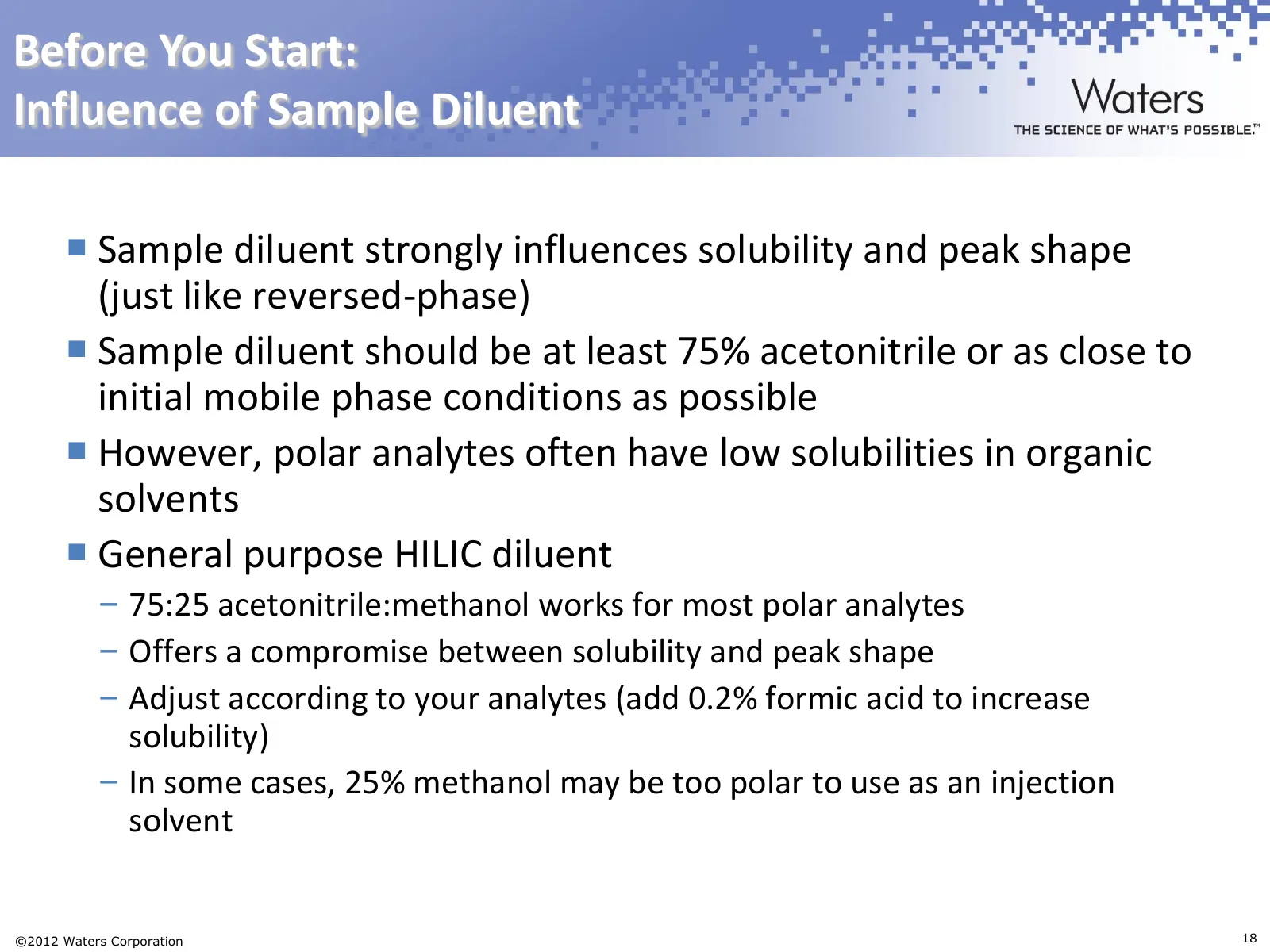
Before You Start: Influence of Sample Diluent Sample diluent strongly influences solubility and peak shape (just like reversed-phase) Sample diluent should be at least 75% acetonitrile or as close to initial mobile phase conditions as possible However, polar analytes often have low solubilitie
Slide 19: Overview
Overview Overview of HILIC Retention mechanisms and characteristics Practical considerations Implementing the Approach: Water Soluble Vitamins What is the Amide Chemistry Hilic Amide – Carbohydrate Analysis Further Application examples ©2012 Waters Corporation 19
Slide 20: Implementing the Approach: Example 1, Water Soluble Vitamins
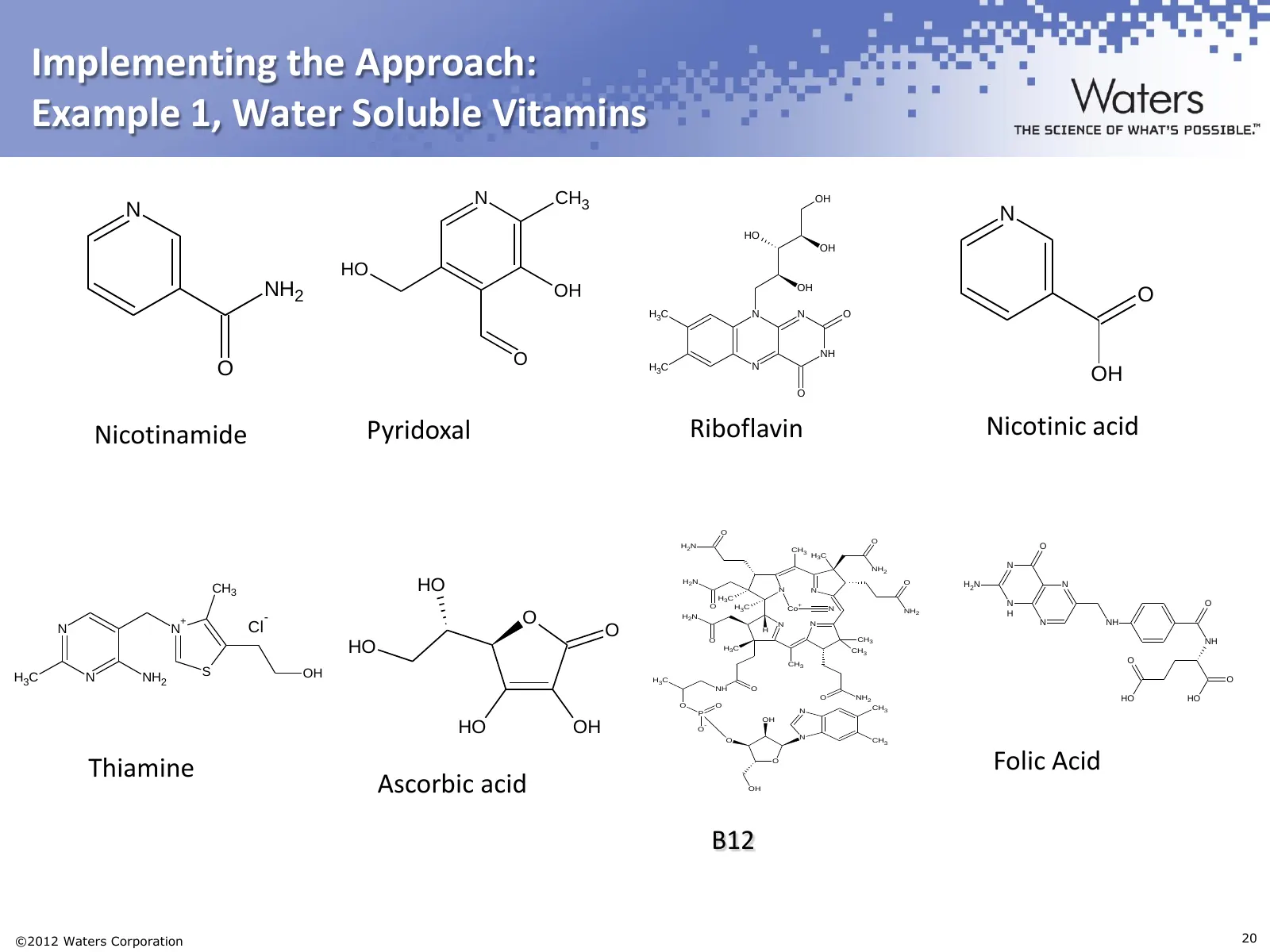
Implementing the Approach: Example 1, Water Soluble Vitamins N CH3 OH N N HO OH HO NH2 OH OH O H3C N N O NH O O H3C N OH O Nicotinamide Pyridoxal Riboflavin Nicotinic acid O O H2N CH3 O H3C NH2 N CH3 HO H2N H3C N N O H2N N O H3C + N O Co N NH2 H + Cl - O H2N N N N NH N N O O H CH3 NH HO H3C CH3 CH3
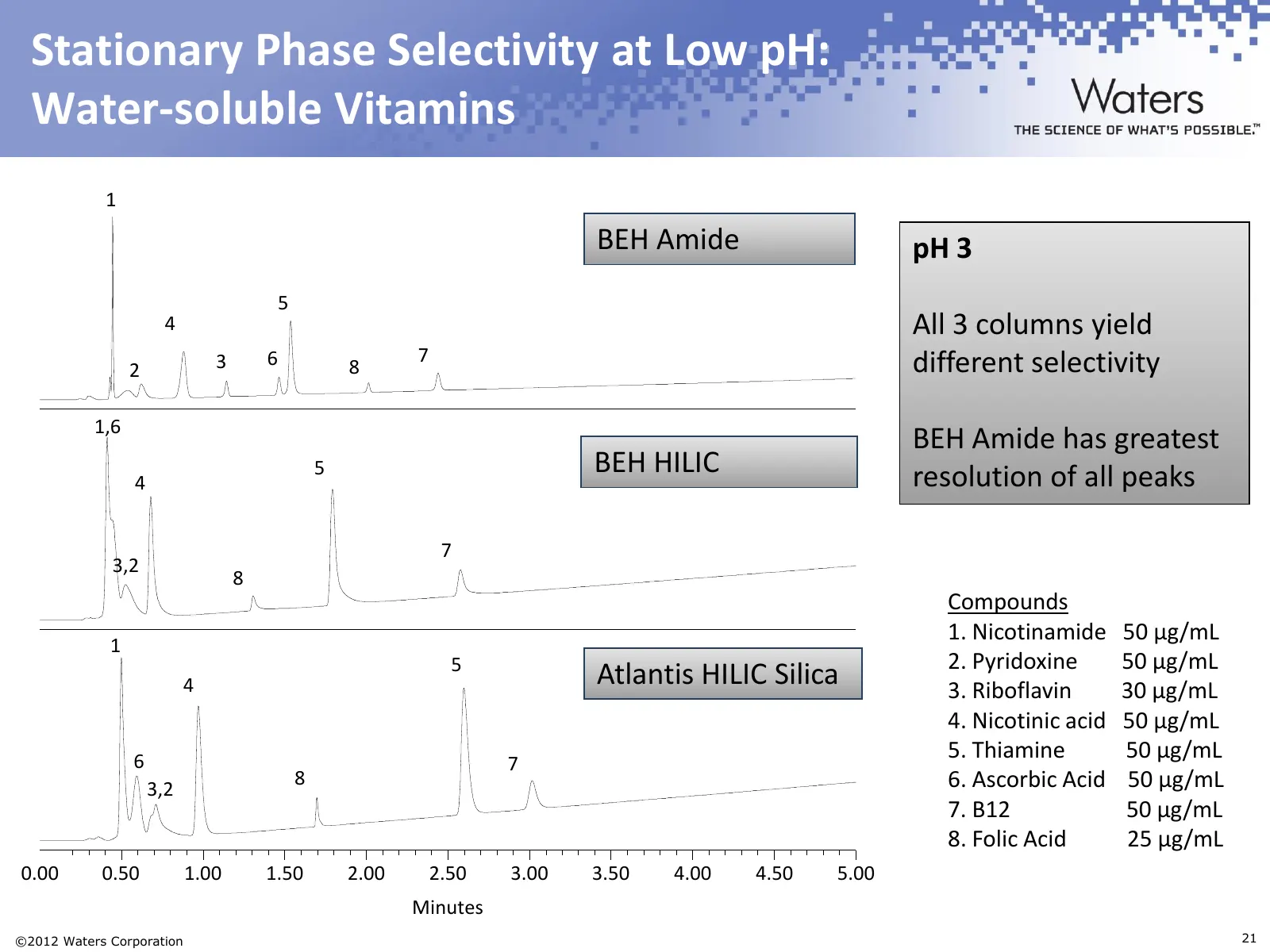
Slide 21: Stationary Phase Selectivity at Low pH: Water-soluble Vitamins
Stationary Phase Selectivity at Low pH: Water-soluble Vitamins 1 BEH Amide pH 3 5 4 All 3 columns yield 3 6 7 different selectivity 2 8 1,6 BEH Amide has greatest 5 BEH HILIC resolution of all peaks 4 7 3,2 8 Compounds 1. Nicotinamide 50 µg/mL 1 5 2. Pyridoxine 50 µg/mL 4 Atlantis HILIC Silica 3. Ri
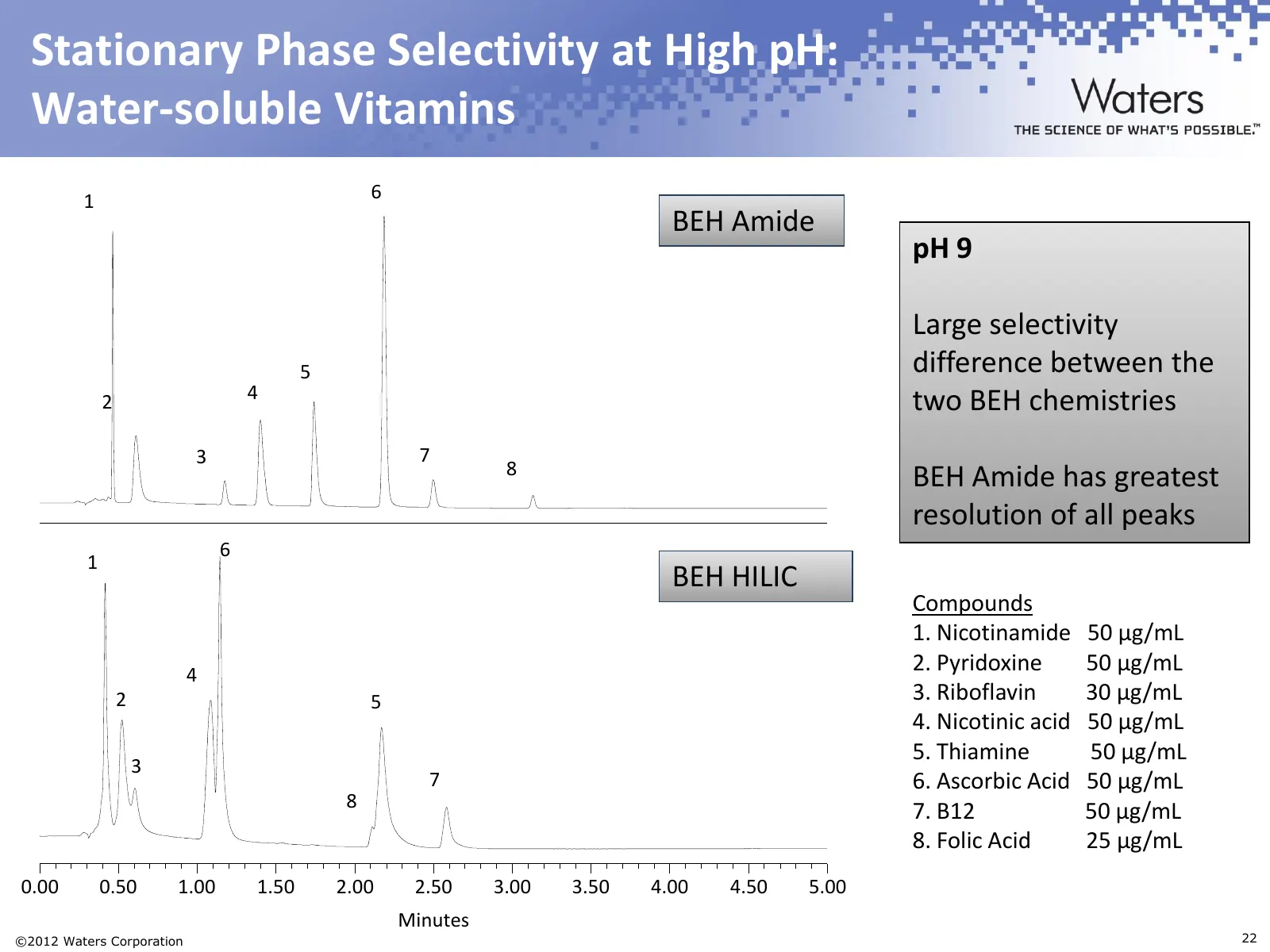
Slide 22: Stationary Phase Selectivity at High pH: Water-soluble Vitamins
Stationary Phase Selectivity at High pH: Water-soluble Vitamins 1 6 BEH Amide pH 9 Large selectivity 5 difference between the 4 2 two BEH chemistries 3 7 8 BEH Amide has greatest resolution of all peaks 6 1 BEH HILIC Compounds 1. Nicotinamide 50 µg/mL 4 2. Pyridoxine 50 µg/mL 2 5 3. Riboflavin 30 µg
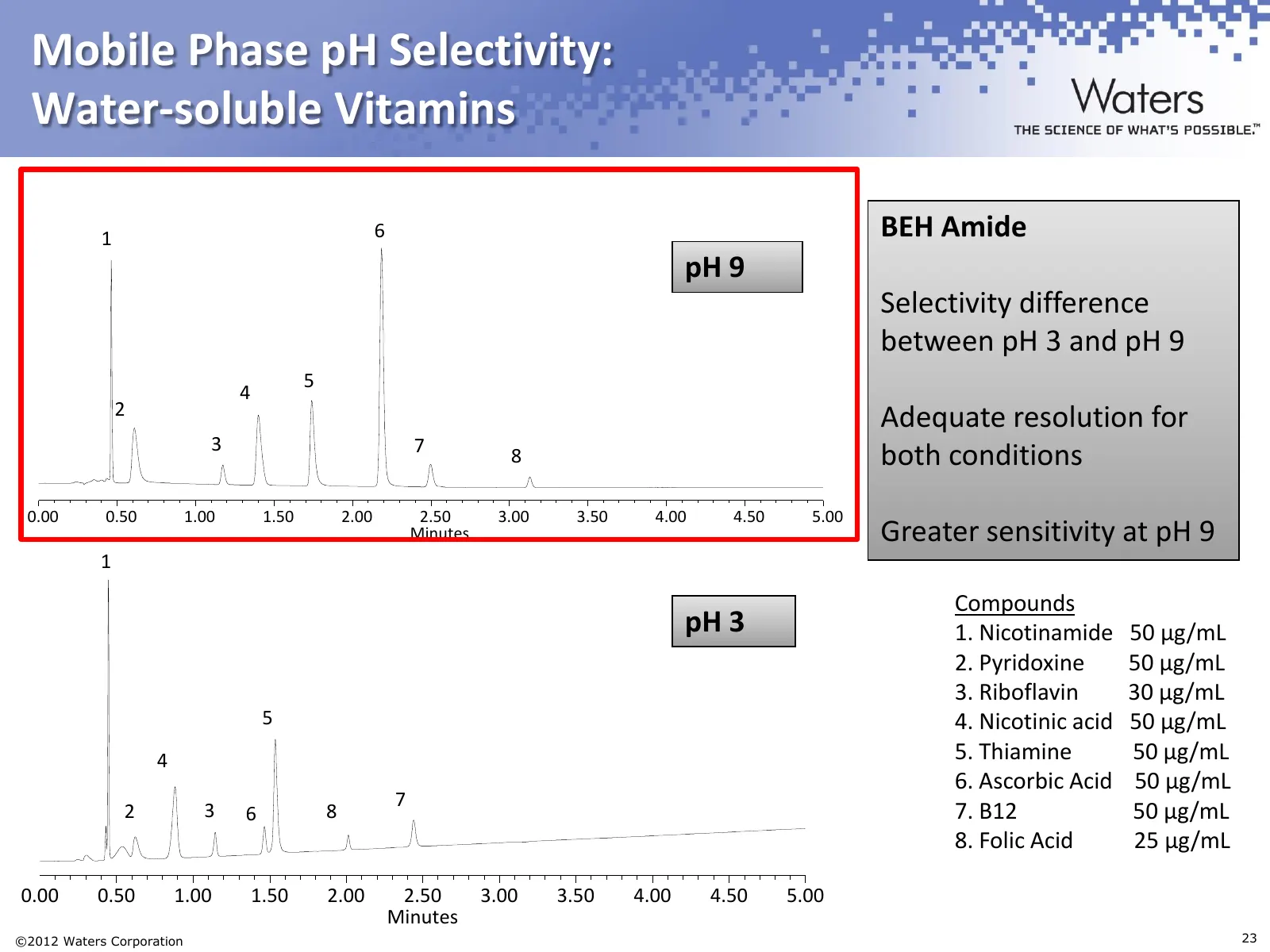
Slide 23: Mobile Phase pH Selectivity: Water-soluble Vitamins
Mobile Phase pH Selectivity: Water-soluble Vitamins 1 6 BEH Amide pH 9 Selectivity difference between pH 3 and pH 9 5 4 2 Adequate resolution for 3 7 8 both conditions 0.00 0.50 1.00 1.50 2.00 2.50 3.00 3.50 4.00 4.50 5.00 Minutes Greater sensitivity at pH 9 1 Compounds pH 3 1. Nicotinamide 50 µg/mL
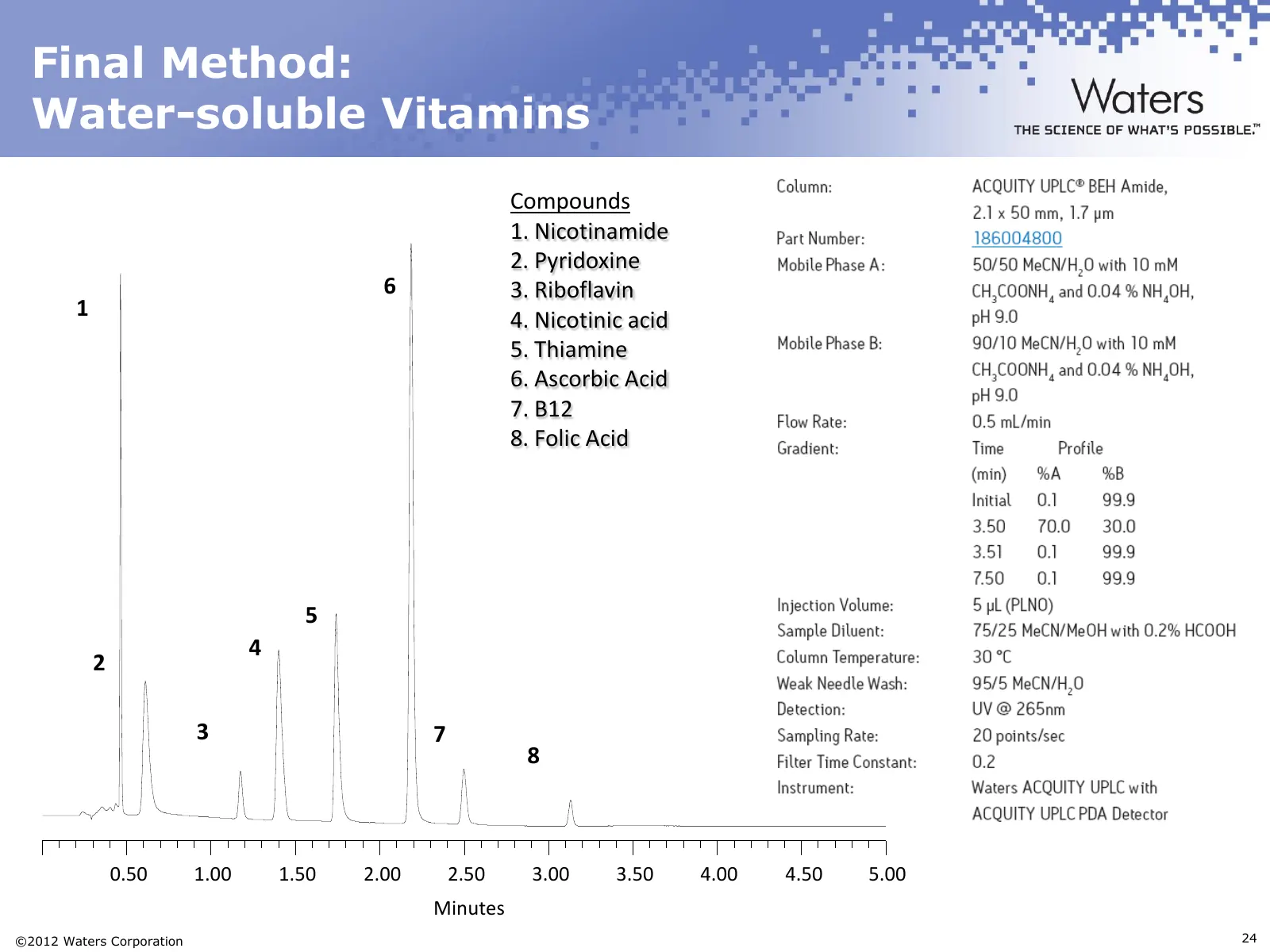
Slide 24: Final Method: Water-soluble Vitamins
Final Method: Water-soluble Vitamins Compounds 1. Nicotinamide 2. Pyridoxine 6 3. Riboflavin 1 4. Nicotinic acid 5. Thiamine 6. Ascorbic Acid 7. B12 8. Folic Acid 5 4 2 3 7 8 0.50 1.00 1.50 2.00 2.50 3.00 3.50 4.00 4.50 5.00 Minutes ©2012 Waters Corporation 24
Slide 25: Summary
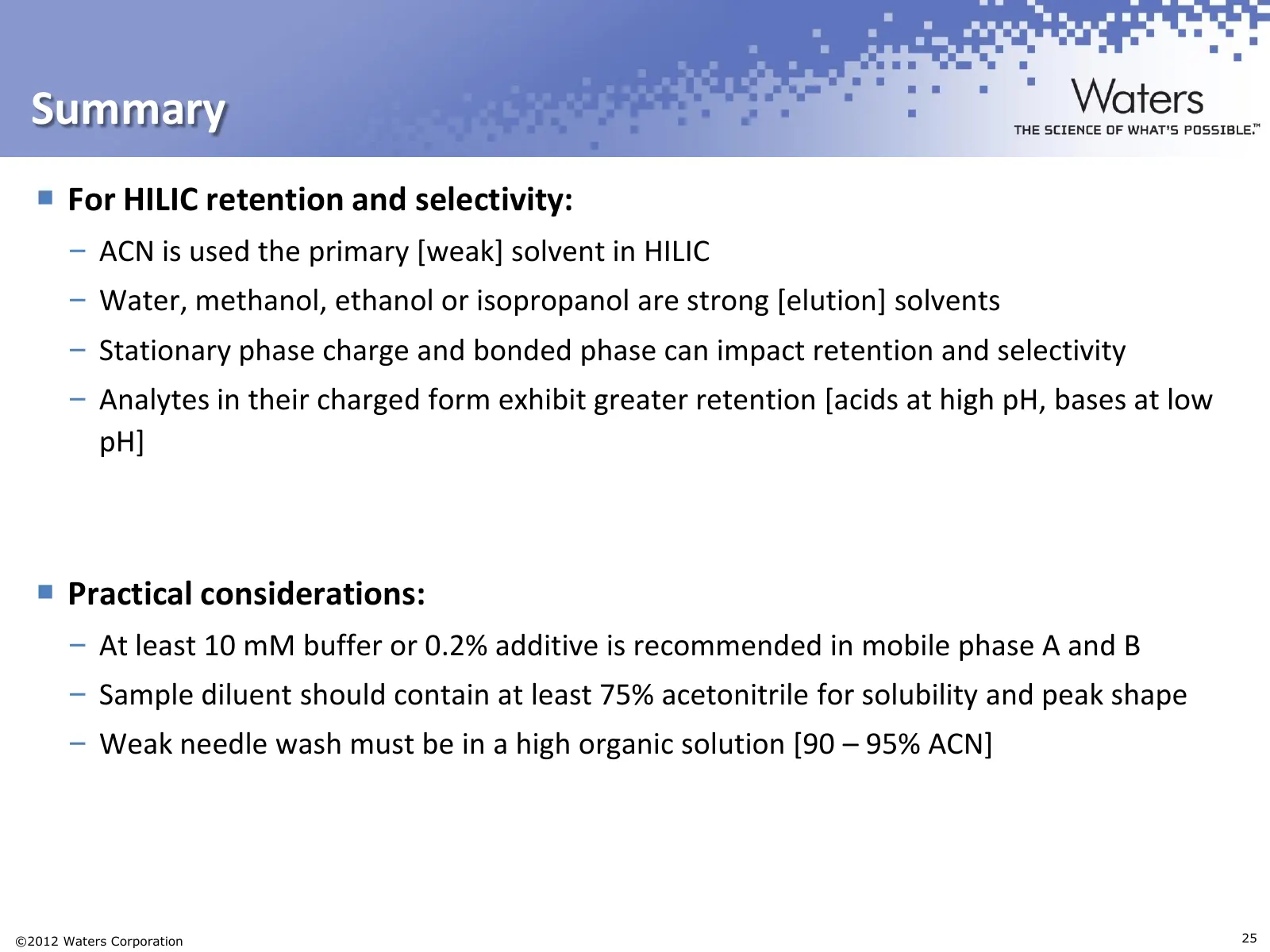
Summary For HILIC retention and selectivity: – ACN is used the primary [weak] solvent in HILIC – Water, methanol, ethanol or isopropanol are strong [elution] solvents – Stationary phase charge and bonded phase can impact retention and selectivity – Analytes in their charged form exhibit greater re
Slide 26: Overview
Overview Overview of HILIC Retention mechanisms and characteristics Practical considerations Implementing the Approach: Water Soluble Vitamins What is the Amide Chemistry Hilic Amide – Carbohydrate Analysis Further Application examples ©2012 Waters Corporation 26
Slide 27: Typical Chromatographic Analysis
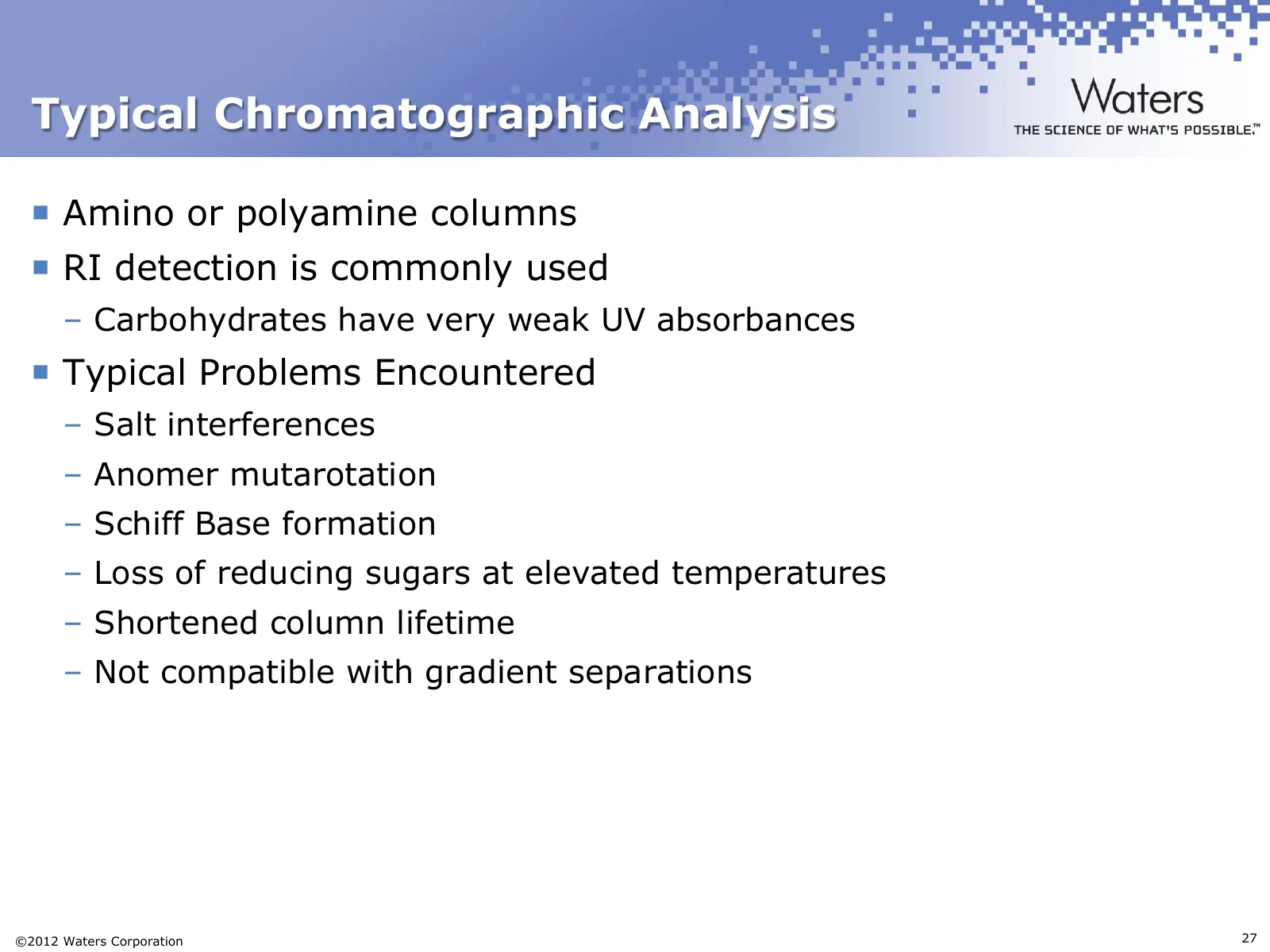
Typical Chromatographic Analysis Amino or polyamine columns RI detection is commonly used – Carbohydrates have very weak UV absorbances Typical Problems Encountered – Salt interferences – Anomer mutarotation – Schiff Base formation – Loss of reducing sugars at elevated temperatures – Shortened
Slide 28: Sample Preparation
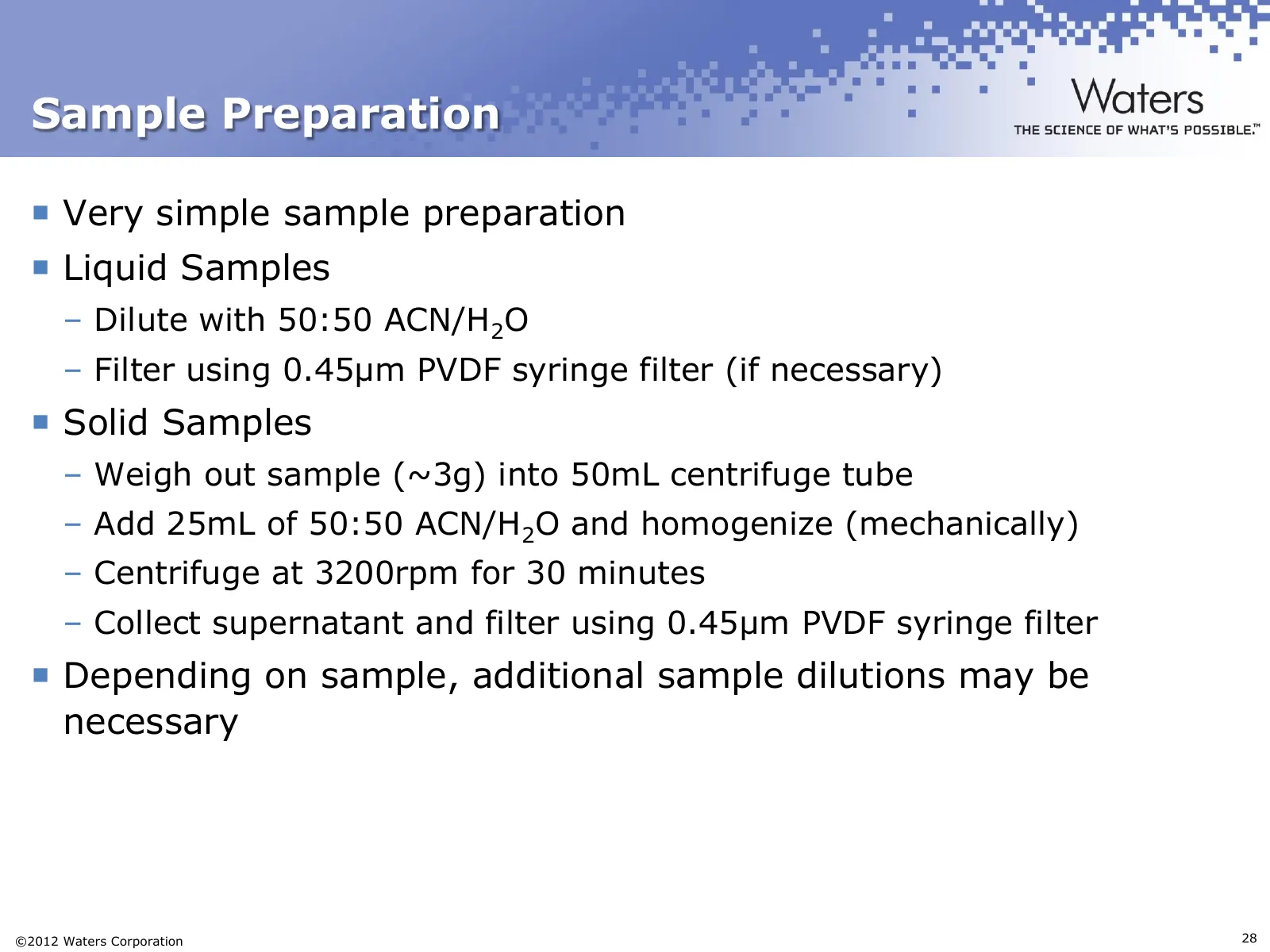
Sample Preparation Very simple sample preparation Liquid Samples – Dilute with 50:50 ACN/H2O – Filter using 0.45µm PVDF syringe filter (if necessary) Solid Samples – Weigh out sample (~3g) into 50mL centrifuge tube – Add 25mL of 50:50 ACN/H2O and homogenize (mechanically) – Centrifuge at 3200r
Slide 29: Carbohydrate Methods Gradient Conditions
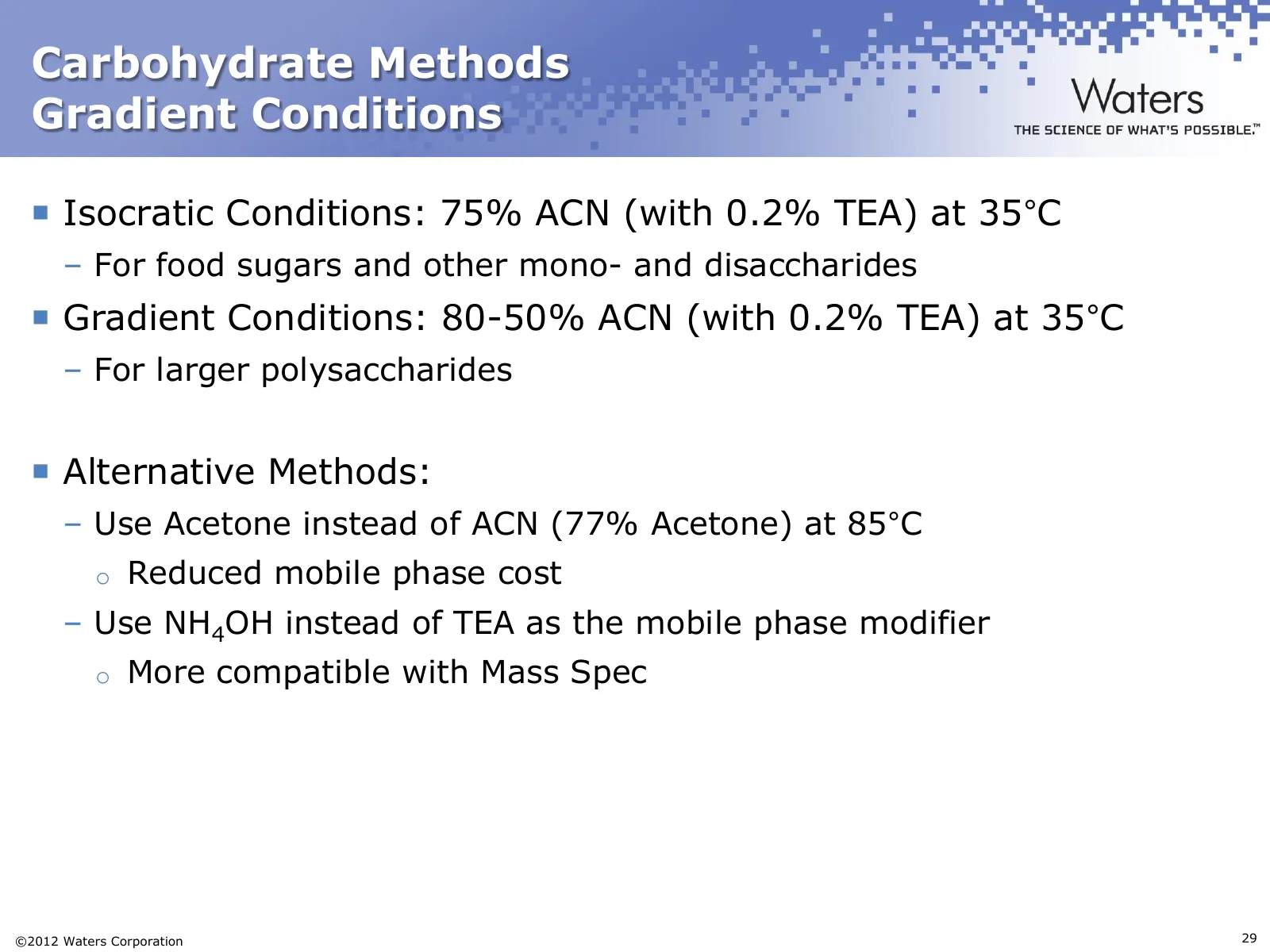
Carbohydrate Methods Gradient Conditions Isocratic Conditions: 75% ACN (with 0.2% TEA) at 35°C – For food sugars and other mono- and disaccharides Gradient Conditions: 80-50% ACN (with 0.2% TEA) at 35°C – For larger polysaccharides Alternative Methods: – Use Acetone instead of ACN (77% Acetone
Slide 30: Stability Testing in ACN
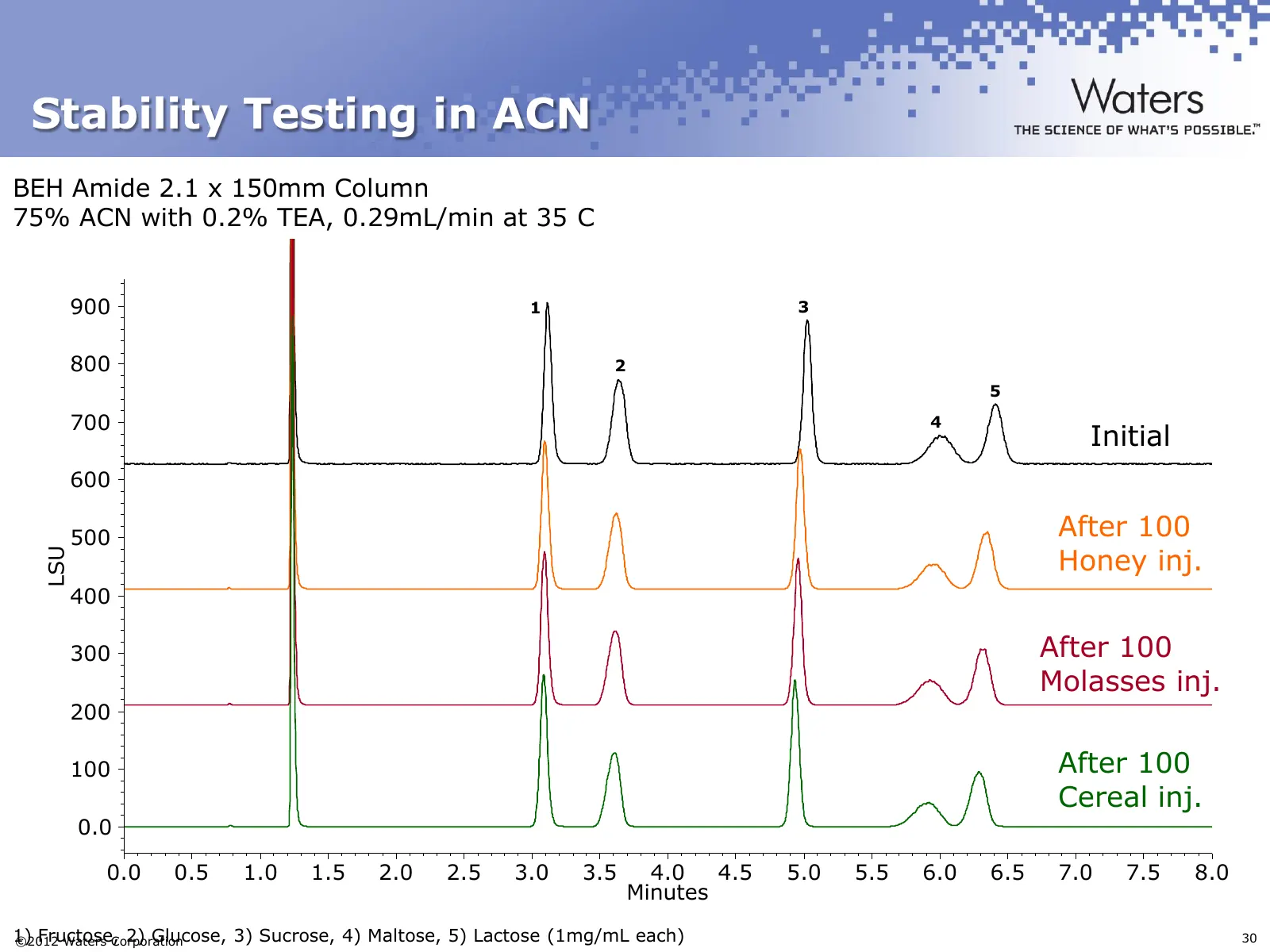
Stability Testing in ACN BEH Amide 2.1 x 150mm Column 75% ACN with 0.2% TEA, 0.29mL/min at 35 C 900 1 3 800 2 5 700 4 Initial 600 500 After 100 Honey inj. LSU 400 300 After 100 Molasses inj. 200 100 After 100 Cereal inj. 0.0 0.0 0.5 1.0 1.5 2.0 2.5 3.0 3.5 4.0 4.5 5.0 5.5 6.0 6.5 7.0 7.5 8.0 Minutes
Slide 31: Salt Interferences
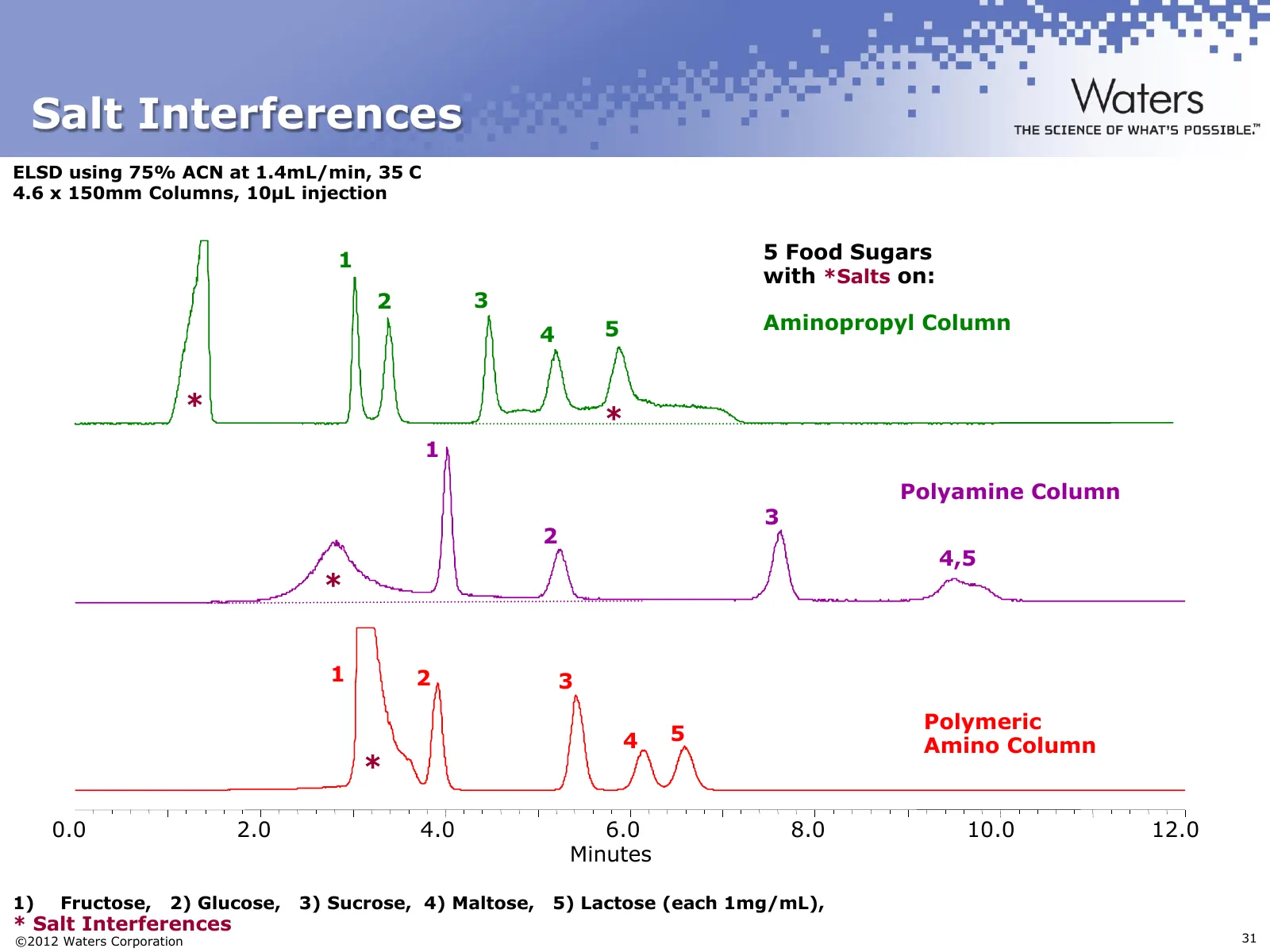
Salt Interferences ELSD using 75% ACN at 1.4mL/min, 35 C 4.6 x 150mm Columns, 10µL injection 1 5 Food Sugars with *Salts on: 2 3 5 Aminopropyl Column 4 * * 1 Polyamine Column 3 2 4,5 * 1 2 3 Polymeric 4 5 Amino Column * 0.0 2.0 4.0 6.0 8.0 10.0 12.0 Minutes 1) Fructose, 2) Glucose, 3) Sucrose, 4) Ma
Slide 32: Salt Interferences
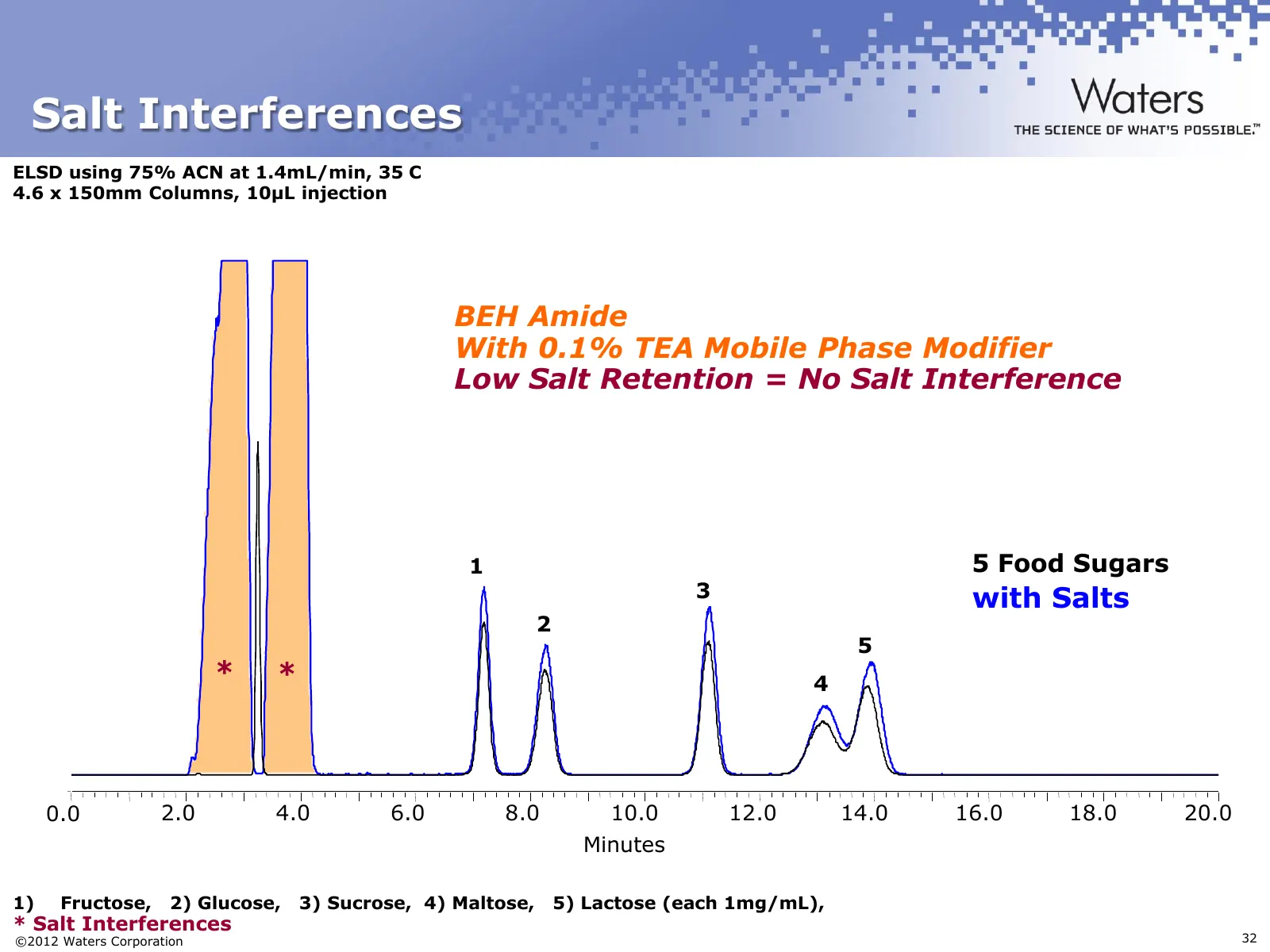
Salt Interferences ELSD using 75% ACN at 1.4mL/min, 35 C 4.6 x 150mm Columns, 10µL injection BEH Amide With 0.1% TEA Mobile Phase Modifier Low Salt Retention = No Salt Interference 1 5 Food Sugars 3 with Salts 2 5 * * 4 0.0 2.0 4.0 6.0 8.0 10.0 12.0 14.0 16.0 18.0 20.0 Minutes 1) Fructose, 2) Glucos
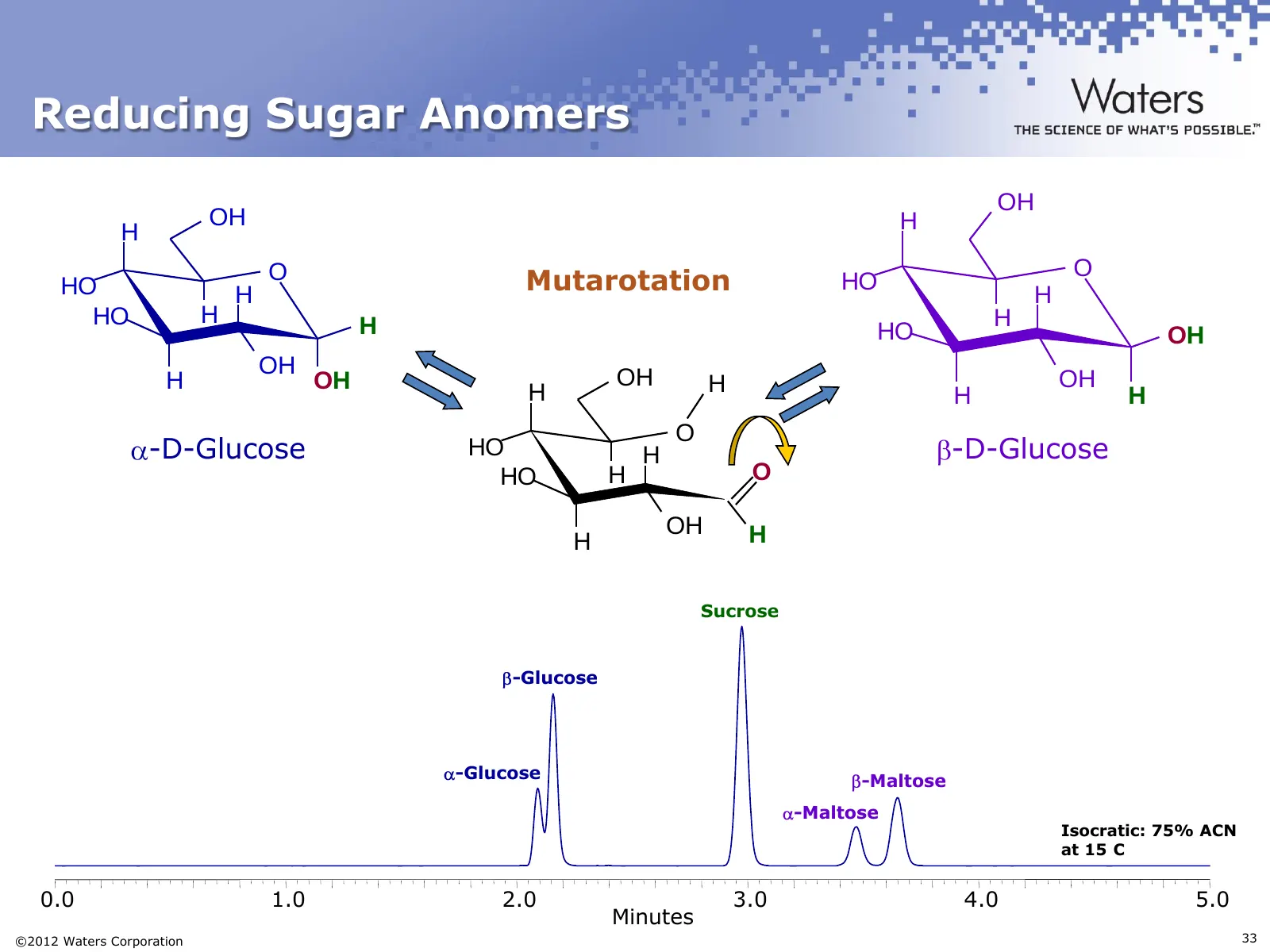
Slide 33: Reducing Sugar Anomers
Reducing Sugar Anomers OH OH H H O HO H O Mutarotation HO H HO H H H HO OH OH OH H OH H OH H H H O -D-Glucose HO H -D-Glucose HO H OH H OHO O H H HO OH HO H H O Sucrose -Glucose -Glucose -Maltose -Maltose Isocratic: 75% ACN at 15 C 0.0 1.0 2.0 3.0 4.0 5.0 Minutes ©2012 Waters Corporation 33
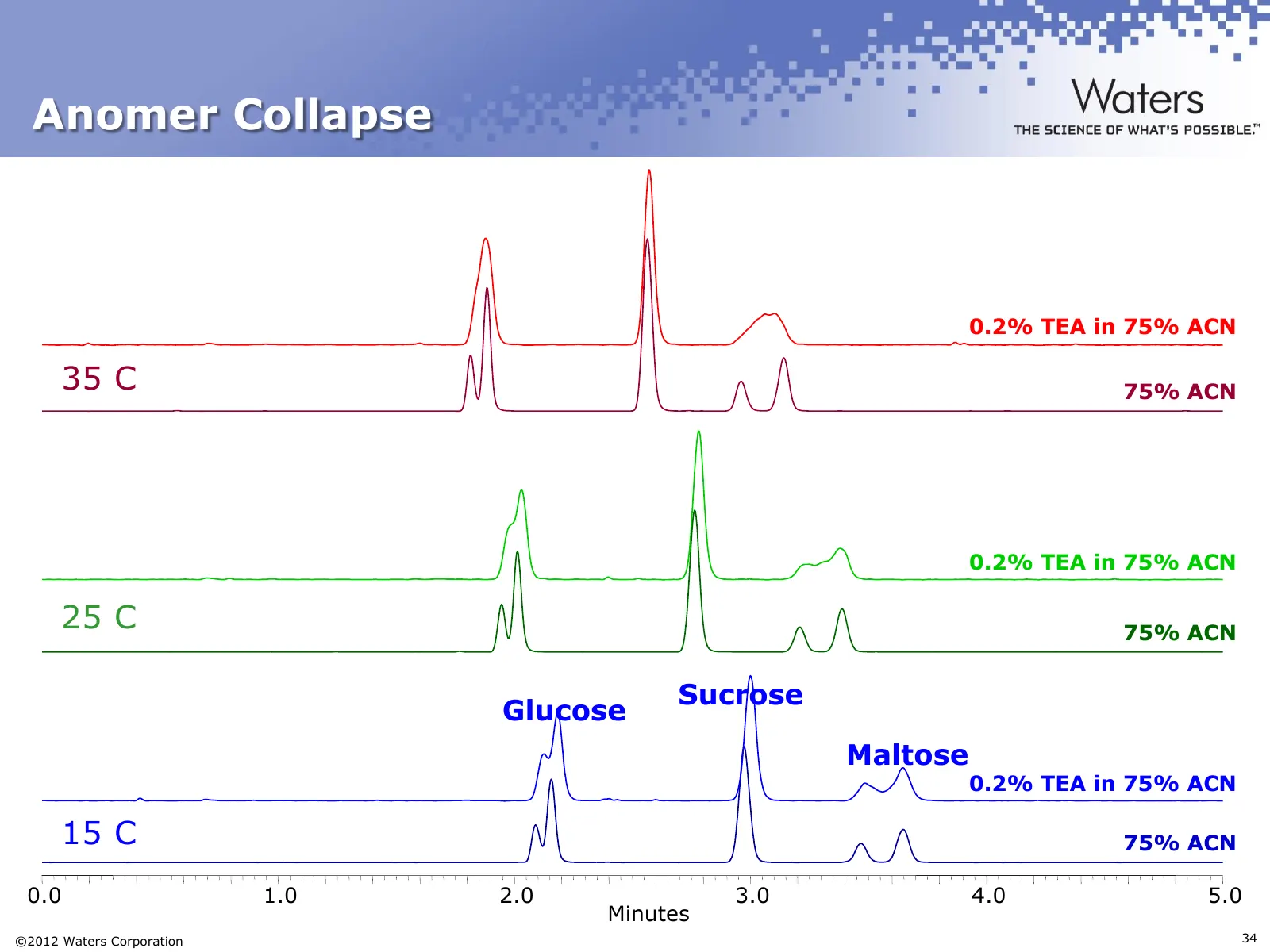
Slide 34: Anomer Collapse
Anomer Collapse 0.2% TEA in 75% ACN 35 C 75% ACN 0.2% TEA in 75% ACN 25 C 75% ACN Sucrose Glucose Maltose 0.2% TEA in 75% ACN 15 C 75% ACN 0.0 1.0 2.0 3.0 4.0 5.0 Minutes ©2012 Waters Corporation 34
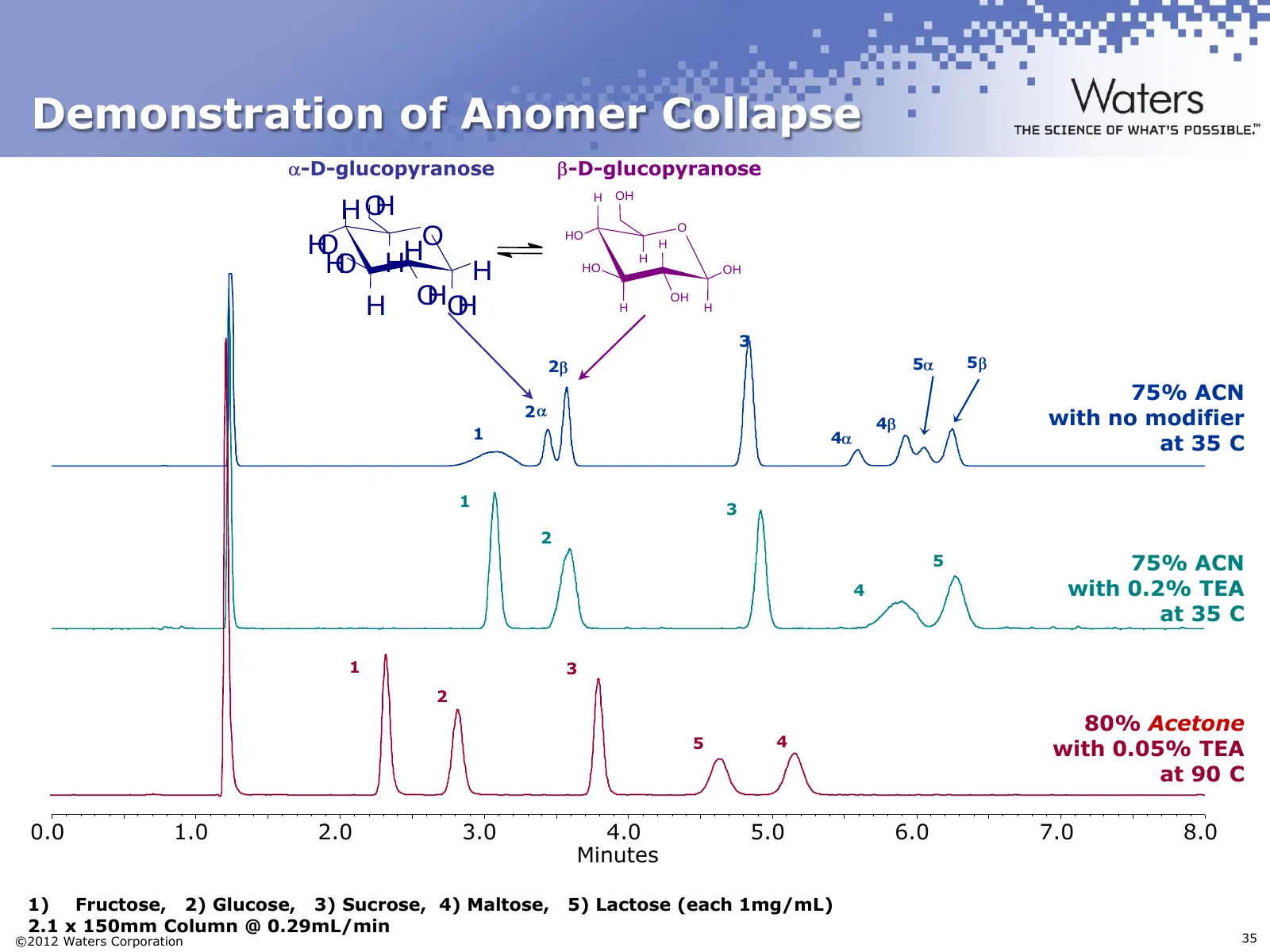
Slide 35: Demonstration of Anomer Collapse
Demonstration of Anomer Collapse -D-glucopyranose -D-glucopyranose H OH H OH O HO O HO HO HH H H H HO OH H OHOH H OH H 3 2 5 5 75% ACN 2 4 with no modifier 1 4 at 35 C 1 3 2 5 75% ACN 4 with 0.2% TEA at 35 C 1 3 2 80% Acetone 5 4 with 0.05% TEA at 90 C 0.0 1.0 2.0 3.0 4.0 5.0 6.0 7.0 8.0 Minutes 1)
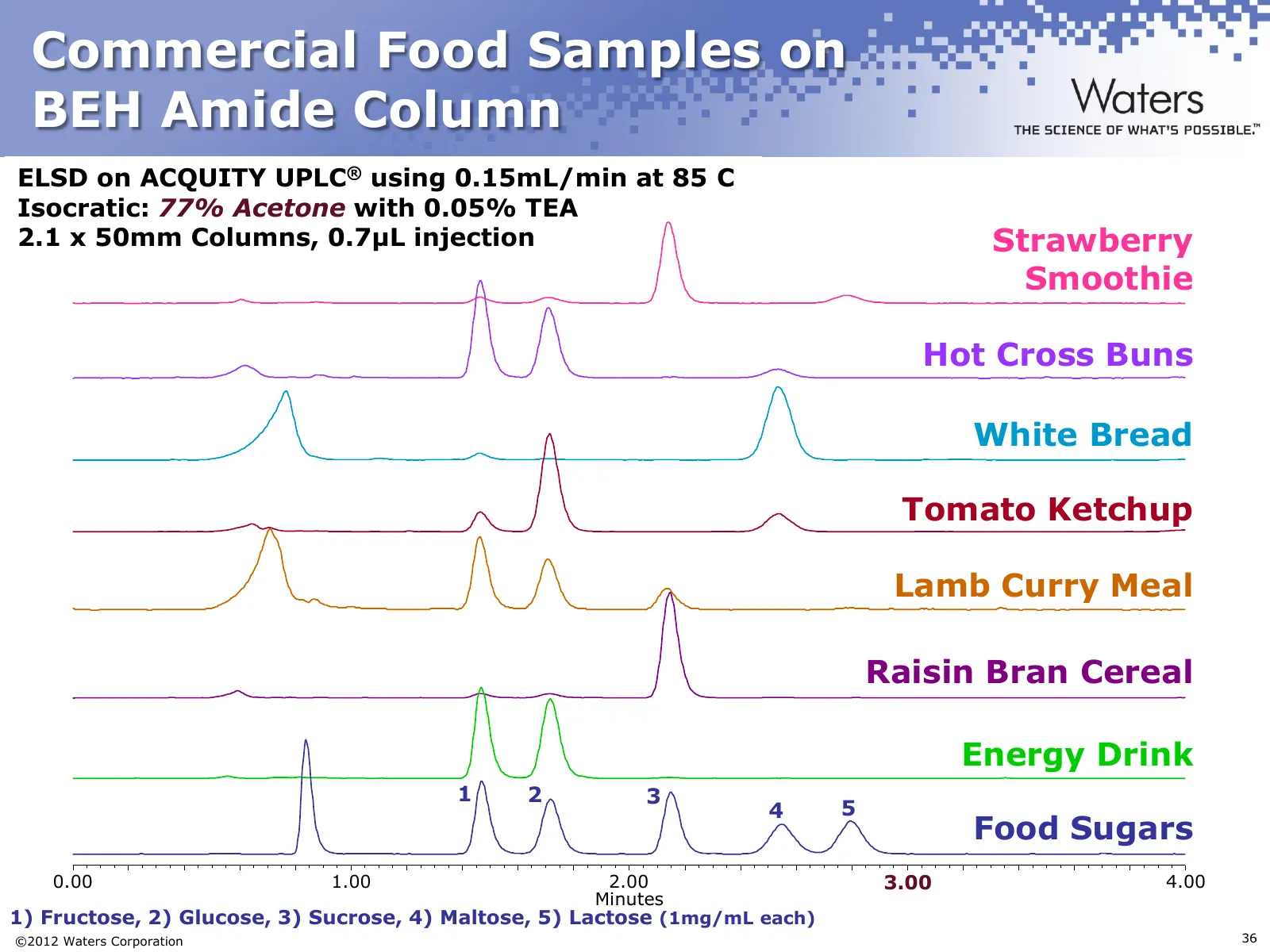
Slide 36: Commercial Food Samples on BEH Amide Column
Commercial Food Samples on BEH Amide Column ELSD on ACQUITY UPLC® using 0.15mL/min at 85 C Isocratic: 77% Acetone with 0.05% TEA 2.1 x 50mm Columns, 0.7µL injection Strawberry Smoothie Hot Cross Buns White Bread Tomato Ketchup Lamb Curry Meal Raisin Bran Cereal Energy Drink 1 2 3 4 5 Food Sugars 0.0
Slide 37: Analysis of Beer
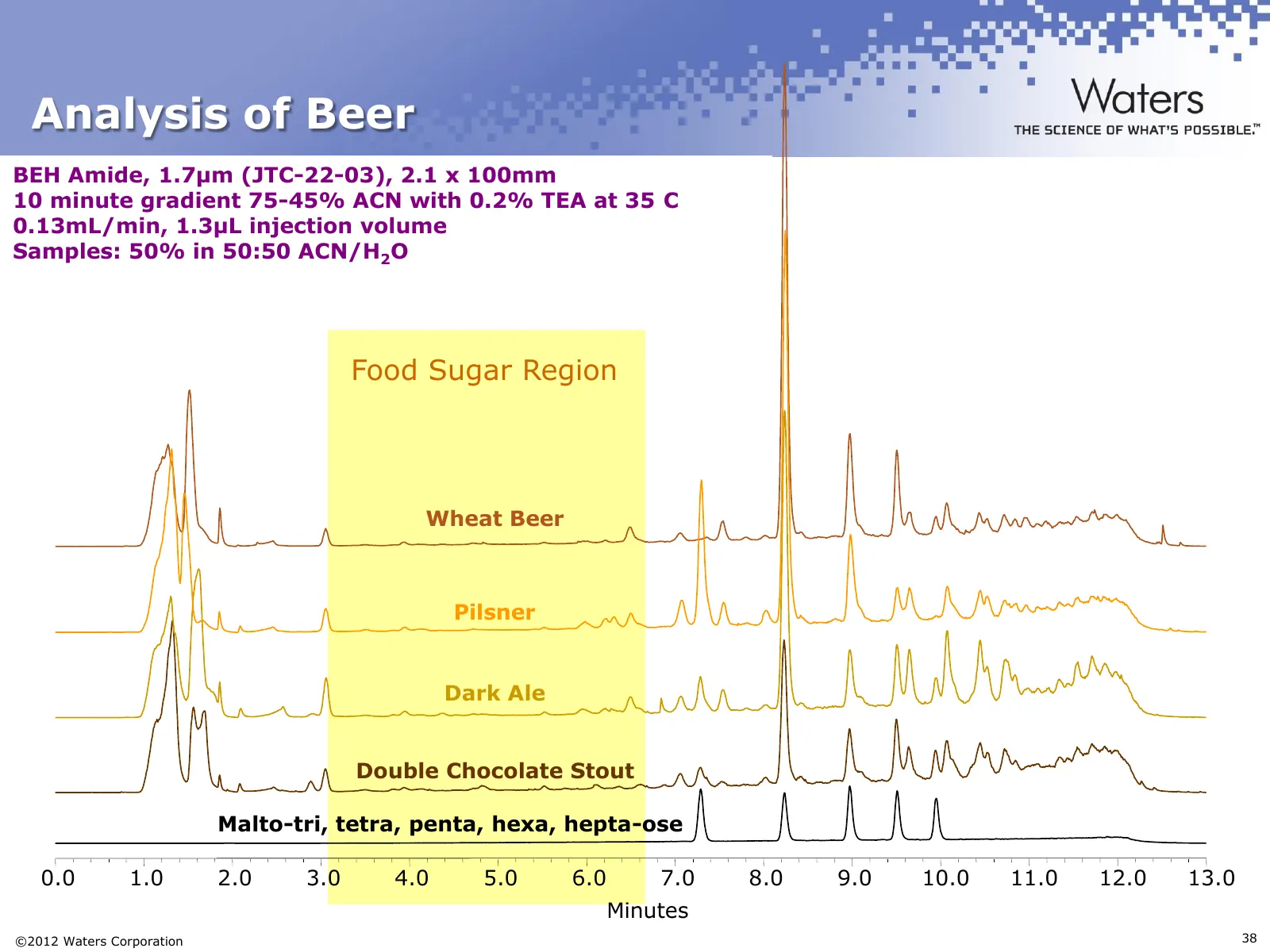
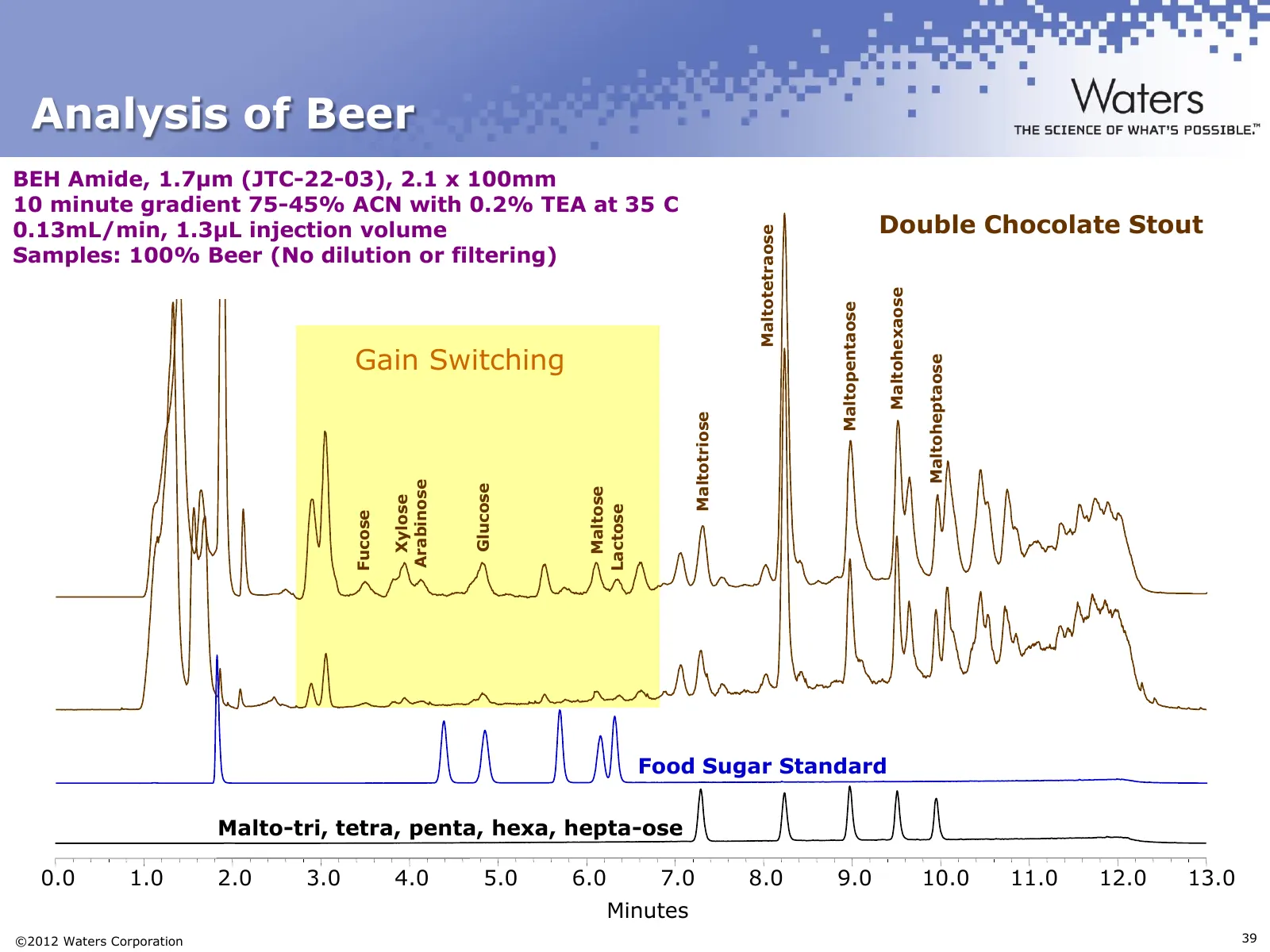
Analysis of Beer Beer is made, in part, with malted barley. When the barley malt is first cooked in the brewing process, the resulting liquid contains maltose, other simple sugars and larger, more complex carbohydrates. During fermentation, yeast consumes the sugars, converting them to alcohol and
Slide 38: Analysis of Beer
Analysis of Beer BEH Amide, 1.7µm (JTC-22-03), 2.1 x 100mm 10 minute gradient 75-45% ACN with 0.2% TEA at 35 C 0.13mL/min, 1.3µL injection volume Samples: 50% in 50:50 ACN/H2O Food Sugar Region Wheat Beer Pilsner Dark Ale Double Chocolate Stout Malto-tri, tetra, penta, hexa, hepta-ose 0.0 1.0 2.0 3.
Slide 39: Analysis of Beer
Analysis of Beer BEH Amide, 1.7µm (JTC-22-03), 2.1 x 100mm 10 minute gradient 75-45% ACN with 0.2% TEA at 35 C 0.13mL/min, 1.3µL injection volume Double Chocolate Stout Maltotetraose Samples: 100% Beer (No dilution or filtering) Maltohexaose Maltopentaose Gain Switching Maltoheptaose Maltotriose Ara
Slide 40: Summary
Summary The BEH particle technology provides a stable and robust substrate for the trifunctional amide bonding, – provides extended column lifetime under a wide variety of conditions (temperature & pH) – Anomer peaks arising from reducing sugars can be collapsed into a single peak by using either
Slide 41: The ACQUITY BEH Method Selector Tool: ACQUITY UPLC BEH Amide Column
The ACQUITY BEH Method Selector Tool: ACQUITY UPLC® BEH Amide Column
Slide 42: Welcome to the ACQUITY BEH Amide Method Selection Tool
a a a om «(VC aters THE SCIENCE OF WHAT'S POSSIBLE. Skip Intro Welcome to the ACQUITY BEH Amide Method Selection Tool
Slide 43: Step 1 Select Column Dimensions
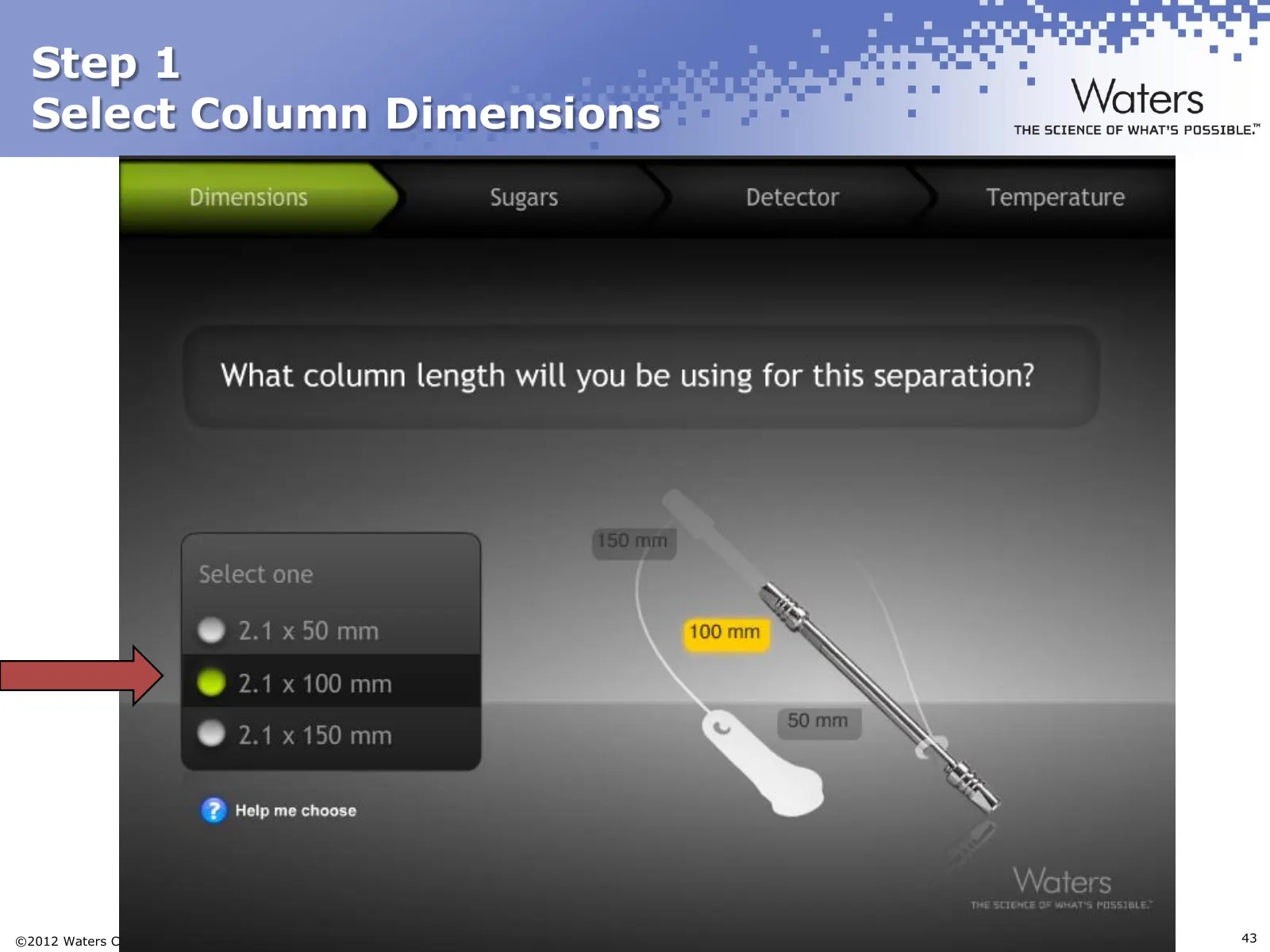
Step 1 Select Column Dimensions ©2012 Waters Corporation 43
Slide 44: Step 1 Select Column Dimensions
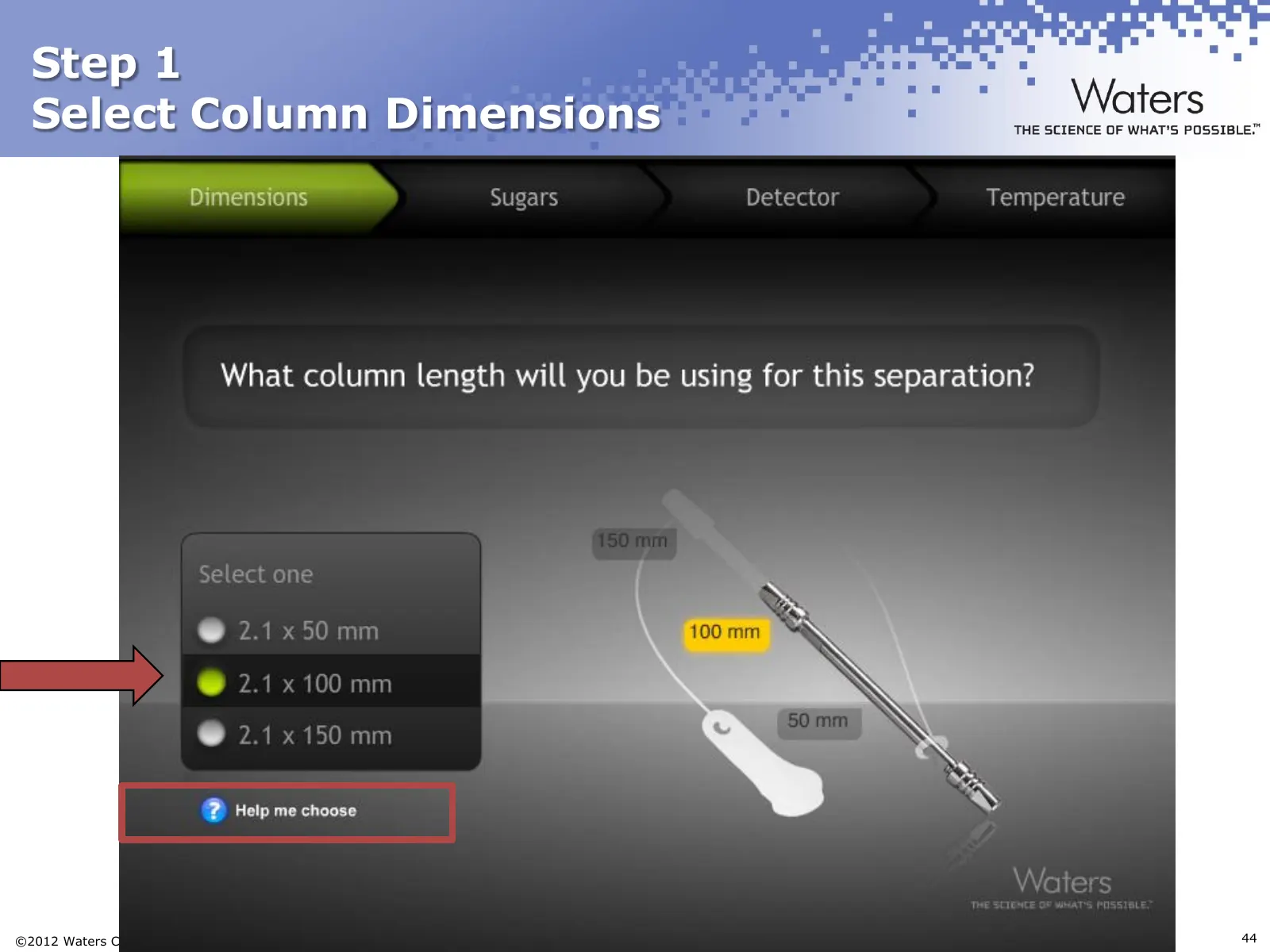
Step 1 Select Column Dimensions ©2012 Waters Corporation 44
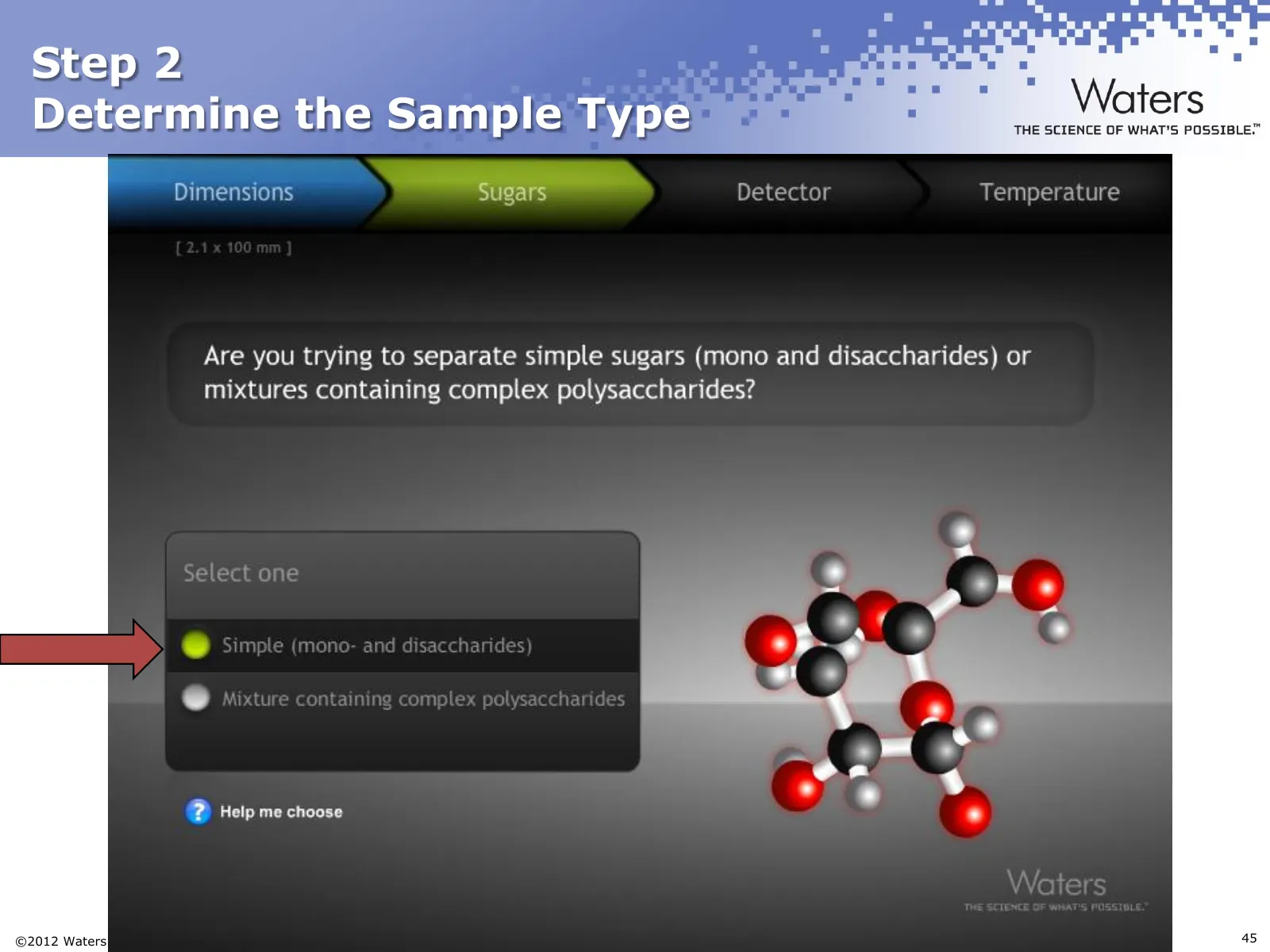
Slide 45: Step 2 Determine the Sample Type
Step 2 Determine the Sample Type ©2012 Waters Corporation 45
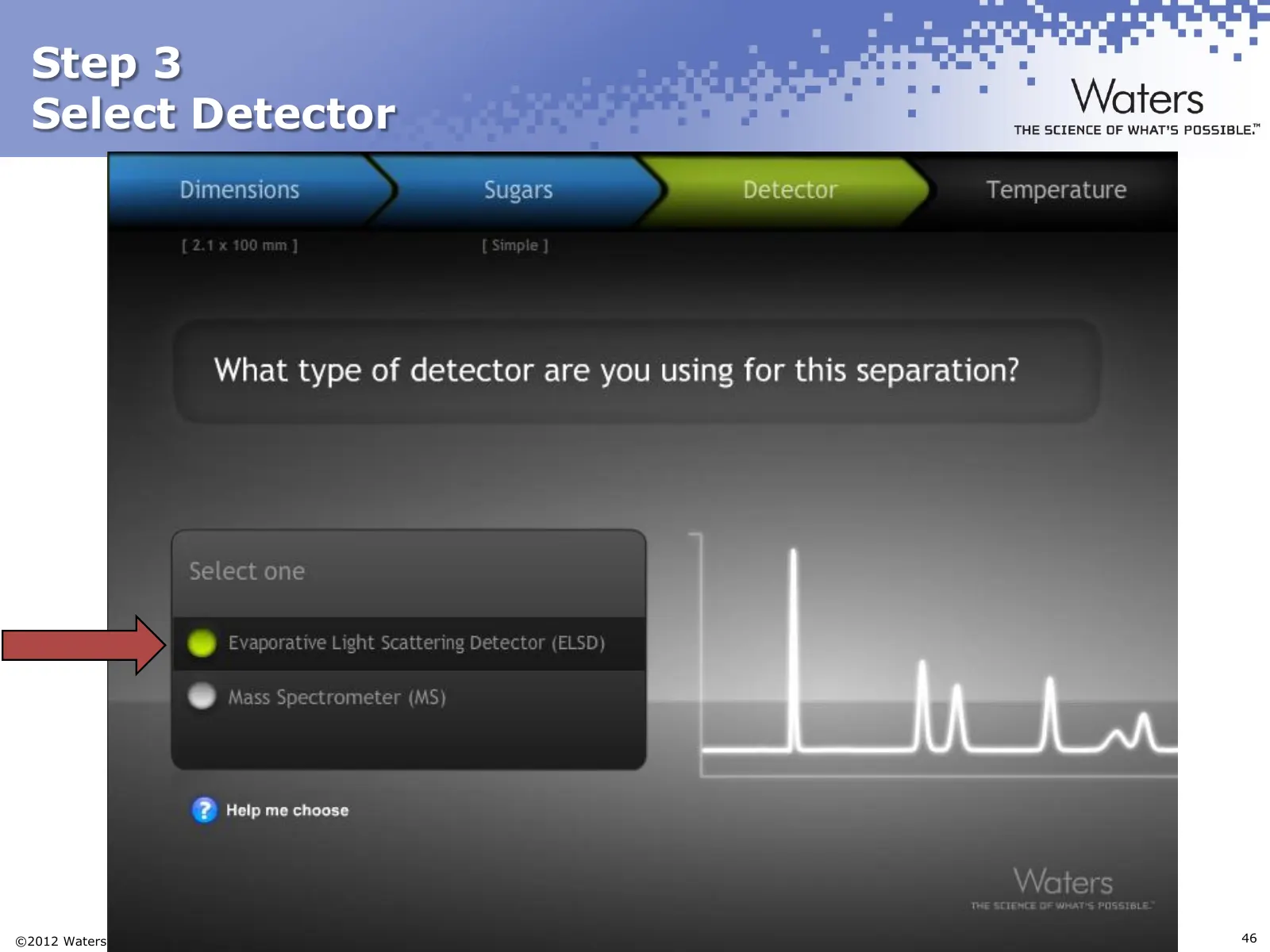
Slide 46: Step 3 Select Detector
Step 3 Select Detector ©2012 Waters Corporation 46
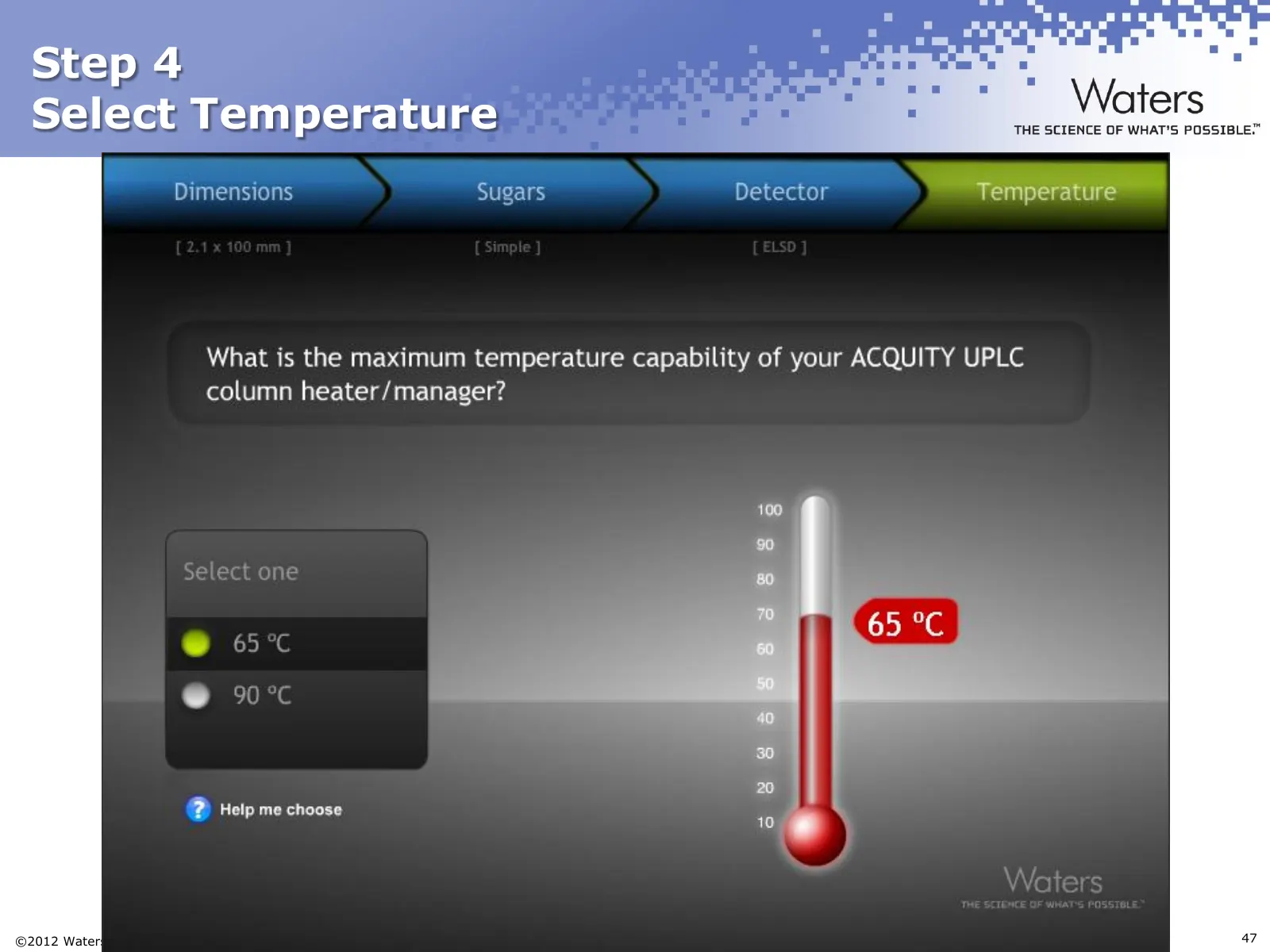
Slide 47: Step 4 Select Temperature
Step 4 Select Temperature ©2012 Waters Corporation 47
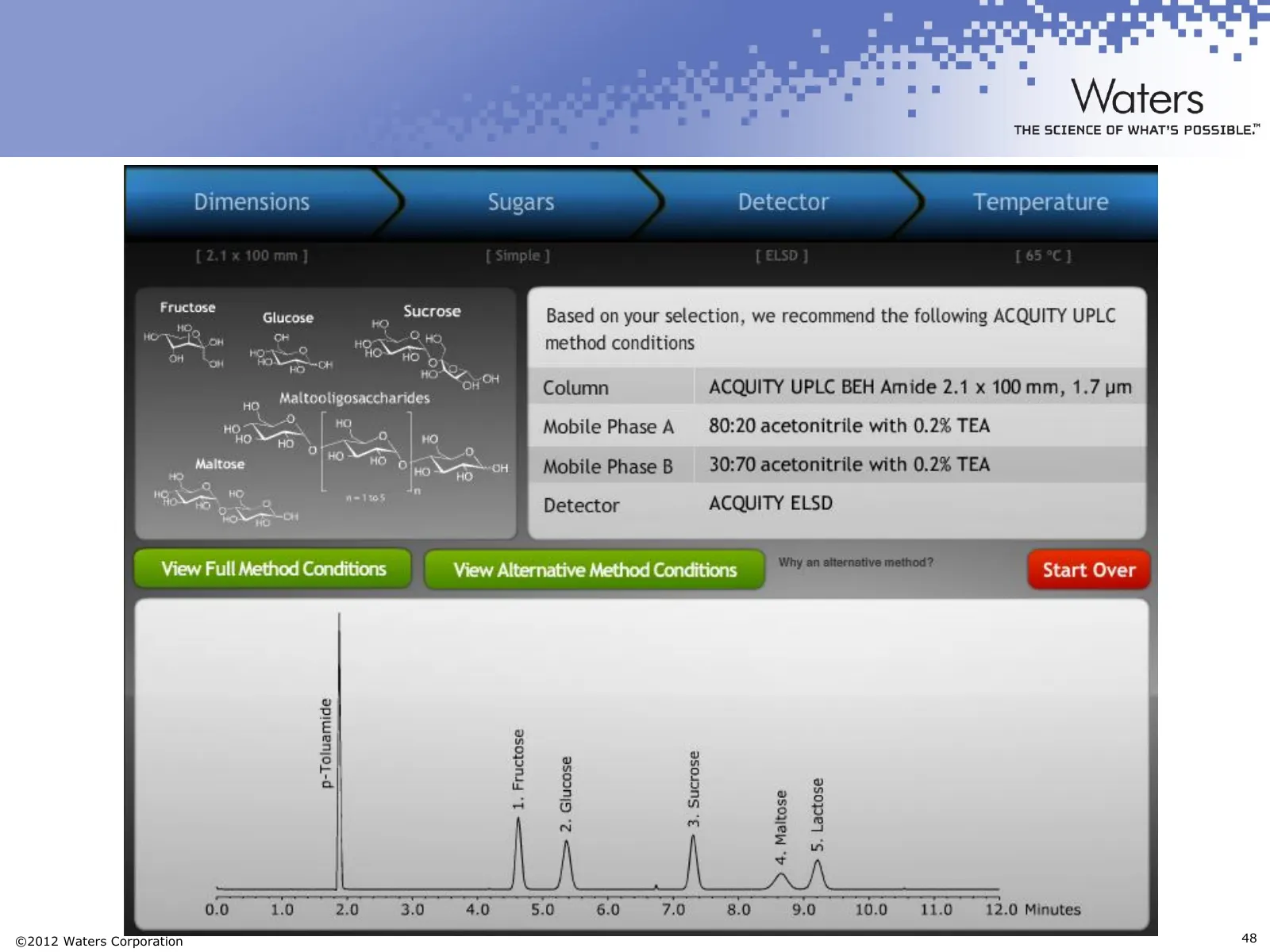
Slide 48: Recommended ACQUITY UPLC method conditions
Waters THE SCIENCE OF WHAT'S POSSIBLE.” Based on your selection, we recommend the following ACQUITY UPLC Fructose Glucose method conditions Column ACQUITY UPLC BEH Amide 2.1 x 100 mm, 1.7 um Mobile Phase A _—-80:20 acetonitrile with 0.2% TEA Mobile Phase B —_30:70 acetonitrile with 0.2% TEA Detector
Slide 49: Overview
Overview Overview of HILIC Retention mechanisms and characteristics Practical considerations Implementing the Approach: Water Soluble Vitamins What is the Amide Chemistry Hilic Amide – Carbohydrate Analysis Further Application examples ©2012 Waters Corporation 49
Slide 50: Quality Control checks
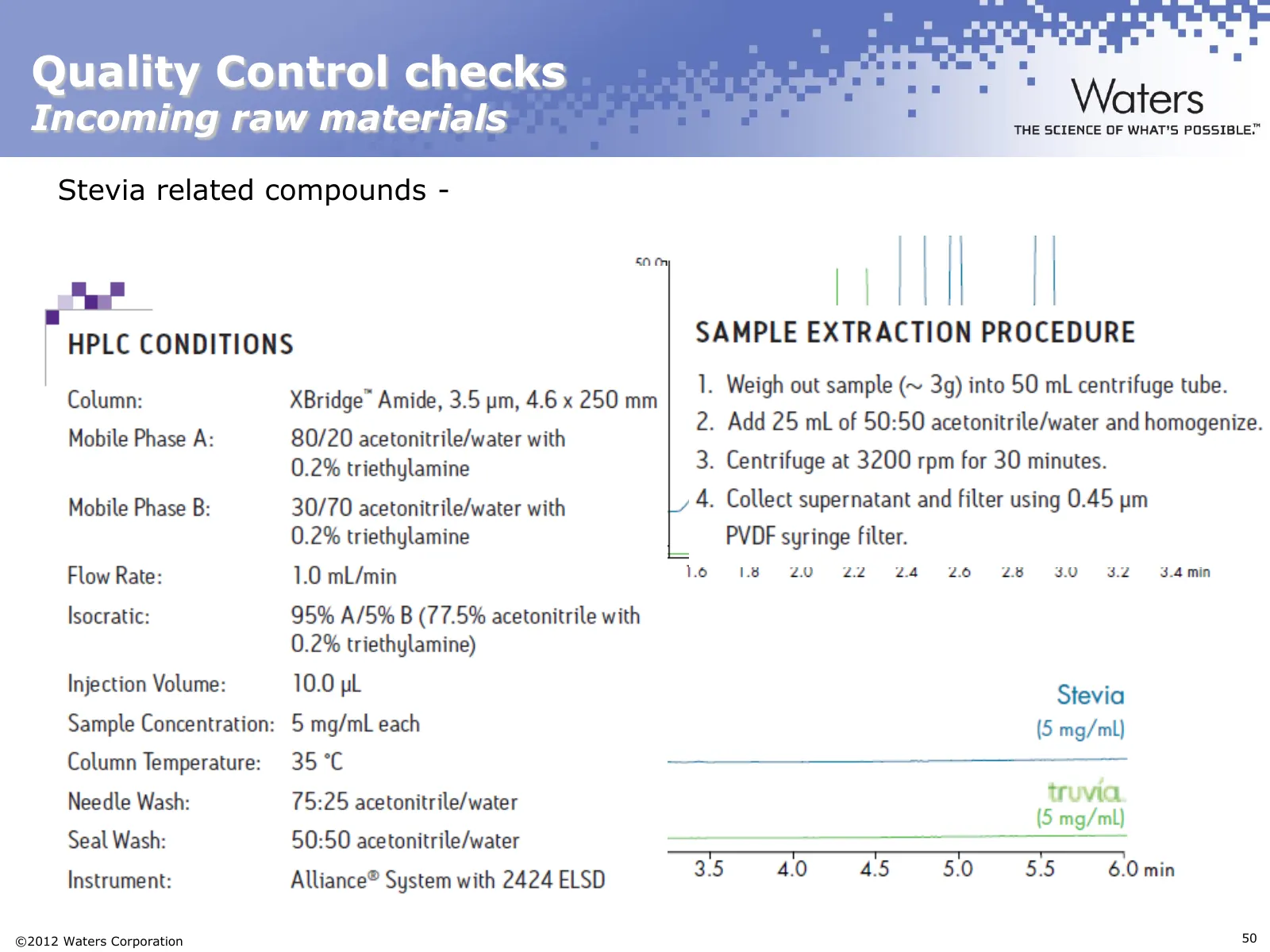
Quality Control checks Incoming raw materials Stevia related compounds - ©2012 Waters Corporation 50
Slide 51: Ascorbic acid and Isoascorbic acid
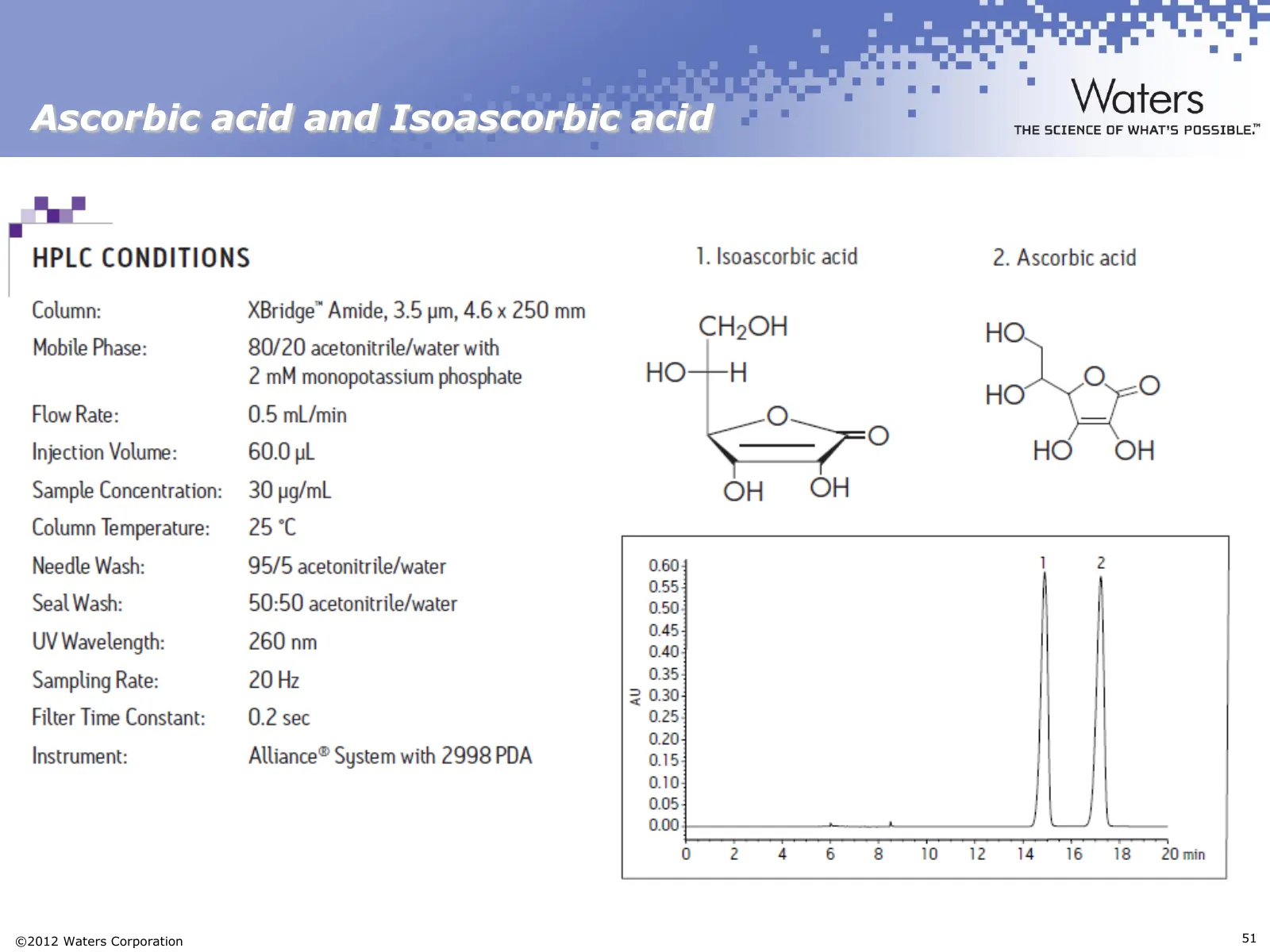
Ascorbic acid and Isoascorbic acid ©2012 Waters Corporation 51
Slide 52: Water Soluble Vitamins
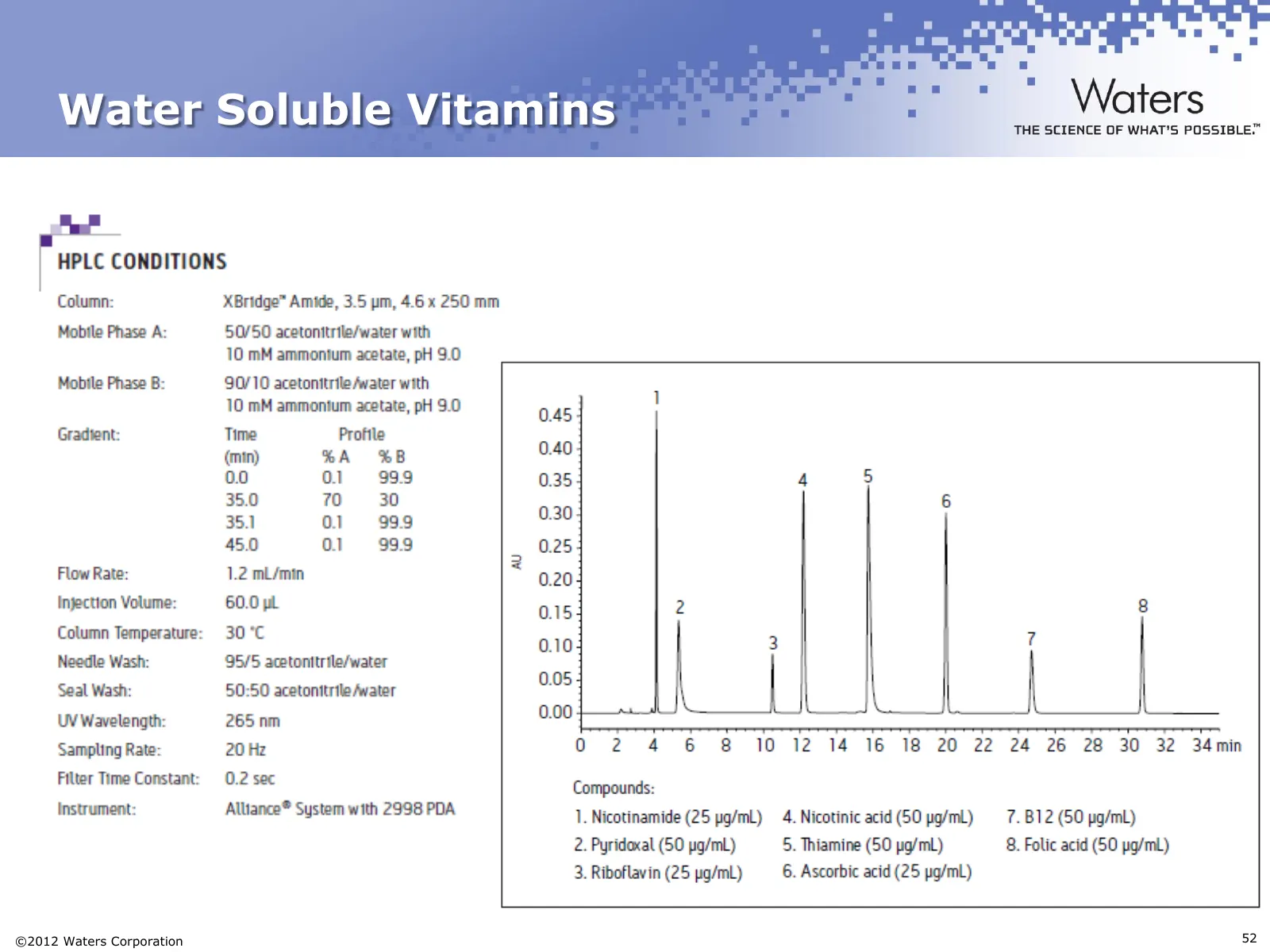
Water Soluble Vitamins ©2012 Waters Corporation 52

Slide 53: Thank You?
Thank You? ©2012 Waters Corporation 53
Source: Internet Archive copy of waters.com
More decks from Waters Corporation
 Q3 2026 Earnings Presentation30 slides · Nov 3, 2026
 Q2 2026 Earnings Presentation33 slides · Aug 4, 2026
 Q1 2026 Earnings Presentation29 slides · May 5, 2026
 Q4 2025 Earnings Presentation22 slides · Feb 9, 2026
 J.P. Morgan 44th Annual Healthcare Conference (January 2026)29 slides · Jan 12, 2026
 J.P. Morgan 43rd Annual Healthcare Conference (November 2025)38 slides · Nov 11, 2025