DiaMedica Therapeutics Inc. · NASDAQ:DMAC
DiaMedica Therapeutics — Technical Presentation (November 2026)
47 slides from DiaMedica Therapeutics's technical presentation, Nov 24, 2026

Slide 1: Key Opinion Leader Event: The Potential of DM199 to Treat Fetal Growth Restriction
x KEY OPINION LEADER EVENT Q The Potential of DM199 to aligg Fetal Growth Restricti Topline Clinical Data November 202
Slide 2: Cautionary Note Regarding Forward-Looking Statements
Cautionary Note Regarding Forward-Looking Statements 2g DiaMedica

Slide 3: Today's Speakers
Today's Speakers a @~ Fl Professor Andrew Shennan Professor Sue Walker Unies of Mesbourne od of castes, mecsegy and Water sett tls edn ae i Professor Stephen Tong ners of Metourne Professor Catherine Cluver ‘Stolenbosh Uno Cope Town 1 ezesenshecs nesnaen ALR es 2g DiaMedica
Slide 4: What We'll Cover Today
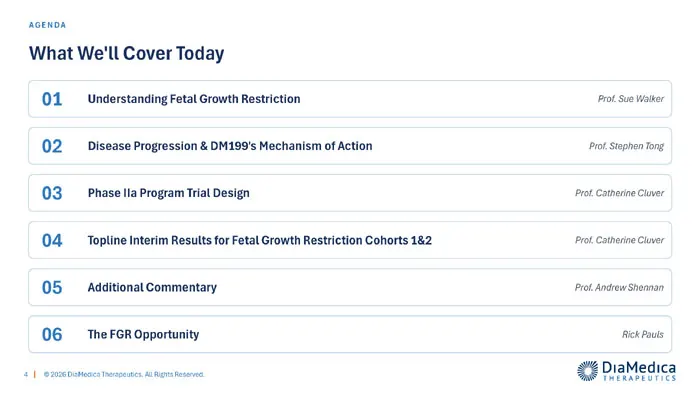
What We'll Cover Today 01 02 03 04 05 06 Understanding Fetal Growth Restriction Disease Progression & DM199's Mechanism of Action Phase lla Program Trial Design Topline interim Results for Fetal Growth Restriction Cohorts 182 Additional Commentary The FGR Opportunity 41 eateosnescs nee Ath es Prot.
Slide 5: Understanding Fetal Growth Restriction
01 Ss s = i} s o cj io o un aly £ Zs i= s s 3 2 o st i= —) c s 2 o 8 n oO oc
Slide 6: Fetal Growth Restriction: Why It Happens and Why It Matters
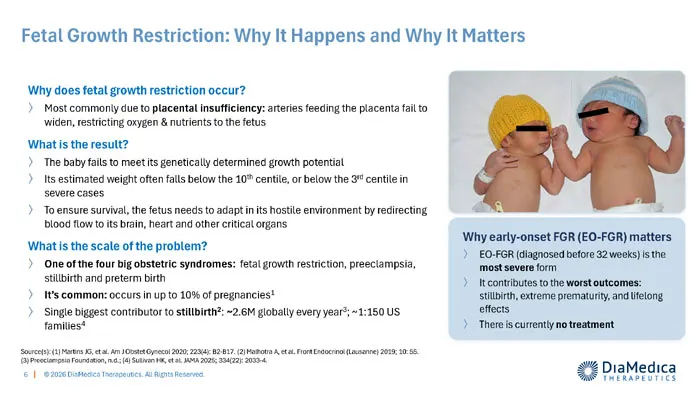
Fetal Growth Restriction: Why It Happens and Why It Matters Why does fetal growth restriction occur? Most commoniy due to placental insuticien ‘widen, restricting orygen & nutrients tothe fetus What is the result? ‘The baby fall to meet its genetically determined growth potential Its estimated weigh
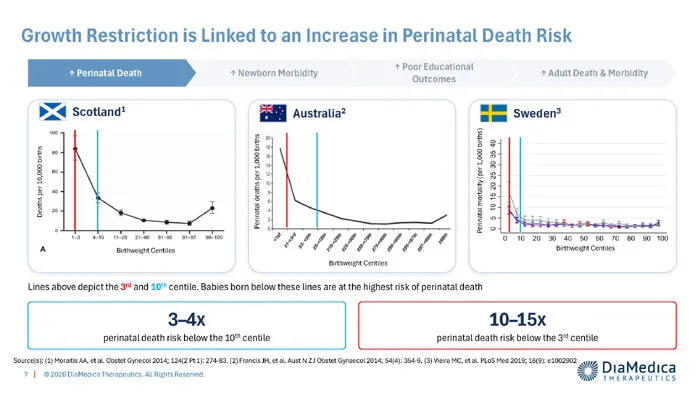
Slide 7: Growth Restriction is Linked to an Increase in Perinatal Death Risk
Growth Restriction is Linked to an Increase in Perinatal Death Risk BZA scottanat BH rusteatoe BEES sweden? evens) eS PPLEELELA ASO Lunes above depiet the and 30° centile, abies born belo thes nes ae at the highest isk of perinatal death sx perinatal deathisk blow the 10 centile 10-15x perinatal dea
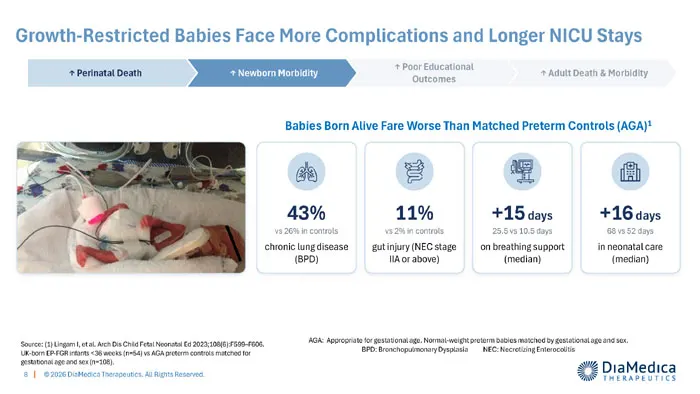
Slide 8: Growth-Restricted Babies Face More Complications and Longer NICU Stays
Growth-Restricted Babies Face More Complications and Longer NICU Stays oe sre eas Babies Born Alive Fare Worse Than Matched Preterm Controls (AGA)* 43% 11% +16 says chen gsnse_en EC ae a oo Haney ror ‘aeenmge see 38) 2g DiaMedica
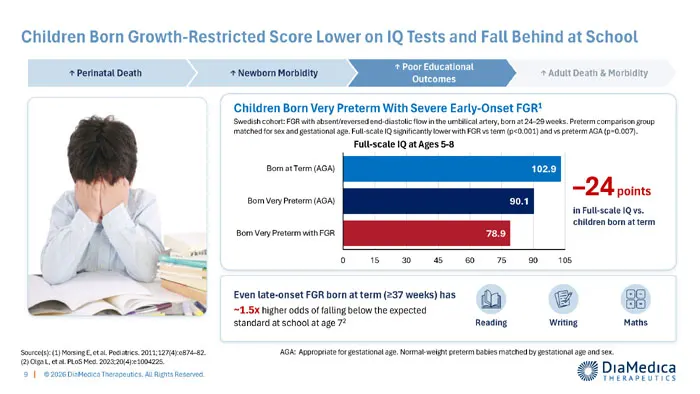
Slide 9: Children Born Growth-Restricted Score Lower on IQ Tests and Fall Behind at School
Children Born Growth-Restricted Score Lower on IQ Tests and Fall Behind at School ‘+ Perinatal Death ‘+ Newborn Moray Children Born Very Preterm With Severe Early-Onset FGR' Fulbscale a at Ages 58 BomatToem (ACA) Boman rotor (AGA EventtoansetFRDomatterm (237 weeksjnas @ 58 ~1.Sxrigher odo alingbetow
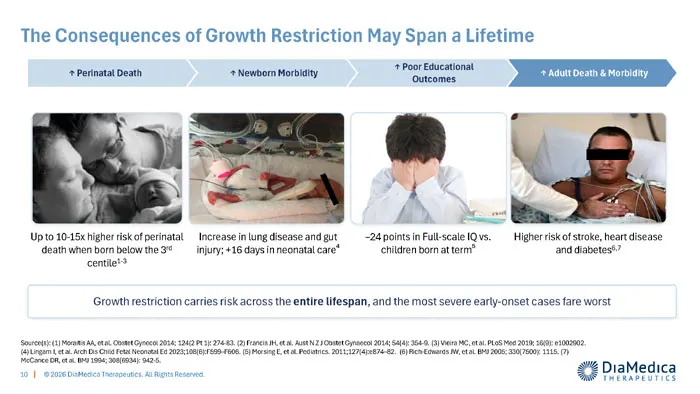
Slide 10: The Consequences of Growth Restriction May Span a Lifetime
The Consequences of Growth Restriction May Span a Lifetime smemen sen x Aba ‘Upto 10-15« higher iskof perinatal Increase in lung disease and gut, -24ppointsinFull-scaleIQvs. Higher skor stroke heart disease death when bombelowthe® injury; +18 daysin neonatal care* hilren born at term? ‘and diabetes!
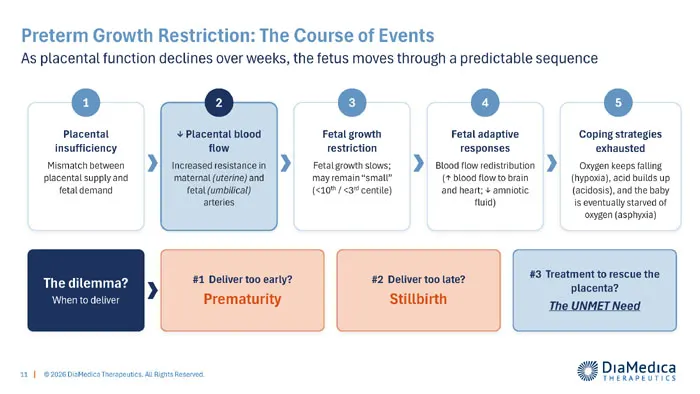
Slide 11: Preterm Growth Restriction: The Course of Events
Preterm Growth Restriction: The Course of Events As placental function declines over weeks, the fetus moves through a predictable sequence icental ‘Placental blood Fetal growth Fetal adaptive Coping strategies Insufficiency flow restriction responses exhausted mismatchbetween —}) Increased > D a1o04
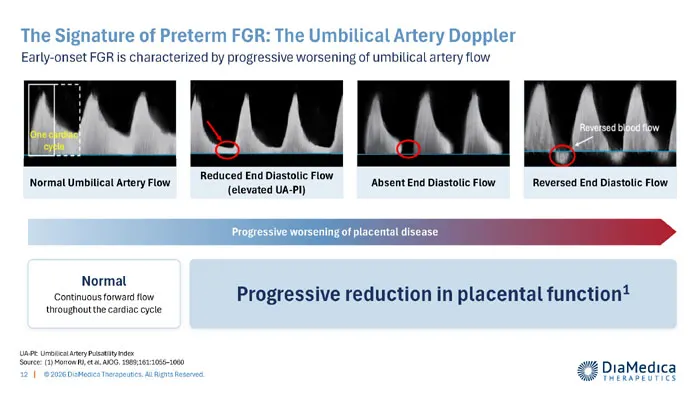
Slide 12: The Signature of Preterm FGR: The Umbilical Artery Doppler
The Signature of Preterm FGR: The Umbilical Artery Doppler Early-onset FGR is characterized by progressive worsening of umbilical artery flow [ONY UU ENN Reduced End Diastolic Flow ‘Normal Umbilical Artery Flow Absent End Diastolic Flow Reversed End Diastolic Flow a (elevated UA-PI) Progressive wors
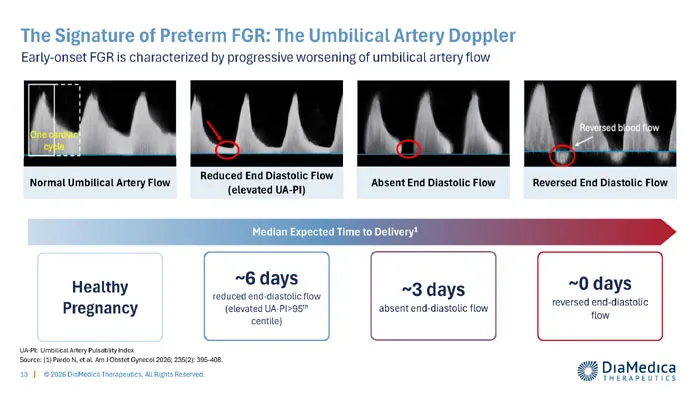
Slide 13: The Signature of Preterm FGR: The Umbilical Artery Doppler
The Signature of Preterm FGR: The Umbilical Artery Doppler Early-onset FGR is characterized by progressive worsening of umbilical artery flow [ONY UU ENN Reduced End Diastolic Flow ‘Normal Umbilical Artery Flow Absent End Diastolic Flow Reversed End Diastolic Flow a (elevated UA-PI) = Median Expecte
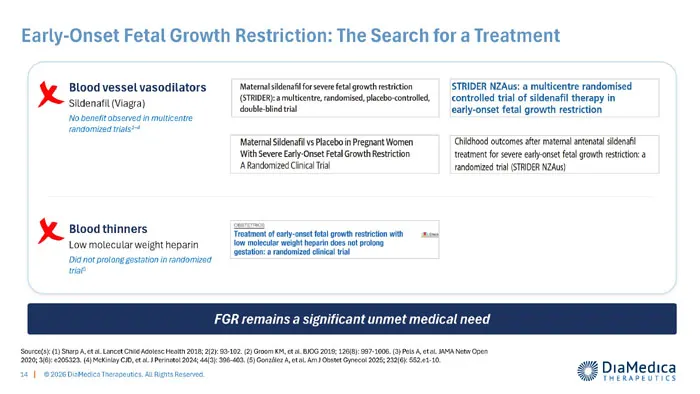
Slide 14: Early-Onset Fetal Growth Restriction: The Search for a Treatment
Early-Onset Fetal Growth Restriction: The Search for a Treatment Blood vessel vasodilators Materlsidatifersevefalgrwthreticion __STRIDER NZAus: a multicentre randomised Suni (stan a ruler andonised cco oaled, controlled tral of sidenafl therapy in anv tle early-onset fetal growth restriction ateral

Slide 15: Disease Progression & DM199's Mechanism of Action
02 Disease Progression & DM199's Mechanism of Action
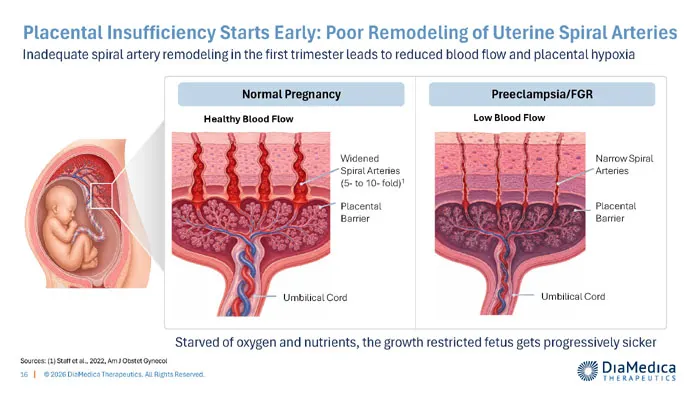
Slide 16: Placental Insufficiency Starts Early: Poor Remodeling of Uterine Spiral Arteries
Placental Insufficiency Starts Early: Poor Remodeling of Uterine Spiral Arteries Inadequate spiral artery remodeling in the first trimester leads to reduced blood flow and placental hypoxia Narrow Spirat, arenes Plscental Borner Umbiical Cord — umbiical Cord Starved of oxygen and nutrients, the grow
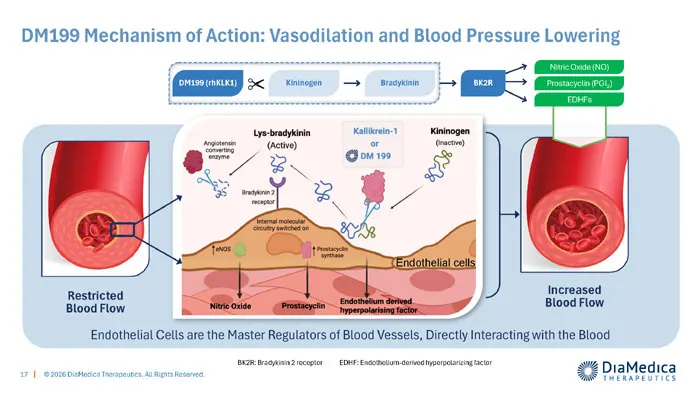
Slide 17: DM199 Mechanism of Action: Vasodilation and Blood Pressure Lowering
DM199 Mechanism of Action: Vasodilation and Blood Pressure Lowering licen) ninogen Onur» & Increased Restricted ces Blood Flow Endothelial Cells are the Master Regulators of Blood Vessels, Directly Interacting with the Blood eR bsopnzniget EONEomui aunectpenciragcat gg DiaMedica
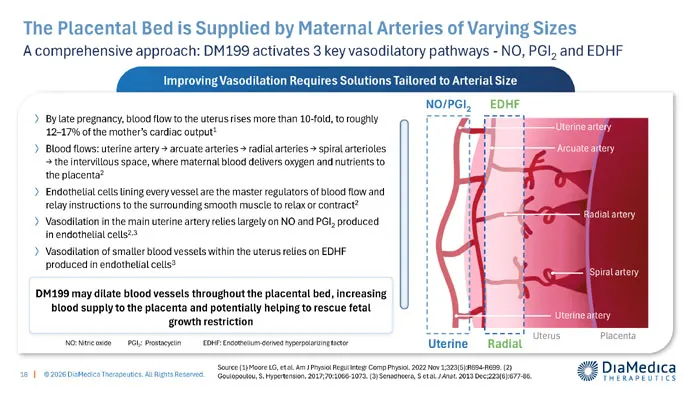
Slide 18: The Placental Bed is Supplied by Maternal Arteries of Varying Sizes
The Placental Bed is Supplied by Maternal Arteries of Varying Sizes A comprehensive approach: DM199 activates 3 key vasodilatory pathways - NO, PGI, and EDHF dilation Requires Solutions Ta > by tate pregnancy, blond flow o the uterus rises more than 10-ol 42-47% ofthe mother's cardiac output > Blood
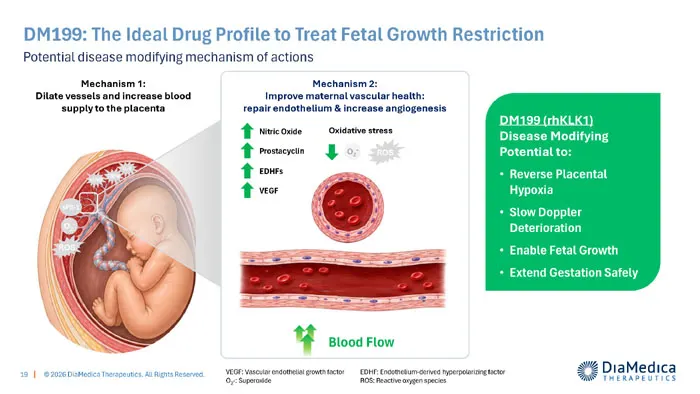
Slide 19: DM199: The Ideal Drug Profile to Treat Fetal Growth Restriction
DM199: The Ideal Drug Profile to Treat Fetal Growth Restriction Potential disease modifying mechanism of actions Improve maternal vascular health: repair increase: M199 (thKLK1) Simeone tlie Disease Modifying PB roseoein Potential to: $ vows wy tor a’ / + Reverse Placental Hypoxi + Slow Doppler Dete
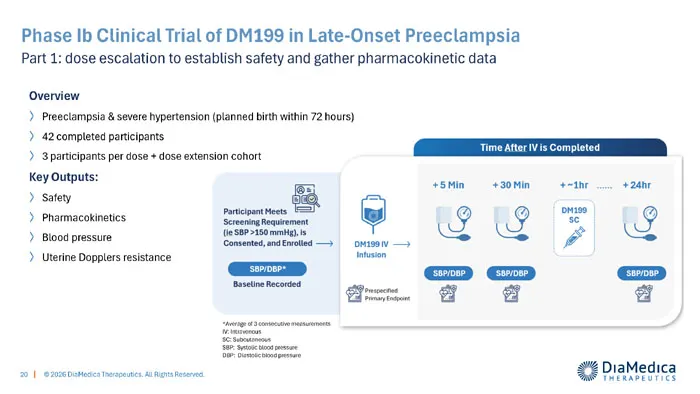
Slide 20: Phase Ib Clinical Trial of DM199 in Late-Onset Preeclampsia
Phase Ib Clinical Trial of DM199 in Late-Onset Preeclampsia Part 1: dose escalation to establish safety and gather pharmacokinetic data Overview > Preectampsia & severe hypertension (planned birth within 72 hours) > 42 completed participants > participants per cose + dose extension cohort Keyoutputs
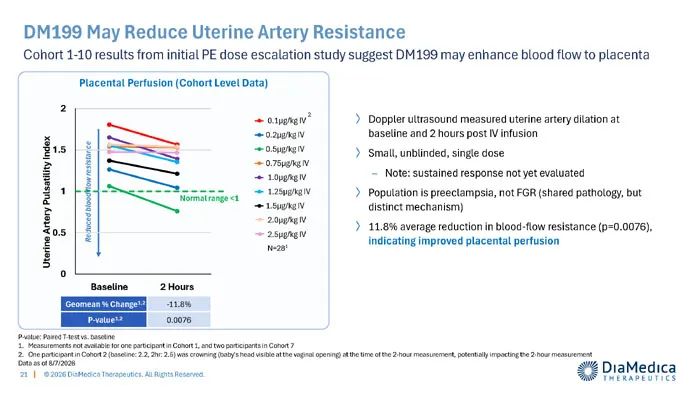
Slide 21: DM199 May Reduce Uterine Artery Resistance
DM199 May Reduce Uterine Artery Resistance Cohort 1-10 results from initial PE dose escalation study suggest DM199 may enhance blood flow to placenta lacental Perfusion (Cohort Level Data) — _reE +oawtaw +05 uenaY 07508 + toyota = 1250taW Leta oan ~ 2500 Uterine Artery Pulsatity Index. emcee tbedhow
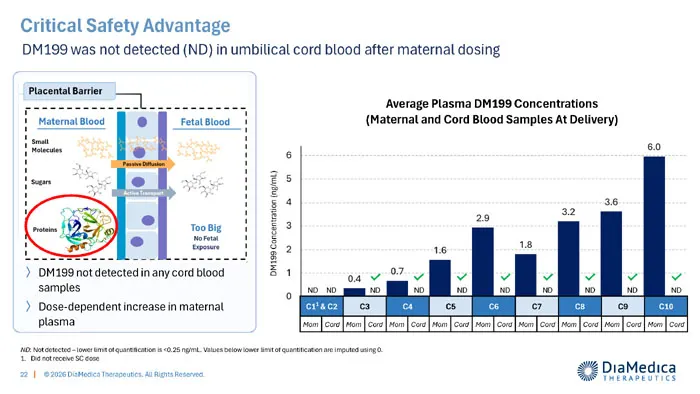
Slide 22: Critical Safety Advantage
Critical Safety Advantage DM199 was not detected (ND) in umbilical cord blood after maternal dosing Placental Barrie ‘Average Plasma DM199 Concentrations (Maternal and Cord Blood Samples At Delivery) eo ° zs g4 36 i = a2 a mm ot ba 1s 1a ) DM199 not detectedin any cord blood Bi av” 9-8 BBB ER sample
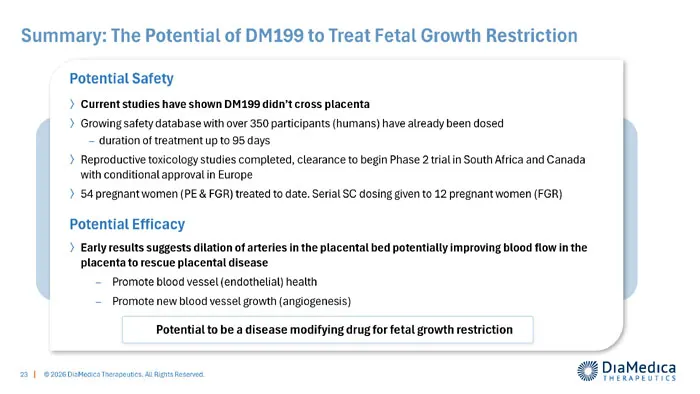
Slide 23: Summary: The Potential of DM199 to Treat Fetal Growth Restriction
Summary: The Potential of DM199 to Treat Fetal Growth Restriction Potential Safety ) Current studies have shown DM199 didn’t cross placenta ) Growing safety database with over 350 participants (humans) have already been dosed ~ duration of treatment up to 95 days. ) Reproductive toxicology studies c

Slide 24: Phase IIa Program Trial Design
Phase Ila Program Trial Design se DiaMedica
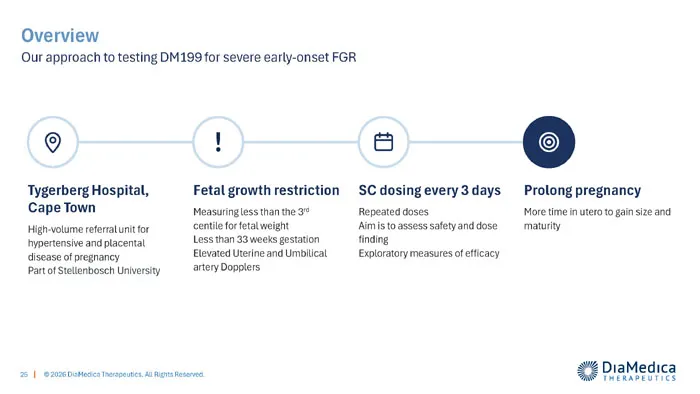
Slide 25: Overview
Overview Our approach to testing DM199 for severe early-onset FGR 9 ! Tygerberg Hospital, Fetal growth restriction Cape Town Measuringless than the * High-volume reteratuit for centile for fetat weight Typercains wn lacotvat Less than 33 weeks gestation Gioeie ol renee Eevated Uterine and Umblicat P
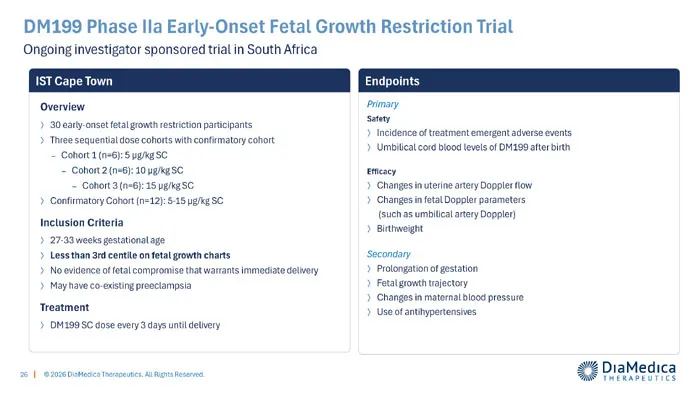
Slide 26: DM199 Phase IIa Early-Onset Fetal Growth Restriction Trial
DM199 Phase Ila Early-Onset Fetal Growth Restriction Trial Ongoing investigator sponsored trial in South Africa Overview > S0eatly-onst fetal gowth esticton participants ) Tivee sequential dose cohorts with contmatory cohort ~ Cohort (n-6): 5 veka SC (Cohort 2(n-6): 10 pease = Gober 3 (096) 35 parka
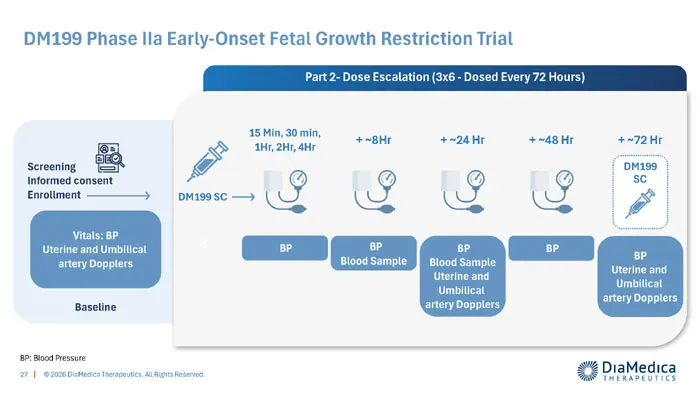
Slide 27: DM199 Phase IIa Early-Onset Fetal Growth Restriction Trial
DM199 Phase Ila Early-Onset Fetal Growth Restriction Trial 15Min,30 min, +-8Hr +024 Hr +-4gHr +-72Hr sereeig fe onset Enatmen” "> pusose—> ( ( Uterine and ‘Umbilical £ pmase sc artery Dopplers. artery Dopplers artery Doppiers Ciecas gf DiaMedica
Slide 28: Topline Interim Results for Fetal Growth Restriction Cohorts 1&2
Topline Interim Results for Fetal Growth Restriction Cohorts 1&2 “é | DiaMedica s Zr
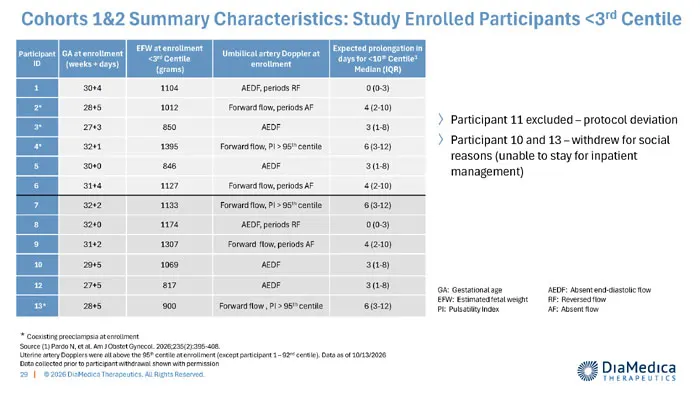
Slide 29: Cohorts 1&2 Summary Characteristics: Study Enrolled Participants <3rd Centile
Cohorts 1&2 Summary Characteristics: Study Enrolled Participants <3" Centile > Participant 11 excluded - protocol deviation ae ) Participant 10 and 13 - withdrew for social reasons (unable to stay for inpatient ce ‘management) a7 7 we 107 tos 2 ‘OF sous stew Sue ipucattat knoe ree ‘in coucne rpc gar
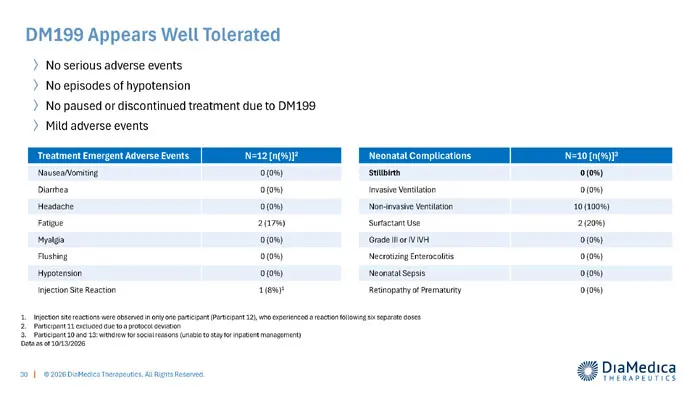
Slide 30: DM199 Appears Well Tolerated
DM199 Appears Well Tolerated ) No serious adverse events ) No episodes of hypotension ) No paused or discontinued treatment due to DM199 ) Mild adverse events J Neonatatcomplcations | Nes0in NawseaNonting oom) sbi 8) Dares avon) Invasive Versaton (om) Headache oom) Nonna Veit 1011008) Fave 207%) sur
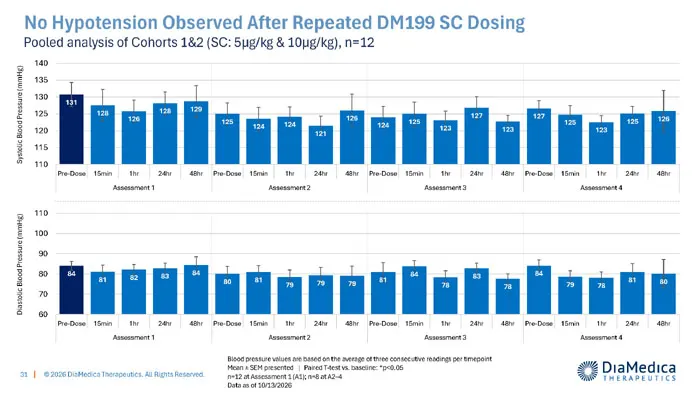
Slide 31: No Hypotension Observed After Repeated DM199 SC Dosing
No Hypotension Observed After Repeated DM199 SC Dosing Pooled analysis of Cohorts 1&2 (SC: 5ug/kg & 10ug/kg), n=12 yet odresreton Danicteod reeset al law 1 £Veemaciemcccneciai Seen = ee DiaMedica

Slide 32: Potential for Prolongation
Potential for Prolongation DiaMei THERAPE 32 a aM
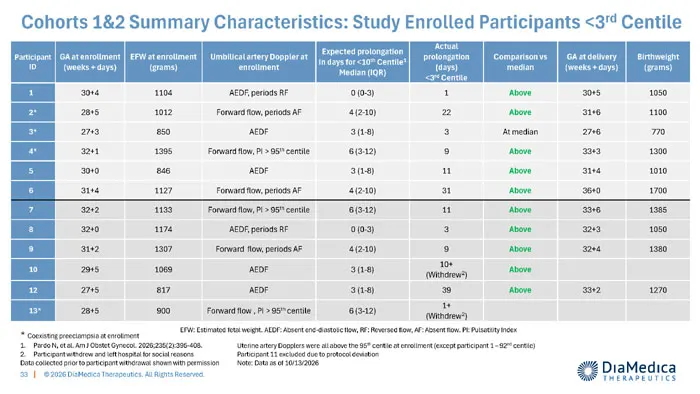
Slide 33: Cohorts 1&2 Summary Characteristics: Study Enrolled Participants <3rd Centile
Cohorts 1&2 Summary Characteristics: Study Enrolled Participants <3" Centile 003) 4e10) sae sex) sae sc10) een) 203) 4e0) sae sue 642) rw atenrtient | Unbideatarier Doppler st PEEEHPPEnry + corn eecimonn tenner SV emnucmoacungem nn ge DiaMedica
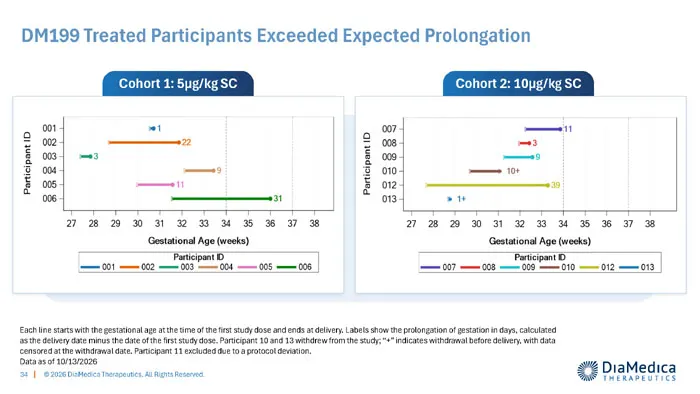
Slide 34: DM199 Treated Participants Exceeded Expected Prolongation
DM199 Treated Participants Exceeded Expected Prolongation Cohort 1: 5ug/kgSC or ” 2 ow. —z 3 on| > 3 om — Eos — 0s — Participant ID 7TABDHDNNQHHSE BT Gestational Age (wecks) 7B SDN NSU BT 8 Gestational Age (weeks) Patiipan 001 — 002 — 95 Oo — 005 — 006 Paiipani — 107 — 008 "898 010 — 012 — 019 Para
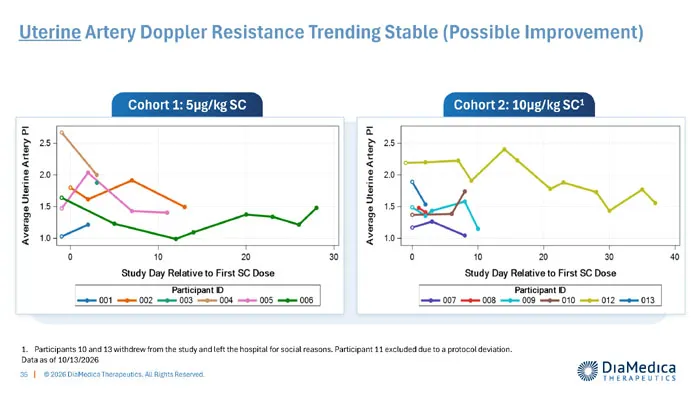
Slide 35: Uterine Artery Doppler Resistance Trending Stable (Possible Improvement)
Uterine Artery Doppler Resistance Trending Stable (Possible Improvement) Cohort 4: 5ug/kg SC Cohort 2: 10yg/kg Sct 2s \ 20 tof ‘Average Uterine Artery Pt ‘Average Uterine Artery Pt yi 0 2 Py 6 ° 2 Py ° ‘Study Day Relative to First SC Dose ‘Study Day Relative to First SC Dose ia ] Paripant © | e001 0
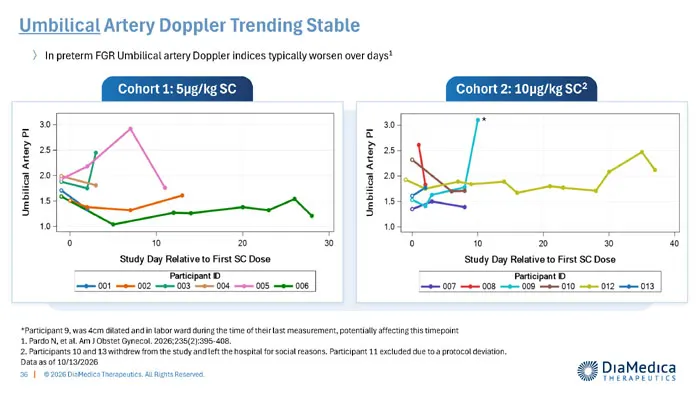
Slide 36: Umbilical Artery Doppler Trending Stable
Umbilical Artery Doppler Trending Stable ) Inpreterm FGR Umbilical artery Doppler indices typically worsen over days! Cohort 4: 5ye/kg SC Cohort 2: 10pe/kgS 30 30. iz 2 Fas 2 20 je 15. 2 15- Nee NN i 10 3 ry Pa Ps * > ® * ‘ut Dy Rativeto Fist 8 ose Study oy Ratio Fist 8 ose Pacer —o amos mo oer moet

Slide 37: Fetal Weight
Fetal Weight
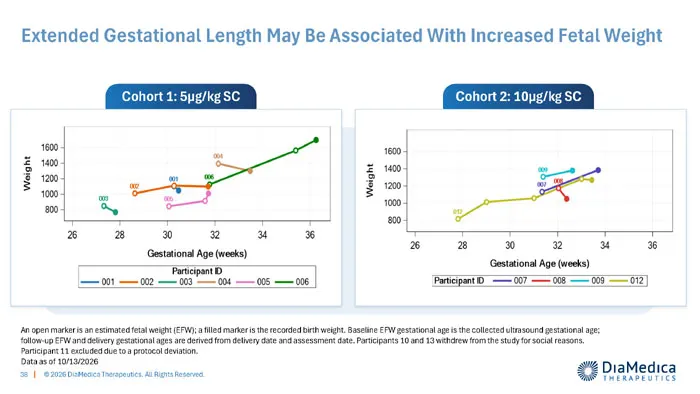
Slide 38: Extended Gestational Length May Be Associated With Increased Fetal Weight
Extended Gestational Length May Be Associated With Increased Fetal Weight Cohort 1: 5ug/kg SC Weight Gestational Age weeks) Panic — or — we — 09 — 0) ve (ere Ce te: Partipr 10 ar reason. ata of 10/13/2026 2g DiaMedica
Slide 39: Key Takeaways from FGR Cohorts
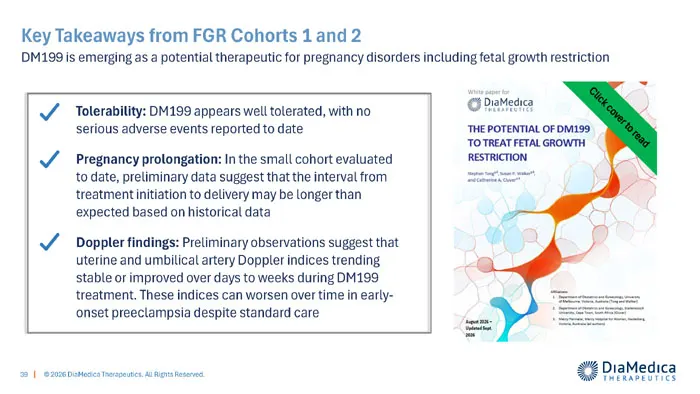
Key Takeaways from FGR Cohorts 1 and 2 DM199is emerging as a potential therapeutic for pregnancy disorders including fetal growth restriction, DiaMeaica S Tolerability: DM199 appears well tolerated, with no Grates serious adverse events reported to date THE POTENTIAL OF M99 TOTREATFETAL GROWTH AS Pr

Slide 40: Additional Commentary
ry & ec o iS = 3 oO 05 Additional

Slide 41: The FGR Opportunity
The FGR Opportunity S"2 DiaMedica ais
Slide 42: Why DM199 Could Be an Attractive Commercial Opportunity
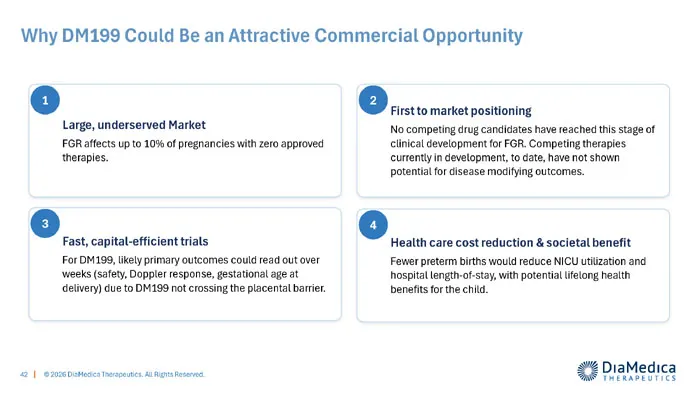
Why DM199 Could Be an Attractive Commercial Opportunity C) Os csinsrersemoe Large, underserved Market No competing crug candidates have reached this tage ot FR affects upto 10% of pregnancies wth zero approved clinical development for FGR. Competing therapies therepes curterty in development, to te,

Slide 43: Appendix
be fats o

Slide 44: oO Os
Fa] Zs < oO Os Qa a <x
Slide 45: Umbilical Artery Doppler Progression
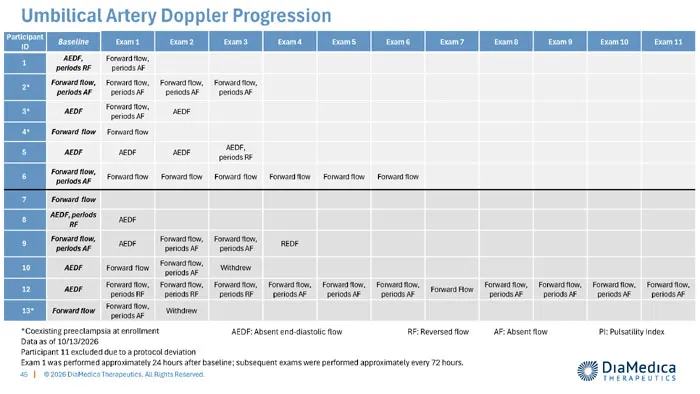
Umbilical Artery Doppler Progression ES recibir” "posse Fevrdton Fons fow Fenaeton Fanon Fowanton FemnarsRon, Fondo. geog acto wae Femartow, Fond on, onan. Fawn, FOMGTON jeaag ron FOU! AON. Fara. Fan Foe pote "perce "pease “pero” "peea ar fononer "pwowa “presiar pomae seoF tow ata 1132028 | Danan ex
Slide 46: Umbilical Artery Doppler Progression
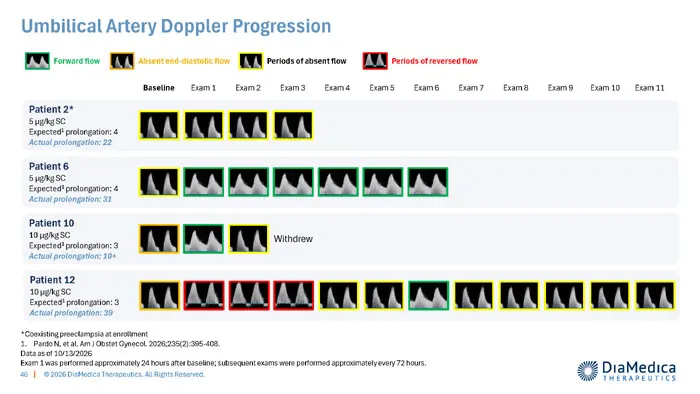
Umbilical Artery Doppler Progression SM LAAT AAT AAT AL AAA Patient 10 winerow CON EWN CW EWN EWN Gh Prabtenies
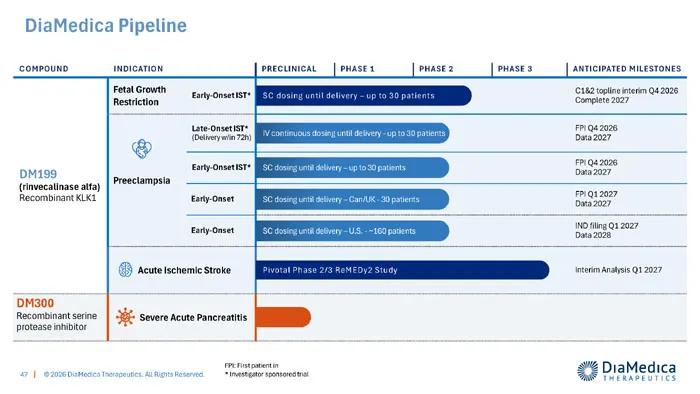
Slide 47: DiaMedica Pipeline
DiaMedica Pipeline conrouno tmoicarion [raccumica _Jonasex __[rwase2 | pnases __| ANTICIPATEO MILESTONES Fetat Growth ‘82g tern 062026, Restriction ‘plete 2027 rmgezams ® Dusaser Pageaas DM199 Swozaer (Cinvecatnase atta) =e Recombinant KK? gnaee Wong 932027 @ Acute ischemic stroke tntenm Anais 12027
Source: SEC EDGAR · 8-K filed Nov 24, 2026
More decks from DiaMedica Therapeutics Inc.
 Investor Presentation (November 2026)38 slides · November 2026
 Investor Presentation (June 2026)39 slides · June 2026
 Q4 2025 Earnings Presentation40 slides · Mar 31, 2026
 Q2 2025 Earnings Presentation46 slides · Aug 13, 2025
 Technical Presentation (July 2025)21 slides · Jul 17, 2025
 Corporate Update (November 2024)6 slides · Nov 13, 2024